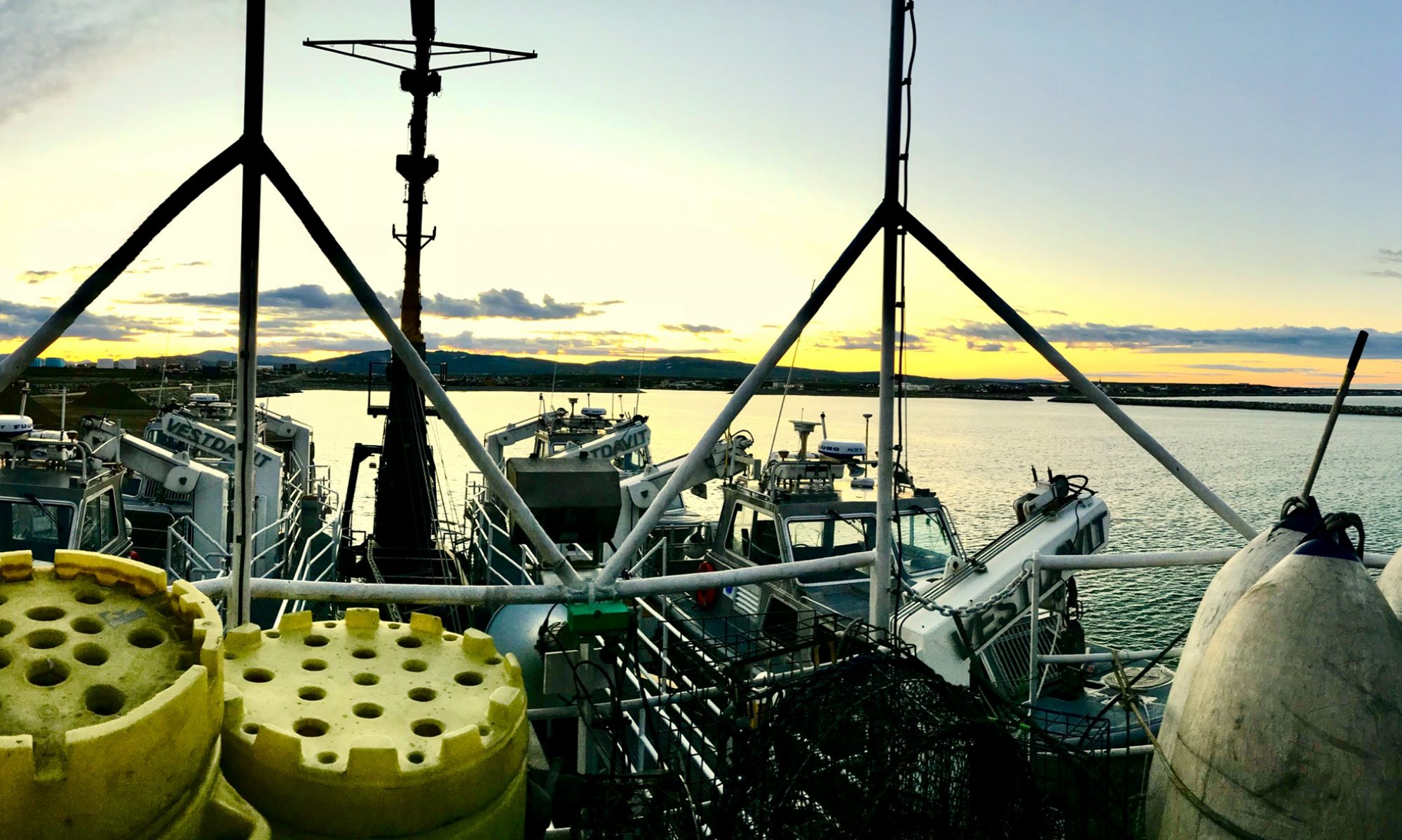
Rebecca Himschoot, June 26, 2007

NOAA Teacher at Sea
Rebecca Himschoot
Onboard NOAA Ship Oscar Dyson
June 21 – July 10, 2007

Mission: Summer Pollock Survey
Geographical Area: North Pacific Ocean, Unalaska
Date: June 26, 2007

Weather Data from Bridge 
Visibility: .5 nm (nautical miles)
Wind direction: 80° (ENE)
Wind speed: 10 knots
Sea wave height: 1 foot
Swell wave height: 1 feet
Seawater temperature: 4.4°C
Sea level pressure: 1018.8 mb (millibars)
Cloud cover: stratus

Deck crew of the OSCAR DYSON retrieving sensors from a buoy.

Science and Technology Log: Data buoy retrieval and replacement 

Luckily we had calm weather today to retrieve two data buoys that were deployed in 2006, and replace them.  These buoys contained an Acoustic Doppler Current Profiler, a marine mammal voice recorder, and sensors for other data such as water temperature, nitrates, and salinity.  Because the sensors are on a stationary buoy, the information is collected at depth (much of this same information is collected on board the OSCAR DYSON continuously, but at the surface), and over a long period of time.

Life Cycle of the Walleye Pollock  
(Interview with Dr. Mikhail Stepanenko, scientist from TINRO)

Dr. Mikhail Stepanenko is assisting in the summer pollock survey from his home institution, the Pacific Research Fisheries Center (TINRO), which is located in Vladivostok, Russia. Dr. Stepanenko graduated with a degree in fish biology in 1968, the year before an agreement was signed for scientists in the Soviet Union and the United States to cooperate to help manage international fisheries.  Dr. Stepanenko took some time to share what he knows about the life history of the walleye pollock. According to Dr. Stepanenko, walleye pollock are found throughout the Bering Sea, and south into the Gulf of Alaska. Their range extends as far west as Russian and Japanese waters, and east to the Eastern Aleutians.  These fish can live up to 25 years, however the average age of a walleye pollock is 10-12 years. Pollock are related to the cod family.

Scientist Bill Floering with some of the new sensors deployed today from the OSCAR DYSON.
Scientist Bill Floering with some of the new sensors deployed today

Pollock begin spawning around age 4, although the most productive spawning years for both males and females is between 5-8 years of age.  Dr. Stepanenko has observed pollock spawning in an aquarium setting.  The male will swim next to a female to show his interest.  If she is also interested in that male, the female will swim next to him with sudden, short bursts of speed for several hours before they spawn. If she is not interested, she will continue to swim normally until the male gets the message.

Mature pollock spawn annually in nearshore areas, mostly in the Bering Sea and Gulf of Alaska (98% of pollock spawn in US coastal waters). Although the females will spawn only once annually and then move to the edge of the spawning area to feed, the males will spawn 4-5 times during the annual spawning season.

The eggs will hatch about 25 days later, or longer if the water temperatures are colder.  The annual survival rate of the eggs and larvae is highly dependent on the sea conditions and salinity.  At the correct salinity, the eggs sink and then are suspended at a certain depth due to a thermocline at that depth.  Poor sea conditions or a dramatic shift in salinity can result in higher mortality for the eggs or the larvae. They must also survive predators such as jellyfish and other small fish.

Dr. Mikhail Stepanenko processes walleyed Pollock
Dr. Mikhail Stepanenko processes walleye Pollock

Directly after hatching the pollock larvae have enough yolk reserve to survive a few days, but they must find food within the first three days of hatching if they are to survive. The larvae are approximately 3.5 mm long when they hatch, and with enough food will grow several centimeters in the first year of life. Only two of the 30-40 types of plankton in the Bering Sea are small enough to serve as prey for these tiny fish.  Harsh sea conditions, salinity changes, and scarce food resources in the first year contribute to a survival rate of only about .1% of pollock eggs. Adult pollock eat euphausids, as well as smaller fish such as capelin or smelt.  In times of scarcity, pollock are given to cannibalism.

The international pollock fishery targets four-year-old fish, and the total Bering Sea harvest of pollock is around two million metric tons annually.  Pollock is used in frozen seafood products, such as fish sticks, and as a central ingredient in surimi.

Personal Log 

We have been in an area where there are very few fish, so much of my time has been spent learning about pollock and the work that is done here on board.  The sea has been pretty rough at times, and I have continued to take some seasickness medication. We’re getting back into places with fish, so soon we’ll be collecting more data.

Question of the Day 

Answer to the last question about the controlled variables in the summer pollock survey: (The scientific method includes controlling the variables in an experiment.  What are some examples of variables the science team from the AFSC is controlling in the summer pollock survey?)

One example is the calibration of the acoustic equipment at the beginning of each leg of the survey. Another example is that the OSCAR DYSON cruises the same area of the Bering Sea during each summer pollock survey on transects of the same basic lengths and directions. The survey is conducted at the same time every year, as well.

Today’s question: Scientists use Latin names for each animal or plant they find, even though Latin is no longer a living language. How do scientific (Latin) names get selected and why are they important?

Walleye pollock
Walleye pollock

Beth Carter, June 26, 2007

NOAA Teacher at Sea
Beth Carter
Onboard NOAA Ship Rainier
June 25 – July 7, 2007

Mission: Hydrographic Survey
Geographical Area: Gulf of Esquibel, Alaska
Date: June 26, 2007

Weather Data from the Bridge
Visibility:  10 nautical miles
Wind Direction:  132 degrees, from the Southeast
Wind Speed:  6 knots
Sea Wave Height:  0-1 feet
Swell Wave Height – no swell
Seawater Temperature: 11.7 degrees Celsius
Sea Level Pressure: 1018.8 millibars
Cloud Cover & Type: 7/8 coverage, mixed cumulus and stratus
Air temperature:  Dry Bulb: 15 degrees C,  Wet Bulb:  10 degrees C
At anchor, water depth: 32 fathoms

NOAA Teacher at Sea, Beth Carter, prepares to set sail on NOAA Ship RIANIER.
NOAA Teacher at Sea, Beth Carter, prepares to set sail on NOAA Ship RAINIER.

Science and Technology Log

At 8:00 this morning, our CO (Commanding Officer) held a safety and mission briefing on the fantail of the ship.  The fantail is the back open area of the ship. The RAINIER’s main mission is to conduct hydrographic mapping surveys from its six small launches that are carried aboard the RAINIER. Each launch has equipment that transmits sound waves that are directed toward the floor of the bay, or area to be mapped.  The sound waves bounce back to a special receiver on the launch, and the depth data is recorded on the launch.  These depths are plotted as dots, and so later in the evening, the technicians basically “connect the dots” to form a picture of the ocean floor in the area that was surveyed that day. When the RAINIER finishes this 3-week leg of its mission, all of this data will be given to the NOAA Office of Coast Survey, Pacific Hydrographic Branch, in Seattle, WA.  They take the data and create digital terrain models, or DTM’s, which are color-coded maps of the sea floor.  The maps look very cool…the deepest waters are shown to be dark blue, lighter blues show shallower water, and hazards and rocks and sand bars are shown in various shades of green, yellow, red and orange. The resulting DTM’s represent the most probable bathymetry of the area. The maps are so detailed you can see the outlines of sunken ships and large rocks on the bottoms of the bays. The information from our leg will be compiled for chart 17404, and for smaller scale charts. If you are interested in seeing maps that show the areas we are charting, try this website.

Crew of the NOAA Ship RAINIER prepare to deploy a launch.

Creating these maps is important because current maps of the waterways in Alaska are outdated – some of them very outdated.  Yesterday, the CO showed me some sections of map that were created as long ago as 1834-1899, with more of the maps being created between 1900-1939, or 1940-1969. It is interesting that NOAA (National Oceanic and Atmospheric Agency) is using sonar in much the same way that whales and dolphins and bats use sound waves for echolocation so that they can determine locations of the sea floor, obstacles, or other animals.

I asked about the current debate over the Navy’s use of sonar, and the belief that its sonar is interfering with the whales/dolphins’ abilities to use their sonar. Vincent Welton, our Electronics Technician, explained to me that NOAA uses a higher frequency, less amplified type of sound waves that will not confuse the marine mammals.  The Navy sometimes uses a very low frequency sonar to detect submarines. Today, two of the launches are out doing the hydrographic mapping.  Later in the day, two divers will go out to check the bottom of the hull, and I will go out on a small skiff to watch some of the technicians gather some data on tides. It appears that some of the equipment to measure tides is working erratically, so we will go check that out. 

Personal Log

I enjoyed watching the crew deploying the four skiffs and launches that are going out for today’s work. Everyone has to wear hard hats and float coats to stay safe when out on the fantail. The best part of the morning was when Steve Foye, the Boatswain Group Leader, pointed out to me that a humpback whale was swimming near the ship.  I saw the whale spout several times, and twice, he seemed he rolled on his side, as I saw a fin pop up. Then, his fluke appeared above the water, and he slapped the water and disappeared.  Steve told me he was “diving down to check out the groceries…he knows which aisle to shop on.” He also said he’d be down a long time, as he’d taken a big breath and was going to going to be eating until he needs to come back up to breathe.  If you are a CFCI student (or any student!) and have a question for me, please E-mail this address: teacheratsea.rainier@noaa.gov. I’d love to hear from you, and promise to try to respond in my logs.

Terms Used Today

  1. Fathom:  1 fathom equals 6 feet
  2. Sea level pressure:  Barometric, or air pressure.  When air pressure is high as it is today (over 1000 millibars or mb) it indicates that the weather is sunny or overcast, with little threat of rain.  When the pressure drops, it often means a storm or rain is on the way.  The eye of a hurricane can have a barometric pressure reading as low as 875 mb.
  3. Cloud cover: expressed in terms of portions of the sky covered out of 8 parts (whole coverage)
  4. Wind direction:  indicates which direction the wind is blowing FROM.  0 degrees is North, 90 degrees is East, 180 degrees is South, and 270 degrees is West.

Questions of the Day

  1. Why is it important to have updated maps of waterways in Alaska, or anywhere? Who needs to use these maps?  Why?
  2. Before this sonar technology was developed, how were depth maps created?
  3. We are anchored today.  How deep is the water under the ship? (1 fathom equals 6 feet, and the water is 32 fathoms deep now)

Chris Monsour, June 26, 2007

NOAA Teacher at Sea
Chris Monsour
Onboard NOAA Ship Oscar Elton Sette
June 12 – July 12, 2007

Mission: Lobster Survey
Geographical Area: Northwestern Hawaiian Islands
Date: June 26, 2007

Above is an example of the bluestriped snapper that was caught off of Necker Island. This species has become a nuisance since it was introduced to the Hawaiian Islands.
Bluestriped snapper that was caught off of Necker Island. This species has become a nuisance since introduced to the Hawaiian Islands.

Science and Technology Log 

Today we hauled our first set of lobster traps at Necker Island.  I must say the Chief Scientist was right when he said there would be less lobster here.  I think we may have caught 25 lobsters out of 160 traps. Very disappointing numbers, less than one lobster per trap. It is possible that the traps were in too deep of water and the substrate being sand made conditions unfavorable. We will be here for 13 more days or for 13 more sets, depending on how you want to look at it. A majority of what we caught today were different types of crustaceans and bluestriped snapper.

The bluestriped snapper is a non-native species that was brought to Hawaii from French Polynesia in the 1950’s. The fish’s native distribution is the Indo-Pacific from east Africa – Tuamotus; north to southern Japan; south to New Caledonia. The fish was brought to Hawaii to fill a vacant niche in the reef community, a shallow water snapper.  The bluestriped snapper does not have a good reputation.  In Hawaii, the bluestriped snapper share the same habitat with native fishes and this may result in competition for habitat use and food sources. Evidence has been documented which suggests that bluestriped snapper may displace native fish from important refuge habitat.  However this remains a controversial topic and more research investigating the ecological niche of L. kasmira is needed. From what I saw today though, the most common fish brought up from the traps was the bluestriped snapper.

NOAA Teacher at Sea Chris Monsour holds up an example of a sponge crab that was captured off Necker Island.
Chris Monsour holds up an example of a sponge crab that was captured off Necker Island.

When I searched the internet for “bluestriped snapper” and “Hawaii”, I found that many of the links discussed the fish as being a great aquarium fish and really no other use.  Yes, I will admit the fish are great to look at, but what will be the future impact?  The discussion of the bluestriped snapper led into the problems which exists in Lake Erie with the invasive round gobi, zebra mussel, and purple loosestrife.  The main difference here in Hawaii is that this species was introduced intentionally and the impact is yet to be seen. Granted, it has been over 50 years since the bluestriped snapper was introduced, but most of the people I have talked to on the ship see it as a nuisance and not a threat.

Today, as mentioned earlier, I saw more species of crustaceans, especially crabs. There were two groups that I have been seeing quite a bit and that is hermit crab and sponge crab.  Anyone who has explored a tide pool is familiar with the hermit crab.  Although an external skeleton like other crabs covers their front parts, their long soft tails are not protected.  Hence, they use empty snail shells for protection and are very difficult to remove.

One of the many hermit crabs that was caught during OSCAR ELTON SETTE’s cruise of the North West Hawaiian Islands poses for a picture.
One of the many hermit crabs that was caught during the cruise poses for a picture.

The other species that has really caught my attention is the sleepy sponge crab. The sleepy sponge crab is considered to be the most evolutionary primitive of the true crabs. As I found out, they are very slowing moving and nocturnal. They use their hindmost legs to carry a piece of sponge over its back. The crab uses the sponge for camouflage and within the sponge is living a whole myriad of other organisms like sea stars and forminifera (algae).  Unfortunately as I found out, when the sponge comes off the back of the crab, you can’t put it back on.

Personal Log

I was posed this question by the CO (commanding officer) of the ship: What does a Teacher at Sea do on a transit day after a hard week of lobstering at Maro Reef? 

Transit days are spent catching up on reading, laundry and rest.  I finished up one book and read the first half on another. On Sunday at twilight we had a pyrotechnic display on the fantail of the ship. Essentially we had to get rid of the expired flares, so we had a good time setting them off.  Then on Monday before we set the gear, we had four sets of drills which included a quarters escape drill.  Right now though, I am glad to see Necker Island, the first land I have seen in a long time (it resembles Abe Lincoln’s profile).  So with this I will be posting another log in a few days.

Questions of the Day 

1. What type of relationship exists between the sponge crab, the sponge on it’s back , and anything living in the sponge?  Commensalism, mutualism, or parasitism?

A hui hou,… Chris

Maggie Flanagan, June 26, 2007

NOAA Teacher at Sea
Maggie Flanagan
Onboard NOAA Ship Oscar Elton Sette
June 12 – July 12, 2007

Mission: Lobster Survey
Geographical Area: Pacific Ocean; Necker Island
Date: June 26, 2007

NOAA Teacher at Sea, Maggie Flanagan, repairs a trap aboard NOAA Ship OSCAR ELTON SETTE.

Science and Technology Log 

We just spent an exciting week setting lobster traps at Maro Reef. Sliced mackerel is our preferred bait, and we scrub the bloody patches that drip to deck every day. We hauled back many lobsters, as well as eels, crabs, urchins, and fish. Shark and Octopus can really break up the traps, and ocean conditions can be hard on the gear, so we make repairs as needed. I was proud to put my sailor skills to work helping to splice new bridles on traps.  (Splicing is weaving a line back into itself to create a loop, which is used to attach the trap to a fishing line).  In the past week our Commanding Officer, Karl F. Mangels, shared a little history on The Marine National Monument area created out of the Northwest Hawaiian Islands.  This status is the most protected, but also complex to initiate.  The US Fish and Wildlife Service, NOAA, and the State of Hawaii, among others, have targeted this area for preservation for many years.  Recently President Bush moved quickly to legalize the Monument status, but it is taking time to work out the details of regulations and procedures, considering the multiple jurisdictions involved.

Regulations indicate all activities must be approved by permit, including scientific research, and all ships must have vessel monitoring systems.  But, access for native Hawaiian cultural activities is preserved as several of the islands are ancient holy sites.  Midway Atoll retains special status and will be open to more public visitation. All commercial fishing in the Monument waters will be phased out by 2011, and oil and gas exploration and extraction is prohibited. Having been part of a research crew in the Monument for a week now, I appreciate all these efforts at conservation. There is little dry land surfacing out of the Pacific here, but the bird life and sea life are precious, including rare seals, sea turtles, and albatrosses.

Watch out when there’s an eel in your trap!  Most of the local species have sharp teeth, and are quick and eager to use them to gain their freedom.
Watch out when there’s an eel in your trap! Most of the local species have sharp teeth, and are quick and eager to use them to gain their freedom.

Personal Log

Working at sea makes me think often of the legacy of sailors before me.  Though he was a global voyager, Captain James Cook’s influence is heavily felt in the Pacific.  He honed his seamanship skills in the coasting collier (coal cargo) trade in Britain and honed his surveying skills in Canada, helping the British Navy fight the French.  He charted the St. Lawrence River and the coast of Newfoundland, but was a surprise choice among his contemporaries for the Pacific voyages due to his lack of noble title and lack of Royal Navy training. His first command aboard Endeavour in 1768 was to observe the transit of Venus viewable from Tahiti.  A replica of Endeavour now sails out of Australia, and for $1,000 Aussie you can too! The mission of Cook’s second voyage to the Pacific in 1772 was to “complete the discovery of the Southern Hemisphere.”  He took command of Resolution and penetrated the Antarctic circle several times.

Both Endeavour and Resolution were converted North Sea colliers, sturdy vessels familiar to Cook from his merchant marine experience. For the third voyage, Resolution also carried the latest equipment, including a Gregory Azimuth Compass, apparatus for distilling fresh water from seawater, and a new five inch marine chronometer, the K1, by Larcum Kendall.  The chronometer provided for even better chart making as it was easier to use than lunar measurements and proved more accurate for finding longitude.  In 1778, sailing to find a northwest passage between the Atlantic and Pacific, Cook encountered the Hawaiian Islands. Natives were friendly to the Captain and his crew, and when Resolution’s foremast cracked badly in February 1779, they returned to Kealakekua Bay on the big island of Hawaii to down rig the mast and float it to the beach for repairs.  Misunderstandings developed as from both sides, resources were taken and tempers flared.

When Cook went ashore with marines to seek settlement, a crowd gathered and became aggressive. Cook shot a Hawaiian, and in the retreat to the bay, Cook was clubbed and stabbed from behind, dying in the surf.  Two other important figures were also witnesses that day in Kealakekua Bay.  William Bligh of Bounty infamy was one of the ship’s officers, and Kamehameha, who unified the islands to become the first King of Hawaii, was nobility of the village ashore. Cook left quite a legacy of knowledge with his charts and logs, and a legacy of British influence around the globe.  He accomplished surveys of the Pacific from Australia to Alaska.  Resolution’s officers demanded Cook’s body be returned, but it came back as pieces of bone and flesh, which were buried at sea.  There is a monument to Captain Cook in the form of an obelisk on Kealakekua Bay, and it’s curious to think that perhaps missing parts of his remains are buried there.  Interestingly, that little part of Hawaii is technically British soil even to this day.  Now, Kealakekua Bay is also a Marine Life Conservation District filled with coral, schools of tropical fish, and even spinner dolphins – another legacy this historic site can offer for the future.

Rebecca Himschoot, June 24, 2007

NOAA Teacher at Sea
Rebecca Himschoot
Onboard NOAA Ship Oscar Dyson
June 21 – July 10, 2007

Mission: Summer Pollock Survey
Geographical Area: North Pacific Ocean, Unalaska
Date: June 24, 2007

Weather Data from Bridge 
Visibility: less than .5 nm (nautical miles)
Wind direction: 260° (SW)
Wind speed: 18 knots
Sea wave height: 4-6 foot
Swell wave height: 0 feet
Seawater temperature: 2.9°C
Sea level pressure: 1006.0 mb (millibars)
Cloud cover: fog

Science and Technology Log: What Is the Summer Pollock Survey? 

The Alaska Fisheries Science Center (AFSC) is one of six regional centers charged with monitoring commercial fish stocks in the United States.  The AFSC is located in Seattle, Washington, however the data the scientists from the Center collect is gathered from coastal areas across the state of Alaska. For over 20 years the AFSC has been surveying Pollock stocks in the Bering Sea of northwestern Alaska in the summer months.  More recently they have also been surveying stocks in the Gulf of Alaska during the same season.  During the Pollock spawning months of February-March surveys are also conducted in known spawning areas. The AFSC scientists’ data are one part of the fishery management triangle: The summer Pollock survey on the OSCAR DYSON will take place in three sessions of three weeks each.  The first day of each leg is spent calibrating the acoustic equipment to make sure it is accurate for the rest of the research in the next three weeks.  Once the OSCAR DYSON reaches the Bering Sea, the navigation team locates the transects that have been surveyed in years past. The science team begins collecting acoustic data, and fishing intermittently to collect more data about the fish, such as exact lengths, gender and age information.

Screen shot 2013-06-01 at 5.58.08 PM

The acoustic data are collected every second.  Sound waves are emitted from a transducer affixed to the hull of the ship; when these sound waves strike a surface, they return to the transducer. By calculating the time the sound waves traveled it is possible to “see” where the objects are the sound waves bounced off of.  The bottom of the ocean shows up as a very strong, solid line, whereas fish in groups show up as “clusters” in the water column (the sound waves bounce off the air-filled swim bladders of the fish).  By using different frequencies, the scientists are able to determine if the clusters are larger or smaller fish, including plankton-sized euphausids (i.e., krill).  This amazing system for “seeing” fish using sound waves is modeled on the feeding strategies of some of the oldest and best-adapted fishers, the toothed cetaceans such as dolphins and sperm whales.

Acoustic data for seafloor mapping

Personal Log 

Luckily the crew of the OSCAR DYSON were able to give me some very good advice about seasickness medication.  We entered some moderate seas our first day out, but I’m slowly getting my sea legs.  The Bering Sea is a very shallow body of water, less than a hundred meters deep in many places, so that it has a great deal of wave action in any kind of windy weather.  Today we passed the Pribilof Islands, but it was too foggy to see them.

Question of the Day 

Answer to Day 1 question about solstice: The word “solstice” comes from the Latin words “sol,” which means sun, and “sistere,” which means to rest or relax.  The solstice occurs twice each year, when the Sun is at its northern- or southernmost point from the equator. The solstice is the turning point at which we experience either increasing or decreasing increments of daylight (paraphrased from the Encyclopedia Britannica online).

Today’s Question:  The scientific method includes controlling the variables in an experiment.  What are some examples of variables the science team from the AFSC is controlling in the summer Pollock survey?