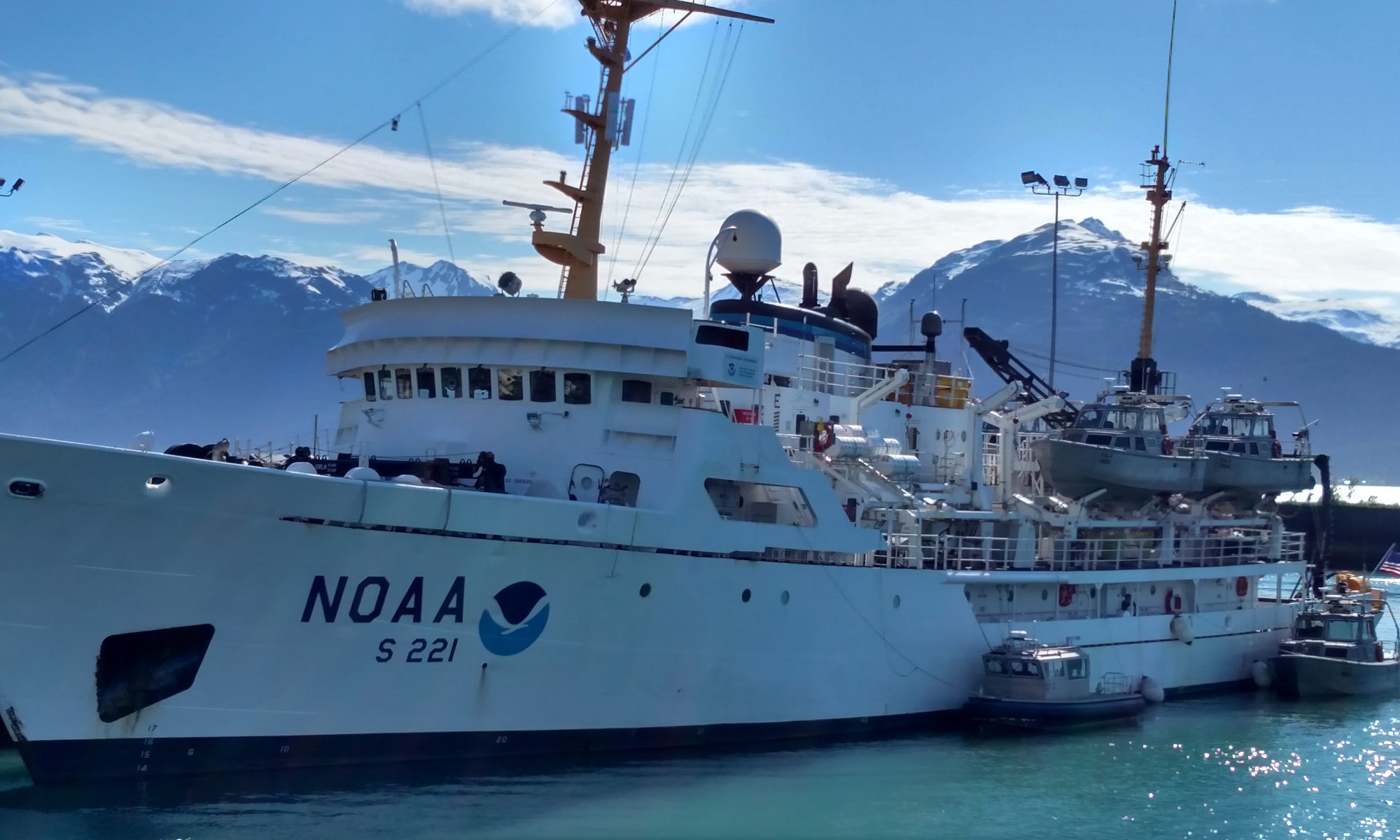
Chris Harvey, June 5, 2006

NOAA Teacher at Sea
Chris Harvey
Onboard NOAA Ship Oscar Elton Sette
June 5 – July 4, 2006

Mission: Ecosystem Survey
Geographical Area: Central Pacific Ocean, Hawaii
Date: June 5, 2006

Science and Technology Log: “Sea Legs”

I am having difficulty acquiring my “sea legs,” but it seems that I am not the only one.  I took my non-drowsy Dramamine an hour before departure and I have seen others among us landlubbers with seasickness-medicated patches behind their ears.  Amee, my British confidante in which I have already found similar humor, perspective on life, and taste for tea, has assured me that it is all inside my head.  “Stop thinking you’ll be sick,” she says in a Mary Poppins’ motherly sort of way. “And you won’t be sick…And stop drinking so much tea!”  Had she been a psychologist or a flight surgeon and not a marine biologist, I might have accepted her advice as truth.  As for the tea, I have fallen asleep by 7 PM both nights I have been in Hawaii and I have resorted to drinking caffeine tea to try to extend my waking hours.  Amee says that drinking too many fluids will make me sick.  I say, not drinking enough tea will make me fall asleep on the job.

And here it is 8:15 and I have already conceded defeat unto the Sea.  I have taken my drowsy Dramamine coupled with some Tylenol PM, Melatonin, and Gaba to ensure myself a good night’s sleep. Surviving the first night of rest is imperative to the success of the other 29. I think that sleep shall come swiftly and gently.

“The Head” I learned several things when I was young, most of which I learned from my father’s good example:

  1. Never pee into the wind. (Ladies, this does not really apply to you.  Guys, I hope you know this by now!)
  2. Buy a LOT of Girl Scout cookies when they are on sale.  Do not forget that you can always freeze them, and they are only on sale once per year.
  3. Chew with your mouth closed and come to the dinner table wearing a shirt.  (Again, ladies hopefully this does not apply to you!)
  4. Do not try to take a shower on board a moving ship unless you are prepared for water shortages, drastic changes in water temperature and pressure, a general inability to hold oneself upright without the use of one’s hands long enough to use one’s hands to scrub one’s back or hair without falling over, and the door to suddenly open, exposing you to your roommate to both of your dismay.  (Yeah, you are right. I did not learn this one until today.  Father, the veteran Navy sailor, should have explained these things to me years ago!)

Bathrooms are affectionately referred to as “the head” onboard a ship.  As so, I have not figured out why, nor had the inquisitive mind enough to research the reason.  But one thing that I did know about moving ships at sea, which my younger sister Lauren taught me in the Galapagos, is to sleep with a trashcan by your side.  That poor child slept curled at my feet by the toilet while she “popped” at intermittent intervals because we didn’t have a good trashcan in our room.  I have a great one by my side right now, double lined with Hefty bags, though I am hoping not to use it!

“Chow”: We had buffet-style dinner tonight that included salad (with ranch dressing!), spaghetti with shrimp, teriyaki chicken, and Hawaiian pig and roasted vegetables. I had a little of each, with a second helping of green vegetables.  I told Amee that I was worried about scurvy. She told me that I was dumb for worrying about scurvy.  I told her to re-read the history of the merging of her ancestors and mine through the long ship rides from England to what would become the United States; it is littered with failed attempts to colonize due to scurvy. She told me I was dumb and to shut up and eat.  I did. (Did I mention how well our personalities compliment each other?!)  We have to bus our own dishes after we are through eating.  That is better than having to bus everyone else’s dishes after they are through eating. (So long to the restaurant server life…for now.)

“Teacher at Sea”: I am treated somewhat like royalty here—in the sense that I have my own large room, I have to have my correspondence screened by the Commanding Officer of the ship, and everyone knows me as The Teacher at Sea. Being royalty makes life kind of nice.  It doesn’t make the rocking of the ship upon the sea any calmer (I think Jesus is technically the only person capable of such a feat!).  But it does give me an air of importance.  It’s strange, but I am looking up to these “kids” (being college students, they are “kids” to me, though several of them are actually older than me) for their experience and expertise as scientists, researchers, and specialists while it seems from conversation that they all look up to me for the same.  A mutual environment of respect will be important for the bonds we are to form over the next thirty days.

Also, when purchasing a souvenir T-shirt from the ship’s store today, I told the officer that I was a Teacher at Sea, and asked if he had any special deals for me.  “Yeah,” he said as he handed me a blue Oscar Elton Settee t-shirt.  “Fifteen dollars.”  “How much are they regularly?” I asked not really sure if this was a good deal.  “Fifteen dollars!” He replied with a smile on his face.  I handed him the money, returning the smile.  Most everyone seems to be good-humored here…at least for now.  Thirty days at sea is a lot of time together.  We will see how the rest of the days go.

Today was essentially a “get-acquainted-with-the-ship” day.  We will be charging ahead for the next day and a half towards Necker Island.  I hope to have acquired my “sea legs” by then. Breakfast is at 7 AM.  Maybe I will write more after breakfast.  Until then…

Oh yeah. There is talk of getting Tonatiuh back in a few days if his foot heals.  We are meeting up with a charter fishing boat to drop off some researchers around Necker Island.  He may come out on that boat and jump on with us.  It would be nice to have some company to talk to at night.  I am sleeping in a bunk bed like the good old times of sleepovers in my childhood, yet I have no friend above me with which to talk into the early hours of the morning.  Oh well for now.  Woe is me for being in such a terrible position as I am now, on a ship in the middle of the tropical Pacific with a place to sleep, good company, good food, and wonderful scenery.  There is no pity party for me!  Not yet at least!

Chris Harvey, June 4, 2006

NOAA Teacher at Sea
Chris Harvey
Onboard NOAA Ship Oscar Elton Sette
June 5 – July 4, 2006

Mission: Ecosystem Survey
Geographical Area: Central Pacific Ocean, Hawaii
Date: June 5, 2006

Science and Technology Log 

I was picked up at my hotel in downtown Honolulu around 12:30 PM.  Boarding the van with the other researchers, I was pleasantly surprised to find that they were mostly young undergraduate students, by appearance, about my age.  I am sure that they sighed the same relief to find that their Teacher at Sea was not some “old fart” science teacher from the mainland, but instead a bearded 24-year-old man on a similar quest as their own: to gain insight into the happenings of the science and research world.  It is a common misconception that teachers keep up with, and know all about the subjects that they teach.  This may be true for literature teachers, (When was the last time that Shakespeare composed a piece of literary art?) and even more so for mathematics teachers (I cannot tell you the last time a math story made the front page!).  But science- Wow!  is that a hard subject to master!  Even yesterday a volcano erupted in Indonesia.

This is the last thing I told my students at the end of May before they were released for summer break (and most of them just rolled their eyes because they have heard it so many times throughout the year): the Earth is truly a living thing, and there will be more signs of its life in the coming years as we advance our perception of it through the use of the same science and technology that we learn about in class.  Here I am, a Teacher at Sea aboard a NOAA research vessel, participating in the scientific studies that some of my students may get involved in on their own as college students and beyond!  I am amazed, and truly fortunate to have this opportunity to connect the science of the real world to the science of my classroom.

We are leaving Oahu now for 31 days (counting today).  Right now I am on the ship’s “boat deck,” the level of the ship where all of the life rafts and rescue boats are located, sitting in a chair watching the crew scurry about to send us on our way.  The port around us is full of freight ships loading and unloading cargo, and the airport behind me is active intermittently with an overseas arrival or departure.  The temperature is perfect for shorts and a t-shirt and a nice breeze keeps the air from becoming too hot and stale for comfort.  I am not going to lie, this is one heck of a good deal!  And until the Pacific swells become too much and I find myself keeling over the side, I cannot imagine a better way to spend my summer than on this ship.  Then again, you must remember that I am a science geek, and we geeks tend to get excited about this sort of thing!

On a low note, my bunkhouse mate and best friend so far on the trip, Tonatiuh, has been removed from the cruise due to an infection on his foot.  We have already had several great conversations and I was looking forward to working with him, as he has much graduate work experience that I have not.

Jeff Lawrence, June 2, 2006

NOAA Teacher at Sea
Jeff Lawrence
Onboard NOAA Ship Rainier
May 22 – June 2, 2006

Mission: Hydrography survey
Geographical area of cruise: Alaska
Date: June 2, 2006

Weather Data from Bridge as of 0730 Hours: 
Visibility: 10.0 miles
Wind direction: 0 deg. (N)
Wind Speed:  0 calm
Sea level pressure: 1005
Temperature:  48 deg. wet/dry 51 deg.

Science and Technology Log 

Today is my last full day on the RAINIER.  We came into port at Juneau this morning.  Today I will tour around Juneau trying to see and do as many things as I can since I am leaving early in the morning to fly back to Oklahoma.  The trip from Hot Springs Bay to Juneau last night was beautiful and spectacular.  The crew of the RAINIER did an excellent job piloting the ship through some treacherous narrows.  They know these waters well since they have surveyed most of this part of Alaska.  Captain Guy Noll has a lot of experience in these waters and has a well-trained crew.

Personal Log 

I have thoroughly enjoyed my trip and want to thank NOAA personally for allowing me this opportunity to live and work aboard the RAINIER.  This trip has provided with memories that will last a lifetime and I am thrilled I took the time to apply and come to Alaska. Alaska is such a beautiful stat—every American should put it on their schedule of things to do. There is so much to see and experience.  NOAA gave me the opportunity at literally no cost to myself.  I also learned a lot of about what NOAA scientists are doing in Alaskan waters as well as around the world.

I would also like to give a special thanks to LTJG Nicola Samuelson and ENS Laurel Jennings who took the time to explain what they were doing in detail.  They didn’t seem to be afraid of overwhelming me with information, and I found them to be very helpful in helping me understand how and why the data collected was used.  Both were very professional, skilled, knowledgeable, and helpful in every endeavor that I was involved in. NOAA has done well to secure two such bright, motivated, and eager officers.  I am sure they will have a positive career and impact while at NOAA.  All the crew were a great help and very nice to me while aboard the RAINIER.  Also AB Tonya Watson and Survey Tech Nick Gianoutsos have shared many stories with me about their lives on and off the RAINIER.  It was nice to talk to Nick, a neighbor from Texas.  You meet a lot of fascinating people on board the RAINIER.  AB Leslie Abramson was always willing to explain to me her role on the ship and how to do certain things in the deck department.

On the bridge I found ENS Nathan Eldridge, GVA Kelson Baird, and ENS Megan McGovern to be very helpful when I was attaining weather data from the ship or had general questions about the bridge and the function of different departments on the ship.  The FOO, LT. Ben Evans, was helpful in explaining the scientific research of the vessel and its main goals and objectives.  ENS Sam Greenaway was very helpful in taking time each day we set sail to explain how the ship would navigate the waters, how to read the charts, and how the charts were developed and used by the ship.  LTJG Abigail Higgins was always nearby when we were launching and recovering boats to explain to me what everyone was doing and what I would need to know to do some of the tasks.  She was very instrumental in making me feel a part to what was going on during operations.  In the deck department I would like to thank everyone—all the crew, made me feel welcome, whether it was aboard their boat or as a fellow crewmember of the RAINIER.  Thank you Chief Scientist Steve Foye for all the information on the native Alaskan wildlife. I found it very useful and will use it with my students next year.  Thanks to Kenny Keys for teaching me about the navigation on the small boats through the Wrangell Narrows.  Thank you to Floyd Pounds for always greeting every morning with a warm smile and welcome and the great meals you and the other stewards provided me while at sea.

A special thanks to Captain Guy Noll and the XO, Julia Neander for making me feel right at home, answering all my questions, allowing their crew to be at my disposal for questions and interviews, and for a really terrific time aboard the RAINIER.  I am usually a little quiet and reserved and make friends slowly.  However, aboard the RAINIER I feel that I have made many friends in a short time and I will think of them quite often and have fond memories of my time aboard the RAINIER.  Surely no other ship in the fleet could be as complete as the RAINIER.  THANK YOU NOAA FOR A GREAT TIME!

Question of the Day 

What does each letter in the acronym NOAA stand for?

Name 5 projects from around the world that NOAA is involved in.

Jeff Lawrence, June 1, 2006

NOAA Teacher at Sea
Jeff Lawrence
Onboard Research Vessel Rainier
May 22 – June 2, 2006

Mission: Hydrography survey
Geographical area of cruise: Alaska
Date: June 1, 2006

Alaskan beauty, Humpback Whale in the distance

Weather data from bridge
Visibility: 8.0 miles
Wind direction: 0 deg. (N)
Wind Speed:  calm winds
Sea level pressure: 1019 mb
Present weather: light sprinkles, partly sunny, calm seas
Temperature:  51 deg. wet/dry 52 deg.

Science and Technology Log 

Alaska has to be one of the most beautiful places on the Earth.  Add to this working aboard a beautiful ship like the RAINIER with a wonderful crew and it equals a really good time.  I saw a variety of wildlife I never thought I would see up close and personal.  I also learned so much about hydrography.  Before this trip I didn’t know the term even existed.

Beautiful sunsets aboard RAINIER!

NOAA provides a wealth of data and information for the general public, private industries, and scientists all over the world.  The trip aboard the RAINIER is a lifetime experience that I will cherish and remember.  Any teachers reading this log who have thought about applying for the Teacher at Sea Program ,but for some reason haven’t done so yet, need to apply NOW!  If you like to learn new things, meet interesting people, see fascinating wildlife, and see extraordinarily beautiful scenery, than a trip aboard the RAINIER is your ticket. The staff at NOAA, take care of all the travel arrangements— all you have to do is be at the airport on time. I have had the best time of my life.  I have been to teacher camps, workshops, and conventions all around the country, but none compare to my time aboard the RAINIER.

XO of the RAINIER: Julia Neander

Captain Guy Noll and XO Julia Neander have gone out of their way to ensure that I was involved in the activities aboard the ship and a part of the crew.  The crew on board the RAINIER, are very helpful and all of them have made my stay at sea a pleasurable experience. I hope I have the opportunity to partake in this program again.  Thanks again to the crew of the RAINIER and the staff at NOAA for taking care of everything.  In the 19 years I have been teaching this has been one of the most rewarding and exciting opportunities of my career.  If you are a teacher thinking about the Teacher at Sea Program, wait no longer, apply today! 

Personal Log 

Captain of the RAINIER: Guy Noll

Terrific, outstanding, excellent, a perfect 10 on the rating scale of what an exciting teacher learning experience should be.  I can’t wait for school to start to share this trip with my students.  Developing lessons that correlate with my experience should be quite easy due to the wealth of information I attained from the crew of the NOAA ship RAINIER. Today I helped them take bottom samples from around the area.

Question of the Day 

FOR TEACHERS:  How do I apply for the Teacher at Sea Program? ANSWER: go here.

Erin Campbell-Survey Tech
Carl Verplank-Seaman Surveyor
This could be you working aboard a NOAA science research vessel.