NOAA TEACHER AT SEA STEVEN WILKIE ONBOARD NOAA SHIP OREGON II JUNE 23 — JULY 4, 2011
Mission: Summer Groundfish Survey
Geographic Location: Northern Gulf of Mexico
Date: July 4, 2011
Ship Data
Latitude
29.31
Longitude
-94.79
Speed
0.00 kts
Course
172.00
Wind Speed
4.99 kts
Wind Dir.
268.67 º
Surf. Water Temp.
30.60 ºC
Surf. Water Sal.
24.88 PSU
Air Temperature
30.70 ºC
Relative Humidity
68.00 %
Barometric Pres.
1014.50 mb
Water Depth
10.40 m
Personal Log
My final watch ended last night with what was one of our largest catches of the trip. The knowledge that it was our last trawl–well mine at least–and the Oregon II will head back out in a few days for its final leg of the ground fish survey, allowed us to knock it out in no time.
Our final (and one of our largest) catches waiting to be sorted.
It is amazing how similar my experience has been on this trip to the experiences I have with my students in my classes at school. They come in “green” on the first few days of class: some of them have a some background knowledge, some of them have little, but slowly but surely as we build on their existing knowledge they get to a point where they are confident enough to speak up about issues and content that we have been discussing. Towards the end of the year, they can link the ideas of what was talked about at the beginning of the year to what we discussed the week before final exams. Everything is connected.
I feel now, how I hope my students feel on their last few days of my classes. A sense of understanding, a battery of skills that I didn’t have when I started now at my disposal, and an appreciation for what it is that the people who taught me know and do on a daily basis. In all of my years of professional development, summer workshops and the like, I can say that none has been as enjoyable or rewarding as this experience.
With the help of chief scientist Michael Hendon, I remove the otiliths (ear bones) from a snapper. These bones can be used to help determine the age of a fish.
I came into the Teacher at Sea program with a good sense of the marine environment, and I have relied heavily on NOAA’s resources for years to help my students better understand the ocean and its processes. But to see firsthand how some of that information is gathered and to get a sense of how hard these scientists work to ensure their data and procedures are valid is both commendable and reassuring, as I am consistently telling my students how good procedures will lead them to good data, and will, in turn, allow them to draw well-supported conclusions.
I pride myself on the hands-on approach I bring to science in my classroom, and nothing is more hands on then being elbow deep in 600 croakers flopping on the deck! Everyone learns differently. I am a learn-by-doing kind of guy, and I try to provide as much of that in my classroom as possible, but even doing something doesn’t guarantee that you will understand it–that often requires a good teacher. The Oregon II’s crew is the epitome of good teachers in action. I have to personally extend a thank you to Brittany Palm, my watch leader, and Michael Hendon the chief scientist on board. Both of these gifted scientists helped me go from a fumbling, taxonomically challenged amateur, to a less fumbling, taxonomically appreciative assistant in training! Their patience as we butchered scientific names and misidentified organisms allowed us to slowly but surely get a better understanding of the procedures until we could practically work up a catch on our own. Well, we left the fish we couldn’t identify for them, but none the less….
I am happy to be heading home to my family and to a more regular work day (12 hour shifts are tough), but I do think I will miss the experience and the camaraderie among the people on the ship, and the soothing rhythm of the ship’s engines and the waves. I hope those of you that read this get a sense of what an awesome experience this is, as well as take away the importance of the work that NOAA does, and the need for it!
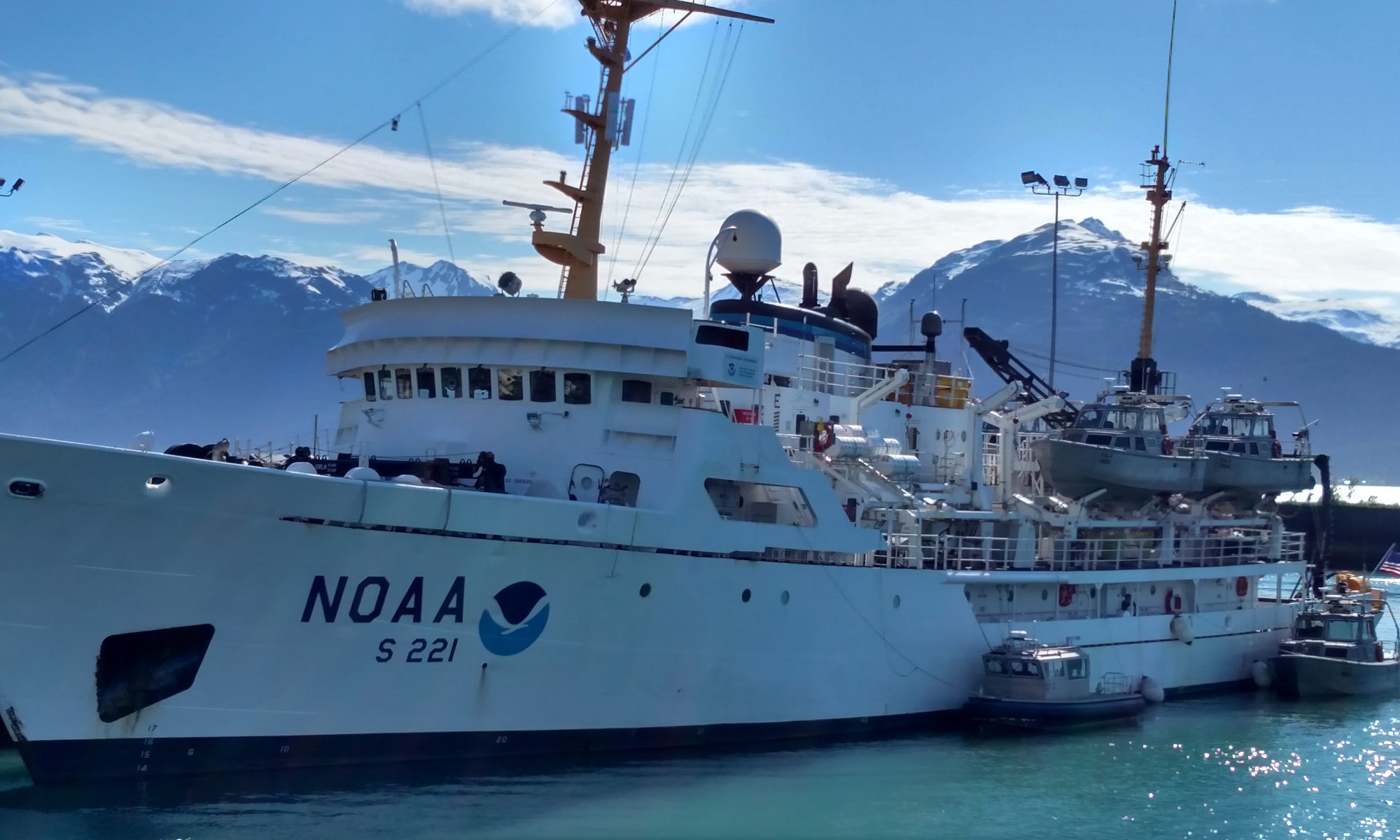
My watch on our last day, notice how happy we are! From left Michael Hendon (chief scientist), me, Amy Schmitt, Kristin Foss, Brittany Palm (watch leader).The Oregon II docked in Galveston
NOAA TEACHER AT SEA STEVEN WILKIE ONBOARD NOAA SHIP OREGON II JUNE 23 — JULY 4, 2011
Mission: Summer Groundfish Survey Geographic Location: Northern Gulf of Mexico Date: July 3, 2011 Ship Data
Latitude
29.27
Longitude
-94.39
Speed
9.30 kts
Course
298.00
Wind Speed
6.70 kts
Wind Dir.
281.88 º
Surf. Water Temp.
29.90 ºC
Surf. Water Sal.
24.88 PSU
Air Temperature
29.30 ºC
Relative Humidity
75.00 %
Barometric Pres.
1015.75 mb
Water Depth
15.70 m
Science and Technology Log
One of the first expeditions devoted to the study of the world’s oceans was that of the H.M.S. Challenger. This voyage covered a distance of more than 68,000 nautical miles. Although other expeditions prior to the Challenger expedition would periodically collect data about the ocean environment, none were devoted solely to the exploration of the chemical, biological and physical attributes of the oceans.
The HMS Challenger’s voyage spanned 4 years and covered close to 70,000 nautical miles.A sounding device used by the Challenger expedition. This weighted line would be lowered over the side of the ship and the amount of line let out would indicate depth.
If you have read my previous posts, you know how important monitoring the abiotic factors are. This was no different aboard the Challenger expedition.
And remember it took 23 years to process and publish all of the data, well with the help of computers and the internet, the Oregon II’s data is available in hours.
Michael Hendon (lead scientist) performs a winkler titration to determine dissolved oxygen content. See wet chemistry skills are still important!
Although technology plays a pivotal role in collecting and analyzing the data, computers still need to be cross referenced against tried and true scientific processes. In order to ensure that all of the CTD equipment is accurate, random water samples are pulled using the CTD’s sample bottles. A chemical titration, known as the Winkler titration is used to determine the amount of dissolved oxygen present in the water samples.
The method for sampling the living organisms along the bottom of the seafloor has not changed much since the Challenger expedition. Trawl nets are still the name of the game, although the way they are deployed might vary a bit!
Mike and Cliff bring the Oregon II's trawl aboard complete with catch.
Once the catch is on board, the process begins to collect data (remember that is why NOAA is out here) to better understand how populations are changing in order to set catch limits and analyze human impact. In the day’s of the Challenger expedition, the work of analyzing samples and collecting their would have been done in a lab aboard ship, and we rely on similar if not more automated facilities onboard the Oregon II. Follow this link to take a virtual tour of the Challenger’s “Wet lab”. The wetlab onboard the Oregon II is where I spend the majority of my 12 hour watch. It is here that the catch is brought after we bring it on deck, we sort the catch, count and measure a subsample of what is brought on board. If we had to measure everything that came up with the net we would never get finished. By taking a subsample we can split the catch into percentages depending on the weight of the entire catch and count a smaller sample of the catch. This subsample’s diversity can then be used as a basis for the entire catch. This saves time and effort on our part and still provides an accurate representation of what was in the net. A few species are selected to be counted in their entirety, that includes all commercially important shrimp (brown shrimp, pink shrimp and white shrimp) and all red snapper. We will also pull organisms into our subsample that are unique to the catch such as sharks, rays, skates etc.
Now I am not quite sure how the Challenger expedition determined where it would sample and when, perhaps if they saw something interesting they would simply drop their nets in the water, but with the Oregon II, the sampling sites are predetermined and the method to set up those sites is quite sophisticated. In order to ensure that the cruise covers the majority of the Gulf of Mexico NOAA uses a method known as independent random sampling. This method uses a computer program to randomly select stations based on depth data, and spatial area. By choosing random samples independently, the scientists can rest assured that they haven’t purposefully singled out an area with “good fishing” or “bad fishing” and that the data they collect will represent a more accurate count of the actual fish populations in the Gulf of Mexico.
NOAA TEACHER AT SEA STEVEN WILKIE ONBOARD NOAA SHIP OREGON II JUNE 23 — JULY 4, 2011
Mission: Summer Groundfish Survey
Geographic Location: Northern Gulf of Mexico
Date: June 30th, 2011
Ships Data
Latitude
28.32
Longitude
-95.19
Speed
9.10 kts
Course
273.00
Wind Speed
12.71 kts
Wind Dir.
79.58 º
Surf. Water Temp.
28.20 ºC
Surf. Water Sal.
24.88 PSU
Air Temperature
29.50 ºC
Relative Humidity
75.00 %
Barometric Pres.
1014.84 mb
Water Depth
35.70 m
Science and Technology Log
So despite the long shifts, I managed to rouse myself out of bed early for my shift. I wandered up to the drylab (just off of the deck) to check in and see what had been brought on board during the last trawl. The second watch was working up a catch in the wet lab and on the deck was an unusual but significant catch, a sea turtle. Definitely not a targeted species of
An unintended catch, the Kemp's Ridley (Lepidochelys kempi) was brought on board with one of the trawls, but returned to the sea safe and sound.
this cruise. Although rare on NOAA cruises, sea turtles are unfortunately often caught up as bycatch by the fishing industry. Bycatch is an unintended species in the net, and sea turtles were a large bycatch component of the shrimp industry.
NOAA takes sea turtle bycatch very seriously. No sooner had the turtle been put on the deck did the science team spring into action to collect vital statistics and data about the turtle before returning it back to the Gulf safe and sound. The Kemp’s Ridley sea turtle (Lepidochelys kempi), like most sea turtles, is considered and endangered species. By collecting data about the sea turtles, NOAA scientists can continue to monitor the health of the population, especially in light of last year’s Deep Water Horizon oil spill.
Scientists worked the turtle up by collecting measurements (length and width) of the shell, and collecting a tissue sample in order to perform DNA analysis. An electronic tag was inserted under the skin, so that if the turtle is caught again it can be scanned and more data can be added to its file. This would allow scientists to determine migratory patterns and growth rates. Finally the turtle’s rear flippers were fitted with tags that, again, would allow scientists to monitor its movement, age and growth.
Trained NOAA scientists measure the carapace length of our unexpected catch.Before being returned to the Gulf, the Kemp's Ridley is outfitted with two flipper tags. These tags can be used to help scientists monitor the life history of this particular turtle.Trained NOAA scientists fit the Kemp's Ridley sea turtle with tags that can be used to collect additional data should the turtle be caught again.
In the early 1980s the situation with turtle populations in the Atlantic and Gulf of Mexico waters had gotten so dire, that scientists began researching ways to reduce turtle bycatch. TEDs or Turtle Exclusion Devices were introduced to the shrimping industry on a volunteer basis. These devices are rigged to the catch-end of shrimpers’ nets and act like a grate over a storm drain. The water (and shrimp) can flow into the end of the net, but anything as big as a turtle is stopped and able to escape through a trap door. To get a better idea of how a TED works follow this link to NOAA’s video of a TED in action.
Today, TEDs are mandated on all trawl nets used by the fishing industry. Although at first the shrimping industry was reluctant to embrace the technology, by working collaboratively, scientists, the fishing industry, and government legislators are helping to curtail the drastic reduction in sea turtle populations in American waters.
NOAA TEACHER AT SEA STEVEN WILKIE ONBOARD NOAA SHIP OREGON II JUNE 23 — JULY 4, 2011
Mission: Summer Groundfish Survey
Geographic Location: Northern Gulf of Mexico
Date: June 29, 2011
Ship Data
Latitude
28.06
Longitude
-96.43
Speed
8.40 kts
Course
89.00
Wind Speed
13.90 kts
Wind Dir.
71.56 º
Surf. Water Temp.
27.80 ºC
Surf. Water Sal.
24.88 PSU
Air Temperature
29.30 ºC
Relative Humidity
76.00 %
Barometric Pres.
1013.73 mb
Water Depth
26.00 m
Science and Technology Log
A preserved plankton sample from one of the Oregon II's bongo nets.
So now that we have an understanding of abiotic factors, let’s talk biotic factors, and for the most part, those biotic factors are going to be fish and plankton. The majority of our plankton (plankton are organisms–plants or animals–that are too small to fight against the current and thus drift along with it) samples come from the neuston and bongo nets. After we have our bongo or neuston nets back on board, the science crew goes to work preserving the specimens.
Something common in the neuston net, is Sargassum a type of brown algae belonging to the Kingdom Protista and the Phlyum phaeophyta (kingdoms and phylums are associated with the science of taxonomy or classification). If you are familiar with kelp, then you are familiar with brown algae. Kelp is a long algae that fastens itself to the bottom of the seafloor with a root of sorts called a holdfast. Sargassum, however, does not hold fast, but rather drifts out in the open ocean. It can stay afloat because Sargassum has little tiny gas-filled floats called pneumatocysts. These clumps of algae can provide much needed hiding places for small marine organisms out in the open ocean. Because so many organism might live in, on or around the mats of Sargassum whenever we capture Sargassumin our nets we have to be sure to wash them down thoroughly in order to ensure that we get as many of the creatures off of the blades as possible.
Sargassum, a brown algae, provides important habitat for many marine organisms including juvenile fish. Clearly visible are the pneumatocysts, gas-filled floats, that help keep the algae at the surface of the ocean.
The currents of the Gulf of Mexico and the Atlantic actually concentrate the Sargassum into a giant mass in the middle of the North Atlantic ocean, commonly referred to as the Sargasso Sea. So significant is the Sargassum, that Christopher Columbus feared for the safe passage of his ships because of the thick mass of algae.
The adventures of Captain Nemo as penned by Jules Verne in the late 19th century even commented on the nature of this floating mass of algae: “This second arm–it is rather a collar than an arm–surrounds with its circles of warm water that portion of the cold, quiet, immovable ocean called the Sargasso Sea, a perfect lake in the open Atlantic: it takes no less than three years for the great current to pass round it. Such was the region the Nautilus was now visiting, a perfect meadow, a close carpet of seaweed, fucus, and tropical berries, so thick and so compact that the stem of a vessel could hardly tear its way through it. And Captain Nemo, not wishing to entangle his screw in this herbaceous mass, kept some yards beneath the surface of the waves. The name Sargasso comes from the Spanish word “sargazzo” which signifies kelp.”
As interesting and important as Sargassum is to the ocean environment, it is not our targeted organism, which is, for the most part fish! Although not a fish, crustaceans are still an important fishery, and few are more significant than Panaeus aztecus (brown shrimp), Panaeus setiferus (white shrimp) and Panaeus duorarum (pink shrimp). Chances are if you are dining on shrimp cocktail you are eating one of these three species.
One of many (so many) brown shrimp to be measured. We measure from the length of the rostrum (the point part by their eyes) to the tip of their (tail).
Lutjanus campiechanus (or the red snapper) is another commercially important species that scientists are particularly interested in. Species like the red snapper are of particular concern because, according to NOAA’s Fish Watch website, the population is currently at low levels prompting NOAA to establish temporary restrictions on fishing this species in past years.
It is the work of the crew aboard the Oregon II to collect the data that helps scientists predict population trends in species such as these which allows government regulations to be based on sound science. Although sometimes unpopular with the local fishing industry the temporary ban on fishing for some species is aimed at providing a long-term sustainable population for future generations.
Prized by the fishing industry and restauranteurs, red snapper are a species of particular concern because of the pressures local fisheries have placed on the species.
Although not a primary target of this fish survey, cartilaginous fish (Class Chondricthyes…there’s that taxonomy again) like sharks, rays and skates are also organisms of particular concern. Unlike the majority of the fish we bring on board, which are bony fish belonging to the Class Osteicthyes, the majority of cartilaginous fish reproduce internally. This means that a female shark, ray or skate, might have much fewer offspring in a given year, but those offspring might be more mature once they are born. Bony fish on the other hand often lay eggs externally by the thousands, but only a small percentage survive.
The watch leader of my watch, Brittany Palm, realizes the significance of the reproductive habits of these organisms (follow this link to review Brittany and her fellow authors extensive work) and has used much of her expertise gained through NOAA cruises like this one to publish scientific papers in peer-reviewed journals.
If you recall, one of the steps of the “scientific method” is to share your results, and there is no better way than to publish your findings in journals for other scientists to read. Although writing a paper may sound simple, this is not your average high school term paper–there is considerably more effort required. Brittany and her fellow authors labored for close to four years to finally draft and submit the paper for publishing.
An example of a cartilaginous fish, the Atlantic angelshark (Squatina dumeril) was brought on board as part of one of our trawls.
Although we may not write anything as extensive at the high school level, good sound scientific investigations will always end up with you sharing your results, and as a result, well-researched background information is always essential. To all my past and future students out there, feel free to take note of the reference section of the paper and remember how important references and good research is in backing up your work!
Personal Log
It has not taken long to get into the rhythm of things aboard ship. Although I thought that the waves might lead to a little sea sickness, I now find them quite soothing, and am curious as to how I might feel once back on shore as I struggle to get my land legs back. Sleeping with the waves is a slightly different story. At times they can lull you off to sleep (or it might simply be the twelve hours of sorting, measuring and weighing the catch that does that); other times they can roll you right into your bunk wall and snap you awake. My bunk is on the top, so the wall is better than the floor I suppose!
Although the waves have been soothing up to this point, we are possibly facing some inclement weather as the first tropical storm of the season, Arlene, is to our southwest heading towards the Mexican coast. If the weather picks up too much we may have to head in shore to work up some of the shallower stations while the Gulf settles back down. Either way we will be kept busy, measuring fish or measuring the waves!
Tropical Storm Arlene, the first tropical storm of the Atlantic season is headed for the Mexico coast in the next few days.
NOAA TEACHER AT SEA STEVEN WILKIE ONBOARD NOAA SHIP OREGON II JUNE 23 — JULY 4, 2011
Mission: Summer Groundfish Survey Geographic Location: Northern Gulf of Mexico Date: June 26, 2011
Ship Data:
Latitude
26.56
Longitude
-96.41
Speed
10.00 kts
Course
6.00
Wind Speed
4.55 kts
Wind Dir.
150.72 º
Surf. Water Temp.
28.30 ºC
Surf. Water Sal.
24.88 PSU
Air Temperature
29.20 ºC
Relative Humidity
78.00 %
Barometric Pres.
1012.27 mb
Water Depth
115.20 m
Before getting down to work, it is important to learn all precautionary measures. Here I am suited up in a survival suit during an abandon ship drill.
Science and Technology Log
After two days of travel we are on site and beginning to work and I believe the entire crew is eager to get their hands busy, myself included. As I mentioned in my previous post, it is difficult if not impossible to separate the abiotic factors from the biotic factors, and as a result it is important to monitor the abiotic factors prior to every trawl event. The main piece of equipment involved in monitoring the water quality (an abiotic factor) is the C-T-D (Conductivity, Temperature and Depth) device. This device uses sophisticated sensors to determine the conductivity of the water, which in turn, can be used to measure salinity (differing salinities will conduct electricity at different rates). Salinity influences the density of the water: the saltier the water the more dense the water is. Density measures the amount of mass in a specific volume, so if you dissolve salt in a glass of water you are adding more mass without much volume. And since Density=Mass/Volume, the more salt you add, the denser the water will get. Less dense objects tend to float higher in the water column than more dense objects, so as a result the ocean often has layers of differing salinities (less salty water on top of more salty water). Often you encounter a boundary between the two layers known as a halocline (see the graph below for evidence of a halocline).
Temperature varies with depth in the ocean, however, because warm water is less dense than cold water. When liquids are cold, more molecules can fit into a space than when they are war; therefore there is more mass in that volume. The warm water tends to remain towards the surface, while the cooler water remains at depth. You may have experienced this if you swim in a local lake or river. You dive down and all of a sudden the water goes from nice and warm to cool. This is known as a thermocline and is the result of the warm, less dense water sitting on top of the cool more dense water.
Here is the fancy piece of technology that makes measuring water quality so easy: the CTD.
Temperature also influences the amount of oxygen that water can hold. The cooler the temperature of the water the more oxygen can dissolve in it. This is yet another reason why the hypoxic zones discussed in my last blog are more common in summer months than winter months: the warm water simply does not hold as much oxygen as it does in the winter.
The CTD is also capable of measuring chlorophyll. Chlorophyll is a molecule that photosynthetic organisms use to capture light energy and then use to build complex organic molecules that they can in turn be used as energy to grow, reproduce etc. The more chlorophyll in the water, the more photosynthetic phytoplankton there is in the water column. This can be a good thing, since photosynthetic organisms are the foundation of the food chain, but as I mentioned in my earlier blog, too much phytoplankton can also lead to hypoxic zones.
Finally the CTD sensor is capable of measuring the water’s turbidity. This measures how clear the water is. Think of water around a coral reef — that water has a very low turbidity, so you can see quite a ways into the water (which is good for coral since they need access to sunlight to survive). Water in estuaries or near shore is often quite turbid because of all of the run off coming from land.
This is a CTD data sample taken on June 26th at a depth of 94 meters. The pink line represents chlorophyll concentration, the green represents oxygen concentration, the blue is temperature and the red is salinity.
So, that is how we measure the abiotic factors, now let’s concentrate on how we measure the biotic! After using the CTD (and it takes less time to use it than it does to describe it here) we are ready to pull our trawls. There are three different trawls that the scientists rely on and they each focus on different “groups” of organisms.
The neuston net captures organisms living just at the water's surface.
The neuston net (named for the neuston zone, which is where the surface of the water interacts with the atmosphere) is pulled along the side of the ship and skims the surface of the water. At the end of the net is a small “catch bottle” that will capture anything bigger than .947 microns. The bongo nets are nets that are targeting organisms of a similar size, but instead of remaining at the surface these nets are lowered from the surface to the seafloor and back again, capturing a representative sample of organisms throughout the water column. The neuston net is towed for approximately ten minutes, while the bongo nets tow times are dependent on depth. Once the nets are brought in, the scientists, myself included, take the catch and preserve it for the scientists back in the lab to study.
The bongo nets will capture organisms from the surface all the way down to bottom.
The biggest and baddest nets on the boat are the actual trawl nets launched from the stern (back) of the boat. These are the nets the scientists are relying on to target the bottom fish. This trawl net is often referred to as an otter trawl because of the giant heavy doors used to pull the mouth of the net open once it reaches the bottom. As the boat moves forward, a “tickler” chain spooks any of the organisms that might be lounging around on the bottom and the net follows behind to scoop them up. This net is towed for thirty minutes, and then retrieved and we spend the next hour or so sorting, counting and measuring the catch.
Here you can see the otter trawl net extending off the starboard side of the Oregon II. When lowered into the water the doors will spread the mouth of the net.
Personal Log
I thought that adjusting to a 12 hour work schedule would be tough, but with a 5-month old son at home I feel I am more prepared than most might be for an extended day. I might go as far as to say that I have more down time now than I did at home! Although the ship’s crew actually manages the deployment of the majority of the nets and C-T-D, the science team is always involved and keeping busy allows the hours to tick away without much thought. Before you know it you are on the stern deck of the ship staring at a gorgeous Gulf of Mexico sunset.
As we steam back East, the sun sets in our stern every day, and we have been treated to peaceful ones thus far on this trip.
The sun has long since set. As I write this it is well after midnight and my bunk is calling.


 I am happy to be heading home to my family and to a more regular work day (12 hour shifts are tough), but I do think I will miss the experience and the camaraderie among the people on the ship, and the soothing rhythm of the ship’s engines and the waves. I hope those of you that read this get a sense of what an awesome experience this is, as well as take away the importance of the work that NOAA does, and the need for it!


