


Recently NOAA Teacher at Sea Jason Moeller was interviewed about his cruise.
Read this article in the knoxnews.com about Jason.
Read this interview in the metropulse.com about Jason.
Read this article in the Stanford Daily about Jason.
Recently NOAA Teacher at Sea Jason Moeller was interviewed about his cruise.
Read this article in the knoxnews.com about Jason.
Read this interview in the metropulse.com about Jason.
Read this article in the Stanford Daily about Jason.
NOAA TEACHER AT SEA
JASON MOELLER
ONBOARD OSCAR DYSON
JUNE 11-JUNE 30
NOAA Teacher at Sea: Jason Moeller
Ship: Oscar Dyson
Mission: Walleye Pollock Survey
Geographic Location: Kodiak Harbor
Date: June 29-30
Ship Data
Latitude: 57.78 N
Longitude: -152.42 W
Wind: 4.9 knots
Surface Water Temperature: 8.5 degrees C
Air Temperature: 9.1 degrees C
Relative Humidity: 69%
Depth: 18.99
Personal Log
For the last time, welcome aboard!
We are now back in Kodiak, and I fly out on Thursday, June 30th. We got in late on the 28th, and so that gave us some time to explore! Once again, it was back to the trail to try and look for some bears!


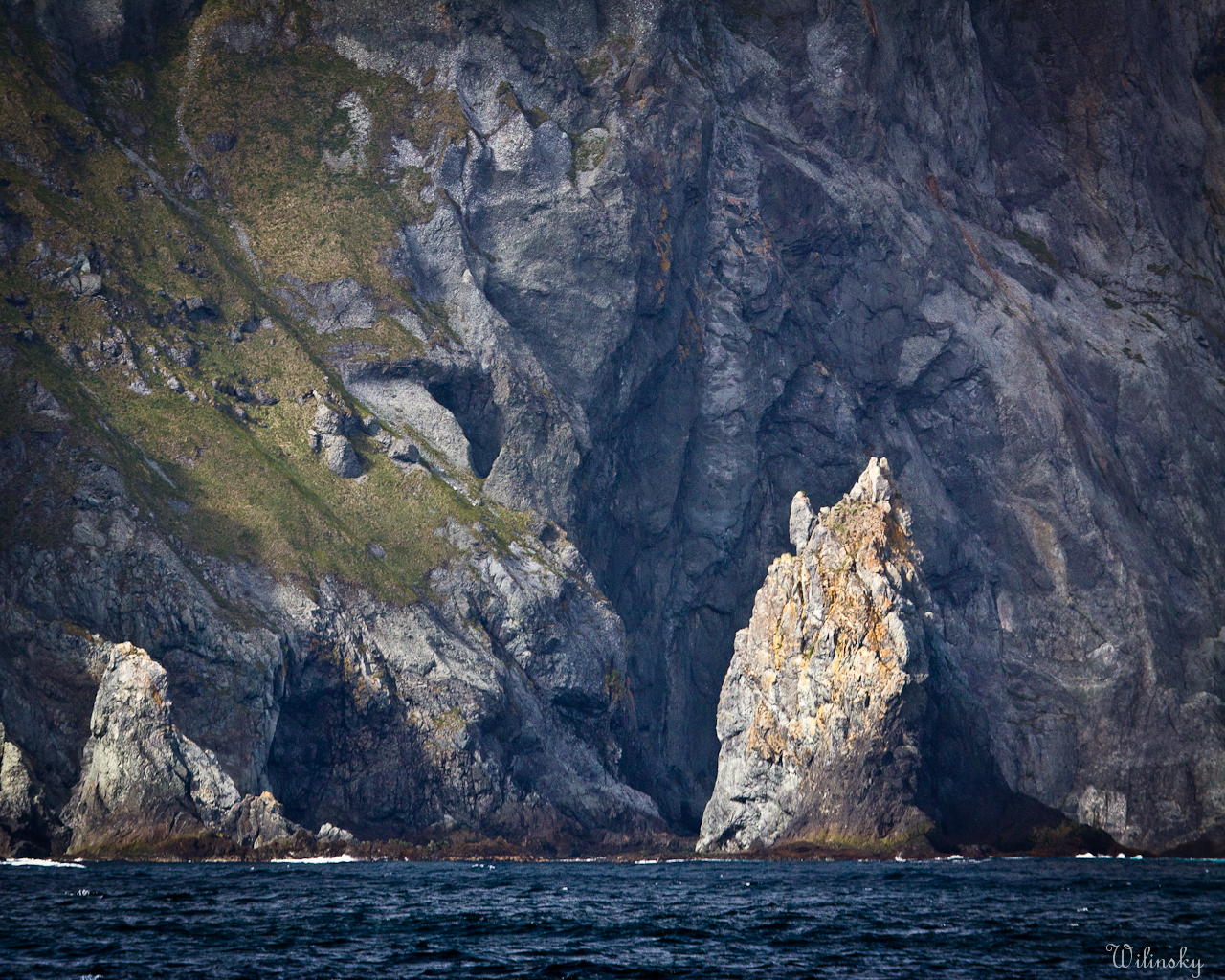
On June 29th, after stopping for some Mexican food, Paul, Jake, Jodi and I hopped in a car and drove out to Anton Larsen Bay in hopes of some great photo opportunities and wildlife. Below are some of the best photographs that I took of the trip.


Science and Technology Log
As the survey is now over, there is no science and technology log.
Species Seen
Gulls
Arctic Tern
Bald Eagle
Red Fox
Mouse
Reader Question(s) of the Day!
There are no questions of the day for this last log. However, I would like to extend some thank yous!
First, I would like to thank the NOAA organization for allowing me the wonderful opportunity to travel aboard the Oscar Dyson for the past three weeks. I learned an incredible amount, and will be able to bring that back to my students. I had a great time!
Second, I would like to thank the crew of the ship for letting me come onboard and participate in the survey. Thanks for answering all of my questions, no matter how naive and silly, teaching me about how research aboard this vessel really works, editing these blogs, and for giving me the experience of a lifetime.
Third, I would like to thank Tammy, the other NOAA Teacher at Sea, for all of the help and effort that she put into working with me on the science and technology section of the blog. Tammy, I could not have done it without you!
Next, a huge thank you to the staff of Knoxville Zoo for their support of the trip and granting me the time off! A special thanks especially needs to go to Tina Rolen, who helped edit the blogs and worked with the media while I was at sea. She helped keep me from making a complete fool of myself to the press. Another special thanks goes out to Dr. John, who loaned me the computer that I used to post the first several logs.
Thanks also go out to Olivia, my wonderful and beautiful wife, for supplying the camera that I used for the first half of the trip.
Finally, I would like to thank everyone who read the log and sent comments! I received many positive comments on the photography in this blog, although I must confess that I laughed a bit at those. Paul, our chief scientist, is the expert photographer on board, and his photos expose me for the amateur that I actually am. I would like to end this blog by posting some of the incredible images he gave me at the end of the trip.



NOAA TEACHER AT SEA
JASON MOELLER
ONBOARD NOAA SHIP OSCAR DYSON
JUNE 11 – JUNE 30, 2011
NOAA Teacher at Sea: Jason Moeller
Ship: Oscar Dyson
Mission: Walleye Pollock Survey
Geographic Location: Whale Pass
Date: June 28-29, 2011
Ship Data
Latitude: 58.01 N
Longitude: -152.50 W
Wind: 23.95 knots
Surface Water Temperature: 9.4 degrees C
Air Temperature: 10.8 degrees C
Relative Humidity: 71%
Depth: 177.72 m
Personal Log
Welcome back, explorers!
Due to the injury to the deck hand, we are done fishing. Our trip has been cut a day short and we are now headed back to Kodiak. We should arrive tomorrow morning, and I will fly back home on the 30th.
The shortest route to Kodiak was through Whale Pass, a break in Kodiak Island. The pass made for some spectacular scenery.


The coolest part of the pass, though, is definitely the wildlife. We saw sea otters everywhere! Unfortunately, they were so fast and at a great enough distance that the following shot is the only decent one I was able to take.

We also saw an animal that I have been hoping to see for a long time.

We also saw a puffin, but it moved so quickly that there was no hope at a photo for it. Bummer. Several humpback whales were also spotted, along with numerous gulls and other seabirds.
Science and Technology Log
Today, lets talk about krill!
What are krill, you ask? They’re animals in the Phylum Arthropoda, which means they’re related to insects, spiders, crabs, lobsters, etc. They have jointed legs and an exoskeleton, are usually a couple of centimeters in length, and are reddish/orange-ish in color. They can often be found in dense schools near the surface of the water, and play an important role in the ecosystem as a source of food for lots of larger animals (like fish, whales, & penguins).
I’ve mentioned the two types of trawl gear that we use to catch fish, but if we want to catch smaller things like plankton, the mesh on those nets is way too small. Therefore, we use a third type of trawl called the Methot which has very fine mesh to corral the plankton down into a collection container at the end of the net. In addition to having a hard container at the end — as opposed to just a bag/codend that you see in the fish trawls — the Methot trawl also has a large metal frame at the beginning of the net. Check out the photos below.


After the net is brought back on deck, one of the fishermen or deck hands brings the container of krill into the fish lab. The first thing we do is dump the container into a sieve or a bucket and start picking out everything that isn’t krill. The two most common things that are collected (besides krill) are gelatinous animals (like jellyfish & salps) and larval fish. The fish get weighed (as one big unit, not individually) and then frozen for someone to look at later on.

After sorting the catch, we’re left with a big pile of krill, which gets weighed. We then take a small subsample from the big pile of krill (it’s a totally random amount depending on how much we scoop out!) and then weigh the subsample. Then the fun begins, as I’m the one that does this job; I get to count every single individual krill in the subsample. Tedious work. All of the data is then entered into the computer system, and the krill and anything else that we’ve caught (besides the larval fish) are thrown back into the water.


Species Seen
Northern Fulmar
Gulls
Puffin
Humpback Whales
Killer Whale!!!
Sea Otters!!!
Reader Question(s) of the Day!
Q. What has been your favorite thing about this trip so far?
A. I’ve been asked this question several times over the course of the last few weeks, but I’ve waited until the end to answer it.
Truth be told, it’s almost impossible to pick a favorite thing that I’ve seen or done. There are so many candidates! Exploring the Buskin River and seeing bald eagles before we set sail was a blast! Eating fresh caught salmon for the first time was a great experience, as it just melted in my mouth. Leaving shore for the first time was a lot of fun, as there is no feeling like the salt air blowing past your face at the front of a boat. Trying to take pictures of flying birds with a digital camera was a challenge, and we all had a good time laughing at the blurred images. Getting better at photography is something I’ve always wanted to do, and I feel like I have improved that. The first fish lab with the sleeper shark was great! Working in the fish lab, as messy as it was, was also a lot of fun! The XBT prank that was pulled on me was one of the best executed pranks I’ve ever seen, and it was hilarious! Hanging out and reading Martin’s Game of Throne series during breaks with my fellow scientists was a lot of fun as well, as it was just like a book club. Today’s ride through Whale Pass with the otters, whales, and mountains was exactly what I dreamed Alaska would be like.
The scientists sense of humor also made it an enjoyable trip. For example, this is what happens when you play around with the net camera for too long.

That being said, if I was absolutely forced to pick a favorite memory, it would probably the impromptu fishing trip at Sand Point. You know you love your job when you decide to keep going at it on your day off.
There will be one last log posted, so if you have questions please send them to me at jmoeller@knoxville-zoo.org!
NOAA TEACHER AT SEA
JASON MOELLER
ONBOARD NOAA SHIP OSCAR DYSON
JUNE 11 – JUNE 30, 2011
NOAA Teacher at Sea: Jason Moeller
Ship: Oscar Dyson
Mission: Walleye Pollock Survey
Geographic Location: Gulf of Alaska
Dates: June 25-27, 2011
Ship Data
Latitude: 55.58 N
Longitude: -159.16 W
Wind: 14.11
Surface Water Temperature: 7.2 degrees C
Air Temperature: 9.0 degrees C
Relative Humidity: 90%
Depth: 85.61
Personal Log
Anyone who has seen the show Deadliest Catchknows how dangerous crab fishing can be. Fishing for pollock, however, also has its dangers. Unfortunately, we found out the hard way. One of our deck hands caught his hand between a cable and the roller used to pull up the trawl net and hurt himself badly.

Fortunately, the injuries are not life threatening and he will be fine. The injuries did require a hospital visit, and so we stopped at Sand Point to treat him.


We stayed at Sand Point for nearly 48 hours. What did we do? We fished, of course! We used long lines and hooks, and had a great time!


A one-day fishing license in Alaska costs $20.00. We had internet, so five of us went online and bought the fishing passes. Was it worth it?

We filleted it and had the cooks make it for dinner. With the halibut, we also cut out the fleshy “cheeks” and ate them as sushi right on the spot! It doesn’t get any fresher (or tastier!) than that!
Science and Technology Log
Today we will look at the acoustic system of the Oscar Dyson! Acoustics is the science that studies how waves (including vibrations & sound waves) move through solids, liquids, and gases. The Oscar Dyson uses its acoustic system to find the pollock that we process.
The process begins when a piece of equipment called a transducer converts an electrical pulse into a sound wave. The transducers are located on the underside of the ship (in the water). The sound travels away from the vessel at roughly 1500 feet per minute, and continues to do so until the sound wave hits another object such as a bubble, plankton, a fish, or the bottom. When the sound wave hits an object, it reflects the sound wave, sending the sound wave back to the Oscar Dyson as an echo. Equipment onboard listens to the echo.
The computers look at two critical pieces of information from the returning sound wave. First, it measures the time that it took the echo to travel back to the ship. This piece of information gives the scientists onboard the distance the sound wave traveled. Remember that sound travels at roughly 1500 feet per minute. If the sound came back in one minute, then the object that the sound wave hit is 750 feet away (the sound traveled 750 feet to the object, hit the object, and then traveled 750 feet back to the boat).
The second critical piece of information is the intensity of the echo. The intensity of the echo tells the scientists how small or how large an object is, and this gives us an idea of what the sound wave hit. Tiny echos near the surface are almost certainly plankton, but larger objects in the midwater might be a school of fish.


One of the things that surprised me the most was that fish and bubbles often look similar enough under water that it can fool the acoustics team into thinking that the bubbles are actually fish. This is because many species of fish have gas pockets inside of them, and so the readout looks very similar. The gas pockets are technically called “swim bladders” and they are used to help the fish control buoyancy in the water.

Species Seen
Northern Fulmar
Gulls
Cod
Pacific Halibut
Flounder
Sea Urchin
Crab
Kelp
Reader Question(s) of the Day
Today’s questions come from Kevin Hils, the Director of Chehaw Wild Animal Park in Chehaw, Georgia!
Q. Where does the ship name come from?
A. Oscar Dyson was an Alaska fisheries industry leader from Kodiak, Alaska. He is best known for pioneering research and development of Alaska’s groundfish, shrimp, and crab industry. Dyson was a founding partner of All Alaskan Seafoods, which was the first company actually controlled by the fishermen who owned the vessel. He also served on the North Pacific Fisheries Management council for nine years. He is in the United Fishermen of Alaska’s hall of fame for his work. The ship was christened by his wife, Mrs. Peggy Dyson-Malson, and launched on October 17, 2003.


Q. How do you see this helping you teach at Knoxville Zoo, not an aquarium?
A. This will be a long answer. This experience will improve environmental education at the zoo in a variety of different ways.
First, this will better allow me to teach the Oceanography portion of my homeschool class that comes to the zoo every Tuesday. For example, I am in the process of creating a hands on fishing trip that will teach students about the research I have done aboard the Oscar Dyson and why that research is important. Homeschool students will not just benefit from this experience in Oceanography, but also in physics (when we look at sound and sonar) and other subjects as well from the technical aspects that I have learned during the course of the trip.
Scouts are another group that will greatly benefit from this experience as well. The Girl Scout council wishes to see a greater emphasis in the future on having the girls do science and getting real world experiences. While the girls are still going to desire the animal knowledge that the zoo can bring, they will also expect to do the science as well as learn about it. My experience aboard the Dyson will allow me to create workshops that can mimic a real world animal research experience, as I can now explain and show how research is done in the field.
The same can be said of the boy scouts.
In addition, one of the most common badges that is taught to boy scout groups that come in is the fish and wildlife merit badge. In the past, the badge has primarily focused on the wildlife aspect of this topic. However, I now have the knowledge to write and teach a fisheries portion for that merit badge, as opposed to quickly covering it and moving on. This will enrich future scouts who visit the zoo for this program.
A major focus for all scouts is the concept of Leave No Trace, where scouts are supposed to leave an area the way they found it. The fisheries research being done aboard the Dyson is focused toward that same goal in the ocean, where we are attempting to keep the pollock population as we found it, creating a sustainable fishery. The goal aboard the Dyson is similar to the goal in scouting. We need to be sustainable, we need to be environmentally friendly, and we need to leave no trace behind.
School children on field trips will greatly benefit, especially students in the adaptations section. There are some bizarre adaptations that I never knew about! For example, sleeper sharks slow, deliberate movement coupled with their fin and body shape basically make them the stealth fighter of the fish world. They can catch fish twice as fast as they are! Lumpsuckers are neat critters too! This knowledge will enhance their experience at the zoo during field trip programs.
Finally, I can pass the knowledge from this experience on to my coworkers. This will not only better the experience of my students, but it will also improve the outreach programs, the bedtime programs, the camps, and other programming done at the zoo.
Q. Are you old enough to be on a ship? You look like you’re 13???!!!!
A. SHHHHHHH!!!! You weren’t supposed to tell them my real age! They think I’m 24!
NOAA TEACHER AT SEA
JASON MOELLER
ONBOARD NOAA SHIP OSCAR DYSON
JUNE 11-JUNE 30, 2011
NOAA Teacher at Sea: Jason Moeller
Ship: Oscar Dyson
Mission: Walleye Pollock Survey
Geographic Location: Gulf of Alaska
Date: June 23-24, 2011
Ship Data
Latitude: 54.86 N
Longitude: -161.68 W
Wind: 12.1 knots
Surface Water Temperature: 8.5 degrees C
Air Temperature: 9.1 degrees C
Relative Humidity: 95%
Depth: 52.43 m
Personal Log
As I mentioned in the last post, everything here has settled into a routine from a personal standpoint, and on that end there is not much to write about. However, there were three things that broke up the monotony. First, as always, the scenery was beautiful.


Second, I found out that even with all of the modern equipment on board, catching fish is still not guaranteed. We trawled three times last night on the 23rd and caught a total of 14 fish in all three trawls! Remember, a good sample size for one trawl is supposed to be 300 pollock, so this is the equivalent of fishing all day long and catching a minnow that just happened to swim into the fishing hook.
The first trawl caught absolutely nothing, as the fish dove underneath the net to escape the danger. The second trawl caught two pacific ocean perch and one pollock, and the third trawl caught eleven pollock. All in all, not the best fishing day.

Despite the poor fishing, we did bring up this neat little critter.


The third thing to break up the monotony was the Aleutian Islands earthquake. On the evening of June 23rd, a magnitude 7.2 earthquake shook the Aleutian Islands. According to ABC news, the earthquake was centered about 1,200 miles southwest of Anchorage. The quake spawned a brief tsunami warning that caused a large number of Dutch Harbor residents (Dutch Harbor is the home base of the show Deadliest Catch) to head for higher ground. We had been in the Aleutian Islands and Dutch Harbor area on our survey route, but had left two days before, so the Oscar Dysonwas completely unaffected by the earthquake.

Science and Technology Log
In order to obtain photos of all of this neat sealife, we first have to catch it! We catch fish by trawling for them. Some of you may not know exactly what I’m talking about, so let me explain. Trawling is a fishing method that pulls a long mesh net behind a boat in order to collect fish. Trawling is used to collect fish for both scientific purposes (like we’re doing) and also in commercial fishing operations. We have two types of fish trawls onboard the NOAA Ship Oscar Dyson — a mid-water trawl net and a bottom trawl net. We’ve used both types throughout our cruise, so let me tell you a little about each.
The mid-water trawl net is just as it sounds — it collects fish from the middle of the water column — not those that live on the seafloor, not those that live at the surface. The technical name for the net we have is an Aleutian Wing Trawl (AWT) — it’s commonly used by the commercial fishing industry.

The end of the net where the fish first enter has very large mesh, which is used to corral the fish and push them towards the bag at the end. The mesh gets progressively smaller and smaller the further into it you go, and at the very end (where the collecting bag is), the mesh size is 0.5 inches. The end (where the bag is, or where the fish are actually collected) is called the codend.

This is the kind of net we use when we want to collect a pollock sample, because pollock are found in the water column, as opposed to right on the seafloor (in other words, pollock aren’t benthic animals). Our particular net is also modified a little from a “normal” AWT. Our trawl has three codends (collecting bags) on it, each of which can be opened and closed with a switch that is controlled onboard the ship. The mechanism that opens and closes each of the 3 codends is called the Multiple Opening and Closing Codend (MOCC) device. Using the MOCC gives us the ability to obtain 3 discrete samples of fish, which can then be processed in the fish lab.

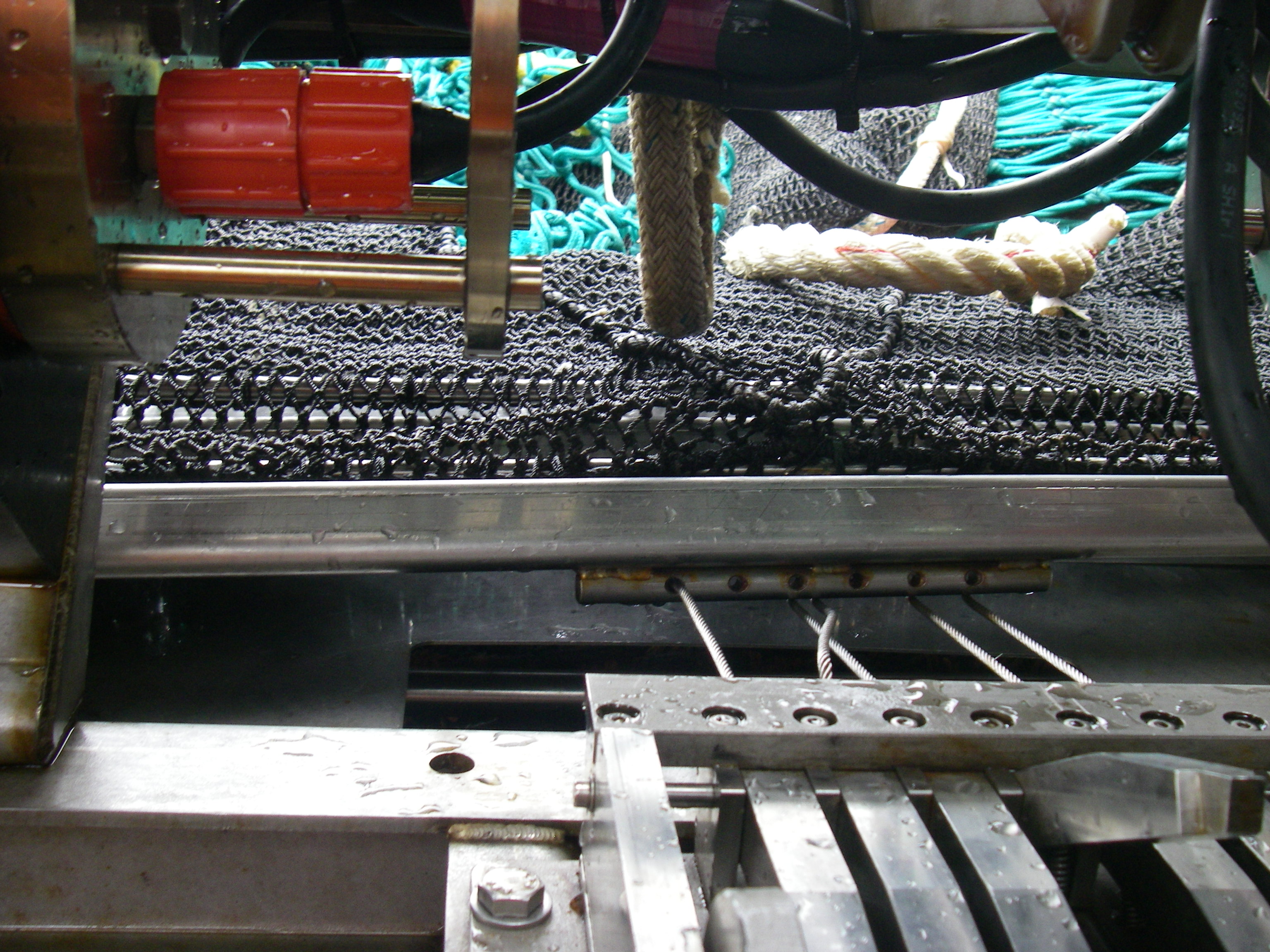

One other modification we have on our mid-water trawl net is the attachment of a video camera to the net, so we can actually see the fish that are going into the codends.

When we spot a school of fish on the acoustic displays, we then radio the bridge (where the captain is) and the deck (where the fishermen are) to let them know that we’d like to fish in a certain spot. The fishermen that are in charge of deploying the net can mechanically control how deep the net goes using hydraulic gears, and the depth that we fish at varies at each sampling location. Once the gear is deployed, it stays in the water for an amount of time determined by the amount of fish in the area, and then the fishermen begin to reel in the net. See the videos below to get an idea of how long the trawl nets are — they’re being reeled in the videos. Once all of the net (it’s VERY long — over 500 ft) is reeled back in, the fish in the codends are unloaded onto a big table on the deck using a crane. From there, the fish move into the lab and we begin processing them.
Videos of the net being reeled in and additional photos are below!
http://www.youtube.com/watch?v=I50Q4SJzzaE
http://www.youtube.com/watch?v=VVAqbAGcxRs


The other type of trawl gear that we use is a bottom trawl, and again, it’s just as it sounds. The bottom trawl is outfitted with roller-type wheels that sort of roll and/or bounce over the seafloor. We use this trawl to collect benthic organisms like rockfish, Pacific ocean perch, and invertebrates. There’s usually a random pollock or cod in there, too. The biggest problem with bottom trawls is that the net can sometimes get snagged on rocks on the bottom, resulting in a hole being ripped in the net. Obviously, we try to avoid bottom trawling in rocky areas, but we can never be 100% sure that there aren’t any rogue rocks sitting on the bottom 🙂


Species Seen
Northern Fulmar
Gulls
Pollock
Pacific Ocean Perch (aka rockfish)
coral
Isopod
Reader Question(s) of the Day!
The first question for today comes from Rich, Wanda, and Ryan Ellis! Ryan is in the homeschool Tuesday class at the Zoo.
Q. We looked up what an anemone was and we found it was some kind of plant. Is that correct?
A. Great question! The answer is both yes and no. There is a type of flowering plant called the anemone. There are about 120 different species, and they are in the buttercup family. For one example of the plant, look below!

The sea anemone, however, is not actually a plant but an animal! Anemones are classified as cnidarians, which are animals that have specialized cells for capturing prey! In anemones, these are called nematocysts, which have toxin and a harpoon like structure to deliver the toxin. When the nematocysts are touched, the harpoon structure injects the toxin into the animal that touches it.
Cnidarians also have bodies consist of mesoglea, a non living jelly like substance. They generally have a mouth that is surrounded by the tentacles mentioned above.

The second question comes from my wife Olivia.
Q. What has surprised you most about this trip? Any unexpected or odd situations?
A. I think the thing that has surprised me the most is the amount of down time I have had. When I came on, I assumed that it would be physical and intense, like the show Deadliest Catch, where I would spend my whole time fishing and then working on the science. I figured that I would be absolutely toast by the end of my shift.
While I have worked hard and learned a lot, I have quite a bit of down time. Processing a catch takes about one hour, and we fish on average once or twice a night. That means I am processing fish for roughly two hours at most, and my shift is twelve hours. I have gotten a fair amount of extra work done, as well as a lot of pleasure reading and movie watching.
As for unexpected and odd situations, I didn’t really expect to get your camera killed by a wave. Fortunately, I have been allowed to use the scientist camera, and have been able to scavenge photos from other cameras, so I will still have plenty of pictures.
Another technological oddball that I didn’t think about beforehand was that certain headings (mainly if we are going north) will cut off the internet, which is normally fantastic. It is frustrating to have a photo 90% downloaded only to have the ship change vectors, head north, and cut off the download, forcing me to redownload the whole photo.
I also didn’t expect that the fish would be able to dodge the trawl net as effectively as they have. We have had four or five “misses” so far because the fish will not stay in one spot and let us catch them. While the use of sonar and acoustics has greatly improved our ability to catch fish, catching fish is by no means assured.
Perhaps the biggest “Are you kidding me?” moment though, comes from James and David Segrest asking me about sharks (June 17-18 post). An hour after I read the question, we trawled for the first time of the trip, and naturally the first thing we caught was the sleeper shark. Also naturally, I haven’t seen a shark since. Sometimes, you just get lucky.