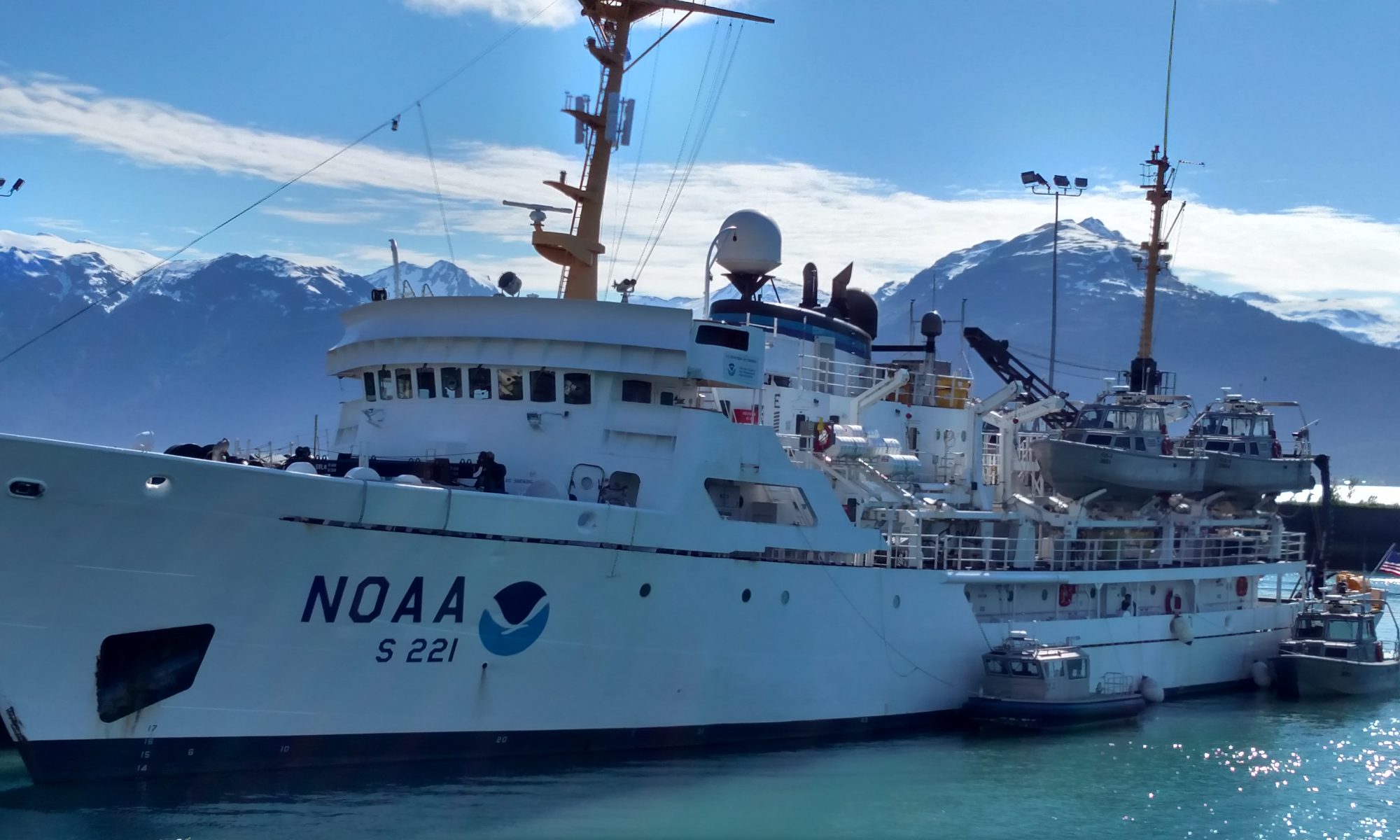
Roy Arezzo, July 16, 2007

NOAA Teacher at Sea
Roy Arezzo
Onboard NOAA Ship Oscar Dyson
July 11 – 29, 2007

Mission: Summer Pollock Survey
Geographical Area: North Pacific, Alaska
Date: July 16, 2007

We love Plankton
We love Plankton

Weather Data from Bridge 
Visibility: 8 nm (nautical miles)
Wind direction:   260° (SW)
Wind speed:   6 knots
Sea wave height: 1 foot
Swell wave height: 3 feet
Seawater temperature: 9°C
Sea level pressure: 1014.4 mb (millibars)
Air Temperature:   8°C
Cloud cover: 8/8, stratus

Science and Technology Log: Why fish pollock? What do pollock fish? Pelagic Food Webs of the Bering Sea 

Surveying pollock on the Bering shelf provides the data needed to set catch limits to manage the fishery. Catch limits for American fishing fleets are to be decided soon for next year. The pollock survey I am part of as Teacher at Sea is technically known as the Echo Integration Trawl Survey been an annual tradition of NOAA since 1971! The OSCAR DYSON, and before her the MILLER FREEMAN, use traditional trawling gear to achieve this goal. The fishing gear tends to be smaller then the larger fishing vessels since we don’t need to catch as many fish to estimate population trends. Like commercial operations we are interested in where the fish are in the water column and their geographic distribution. We also are concerned with their age composition. Although we primarily use acoustic sensors to detect fish, by trawling we can see how the technology used to locate fish in the water matches with what is being caught in the net. We also monitor by-catch organisms to observe what is mixed in with pollock when trawling.

Aleutian Islands
Aleutian Islands

Dutch Harbor, AK, according to the National Fisheries Service continues to be the No. 1 port by weight for seafood landings. In 2005, 877 million pounds of seafood passed through port, in 2006 it was more. In terms of seafood value only New Bedford, Mass., surpasses Dutch Harbor mostly due to the increase in the scallop market and decrease in crab populations. Dutch Harbor is known for its king crab industry in the winter and finfish year round, including hake, cod and salmon. Although shrimp is American’s most popular seafood item in terms of sales, finfish occupy much of the top five. Canned tuna is second highest for sales in the U.S., salmon is third and then pollock and tilapia; however if you factor in the global market, the amount of pollock being harvested and the sales for food products such as frozen whitefish foods, filets and surimi (Asian fish paste used in foods such as artificial crab) make it the largest seafood industry in the world (Anchorage Daily News). In addition Pollock are seasonally fished for roe. Commercially, fishing pollock is a good business venture due to its large schools and typically low by-catch. According to the National Marine Fisheries Service approximately 307 million dollars in pollock sales was made in the U.S in 2005. More than 3 million tons of Alaska pollock are caught each year in the North Pacific from Alaska to northern Japan. Of that the U.S. is responsible for about half. The population of Pollock in the Bering alone was estimated at 10 million metric tons early this decade and the catch limit was set around 10 –15% of the population size. Last year the survey team found a significant decline in populations and thus the catch limit was lowered but anecdotally there are preliminary signs of good recruitment with many young pollock being identified in this summer’s survey.

Assorted diatoms
Assorted diatoms

We are clearly at the top of the food web and consuming a large amount of pollock. The pollock are part of a very complex ecosystem. They are fragile fish and short lived but fast growing and quick to reproduce. The pollock population seems to be greater in number then most other harvestable finfish in the Bering, possibly due to a decline in Pacific Ocean perch, and shows interesting fluctuations in population density in response to global climate changes and sea current patterns. The Bering Sea lies between the Arctic Ocean to the north and the North Pacific to the south but remains a unique ecosystem exhibiting some characteristics of each of its neighbors.

Jellyfish found in the plankton net - large plankton!
Jellyfish found in the plankton net – large plankton!

The food web of the pelagic zone of open water in the cold Bering Sea is contingent on movement of nutrient rich waters. The main source of nutrients for the upper shelf region where one finds pollock seems to be influenced by the flow of the Alaskan Stream near shallower coastal waters which flows east across the Aleutian chain. Some of the water flows up through passes and becomes parts of currents like the Aleutian North Slope Current that feed the shelf. The Bering Sea is an extremely large and a relatively shallow body of water making it very different and it is this nutrient flow between shallow waters of the coast and shelf and deep basin/trenches to the west and south that account for its high biodiversity. In addition to currents ice melt and water temperature greatly affects nutrient flow and productivity. The nutrient rich water enables phytoplankton to flourish and reproduce in otherwise cold barren water. In turn zooplankton feed on the phytoplankton which transfers the organic carbon foods from producers to other levels of the food web. Invertebrates (ex. crabs, shrimp and jellyfish), small birds, small fish and baleen whales feed on the zooplankton. Seals, sea lions, skates, larger seabirds, porpoises and toothed whales feed on the fish and invertebrates. A substantial portion in the diet of larger pollock is made of plankton such as krill. This is the same food baleen whales filter out of the water when feeding.  Krill is the common name of shrimp-like marine invertebrates belonging to the order of crustaceans called the Euphausiids. Adult Pollock also dine on smaller pollock and this has been seen in our harvest as some pollock come up from the net with smaller fish in their mouth or stomach contents.

Pollock larvae
Pollock larvae

What is plankton? 

Plankton is a general word used to describe aquatic organisms that tend to drift with the current and are usually unable to swim against it. They are generally buoyant and found in the epipelagic zone (top of water receiving sun energy) although many species have serious vertical migration to feed and escape predators.  Most folks think of plankton as being tiny but large seaweeds and jellyfish are considered plankton. Phytoplankton refers to algae and photosynthetic organisms that make food with the sun’s energy. Diatoms are important phytoplankton in the Bering Sea ecosystem an have amazing silicon patterns. Zooplankton includes many groups of animal-like organisms, including microscopic protozoa and tiny crustaceans such as daphnia and copepods. The copepods population seems like an important link in understanding survivorship of young pollock. Many benthic crustaceans and mollusks (oysters and clams) start their life cycle as free-swimming larvae high in the water column. Young fish such as pollock also start their life cycle as plankton-like larvae.

Methot net, flow meter, and emptying the plankton net

Observing and Measuring Pollock Food: Last night we did a Methot Trawl. This involves dragging a net with a finer mesh than our fish trawl to pick up plankton. This is important in understanding what the fish we study are eating. When we dissect the belly of a pollock we often find it full of zooplankton with the occasional small fish, such as smelts or young pollock. We correlate the mass of the plankton caught in the net with the flow rate to estimate population density. We estimated 44,000 critters in the 35,000 cubic meters of water that passed through the net, much of which consisted of Euphausiids and Amphipods. This works out to approximately 1.3 plankton organisms per cubic meter of water.

Euphausiid pictured left and Amphipod pictured right

Personal Log

The Bering Sea has been relatively calm with good visibility. We have seen our first boats in over 36 hours, some fishing boats and a Coast Guard Cutter. There have been some marine mammal sightings but nothing close enough to make an ID. I am settling into a bit of a routine, waking around 10:30 AM for lunch and then relaxing and working out before checking in for my shift at 4 pm. I spend a fair amount of my off time in our spacious bridge discovering new technological toys and looking out for wildlife. Each day I spend some time out on the deck above the bridge for fresh air.

Mature Female Pollock with visible eggs

After dinner we usually begin fishing and I don my foulies and safety equipment and observe operations from the back deck. I then photo anything new that comes in and try to process any bycatch to make sure it is returned to the water quickly and in good shape. The science team then works together, processing the pollock and helping with the clean up. Sometimes the fish schools are large so we have to stay in our gear and work back to back trawls. After trawling we often look at the data collected or deploy various test equipment and water quality checks. Nighttime is not best for trawling so the few hours between sunset and sunrise is reserved for special project applications designed to modify our methods. In between fishing I work on my Teacher-At-Sea writings and interviewing folks on the boat.

Mature Male Pollock; testis visible above

Question of the Day 

Today’s question: How is the field of acoustics used in science?

Previous Question: How does one tell a male fish from a female fish in Pollock?  

Male and female Pollock look the same from their exterior anatomy. Although we weigh and catalog all the fish we pull in, we sex a 300 fish sample batch from each trawl. This involves dissecting the fish to identify their gonads. We make a cut on the ventral surface from the gills towards the anus. We open the body cavity and move the liver to the side to expose the other internal organs. Gravid females are relatively simple to ID since they have large egg sacks with whitish eggs. A mature female will have a large ovary that tends to be reddish and lined with blood vessels. Immature females are more difficult to identify and have a less pronounced ovary that varies in color.

Mature males will have developed white coiled testis. For undeveloped males one looks for pink globular organs where the white testis should be. Immature males are more difficult to identify but when no ovary is visible we search for a thin membranous tissue running from the Uro-genital opening up into the body cavity towards the backbone.

Interested in more about Alaskan fisheries?

NOAA Alaska Fisheries Science Center

Pacific State Marine Fisheries Commission 

Anchorage Daily News 

Roy Arezzo, July 13, 2007

NOAA Teacher at Sea
Roy Arezzo
Onboard NOAA Ship Oscar Dyson
July 11 – 29, 2007

Mission: Summer Pollock Survey
Geographical Area: North Pacific, Alaska
Date: July 13, 2007

arezzo_log1Weather Data from Bridge 
Visibility: 2 nm (nautical miles)
Wind direction:   227° (SW)
Wind speed:   4 knots
Sea wave height: <1 foot
Swell wave height: 4 feet
Seawater temperature: 8°C
Sea level pressure: 1010.3 mb (millibars)
Air Temperature:   5.8°C
Cloud cover: 8/8, stratus

Roy Arezzo, Teacher at Sea, on land before his sail, low visibility but great view.

Science and Technology Log: Introduction to the Pollock Survey 

Where does one start? Monday, July 9, 2007, I left my apartment in NYC at 6:30 AM and by the time I was making a descent to OSCAR DYSON Seattle I started to realize I Pictured to right was going far away. I was half way thereI then flew to Anchorage and finally took a small prop plane to Dutch Harbor. At 12 AM Eastern Standard time I was stepping out on the Tundra of Unalaska, my bag didn’t arrive until the next day. I had come a long way to fish, like many others, but this is the place to do it.  The global fish market seems to just keep increasing and someone needs to be looking at the fish populations. That is where NOAA comes in.  NOAA’s Teacher At Sea program sent me here and I ate some fresh salmon, some crab, hiked the tundra and soaked up the views in town before boarding for my expedition.

The OSCAR DYSON departed from the dock at 12 pm on Wednesday, July 11, 2007.  I remained outside, above the bridge, watching land disappear for most of our transit past the sea buoy and into the Bering. Within two hours the U.S. Fish & Wildlife Service folks were camped out in the bridge collecting bird data. Knowing it would be some time before we reached our study area to fish, I spent most of my first two days up in the bridge absorbing ship operations, navigation technology, sea bird names and searching for marine mammals. Two hours into our trip we had spotted over a dozen Humpbacks’, one breaching off the port beam about a half mile out. Some came a fair bit closer.

Acoustic Image of the trawl net from the Bridge:  The red line at bottom indicates the sea bottom. The circle represents the net and the specs inside the circle represent fish going in the net.
Acoustic Image of the trawl net from the Bridge: The red line at bottom indicates the sea bottom. The circle represents the net and the specs inside the circle represent fish going in the net.

Within 24 hours we had seen and recorded information on 5 different whale species, including, Humpback, Fin, Orca, Sei and a Beaked whale, the Fin whales being the largest. The pod of Orca’s moved with a mission. Dall’s Porpoises were cruising in our wake as Murres, Tufted Puffins, Northern Fulmar’s, Black-legged Kittiwakes, Fork tailed Storm Petrels and some immature gulls, that I could not ID, circled above. It was a spectacular show to start our trip. Although the Ship has many projects going on at the same time the primary mission is to monitor Pollock.

Nate, a fisherman, works the trawl net

Cruising at 12 knots for 2 days put us out on the first transect line. A transect line is a predetermined slice of ocean in a study area that we travel over in a straight line. Our mission is to spend 3 weeks monitoring the northern most region of a 9 week annual monitoring period (31 transects). We will travel northwest for most of the 3 weeks to cover all transects in this region. By 9 pm on Thursday we found ourselves on our first transect. When we pass over a transect line, which can be over a 200 miles long, we consistently send down sound waves from our center board several meters below any ship vibration. The reflection of sound waves from below can be interpreted as biomass data. Two science teams work 12 hour shifts to monitor the instruments and the data 24/7. The entire study covers the main area Pollock is found and fished in the Bering Sea. We can pick up small krill near the surface or schools hundreds of meters down depending on the frequency of the sound wave we use. On our monitors we get a visual image of the school of fish below us. When we find a significant fish footprint that resembles Pollock we put out trawl nets to catch an appropriate sample size. The ship has completed over 90 trawls in this study. When the nets come in we separate and record “by catch”, which I am happy to report there has been very little of (2 cod and some jellyfish). We then weigh all the fish, record size and sex on a sample size of 300. In addition we remove ear bones (the otolith)  from 50 fish each trawl to age them back at NOAA’s lab headquarters in Seattle, WA. We have fished three times today and landed 3.65 tons of fish. The day is not done.

Personal Log 

 Roy separates the boys from the girls.
Roy separates the boys from the girls.

I am excited at the opportunity to work along so many experienced and knowledgeable crew members from the science team to the deckhands and to observe how they work together to reach the objectives of the mission. Folks here have interesting backgrounds ranging from surfing to tall ships to commercial crab fishing. The Ship is very comfortable and quiet for her size and workload. I have yet to see the dark but I will be up late tonight as I switch over to the 4pm to 4am shift. Fortunately there is a proper cup of tea and left over clam chowder to keep me awake and warm. I would like to thank Rebecca Himschoot, Teacher at Sea participant on the previous sail, for showing me around and providing invaluable insight into preparing for my trip.  Thanks also to Amy and Forrest for a warm welcome to Alaska.

Question of the Day Today’s question: How does one tell a male fish from a female fish in Pollock?

The deck crew works a full net aboard NOAA Ship OSCAR DYSON.


Jill Carpenter, September 14, 2006

NOAA Teacher at Sea
Jill Carpenter
Onboard NOAA Ship Delaware II
September 5 – 15, 2006

Mission: Herring Hydroacoustic Survey
Geographical Area: North Atlantic
Date: September 14, 2006

Weather Data from Bridge 
Visibility: 10 nautical miles
Wind direction: 180o 
Wind speed: 14 kts
Sea wave height: 2ft.
Swell wave height: 7 ft./9 sec. from 90o
Seawater temperature: 16.8oC
Sea level pressure: 1018.7mb
Cloud cover: PC

Teacher at Sea Jill Carpenter on board the DELAWARE II.

Science and Technology Log 

The trip is winding down and we will be in port in a few hours. I am writing this final log in the early hours of the morning of my last night shift.  We will soon be approaching Cape Cod Canal, and our time of arrival into Woods Hole is scheduled for 9:30 this morning. On last night’s shift, we passed the time taking CTD measurements and logging the events. Unfortunately, no trawls were completed since we didn’t come upon a location with an abundance of fish. Tonight we began with a trawl. As with the last trawl, the majority of our catch was redfish.  We also caught Atlantic herring, northern shrimp, anchovies, pearlsides, silver hake and red hake, short fin squid, several dogfish and a goosefish. The catch from the trawl was sorted by species, just as before.  The individual species were weighed and measured.  Again, we took a subsample of redfish which means that we took a portion of the total catch and measured each individual length. Additional information was again gathered on the herring including sex, maturity stage, and stomach contents, and then a subsample was frozen for age analysis back at the lab.  The Fisheries Scientific Computer System (FSCS) system was used for entry of the biological data.

I was also able to interview a few more of the crewmembers on the ship. Commanding Officer Richard Wingrove (otherwise known as Captain) has worked his way up to his Commander position during his 17 years experience with NOAA.  Richard has a degree in Marine Biology and has loved the ocean from the time he was a child.  His extensive background experiences include being a satellite oceanographer for the NOAA Hurricane Center, working for the National Marine Sanctuary on oil spill cleanups, and serving the Peace Corps as a fisheries officer in Antigua.  As commanding officer of the NOAA ship DELAWARE II, his job involves overseeing the entire ship, supervising officers, and safely completing missions.  He claims the best part of his job is working with the crew, which he thinks of as his family at sea, although he admits it is still tough being away from his real family.  As one can imagine, the job of commanding officer comes with a great amount of responsibility.  Richard is in charge of a $12 1/2 million ship and a crew of 34 people.  Pretty intimidating!

Jill Carpenter in her survival suit

He has a great deal of fond memories and stories of rough seas, though he recalls one humorous incident in particular.  He was once on board a ship off the coast of Alaska when the seas were 25-30 ft. It was so rough that all the crew could do was ride out the seas; the cooks weren’t even able to make a meal!  On a dare from the other crew members, Richard tried jumping up to touch his back to the ceiling, but mistimed his jump and ended up being slammed to the floor when the ship descended quickly and the ceiling pushed him down.  He was stunned, but otherwise okay.  This legendary stunt is still spoken of amongst Richard’s seafaring friends.  Richard recommends taking many classes in science and math if one is interested in commanding a ship.

Lead fisherman Pete Langlois has experienced a lot of rough weather during his six years at sea aboard NOAA ships. He has many responsibilities aboard the DELAWARE II.  A lead fisherman splits a 24 hour shift with the boatswain, and their duties are to operate the machinery on deck, such as the nets, winches and crane.  Pete is responsible for the fishermen’s and scientists’ safety on deck while machinery is operating.  He also oversees the deployments and recoveries of scientific instruments such as the CTD sensor. Additional duties of a lead fisherman include general maintenance of the ship, such as loading and unloading stores and equipment.  Mr. Langlois also serves as third mate of the ship.  A third mate is in charge of the track lines of the ship and acts as a representative of the captain.

One of the first things that Pete recommends for future sailors is to try spending time aboard a ship to see if you like it.  It is also necessary to get your Able Seaman Certificate which is issued by the U.S Coast Guard. One path to pursuing your career is through a maritime academy, such as the Massachusetts Maritime Academy.  He claims there is a high demand for all positions aboard ships, and it is important to get experience at sea in order to get an Able Seamen or Captain’s license.

TAS Jill Carpenter in front of the NOAA ship DELAWARE II.
TAS Jill Carpenter in front of the NOAA ship DELAWARE II

Personal Log

Although I am sad for the trip to be over, I am looking forward to returning home to my family, friends, and classroom and sharing my experience with them.  This trip has been invaluable to me in so many ways.  I have met many amazing people, I have participated in recording ocean data, and I have seen how much thought, effort and talent goes into a fisheries research vessel.  I am fortunate to have completed 3 mid-water trawls while on board. Being able to see and touch the fish that we are studying was amazing.  I gained hands-on knowledge and experience, and I began to see the species not as slimy and gross fish, but as a necessary tool for progressing our understanding of ocean species.

The crew of the DELAWARE II has been nothing but welcoming and accommodating to me.  I appreciated all of their care, time and patience with me as I learned about life on board a scientific research ship. Their sincere good natures and the humorous spirits will always be remembered by me.  I can now better understand the wisdom shared by our Chief Scientist, Bill Michaels, about how people and teamwork are to be greatly appreciated. People are such a large part of what make a job enjoyable.  It is easy to see that the entire crew of the DELAWARE II enjoy their jobs and each other’s company. They make an unbelievably great team. Thanks to all of the crewmembers of the DELAWARE II. I will never forget you or my experiences on board.  My students will surely benefit from my gained knowledge for years to come.  Thanks again for sharing a slice of your lives with me.  I’ve been inspired by all of you.

Jill Carpenter, September 12, 2006

NOAA Teacher at Sea
Jill Carpenter
Onboard NOAA Ship Delaware II
September 5 – 15, 2006

Mission: Herring Hydroacoustic Survey
Geographical Area: North Atlantic
Date: September 12, 2006

Weather Data from Bridge 
Visibility: 10 nautical miles
Wind direction:  60 degrees
Wind speed: 17 knots
Sea wave height: 5 feet
Swell wave height: ~ 1f
Seawater temperature: 17.3oC
Sea level pressure: 1029.1 mb
Cloud cover: PC (partly cloudy)

TAS Jill Carpenter with a lumpfish caught with a mid-water trawl

Science and Technology Log

On Sunday, the DELAWARE II steamed out of the Great Harbor.  Our first stop was Cape Cod Bay, and then we continued to the Gulf on Maine. It’s great to be at sea! My first night on the night shift felt very productive to me.  I worked with fisheries biologists Dr. Jech and Karen to rig up the monofilament (fishing line) so we could attach the copper spheres beneath the hull in order to complete calibrations of the acoustic system.  As explained in an earlier log, calibrations are required for each survey to ensure data quality and to verify that the equipment is working properly. We were mostly successful, but a few events slowed our progress, such as having to reposition the ship because of fixed gear (lobster traps) in the water near us.  Once we located the copper spheres in each of the remote-controlled downriggers in order to move the copper sphere in all directions within the beam.  After we worked out all the bugs during the first calibration, the system worked smoothly for the two remaining frequency calibrations.  When we finished, we disassembled the downriggers and put away the gear.

We finished our first shift by deploying a Conductivity-Temperature-Depth (CTD) sensor and keeping track of it in the Event Log book and computer program.  A CTD is an instrument that is equipped with devices which measure the salinity and temperature of the water and the depth of the instrument.  Connected to a cable and winch system, it is lowered into the water within meters of the ocean floor, all the while taking measurements and sending data to computers on deck.  A profile of salinity and temperature is taken at the end of each transect, or path, that the ship makes and also before a trawl is completed.

TAS Jill Carpenter with two redfish caught with a mid-water trawl

Deploying a CTD is a joint effort on the part of the officers on the bridge, the fishermen and the scientists. Communication takes place via walkie-talkies to synchronize the deployment time.  While the officers on the bridge maintain the location of the ship and watch out for traffic, the fishermen are deploying the CTD instrument and the scientists are logging the event, recording information such as time of deployment and the latitude and longitude of the deployment. My second night on the night shift was also very eventful.  We had begun a series of transects, which basically means that the ship zigzags back and forth across the ocean in order to take CTD measurements and locate large schools of fish for the purpose of trawling, or catching fish for biological sampling. Twice during the night, in the middle of parallel transects, we completed trawls.  The High Speed Midwater Rope Trawl (HSMRT) is a funnel-shaped net attached to wires, also known as trawl warps, which are spooled onto winches located on the aft deck of the ship. The HSMRT is used to collect biological samples.  The decision on where to trawl rests with the scientists as they interpret acoustic data, so if the acoustic system shows that there is a large collection of objects (hopefully fish) below the surface, a trawl may be completed.  Trawling is also a group effort between the officers, the fishermen, and the scientists.  The net is set out and retrieved by the fishermen who control the depth of the net and monitor its performance.  The officers on the bridge work with the fishermen during the trawl to ensure its success.

The catch from the trawls is sorted by species. Then the individual species are weighed and measured.  The catch from our first trawl included redfish, Atlantic herring, lumpfish, and northern shrimp.  We then took a subsample of redfish which means that we took a portion of the total catch and measured each individual length.  Because herring is the primary focus of this survey, additional information was also gathered on this species including sex, maturity stage, and stomach contents, and then a subsample was frozen for age analysis back at the lab.  The Fisheries Scientific Computer System (FSCS) system was used for entry of the biological data. This is done by using a stylus to press the buttons on the computer screen to enter the catch information.  The scales used for weighing the fish and the measuring boards automatically send their information into the computer system.  The data is saved and later will be analyzed by the National Marine Fisheries Service.

TAS Jill Carpenter with a basket of redfish caught with a mid-water trawl for the Atlantic Herring Hydroacoustic Survey
TAS Jill Carpenter with a basket of redfish caught for the Herring Hydroacoustic Survey

Personal Log

I apologize for not writing in a few days. As I predicted, the shift work is taking a bit of a toll on me, and I haven’t been sleeping well during the day due to slight seasickness.  It is such a strange feeling to be lying in bed and rocking back and forth. Sometimes the boat pitched so much that my stomach got butterflies, just like when you ride a roller coaster and go down a steep hill. I had to keep getting up and sitting on one of the decks so I could see the horizon and get some fresh air.  Our stateroom has no windows, so there is no way of telling what the conditions are outside.  I had to laugh at myself when I went up to the bridge, expecting to see a ferocious storm and high sea swells, only to find blue skies and slightly choppy waters. A combination of Dramamine, ginger root tablets, and Saltine crackers also helped to calm my stomach.

This past night of sleeping (rather, day of sleeping) went much better.  I seemed to be used to the motion of the ship, and I fell asleep right away.  It helped to wedge myself in between the wall and my bag to keep from rocking back and forth so much.  I feel rested and much more confident to handle the seas.  It was forecasted that Hurricane Florence would make our ride a bit rough, though she is passing several hundred miles from our location and seas have been much calmer than expected, which is fine with me!  Even so, I can now see why we had to spend time tying down equipment so it wouldn’t slide or roll. When the ship was docked, it was hard to imagine it moving so much to necessitate securing items so well, but the need was evident to me after this shift.  Several times during the night, the ship rolled side to side so much that even heavy items fell over and off tables.  The chairs we were sitting in kept sliding back and forth, and we had to hang on to the tables to keep from moving around! It was wild. I loved it! I tried to get a picture, but I had to hang on instead!

Removing otoliths (ear bones) from a redfish. Otoliths are used by scientists to age a fish.

I was proud of myself when we completed our trawls and I had to handle the fish. It was rather disturbing to see the eyes and stomachs of the fish bulge out because of the change in pressure. We had to be careful when picking up the redfish because of the prickly spines sticking out of their fins. I was a little apprehensive to feel the fish through my gloves, and I was very grossed out at the thought of picking up a slimy, dead fish, but I tried to put that aside so that I could be of some help, at least.  The biologists I was working with jumped right in and weren’t squeamish at all.  After all, this is part of their job and the focus of their research. I tried to be brave and handle the fish confidently and without shrieking just as they did, but I still looked a bit wimpy.  The important thing, though, is that I tried something new and walked away with an invaluable learning experience. Cutting apart a herring to examine its insides was a little over my limit, but I tried it anyway and now I am glad that I did. I figured that it’s not every day that I have the chance to dissect a fish in the name of research.

I spoke with Mrs. Nelson the other day, and she said I have a bright group of fifth graders awaiting my return.  I can’t wait to show all of you my pictures and share this incredible learning experience with you.

Question of the Day

When weighing fish on board the ship, it is necessary to “tare” the scale.  This means that if a fish is being weighed in a bucket, we must first put the empty bucket on the scale, and then we need to reset the scale so it measures to zero kilograms.  After that, we place the fish in the bucket and put it back on the scale.

Why do you think it is important for scientists to tare a scale when weighing objects that are in containers?

Jill Carpenter, September 9, 2006

NOAA Teacher at Sea
Jill Carpenter
Onboard NOAA Ship Delaware II
September 5 – 15, 2006

Mission: Herring Hydroacoustic Survey
Geographical Area: North Atlantic
Date: September 9, 2006

Weather Data from Bridge 
Visibility: 3 nautical miles
Wind direction: 240 degrees
Wind speed: 15 knots
Sea wave height: 1-2 feet
Swell wave height: no swell
Seawater temperature: 19.4 degrees Celsius
Sea level pressure: 1016.2 millibars
Cloud cover: hazy skies 1/8

Chief Scientist Bill Michaels on the aft deck of the DELAWARE II.
Chief Scientist Bill Michaels on the aft deck

Science and Technology Log

Today, the DELAWARE II left the port and steamed out into the waters of Vineyard Sound for the day. It was exciting to finally get underway.  While out at sea, the AFTV underwent additional testing and troubleshooting. I was able to work the joystick which controls the video camera on the front of the AFTV and enter information into the Event Log program to document the beginning and end of the AFTV deployment.  We steamed back to Woods Hole for the evening, and our scheduled time of departure is tomorrow at noon. Once we leave tomorrow, we should be out to sea for the remainder of the cruise. Additionally, I was able to interview two other members of the crew. The Chief Scientist aboard this mission is Fisheries Research Biologist Bill Michaels.  He has worked for NOAA and been a chief scientist for 27 years. He started as a co-op student at the Northeast Fisheries Science Center.  Bill’s parents knew he would grow up to be a scientist when they saw him spending his time collecting feathers and examining flowers as a six-year old. He has extensive training in marine and fisheries biology and has been in charge of the National Marine Fisheries acoustic program working on advanced sampling techniques for almost 10 years.  Bill has logged over 2000 days at sea and has been a part of many different research boats in many different countries! Bill believes that by incorporating advanced technologies into cruise operations, we will be able to provide more accurate, cost-effective and timely scientific information in order to meet NOAA’s goals. 

Mr. Michaels says the best parts about his job are the diversity associated with the work and the teamwork involved.  Because of these, he has enjoyed every day of his career.  Although he loves working with new technologies such as his new Advanced Fisheries Towed Vehicle, he has come to enjoy working with people more and more, especially with scientists from other countries. Bill shared with me that he once went overboard during winter temperatures, though he wouldn’t say if it was by accident or on purpose!  Some of his more challenging voyage experiences include being out to sea with 25 ft waves, having to sleep in a fish bin, and being on a foreign boat that was infested with cockroaches.  Bill’s advice to someone who would like to become a scientist is to focus on all subjects, not just biology and math.  He says that you can’t be a good biologist by studying only biology.  He advises future biologists to understand people, value teamwork, appreciate different cultures, learn new technologies, and study from a variety of disciplines, ranging from geology to English and foreign languages.

TAS Jill Carpenter (far right) with NOAA Program and Management specialist Jeannine Cody, Chief Scientist Bill Michaels, and Fisheries Biologist Karen Bolles on board

I also spoke with my roommate and NOAA Program and Management Analyst, Jeannine Cody. She works in the National Marine Fisheries Service (NMFS) Office of Management and Budget in the Program Planning and Budget Formulation Division.  She serves a liaison to NMFS’ Office of Science and Technology, the Ecosystem Observations Program, and the Climate and Ecosystems Productivity Program.  She also tracks all of NMFS’ research and development activities at their six Science Centers. Each year, the President of the United States submits a budget request asking Congress for money to support NOAA activities. It’s kind of like asking for an allowance and then telling your parents the reason why you need the money.  In Jeannine’s line of work, telling the reasons why money is needed is called a budget justification. Each fiscal year (Oct 1 through Sept 30) she works on budget justifications for NOAA’s fisheries research programs.  This involves talking to a scientist to understand his/her plans for research in the upcoming year and writing a summary about the need for the activity, the cost of the activity, and the benefits to the country. She says that although her job description changes day to day, she spends much of her time responding to questions from the Department of Commerce, the Office of Management and Budget and from Congressional staff. 

I found it interesting that Jeannine first became interested in working in marine biology while watching Jacques Cousteau’s TV show as child.  Later, she volunteered to work with National Museum of Natural History curator Dr. Clyde Roper after watching a Discovery Channel program on giant squid.  She’s proud to say that one of her reference letters for graduate school had a giant squid at the top of the letterhead!  Ten years later, Jeannine’s back where she started as a research collaborator in the Museum’s Division of Fishes.

Sunset from Cape Cod Bay

She says the best part of her job is when her efforts are successful in getting funding for NMFS’ programs. “It’s nice to know that you’re a part of a larger effort to understand the oceans and marine life,” says Jeannine.  To prepare for a NMFS career in program planning and budget formulation, Jeannine recommends a biological degree, such as one in fisheries science, marine biology, environmental biology, or environmental policy.  You should be comfortable working with numbers and asking a lot of tough questions. Jeannine spends a lot of time writing, creating slideshow presentations, designing websites and talking to different groups, therefore good communication skills will help as well. Internships, fellowships and volunteering on NMFS cruises are also great ways to know how NMFS works.

Personal Log

What a beautiful day! It was a wonderful experience to be steaming on board the ship.  It was a warm, sunny day, although it was considerably cooler when we got away from land. Today was the first day that I was able to get weather and sea measurements from the bridge. I am hoping to become independent in reading the instruments that take these measurements by the time we return.

On the return trip, I was able to sit up on the flying deck (which is the top level deck) and watch as we pulled back in to the harbor at Woods Hole. The view was incredible and made me feel so far away from Virginia!  Don’t worry, I am still planning on returning to school on the 18th! I am sure once we begin with the more intense work load that comes with trawling and completing biological sampling, paired with the overnight (6 PM to 6 AM) watch that I have been assigned to, I will be looking forward to returning to my own bed soon enough!

Question of the Day

A seafaring riddle for you: What is alive without breath, As cold as death, Never thirsty, never drinking, All in mail but never clinking?