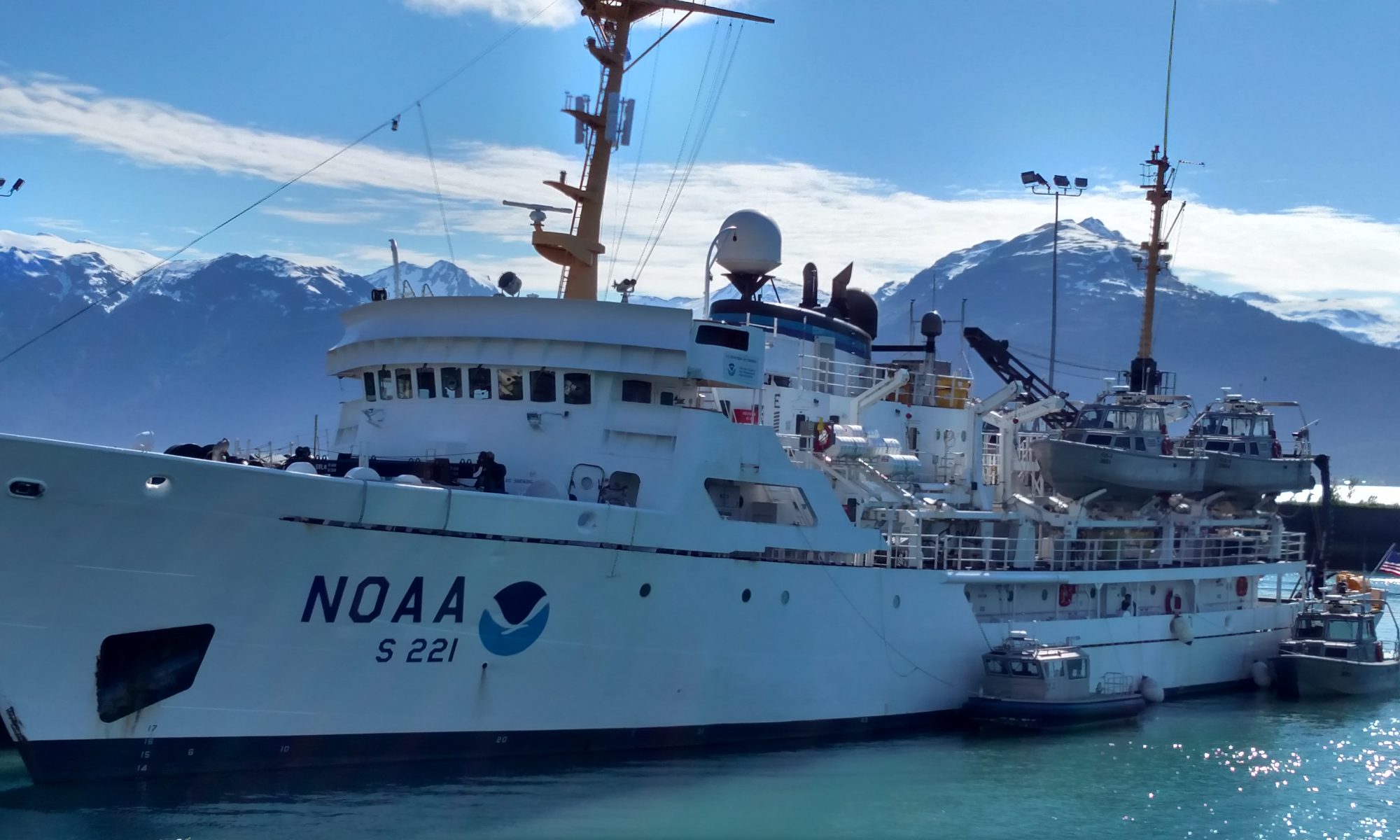
Nicolle von der Heyde, June 21, 2010

NOAA Teacher at Sea
Nicolle Vonderheyde
Onboard NOAA Ship Pisces
June 14 – July 2, 2010

Nicolle von der Heyde
NOAA Ship Pisces
Mission: SEAMAP Reef Fish Survey
Geographical Area of Cruise: Gulf of Mexico
Dates: Monday, June 21

Weather Data from the Bridge

Time: 0800 hours (8 am)
Position: Latitude: 28º 09.6 minutes N
Longitude: 094º 18.2 min. W
Visibility: 10 nautical miles
Wind Direction: variable
Water Temperature: 30.6 degrees Celsius
Air Temperature: 27.5 degrees Celsius
Ship’s Speed: 5 knots

Science Technology Log

Atlantic Spotted dolphins are the graceful ballerinas of the sea. They are just incredible! The Gulf of Mexico is one of the habitats of the dolphin because they live in warm tropical waters. The body of a spotted dolphin is covered with spots and as they get older their spots become greater in number.

Atlantic Spotted Dolphins
Atlantic Spotted Dolphin

Here you can see the spots on an older Atlantic Spotted Dolphin. To read more about dolphins go to http://www.dolphindreamteam.com/dolphins/dolphins.html

Because Dolphins are mammals they breathe air through a single blowhole much like whales. Dolphins live together in pods and can grow to be 8 feet long and weigh 200-255 pounds. Like whales, dolphins swim by moving their tails (flukes) up and down. The dolphin’s beak is long and slim and its lips and the tip of its beak are white. They eat a variety of fish and squid found at the surface of the water. Since dolphins like to swim with yellow fin tuna, some dolphins die by getting tangled in the nets of tuna fishermen.

Newborn calves are grey with white bellies. They do not have spots. Calves mature around the age of 6-8 years or when the dolphin reaches a length of 6.5 feet. Calving takes place every two years. Gestation (or pregnancy) lasts for 11 1/2 months and babies are nursed for 11 months.

While watching the dolphins ride the bow wave, Nicolle and I wondered, “How do dolphins sleep and not drown?” Actually, we found that there are two basic methods of sleeping: they float and rest vertically or horizontally at the surface of the water. The other method is sleeping while swimming slowly next to another dolphin. Dolphins shut down half of their brains and close the opposite eye. That lets the other half of the brain stay “awake.” This way they can rest and also watch for predators. After two hours they reverse this process. This pattern of sleep is called “cat-napping.”

Dolphins maintain a deeper sleep at night and usually only sleep for two hours at a time. This method is called “logging” because in this state dolphins look like a log floating in the ocean.

The 1972 Marine Mammal Protection Act (MMPA) prohibits the hunting, capturing, killing or collecting of marine mammals without a proper permit. Permits are granted for the Spotted Dolphins to be taken if it is for scientific research, public display, conservation, or in the case of a dolphin stranding. The maximum ffor violating the MMPA is $20,000 and one year in jail.

Atlantic Spotted Dolphin

Personal Log

The best part of this trip is all the marine life I see in the Gulf. In the past few days, dolphins have been swimming up to the boat and riding the bow wave of the ship. They are so graceful and playful in the water. In addition to the Tiger Shark seen feasting on the dead Sperm Whale, I have seen quite a few sharks swimming in the water near our ship. One, called a Silky Shark, took the bait as some of the crew was fishing from the stern of the boat (shown to the left). It was hauled up so the hook could be taken out and released back into the water. The second was a baby shark swimming near the bow of the ship as I watched the dolphins in the distance. I also saw a shark swimming near the starboard side of our ship while the deckhands were hauling up one of the camera arrays.

The fourth shark was the most exciting. As the crew was working at the stern of the ship to release a line that was caught in the rudder, I looked over the stern to see a large shark very near the surface swimming toward the starboard (right) side of the ship. I hurried to look and to my surprise it was a giant Hammerhead! I never expected to see one of these in its natural habitat. Unfortunately, by the time I got my camera out, the Hammerhead was too far away and too deep to get a clear shot, but what a sight to see!

Hammerhead shark
Hammerhead shark
The photo on the right is from Monterey Bay Aquarium. For more information, go to http://www.montereybayaquarium.org/animals/AnimalDetails.aspx?enc=C53nR+hhcrXgfKW+bt/MWA==

The photo on the right is from Monterey Bay Aquarium. For more information, go to http://www.montereybayaquarium.org/animals/AnimalDetails.aspx?enc=C53nR+hhcrXgfKW+bt/MWA==

I often mistake the fish shown on the left for sharks. Actually they are Cobia, also known as Lemonfish. Once in a while thefish approach the boat as we are hauling fishup on the bandit reel. I have also seen bojellyfish in the water as we are working on the starboard side of the ship and I spotted a brief glimpse of an Ocean Sunfish (Mola mola) from the bridge of the ship as I was talking to our Commanding Officer (CO). I wish I could have seen this fish up close. They are the largest bony fish in the oceans and as someone on the ship described, they resemble a giant Chiclet swimming in the water.

The smallest living things I have seen while at sea are the tiny creatures that live in the Sargassum, a type of seaweed that floats freely within and on the surface of the Gulf waters. The Sargassum provides a habitat for tiny creatures that are the foundation of the food web, even providing food for some of the largest animals in the sea like whales. The picture below on the left shows a giant patch of Sargassum, while the picture on the right shows some of the creatures that live within it including tiny shrimp, krill, and very small crabs.

Sargassum
Sargassum
Creatures that live within the sargassum including tiny shrimp, krill, and very small crabs

Seeing all this life has been reassuring as the oil continues to gush into Gulf waters off the coast of Louisiana, however I can’t help but think what the overall impact of this spill will be for the future of the Gulf. Will we see the negative environmental impact spread to the Eastern Gulf? Are microscopic droplets of oil and chemical dispersants infecting the food chain beyond the area that we visibly see being impacted? These questions will be answered as NOAA scientists continue to collect and analyze the type of data that I am helping gather on this SEAMAP Reef Fish Survey. I feel so fortunate to be a part of this scientific endeavor.

Animals Seen

Silky Shark (Carcharhinus falciformis)

Hammerhead (Sphyrna mokarran)

Cobia (Rachycentron canadum)

Ocean Sunfish (Mola mola)

Krill, Shrimp, Crab (species unidentified)

Heather Haberman: Groundfish Surveying, July 7, 2011 (post #2)

NOAA Teacher at Sea
Heather Haberman

Onboard NOAA Ship Oregon II
July 5 — 17, 2011 


Mission: Groundfish Survey
Geographical Location: Northern Gulf of Mexico
Date: Thursday, July 07, 2011

Weather Data from  NOAA Ship Tracker
Air Temperature:  29.2 C      (84.6 F)
Water Temperature:  29.3 C    (84.7 F)
Relative Humidity:  72%
Wind Speed:  2.64 knots

Preface:  There is a lot of science going on aboard the Oregon II, so to eliminate information overload, each blog I post will focus on one scientific aspect of our mission.  By the end of the voyage you should have a good idea of the research that goes into keeping our oceans healthy.

In case you’re new to blogging, underlined words in the text are hyperlinked to sites with more specific information.

Science and Technology Log

Topic of the day:  Groundfish Surveying

To collect samples of marine life in the northern Gulf of Mexico, NOAA Ship  Oregon II is equipped with a 42-foot standard shrimp trawling net.  NOAA’s skilled fishermen deploy the net over the side of the ship at randomly selected SEAMAP (Southeast Area Monitoring and Assessment Program) stations using an outrigger.  The net is left in the water for 30 minutes as the boat travels at 2.5 to 3 knots (1 knot = 1.15 mph).

Shrimp trawl net attached to an outrigger. Notice the large wooden “doors” that help spread the net as it is lowered into the water.

Bottom trawling is a good method for collecting a random sample of the biodiversity in the sea because it is nonselective and harvests everything in its path.  This is excellent for scientific studies but poses great problems for marine ecosystems when it is used in the commercial fishing industry.

One problem associated with bottom trawling is the amount of bycatch it produces.  The term bycatch refers to the “undesirable” fish, invertebrates, crustaceans, sea turtles, sharks and marine mammals that are accidentally brought up to the surface in the process of catching commercially desirable species such as shrimp, cod, sole and flounder.  At times bycatch can make up as much as 90% of a fisherman’s harvest.  To address this problem, NOAA engineers have designed two devices which help prevent many animals from becoming bycatch.

Bycatch photo: NOAA

All sea turtles found in U.S. waters are listed under the Endangered Species Act and are under joint jurisdiction of NOAA Fisheries and the U.S. Fish and Wildlife Service.  In an effort to reduce the mortality rate of sea turtles, NOAA engineers have designed  Turtle Exclusion Devices (TED).  TEDs provide these air-breathing reptiles with a barred barrier which prevents them from going deep into the fishing net and guides them out of an “escape hatch” so they won’t drown.  TEDs have also proven to be useful in keeping sharks out of  bycatch.

Loggerhead sea turtle escaping a trawling net through a TED.

Another device that was introduced to the commercial fishing industry is the Bycatch Reduction Device (BRD).  BRDs create an opening in a shrimp trawl net which allows fishes with fins, and other unintended species, to escape while the target species, such as shrimp, are directed towards the end of the capture net.

Notice the location of the TED which prevents the turtle from entering into the net and the BRD that allows swimming fish to escape. Illustration provided by the University of Georgia Marine Extension Service
This is a very small catch we harvested from 77 meters (253 feet).

Once the trawl net is brought back on board the Oregon II, its contents are emptied onto the deck of the ship.  The catch is placed into baskets and each basket gets weighed for a total weight. The catch then goes to the “wet lab” for sorting.  If the yield is too large we randomly split the harvest up into a smaller subsample.

Each species is separated, counted, and logged into the computer system using their scientific names.  Once every species is identified, we measure, weigh, and sex the animals.  All of this data goes into the computer where it gets converted into an Access database spreadsheet.

My team and I sorting the catch by species.
Amy entering the scientific name of each species into the computer.
I measure while Amy works the computer. Collecting data is a team effort!

When the Oregon II ends its surveying journey, NOAA’s IT (Information Technology) department will pull the surveying data off the ship’s computers.   The compiled data is given to one of the groundfish survey biologists so it can be checked for accuracy and consistency.  The reviewed data will then be given to NOAA statisticians who pull out the important information for SEAMAP (Southeast Area Monitoring and Assessment Program) and SEDAR (Southeast Data and Review)

SEAMAP and SEDAR councils publish the information.   State agencies then have the evidence they need to make informed decisions about policies and regulations regarding the fishing industry.  Isn’t science great!  Most people don’t realize the amount of time, labor, expertise and review that goes into the decisions that are made by regulatory agencies.

Personal Log

Day crew from left to right: Chief Scientist Andre, college intern Brondum, myself, Team Leader Biologist Brittany and Biologist Amy

During our “welcome aboard” meeting I met the science team which consists of a Chief Scientist, four NOAA Fisheries Biologists, three volunteers, one college intern, one Teacher at Sea (me) and an Ornithologist (bird scientist).

I was assigned to work the day shift which runs from noon until midnight while the night shift crew works from midnight until noon.  This ship is operational 24 hours a day in order to collect as much information about the northern Gulf fisheries as possible.  The Oregon II costs around $10,000 per day to operate (salaries, supplies, equipment, etc.) so it’s important to run an efficient operation.

I am learning a lot about the importance of random sampling and confirming results to ensure accuracy.   Amy and Brittany taught me how to use the CTD device (Conductivity, Temperature and Depth), set up plankton nets as well as how to sort, weigh, identify and sex our specimens.

The food has been great, the water is gorgeous and I love the ocean!  Stay tuned for the next blog post about some of the most important critters in the sea!  Any guesses?

Species seen (other than those collected)

Birds:  Least Tern, Royal Tern, Sandwich Tern, Laughing Gull, Neotropical Cormorant, Brown Pelican, Magnificent  Frigatebird

Go to http://www.wicbirds.net for more information about the various bird species seen on this trip.

Mammals: Common bottlenose dolphin

Bruce Taterka, July 13, 2010

NOAA Teacher at Sea: Bruce Taterka
NOAA Ship: Oregon II 

Mission: SEAMAP Summer Groundfish Survey 
Geographical Area of Cruise: Gulf of Mexico 
Date: Tuesday, July 13, 2010 

It’s All Connected

Weather Data from the Bridge 
Time: 0015 (12:15 am)
Position: Latitude = 28.13.24 N; Longitude = 094.15.51 W
Present Weather: Cloud cover 20%
Visibility: 6-8 nautical miles
Wind Speed: 20 knots
Wave Height: 2-4 feet
Sea Water Temp: 29.4 C
Air Temperature: Dry bulb = 29.6 C; Wet bulb = 25.7 C
Barometric Pressure: 1011.96 mb

Science and Technology Log“IT’S ALL CONNECTED.” If you took my Environmental Science class I hope you know what I’m talking about. Everything in an ecosystem is connected to everything else. This is a guiding principle of studying and managing ecosystems. I saw this last summer when I helped investigate the relationship between plants, caterpillars, parasitic wasps and climate change in the cloud forest of Ecuador. I see it in the relationship between human development, deer, invasive plants and native plants at the Schiff Nature Preserve in New Jersey.

I’m seeing it now in the Gulf of Mexico. Obviously, the ocean environment is connected to human activities – the BP-Deepwater Horizon oil spill makes that abundantly clear. But there are also countless natural connections, and much less obvious human impacts, that must be understood and assessed if the Gulf ecosystem is to be protected. Commercial fish and shrimp stocks can only be sustained through a careful understanding of the human impact and natural connections in the Gulf.

Drilling platform off the coast of Texas.

That’s why we identify and count every organism we bring up in a trawl. Sometimes we get 50 or more different species in one catch, and we don’t just count the commercially important ones like red snapper and shrimp. We count the catfish, eel, starfish, sea squirts, hermit crabs and even jellyfish we haul in. Why? Because even though these organisms might seem “unimportant” to us, they might be important to the red snapper and shrimp. They also might be important to the organisms the red snapper and shrimp depend on. And even if they’re not directly important, studying them might tell us important things about the health of the Gulf.

Brittany Paul, Fisheries Biologist
Brittany Palm, Fisheries Biologist

I’m learning a lot about this from the incredibly knowledgeable marine biologists in the science party. Brittany Palm is a Research Fishery Biologist from NOAA’s Southeast Fishery Science Center (SEFSC) in Pascagoula, MS, and leader of the day watch on this leg of the Oregon II’s Summer Groundfish Survey. Brittany is working on her M.S. on a fish called croaker, Micropogonias undulatus, studying its stomach contents to better understand its position in the food web. Croaker is not an economically important species, but it lives in the same shallow sea floor habitat as shrimp so shrimpers end up hauling in a huge amount of croaker as bycatch. So, when the shrimping industry declined in 2003-2004, the croaker population exploded. Since croaker are closely associated with shrimp habitat and the shrimp fishery, we might gain important insights by studying croaker population and understanding what they eat, and what eats them.

Alonzo Hamilton, Fisheries Biologist

Alonzo Hamilton is another NOAA Fishery Biologist from the SEFSC. Alonzo explained to me that there’s a lot to be learned by looking at the whole ecosystem, not just the 23 commercial species that are managed in the Gulf. For example, many of the crabs we commonly catch in our trawls are in the genus Portunas, known as “swimming crabs.” Portunas species normally live on the sea floor, but when severe hypoxia sets in, Portunas crabs can be found at the surface, trying to escape the sever oxygen depletion that typically takes place at the bottom of the water column.

Portunas spinicarpus
Sean Lucey is a Research Fishery

Biologist from NOAA’s Northeast Fishery Science Center in Woods Hole, Massachusetts. He’s working on the Oregon IIright now to support the SEFSC because of huge manpower effort demanded by the oil spill. Sean explained that the NEFSC has been conducting its groundfish survey annually since 1963, making it the longest-running study of its kind. Originally the survey only looked at groundfish population, but as our understanding of ecosystem dynamics increased over time, more and more factors were analyzed. Now NEFSC looks at sex, age, stomach contents and many other species besides groundfish to obtain a more complete picture of the food web and the abiotic factors that affect groundfish. NEFSC even measures primary production in the marine ecosystem as one tool to estimate the potential biomass of groundfish and other species at higher trophic levels.

Andre DeBose, Fisheries Biologist

Andre DeBose is a NOAA Fishery Biologist from the SEFSC and the Field Party Chief for the Summer Groundfish Survey. In addition to leading the science team on the Oregon II, Andre is conducting research on Rough Scad, Trachurus lathami, an important food species for red snapper and important bait fish for red snapper fisherman. By gaining a better understanding of the relationship between Red Snapper and its prey we can better understand, and better manage, the ecosystem as a whole.

There’s a lot of information to be learned beyond just counting fish. By taking a wide look at the marine environment we can better understand how the whole ecosystem functions. This enables us not only to be more informed in setting sustainable catch levels, but also enables us to identify and respond to things that contribute to hypoxia and other problems that degrade habitat and reduce populations. It’s all connected.

Sunset
Sunset

Bruce Taterka, July 11, 2010

NOAA Teacher at Sea: Bruce Taterka
NOAA Ship: Oregon II

Mission: SEAMAP Summer Groundfish Survey
Geographical Area of Cruise: Gulf of Mexico
Date: Sunday July 11, 2010

Sorting the Catch

Weather Data from the Bridge

Time: 0730 (7:30 am)
Position: Latitude 28.18.6 N; Longitude 95.19.4 W
Present Weather: party cloudy
Visibility: 10 nautical miles
Wind Speed: 12.35 knots
Wave Height: 2 feet
Sea Water Temp: 28.9 C
Air Temperature: Dry bulb = 29.1 C; Wet bulb = 25.4 C
Barometric Pressure: 1014.30 mb


Science and Technology Log

Kim and I have blogged about some of the tools we use aboard the Oregon II like FSCS, CTD, Bongos and the Neuston. But what, you ask, are some other tools we use that are not high tech?

Me with a shovel
Me with a shovel

Believe it or not, shovels, baskets and trays are important tools on the ground fish survey. When a catch comes in the net is held by a crane and emptied into baskets, but a lot flops out onto the deck. We use shovels to pick up the rest. In the wet lab we use small shovels to move the catch along and trays to sort the organisms by species.(Check out the video below!) When it comes to identification paperback field guides and laminated posters can help with ID.

Once we sort the catch, certain species have to be prepared and saved for research.Some specimens go to university scientists. For example, we bag and freeze specimens of batfish for an ongoing research study.

Slantbrow batfish, Ogcocephalaus declivirostris

For food species like shrimp and red snapper, we bag specimens to go to NSIL (National Seafood Inspection Lab). This is especially important now because of the oil spill –seafood samples are being tested to determine what parts of the Gulf can be opened to commercial fishing. Samples from leg I of the Groundfish Survey are going to be sensory tested, or “sniff” tested. For this test we have to wrap the specimens in foil to contain any scents so that the ‘sniff testers’ (people trained to pick up petroleum scent at an amazing 100 ppm) can identify if petroleum products are present. For leg II the focus is on chemical sampling for petroleum. However, protocols can change daily when you are sampling during a disaster. Here’s a link to a recent news story on testing the fish we’re catching and sending to the lab:http://www.cnn.com/video/#/video/us/2010/07/09/gupta.seafood.test.cnn


Personal Log:

Shark
Shark

We’ve been seeing lots of cool stuff. Yesterday we were trailed by a school of sharks for most of the day.


Here's a shark circling our CTD.
Here’s a shark circling our CTD.

We also caught a large Roughtail Stingray, Dasyatis centroura, in our trawl.

Roughtail Stingray, Dasyatis centroura

He swam away feeling fine.

Stingray swimming
Stingray swimming

Kimberly Lewis, July 7, 2010

NOAA Teacher at Sea Kimberly Lewis
NOAA Ship: Oregon II
July 1 -July  16 2010

Mission: SEAMAP Summer Groundfish Survey
Geographical Area of Cruise: Gulf of Mexico
Date: Sunday, July 7, 2010

July 7, Science is dirty 🙂

Here I am getting ready to enter data about one of the MANY shrimp that I have seen over the past few days.
Personal Log:
This was the first night (day) that I actually slept straight thru. 8 hours of sleep has never felt so good!The scientist aboard the Oregon II have a very important job to do and they work very hard. Sometimes when people think of scientist they think of a nice clean lab with everyone wearing white coats. Not the case here! It not uncommon to be shoveling fish into buckets.

Here is a photo of a bucket of organisms that are being measured.

Our ship’s tracker has not been updated since we left Galveston so if you see we are still there, we are not. Hopefully it will be updated soon.

Well, I do have to go because my shift started 35 minutes ago and there are things to do. I will try to remember to take photos tonight. We collected a sea horse yesterday, but I didn’t get to take my photo before it was discarded, I was out doing a titration.

Bye for now.