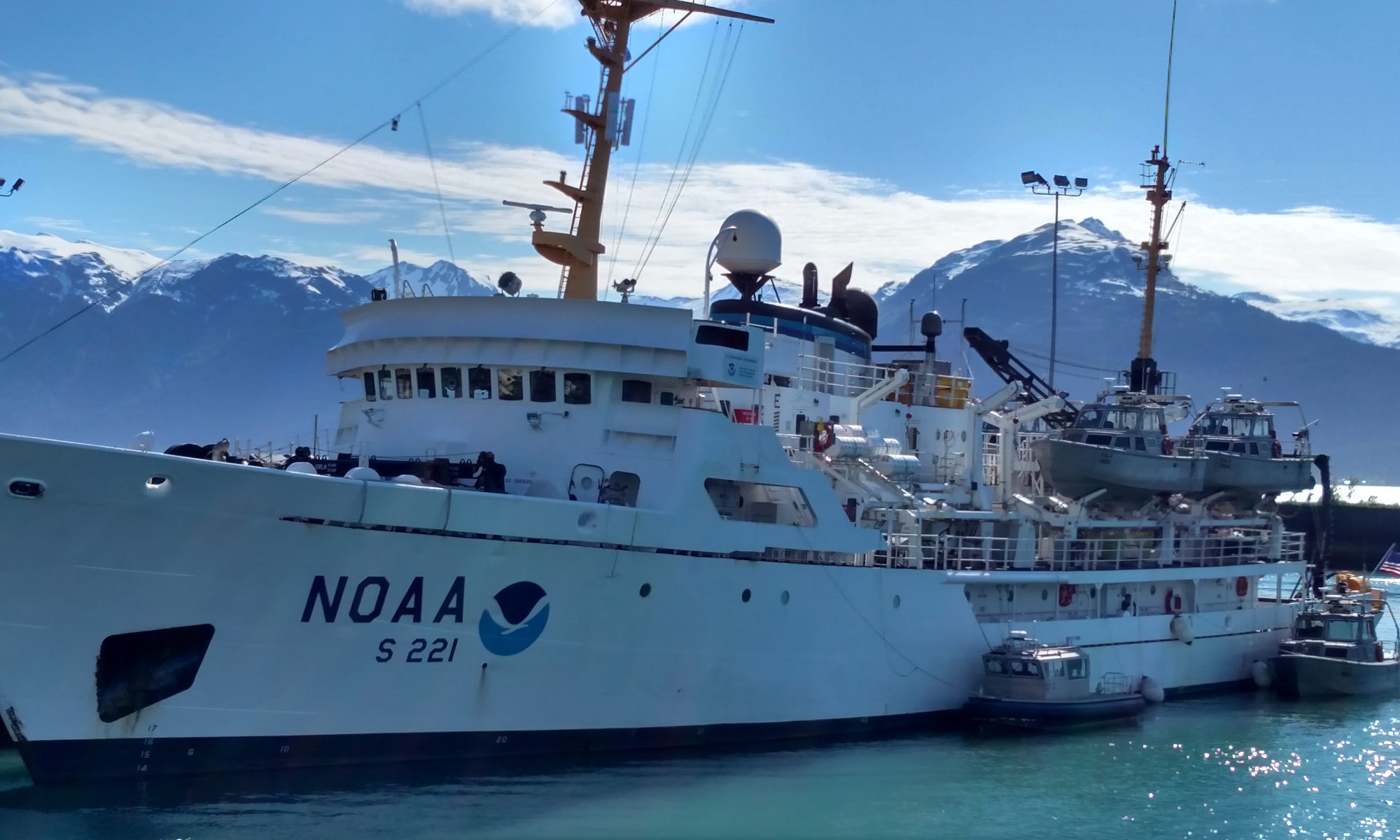
NOAA TEACHER AT SEA STEVEN WILKIE ONBOARD NOAA SHIP OREGON II JUNE 23 — JULY 4, 2011
Mission: Summer Groundfish Survey
Geographic Location: Northern Gulf of Mexico
Date: June 29, 2011
Ship Data
Latitude
28.06
Longitude
-96.43
Speed
8.40 kts
Course
89.00
Wind Speed
13.90 kts
Wind Dir.
71.56 º
Surf. Water Temp.
27.80 ºC
Surf. Water Sal.
24.88 PSU
Air Temperature
29.30 ºC
Relative Humidity
76.00 %
Barometric Pres.
1013.73 mb
Water Depth
26.00 m
Science and Technology Log
A preserved plankton sample from one of the Oregon II's bongo nets.
So now that we have an understanding of abiotic factors, let’s talk biotic factors, and for the most part, those biotic factors are going to be fish and plankton. The majority of our plankton (plankton are organisms–plants or animals–that are too small to fight against the current and thus drift along with it) samples come from the neuston and bongo nets. After we have our bongo or neuston nets back on board, the science crew goes to work preserving the specimens.
Something common in the neuston net, is Sargassum a type of brown algae belonging to the Kingdom Protista and the Phlyum phaeophyta (kingdoms and phylums are associated with the science of taxonomy or classification). If you are familiar with kelp, then you are familiar with brown algae. Kelp is a long algae that fastens itself to the bottom of the seafloor with a root of sorts called a holdfast. Sargassum, however, does not hold fast, but rather drifts out in the open ocean. It can stay afloat because Sargassum has little tiny gas-filled floats called pneumatocysts. These clumps of algae can provide much needed hiding places for small marine organisms out in the open ocean. Because so many organism might live in, on or around the mats of Sargassum whenever we capture Sargassumin our nets we have to be sure to wash them down thoroughly in order to ensure that we get as many of the creatures off of the blades as possible.
Sargassum, a brown algae, provides important habitat for many marine organisms including juvenile fish. Clearly visible are the pneumatocysts, gas-filled floats, that help keep the algae at the surface of the ocean.
The currents of the Gulf of Mexico and the Atlantic actually concentrate the Sargassum into a giant mass in the middle of the North Atlantic ocean, commonly referred to as the Sargasso Sea. So significant is the Sargassum, that Christopher Columbus feared for the safe passage of his ships because of the thick mass of algae.
The adventures of Captain Nemo as penned by Jules Verne in the late 19th century even commented on the nature of this floating mass of algae: “This second arm–it is rather a collar than an arm–surrounds with its circles of warm water that portion of the cold, quiet, immovable ocean called the Sargasso Sea, a perfect lake in the open Atlantic: it takes no less than three years for the great current to pass round it. Such was the region the Nautilus was now visiting, a perfect meadow, a close carpet of seaweed, fucus, and tropical berries, so thick and so compact that the stem of a vessel could hardly tear its way through it. And Captain Nemo, not wishing to entangle his screw in this herbaceous mass, kept some yards beneath the surface of the waves. The name Sargasso comes from the Spanish word “sargazzo” which signifies kelp.”
As interesting and important as Sargassum is to the ocean environment, it is not our targeted organism, which is, for the most part fish! Although not a fish, crustaceans are still an important fishery, and few are more significant than Panaeus aztecus (brown shrimp), Panaeus setiferus (white shrimp) and Panaeus duorarum (pink shrimp). Chances are if you are dining on shrimp cocktail you are eating one of these three species.
One of many (so many) brown shrimp to be measured. We measure from the length of the rostrum (the point part by their eyes) to the tip of their (tail).
Lutjanus campiechanus (or the red snapper) is another commercially important species that scientists are particularly interested in. Species like the red snapper are of particular concern because, according to NOAA’s Fish Watch website, the population is currently at low levels prompting NOAA to establish temporary restrictions on fishing this species in past years.
It is the work of the crew aboard the Oregon II to collect the data that helps scientists predict population trends in species such as these which allows government regulations to be based on sound science. Although sometimes unpopular with the local fishing industry the temporary ban on fishing for some species is aimed at providing a long-term sustainable population for future generations.
Prized by the fishing industry and restauranteurs, red snapper are a species of particular concern because of the pressures local fisheries have placed on the species.
Although not a primary target of this fish survey, cartilaginous fish (Class Chondricthyes…there’s that taxonomy again) like sharks, rays and skates are also organisms of particular concern. Unlike the majority of the fish we bring on board, which are bony fish belonging to the Class Osteicthyes, the majority of cartilaginous fish reproduce internally. This means that a female shark, ray or skate, might have much fewer offspring in a given year, but those offspring might be more mature once they are born. Bony fish on the other hand often lay eggs externally by the thousands, but only a small percentage survive.
The watch leader of my watch, Brittany Palm, realizes the significance of the reproductive habits of these organisms (follow this link to review Brittany and her fellow authors extensive work) and has used much of her expertise gained through NOAA cruises like this one to publish scientific papers in peer-reviewed journals.
If you recall, one of the steps of the “scientific method” is to share your results, and there is no better way than to publish your findings in journals for other scientists to read. Although writing a paper may sound simple, this is not your average high school term paper–there is considerably more effort required. Brittany and her fellow authors labored for close to four years to finally draft and submit the paper for publishing.
An example of a cartilaginous fish, the Atlantic angelshark (Squatina dumeril) was brought on board as part of one of our trawls.
Although we may not write anything as extensive at the high school level, good sound scientific investigations will always end up with you sharing your results, and as a result, well-researched background information is always essential. To all my past and future students out there, feel free to take note of the reference section of the paper and remember how important references and good research is in backing up your work!
Personal Log
It has not taken long to get into the rhythm of things aboard ship. Although I thought that the waves might lead to a little sea sickness, I now find them quite soothing, and am curious as to how I might feel once back on shore as I struggle to get my land legs back. Sleeping with the waves is a slightly different story. At times they can lull you off to sleep (or it might simply be the twelve hours of sorting, measuring and weighing the catch that does that); other times they can roll you right into your bunk wall and snap you awake. My bunk is on the top, so the wall is better than the floor I suppose!
Although the waves have been soothing up to this point, we are possibly facing some inclement weather as the first tropical storm of the season, Arlene, is to our southwest heading towards the Mexican coast. If the weather picks up too much we may have to head in shore to work up some of the shallower stations while the Gulf settles back down. Either way we will be kept busy, measuring fish or measuring the waves!
Tropical Storm Arlene, the first tropical storm of the Atlantic season is headed for the Mexico coast in the next few days.
The first creature I saw when I boarded the Pisces was the Laughing Gull. Almost everyone who answered this survey said Sea Gull would be the first creature I would see. Good job! The gulls were flying all over the harbor. Ironically, this is the picture I chose to use in my first entry to this blog. Later that day I saw Dolphins, Mullet, a Brown Pelican, Sargassum, a Loggerhead Sea Turtle, Flying Fish, and Moon Jellies. Still waiting on a whale and the Lophelia. We have only been out a short time. Gull landing at dusk
New survey. What do you think these are?
In this log I want to talk about the two marine biology graduate students whom I have been working with this week, Chelsea Bennice and Lorin West. They are both 2nd year students at the University of South Florida, and they have been conducting biological sampling all week long. They have been a lot of fun to get to know, and in discussing their research I have really been struck by the similarities between graduate level scientific research and the science projects that many of my students have worked so hard on for this year’s science fair.
***This is cool– as I sit on the deck of the boat writing this, a pod of bottlenose dolphins has joined us! We are cruising at about 7 knots and they are leaping out of the water at the edge of our wake.
Both Chelsea and Lorin are working with a genus of macro algae known as Sargassum. There are two pelagic (floating) species of Sargassum: Sargassum fluitans and Sargassum natans. These species form clumps/patches on the surface of the ocean and serve as habitat for small organisms like crustaceans (and other invertebrates) and juvenile fishes. Throughout the Florida Keys and the Florida Bay, we have seen Sargassum nearly everywhere.
At different stations along the cruise, Chelsea and Lorin have conducted net tows, in which a 2 m^2 fine mesh, windsock-shaped net is pulled along side of the boat for 30 minutes. At the end of this tube is a selectively permeable collection bucket (cod end) that traps Sargassum and the organisms that it hosts, but it allows the water to pass through. These net tows have been pretty cool, because every time we bring one in, there are always interesting creatures waiting to be discovered. Crabs, shrimp, nudibranchs, eels, fishes (including puffers, filefish, frogfish, jacks, flying fish, juvenile billfish, pipefish), copepods, amphipods, cnidarians (“by the wind sailor”), and a sea horse are just a few of the organisms that live in the uppermost meter of the ocean and make the Sargassum their home. And here I thought we had been floating past little chunks of lifeless seaweed! In fact, each patch of Sargassum is its own little ecosystem. Here is where Chelsea and Lorin’s work begins.
Chelsea is conducting a study in which she intends to describe the habitat architecure of pelagic Sargassum species. I had her describe her work: She intends to answer the question of how habitat selection among fishes and shrimp in the pelagic Sargassum community are influenced by the habitat architecture (interstitial spaces and depth) of a Sargassum patch. She will be manipulating the patches by changing their interstitial spaces (spacing the pieces of Sargassum differently among the surface of the patch). Sargassum pieces that are spaced tightly together are thought to create “microhabitats or niches” in the Sargassum for the fishes or shrimp to hide in. She will also be varying depth of the patches of Sargassum. Patches of Sargassum can range from 2cm to 12 cm (sometimes deeper!) in the water column. Having a deep depth patch may make it easier for a fish or shrimp to find its “home” in the open blue water.
Lorin is also working with Sargassum, but her work focuses on the mechanisms (visual and chemical cues) by which organisms are attracted to Sargassum in the open ocean. Her master’s thesis is titled “The role of chemical and visual cues used by the the sargassum crab Portunus sayi in selecting and locating habitats.” Sargassum is highly variable and broken up by waves and even washes up on shore. So, she has created controlled experiments in her lab where she can test whether the sargassum crab can detect chemicals from sargassum when they are dripped into the aquarium. She will also test to see if the crabs can visually detect sargassum without chemical cues and if they can distinguish between the two species of sargassum
As I spoke with Chelsea and Lorin, I couldn’t help but hope that some of my students go to college and graduate school in order to study ocean science. These women love their work and it shows. They describe their studies with enthusiasm and excitement. Chelsea and Lorin both teach introductory biology labs (they were grading punnett squares after hours during the cruise!), attend classes, and take research field trips to the ocean. They are each about to finish a thesis, graduate, and head into a promising career in marine biology!
Personal Log
It is Friday now, and we have north back toward Miami. We had a few CTD stops along the way and couple of other samples to collect, but overall there is a general feeling on board the R/V Walton Smith that we are headed home! Everyone seems ready to head home to be with their family, including me. This ship will begin a 49 day cruise to ground zero of the Deepwater Horizon oil spill next week, and therefore everyone is anxious to get as much shore time as possible. This week went by very quickly, and I enjoyed all of the experiences I had on board, I wish I could stay longer, but I’m excited to get back to work at Heights!
Here are Chelsea, Lorin, Josh (a University of Miami student of Marine Policy), and Matt (the ship’s chef) hanging out on deck after a long day.
Chelsea, Lorin, Josh (a University of Miami student of Marine Policy), and Matt (the ship's chef)
Nelson, Dennis, Lorin, and Chelsea watching a net tow in progress.
Nelson, Dennis, Lorin, and Chelsea
Here is the net in action! Lorin keeps her hands on the cable so that it doesn’t come too far out of the water.
Net in action
In this shot, Chelsea is gathering the sargasum she collected in a bucket.
Chelsea gathering sargassum
Once all of the organisms had been rinsed off the seaweed, this is what she got! A ‘soup’ of fish and small organisms. These blue ones were unsuspected!
In the wet lab, everything gets rinsed again with sea water and filtered through a mesh.
Wet Lab
Here are the fish they collected in a net tow. Sometimes fish use sargasum like a nursery to raise their juveniles. In this case, a small school of fish were found all at once.
Fish in an aquarium
Like all field science, they have plenty of work to do in the lab once their collection is done! Here they are writing their results. Nelson is also at his computer working on graphs from his experiments.
Lab work
Here is a group shot we took at sunset off of Key West on Thursday night. From left to right, Josh, Lorin, Erik, Cheryl, Nate, Chelsea and Nelson.
The crew near Key West
A nice sunset cruise passes by off of Key West (in the background). As we worked a CTD offshore, about 10 of these ships came out of the harbor and did circles around us. It was a really nice sunset, too!
NOAA Teacher at Sea: Bruce Taterka NOAA Ship: Oregon II
Mission: SEAMAP Summer Groundfish Survey Geographical Area of Cruise: Gulf of Mexico Date: Wednesday, July 7, 2010
Trawling in Deeper Waters
Weather Data from the Bridge
Time: 2015 (8:15pm) Position: Latitude = 27.20.39 N; Longitude = 096.35.21 W Present Weather: Could cover 90% Visibility: 4-6 nautical miles Wind Speed: 15 knots Wave Height: 2-4 feet Sea Water Temp: 28.6 C Air Temperature: Dry bulb = 28.5 C; Wet bulb = 26.7 C Barometric Pressure: 1008.27 mb
Science and Technology Log
Since setting out on Friday we’ve headed south along the Gulf coast of Texas almost to the Mexican border, and now we’re heading back north but farther offshore, in deeper water. As a result our trawls are pulling up a deep-water assemblage of species different from those we saw in shallower waters a few days ago. There is still no sign of oil in this part of the Gulf, but we’re still taking samples of fish and shrimp for analysis to make sure there’s no contamination here from the BP-Deepwater Horizon oil spill.
Ten-foot seas are predicted for tonight so we’re heading north along the Texas coast, away from the storm, and we’ve put away the fishing gear until it gets calmer.
Last log we talked about FSCS (Fisheries Scientific Computer System). So what is it, how is it used, and what is so great about it?
FSCS, pronounced ‘fiscus’, is an automated system for recording the massive amount of biological and oceanographic data generated 24 hours a day by NOAA scientists during fisheries surveys. During a trawl survey, fish and invertebrates from each haul are sorted, counted and weighed by species. Scientists record data from individual fish, such as sex, weight, length and even stomach contents, resulting in tens of thousands of new data points every day. Before NOAA rolled out FSCS in 2001 aboard the ship Albatross IV, scientists recorded all data by hand, an incredibly tedious process. With FSCS, however, data are recorded digitally which is much faster, allows integration of biological and oceanographic data. It also enables NOAA to obtain critical real-time information to assess and manage the health of the marine ecosystem and individual fish stocks.
FSCS uses a Limnoterra FMB4 (fish measuring board) which has a magnetic pen to upload the length of an organism within a millimeter, and software that annotates all of the data on length, mass, sex, etc. The software has an index of species scientific names and can print labels for specimen samples that are to be shipped to other scientists and to the National Seafood Inspection Laboratory in Pascagoula, MS.
We use FSCS 24 hours a day, and I can’t imagine how NOAA scientists did this work without it.
Personal Log
I’m enjoying my 12-hour shifts processing fish, shrimp and invertebrates on theOregon II. Our noon-to-midnight watch is working well together and starting to bond.
My watch-mates in the Oregon II wet lab.
I’m seeing lots of very cool marine life that we’re hauling up from the bottom of the Gulf with our trawling net. Here are just a few of the things I’ve seen in the past two days:
Singlespot frogfish – Antennarius radiosus.
Note the lure on its snout.
Examining the stomach contents of a catfish.Red snapper – Lutjanus campechanus.Camouflage in the Sargassum. Can you spot the crabs?Sunset
NOAA Teacher at Sea Mechelle Shoemake Onboard NOAA Ship Oregon II June 19 – 30, 2010
Mission: SEAMAP Groundfish Survey Geographical Area of Cruise: Northwestern Gulf of Mexico Date: Sunday, June 27, 2010
Weather Data from the Bridge Time: 0700 hours (07:00am) Position: Latitude = 28.80.02 N; Longitude = 090.20.40 W Present Weather: partly cloudy Visibility: 8 nautical miles Wind Speed: 8 knots Wave Height: 3 foot swells Sea Water Temp: 29.8 degrees Celsius Air Temperature: Dry bulb = 27.9 degrees Celsius; Wet bulb = 25.5 degrees Celsius
Here I am measuring and weighing the fish.
Science and Technology Log
We are on twelve hour shifts while on the Oregon II. That means that we have two crews of scientists that work around the clock taking fish, plankton, and water samples. My shift begins at 12:00 noon and ends at midnight. Our first shift began on Sunday. We had finally reached our first station for study, so we took over for the first set of scientists. They had just finished a trawl and had separated the fish.
Here I am measuring and weighing the fish
We finished weighing and measuring the fish. Next on the agenda was a fire and abandon ship drill. We had to “muster” to our stations for a head count during the fire drill. Next, the alarm sounded for the abandon ship drill. We all had to get our survival suits and meet on the top deck.
As soon as the drill was over, we were able to get back to work. we first did a CTD test, which stands for conductivity, temperature, and density. This fancy machine tests these variables of ocean water at different depths. We took water samples from the bottom of the ocean, in the middle, and on the surface of the water column. This is a very important sampling because it will help to determine if the shrimping and fishing waters can be opened back up since the Deepwater Horizon/BP oil spill.
During the safety drill, I donned my survival aute, also called a Gumby suit!I’m assisting in getting the CTD ready for deployment
We then had to take a plankton samples. This is done buy using a plankton net called a Neuston net. it is very fine woven net that catches all of the small fish and other animals that we label as plankton. This was amazing to see. The net caught “floating nursery,” a plant called sargassum. Many fish lay their eggs in this floating grass. Sea turtles also use it as a resting ground. We gathered all the plankton and preserved it for further testing. Sad to say, we also picked up some tarballs in our plankton net. This is not a good sign.
We soon did a trawl with the shrimping nets. This was very interesting to see what we caught. You never know what you might catch when you drag the ocean floor with a net. I never realized how many different species of fish there are. We caught some very nice sized brown shrimp. We had to count, weigh, and preserve all the fish and other critters.
This is a close up of the Neuston net.I’m helping sort the catch. Those are squid I’m holding up.
Personal Log
I really admire the NOAA employees. They all work very hard for us. Our ship is performing a very important job by determining whether areas of the Gulf will be safe for fishing again. These men and women are gone from their families for extended periods of time and stay at sea for long voyages. I am enjoying my stay on the Oregon II, but I have to admit that I am still trying to grow my “sea legs”.