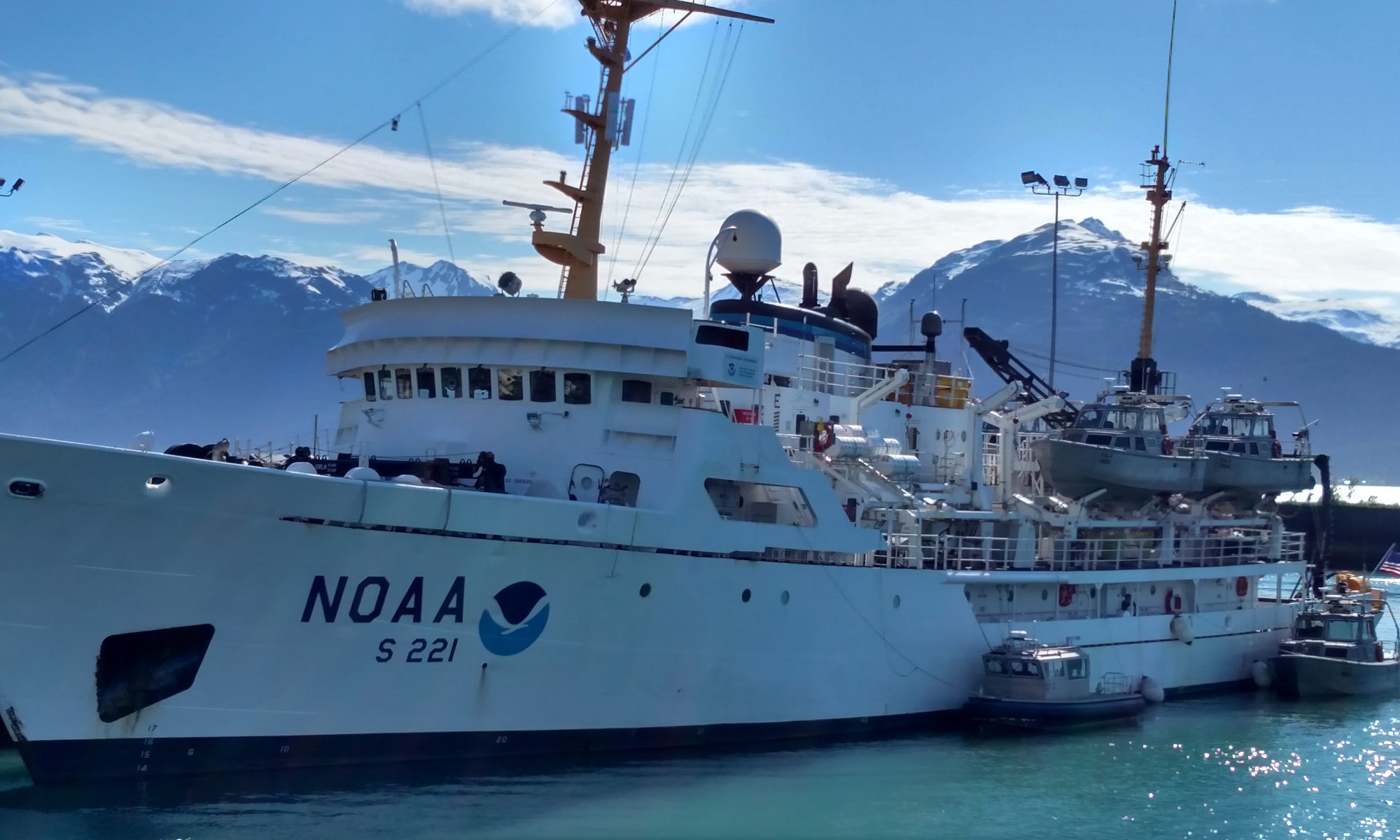
NOAA Teacher at Sea
Ruth S. Meadows
Onboard NOAA Ship Henry B. Bigelow June 12 – July 18, 2009
Mission: Census of Marine Life (MAR-Eco) Geographical Area: Mid- Atlantic Ridge; Charlie- Gibbs Fracture Zone Date: July 5, 2009
Dumbo octopus
Weather Data from the Bridge
Temperature: 10.3o C
Humidity: 93%
Wind: 8.9 kts
Science and Technology Log
Dr. Mike Vecchione holds a very large dumbo octopus from one of the deep sea trawls. This octopus got its name from the large fins that look like the ears of “Dumbo” the elephant. It is a benthic cephalopod (an ancient group in the phylum Mollusca) that lives above the floor of the ocean. It probably feed on copepods and other small crustaceans, but we don’t know much about its biology. This particular species (Cirrothauma magna) has only been caught a few times before.
A very large example of a slickhead
John Galbraith and Tom Letessier hold a very large example of a slickhead. These fish are dark in color and their exterior is slippery. These soft-bodied soggy fish are common in waters greater than 1000m deep. They get their common name from the slimy look of their head. They lack a swim bladder and make themselves as light as possible by having weak bones and watery flesh. Chimeras are distantly related to sharks and rays and can be found at depths up to 2500m. These fish have cartilage instead of bones. We caught several of these in the benthic trawls, but this one was the largest. Most of these fish have a venomous spine at the back of its dorsal fin.
This is a chimaera that weighed in at 12 kilograms.Basti (from Germany) with a chimaera, Venda (from Portugal) has a slickhead and Meridith (from Boston) has a lizardfish.
Do You Know?
What would happen between a shark and an octopus? Find out here.
NOAA Teacher at Sea
Ruth S. Meadows
Onboard NOAA Ship Henry B. Bigelow June 12 – July 18, 2009
Mission: Census of Marine Life (MAR-Eco) Geographical Area: Mid- Atlantic Ridge; Charlie- Gibbs Fracture Zone Date: July 3, 2009
Weather Data from the Bridge
Temperature: 6.2oC
Humidity: 81%
Wind: 16.47 kts
This is one of the glass floats encased in plastic that can withstand the pressure of the deep waters.
Science and Technology Log
High winds and high waves put a temporary stop to our fishing with the nets. When the waves are too high, the safety of the crew comes first and we wait for the weather to clear before we can start using the trawl again. The waves finally calmed down enough for the net to be used today. We are using a different type of net to fish the deep bottom (benthic trawling) than was used to fish the mid-water (pelagic trawling). This net is much simpler in design. It is a very large net lowered to the bottom of the ocean and then pulled behind the ship. The top part of the net is held open by floats. These floats were bought specifically for this cruise. The pressure on the bottom of the ocean is so great that normal floats would collapse. The new floats are made of glass spheres with a hard plastic covering. Only glass can withstand the amount of pressure that is found at these depths.
This is the net used for deep bottom trawling that has the yellow floats attached to it.
There are rubber tire-like rollers that move along the bottom to help prevent snags and also to stir up the sea floor and cause the fish and other organisms to move into the net where they are then funneled back into the narrow end of the net (cod-end). There are weights on the bottom section of the net to keep it on the ground.Of course, there are always obstacles on the bottom of the ocean floor and occasionally the net will get caught on one of these. This is a particular problem here because of the mountainous terrain. When the net gets hung up the crew works very carefully to release it from the obstacle. Sometimes the ship moves backwards as the winches try to pull on the net to release it. Sometimes the ship moves in a circle to try and pull the net clear.
The full net after it’s been retrieved on deck.
So far the benthic net has gotten caught twice but the crew successfully retrieved the net without damage. Once the net is on deck, the cod-end is opened and everybody comes out of the lab with foul weather gear (waterproof boots, overalls, jackets, life preserver and hardhats) on to collect the catch. We use lots of baskets to do a quick rough sort of the organisms caught. If the net is full, it takes a while to complete the first sort. Some of the fishes are large and some of the organisms have been torn. The organisms found on the floor of the deep floor are very different from the ones found in the mid-waters. They are much larger in size and very different in coloration.
Personal Log
A bucket with squid and other fishes.
The scientific crew is divided into three groups. We have a “day” shift, called a watch, that works from 12 noon to 12 midnight, and a “night” watch that works from 12 midnight to 12 noon, and then one group that works whenever a net comes up. I am on the day watch and we have all gotten into a pattern of who does what in the lab. My watch chief scientist is Dr. Shannon Devaney from Los Angeles. She works at the Natural History Museum there. Dr. Amy Heger from Luxembourg, Tom Letessier from Norway, CJ Sweetman from Connecticut and Randy Singer from Georgia rounds out our crew. CJ takes DNA samples, Tom takes care of the crustaceans, Randy removes the ototliths (this helps the scientist figure out the age) from the fishes, and Amy and I use the computer to enter the data. With some species we remove the stomach, liver and gonads from the fishes. These body parts are then measured and either frozen or preserved for scientists that are not on the trip. It has been fun relearning how to do some of the procedures.
NOAA Teacher at Sea
Ruth S. Meadows
Onboard NOAA Ship Henry B. Bigelow June 12 – July 18, 2009
Mission: Census of Marine Life (MAR-Eco) Geographical Area: Mid- Atlantic Ridge; Charlie- Gibbs Fracture Zone Date: June 26, 2009
Weather Data from the Bridge
Temperature: 10.8oC
Humidity: 83%
Wind: 20.11 kts
Science and Technology Log
We are collecting lots of specimens for the scientists to take back with them and study further. Some of the animals are very abundant, showing up in every trawl, and others are rarer. The most common fish collected is the Cyclothone. This small fish (1 – 2 inches in length) is the most abundant vertebrate (has a backbone) in the world. We have caught them by the hundreds at all depths. It has a large mouth for such a small fish.
A Cyclothone, commonly known as a bristlemouth or anglemouth
Chauliodus sloani, commonly known as a viperfish, is larger than the Cyclothone. It normally lives in deep water from 1000 to 2000 meters but it can migrate to shallower water during the night. We try to collect samples both at night and in the daytime so we can compare the depths the organisms are found. As you can see these fish have very large teeth. This one had a copper color to most of its body. My finger is at the bottom of the jaw so you can have an idea of the size of the teeth.
One of the most interesting fish caught so far is an anglerfish. We have only caught three since they are not as abundant as many of the other types of fish. When the first one was brought out of the net, Dr. Mike Vecchione immediately knew it was a female. I asked how he knew so quickly because the sex of the other types of fish we previously caught could not be identified by just looking at it. The male angler fish is very small when it is young. When he finds a female, he attaches to her side and most of his organs disintegrate so he is totally dependent on the female for food. When the female is ready to lay her eggs, the male is right there ready to fertilize them.
An anglerfish—see the bioluminescent tip of the lure located at the top of the head? (photo by David Shale)
She has her own “fishing pole” and lure located at the top of her head. The tip of the lure has a bioluminescent organ that glows with a blue- green light. The fish uses this like a fishing lure, waving it back and forth to attract its next meal. The jaw can be extended to an incredible size and the fish can swallow prey twice as large as it is. Food in this area of the ocean can be scarce at times, so the anglerfish can stock up on food when she finds it.
Dr. John Galbraith looks for animals.
Personal Log
It took five days of travel to arrive at our first sampling location. During this time we had a chance to get to know each other and to rest up for the work to come. Everybody enjoys the outdoors and when the sun is shining there are usually at least some people on deck looking for animals or just enjoying the day.
A nap in a hammock is just what Zach Baldwin needsReading and enjoying the fresh air at sea on the flying bridge
NOAA Teacher at Sea
Ruth S. Meadows
Onboard NOAA Ship Henry B. Bigelow June 12 – July 18, 2009
Mission: Census of Marine Life (MAR-Eco) Geographical Area: Mid- Atlantic Ridge; Charlie- Gibbs Fracture Zone Date: June 19, 2009
Weather Data from the Bridge
Temperature: 9oC
Humidity: 95%
Wind: 4.36 kts
Scientific and Technology Log
We are currently working in the pelagic zone of the ocean. Pelagic refers to the open ocean away from the bottom. The word pelagic comes from a Greek word that means “open ocean”. The pelagic area is divided by depth into subzones. .
The epipelagic , or sunlit zone, is the top layer where there is enough sunlight for photosynthesis to occur. From 0 – about 200 meters (656 feet)deep
The mesopelagic, or twilight zone, receives some light but not enough for plants to grow. From 200 – 1000 meters (3281 feet)
The bathypelagic, or midnight zone, is the deep ocean where no sunlight penetrates. From 1000 – 4000 meters(13,124 feet)
The abyssal zone is pitch black, extremely cold and has very high pressure. From 4000 – 6000 meters.(19,686feet)
Hadalpelagic zone is the deepest part of the ocean. These zones are located at trenches where one tectonic plate is being subducted under another plate. 6,000 meters to over 10,000 meters. (35, 797 feet)
Setting up the net that will collect organisms
Today we are using a special trawling net to capture organisms that live in the mid-water area around 3000 meters deep. The closed net is lowered slowly from the rear of the ship until it arrives at the correct depth. The length of the wire released is measured by the winches as they unwind. A timer is used to open the cod-ends (containers at the end of the net). It is then pulled underwater very slowly. The five cod-ends are set to open and close at different times so there will be samples of organisms from different depths. After a specific amountof time the net is slowly reeled in. It takes about 8 hours to fully deploy and retrieve the trawl. Each cod-end should have samples from different depths. Once the net is back on board the ship, it is very important that the material collected from each cod-end be kept separate and labeled correctly.
All the blue buckets contain various organisms
The second trawl came in around 4:30 in the afternoon. We were really excited to see the organisms that were collected in each of the cod-ends. Each container was emptied into a large bucket and a picture was taken to record the catch. One set of material was left out to begin sorting and the other containers were put into the freezer to remain cold. David Shale, the professional photographer for the cruise, selected the best samples to use for his photographs. Then the actual sorting began. Several of us would do a rough sort, all the crustaceans (different types of shrimp-like animals) in one container, fishes in another, and jellyfishes in another. After the rough sort then the final sort is started (dividing all the organisms into groups by specie or family).
Certain types of organisms were abundant – hundreds of them, others were rarer – only one or two of each species. As soon as we are finished with one species, information about them is entered into the computer (number, length, mass) and then the organism is saved for later investigations by either freezing or placing in a preservative. A printed label is included in all samples so they can be identified by name, depth and location of trawl.
Personal Log
A viperfish
Everyone on board the ship is always interested in any sightings of marine mammals. The officer on the bridge will often announce to the lounge area if he spots any type of animal, “Whales off the bow.” As soon as the announcement comes on, we bolt out of the lounge to the outside as fast as we can. Sometimes you are fast enough and sometimes you aren’t. The dolphins usually are the easiest to spot as they swim in groups and surface frequently as they are swimming. The whales, however, are a little more difficult to see. They are usually far off so the distance makes them difficult to spot. When they surface, the spray from the blowhole is usually your first indication of where they are. After that, most of them dive again and you may not get a second chance to see them. So far the type of whales spotted have been pilot whales, sei whales and a sperm whale. They knew it was a sperm whale because the spray from the blowhole was at an angle. It is much more difficult to see these animals than I thought it would be. It is like trying to find a needle in a haystack – a very big haystack…
The Mola mola is the heaviest known bony fish in the world. It eats primarily jellyfish which doesn’t have a lot of nutrition in is so they have to eat LOTS of them. It looks like a fish with only a head and a tail, no middle part.
Dr. Mike Vecchione took this picture of a Mola mola, a very large ocean sunfish, at the beginning of the cruise off the coast of Rhode Island.
NOAA Teacher at Sea
Ruth S. Meadows
Onboard NOAA Ship Henry B. Bigelow June 12 – July 18, 2009
Mission: Census of Marine Life (MAR-Eco) Geographical Area: Mid- Atlantic Ridge; Charlie- Gibbs Fracture Zone Date: June 17, 2009
Iceberg from a distance
Weather Data from the Bridge
Temperature: 10o C
Humidity: 74%
Wind: 10 kts
Scientific and Technology Log
As we left St. John’s, Newfoundland, our course went through an area where icebergs were located. By the middle of the afternoon, we had several icebergs in sight. From a distance they appear to be very small white objects, but as you get closer you begin to realize how large they really are. Using equipment on the bridge, they know where the large icebergs are located well before we can see them. As we circled around them, the captain made sure we didn’t get too close.
Iceberg up close.
Icebergs are masses of ice that break off of a glacier and fall into the ocean. North Atlantic icebergs originate from Greenland and are carried by the Labrador Current south until they melt. Although they look really large, you can only see a small part. The part you can see is only about 1/5th to 1/10th of the entire iceberg. Occasionally we could see seabirds on the iceberg. The weather cooperated with our viewing with clear skies and somewhat warmer temperatures. Most of the viewing was done from the flying bridge which is the top most level of the ship. It is located directly on top of the bridge which is where the navigation of the ship takes place.
Here I am in front of the iceberg with my roommate, Meredith, who works with NOAA.
Personal Log
As we were approaching the icebergs, most of the crew came up on the deck to see them. We could see them in a distance but it took almost an hour before we reached them. Of course, everyone had their cameras out. This is really one iceberg. The blue section in the middle is under water so it has a shallow pool in the middle. Waves break over the top and erode the ice. As the iceberg breaks up, their name changes based on the size of the chunks. Bergy bits rise 1-4 meters out of the water. Very small chunks of ice that rise only about 1 meter out of the water are called growlers.
Another view of the icebergOn clear days like this, the sunsets over the ocean are amazing.