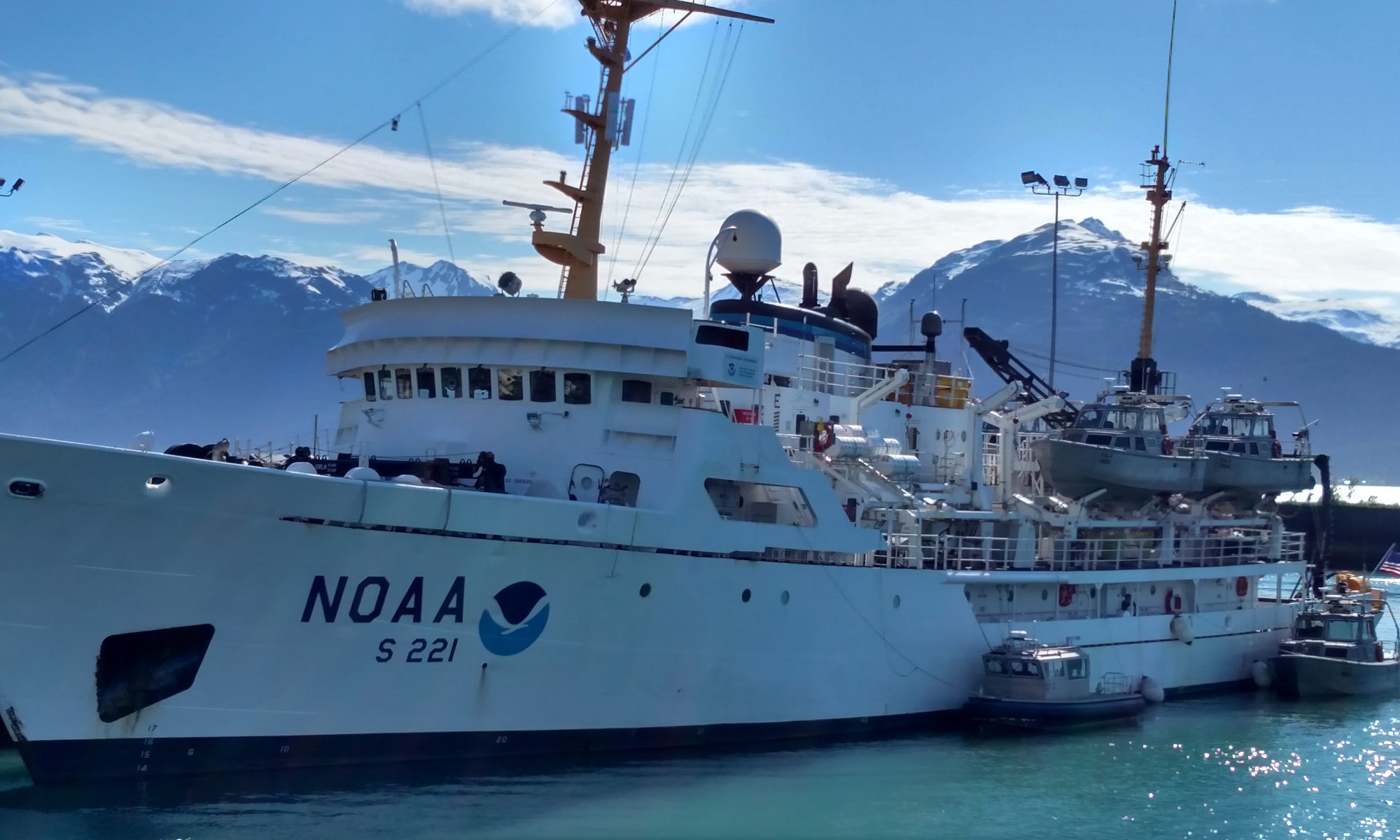
Lisa Battig: The Interview Issue, September 8, 2017

NOAA TAS Lisa Battig

Aboard Fairweather Alaskan Hydrographic Survey Ship

September 8, 2017

Location: Coast Guard Base, Kodiak Alaska

Weather from the bridge: 48o F, 1-2 knot wind from, Completely overcast,


XO Gonsalves
Executive Officer Michael Gonsalves in his overwhelming (because of all the things he does) office.

An Interview with XO (Executive Officer) Michael Gonsalves

How long have you been with NOAA?

I’ve been here for 13 years…I’ve been on the ship for about 6 months.

What brought you into NOAA?

Certainly I’ve always had an interest in the ocean and in the environment. One of my undergraduate degrees was in oceanography. So I think that’s what steered me towards NOAA. My other undergraduate degree was in math, so I liked the idea of being able to apply math in an environmental setting.

As a side note, XO Gonsalves also has a MS in Applied Math and a PhD in Marine Science

What is it that you do – what is the job of an executive officer?

The Executive Officer position is second in command. So if anything should happen to the CO (commanding officer) I would assume command. Though that is a contingency; that is not my actual job… All administrative work goes through me. For example, the budget, payroll, travel, performance, disciplinary actions, scheduling, arranging all port logistics, …getting augmenters to come out to the ship to fill in… I do everything to allow everyone else to do their job. My job is not the mission. My job is keeping the ship safe and logistically ready to execute the mission.

This is typically a step on the path to becoming a CO, is that correct?

Typically, that’s right. Usually the average NOAA Corps officer will have four sea assignments. Basically every five years, give or take, they will be going back to sea. The first will be as a junior officer, an Ensign. The second is as an Operations Officer who will be coordinating the mission [of that ship]. On the hydro ships that means coordinating the hydrographic science. The third sea tour will be as an Executive Officer and the fourth, around year 15, will be as a Commanding Officer.

I know that NOAA Corp officers spend roughly two years at sea and then three at a land billet. So what has your path been thus far?

I lingered in nearly all of my assignments by a little bit. My first assignment was here, on Fairweather, just after she was reactivated. It was a very skeletal crew. I had opportunities to be trained quickly. We only had two launches at the time. There were so few boats, there were so few people trained in doing things, it was in the crew’s best interest to qualify me because very few people were qualified to do anything.

My first land assignment was at the University of Southern Mississippi. It was a double billet. Number one, it was full-time university training. There was also working with an inter-agency group, The Naval Oceanographic Office and the Army Corps of Engineers, both also conduct survey operations. It’s a nice inter-agency group with similar issues and problems and we can share best practices and things like that. Their particular niche is airborne laser bathymetry, so they are working from an airplane.

Back to University of Southern Mississippi, what was the degree you were pursuing?

Initially it was a master’s degree as a one year program. As it happened, there was a project that I could work on of suitable interest to the joint LIDAR center. We all agreed that I could continue to work on it. The university felt that it was dissertation worthy. So I received my Ph.D.

What was your second tour at sea?

My second tour was as an Operations Officer on Fairweather’s sister ship, Ranier. All three of my assignments thus far have been on hydro ships. There is something to be said for that. It’s a little bit tricky to bring someone in from the outside. It’s a steep learning curve.

My second land assignment was working for the NOAA Operations Branch in Washington D.C. This is a part of the Hydrographic Surveys Division. They govern the field units on the large scale. So I was making the big decisions for what the hydro ships would be responsible for during that particular season. We determined what type of coverage would be needed in each area. That is then the information that the Operations Officer on the ship is working from.

What made NOAA so attractive to you?

Giving service to the US government was a big part. I happily pay my taxes. I appreciate having a police force and knowing that my meat is safe. So that was definitely a big part of it. But NOAA also has a unique mission that I found attractive. And the variety is important to me – just knowing that every couple of years the assignment will change.

And what is it that keeps you going while you’re out here at sea? Is there anything you miss or are looking forward to when this sea tour is complete?

People are tricky and a lot of my job involves personnel. The whole job keeps me going, really. I do miss Washington, D.C. – the public transport, the museums and the shows. There are so many things to do and see. There are a lot of jobs in D.C. and I am making clear that is a desire for the next land billet.


ENS Calderon

ENS Carroll
Junior officers, ENS Calderon and ENS Carroll on the bridge working on the computer navigation system. Both also are intimately involved with the surveying program.

A quick one question survey for the junior officers on the ship… Why did you choose a hydrographic survey ship? A collection of the answers I received are below:

  • To have the opportunity to be much more deeply involved with the science
  • My background is math or math/mapping
  • To be in Alaska
  • This is a route to pursue flying with NOAA Corps
  • Didn’t want the technical skills developed in prior work to go to waste
  • Had already worked on fisheries ships with Department of Fish and Wildlife

As with all officers in our uniformed services; NOAA Corps officers have had degrees conferred prior to service. Most of the degrees are math and science. The hydrographic survey ships tend to attract the math, physics, and geological science degrees for obvious reasons. Many then go on to pursue advanced degrees as did LCDR Gonsalves, the focus of my interview.


An interview with Kathy Brandts and Tyrone Baker; Ships Stewards

How long have you been cooking for NOAA Ships and what were you doing prior?
Chief cook Tyrone in the kitchen
Chief Cook Tyrone Baker, master of the grill

T: I cooked for the Navy for 20 years out of school. When I finished, I went to work for a casino for a while – still cooking. Then NOAA called me up (he had put in an application a while before and forgotten about it) and here I am! That was back in 2005.

K: I started out in the Coast Guard…I wanted to be a bosun [boatswain] mate, which is what everyone wants to do. But it was going to take a long time to make grade, and hardly anyone wants to be a cook because it’s a lot of work. I decided to go through their school, which was two months. That was when it started, in ’94. My first ship assignment was the Polar Star, which was an ice breaker.

Chief steward Kathy B and me
Kathy Brandts, Queen of the kitchen – also known as the Chief Steward. This is the day she let me cook a bit with her.

Kathy, why did you get out of the Coast Guard and what finally got you to NOAA?

K:  All of the land assignments were being contracted out to [private companies]. So I was never going to get a chance to cook on land. So I decided that wasn’t for me. I got out after my four and a half years. I landed in Seattle, and that’s where NOAA was based. I had heard about them when I was in the Coast Guard. I knew they were hiring, talked with somebody, and essentially got hired on the spot. And I was in Alaska! I started out in the augmentation pool, I worked on Discovery and then on Ranier. Then a permanent position came up and I jumped at it. I didn’t really get along with the Chief Steward, though – so I left NOAA and worked for Keystone Ski Resorts in Colorado at their stables. [She spent several years on land at that point.]

The Chief Steward on Ranier tracked me down [in Colorado] and asked me to come back. There was talk of Fairweather coming back online and I wanted the Chief Steward job. I didn’t have the experience at that point, so I took a year off and went to Culinary School. I applied for the Chief Steward job on Fairweather and got it. I was on Fairweather from 2004-2013. [She is now the Chief Steward on Ruben Lasker, another NOAA ship, but is helping out on this leg]

Why be a ship cook?

T: I’ve been so many places and seen so many things I wouldn’t have otherwise seen. I’ve really been all around the world. I’ve been in almost every port of the world. How many people can say that? I wouldn’t trade it.

K: I was a restaurant cook for a while. I hated it. You’re either going 9 million miles an hour or there’s nothing. There’s a lot of alcoholism and drug use in that industry and they live a different life. The service industry… (laughs). And people are either sailors or they’re not. I think, much to my chagrin, I found it out after I quit the Coast Guard.

T: Yes, I agree. I’m a sailor. It was why I joined the Navy.

What are the best and most rewarding things about what you do?

T: I just really like it. I enjoy the cooking. I enjoy the work.

K: I like good food and I like when people are appreciative of what I do. And we’re all stuck out here together, why not make it the best that it can be. Meal time is what you look forward to when you’re on a ship.

David GVA and me
GVA Dave – he just joined Fairweather and was actually helping out the stewards on this leg, but now he’s where he’s supposed to be in the deck department.

Crew member of the Day: Electronic Technician (ET) Charlie Goertzen 

Charlie and me
Charlie Goertzen, tech guy extraordinaire!

So today as we pulled into Kodiak, the news came in that the long awaited new televisions were here. Immediately, Charlie was notified. And he will work hours to make sure that each crew member has a working television in their room.

He is the guy that keeps the connectivity going in pretty difficult conditions. He has to spend a lot of time keeping various computer components talking to each other. He has to content with all of the complaints about lack of bandwidth, slowness of applications, slowness of wireless – and he does his best to keep things optimized and clean and efficient all the time. Two of the things he loves the most are the ocean and working with electronic components. He gets both of them all the time!

Kip Chambers: Parting Shots II of II… August 7, 2017

NOAA Teacher at Sea

Kip Chambers

Aboard NOAA Ship Reuben Lasker

July 17 – 30, 2017


Mission:  West Coast Pelagics Survey   

Geographic Area of Cruise:  Pacific Ocean; U.S. West Coast

Date: August 7, 2017


L to R Austin Phill Nina Kip
Left to Right: Austin, Phill, Nina, Kip


Weather Data from the Bridge:  (Pratt, Kansas)

Date: 08/07/2017                                    Wind Speed: E at 9 mph

Time: 19:25                                               Latitude: 37.7o N

Temperature: 22o C                                  Longitude: 98.75o W  


Science and Technology Log:

A week has passed since I left the Reuben Lasker, but I have continued to monitor the haul reports from the ship.  The last haul report indicates that haul #79 of the West Coast Pelagics Survey was conducted off of the coast of California just south of San Francisco Bay.  The survey is fast approaching the concluding date of August 11th when the Reuben Lasker is scheduled to be in port in San Diego.  Based on their current location, there are probably only a couple of days/nights of sampling left for the survey before the ship has to steam for its home port of San Diego.

As I looked through the spreadsheet with the summary of the data that is being collected for the survey, I can’t help but be impressed by the volume of data and the efficiency in which it is being recorded.  Although I was only on the ship for a short period of time, I know how much work is involved in preparing for the evening trawls and how much time it takes to process the catch and record the data.  I have a tremendous amount of respect for the talented, dedicated, hard-working science team members aboard the Reuben Lasker.  Below is a series of interviews with many of the science team members that I had the pleasure to work with while I was on the ship.

 Each team member was asked the following 3 questions:

Q1:  Can you tell me a little bit about your background, including education and work history?

Q2:  What have you learned from your time on the Reuben Lasker during the 2nd leg of the Pelagic Species Survey?

Q3:  What advice would you give to a 1st year college student that was interested in pursuing a career in marine science?

Science Team Member: Phill Dionne


Q1:  Phill’s post-secondary academic career started at Stoney Brook College in New York where as an undergraduate he studied Geology.  Phill’s undergraduate program also included time in Hawaii where he took several courses towards his minor in Marine Science. After his bachelor’s degree, Phill spent a year in the Florida Keys, initially as an intern, then as a marine science instructor at a science camp.  As Phill continued to pursue his educational goals he began to focus on marine science as a career pathway.  Ultimately, Phill completed a graduate degree program at the University of Maine where he studied the migrations and abundance of ESA listed sturgeon and earned masters degrees in marine biology and marine policy.

Phill moved to the state of Washington in 2011 where he currently works for the Department of Fish and Wildlife.  Phill’s current positon as Senior Research Scientist includes overseeing programs centered on habitat and stock assessments for forage fish including surf smelt, sand lance and Pacific herring.

Q2:  When asked what he had learned during his time on the Reuben Lasker, Phill pointed to gaining a better understanding of the techniques and challenges associated with managing coastal fisheries, and how they differ from nearshore survey techniques.

Q3:  Phill’s advice to first year college students considering a career in science is to get experience in data management and to get involved in internships early in your academic career.  Phill also emphasized that it is important to understand that a career in marine science is more than just a job, it is a “lifestyle” that requires commitment and hard work.

Science Team Member: Andrew Thompson

Q1:  Although originally from California, Andrew earned his graduate degree from the University of Georgia where his studies focused on stream ecology.  Eventually Andrew would earn his PhD from the University of California in Santa Barbara.  As part of his work for his PhD, Andrew studied a unique mutualistic symbiotic relationship between a species of shrimp and shrimp gobies (fish) on tropical reefs near Tahiti.  In this unusual relationship there is a system of communication between the fish and shrimp in which the fish acts as a type of watchdog for the shrimp communicating the level of danger in the environment to the shrimp based on the number of tail flips.  After a stint with the United States Fish and Wildlife Service in California, Andrew began working for NOAA in 2007 where he specializes in identification of larval fish.

Q2:  Having experienced multiple assignments on NOAA research vessels, Andrew’s response to what he had learned while on this cruise related to his enjoyment in watching the younger volunteers see and experience new things.  He voiced an optimism in the younger generation expressing how many “good, talented kids are coming through programs today.”  One of the observations that Andrew pointed out about this survey was the number of pyrosomes that are being found which is uncommon for this geographical area.  In a bit of an unusual find, a juvenile medusa fish within a pyrosome also sparked Andrew’s interest (see photo above).

Q3:  With regards to advice for prospective students, Andrew pointed out that a career path in science is often non-linear.  Like many of the science team members that I interviewed, he talked about how important it is to persevere and push through the difficult times as you pursue your goals.

Science Team Member: Nina Rosen


Q1:  Nina Rosen grew up in California where her connection and love of the ocean developed at an early age.  Nina completed her undergraduate degree at Humboldt State University in northern California.  Her graduate degree is a masters degree in advanced studies (MAS) from SCRIPPS Institution of Oceanography.  Nina’s work while at SCRIPPS was focused on understanding interactions between communities and ocean resources with a particular interest in small scale fisheries.  Nina’s background includes a diverse work history that includes working as a naturalist at field stations in Alaska, and working with the Department of California Fish and Wildlife to gather information from anglers that is used to help manage the California’s recreational fisheries.

Note: A special thank you to Nina.  Many of the outstanding photos included on my blogs throughout the survey were taken by her (see images above).

Q2:  When asked about what she had learned while on the survey, Nina stressed how important it was for a variety of people with different specialties to come together and communicate effectively to make the project successful.  I think her comment “all of the parts need to come together to understand the fishery” reflects her holistic approach to trying to understand our oceans and how people interact with this precious resource.

Q3:  Nina’s response when asked what advice she would give to 1st year college students interested in a career in science was simple and to the point. She said “go for it” reflecting her enthusiasm for marine science and research.  She went on to point out how important it is to take advantage of every opportunity that presents itself because “you never know what may come out of the experience.”

Science Team Member:  Austin Grodt


Q1:    Austin is from Orange, California, he will be entering his 4th year of studies at the University of California in San Diego majoring in environmental chemistry.  In addition to going to school, Austin works as a California state lifeguard.  Like many of the people I met while on the ship Austin’s connection to our oceans is central to his core values.  When I first met Austin he described himself saying “I am a stereotypical California guy, I am all about the water.”

Q2:  With regards to what he has learned while on the survey, Austin expressed that he had developed a greater understanding of the state of California fisheries and how they operate.  Austin also spent a lot of time interacting with the members of NOAA Corps learning about how the ship functions and large vessel navigation.

Q3:  When asked what advice he would give 1st year college students Austin said “when it gets hard don’t be discouraged, keep pushing. It is totally worth it.”  Austin also pointed out that the opportunities and number of fields available for STEM graduates are diverse and “in higher quantity than you can imagine.”

Science Team Member: Lanora

Q1:  Lanora’s first experiences with the ocean were in the Gulf of Mexico during family vacations. She went on to earn a BS degree from the University of Southern Mississippi.  After graduating, she spent time working for NOAA on research cruises in the Gulf of Mexico.  Lanora would eventually return to school and complete a masters program in marine science at the University of South Alabama.  In 2016 she would once again go to work as a NOAA scientist where she is currently working on research vessels stationed out of California.

Q2:  When asked what she had learned during the survey Lanora said “all of the pieces have to come together in order for the big picture to work.”  She went on to explain that several groups of people with a common task have to work together in order for the overall goals of the survey to be accomplished.

Q3:  Lanora’s advice to college students interested in marine science is to seek out opportunities to volunteer and participate in internships.  She indicated it was important to explore different areas to find out what you are truly interested in.  Like many of the science team members she went on to say that if you are passionate about science “go for it, don’t quit, and persevere.”

Personal Log:  Final Thoughts…


The most important, lasting impression that I will take away from this experience is the quality and commitment of the people that I have met along the way.  Although I will remember all of the people that I have worked with, the individuals on the science team have each given me something special.  I will remember and learn from: Dave, his calm demeanor, focus and attention to detail; Sue, her easy smile, and determination; Lanora, her relentless work ethic, and ability to manage multiple layers of responsibility; Andrew, his sense of optimism and genuine happiness; Phill, his relaxed sense of self awareness and wisdom beyond his years; Nina, her contagious laugh and commitment to, and love of our oceans; Austin, his boundless energy and curiosity about everything… thank you.

I also learned that the ocean has a heartbeat. If you’re quiet you can hear it in the rhythm of the waves.  The ocean has a soul; you can feel it in your feet if you wiggle you toes in the sand.  The ocean has an immensity and strength beyond imagination.  At first glance it seems as if the ocean has a beauty, diversity and abundance that is boundless, but of course it is not.

Due to our relentless pursuit of resources, and the pollution generated by that pursuit, our oceans are hurting.  We have to do better.  In many ways we live in troubling times, but as I learned from Andrew, it is not too late to be optimistic.  We can live a more peaceful, balanced existence with the planet’s resources and the other organisms that call the earth home.  It is my sincere desire that through hard work, education and the commitment of people from all generations we can come together to make our oceans and the planet a more harmonious home for all species…Thank you to everyone who has made this journey such a rewarding experience.

Learn more about education and career opportunities in marine science at the web site below.

NOAA Fisheries: Southwest Fisheries Science Center

https://swfsc.noaa.gov/swfsc.aspx?id=7532&ParentMenuId=33


Sian Proctor: A Fast Farewell!, July 22, 2017

NOAA Teacher at Sea

Sian Proctor

Aboard Oscar Dyson

7/2/2017-7/22/2017

Mission: Gulf of Alaska Pollock Survey

Geographic Area of Cruise: Gulf of Alaska

Date: July 22, 2017

Me Back in Kodiak
Me Back in Kodiak, Alaska

Life at sea can often be unpredictable. When I started my 4am shift I learned that we were having issues with the main engine on the NOAA Ship Oscar Dyson and had to return to Kodiak. This cut my adventure at sea down to just two weeks instead of three. An unexpected bonus from returning to Kodiak was getting to visit the Kodiak Fisheries Research Center.

Science and Technology Log: Kodiak Fisheries Research Center

The Kodiak Fisheries Research Center was built in 1998 using funds from the Exxon-Valdez Oil Spill (1989). The purpose of the center is to provide educational information about the wildlife, marine life, commercial fishing resources and fisheries research programs on the island. Click this link for more information: KFRC

Interview with Kresimir Williams

Fisheries Biologist

Kresimir in the Acoustics Lab
Kresimir in the Acoustics Lab Image from TAS Mary Murrian
  • Official Title
    • Fisheries Biologist
  • Normal Job Duties
    • On this cruise, I am responsible for collecting physical measurements of fish caught in our science trawls, as well as providing support for various acoustic and camera instruments we’re putting in the water.
  •  How long have you been working on Oscar Dyson?
    • Since it’s first science cruise in 2005, but only for a few weeks each year.
  • Why the ocean? What made you choose a career at sea?
    • I got hooked on sea exploration at an early age spending summers on the Croatian coast, snorkeling, fishing, and riding boats. The ocean represents an exploration opportunity that is more “accessible” to us, unlike the deep jungles or space. The edge of our knowledge is never very far in the marine environment. The more time I spend in ocean research, there always seem to many more questions than answers.
  • What is your favorite thing about going to sea on Oscar Dyson?
    • I enjoy the scientific challenges and the things that are new each cruise, whether it is some unique types of fish we encounter, or new ways of exploring the sea, such as new instrumentation. There always seem to be new things to see, even after being on these cruises for 15 years. And there are also new people on board that are interesting to meet, people with new perspectives and ideas.
  • Why is your work (or research) important?
    • There is a basic component to the work of essentially performing a marine “census” that is the backbone of resource management for the important fisheries that take place here. We have to have good information on the state of the fish populations in order to properly manage sustainable fish harvests. But the results of our surveys also provide essential data for many studies of the ocean, such as climate related fish distributions, questions of fish biology, and marine ecosystem functioning – critical research efforts that are carried on by academic and government researchers. On top of all that, we also do a lot of research into our survey methods, to develop new ways of collecting data and to determine the precision and accuracy of the tools we use. This latter part is more interesting to me.
  • When did you know you wanted to pursue a career in science or an ocean career?
    • I was interested in all things oceanic from an early age. I always wanted to work specifically with fish. My toddler doodles were of fish. I’ve followed this path throughout my education and job history, and have no regrets.
  • What part of your job with NOAA (or contracted to NOAA) did you least expect to be doing?
    • On the job I somewhat unexpectedly learned how to write computer programs, and to develop and design camera systems. But this is also a very rewarding activity for me.
  • What are some of the challenges with your job?
    • As we incorporate more and more advanced technology into our work, trying to keep all of the systems operational requires a broad base of knowledge, spanning from computer networks, underwater optics, electronics, and engineering that can be a little beyond my background. So this is a challenge for me to keep myself up to speed on these aspects of the work and keep our instruments and cameras running smoothly. Also, as scientists we are obligated to share our work with others, which means writing papers and making presentations, which can be a challenge.
  • What are some of the rewards with your job?
    • I love discovering new ways of collecting data in the environment, and understanding how fish behavior influences our ability to observe them. Finding answers to research questions relating to these areas is a very rewarding experience for me. There are distinct moments, not very often encountered even in entire careers, when you know that you have found something, possibly something completely new, that produces an excitement that is almost difficult to describe.
  • Describe a memorable moment at sea.
    • A positive memorable moment would be when we first started operating cameras inside the trawl and were able to distinguish how fish behaved within the trawl for the first time. The first few tows with the new camera equipment were very exciting. A negative memorable moment: We did run out of coffee on a cruise in the Bering sea a few years ago. Bad scene.

Interview with Caroline Wilkinson

NOAA Corps Junior Officer

NOAA Corps Officer Caroline Wilkinson
  • Official Title
    • Junior Officer
  • Normal Job Duties
    • Standing bridge watch 8 hours a day, often with a Officer of the Deck in training. As Environmental compliance officer- ensuring the ship meets all required environmental standards for garbage disposal, discharge, etc. As medical officer- ensuring all personnel are physically and mentally fit for sea duty, keeping the hospital clean, tidy, and stocked, responding to medical emergencies at sea. As Imprest officer- maintaining our cash fund and reimbursing crew for missed meals. As Navigation officer- planning our route and ensuring the charts and electronic navigation reflects our intended tracklines.
  •  How long have you been working on Oscar Dyson?
    • Since December 2015
  • Why the ocean? What made you choose a career at sea?
    • I grew up spending summers on Long Island Sound and fell in love with the beach and the smell of the ocean.
  • What is your favorite thing about going to sea on Oscar Dyson?
    • The amazing animals, land masses, and weather phenomenon that we get to experience.
  • Why is your work (or research) important?
    • The work I do facilitates the scientists ability to collect the necessary data to ensure the pollock population remains sustainable.
  • When did you know you wanted to pursue a career in science or an ocean career?
    • As a child, I spent a lot of time out doors looking for bugs and critters; a career in science seemed like a natural next step.
  • What part of your job with NOAA (or contracted to NOAA) did you least expect to be doing?
    • I didn’t expect there to be so much paperwork involved with driving the ship!
  • What are some of the challenges with your job?
    • The long stints away from friends, family, and civilization.
  • What are some of the rewards with your job?
    • Meeting a variety of incredibly smart and talented people and exploring parts of Alaska most people don’t get to experience.
  • Describe a memorable moment at sea.
    • Being in the northern Gulf of Alaska at night and spending hours watching the northern lights dance across the sky.

Personal Log

Here is a quick video tribute to the NOAA Teacher at Sea program, the NOAA scientists and Oscar Dyson officers and crew. Thank you!

Education Tidbit: 

I have one more NOAA website to share with you. It is a great resource for students who are doing a paper on a particular fish. I use the NOAA Alaska Fisheries Science Center page and information on pollock as my example.

Did You Know?

That the NOAA Teacher at Sea Program has been around for over 25 years! You can learn more about the program by   clicking this link: NOAA Teacher At Sea

Sian Proctor: It’s Getting Fishy, July 20, 2017

NOAA Teacher at Sea

Sian Proctor

Aboard NOAA Ship Oscar Dyson

July 2 – 22, 2017

Mission: Gulf of Alaska Pollock Survey

Geographic Area of Cruise: Gulf of Alaska

Date: July 20, 2017


Me with an adult pollock.

Weather Data from the Bridge

  • Latitude:  57° 47.02 N
  • Longitude: 152° 24.56 W
  • Time: 1700
  • Sky: Overcast
  • Visibility:  2 nautical miles
  • Wind Direction: variable
  • Wind Speed:  Knots
  • Sea Wave Height:  0  foot swell
  • Barometric Pressure:  994 millibars
  • Sea Water Temperature:   11.9° C
  • Air Temperature:   12.2° C

Science and Technology Log: It’s Getting Fishy!

Alaska pollock are found in the Bering Sea and Gulf of Alaska and are part of the cod family. The dorsal side of the pollock is speckled brown in color with a slight olive green hue and the ventral side is silver. They eat krill, copepods, and small fish – mainly their own offspring. They quickly grow into adults, reaching reproductive age after 3-4 years, and are very fertile, replacing harvested fish in just a few years. Pollock swim in large schools during the day and disperse overnight. They can be found throughout the water column, but young pollock tend to live in the mid-water region while the older fish tend to live near the sea floor.

Alaska_Pollock_-_source_NOAA_fishwatch.govScience-based monitoring and management play a key role in the sustainability of the Alaska pollock fishery. It is managed by the North Pacific Fishery Management Council based on data provided by the NOAA’s Alaska Fisheries Science Center. The Alaska pollock fishery is the largest, by volume, in the United States and one of the most valuable in the world.  Products made from pollock include fish fillet, roe eggs, and imitation crab. The entire industry is valued at over a billion dollars. It is also considered one of the best-managed fisheries in the world. Scientists from the Alaska Fisheries Science Center conduct acoustic trawl surveys to estimate the abundance of Alaska pollock using acoustics and by catching small samples.

While on NOAA Ship Oscar Dyson I had the opportunity to spend time in  the fish lab learning how pollock data are collected.. This video is an example of what I experienced.

The main way commercial pollock is caught in the United States is by net. Scientifically trained observers are sent out on U.S. pollock fishing boats and, similar to the NOAA scientists, they collect sample data from each catch and send it back to NOAA.  They also observe the fishing practices on the boat and  report any regulatory infractions. All the collected data and interactions between the fishing industry and NOAA have been established to make sure the Alaska pollock fishery remains sustainable.

NOAA Opportunities for students: https://www.afsc.noaa.gov/education/students/careers.htm 

Interview with Michael Martin

Fisheries Biologist

  • Official Title
    • Deputy Director
  • Normal Job Duties
    • Leadership and administration of the Resource Assessment and Conservation Engineering (RACE) Division within Alaska Fisheries Science Center (AFSC)
  • What is your current position on Oscar Dyson?
    • Fish lab biologist
  • How long have you been working on Oscar Dyson?
    • of and on for ~ 10 years
  • Why the ocean? What made you choose a career at sea?
    • I loved exploring sea creatures a the beach as a kid; Jacques Cousteau.
  • What is your favorite thing about going to sea on Oscar Dyson?
    • Getting out of the office; Seeing amazing scientists do their work and getting to participate.
  • Why is your work (or research) important?
    • The information we collect plays a very important role in managing fisheries in Alaska, providing economic and food security for many people. We also do tremendous research that benefits the science community and subsequently people world-wide. We are among the leaders in understanding fish and invertebrate abundance and behavior in the world.
  • When did you know you wanted to pursue a career in science or an ocean career?
    • I’m still trying to figure out what I want to do if I grow up! Probably between 10 and 13 years old I developed an interest in the ocean.
  • What part of your job with NOAA (or contracted to NOAA) did you least expect to be doing?
    • Dealing with bureaucracy.
  • What are some of the challenges with your job?
    • Leading a group of scientists is, in some ways, like herding a group of very intelligent cats. They are very focused on their research and have very strong opinions about things that they feel could detract their ability to do the best job possible. This can be a challenge for me at times, but is a great problem to have!
  • What are some of the rewards with your job?
    • Being able to facilitate scientists and help them accomplish their goals is very rewarding.
  • Describe a memorable moment at sea.
    • Rescuing a family in a life raft that had been missing for 3+ days.

P1130809

Interview with Meredith Emery

Fisheries Biologist

  • Official Title
    • Survey Technician
  • Normal Job Duties
    • As Survey Technicians, our primary responsibility is to monitor and maintain fisheries and oceanographic equipment. In addition, we have to run and verify the Scientific Computer System (SCS) is collecting quality data and all the ship’s sensors connected to SCS are working properly. We also are the liaison between scientists and the crew members, and assist the scientists with any part of their research. Survey Technicians have the unique opportunity to participate in all aspects of the fisheries or oceanographic operation start to finish. During the fishing operations: 1. Scientist communicates to the people on the bridge, deck and survey technicians when they are going to fishing. 2. We put the fishing equipment on the net, as the net is casting out. 3. Assist the scientists log net dimension data when the net is in the water. 4. As the net is being recovered, we retrieve all the fishing equipment. 5. We help the deck with emptying the catch on the fish table, when needed. 6. Lastly, which is my favorite part, is when we get to assist the scientists collect biological fish samples in the wet lab. During oceanographic operations we are in charge of deploying and recovering the equipment (Conductivity, Temperature and Depth (CTD)). In addition we verify all the sensors on the CTD are presenting quality real time data. From the CTD we can collect water samples that can be used for several studies, like salinity, dissolved oxygen, chlorophyll, or micro plankton. We are able to see the operations in action, understand the importance of the research through the science perspective and ultimately know the reason the Oscar Dyson is in the middle of the Gulf of Alaska.
  • What is your current position on Oscar Dyson?
    • I am one of two Survey Technicians on the Oscar Dyson.
  • How long have you been working on Oscar Dyson?
    • I have been working on the Oscar Dyson about 10 months.
  • Why the ocean? What made you choose a career at sea?
    • My fascination for the ocean started when I was young playing with the anemones on the rocky intertidal beach. I’ve always enjoyed being at the beach and seeing the organisms there. I became curious of life at sea and really wanted to see the marine wild life in action, especially when the ice first melts and there is a high abundance of phytoplankton and zooplankton that attracts marine mammals, birds and fish to migrate there. Being on the Oscar Dyson, I was able to observe the fluctuation between high abundance of phytoplankton, zooplankton or fish, depending on the area and time of year.
  • What is your favorite thing about going to sea on Oscar Dyson?
    • I enjoy seeing the scenery. Like the untouched lands, glaciers, marine wild life; the fishes, mammals or birds. Also I like seeing the endless blue of the ocean, especially calm weather. Really puts the vastness of the ocean in perspective.
  • When did you know you wanted to pursue a career in science or an ocean career?
    • The reason I pursued a career in studying the ocean is because I come to realize that people take the ocean for granted and don’t recognize how much we depend on it. I obtained a Bachelor’s of Science degree in Biology emphasis marine. One of my favorite college courses was oceanography. It was the first time for me to see the connection between geology, physics, chemistry and biology in one scenario like in the ocean processes. Each component relies on the other. First the geological features of the ocean floor and land masses influences the physics of the current flow, wave motion, and up-welling. Then the ocean movement determines the mixing and distribution of the water chemistry. Finally the biodiversity, location, and populations of marine organisms rely on the water chemistry, like nutrients or dissolved oxygen.

Personal Log

I really enjoyed learning about the variety of sea creatures in the Gulf of Alaska. Here is a video showing a few of the sea creatures I encountered. Totally amazing!

Education Tidbit: FishWatch Website

Another cool resources is the Fishwatch website. Here you can learn more information about sustainable fisheries and the science behind the fish we eat. It is worth checking out!

Did You Know?

Did you know that fresh pollock have a very distinctive smell that isn’t like any other fish? It’s not fishy – more like dirty feet!

Melissa Barker: Navigation and People of the Oregon II, July 2, 2017

P1030109NOAA Teacher at Sea

Melissa Barker

Aboard NOAA ship Oregon II

June 22-July 6

Mission: SEAMAP Groundfish Survey

Geographic Area of Cruise: Gulf of Mexico

Date: July 2, 2017

Weather Data from the Bridge

Latitude: 28 37.91 N

Longitude: 89 19.41 W

Air temp: 30.5 C

Water temp: 31.7 C

Wind direction: 340 degrees

Wind speed: 4 knots

Wave height: 0 meters

Sky: partly cloudy


Science and Technology Log

Point plotted on electronic chart. We are the little green boat icon on the screen.

I spent some time on the bridge with LT Reni Rydlewicz learning about how the ship is navigated. The officers and crew are reliant on technology to navigate the Oregon II from station to station. There are many obstacles here off the coast of Louisiana that must be avoided including rigs, oil field traffic, shipping boats and shrimpers. The radar, electronic charts and weather screen are vital to successfully navigating the Gulf. The first step in navigation is using the electronic chart to plot a line to the station.


Radar is critical to navigation in a busy Gulf


We keep at least one mile away from any rigs or other obstacles. The officer on duty will check the radar and then visually confirm what they see out on the water. They may also radio any nearby vessels to discuss their routes and make sure we can safely pass.


Melissa at the helm being instructed by LT Rydlewicz


Next, the officer will turn the helm to the proper heading using degrees, like on a compass.  Zero degrees is due north. Once on the proper heading, we will go to the way point of the set track-line monitoring for obstructions and vessels along the way.


Plotting our location on the chart


About every thirty minutes to one hour, the officer will drop a fixed position on the paper chart to track our progress based on our latitude and longitude.

Wind direction indicator


You can see us sitting on the south edge of the storm cell on the weather screen


Another vital piece of technology is the WXWorks weather screen that shows weather patterns and lightning strikes.


Currently, the water is calm and we are cruising to a station near the mouth of the Mississippi River. The image below shows the route we have taken thus far as we zig zag our way from station to station.

You can see our route as of 7/1/17 marked in blue. The Oregon II is the little green boat on the map.

The pitch and RPM’s can be adjusted to change the speed of the ship. The Oregon II has two engines, but we usually operate on one to save wear and tear and to have a backup engine just in case. Our average cruising speed is about 8 knots. With both engines, we can cruise at 10-11 knots.

When conducting a CTD, the officer often uses one of the side stations to control the speed and rudder so they can see what is happening with the CTD instrument. They must keep the ship as still as possible, which can be challenging in some conditions. Before the trawl is lowered into the water, the officers must plot a course making sure they can trawl continuously for about 1.5 miles at 2.5-3 knots within 5 miles radius of the station. The bridge, deck crew and FPC are in radio communication when setting the trawl. At night, the bridge operates with red screens and lights so the officers can keep their night vision. There is also video feed that shows the bow and stern decks and engine room to keep an eye on folks when they are out doing their work.

I can only imagine how overwhelming it must have been for ENS Parrish, when she started on the Oregon II in December, trying to learn how to use all the technology that helps her and the other officers navigate the ship as well as actually learning how the ship moves in the water.


Interviews with the People of the Oregon II

I’ve spent some time talking with people who work on the ship from the different departments trying to understand their jobs and their desire to work at sea. I have posted three interviews here and will post more in the next blog.


ENS Chelsea Parrish

ENS Chelsea Parrish holding a cobia

Chelsea is a Junior Officer learning to stand her own watch on the bridge. She reported to the Oregon II in December and needs to have at least 120 hours at sea, become proficient navigating the ship and have the Commanding Officer’s blessing to become an Officer Of the Deck. In addition to learning the details of navigation and fishing operations, she also is the Environmental Compliance Officer, completes chart corrections weekly and heads up social media for the ship. You can learn more about the NOAA Corps here.

What did you do before working for NOAA?

I earned my masters in marine science and then applied to the NOAA Corps. The training for NOAA Corps is nineteen weeks, seventeen of which are spent at the Coast Guard Academy in New London, CT training and taking classes.

ENS Chelsea Parrish in her Service Dress Blues. (photo credit: Chelsea Parrish)

Why did you join the NOAA Corps?

I heard about it in graduate school and it sounded like a great way to serve my country and help scientists do their work. I consider the NOAA Corps a hidden gem because not that many people know about it. We are stewards of our oceans and atmosphere by contributing to oceanographic, hydrographic and fisheries science. I will spend two years at sea and then three years on land and continue that rotation. We even have a song, check it out here.

Tell me about one challenging aspect of your job?

The balance between work and personal life can be a challenge on the ship, but I’m finding a routine and sticking to it.

What do you enjoy most about working on the Oregon II?

I love watching the sun rise and set over the ocean each day and the mystery of what we will find in the ocean each day.

What advice or words of wisdom do you have for my students?

Be adaptable and take advantage of every opportunity that comes your way. Don’t be afraid to go against the norm and follow your passion.


Lead Fisherman Chris Nichols

In Chris’ role as Lead Fisherman, he is second in charge of on the deck crew and leader of the night watch. He operates the cranes and is responsible for fishing operations on the ship. He also stands a look out watch on the bridge. His other responsibilities involve mending fishing nets and handling the sharks (especially during the shark survey). Chris has many certifications that give him additional responsibility such as being a surface rescue swimmer, NOAA working diver and one of the MPIC’s (medical person on duty).

What did you do before working for NOAA?

Lead Fisherman Chris Nelson

I was a charter fishing boat captain, an able body seaman with the Merchant Marines and had a navigation job with the Navy.

Why work for NOAA?

My specialty is big game fish, so I was initially attracted to the NOAA shark surveys. I’ve been at sea since 1986 and am always up for another adventure.

Tell me about one challenging aspect of your job?

I have a lot of additional duties besides being a Lead Fisherman. The upkeep of all of my certifications takes a significant amount of time.

What do you enjoy most about working on the Oregon II?

The camaraderie of the people. We have a great steady group of people and our repeat ports are nice places to visit. I really enjoy working with the scientists and the fish too.

What advice or words of wisdom do you have for my students?

Embrace adventure. I was inspired by early on by reading adventure stories like Tom Sawyer. Work has taken me all around the world. And definitely take those math courses, especially algebra and calculus. I use math every day in my work.


Chief Steward Valerie McCaskill

For two years Valerie has been the Chief Steward who keeps everyone on the ship well fed. She and her assistant, Arlene, attempt to satisfy 30 different appetites three times per day.

Valerie’s welcoming smile

What did you do before working for NOAA?

I worked oil industry first in food service, but wanted to work for NOAA. I have a small catering business and like to experiment with food.

Why work for NOAA?

I love running a kitchen without the unreliable schedule and endless hours of land based restaurants.

One of the amazing meals from the galley

Tell me about one challenging aspect of your job?

Trying to please everyone is a big task. It can also be challenging to meet people’s dietary restrictions with the limitations of the kitchen.

What do you enjoy most about working on the Oregon II?

I enjoy the people. Even if the boat is rocking and people are tired, I try to being comfort through food.

What advice or words of wisdom do you have for my students?

Never let fear of failure stop you.


Personal Log

Chart of the turn I made

A few days ago, we were on weather hold and I went up to the bridge to see what was going on. I was starting to feel a little sick from all the movement. Being in the bridge, where I could see the horizon, helped sooth my stomach and distract me from the motion. We were running “weather patterns”, which means that we are running a course for the best ride possible while waiting for the weather system to pass. Then we can go back to the station we need to sample. Reni let me turn the ship which was a pretty cool experience. She directed me to turn the helm to 40 degrees to the port side, then as we started to turn, she had me easy back to 30, 20, 10 and finally back to zero to complete our 180 degree turn back towards the station.

Yesterday between trawls, David, Sarah and I went up to the forward most part on the bow. We peered over the railing to see four bottlenose dolphins playing on the bow wake. It was incredible to see them so close. As they were swimming at 7-8 knots right alongside the ship, they rotated position allowing each to take a turn coming to the surface for air. It was similar to bikers rotating in a peloton to stay out of the wind. Once I’m back on shore, I’ll post some video, but here is a still shot for you.

P1030109
Bottlenose dolphins riding the bow wake
Standing at the forward most part of the bow
P1030103
Looking back from the bow to the bridge
View from the flying bridge


I’ve been waking up a few hours before my shift starts to work on my blogs and get a little exercise. I never know what the weather is like when I wake up because I sleep on the lower deck. Technically I sleep under water and hear the water slapping the side of the ship as I’m drifting off to sleep. This morning I decided to go to the flying bridge, which is at the top of the ship, to do a little workout. The sea was glass-like and the visibility was over 10 nautical miles. I decided it was the perfect location for some yoga. I enjoyed the extra challenge of holding poses on the moving ship.


Did You Know?

The northern two-thirds of the continental US and part of Canada drains into the Gulf of Mexico. These rivers bring accumulated runoff from cities, suburbs, rural areas, agriculture and industry and have the potential to influence the health of the Gulf.  (source: flowergarden.noaa.gov)

gomwatershed
Rivers that drain into the Gulf of Mexico (photo credit: http://flowergarden.noaa.gov)

Dawson Sixth Grade Queries

Are you going to see sharks? (Gemma, Sylvia, Mae, Finn)

We have caught two small sharpnose sharks so far on this cruise. The Oregon II does a shark survey in the late summer where they focus on catching sharks.

How long does the whole process of catching fish take? (Sam)

Once we come upon the station, they set the trawl for 30 minutes. Depending on how deep we are sampling, it might take 10-20 minutes to bring the net back in.

What classes or skills would you have to master to become a marine biologist? (Rowan, Ava, Julia) 

I asked this question to a room full of students studying some sort of marine biology or science and here is what they said…

It depends on your area of interest, but reading and writing skills are critical. It would be helpful to take courses in biology, chemistry, comparative physiology and anatomy, biological and ecological systems and applied math like calculus and statistics. In David’s program at University of Miami, he had to choose a concentration like biology, physics, or chemistry with his marine science degree.