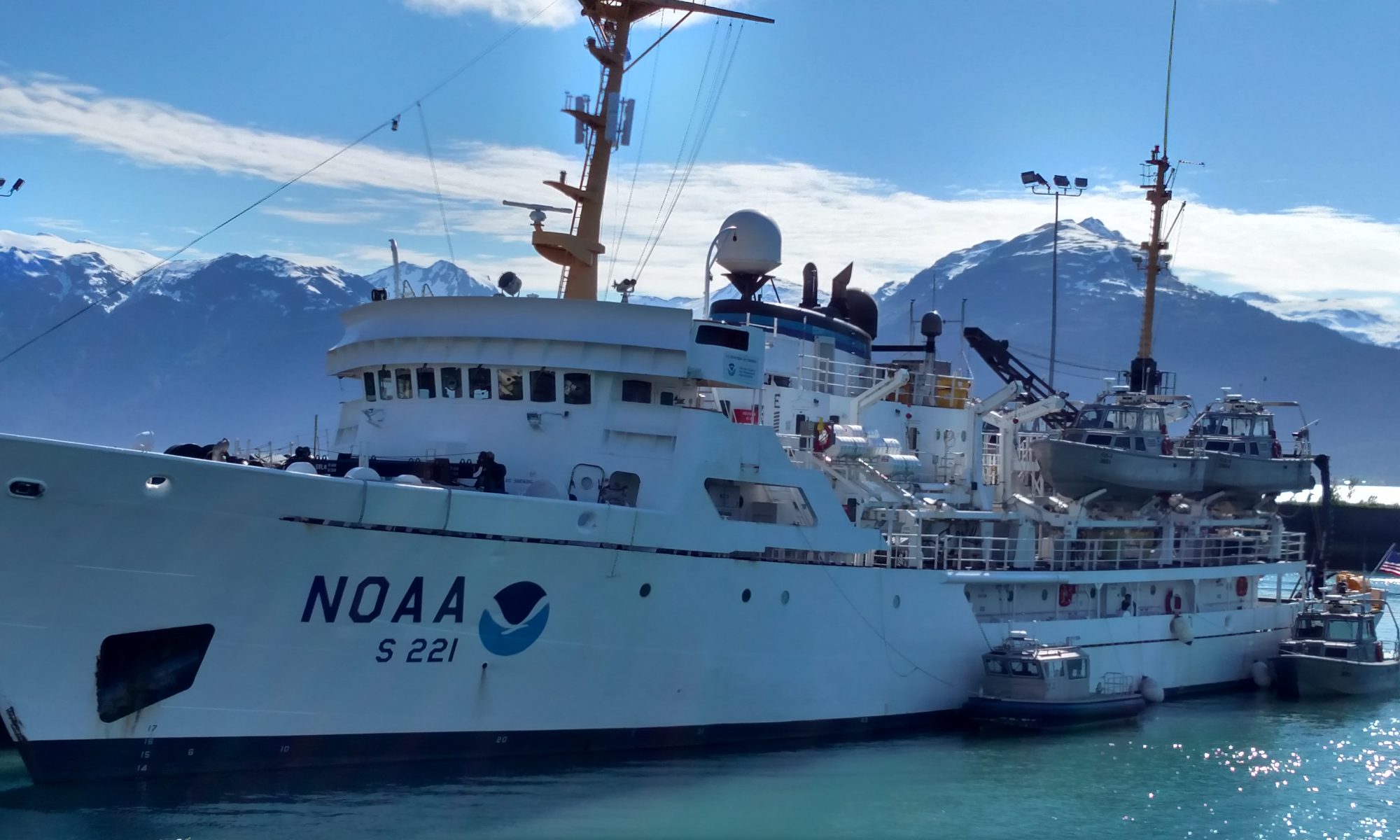
Kimberly Gogan: Night Crew Oceanography! More than just a Bongo! April 29, 2014

NOAA Teacher at Sea
Kim Gogan
Aboard NOAA Ship Gordon Gunter
 April 7 – May 1, 2014

Mission: AMAPPS & Turtle Abundance Survey, Ecosystem Monitoring
Geographical area of cruise:  North Atlantic Ocean
Date: April 29, 2014

Weather Data from the Bridge
Air Temp: 15.5  Degrees Celsius
ind Speed: 7 – 12 Knots
Water Temp: 8.8  Degrees Celsius
Water Depth: 10 Meters

Science and Technology Log

As I mentioned in my previous blogs, there are many layers of science that are happening simultaneously that support the AMAPPS project (see April 9th blog). One of these layers is monitoring the ecosystem with oceanography. In the April 9th blog I explained all about the Bongo Nets, and in April 15th blog I explained about the VPR and it’s plankton picture data. While the rest of the ship slept, the night time oceanography team – Betsy Broughton (scientist from NEFSC in Woods Hole), John Rosendale (lab technician from NOAA Fisheries Howard Labratory in Sandy Hook) and Brian Dennis (volunteer) were busy conducting Benthic science with the Beam Trawl and Van Veen Grab Sampler.

Although  this equipment was not used every night, I was lucky enough to have stayed up some of the night to see these two in action. The Benthic Zone, in a body of water, like the ocean refers to the very bottom of that aquatic ecosystem. The night time science team use a Beam Trawl or a bottom fishing net that is towed along the bottom of the ocean to take a sample of the organisms that live there. The Beam Trawl is attached to a winch that is on the stern of the boat, that one is much larger than the winch that is used to lower the Bongo Nets. The trawl is lowered down until it touches the bottom and then towed along the bottom picking up whatever is in its path. The trawl is then brought to the surface and the sample is sorted in the wet lab and preserved in formaldehyde just like the other samples. The Van Veen Grab Sampler is lowered into the water by the same smaller winch that is used for the Bongo Nets along the port side of the ship. The grab is rigged so that when it touches the bottom of the ocean, two arms open up and grab a large sample of the sediment at the bottom of the ocean. To me it looked just like the suffer muck I know as “clam flats.” Once the Van Veen Grab is brought up to the surface, the arms of the grab are released and the sediment is dropped into a bucket. From there the soil is washed over and over using several sized sieves until all of the muck is washed away and just the organisms, shells and assorted bottom treasures are left. This sample, once cleaned, is also brought back to the chemistry lab for processing in formaldehyde.  The scientists worked at a much faster pace to get all the sediment removed and the  samples processed. It was fun to be able to watch and help out.

Betsy teaching me how to run the computer software for the CTD.

Personal Log:

For most of the trip, my “assigned” task has been to work with Jerry Prezioso as the day Oceanography team. Jerry and I are in charge of the mid-day Bongo Nets (see April 9th blog). Sometimes we are up early and timing is such that our morning Bongo Net overlapped with night crew’s scheduled time. Sometimes they would start the morning Bongo and Jerry and I would take over and finish the work, or we would just all work together to get it done twice as fast.  Since there were more people to help in the morning, Betsy Broughton (see April 15th blog) was available to help teach me how to run the computer software that was attached to the Bongo called a CTD Sensor.

The graph on the computer software of the  Conductivity, Temperature and density data the CTD collects as the Bongo drops to it's lowest depth.
The graph on the computer software of the Conductivity, Temperature and density data the CTD collects as the Bongo drops to its lowest depth.

CTD stands for Conductivity, Temperature and Depth and it sits above the Bongo Net collecting this data that it sends back to the computers. Generally one scientist is in charge of running the software that turns on the CTD and gets it to start collecting data as it is dropped down into the deep water. The person on the computer is in charge of knowing how deep the Bongo Net should go and telling the winch operator when to pull the Bongo Net back up to the surface. They are also responsible for letting the NOAA Corps officer on the Bridge know when the equipment is ready and telling the winch operator the speed at which the Bongo should be dropped. If this information is not relayed correctly the Bongo Net could go crashing into the bottom of the ocean. It took a couple of days of Betsy overseeing what I was doing, but in no time at all, Jerry felt confident enough in me to leave me at the helm and let me run the software on my own. From net washer to computer software operator, I was moving up!

Kimberly Gogan: A Ship Full of Science! April 9, 2014

NOAA Teacher at Sea
Kim Gogan
Aboard NOAA Ship Gordon Gunter
April 7 – May 1, 2014

Mission: AMAPPS & Turtle Abundance Survey,  Ecosystem Monitoring
Geographical area of cruise:  North Atlantic Ocean
Date: Wednesday, April 9th

Weather Data from the Bridge
Air Temp: 5.5 Degrees Celsius
Wind Speed: 9.0 Knots
Water Temp: 4.6 Degrees Celsius
ater Depth: 41.2 Meters

The Science Teams (Photo Credit to Mark Weekley)
The Science Teams – Photo by Mark Weekly

Science and Technology Log

If Science at Sea is what I wanted, this is the ship for it!  The evening of our departure from Newport, R.I. on Monday, April 7th, the group of scientists met in the staff lounge for a meeting of the minds. I soon found out that there was an array of scientist on the ship all with different goals and science they wanted to conduct. On this ship we have two teams of Oceanographers, a day team and a night team. The Oceanographers are generally taking underwater tests and samples using a variety of equipment. We also have the Marine Mammal Observer Team who are on the look out for any sort of mammals that may poke head out of the water such as whales and dolphins.

There is also a group of Birders collecting data on any bird sightings. And lastly we have our Acoustics, or sound team, that is listening for the sounds of marine mammals. I also learned at that meeting that it would take a lot of teamwork and collaboration on the part of each of the Scientist crews, as well as the NOAA Corps and crew to make it all happen.

Every day the representatives from each team have to get together to coordinate the timing of each of the events that will happen throughout the day. The Mammal and Birding Observer teams are on the same schedule and can collect sighting data throughout the day from 7 AM to 7 PM, only stopping for lunch, as they need daylight to conduct their work. The daytime Oceanographers plan their work of collecting samples around the observer teams, sending off their collection equipment before 7AM, at lunch, and then again at 7PM when the observers teams are done. The nighttime Oceanographers are not working during the same time as other scientists so this gives them the opportunity to to do as many test and collections as they can without interrupting anyone else’s work. The Acoustic team can work anytime of day or during any kind of weather without conflicting with anyone as long as the water is deep enough to drop their equipment. It sounds like an easy schedule but there are many things, like weather, technology and location, that could disrupt this carefully orchestrated schedule of science. When that happens, and it has, everyone must be flexible and work together to make sure everyone can conduct the science they need.

Me helping to bring the Bongo net back onto the ship for cleaning. (Photo credit Chris)
Me helping to bring the Bongo net back onto the ship for cleaning. – Photo by Chris Tremblay
Jerry Prezioso tying the bottom of the Bongo nets getting them really to be put in the water.
Scientist Jerry Prezioso tying the bottom of the Bong nets getting them really to be put in the water.

Science Spotlight

Since there is so much science happening on the ship that I am doing every day, I am going to have to share just one thing at a time or I would be writing for hours! Today’s science spotlight is about scientist Jerry Prezioso and the Bongo nets. Jerry is an Oceanographer who works at the NOAA Lab in Narragansett, R.I. Jerry primarily studies plankton distribution. He has been on many trips on NOAA ships since he was 18!

Today Jerry taught me how to do a Bongo net sample that is used to collect plankton from the various water columns. At the top of the net there is a piece of equipment called a CTD (Conductivity Temperature & Depth Unit) that communicates with the computers in the lab on the ship. The scientists in the lab use that piece of equipment to detect how far down the net is going and when it is close to the bottom, as well as collect data on the water temperature and salinity.

Once the CTD is set and turned on, the Bongo net can be lowered into the water. The nets have weights on them to sink them close to the bottom. Once the nets are close a scientist at the computer has the cable operator pull the nets up and out of the water. Once they are on deck they have to be washed down so all the organisms that were caught in the netting go to the cod end of the nets. The cod ends of the nets are opened up and the organisms are rinsed into a sieve where they will carefully be transferred into glass bottles, treated with formaldehyde and sent to a lab for sorting. There were lots of organisms that were caught in the net. Some that we saw today were: Copepods, Comb Jellies or Ctenophora, Herring Larva, aquatic Arrow Worms or Chaetognaths and tons of Phytoplankton and Zooplankton. The Bongo nets are towed several times a day and night to collect samples of plankton.

Jerry Prezioso and I washing down the Bongo Nets.
Jerry Prezioso and I washing down the Bongo Nets. – Photo by Chris Tremblay.
A shot of some of the creatures we caught being filtered into sampling jars for processing.

Personal Log

The start to the trip has been a little rough. It feels like this is the first day we have been able to do anything. Monday we had to sit in port and wait for a scientist to calibrate some equipment before we left so we didn’t get underway until bed time. When we awoke, the weather was bad and the seas were very rough. Several people were very sick and some still are. We were only able to drop one piece of acoustic equipment all day (more on that in another blog).  We also had to change the plans on where we were going and move closer to shore due to the weather.

On a ship you need to be very flexible as things are changing all the time! Today was the the first day we were able to do any real science for a sustained amount of time and there were definitely lots of bugs and kinks that needed to be worked out. On top of dropping the BONGO nets with Jerry, I was also able to spend some time and fill in some shifts on the the decks with the Marine Mammal team watching for whales and dolphins. We had a few cool sighting of Humpbacks, Minke, and a Right Whales! (More on them and what they do in another blog too.) On another note, the state rooms are huge and I am sharing a room with one of the acoustic scientists, Genevieve. She is very nice and helpful. The food on the ship is spectacular! I am very surprised how good it is and how many choices there are every meal. All and all things are off to a good start and there is so much more I have to share with everyone about what all these scientist do and it is only our first “real” day!

Did You Know? 

Did you know that North Atlantic Right Whales have a V- shaped blow. Their blow holes (two) are separated which gives them the characteristic blow shape.

Check out this link  to the website at Northeast Fisheries Science Center’s Protected Species Branch (NEFSC PSB) Right Whale Team and the work we do there. There is an interactive Google map site and wonderful links.

Boarding the NOAA Ship Gordon Gunter.
Boarding the NOAA Ship Gordon Gunter in Newport, R.I.


Sarah Boehm: Plankton, July 6, 2013

NOAA Teacher at Sea
Sarah Boehm
Aboard NOAA Ship Oregon II
June 23 – July 7, 2013

Mission: Summer Groundfish Survey
Geographic area of cruise: Gulf of Mexico
Date: July 6, 2013

Weather at 21:21
Air temperature: 27°C (81°F)
Barometer: 1016 mb
Humidity: 82 %
Wind speed: 5 knots
Water temp: 26°C
Latitude: 30.13° N
Longitude: 87.96°  W

Science and Technology Log

cleaning up
The daily ritual of cleaning up the wet lab

We are steaming our way to port now after 14 days at sea. We will pull in to Pascagoula, Mississippi tomorrow morning. Research has finished and our last task today was to clean up the wet lab. Even though we haven’t had fish in the wet lab in days, a slight fishy smell lingers there and on the stern deck where the nets are stored. My nose must be fairly used to it by this point though, because it was far more noticeable the first days on the boat. A few students asked if the boat was smelly – I think at this point my shoes are the smelliest things on board, despite my efforts to wash off the fish slime and salty crust.

We finished all our trawling stations a few days ago and switched to plankton stations. So instead of pulling up big fish, we used smaller nets to pull up the tiny organisms that float about on ocean currents. We sample with two types of nets: the Neuston net skims the surface of the water and the bongo nets have a weight that pulls them down into deep water.

Neuston Net
The Neuston net gathering plankton at the surface
bongo nets
The bongo nets being lowered into the water.
jar of plankton
This batch of plankton has a lot of tiny shrimp and a few little fish

A lot of plankton is microscopic algae and protists that are the base of the ocean food web. This study is more interested in ichthyoplankton – baby fish. Most fish and marine invertebrates actually start life as plankton, floating about until they are big and strong enough to swim against the current. We collect plankton in the nets, transfer them over to glass jars and preserve them in alcohol. Back in the lab scientists will use microscopes to identify and study the little guys.

plankton
Tiny planktonic critters
sargassum
Sargassum floating by

Sometimes the Neuston goes through sargassum, a free floating seaweed. The sargassum sometimes floats as small clumps, and sometimes vast mats cover the water. I watched a few pieces float by with fish seeking protection by carefully positioning themselves directly underneath the seaweed. The sargassum is great refuge for little critters and we have to pick through it carefully to pull out all the plankton, many of which are well camouflaged in the tangle of orange.

sargassum critters
Tiny fish living in the protection of floating sargassum. Notice how well they camouflage with the orange/brown of the sargassum.

Personal Log

The folks on board the Oregon II are knowledgeable, professional, and a whole lot of fun. I’d love to introduce you to everyone – but I’m out of time, so let’s go with the day watch science team.

Day watch
The science day watch team – Mara, Joey, Andre, Sarah, and Caitlin
Andre and the sting ray
Andre measures a sting ray.

Andre, our watch leader, is a biologist with the groundfish survey at the NOAA Pascagoula lab. He can identify and give the scientific names for an impressive amount of fish and invertebrates we pull up in the nets. Joey is also a biologist at the labs and while he works mainly with reef fish, he also knows a lot about everything from plankton to sharks. Andre and Joey are also good teachers who helped us learn those scientific names through lots of jokes and nicknames (Celine Dion, Tom Hanks, and Burt from Sesame Street each are now associated with a specific species of fish in my mind, and Mel Gibson is a lovely crab with purple legs).

Mara and Caitlin
Mara and Caitlin filling a jar with plankton

Also on our watch are two interns. Caitlin graduates at the end of the summer from University of Texas at Corpus Christi and is on the groundfish survey as part of her summer internship with the Center for Coastal Studies.  As part of her internship she dissected a few larger fish to examine their stomach contents, determining if that partially digested thing was a squid, crab, fish, etc.  The other member of our team is Mara Castro, from Puerto Rico where she is a graduate student at the University of Puerto Rico in San Juan working on her Environmental Health Masters degree. She is doing an internship at the Pascagoula labs this summer and came out for this leg of the groundfish survey. Her favorite part of being on the boat is working with the fish, especially trying to identify them. She also loves the unusual fish we pull up, from transparent plankton to large shark suckers.

I have loved being out at sea for two weeks, but sometimes I felt a little trapped in such a small space. Then I would go up to the top deck, the flying bridge, and enjoy the view and the wind. It is a great place to watch the water and clouds and look for dolphins and birds. On a regular day on land I would move my body a lot more through normal activities like walking around the grocery store or climbing the stairs to the 3rd floor office at school. When I found myself with pent up energy I’d drag out the rowing machine or yoga mat that are stored up on the flying bridge to get some exercise. I have mixed feelings about reaching port tomorrow. I am ready to be on land again, but will miss all the people I have gotten to know and the beauty of the sea.

CDCPS Science Students –

Where do you think the bongo nets got their name?

What does ” ichthyo” mean? Two words that use this root are ichthyoplankton and ichthyologist.

Frank Hubacz: Our First Day at Sea, April 29, 2013

NOAA Teacher at Sea
Frank Hubacz
Aboard NOAA ship Oscar Dyson
April 29 – May 10,  2013

Mission: Pacific Marine Environmental Laboratory Mooring Deployment and Recovery
Geographical Area of Cruise: Gulf of Alaska and the Bering Sea
Date: April 29, 2013

Weather Data from the Bridge:

Partly cloudy, Winds 10 – 15 knots
Air temperature: 4.0 C
Water temperature: 5.3 C
Barometric Pressure: 1014.14 mB
 

Science and Technology Log

The primary mission of this cruise is to deploy and recover moorings in several locations in the Gulf of Alaska and the Bering Sea.  These moorings collect data for a group of scientist under the auspices of the Ecosystems & Fisheries-Oceanography Coordinated Investigations (EcoFOCI) which is a joint venture between the NOAA Pacific Marine Environmental Laboratory (PMEL), and the NOAA Alaska Fisheries Science Center (AFSC).  Participating institutions on this cruise include NOAA-PMEL, AFSC, Penn State, the National Marine Mammal Laboratory (NMML), and the University of Alaska (UAF). This interdisciplinary study helps scientist better understand the overall marine environment of the North Pacific.  This understanding will lead to a better management of the fishery resources of the North Pacific Ocean and the Bering Sea.

To ensure that time at sea is maximized for data collection, a day or so before leaving Seward, Alaska, the science crew begins assembling their various monitoring instruments under the directions of Chief Scientist for this project, William (Bill) Floering, PMEL.

William Floering, Chief Scientist
William Floering, Chief Scientist.
Dan Naber from University of Alaska
Dan Naber from University of Alaska.

Some of the equipment that will be deployed includes an Acoustic Doppler Current Profiler (ADCP), which measure speed and direction of ocean current at various depths.  This data helps physical oceanographers determine how organisms, nutrients and other biological and chemical constituents are transported throughout the ocean.  Argos Drogue drifters will also be deployed to help map ocean currents. Conductivity, temperature, and depth (CTD) measurements will be conducted at multiple sites providing information on temperature and salinity data.  Additionally, “Bongo” tows will also be made at multiple locations which will allow for the collection of zooplankton.  The results of this sampling will be used to characterize the netted zooplankton and help to monitor changes from previous sampling events.  In future blogs I will describe these instruments in greater detail.

The furthest extent of our mission into the Bering Sea is very much weather and ice dependent with much variation this time of the year in the North Pacific Ocean.  Current ice map conditions can be found at http://pafc.arh.noaa.gov/ice.php.

Operation Area

Cruise Area
Cruise Area

Personal Log

As I rode in the shuttle bus from Anchorage to Seward, Alaska on Friday, April 27, and then onto the pier where the Oscar Dyson was docked, I was immediately impressed by its size and overall complexity.

Traveling to Seward, Alaska.
Oscar Dyson in port.

Upon arrival I was met by Bill Floering, Chief Scientist on the cruise.  He gave me a tour of the overall ship and then I settled into my room, a double.  Just like being back in college myself, and being the first to the room, I had my choice of bunks and therefore selected the lower bunk (I did not want to fall out of the top bunk if the seas turned “rough”).  Arriving early provided me time to become oriented on the vessel given that I have never been aboard such a large ship before. I also had the opportunity to walk into Seward, AK, with a member of the science team, for a dinner downtown with extraordinary views of the surrounding mountains.

My stateroom!

My stateroom!

Seward
View from Seward, Alaska.

On Saturday, April 27, the rest of the science crew arrived and my roommate, Matthew Wilson, moved in.  Matt is from the Alaska Fisheries Science Center (AFSC) based in Seattle, Washington.  That evening we traveled into town again for another great dining experience…halibut salad with views of Resurrection Bay.

Matt Wilson from the Alaska Fisheries Science Center
Matt Wilson from the Alaska Fisheries Science Center.

Sunday, April 28, was a busy day of sorting and setting up various instruments for deployment.  Winds were very strong, with snow blowing over the peaks of the mountains, glistening in the brilliant sunshine.

Scott McKeever from the Alaska Fisheries Science Center
Scott McKeever from the Alaska Fisheries Science Center.
Scott at work on an ADCP buoy.
Installing instruments
Here I am helping to install instrumentation.
View of Seward Harbor.

Monday, April 29, our day began with a safety meeting followed by our science meeting.  At that time we were assigned to our work shift.  I will be working from 12 midnight to 12 noon each day during the cruise.  Once the ship sets sail, the science crew is working 24 hours per day!

Science team meeting with Bill and crew.
Science team meeting with Bill and Survey Tech Douglas Bravo.

At 1500 hours we set sail!  The Journey begins!

Releasing tie lines.
Off we go!
Off we go!
Related articles

Stacey Jambura: Sargassum, Sargassum, Sargassum! July 15, 2012

Stacey Jambura
July 6 – 17, 2012
.
Geographical Area of Cruise: Gulf of Mexico
(You can view the NOAA ShipTracker here: http://shiptracker.noaa.gov/shiptracker.html)
Date: July 15, 2012
.
Weather Details from Bridge: (at 18:45 GMT)
Air Temperature:  28.6◦C
Water Temperature: 28.5◦C
Relative Humidity: 73%
Wind Speed: 9.28 kts
Barometric Pressure: 1,017.65 mb
 

Science and Technology Log

The Neuston Net

Nueston Net
Neuston Net

The Neuston net is the first net to be deployed at sampling stations. This net has a wide rectangular opening that skims the surface of the water to collect surface dwelling organisms. Before the net is deployed, a cylindrical cod end is attached to the bottom of the net. The cod end has many holes that are covered by a screen. The screen allows water to flow through, but the organisms to get caught. We usually deploy the neuston net for 10 minutes, but sometimes we only deploy it for 5 minutes, depending on the amount of sargassum that is collected inside the net.

Filefish
Filefish collected from sargassum.

Sargassum is a type of seaweed that floats at the surface of the water, almost like little islands. Sargassum provides an important habitat for many marine animals in the open ocean. We frequently find small filefish, jacks, and flying fish, as well as juvenile puffer fish, crabs, and shrimp. Young sea turtles also use the sargassum as a hiding place from larger predators, though we have not found any during this trip.

Sargassum
Sargassum
(image from www.bigelow.org)
Emptying the Neuston net
Emptying the Neuston net.

When sargassum makes its way into our Neuston net, we collect all of it into large buckets. We have to rinse all of the sargassum off into large buckets to make sure that we collect all of the creatures living inside of it. We do this because we want to get the most accurate sampling of the population of living organisms in the sampling area. Depending on how much sargassum is collected in the Neuston net, the collection process can anywhere from 10 minutes to an hour!

.

Rinsing a sample into a sieve.

Once the sample has been rinsed into buckets, the buckets are poured into sieves. The sieves have screens that allow the water to flow through, but not the organisms we want to save. Once the buckets have been poured into the sieves, rinsed, and poured out again (to make sure nothing stuck to the inside of the bucket), we use alcohol to rinse the sieves into funnels that channel the sample into quart-sized jars. Once the entire sample has been rinsed into a jar, we fill the jar with alcohol, place a label inside the jar to record the location the sample came from, stick a similar label on the lid, and place the jar in a box back in our chem lab. The samples are analyzed later at a lab once the survey is over.


The Bongo Nets

Bongo Nets
Bongo nets being deployed.

Bongo nets are similar to the neuston net, but there are some differences. The bongo nets have cod ends like the neuston, but they have two cod ends because there are two separate nets, where the neuston has only one. The holes of the bongo cod ends are covered by screens that have smaller openings than the neuston cod ends so that they can collect smaller organisms. The main purpose of the bongo nets is to collect plankton samples. We cannot collect plankton easily using the neuston net because the openings in the screen on the cod end are larger.

Bongo Nets and Cod Ends
Relaying Flow Meter Numbers to the Lab

Before the bongo nets are deployed, we have to report the numbers on the flow meters from the left bongo net and the right bongo net. The numbers on the flow meters are used to determine the amount of water that passed through the nets during deployment. Depending on how deep the water is determines how much water passes through the nets. After the nets are deployed, a sensor sends a message back to the lab to determine their depth. The person back in the lab monitors the depth and makes sure that the nets go as far down as possible, but do not make contact with the ocean floor. If the nets were to make contact with the ocean floor there is a good possibility that they could be damaged, which is why it’s so important to closely monitor the depth of the bongo nets. After the nets are brought back up on deck, the numbers are reported back to the lab where they subtract the first number of each flow meter (left bongo net and right bongo net) from the final number from each bongo. The difference is then divided by the length of time the net was deployed in the water.

Flow Meter Numbers
Flow Meter Numbers
Bongo Net Sample
Bongo Net Sample

Personal Log

Day 8 – July 12th

Sunset
Calm waters as the sun sets over the Gulf of Mexico.

Today was a VERY slow day. We only had four sampling stations, and of those only one was a trawl station. I was able to work a bit more on my blogs today, and start working on some cool lesson plans to bring back to school with me this fall. We also managed to watch a couple movies and raid the ice cream freezer during our down time. The seas were exceptionally calm tonight, almost as smooth as glass. It was very calming and serene, almost surreal! I made sure to take several pictures before the sun had set. The waters were smooth for the rest of the night which made for easy sleeping..

Day 9 – July 13th

Trawling was the focus of today. We had 4 trawls plus a couple neuston and bongo net sampling stations, so it was quite the busy day! We saw quite a number of new species that we hadn’t seen in previous trawls so I made sure to photograph those to share with my students later. At one of our sampling stations, we collected almost 6 5-gallon buckets worth of sargassum in our neuston net. It took us quite a bit of time to rinse it all down and collect the samples into preservation jars. It took three, quart-sized jars to hold all of the sample we collected!

Day 10 – July 14th

I found out this was our last day of sampling before we make our way back to Pascagoula. We mostly had trawls today, so we got to examine lots of critters. We had lots of down time because one of our runs to a sampling station was almost four and a half hours long! I spent that time working on my blog, and taking a much needed nap to catch up on my sleep! We had a really pretty sunset right before a thunderstorm that delayed one of our trawls. We worked right up until the next team came onto their shift and took over cleaning up from our trawl.

Day 11 – July 15th

All of our sampling was completed over the night, but I was able to work on the last neuston/bongo sampling when I went onto my shift. After all of the sampling was done, it was time to start scrubbing everything down to get it back into ship shape! The wet lab, dry lab, neuston net, bongo nets, and the stern were all hosed down, power-washed, scrubbed, bleached, and Windex-ed until everything smelled clean again. It took us most of the afternoon, but when it was done, we were done! The rest of our time on the Oregon II was left for unwinding and relaxing. After a lunch of king crab legs and a Thanksgiving-like dinner, my stomach was happy and satisfied (but not until after an ice cream sandwich of course!) Movies filled the remainder of the afternoon and evening, until I was ready for bed.