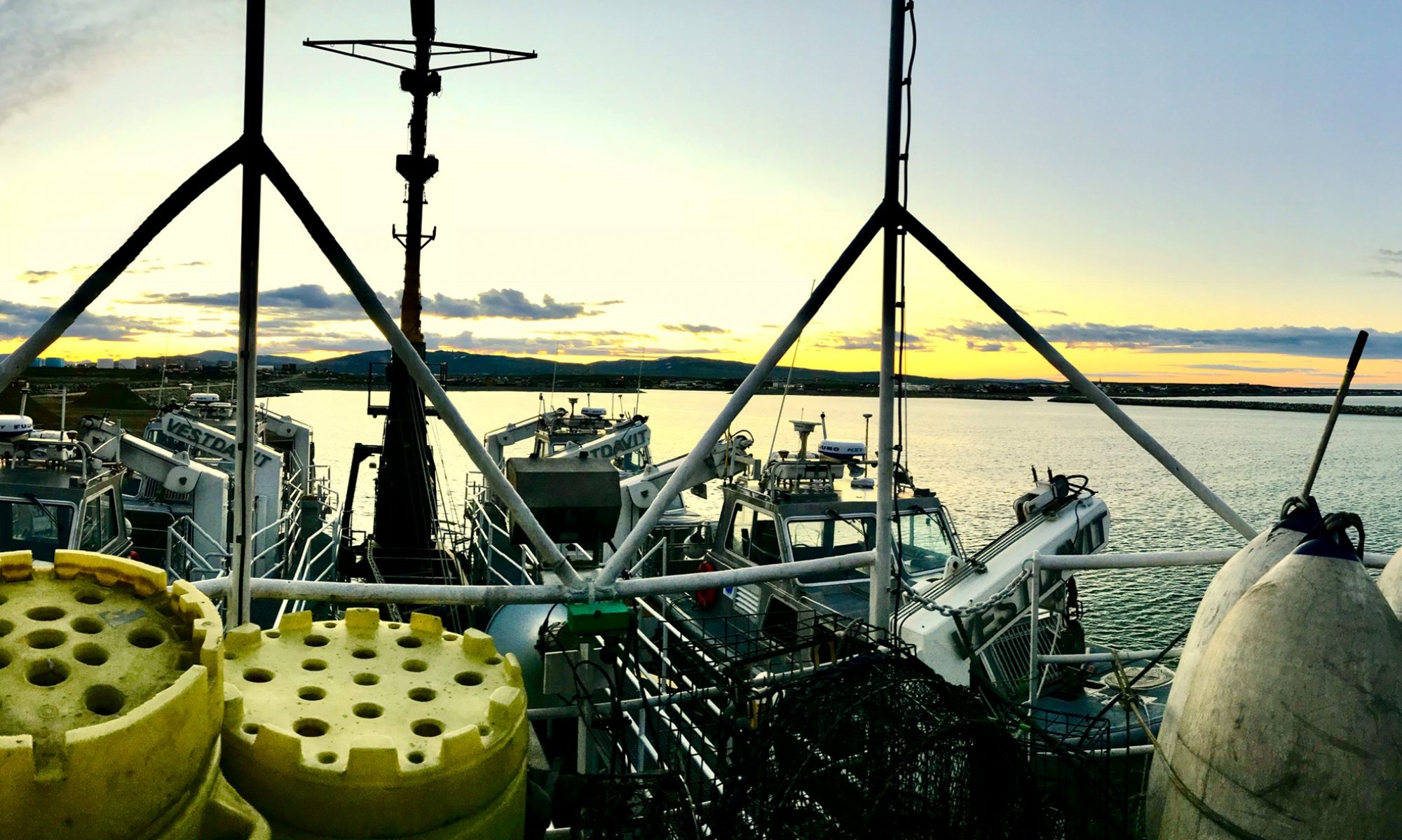
Jillian Worssam, July 9, 2004

NOAA Teacher at Sea
Jillian Worssam
Aboard NOAA Ship Miller Freeman
July 5 – August 1, 2004

Day: Four
Friday July 9th, 2004 21:15

Longitude: 57° Sea Wave Height: 0-1′
Latitude: 172° 44 Swell Wave Height: 0-1′

Visibility: 25 yrds fog Sea Water Temperature: 9.3C
Wind Direction: 69.6 Barometric Pressure: 1022 strong high pressure
Wind Speed: 14.1kts Cloud Cover: complete 100%

Haul Data
Depth of haul: 89 meters
Temperature at depth: 4.1° C
Species breakdown: walleye pollock, chum salmon, smooth lumpsucker, unidentified jellyfish

Science and Technology Log:

First haul of the evening and to our surprise pulled up a smooth lumpsucker (Aptocyclus ventricosus). What an amazing fish quite large in girth, but relatively short( approximately 10 inches). A large globe shaped body with the ventral sucking disk. We placed the fish in water and released it back into the Bering.

As for the rest of the catch, quite a few chum salmon this time, so I anticipate some smoked snacks tomorrow. I am becoming more and more comfortable with the process of slicing the fish to determine gender. Tomorrow will attempt the removal of the otoliths. Amazing the data that can be removed for the preservation of an ecosystem. We are off to complete another haul right now, so I am off to don my rain gear: thick rubber pants, rubber boots, and rubber jacket. I must also wear a hard hat and life jacket when on deck while the cranes are in motion and the ramp is down. With the ramp down it is easy access to the ever cold Bering Sea.

Personal Log:

Well I did it, finally tackled the treadmill, what a treat. My body had wanted to jog for days so in thirty minutes this morning I completed three miles, and for the first time ever I was jogging below sea level as the workout room is toward the bottom of the boat. Amazing the difference between 7000 feet and sea level. The way the treadmill is situated it rocks back and forth not side to side, it is similar to walking rises, with an uphill climb every now and then.

I also spent some more time in the bridge today. I would like to learn all the equipment so tonight I was taught about the EOT (Engine Order Telegraph) The one instrument on the bridge that actually looks familiar as it has probably been in every old war sea movie ever made. You know the big round brass machine with a level and an arrow, and the person on deck moves the arrow to face the command they would like sent to the engine room. The commands vary from full ahead to slow, half even stand by. Now with modern technology this apparatus is obsolete, but still on board in case of emergency and the electronics fail.

I was also introduced to an amazing centrifugal force windshield washer, but those details will have to wait until tomorrow.

Jilliam Worssam, July 7, 2004

NOAA Teacher at Sea
Jillian Worssam
Aboard NOAA Ship Miller Freeman
July 5 – August 1, 2004

Day: Two
Wednesday July 7th, 2004 20:05

Longitude: 60° Sea Wave Height: 3′
Latitude: 172° 18 Swell Wave Height: 0-1′

Visibility: closing 5-8 nm fog Sea Water Temperature: 7.9C
Wind Direction: 214 Barometric Pressure: 1028 strong high pressure
Wind Speed: 5 kts Cloud Cover: complete

Science and Technology Log:

The plan for tonight is to run a MOCC trawl to test the equipment prior to live sampling, but lets back up a moment and look at the device used for this fish collecting experiment. Originally known as the KMOCC (Karp Multiple Opening and Closing Codend), the MOCC as it is commonly known is a scientific piece of equipment designed to allow scientists to selectively sample specific layers in the ocean. MOCC has the ability to collect fish samplings from a maximum of three different stratum, allowing the scientists choice. Pollock of different sizes tend to congregate at different oceanic layers and through the use of equipment like the MOCC scientists can look at sonar and choose from which population they would like to sample, without contaminating the haul with fish from different size groups. This form of selective sampling will aid the researchers in observing specific fish (pollock) populations.

Today there have been no fish trawls as according to the sonar data the ships transects have not passed any significant fish populations.

Personal Log:

I am on a 215 foot research vessel, touring the Bering Sea looking for walleye pollock, and can sit at this computer for an hour, watching the sonar all alone. With over thirty individuals living on this floating community it never ceases to amaze me that the schedules can be so well devised as to allow people their individual space. With a spare moment one might even be seen sitting in their stateroom relaxing. This amazing personal space is a person’s home away from home and usually has two residents. Each individual will work mirror hours so that while one person is sleeping, the other is working. Why is this fact so important? Well let me explain to you how many staterooms on the Miller Freeman are designed.

As you enter a stateroom there is on one side a set of berths, similar to a bunk bed, but Spartan by necessity. Each berth is approximately three feet wide and two feet high. Not a lot of room for movement, but functional in the processing of sleep. After the berth there is a spartan sink, a small desk, and two built in closets, all in a space that is eleven feet long and approximately five and a half feet wide. (Please realize that the 5.5’ included the beds, closets everything, so walking space is at its best at 2.5’ in the very middle.) The closets are not standard sized actually they are miniature and already contain your personalized life jacket and survival suit. Once inside the survival suit though you might have more room than in your berth. Space aside the rooms are functional, and a little cozy. I have slept in my berth for a few nights, and with the rocking of the boat and the lull of the engine it is as comfortable as an old porch hammock, on a warm summer evening as the breeze lulls you to sleep.