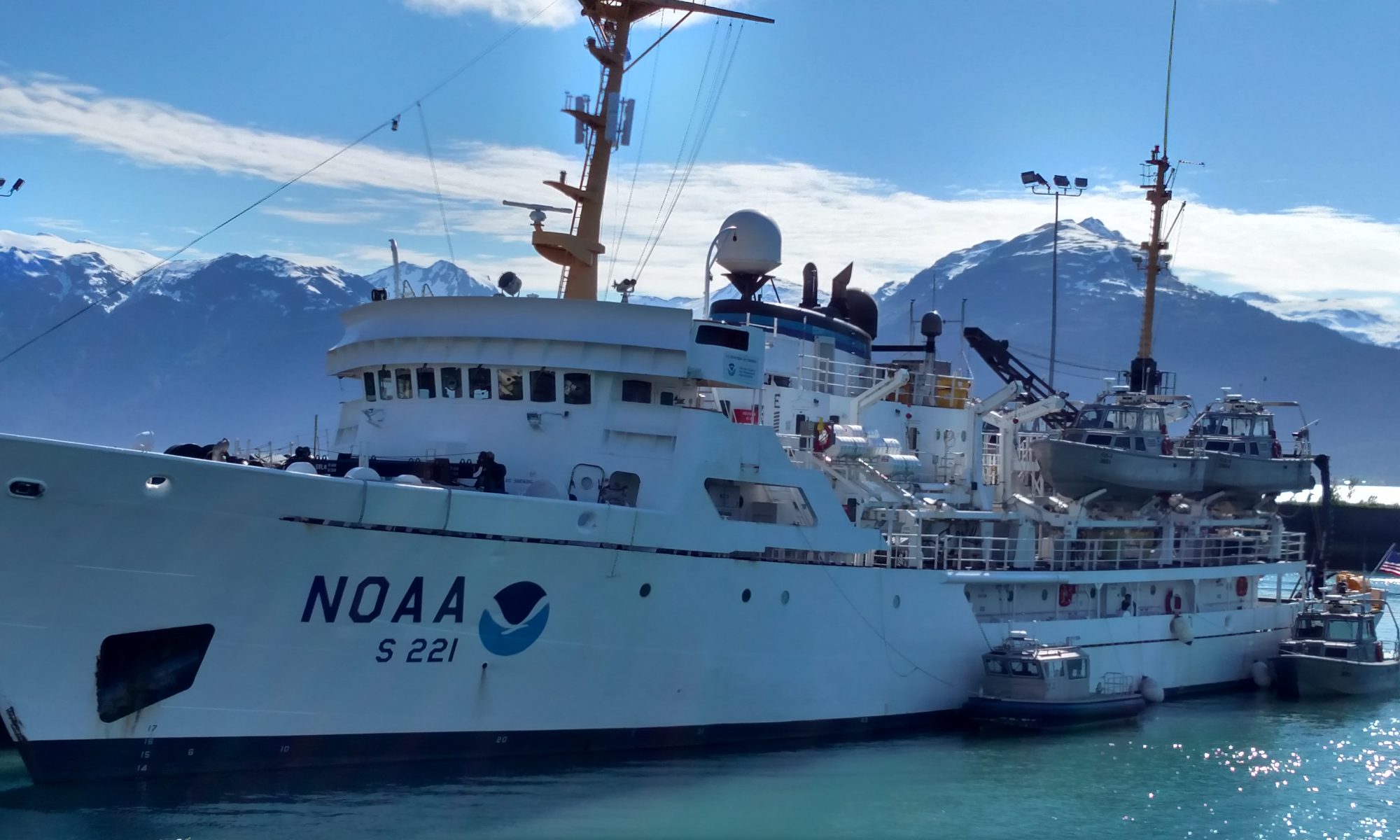
Sue Cullumber: A Slight Delay and Eagerly Awaiting Departure, June, 5, 2013

NOAA Teacher at Sea
Sue Cullumber
Onboard NOAA Ship Gordon Gunter
June 5–24, 2013

Mission: Ecosystem Monitoring Survey
Date: 6/5/2013
Geographical area of cruise:  The continental shelf from north of Cape Hatteras, NC, including Georges Bank and the Gulf of Maine, to the Nova Scotia Shelf

Weather Data from the Bridge:
Time: 1800 (6 pm)
Latitude/ Longitude: 41 degrees 32 N, 71 degrees 19 W
Temperature:  19.5 C or 67 F.

Science and Technology Log:

sueonNOAA
Walkway to the Gordon Gunter. Photo by Kevin Ryan.
map
Map of our Ecosystem Monitoring Survey.

I am currently onboard the Gordon Gunter, however we have been delayed a day due to an issue with the Automatic Steering Gear.  A part was to come in today, but the wrong part was shipped (twice) so we have to remain in port for another day.  We are currently at the Naval Station in Newport, Rhode Island and as soon as the part arrives, we will head up to the Gulf of Maine to start our Ecosystem Monitoring Survey. During the survey we will deploy our equipment and gather data at about 120 fixed stations and 25 random ones from the Gulf of Maine down to Norfolk, Virginia. At each station a Bongo Net (phytoplankton)  and/or CTD Rosette  (salinity, temperature, and density) equipment will be deployed which I will discuss in my upcoming blogs.

saratogatoGgunther
The de-commisioned Aircraft Carrier, Saratoga, at the Newport Naval Base. You can see the Gordon Gunter on the far right.
IMG_8038
The diesel engines on the Gordon Gunter.

The Gordon Gunter: The NOAA ship Gordon Gunter was originally built in 1989 as the U.S. Naval Ship Relentless.  When first built it was designed to be used for ocean surveillance mainly hunting submarines. In 1993 it was transferred to NOAA and became the NOAA ship Gordon Gunter in 1998.  Because it was built for hunting submarines, it is a very quiet ship.  It runs off of four diesel generators that  power all the ship’s systems, which includes the ship’s two electrical propulsion motors and bow thruster.

The Gordon Gunter is 224 feet long with five levels above the water line. It can go at a top speed of 10 knots (about 11.5 miles per hour).  This does not sound very fast, but it is a good speed for completing scientific surveys (and hopefully avoiding getting seasick). Actually most of the trawling nets (like for phytoplankton) are dispatched at 3 knots (about 3.45 miles per hour).  The ship also has V-Sat (very small aperture transmission) satellite to provide connection to the internet and phone communications.

IMG_8235
Gordon Gunter Mess Hall
IMG_8243
The “Wet Lab”

The ship seems to have all the comforts of home!  There is the bridge (ship navigation), observation deck, state rooms (sleeping quarters – with a total of 35 bunks), a gym, movie room, TV room, mess hall, store, laundry area, dry lab,and wet lab.  The “dry lab” is essentially the computer lab and this is where data from the survey will be entered into the computer. The “wet lab” is the location of where the ocean samples will be processed.

IMG_8233
Operations Officer, Mark Weekley, gives us a tour and discusses safety drills.

Today we took a tour of the ship and learned about some of the important safety drills that are required onboard. The three main drills are: Fire and Collision, Man Overboard and Abandon Ship.  Each one has it’s own set of alarms that we need to be aware of.  The day we depart (hopefully tomorrow) we will be doing one or more of these drills to make sure we are ready!

Besides the scientists onboard, there is a NOAA crew that pilots and runs the ship. The Gordon Gunter is involved in many scientific voyages along the Atlantic Coast from as far north as Nova Scotia to down south along the Gulf of Mexico and the Caribbean.  It’s home port is the Pascagoula Laboratory in Pascagoula, Mississippi.  Each of these expeditions has a different scientific crew, but the ship personnel usually remains the same.  This crew is essential to the smooth running of the ship and includes: Commanding Officer, Executive Officer, Operations Officer, Navigation Officer, Safety Officer, Junior Officer, Engineering personnel, Deck personnel, Stewards (meal preparation), and Electronics personnel.

The Bridge - ship operations and navigation.
The Bridge – ship operations and navigation.

 Personal Log:

IMG_8023
My stateroom on the Gordon Gunter.

I am getting to learn my way around the ship and am all moved into my stateroom. I was really surprised at how large it is!  I have a roommate – Kat, a graduate student, for the first leg of the trip and then Sarah, an intern, for our second leg.  We will make a stop in Woods Hole, Massachusetts on June 16th to drop a few people off and welcome aboard some new ones.  So far I have met several marine and bird scientists, a college volunteer, graduate student, and college intern. The science and NOAA crew are all very friendly and welcoming, but it is hard to sit here in port and am really looking forward to heading out to sea and learning all the science that I can share with my students.

sunsetNOAA
Sunset outside the Gordon Gunter – waiting to leave port.

Did you know?  NOAA has its beginnings in as far back as 1807, when the Survey of the Coast was started as the nation’s first scientific agency.

Sherie Gee: Preparing for Life at Sea, May 30, 2013

NOAA Teacher at Sea
Sherie Gee
Aboard R/V Hugh R. Sharp
June 26 – July 7, 2013

Mission:  Sea Scallop Survey
Geographical area of cruise:  Northwest Atlantic Ocean
Date:  May 30, 2013

Personal Log:

Hello, my name is Sherie Gee and I live in the big Lone Star State of Texas. I teach AP Environmental Science and Aquatic Science at John Paul Stevens High School in San Antonio, home of the Alamo and the Spurs. I have been teaching for 31 years and I am still thirsty for new knowledge and experiences to share with the students which is one of the reasons I am so excited to be a NOAA Teacher at Sea. I will get to be a “scientist” for two weeks collecting specimens, data, and using scientific equipment and technology that I plan to incorporate into the classroom.

I am also excited to be on this spectacular voyage because I feel very passionate about the ocean and all of its inhabitants. The ocean is a free-access resource which means it belongs to everyone on Earth so it needs to be taken care of. Overfishing, overharvesting and ocean pollution are global issues that I feel strongly about and feel that there has to be new ocean ethics. Teachers are in the best position to bring about ocean awareness to the students and the public. I feel very fortunate to be given this opportunity by NOAA to be part of an ocean conservation program. One of my favorite quotes is from Rachel Carson: “The more clearly we can focus our attention on the wonders and realities of the universe, the less taste we shall have for destruction.” I truly believe this because in order for people to care for our Earth and environment and not destroy it, they have to understand it and appreciate it first.

For two weeks I will be collecting the Atlantic sea scallop to determine the distribution and abundance of these animals. This survey is conducted in order to assess these scallop populations in certain areas of the Atlantic Ocean and determine if they have been overharvested and need to be closed to commercial fishermen for a period of time. I am very relieved to know that there are such programs around the world that focus on ocean fisheries and sustainability. I will be describing this survey of the Atlantic sea scallop in greater detail in my blogs.

Atlantic Sea Scallop
Courtesy of http://www.fishwatch.gov/seafood_profiles/species/scallop/species_pages/atlantic_sea_scallop.htm

This will definitely be an exciting ocean experience for me. I live three hours away from the nearest ocean (The Gulf of Mexico) and have always managed to venture to an ocean each year. Every year I take my students to the Gulf of Mexico on the University of Texas research vessel (The Katy) to conduct plankton tows, water chemistry, mud grabs and bottom trawls.  I love to see the students get so excited every time they bring up the otter trawl and watch the various fish and invertebrates spill out of the nets.

UT Marine Science Research Vessel, The Katy
Student sorting through the otter trawl on the Katy

I know I will be just like the kids when they bring up the trawls from dredging. People who know me say I am a “fish freak”. Fish are my favorite animals because of their high biodiversity and unique adaptations that they possess. I am a scuba diver and so I get to see all kinds of fish and other marine life in their natural habitat. I am always looking for new fish that I haven’t seen before. The top two items on my “Bucket List” are to cage dive with the great white shark (my favorite fish) and to swim with the whale shark. I recently swam with whale sharks in the Sea of Cortez and would like to do that again in the Caribbean with adult whale sharks.

Juvenile 15 foot whale shark in the Sea of Cortez Photo by Britt Coleman
Juvenile 15 foot whale shark in the Sea of Cortez

Needless to say, I can’t wait to start sorting through all of the various ocean dwellers and discover all the many species of fish and invertebrates that I have never seen before. I hope you will share my enthusiasm and follow me through this magnificent journey through the North Atlantic Ocean and witness the menagerie of marine life while aboard the Research Vessel Hugh /R. Sharp.

R/V Hugh R. Sharp
R/V Hugh R. Sharp

http://www.ceoe.udel.edu/marine/rvSharp.shtml

Sherie Gee holding an Olive Ridley hatchling at the Tortugueros Las Playitas A.C. in Todos Santos, Mexico Photo by Britt Coleman
Sherie Gee holding an Olive Ridley hatchling at the Tortugueros Las Playitas A.C. in Todos Santos, Mexico
Photo by Britt Coleman

Melanie Lyte: May 29, 2013

NOAA Teacher at Sea
Melanie Lyte
Aboard NOAA Ship Gordon Gunter
May 20 – 31, 2013

Mission: Right Whale Survey, Great South Channel
Geographical Area of Cruise: North Atlantic 
Date: May 29, 2013

Weather Data from the Bridge:
Air temperature: 12.8 degrees Celsius (55 degrees Fahrenheit)
Surface water temperature: 11.8 degrees Celsius (53 degrees Fahrenheit)
Wind speed: 21 knots (25 miles per hour)
Relative humidity: 100%
Barometric pressure: 1023.5

Science and Technology Log

Right whale I saw on 5/28
Photo Credit: NOAA/NEFSC/Peter Duley under Permit #775-1875

We finally had a right whale sighting today! It was a juvenile and was quite close to the ship. It was exciting to see it frolicking.  

Allison Henry, chief scientist, recently told me that over 70% of the right whales they see have entanglement scars. The scars are due to entanglement in fishing lines.

Right whale with entanglement scars.
Photo Credit:; Mavynne under Permit # EGNO 1151
Right whale with entanglement scars.

Sometimes teams of scientists with special training attempt to disentangle a whale. It can be dangerous work. The video below shows a team working to remove fishing lines from a whale in 2011. The scientists first need to attach the small boat to the whale with lines so they can stay with it while it swims until it exhausts itself.  Only when the whale is tired, can the team work to cut away the entanglement.

Watch  this video of a whale disentanglement.

The other hazard is that whales tend to rest and feed near the surface of the water in the shipping lanes, and can be hit by ships.

During the day, from 7am-7pm, the scientists take turns on watch. This means we watch for whales using “big eyes” which are giant binoculars. We spend 30 minutes on left watch, 30 minutes in the center, and 30 minutes on the right watch.  At the center station we record sightings and update the environment using a computer program designed for this purpose.

The big eyes
photo credit: Barbara Beblowski
Recording data
phot credit: Peter Duley

I visited the Wheel House on the ship today. This is also called the bridge, and is the control center of the ship (similar to the cockpit of an airplane). The wheel house has many controls that the crew needs to know how to use, and it takes years of training to be able to command a ship. I spoke with Commanding Officer Lieutenant Commander Jeffrey Taylor and Executive Officer Lieutenant Commander Michael Levine about the workings of the Gunter.

Wheel or helm of the ship
Auto Pilot
Auto Pilot

This is the wheel or helm of the ship. The Gunter is one of the last NOAA ships with this type of helm. The newer ships have a helm that looks more similar to that which you find in a race car. Although the helm is still used to steer the ship at times, especially when docking, the steering is left to the auto pilot  the majority of the time.

ARPA radar
ARPA radar

I know some of you were concerned about how the officers could see to steer the boat in the fog. The ship has an ARPA radar system that shows where other boats in the area are in relation to our ship. The radar also shows the course our ship is taking and alerts the crew to anything that may be in the path of the ship.

Throttles
Throttles

The throttles control the speed of the ship. The maximum speed of ship is 10 knots which is about 12 miles per hour. The ship uses diesel fuel and it takes about 1,200 gallons of fuel to run the ship for a 24 hour period. At night they will sometimes shut down one engine which makes the ship go slower, but which saves about 400 gallons or $1,600 a day. This is one reason why we anchored for 3 days during the bad weather. The weather made surveying whales impossible so it didn’t make sense to run the ship during that time. The cost of running the Gunter is $11,000/day on average. This includes everything to do with sailing including salaries, food, etc.

Personal Log

I know that some of my first graders have been asking about where I sleep and eat on the ship. Below are pictures of my stateroom and the galley of the ship. Two very important places!

Stateroom (sleeping quarters)
Galley on the Gordon Gunter

Melanie Lyte: May 26, 2013

NOAA Teacher at Sea
Melanie Lyte
Aboard NOAA Ship Gordon Gunter
May 20 – 31, 2013

Mission: Right Whale Survey, Great South Channel
Geographical Area of Cruise: North Atlantic
Date: May 26, 2013

Weather Data from the Bridge: 

Air temperature: 15.5 degrees Celsius (60 degrees Fahrenheit)
Surface water temperature: 12.01 degrees Celsius (54 degrees Fahrenheit);
Wind speed: 10 knots (12 miles per hour);
Relative humidity: 85%;
Barometric pressure: 1005.5

Science and Technology Log

Here we are on Sunday afternoon and we’ve been anchored off Provincetown since Thursday evening to wait out bad weather and unworkable conditions. When the fog cleared, the view of Provincetown was quite pretty from the ship, but I have seen enough of it, and am ready for some adventure . Luckily, we set sail this evening and will begin our watch for right whales again tomorrow morning. While Monday looks to be quite windy, Tuesday shows promise as a good day for whale sightings. All the scientists aboard are anxious to get back to work!

During our down time I was able to interview two people aboard with very different jobs – Peter Duley, one of the NOAA scientists, and Margaret Coyle, the ship steward.

Peter Duley NOAA scientist

Peter has worked for NOAA for 10 years, and has also worked for The National Science Foundation. He has literally been to the ends of the earth doing research. He did his under graduate work at the College of the Atlantic in Bar Harbor Maine . Upon graduation  Peter did field work in Belize banding birds. While his first love was birds, he became interested in marine mammals and has done research work studying harbor porpoises in the Gulf of Maine, pilot whales in the mid Atlantic to the Gulf of Maine, bowhead whales in Alaska, right whales along the East Coast, and even spent time in Antarctica studying leopard seals. He now spends his summers on right whale survey cruises, and his winters doing aerial surveys of right whales.

While interviewing Peter I was struck by the passion and excitement he has for his work. It is obvious that he loves what he does and is very dedicated to saving the “giants of the sea”. All of the whales Peter studies are endangered and it is imperative  that scientists have a handle on the populations of these endangered whales so they can determine if the number of whales is rising or falling over a period of time, and what factors are influencing their survival. These scientists are so familiar with some of the right whales that they can identify the whales that have already been cataloged when they see them. They are cataloging all the whales using a number system that includes the year the whale was first seen, and another number that matches their mother if she is a whale that has previously been cataloged.

Peter’s favorite marine mammal is  the leopard seal.  He told me a story about the most dangerous situation he has been in while doing field work. He was in Antarctica in a small inflatable boat called a Zodiac and a leopard seal swam right up to the boat. He and his colleagues were excited and started taking pictures when the seal jumped out of the water and came down with its mouth on the side of the boat. The seal put a large hole in the boat. Fortunately, the boat had several different air compartments so the entire boat didn’t deflate in the frigid Antarctic waters, but Peter and his colleagues got back to shore as quickly as possible. My next question was, “What was your best research experience?” Peter said smiling, “The time the leopard seal put a hole in the boat!”

The other person I interviewed is Margaret Coyne, the ship steward. She  probably is one of the most important people on the ship because she keeps us all fed! Not only does she make three meals a day for everyone on board, we actually eat like we are at a 4 star resort. There is always an amazing variety of delicious food at every meal.

Margaret Coyle Ship's Chief Steward
Margaret Coyle
Ship’s Chief Steward

Margaret and her 2nd cook Tyrone  Baker, work 12 hour days from 5:30-6:30 with an hour break during the day. The galley is always buzzing with crew and scientists enjoying meals, snacks, leftovers, or anxiously awaiting for the homemade soup of the day to be brought out. There are always plenty of choices for all types of eaters – Margaret makes vegetarian options for each meal. She also makes her own yogurt, soy milk,  fresh salad, ice cream,  and a delicious dessert daily.

Lunch menu
Lunch menu
Spinach lasagna roll, squash and onions, black eye peas, and roasted potatoes
Spaghetti with meat sauce, pesto grilled chicken breast , squash and onions, and  a garlic bread stick
Spaghetti with meat sauce, pesto grilled chicken breast, squash and onions, and a garlic bread stick
Blueberry cobbler with whip cream

Personal Log

I will be happy when we start moving again and get back to the mission of surveying right whales. It has been difficult to be stationary for such a long time, but luckily, the scientists and crew are all so friendly that there is always someone to talk to. It is really interesting to learn about other people’s lives, and what brought them to where they are today. Hopefully I will remember this experience because of all the amazing whales I will get to see, but if not, I know I will carry fond memories of all the people I met.

Melanie Lyte: May 24, 2013

NOAA Teacher at Sea
Melanie Lyte
Aboard NOAA Ship Gordon Gunter
May 20 – 31, 2013

Mission: Right Whale Survey, Great South Channel
Geographical Area of Cruise: North Atlantic
Date: May 24, 2013

Weather Data from the Bridge:
Air temperature 15.5 degrees celsius (60 degrees fahrenheit)
Surface water temperature 12.01 degrees celsius (54 degrees fahrenheit)
Wind speed 10 knots (12 miles per hour)
Relative humidity 85%
Barometric pressure 1005.5

Science and Technology Log

We are on the fifth day of our cruise and the weather is being very uncooperative! It has been foggy everyday which makes sighting whales very difficult. Before we started the cruise (it sounds strange to call it a cruise. It seems more like a mission),  an aerial survey team did a fly over and spotted some right whales in the area we’ve been combing, but we have been unable to find them. Now we have set anchor off Provincetown, Cape Cod to sit out some bad weather that has moved in. We will stay here in this protected area until Sunday. This morning the wind was blowing at 54 knots or 60 miles per hour. Did you know that a knot is about 1.2 miles per hour? We set anchor last night and the wind was so strong it dragged the  ship and anchor 300 yards!

While this is disappointing for me and for all aboard, I am amazed at the positive attitude and optimism shown by the scientists here. They take it all in stride, and are used to things not turning out as they had planned. I guess that’s the nature of field work. They are all extremely dedicated and passionate about their research.

The Gordon Gunter
NOAA Ship Gordon Gunter
Photo credit: NOAA

You can track the course of the Gordon Gunter by going to the NOAA ship tracker website: http://shiptracker.noaa.gov/shiptracker.html . The ship is always in pursuit of whales so the track will sometimes look like a zigzag with lines crossing back and forth over each other. You can keep checking back to see our progress once we set sail again.

Although I have not seen many marine mammals, I have seen some sea birds that are new to me. The first is the gannet. The gannet is known for its diving ability. It can plunge into the ocean head first and go down 30 ft. It is a sea-bird so it never rests on land other than when it goes to its breeding colony.

Northern gannet photo
Northern gannet
Photo credit: Marie C. Martin

Next, I saw a greater shearwater. This bird is also a sea-bird which means it doesn’t go to land unless it is breeding. They congregate on Nightingale Island to breed. Nightingale Island is located between the tips of Africa and South America. They have a very long flight during breeding season!

Great shearwater
Great shearwater
Photo credit: birdfroum.net

I also saw a Northern Fulmar. They are also sea birds and they nest in Scotland. These birds look much like sea gulls.

Northern Fulmar
Northern Fulmar
Photo credit: Andreas Trepte

Personal Log

Today is day 5 of our cruise. While it is disappointing that the weather has not cooperated, it is such a learning experience to be on a ship like this one. I am learning so much everyday about what it’s like to be a scientist in the field. Besides being patient and optimistic, scientists need to be careful and precise in recording their field work. It is a good lesson for me and for you (my first graders) to always work carefully, and give close attention to detail in your work because that is what being a scientist is all about. Start practicing doing your best and most careful work now so you will be ready to be scientists when you grow up.

At this point I can see Provincetown from the ship, but for 2 days there was no land in sight. I really got a sense of just how big the ocean is. When we’re not sailing there is not much to do on the ship. I am fortunate that there are many new people to befriend, books to read and listen to, and delicious food at every meal. I also enjoy all your comments so keep them coming!

Did You Know?

Did you know that some of the scientists on this cruise have dedicated their entire working lives to surveying and cataloging right whales? They migrate with the whales down south in the winter, and come back up north in the spring.

Did you know that the sea depth is measured in fathoms? 1 fathom equals 6 feet

Question of the day:

Here is a line from a famous poem The Rime of the Ancient Mariner by the English poet Samuel Taylor Coleridge,

“Water, water everywhere, but not a drop to drink”

What do think that means? Why can’t they drink the water? Hint: The poem is written about sailors who are shipwrecked in a big storm out at sea

New  Vocabulary: Draw a ship and label all the parts below
Bow- front of the ship
Stern- rear of the ship
Starboard- right side of the ship
Port- left side of the ship
Aft- toward the back of the ship
Forward- toward the front of the ship