Christine Webb: August 23, 2017

NOAA Teacher at Sea

Christine Webb

Aboard NOAA Ship Bell M. Shimada

August 11 – 26, 2017

Mission: Summer Hake Survey Leg IV

Geographic Area of Cruise: Pacific Ocean from Newport, OR to Port Angeles, WA

Date: 8/23/2017

Latitude: 48.19 N

Longitude: 125.29 W

Wind Speed: 7.9 knots

Barometric Pressure: 1021.70 mBars

Air Temperature: 62.1 F

Weather Observations: Partially cloudy

Science and Technology Log

For today’s science and technology log, I interviewed my roommate Tracie. You only have to talk to Tracie for five seconds to learn that she’s passionate about marine chemistry and marine biology and marine physics…all things marine. She’s the HAB (harmful algal bloom) specialist on board, and she’s been squirreled away in the chemistry lab every day collecting lots of great samples as we travel up the coast. Before we left Newport, she taught me a bit about algae by taking me to the beach to see some bioluminescent dinoflagellates. When we stomped in the water, the dinoflagellates would glow! It looked like puddles full of blue lightning bugs, and it was amazing. One of her quotes from that night was, “I imagine this is what unicorn footprints would look like if they were traipsing over rainbows.” Everyone should have the chance to see that at some point in their life. It gave me a taste of why it makes sense to be so passionate about algae. So, without further ado, here’s your chance to learn a bit more about HABs from my friend Tracie!

  1. What is a HAB, and why should we care about them?

HABs are phytoplankton that have negative consequences either for us or the ecosystem. Some can release neurotoxins that can be damaging to mammals (including humans), amongst other things. A harmful algal bloom (HAB) can also create a dead zone by a process called eutrophication. Bacteria eat the phytoplankton once they begin to die, which removes oxygen from the water.

  1. What makes it a bloom?

A “bloom” is when there is so much algae that the ecosystem can’t support it and they start to die off. There aren’t enough nutrients available in the water. Some people call this a “Red Tide.” There are certain species, such as Alexandrium spp., where even one cell per liter would be enough to create a harmful effect.

  1. What made you decide to study HABs?

During a lab in college, we were allowed to go to the beach and sample phytoplankton. When we got back to the lab with our samples, we found a huge amount of Pseudo-nitzschia spp. It releases a neurotoxin that gives mammals amnesiac shellfish poisoning. That year, we couldn’t eat shellfish and crab from our area because of this bloom. There’s no antidote to this toxin, and it affects the brain function of mammals who eat it. Whales died that year because they forgot how to breathe. This made me super interested in studying more about these types of species.

  1. What are you specifically hoping to find in your research aboard this cruise?

We’re trying to find where blooms start, how blooms begin, and follow them within the California Current system. It’s part of an ongoing study of the California Current system and how species are transported. California fisheries have been dramatically affected by HABs.

  1. Have you been finding what you need so far?

It’s been really interesting…we’ve seen quite a few Dinophysis species (which I find to be the cutest), and some really interesting Pseudo-nitzschia spp., but no blooms. Close to the coast, within 15 nm of shore, I see a lot more diversity in my samples. This is mostly due to upwelling.

  1. Has anything in your research so far surprised you?

There are very few species that I haven’t recognized, which is interesting because we’re so far north. We have fjord-like environments up here by Vancouver Island, so I expected there to be a higher abundance of phytoplankton up here than I saw.

  1. What is a common misconception about HABs?

The term “HAB” itself – they’re called harmful because they’re harmful to us as humans and to various industries, however – they provide a huge amount of support to other animals as primary producers and as oxygen producers.

They’re basically plants that can swim, and they’re all food for something. They’re not harmful for most things, so the name is kind of a misnomer. In defense of the HABs, they’re just trying to survive. Phytoplankton are responsible for around 50% of the world’s oxygen, and they’re the primary producer for marine and freshwater ecosystems.

  1. Anything else you want people to know?

There’s still a lot that we need to learn, and I would like everyone at some point in their life to see how beautiful these fragile organisms are and appreciate how much they contribute to our world.

  1. If you weren’t a marine chemist, what would you be?

I would write nonfiction about the beauty of the world around us. Or maybe I’d be an adventure guide.

  1. What are some fun facts about you that not a lot of people know?

My motto for life is “always look down.” There’s so much around us, even the dirt under our toes, that is so full of life and beauty.

My art is on Axial Seamount, 1400 m below sea level, 300 miles off the coast of Oregon! I drew an octopus high-fiving ROPOS the ROV that placed it there!

Also, I’m a high school dropout who is now a straight-A senior in environmental science at the University of Washington, Tacoma. Other people’s perceptions of you don’t control your destiny.

Here are a couple pictures of some of the HABs Tracie has seen during this trip (she took these pictures from her microscope slides):

329 D. fortii
Algae under the microscope: D. fortii. Image by Tracie.
329 hobbit house 2
Algae under microscope. Image by Tracie.

Personal Log:

Since today’s science log was about Tracie, I’ll feature her in the personal log too! She’s my partner in the ship-wide corn hole tournament, and we won our first-round game yesterday. Look at these awesome corn hole boards that were specially made for the Shimada!

IMG_20170822_153718727
Shimada corn hole board!

We mostly credit our fabulous war paint for the win. Today we play against our fellow scientists Lance and Tim. Wish me luck!

corn hole victory
Christine and Tracie celebrate corn hole victory

Another down-time activity that Tracie (and all the scientists) enjoy is decorating Styrofoam cups. The cool marine biologist thing to do is to sink them to very low ocean depths (3000+ meters). Apparently the pressure at that depth compresses the Styrofoam and shrinks it, making the cup tiny and misshapen but still showing all the designs that were put on it. I’m not kidding: this is a thing that all the marine biologists get really excited about. Tracie even decorated a Styrofoam head (the kind that cosmetologists use) in advance of this trip and brought it with her to sink. Look how cool it is – she’s an amazing artist!

IMG_20170824_171631958_HDR
Styrofoam head, decorated by Tracie, for shrinking

There are shrunken heads in the lab already from other people who have done this. Sinking Styrofoam is a legit marine biology hobby. Well, as the saying goes, “When in Rome…” so I worked on a Styrofoam cup today. I’m making a hake tessellation, which takes longer than you might think. Here’s what I’ve got so far:

IMG_20170823_051528993
Styrofoam cup decorated with hake tesselation

We’re having lots of fun at sea on this beautiful day. Someone just came over the radio and said there’s been a marine mammal sighting off the bow…gotta go!

Special Shout-out:

A special shout-out to Mrs. Poustforoush’s class in Las Vegas, Nevada! I just found out you’ve been following this blog, and it’s great to have you aboard. If you have any questions about algae (from this post) or about life on a ship, please feel free to e-mail me. I can hopefully get your questions answered by the right people. Work hard in Mrs. Poustforoush’s class, okay? She’s a great teacher, you lucky kiddos. Learn a lot, and maybe one day you can be a scientist and live on a ship too!

Susan Brown: Adventure Awaits, August 24, 2017

NOAA Teacher at Sea

Susan Brown

Aboard NOAA Ship Oregon II

September 2 – 15, 2017


Mission: Shark/Red Snapper Longline Survey

Geographic Area of Cruise: Gulf of Mexico

Date: August 24, 2017


Weather Data from the Bridge

I’m currently at home in Flagstaff, Arizona. It’s a typical, monsoon season morning coming in at 11.6 degrees C (53 degrees F) at 7:12 am with humidity at 92%. I’m about 1,700 miles away from Pascagoula, Mississippi, where I will be joining the team on our ship, NOAA Ship Oregon II, in just a few days!

NOAA Ship Oregon II Sunset_NOAA Photo
NOAA Ship Oregon II. Photo credit: NOAA

NOAA Ship Oregon II Photo Credit: NOAA

Weather Data from my desk at school:

Latitude: 35.190807
Longitude: -111.65127
Sea wave height: NA
Wind Speed: 2 Mph
Wind Direction: NW
Visibility:
Air Temperature: 11. 6 degrees C
Barometric Pressure: 29.84” falling Rapdily
Sky:  scattered clouds


Science and Technology Log

Once on board, I will be assisting the science crew with the third leg of the Shark/Red Snapper Longline Survey and will be fishing from Brownsville, TX to Galveston, TX. The mission of this survey is to monitor interannual variability of shark populations of the Atlantic coast and the Gulf of Mexico.

longline_sampling_area
Map of the survey area: the Atlantic coast and the Gulf of Mexico.

My understanding is that we will be working a 12-hour shift using longline gear to capture specimens and measure the length, weight and sex of the animal. The longline is baited with Atlantic Mackerel and will sit in the water for one hour. Here is what longline gear looks like:


longline_gear_illustration
Illustration of longline gear. Credit: NOAA


The larger animals will require landing slings! I can’t even imagine. The science crew will also be tagging the animals as well as retaining a few for research. Finclips, like taking a nail clipping, will be gathered for DNA analysis. I am most excited to get up and close with these wonderful creatures tagging them to monitor their movement and health.


shark_measure2_small
Measuring a tiger shark. Photo credit: SEFSC


shark_measure1
Measuring a shark. Photo Credit: SEFSC


As part of the survey we will be gathering CTD (Conductivity Temperature Depth) data that provides a surface to bottom profile of temperature, salinity, dissolved oxygen, chlorophyll, turbidity and depth. As a class, we will be learning about these in depth in the classroom when we reach our unit on water quality in relation to our local watershed.

Personal Log

I am getting excited for this adventure and happy to have you along for the journey. I look forward to your questions and can’t wait to learn about these beautiful creatures while working with scientists. Please makes sure to check out the “Question of the Day” and other activities that will be posted on this blog. Your current research on sharks will come in handy while I am out here and will be crucial to learning about ocean food webs and current threats. Remember to check in daily for new posts while you are working on your projects.


Did You Know?

That I have never been to the Gulf of Mexico!


Question of the day

What species of shark live in the Gulf of Mexico?

Christine Webb: August 21, 2017

NOAA Teacher at Sea

Christine Webb

Aboard NOAA Ship Bell M. Shimada

August 11 – 26, 2017

Mission: Summer Hake Survey Leg IV

Geographic Area of Cruise: Pacific Ocean from Newport, OR to Port Angeles, WA

Date: 8/21/2017

Latitude: 49.48 N

Longitude: 128.07 W

Wind Speed: 10 knots

Weather Observations: Sunny

Science and Technology Log

Today was our first chance to use the Methot net, and it was a lot of fun! The Methot net is smaller than the net that we usually use, and it is used to catch smaller organisms. Today we were targeting euphausiids. We thought we saw a pretty good aggregation of them on the 120 kHz acoustics data, where they appear the strongest of the three frequencies we monitor. We needed to validate that data by trawling the area to find the source of the backscatter and make sure they really were what we thought they were. There are many scientists who use data on euphausiids, so this was a good opportunity to provide them with some additional data. Because we’ve been working mostly on larger organisms, I was excited for the chance to see what a Methot net would pull up.

IMG_20170821_125553193_HDR
The Methot net coming up with its haul

It was very exciting that when the net came up, we had TONS of euphausiids! (“Tons” here is not used in a literal sense…we did not have thousands of pounds of euphausiids. That would have been crazy). Although we did not have thousands of pounds of them, we did have thousands of specimens. I’m sure thankful that we only had to take data on a subsample of thirty! I got to measure the lengths and widths of them, and using the magnifying lenses made me look very scientific.

IMG_20170821_145225093
Measuring euphausiids

Along with euphausiids, we also found other species as well. We found tiny squids, jellies, and even a baby octopus! It was adorable. I’ve never considered that an octopus could be cute, but it was.

IMG_20170821_131649146
Baby octopus

We also measured volumes and weights on samples of the other specimens we found, and I used graduated cylinders for the first time since college. We would put in a few milliliters of water, add our specimens, and then calculate the difference. Voila! Volume. Good thing I remembered to call the measurement at the bottom of the liquid’s meniscus… I could have messed up all the data! Just kidding… I’m sure my measurements weren’t that important. But still – good thing I paid attention in lab skills. It was definitely a successful first day with the Methot net.

Personal Log

The big buzz around the ship today was the solar eclipse! I was even getting excited at breakfast while I ate my pancakes and made them eclipse each other. We got lucky with weather – I was nervous when I heard the foghorn go off early in the morning. Fortunately, the fog lifted and we had a pretty good view. We all sported our cheesy eclipse shades, and the science team wore gray and black to dress in “eclipse theme.” Even though we couldn’t see the totality here, we got to see about 85%. We’re pretty far north, off the coast of Vancouver Island in Canada. The mountains are beautiful! Seeing land is always a special treat.

Here are some eclipse pics:

IMG_20170821_091709694
Rockin’ our cheesy eclipse shades
IMG_20170821_101636324
Some science team members enjoying the eclipse
IMG_20170821_100819772
Eclipse!

The eclipse would have made the day exciting enough, but the excitement didn’t stop there! While the scientists and I were working in the wet lab, we heard that a pod of orcas was swimming within eyesight of the ship. We dropped everything and hurried to take a look. It was so amazing; we could see five or six surface at once. They must have been hunting. We only see orcas when we’re close to land because their prey doesn’t live in deeper waters. Deeper into the ocean we are more likely to see gray or humpback whales.

It’s almost time for dinner…we sure have been spoiled for food! Last night we had pork loin and steak. I’m not sure that our chef will be able to top himself, but I’m excited to find out. I have heard rumors that he is very good at cooking the fish we’ve been catching, and that really makes me wish I liked seafood. Unfortunately, I don’t. At all. Not even enough to try Larry’s fried rockfish. Luckily, he makes lots of other food that I love.

Tonight after dinner I think Hilarie, Olivia, and I are going to watch Pirates of the Caribbean 2. Last night we watched the first movie while sitting on the flying bridge. It was a pretty cool experience to feel the spray of the sea while watching pirates battle!

IMG_20170820_174605473_HDR
Movie time!

That’s all for now; I’ll be back with more scientific fun soon!

Did you know?

Krill (the type of euphausiid we studied) is one of the most populous species on earth. It basically fuels the entire marine ecosystem.


Christine Webb: August 19, 2017

NOAA Teacher at Sea

Christine Webb

Aboard NOAA Ship Bell M. Shimada

August 11 – 26, 2017

Mission: Summer Hake Survey Leg IV

Geographic Area of Cruise: Pacific Ocean from Newport, OR to Port Angeles, WA

Date: 8/19/2017

Latitude: 48.59 N

Longitude: 126.59 W

Wind Speed: 15 knots

Barometric Pressure: 1024.05 mBars

Air Temperature: 59 F

Weather Observations: Sunny

Science and Technology Log:

You wouldn’t expect us to find tropical sea creatures up here in Canadian waters, but we are! We have a couple scientists on board who are super interested in a strange phenomenon that’s been observed lately. Pyrosomes (usually found in tropical waters) are showing up in mass quantities in the areas we are studying. No one is positive why pyrosomes are up here or how their presence might eventually affect the marine ecosystems, so scientists are researching them to figure it out. One of the scientists, Olivia Blondheim, explains a bit about this: “Pyrosomes eat phytoplankton, and we’re not sure yet how such a large bloom may impact the ecosystem overall. We’ve already seen that it’s affecting fishing communities because their catches have consisted more of pyrosomes than their target species, such as in the shrimp industry.”

IMG_20170817_100329068
Sorting through a bin of pyrosomes

Pyrosomes are a type of tunicate, which means they’re made up of a bunch of individual organisms. The individual organisms are called zooids. These animals feed on phytoplankton, and it’s very difficult to keep them alive once they’re out of the water. We have one alive in the wet lab right now, though, so these scientists are great at their jobs.

We’ve found lots of pyrosomes in our hake trawls, and two of our scientists have been collecting a lot of data on them. The pyrosomes are pinkish in color and feel bumpy. Honestly, they feel like the consistency of my favorite candy (Sour Patch Kids). Now I won’t be able to eat Sour Patch Kids without thinking about them. Under the right conditions, a pyrosome will bioluminesce. That would be really cool to see, but the conditions have to be perfect. Hilarie (one of the scientists studying them) is trying to get that to work somehow before the trip is over, but so far we haven’t been able to see it. I’ll be sure to include it in the blog if she gets it to work!

One of the things that’s been interesting is that in some trawls we don’t find a single pyrosome, and in other trawls we see hundreds. It really all depends on where we are and what we’re picking up. A lot of research still needs to be done on these organisms and their migration patterns, and it’s exciting to be a small part of that.

Personal Log:

The science crew continues to work well together and have a lot of fun! Last night we had an ice cream sundae party after dinner, and I was very excited about the peanut butter cookie dough ice cream. My friends said I acted more excited about that than I did about seeing whales (which is probably not true. But peanut butter cookie dough ice cream?! That’s genius!). After our ice cream sundaes, we went and watched the sunset up on the flying bridge. It was gorgeous, and we even saw some porpoises jumping in the distance.

It was the end to another exciting day. My favorite part of the day was probably the marine mammal watch where we saw all sorts of things, but I felt bad because I know that our chief scientist was hoping to fish on that spot. Still, it was so exciting to see whales all around our ship, and some sea lions even came and swam right up next to us. It was even more exciting than peanut butter cookie dough ice cream, I promise. Sometimes I use this wheel to help me identify the whales:

IMG_20170818_094058774_HDR
Whale identification wheel

Now we’re gearing up for zooplankton day. We’re working in conjunction with the Nordic Pearl, a Canadian vessel, and they’ll be fishing on the transects for the next couple days. That means we’ll be dropping vertical nets and doing some zooplankton studies. I’m not exactly sure what that will entail, but I’m excited to learn about it! So far the only zooplankton I’ve seen is when I was observing my friend Tracie. She was looking at phytoplankton on some slides and warned me that sometimes zooplankton dart across the phytoplankton. Even though she warned me, it totally startled me to see this giant blob suddenly “run” by all the phytoplankton! Eeeeep! Hopefully I’ll get to learn a lot more about these creatures in the days coming up.

Lisa Battig: Getting Excited for an Upcoming Adventure… August 18, 2017

NOAA Teacher at Sea

Lisa Battig

Aboard NOAA Ship Fairweather

August 28 – September 8, 2017


Mission: Hydrographic Survey leg IV

Geographic Area of Cruise: Alaska

Date: August 19, 2017

Weather Data from the Bridge (well, from my home city): 33.656311, -117.887800

I haven’t left yet, so I’ll just report on weather here in coastal southern California. It is a fairly typical August day, late morning temperatures in the high 70s, blue skies and a light 4 knot breeze from 235 deg SW. Yes, there is a reason so many people come to live here, but I’m personally ready for the far more extreme temperatures I will get to experience 30 degrees further north and 50 degrees further west!

Science and Technology Log

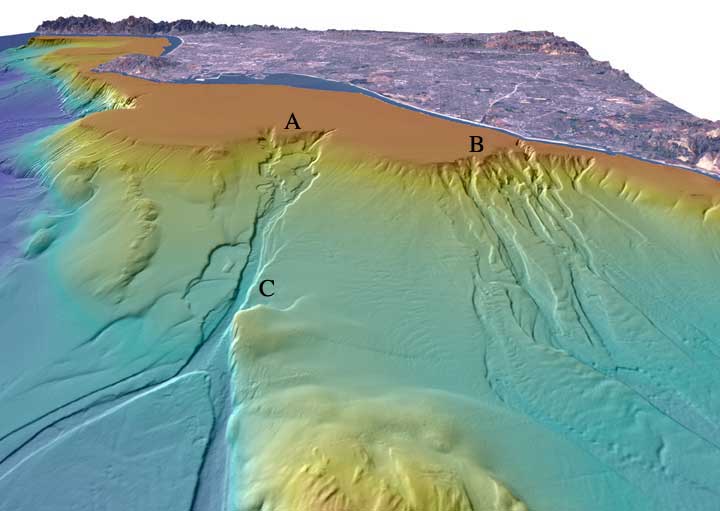
I have the privilege of being a part of the NOAA Ship Fairweather crew for 10 days. We will be off the coast of Alaska doing hydrographic surveys.  While I don’t totally know what to expect, I know that the end goal is mapping for navigation purposes and that the sonar can give some other information, too. Ultimately, that and other hydrographic survey data can be used to make maps and I LOVE maps. This one below (courtesy of USGS) shows the submarine canyons at the end of the Los Angeles River and the Santa Ana River off the coast of Southern California. It’s so cool to have a visual sense of what you’re surfing, paddling, swimming or fishing over.

https://upload.wikimedia.org/wikipedia/commons/8/85/Canyons_off_LA.jpg
A map of the submarine canyons at the end of the Los Angeles River and the Santa Ana River off the coast of Southern California (source: USGS)

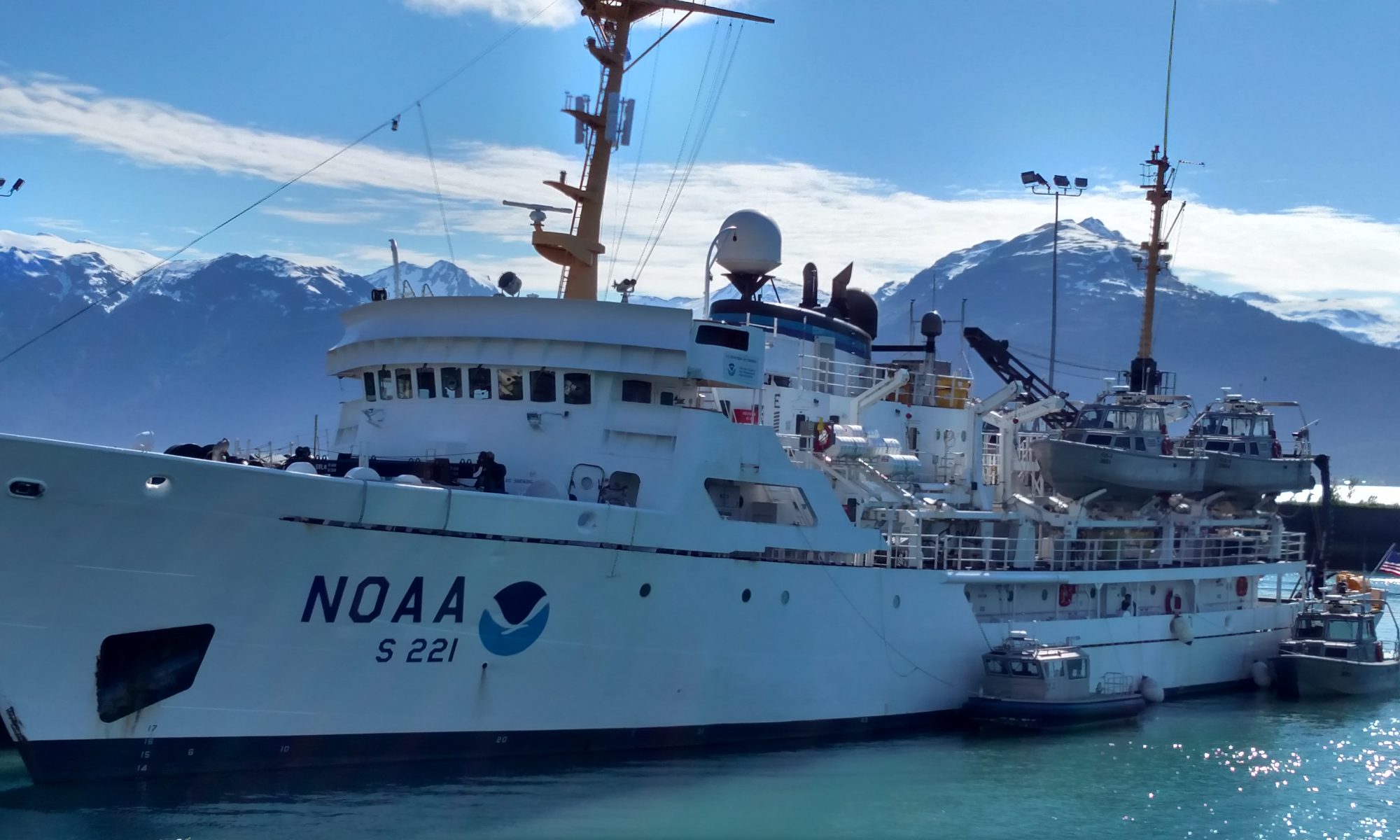
So, what I do know about what we’re doing is that we’ll be taking side scan sonar data of an area around Nome, Alaska in the Bering Sea. I know that the ship will be running some predetermined patterns to add to an existent database that was begun with legs I, II, and III of this same mission. The ship, by the way, is the Fairweather – (image courtesy of NOAA)

NOAA Ship Fairweather
NOAA Ship Fairweather (credit: NOAA)

She’s quite grand and I can’t wait to board and to meet all of the shipboard personnel and learn more about the operations firsthand. I’ll have lots of science and procedure and people to talk about in my next post, I’m sure.

Personal Log and Introduction

Lisa Battig, here! I’ve been teaching at Fountain Valley High School since 2007. Fountain Valley High School is a comprehensive public high school with about 3,800 students. I currently teach Chemistry and Environmental Science there and I love it!  “FVHS” is filled with teachers who are adventurous and willing to try new things. As a result, we’ve always had an administration that is exceedingly supportive of teacher ideas. The culture is collaborative, encouraging and exciting. I could not wish for a better school. Then there are the 3,800 talented young people who walk on campus every day who really make it a fun place to work. Here is an image of me with 64 of them (and lots of parent chaperones!) at Joshua Tree National Park this past January:


DSC_0127
Fountain Valley High School students at Joshua Tree National Park

So a bit more about me…

I couldn’t tell the story of where I am now without paying homage to the great Bob Perry. You may not have the privilege of knowing Bob, but that man has inspired probably thousands of students over his career. He was my high school marine biology teacher who also was a master dive instructor, owned his own boat, wrote his own plankton keys, did photography on the side, expected his first year students to do real research and read journal articles, taught us DOS commands and some Basic so we could analyze our data on a computer (1987!!), and had his classes out in the field at the local pier weekly taking raw data. Not to mention he had a research permit and kept three enormous saltwater tanks in the back of his room holding local species so we would be familiar with them and kept a wet table in class that I used when I took an independent research course with him during my senior year.

I was challenged by him, certified in SCUBA by him, encouraged by him, directed by him, mentored by him and ultimately owe at least 80% of what I do in the classroom today to him and his methods.

That spark of interest in high school was the impetus for my undergraduate Marine Biology degree. The ocean was and still is one of my greatest passions. In my college years, I was again blessed with a professor who allowed me to help with his research on copepods and who made certain that we had plenty of time in the field doing trawls, dredges, plankton tows and so much more. Sadly, though, with just an undergraduate degree it was difficult to find anyone willing to pay me to sit in the ocean and hang out with dolphins all day. But my program had been broad and garnered me a minor in Chemistry, also. So out of college I went to work as an analytical chemist instead. That later led me into a varied and interesting career in technical sales and then finally into teaching. It was a good place for me to land – and it’s allowed me to indulge my desires to become more involved in Environmental Science. I went back to school for my MS in Environmental Science a few years ago and was able to develop a sanitation and hygiene education program to be used with small communities throughout the world. This is part of the program being used one on one by a volunteer in a village in El Salvador.

Applying Glo Germ
Sanitation and hygiene education program in El Salvador

I haven’t lost my love of the ocean, nor my love of research. These days, I indulge the former through surfing and offering my AP students the opportunity to get SCUBA certified. Their certification ends with a three day boat trip to dive spots all around Catalina Island. For the research component, I have my AP students develop their own field or lab research and present the findings in a poster session at the end of the school year. I also find whatever research might be available to me through summer programs and the like. I’ve been able to assist in two local university labs through Howard Hughes Medical Institute grants. The experiences have had broad impacts on me personally and definitely on my teaching as well.

Nias 2
A surfer off of Nias Island


(For clarification, I am behind the camera for this Nias Island beauty, not behind the sheet of water. It was the best surf trip of my life! But this one day was a bit too big for me.)

And finally, how I got involved with the NOAA Teacher at Sea program.

My first year of teaching in 2005, I had a mentor who was chosen to be a part of the Teacher at Sea program. His stories immediately sparked my interest in it and I started dreaming about where I might be able to go and what I might be able to do. Unfortunately, each year some challenge would prevent me from applying. Last November, though, all the pieces finally fell into place and I was able to get that application in. Now I find it almost impossible to believe that a 12 year dream is finally coming to fruition! Again, I am so thankful to have a supportive administration that is willing to let me miss some school so that I can bring real world research, application and STEM connections back into the classroom.

Did You Know?

The solar eclipse of August 21, 2017 will only cover approximately 28% of the sun in Nome, Alaska where I’ll be embarking. However, on March 30, 2033 Nome will be one of the few land masses to be awarded a total eclipse!