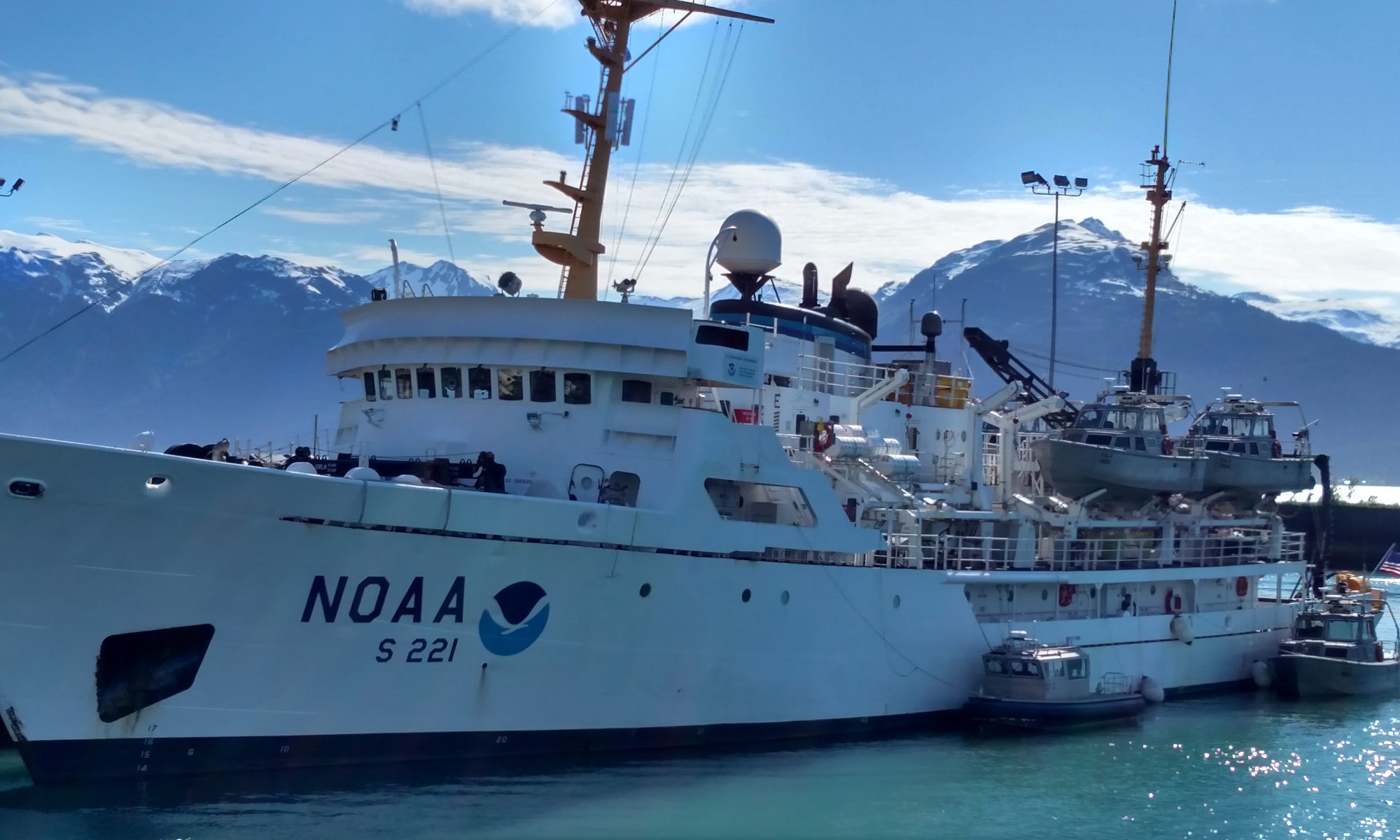

NOAA Teacher at Sea
Sabrina Whitaker
Aboard NOAA Ship Thomas Jefferson
August 18 – 31, 2026
Mission: Hydrographic Survey, Leg 3
Geographic Area of Cruise: Lake Ontario
Date: August 22, 2026
Weather Data from the Bridge
Latitude: 43°22.554’N
Longitude: 76°44.490’W
Winds: South East Winds at 5-10 knots
Temperature: 77 F
Science and Technology Log
Taking care of the ship requires communication from all of the departments aboard the ship. The actual fixing and maintenance of the ship requires the Engineering department. As I followed Oiler Sam Fuller around for the day, I was introduced to just how much is involved in caring for the ship. The engineering department ran through the list of what needs to be tackled for the day and what projects are upcoming or ongoing. They make sure everyone knows what to look out for and discusses the tasks to accomplish.
Just like the rest of the ship, the day starts off with a meeting.

Once the morning meeting was over, Sam took me through a few of the tasks he completes each day. First, he tested the chlorine in the water from the Reverse Osmosis system. They had been having trouble getting the chlorine high enough over the last few months, but today’s reading was finally right on track. Sam made sure to show me the chlorine that gets added to the water and pointed out that I should never be near it without gloves, mask, or goggles because of how dangerous it is. He also let me know that the chlorine added is further from the part of the ship where water is actually used by people because it means more chances to correct for a possible problem.

Then, the engineers showed me how to move the ship’s power from one generator to another. It’s a complicated dance of syncing up the generators so that there is no sudden loss of power to the ship while the next generator comes online. It also prevents catastrophic failure of either generator while one generator slows down and the other takes over.

Then, I got a tour of the engine room. The engine for the ship is massive and it is loud in the engine room. We both wore ear protection while touring the engine room and Sam showed me around.


Then, it was on to Sam’s projects for the day. One of these projects was to better secure the weights in the gym. He and one of the chief engineers want to create something where several weights can be secured by going through a pipe so they do not move as much. He envisions 4 pipes on a base plate for the weights they have. We went down to measure the weights, and the spacing on the wall so that he could cut and weld everything appropriately.

Once he had the measurements, he put the project aside so that he could wait for one of the chief engineers to come on shift. In the meantime, he went to the survey room to fix an air conditioning condensate pump that broke and caused it to leak water over the computer of one of the Senior Survey Technicians. Previously, a condensate drainage tube had been placed to take care of the problem and the condensate water drained into the bucket over time and then was emptied outside. Sam was able to replace it because they got the necessary part in when they were last docked.


Once the pump was installed, Sam went downstairs to start cutting the pieces necessary for the gym weight project.

Sam had a few things cut but then the survey room called and condensate water was leaking again in the survey room. It turned out that the pump was not enough to adjust for the motion of the ship. The pump that broke was meant to make it so that the water went back through the pipe the other way, but it couldn’t because of the elevation of the pipe compared to the other units in the room. The Engineering department decided to install a check valve that allows the water to only flow in one direction. This would make it so that the majority of the water did not make it to the lowest unit in the room and would prevent it from flooding that system. Sam grabbed supplies and started on the repair right away. The Engineering department has enough tools and replacement parts that it can make many repairs while underway and they make sure to keep the ship livable and comfortable without having to wait to take the ship in for repairs.


Once the necessary tools and supplies were collected, they got to work.


Sam returned to his project for the gym until the small boats came in. At that point, anyone who can is asked to come out on deck so they can help if needed while the small boat is put back on the davit. Engineering is especially important in this process and they keep a watchful eye over the process.
After the small boat has been returned to the davit, the engineering department goes over the boat and refills it with fuel, checks the oil, and checks how long it should be until the next maintenance period for the engine. They pass on any problems they find to the crew and it is discussed at the morning meeting the next time the boats are sent out.


Eventually, Sam was able to begin the process of welding the pipes to the stand that would hold the gym weights. It’s important to place a call to the deck officers and let them know that that type of work is being done so that they don’t worry about a burning smell but also to be aware of any potential for fire so it can be stopped should something go wrong. Again, safety, especially around fire, on a boat is treated very carefully.


Personal Log
One of the biggest things that has struck me throughout my time on ship is the huge number of opportunities aboard. The engineering department has one of the best options for vertical movement on the ship because you can start as a wiper or an oiler. Sam started at NOAA by going through the job corp and then joining NOAA as an Oiler. However, that is not the only way to enter into a NOAA engineering department position. Several other engineers came in after serving time in the Navy or Coast Guard and then moving to NOAA and others came in without military experience and joined with experience in other fields instead. The important thing is that they obtained their merchant mariner credential (MMC), which provides proof of their qualifications, which includes their physical readiness as well. More information on obtaining an MMC is found here: https://www.dco.uscg.mil/nmc/merchant_mariner_credential/
Did You Know?
Those working aboard NOAA ships get paid overtime for anything over 8 hours of work completed Monday through Friday and they get overtime for working Saturdays, Sundays, and holidays, too. The jobs listed at https://marinerhiring.noaa.gov/Jobs/Openings list base pay, and while overtime is not guaranteed, it often accounts for up to twice the base pay for a given position. The other benefits for working for NOAA are also numerous as well. For example, while on ship, most incidentals are paid for. There is no need for a car or paying for fuel, all food is paid for while at sea, the ships have Starlink, so internet is fast and hasn’t been any less reliable than my home internet, and of course lodging aboard ship is included as well. The professional mariners are on 2 month rotations and then have a month of shore leave, where as one crew member put it, “I cook, clean, and have no other responsibilities.”