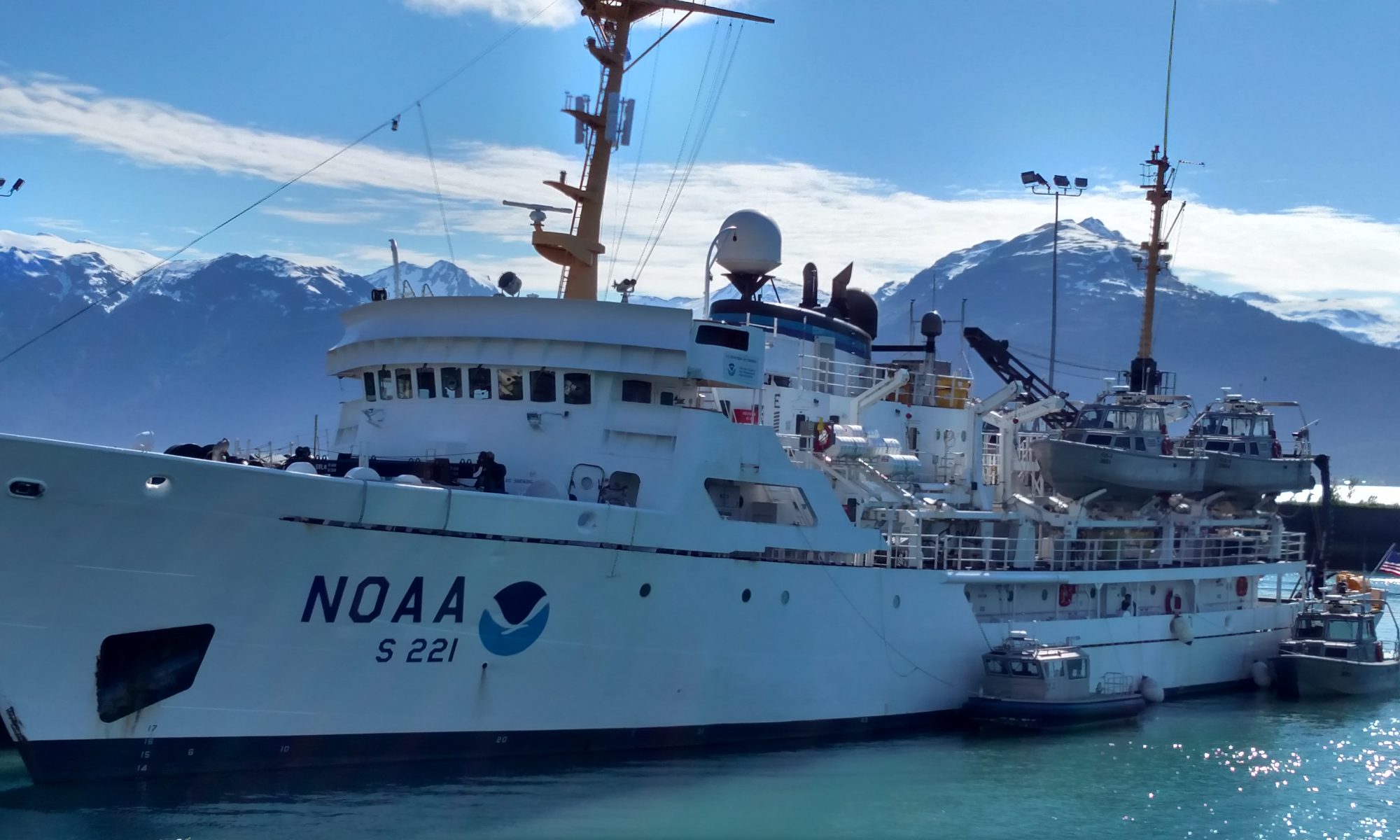
Taylor Parker, April 24, 2009

NOAA Teacher at Sea
Taylor Parker
Onboard NOAA Ship Oscar Elton Sette
April 19-29, 2009 

Mission: Hawaii Bottom fish Survey
Geographical Area: South side of Oahu
Date: April 24, 2009

Sunset with glassy water

Weather Data 
2ft rolling swells.
Air temp: 75F.
Slightly cloudy with variable winds 3-5 Knots.

Science and Technology Log 

One of the things that I’ve figured out is that fisheries scientists like nets. Big nets, small nets, blue nets and red nets. While I won’t go any further with the rhyme, the nets do collect some rather Suess-like creatures. Tonight, we worked a big net and found those creatures. The big net is the biggest on the boat and is called a Cobb trawl. The Cobb is deployed at night and is designed to capture pelagic organisms at deeper depths than the I/K or regular dip nets.

Lowering the net into the water

The target species for this trawl is snappers. It is deployed at night for two reasons: 1) at night there is a better chance the fish won’t be able to avoid the net because they can’t see it and 2) a lot of the fish targeted follow the amount of light that penetrates the surface, they stay at the bottom during the day and swim up at night – this is called vertical migration.  The Cobb is about 30 feet long and has a mouth opening of 7.5 feet that gradually tapers down to a foot long detachable cod-end. It can be dropped to different depths depending on the amount of line let out. There is a 2:1 difference, so if 1,000 feet of net is released then it will drop to 500 feet below the surface. The Sette motors at 3 knots for about 3 hours while the Cobb is busy collecting the ocean denizens. The cod-end is only in the water for two of those hours. The scientists have been either targeting two depths and spending an hour at each or have been staying at one site for two hours.

Bringing in the catch

It takes a crew of at least 4 line-handlers, a crane operator, engineers working on the hydraulics and synchronizing between the officers piloting the boat from the stern and those on the fly-bridge just to keep the large net in the water safely. It is a long and coordinated process to retrieve the necessary sample of a couple pounds.

The catch, ready to be analyzed

For safety reasons, the scientists are required to stay away from the net until everything is on deck and the winch holding the net is off. But once the Cobb is brought up, it is like horses at a track: there is a rush to see what was caught. And I’ve never seen such large 8-year-olds as the scientists; mesmerized by the hundreds of fish, larvae, jellies and other fascinating creatures the group piles in around the sampling trays and quietly picks through trying to find the rare and unique. The haul is definitely something to get lost within. With so many different fish stacked on top of each other and the seemingly infinite number of marine invertebrates, trying to find a juvenile Snapper or rare Lantern fish with a pair of small forceps is much like those claw-games that keep eating your quarters. Of course, the rare and interesting species are analyzed but the rest of the fish need to be sorted also. While trawling took 3 hours, going through the collection was easily a couple hours.

A hydro-lab full of scientists

In the end, I was most intrigued by the eel larvae, the Snaggletooth and the flat fish. If you’ve ever had monsters in your dreams these are probably the culprits. The eel larva is flat, nearly transparent and when stretched out is almost a foot long. It has a black spot (maybe two but it is hard to tell) at the front of its body (you can’t tell that either, really) that I am supposing is its eye. Imaging this creature swimming around my feet is already making me shiver. The Snaggletooth is probably the most horrifying. They are only 5 inches or so but if they were the size of, say, my arm, I would never go in the ocean again. The flat fish babies are just gross. While all of these creatures are going make me sleep with the lights on tonight, they are marvelous representatives of the ocean creatures these NOAA scientists are studying.

Personal Log 

The snaggletooth
The snaggletooth

The Cobb is interesting because it starts 7.30pm and is a whole lot of nothing with bookends of activity. There is a lot of action to get it out, you watch the net in the water for 3 hours, a lot more activity to get it in and then for two hours is the fish sorting. I knew this before-hand and that is why it took me a week to stay up for it. But today I took a nap in the afternoon and was determined to wait for the net.

Flat-fish larvae
Flat-fish larvae

I’m very happy I did because I wouldn’t have seen the stars in the cloudless Hawaiian sky on the moonless night, nor would I have been privy to the green bioluminescence off the bow wake. Also, the catch was a catalyst for the scientific banter in the hydro-lab where everything was sorted. Names of fish were flying past me at exceedingly high speeds and were volleyed by the appropriate guttural sound of “ohh” and “awe” from across the lab. It was well worth a late night bed time, even if the Snaggletooth is waiting for me.

Did You Know? 

Scientist Bruce Mundy with eel larva

The net is named after John N. Cobb who lived from 1868- 1930. He was, among other things, Dean of the College of Fisheries at University of Washington in 1919, the only college of fisheries at the time. My roommate on the Sette, scientist Bruce Mundy, told me another interesting thing. Just off of where we stationed for the Cobb trawl is the site where Captain Cook was killed by the local Hawaiian population on Valentine’s Day in 1779. He was the first European to reach Hawaii on his way to discover the Northwest Passage. Everything was good on the first trip. After a year, however, he returned and he didn’t manage the local politics well. Hawaiians stole one of his boats and he was subsequently beaten and stabbed after trying to take the Hawaiian’s King as a hostage for ransom of his boat. Nevertheless, the local peoples honored him as they would have their own royalty, giving his funeral similar rites.  Apparently there is shrine dedicating his place of death in Kealakekua Bay.

A “caught and released” seahorse
Kealakekua Bay
Kealakekua Bay

Taylor Parker, April 22, 2009

NOAA Teacher at Sea
Taylor Parker
Onboard NOAA Ship Oscar Elton Sette
April 19-29, 2009 

Mission: Hawaii Bottom fish Survey
Geographical Area: South side of Oahu
Date: April 22, 2009 – Earth Day!

Happy Earth Day!
Happy Earth Day!

Weather Data: 
Winds: 1-3 knots variable.
1-2 ft swells.
Water temp: 24 C.
Air temp: 80 F.
Voggy.

Science and Technology Log

This morning I awoke with a cup of tea and this beautiful sunrise coming over the big island. There is something auspicious about a morning like this and our day turned out truly favorable. At 6am we started our safety meeting with the regular GAR survey. The GAR survey is a standard safety check before deploying small boats. It stands for Green, Amber and Red and those are the colors associated with the number that represents the amount of danger with the operation. Apparently we were green because the crew prepared the boats. The larger boat dropped into the water with Chief Scientist Ryan Nichols leading the bottom-fishing. I jumped in the smaller boat with scientist Don Kobayashi to do CTD surveys. CTD’s stand for Conductivity, Temperature and depth. Depth and temperature are pretty self-explanatory but conductivity is the measurement of electrical current that is found in the water. This conductivity is proportional to the amount of salt in the water and it increases with a rise in temperature. Therefore, you can figure out the salinity by analyzing the temperature and conductivity. Don is working on measuring the unique circumstances that occur when two or more ocean currents come together and create calm waters known as slicks.

Me holding the handheld CTD

Lighter plankton collect within the slicks along with debris. It is curious to note whether the calm waters draw the weaker fish or whether they search the slicks out on their own. Not much is known about these converging points of down-welling and Don is trying to find out what makes them special.The weapon of choice for his study is an instrument that is about 5 pounds and about a foot and a half long. For our original drop we set a buoy down in the middle of the slick with a drogue, a sea anchor that works by means of an underwater parachute. We then dropped the CDT 5 times on each side of the buoy at 10 meter intervals, which expanded outside of the slick. This level of specificity allows for accurate readings of what is occurring just below the surface. The way the slicks start to appear and just as quickly disappear or even elongate is mysterious.  The final page of this log has the results from one of the CTD drops with an explanation.

Larvae found while dip-netting

After measuring the physical characteristics of the slicks we started dip-netting them, chasing the plankton and debris. Don sat on the bow and I leaned over the port side cruising along at about 1-2 knots trying to find bubbles, debris or any sign of life like a glimmer from the side of a fish or a Pilot Whale (I’ll get to those soon). We caught a few things; well, actually Don caught almost everything while the baby fish evaded me diligently. We collected our, or rather, Don’s haul and kept in a bucket for safe keeping. We caught a big red light bulb with Goose-neck barnacles on it, but more importantly, fish hiding underneath it. The light bulb brought in most of our haul but we did find some other larvae hanging out under a bunch of bubbles.

The Drogue
The Drogue

After dip-netting for a while we found the other boat and helped them bottomfish. We grabbed one of their reels and spent the remaining two hours of our trip trying to catch fish. Where I wasn’t successful with the larvae, I made up in catching a Yellowbarbel Goatfish (Parupeneus chyrsonemus). Unfortunately for us, yet fortunately for him, this colourful bearded fish was not a target species. We let him go safe and sound with only an odd abduction story to tell his friends.

Personal Log 

Our haul from the slick. The light bulb has life underneath, I swear.

Today I learned a lot about slicks, conductivity and goatfish. The amount of stuff that congregates in the slicks is fascinating and it was wonderful being on the hunt with my net for hours. Even better though was being out on the crystal clear, calm waters off of Kona. There was hardly a breeze, the water was nice and warm and all I wanted to do was jump in. Right when I was thinking about ditching my boat and going for a swim, a 4-5 foot Oceanic White-Tip Shark (Carcharhinus longimanus) swam under us. I was told not to pet it. I have never seen a shark with the reputation as ferocious as this one so close. The ends of his dorsal and pectoral fins were shining white in the clear Hawaiian water and he looked formidable yet tranquil.

Goatfish
Goatfish

While we were dropping the CTD, a call came over the radio from the Sette informing us that Pilot whales (Globicephala macrorhynchos) were in the vicinity. We paid it no mind as a sighting like that would most likely pass without our noticing it. Sure enough, within half an hour a pod of about 8 whales were heading directly for us. The whales were cruising around us showing us their giant domed heads and curved dorsal fins. When they got within about 10 yards of the boat they all disappeared and didn’t reappear until they were well beyond our position. But for a while, we were schooling with Pilot whales.

On our way back to the boat we were flagged down by Ensign Norris, Lieutenant Little and CO Lopez from the Fly Bridge. They needed photos of the Sette with the large NOAA logo while underway. Well, here is one of the shots and if you look closely you can see all three up there.

The Whitetip is in the lower left hand corner with a Pilot Whale in the upper right
Pilot Whale
Pilot Whale
The Oscar Elton Sette with three officers
Here are some of the data from the handheld CTD dropped in the slicks. As you can see the area surveyed within the slick has higher temperatures deeper and more heterogeneity. This is opposed to just outside the slick where it is colder with little variation.

Marilyn Frydrych, September 23, 2008

NOAA Teacher at Sea
Marilyn Frydrych
Onboard NOAA Ship Delaware II
September 15-25, 2008

Mission: Atlantic Herring Hydroacoustic Survey
Geographical area of cruise: New England Coastal Waters
Date: September 23, 2008

Weather Data from the Bridge 
42.42 degrees N, 67.39 degrees W
Cloudy with wind out of the N at 32 knots
Dry Bulb Temperature: 15.5 degrees Celsius
Wet Bulb Temperature:  11.6 degrees Celsius
Waves: 6 feet
Visibility:  10 miles

Science and Technology Log 

Yesterday we were fairly busy doing CTD casts and trawls. Today we woke to find the night crew just starting to record the lengths and weights of their large catch. We grabbed some cereal and took over from them at 5:45 a.m. They had collected and sorted all the fish. Jacquie and I took about two hours measuring, weighing, and examining the innards of the half basket of herring they left us. Our chief scientist, Dr. Mike Jech, summarized his findings so far in a short report to everyone including those back at Woods Hole: “Trawl catches in the deeper water near Georges Bank have been nearly 100% herring with some silver hake.  Trawl catches in shallow water (<75 m) have occasionally caught herring, but mostly small silver hake, redfish, butterfish, and red hake.

A night haul of herring.  Notice the brilliant blue stripe on the top of the herring. The camera’s flash is spotlighted in the reflective tape on the life vests.
A night haul of herring. Notice the brilliant blue stripe on the top of the herring. The camera’s flash is spotlighted in the reflective tape on the life vests.

Small being less than 5-6 cm in length.  We caught one haddock this entire trip.  Trawl catches north of Georges Bank have been a mix of redfish and silver hake, with a few herring mixed in.” This afternoon the Officer of the Deck, LT(jg) Mark Frydrych, gave me a run down of many of the instruments on the bridge.  I spotted a white blob on the northeastern horizon and pointed it out. He showed me where it was on the SIMRAD FS900, a specialized radar.  The SIMRAD FS900is often able to identify a ship and its name.  This time it couldn’t.  Looking through binoculars we could see it was a large container vessel.  Then we looked at a different radar and saw both the ship’s absolute trajectory and its trajectory relative to the Delaware 2.  It was on a path parallel to the Delaware2 so Mark didn’t worry about it intersecting our path.  We also noticed another ship off to the west and north of us on the radar, but we couldn’t yet see it on the horizon. It too was projected on a path parallel to us.

Then Mark pointed out an area on the SIMRAD FS900 outlined in red. It’s an area where ships can voluntarily slow to 10 knots in an effort to avoid collisions with whales. It seems that sleeping right whales don’t respond to approaching noises made by ships.  There are only about 350 to 500 of them left and they are often killed by passing ships. The Delaware 2 was steaming at about 7 knots because in the 6 ft waves it couldn’t go any faster. However the container ship was steaming at 15.5 knots.  Few ships slow down in the red zone.

Mark showed me how to fill out the weather report for that hour.   I typed in all my info into a program on a monitor which assembled all my weather data into the format the weather service uses. I first recorded our position from an instrument displaying the latitude and longitude right there above the plotting table.  I read the pressure, the wet bulb temperature and the dry bulb temperature from an instrument which had a readout in a room off to the starboard of the bridge.  The ship has two anemometers so I averaged these to get the wind speed and direction.  We looked at the waves and tried to imagine standing in the trough of one and looking up.  I figured the wave would be over my head and so estimated about 6 feet.  We also looked at the white foam from a breaking wave and counted the seconds from when it appeared until it rode the next wave. The period of the wave we watched was four seconds.  Next we looked out the window to search out any clouds. It was clear in front of us but quite cloudy all behind us.  I estimated the height of the clouds. I typed all this information into the appropriate boxes on the monitor.  It was all so much easier than my college days when we had to gather the information manually then switch it by hand into the code appropriate for the weather service.  The OOD sent this information to NOAA Weather Service on the hour, every hour operations permitting.

Personal Log 

Though my son was instrumental in persuading me to apply for the Teacher-at-Sea position I haven’t seen much of him thus far.  He’s standing the 1 to 4 shift both afternoon and night.  When I’m free he seems to be sleeping.  We don’t even eat meals together.  That’s why I made a special trip to the bridge today to meet up with him during his watch.

Marilyn Frydrych, September 22, 2008

NOAA Teacher at Sea
Marilyn Frydrych
Onboard NOAA Ship Delaware II
September 15-25, 2008

Mission: Atlantic Herring Hydroacoustic Survey
Geographical area of cruise: New England Coastal Waters
Date: September 22, 2008

Weather Data from the Bridge 
42.52 degrees N, 68.06 degrees W
Cloudy, wind out of the E at 11 knots
Dry Bulb Temperature: 15.2 degrees Celsius
Wet Bulb Temperature:  14.0 degrees Celsius
Waves: 1 foot
Visibility:  10 miles
Sea Surface Temperature:  16.9 degrees Celsius

Science and Technology Log 

Today was more of the same–more CTD’s and trawls.  Just after lunch we had our weekly fire drill. This time the fire was in the galley and Jon Rockwell, the chief cook, was supposedly overcome with fake CO2 smoke.  After everyone except Jon was accounted for the search for him began in earnest.  The Hollywood style smoke machine produced smoke so thick the crew had difficulty finding Jon “passed out” on the floor of the galley.  Part of the drill was lifting Jon on a stretcher up the stairs and out onto the fantail.  Our station was redirected to the bridge this time where we were allowed to listen as LT(jg) Mark Frydrych conducted the exercise.  I had noticed emergency firemen gear here and there in the halls.  Always there was a radio charging next to the gear. That’s how they communicated.  All in all I was very impressed with the expertise and calmness of everyone even when plan A didn’t work and plan B had to be tried.  Safety always came first. For a good 45 minutes following the drill the crew and officers talked over possible improvements.  There was no messing around.  Everyone was in earnest and aware of the seriousness of the drill and the debriefing.  Yet this group had been practicing fire drills weekly every time they were at sea.

Personal Log 

I already knew three people aboard when I arrived.  My son, LT(jg) Mark Frydrych, was the Operations Officer. He’s the one who suggested I apply for the Teacher-at-Sea position.  On a previous visit to Woods Hole I had met Erin Earley, the engineer wiper.  We had hit it off then and continued to get to know each other better on this cruise.  Then there was my hiking pal from Colorado, Jacquie. She and I both work at Pikes Peak Community College in the math department.  She’d taken the semester off and was looking for an adventure.  After applying for the Teacher-at-Sea position I learned that the Herring Legs needed volunteers.  Jacquie signed up for the first two legs. This cruise was her second leg.  I experienced a tremendously easy adjustment stage because of these friendships.


Marilyn Frydrych, September 21, 2008

NOAA Teacher at Sea
Marilyn Frydrych
Onboard NOAA Ship Delaware II
September 15-25, 2008

Mission: Atlantic Herring Hydroacoustic Survey
Geographical area of cruise: New England Coastal Waters
Date: September 21, 2008

Weather Data from the Bridge 
42.00 degrees, 68.06 degrees W
Partly cloudy, wind out of the SE at 6 knots
Dry Bulb Temperature: 18.0 degrees Celsius
Wet Bulb Temperature:  15.7 degrees Celsius
Waves: 1 foot
Visibility:  10 miles
Sea Surface Temperature:  17.7 degrees Celsius

Red Fish waiting to be sorted and later in a clothes basket.

Science and Technology Log 

We returned to a spot that Mike had marked on our computers as a place where he would have liked to have sampled the fish when the seas were high and we were unable to fish.  We sent down a CTD at dawn and then deployed our net.  I’m learning more about the importance of the man at the helm.  If he speeds the boat then the net will rise.  Conversely, if he slows the net falls.  The desire of the scientist is to get a representative sample of the fish in the area, but not to take more than what is needed since we return very few alive to the ocean. The NOAA Corps officer at the helm knows this as well and has his own sonar so that he knows at what level the fish are located.  He adjusts the speed of the boat as he sees fit to catch an appropriate number of fish while checking with the chief scientist or watch chief to ensure the net is where they want it. I also learned that red fish are often associated with American herring.  Red fish are a sweet delicious fish, which were over fished during World War II.  They’ve been on the US’s banned fishing list since that time.

frydrych_log6aWe brought up in today’s catch about 200 small fry red fish.  We also collected about 20 good-sized ones running to about 12”.  The large ones take up to 60 years to grow to the size where they are worth harvesting to eat.  We only brought up 5 herring.  This time there was one 8” squid. We deployed the Tow Body this afternoon around 3:30 p.m.  It’s an undersea camera.  Unfortunately the wires connecting the Tow Body to the computers had gotten broken as it sat on the fantail. Possibly the wires got jostled during clean up.  (We use a fire hose to clean the fantail after each trawl.) Possibly people stepping on and over the wires as they walked about on the fantail broke the wire.  This wasn’t learned until moments before we were to deploy the instrument.  The ET specialist, Dave Miles, figured out where the wire was broken fairly quickly and reconnected it. That gave us connectivity, but still there was a problem of the Tow Body not responding to commands from the computer.  The chief scientist, Mike, tackled that part of the problem.  Somehow he fixed the software. We got the go ahead signal about three hours later. 

Getting ready to deploy the Tow Body

This was the only deployment in which the scientific crew was allowed on the fantail as part of the deployment.  Like the fishermen we had to wear a life jacket and hardhat.  Four of us held onto lines that kept the Tow Body from twisting as it entered the water.  Unfortunately one of the lines got loose. Displaying great skill fisherman Jim Pontz used a grappling hook to retrieve it.   By now we had drifted so far off course we had to circle back into position.  When we finally got the instrument in the water our fish had left the area.  We could tell that by the echograms.  The plans were to leave the Tow Body’s lights off until the camera was surrounded by fish.

Otherwise the fish swim away from the lights.  Only later when we again came into a school of fish did we learn that the lights weren’t responding.  The endeavor was aborted.  From a scientific standpoint we did learn something.  The Tow Body needed more work.  We also learned that we should start disconnecting the wires from the Tow Body when it’s stored on the fantail.

Personal Log 

I watched the Broncos play this afternoon.  No one else was interested.  Four or five of the crew watched different football games throughout the day.  They seemed to have time for their favorite team, but no one seemed to spend hours and hours watching game after game.  The most popular form of relaxation was watching movies.  There must be over a hundred DVD’s to choose from. The screen is a large flat panel screen.

Fisherman Jim Pontz using the grappling hook to retrieve a loose line attached to the Tow Body.
Jim Pontz using the grappling hook to retrieve a loose line.