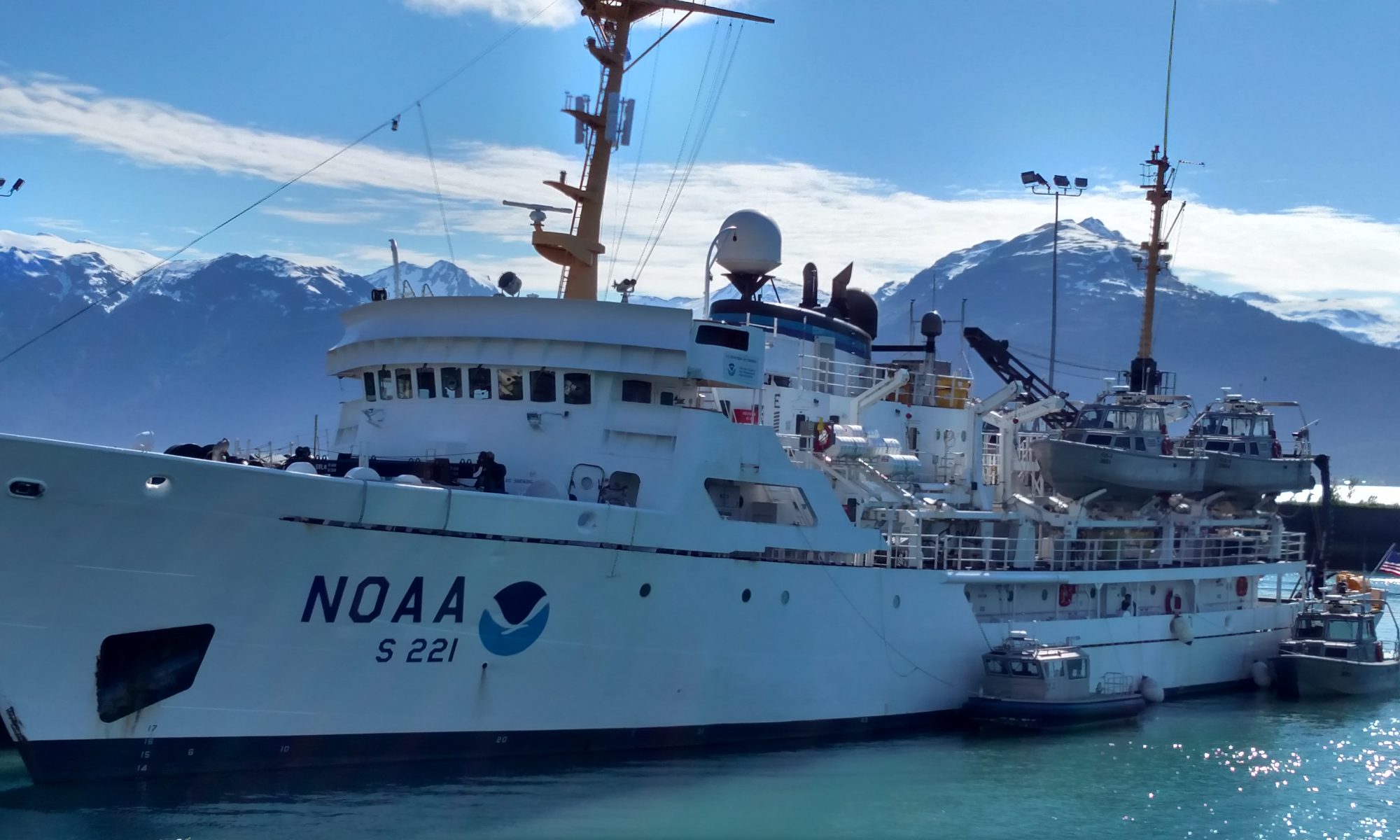
Most of this watch will be spent steaming to the first southern station. Our ETA (estimated time of arrival) is 8:00 am. We are planning to do a full station meaning CTD, Neuston, and a Trawl. It is midnight now and I am hoping to get an interview with our Chief Scientist prior to beginning the station.
The first Bongo is scheduled for noon. Dan Carlson, a graduate student at Florida State University, is aboard researching his master’s thesis. He is utilizing the water samples from the Bongo to learn more about the development and origination of red tides which bloom in the Gulf of Mexico.
I have just been put “in charge” of the Neuston for this station. That means I am responsible for seeing that the net is dragged for ten minutes, that the organisms which are gathered are washed down into the cod end and that the sample is then gathered are delivered to the plankton transfer table.
Personal Log
The Chief Scientist has been actively engaged with data collection and correction activities. I understand that a server has failed and that all time/date information must be hand entered into all data sheets. This is time consuming but very necessary for the sake of accuracy.
Question of the Day
What is red tide?
Answer: It is an organism, named Karenia Brevis, which produces a neurotoxin which, in turn, is toxic to virtually all sea life.
This watch began, again, with fish waiting on the deck. We processed that catch just as we had all the others. While we were processing, another catch of fish were being collected. A CTD was also performed. When the fish catch has been processed, it is necessary to return the processed organisms to the sea. There is a shoot in the wetlab designed for this purpose. The shoot has not been working properly so far on this cruise. During our watch it backed up completely. Water was rising up through the drain in the floor. Clearing the blockage took several hours.
The catch was sitting on the deck and we had no reason to believe that we would get the shoot clear any time soon. The Watch Leader elected to process the catch “dry” so we separated and identified the species without the benefit of water to clean the organisms. Following this catch, the shoot was cleared and the lab was cleaned. We are now making our way south to assess the Texas Gulf Coast shrimp prior to the beginning of their season..
Personal Log
What a mess! Each organism had to be dipped into water just so that we could be sure it was identified properly. We found hundreds of little shrimp that are not even harvested for food purposes.
Question of the Day
Where do the shrimp live? Answer: In the mud on the bottom of the sea.
NOAA Teacher at Sea
Susan Just
Onboard NOAA Ship Oregon II June 15 – 30, 2006
Mission: Summer Groundfish Survey Geographical Area: Gulf of Mexico Date: June 16, 2006
Weather Data from Bridge
Visibility: nautical miles 8-10 (nm)
Wind direction: 205.5 ◦
Wind speed: 11.3
Sea wave height: 0-1
Sea swell height: 1-2
Seawater temperature: 28.7
Sea level pressure: 1016.6
Cloud cover: 5/8 Altostratus and cirus
Science and Technology Log
Tonight we began with a Neuston. Now I know that a Neuston is a rectangular frame to which has been attached a “sock” style net with a round portion at the bottom known as the “cod end.” The Neuston drags at the surface and catches sargassum (sea weed) and also plankton. Why? I’ll need to find out.
Next we pulled in the Bongos. These are round shaped “sock” nets with cod ends. In the cod ends, plankton and other sea life are collected from either the bottom or a maximum depth of 200 feet. The “catch” from both the Neustons and the Bongos are placed into jars with formaldehyde as a preservative. Forty-eight (48) hours later they are transferred to alcohol. They are then shipped out for processing.
The CTD was performed to capture water samples and hydrological data. All of the information is assembled and accompanies the samples to the lab for processing. Finally, we weighed and sorted the catch. Each species is identified by its scientific nomenclature which means we hear a great deal of latin in the wet lab.
Personal Log
OK, I’m not quite as confused now. I had a great night’s sleep. I am beginning to learn some of the scientific names and I have gotten my fingers onto the computers that record the data regarding the organisms we classify. I’ve started having intelligent conversations with people and I am beginning to make sense of the activities aboard the ship.
Question of the Day
What is the purpose of collecting the organisms in the Neuston and the Bongos? Answer: Plankton data is part of a long-term study regarding trends in fish populations.
Our watch began at midnight. When we arrived in the lab there were fish awaiting processing. All commercial quality shrimp were separated from the catch and a representative sample of the whole was reserved for sorting. The sort included many species which were identified, counted, and weighed. Individual members of each species were measured and counted, up to twenty (20) per species. Finally, Two hundred (200) brown shrimp were counted out, separated according to sex and then measured and weighed, individually. Bongo, Neuston and CTD samples were drawn but I was occupied with the fish catches. These catches were repeated constantly throughout the watch until noon at which time we were relieved. Bongo, Neuston and CTD samples were drawn but I was occupied with the fish catches.
Personal Log
What have I gotten myself into? I am on the night watch. This means that my sleeping hours have changed, literally overnight, to between noon and midnight. Dinnertime has disappeared. Lunch has become the big meal of the day. I can best describe myself as confused.
So far my impression is that all members of the ship’s crew and the scientific party are professional, helpful and “nice.” It is easy to recognize the ship’s officers because they are dressed in uniforms. Everyone else is arrayed in their personal gear and, generally, there is a state of designed “disarray.”
Question of the Day
What is the most important skill to be learned before becoming a field scientist? Common courtesy/etiquette (be polite!).
Changing one’s hours to six on and six off could be a subject for a scientific study in itself. Our first day on board was a short one. We left Woods Hole at 3PM and began our sail south. We stopped to do a test drop with the trawl and received a crash course in the computerized world of fishery research. The NOAA vessel uses two computer systems to bottom dredge. Computer times are constantly calibrated to ensure that different machines are reading data at the same time. The onboard systems are the Fishery Science Computer System (FSCS), and the Scientific Communication System (SCS). The computers monitor the ship’s exact, location, the time of the dredge, the speed, the water temperature the substrate composition and aspect of the dredge to the bottom. Later this week we will be attaching the video feed as well.
Working in the lab
This sure isn’t your grandpa’s fishing. Once the dredge is secured to the ship, and the power is shut down the scientific crew is released to the aft deck to release and sort the contents of the dredge. The clams are sorted by variety and by size. Other invertebrates and fish are sorted weighed measured and released. The contents of the dredge are analyzed and catalogued for its overall percentage of substrate, shell debris and fish and animals. The clams are then measured, weighed and analyzed for age. The weighing and measurements are done electronically and simultaneously cataloged into the database. The ages of the clams and quahogs are determined through visual inspection of growth rings. This takes a practiced eye, especially with the ocean quahogs, which grow very slowly and can reach ages of one hundred fifty years. One of the on board scientists indicated that they will soon receive a scanner that will be able to read the rings on the surf clams and ocean quahogs and determine their precise age and growth rate. It’s all pretty amazing stuff. Needless to say, some monster computer mainframe is crunching numbers and providing some great information in determining the health of the stock, the overall biomass and the condition and patterns in the environment. It’s hard not to be impressed, and somewhat overwhelmed.
Sample sorting
We all have a lot to learn about our new duties onboard. We had a quick run down on other experiments we would be conducting at the request of our chief scientist throughout our adventure, and then were on our way to the Delmarva Peninsula (Delaware, Maryland, Virginia). We will start on our first stations at about 3 AM. This will be fishing for real, and learning on the job. We will start in the Delmarva area, and then work our way back up the New Jersey coastline. The New Jersey offshore waters are the area of the greatest concentration of surf clams and also the greatest concentration of commercial fishing. This area is of specific interest to the scientists who are anxious to measure the health of the stock in relation to findings of previous surveys. It is now 1 AM, and we are awaiting our arrival at our first station. I am spending my time reading about surf clams and ocean quahogs. I am so intrigued, I feel compelled to share. Spisula Solidissma, more commonly known as the Atlantic Surf Clam, can be found from the Gulf of St. Lawrence to Cape Hatteras. The largest concentrations are off the Delmarva Peninsula, New Jersey and the Georges Bank. Landings of clams off the coast of Virginia and New Jersey have traditionally accounted for half the landings nationwide.
Measuring clams
The Georges Bank however has been closed to commercial fishing since 1990 due to high concentrations of Paralytic Shellfish Poison (PSP). The surf clam can be found in varying depths from the beach to 60 meters, but concentrations below 40 meters tend to be low. Surf clams can reach a maximum size of 222.5cm (8.9in.), but surf clams larger than 20cm (7.9in.) are rare. Surveys are done because clam populations can, and indeed do, move. Movement predominantly occurs in the larval period. Eggs and sperm are shed into the water column, and may bee carried by currents for as many as three weeks before recruitment to the bottom occurs. The ages of surf clams can be determined by counting the rings on their shells. The rings are formed when a thin tissue adheres to the inner surfaces of the shell, called the mantel, and a thickened rim of muscular tissue at the mantel edge deposit new material at the mantel edge. The resulting rings show how old the clam may be. More on the elusive Ocean Quahog will follow tomorrow.
Personal Log
Who the heck sits up reading about clams at one AM? Is this nuts or what? The life of a scientist is indeed a crazy one. I myself do not qualify as a scientist, but they sure are interesting to hang out with. I am learning tons, and anxious for our day to begin. The food is great, everyone is friendly, but the sleeping part is somewhat sketchy. I’m sure it will catch up with us all pretty darn soon.