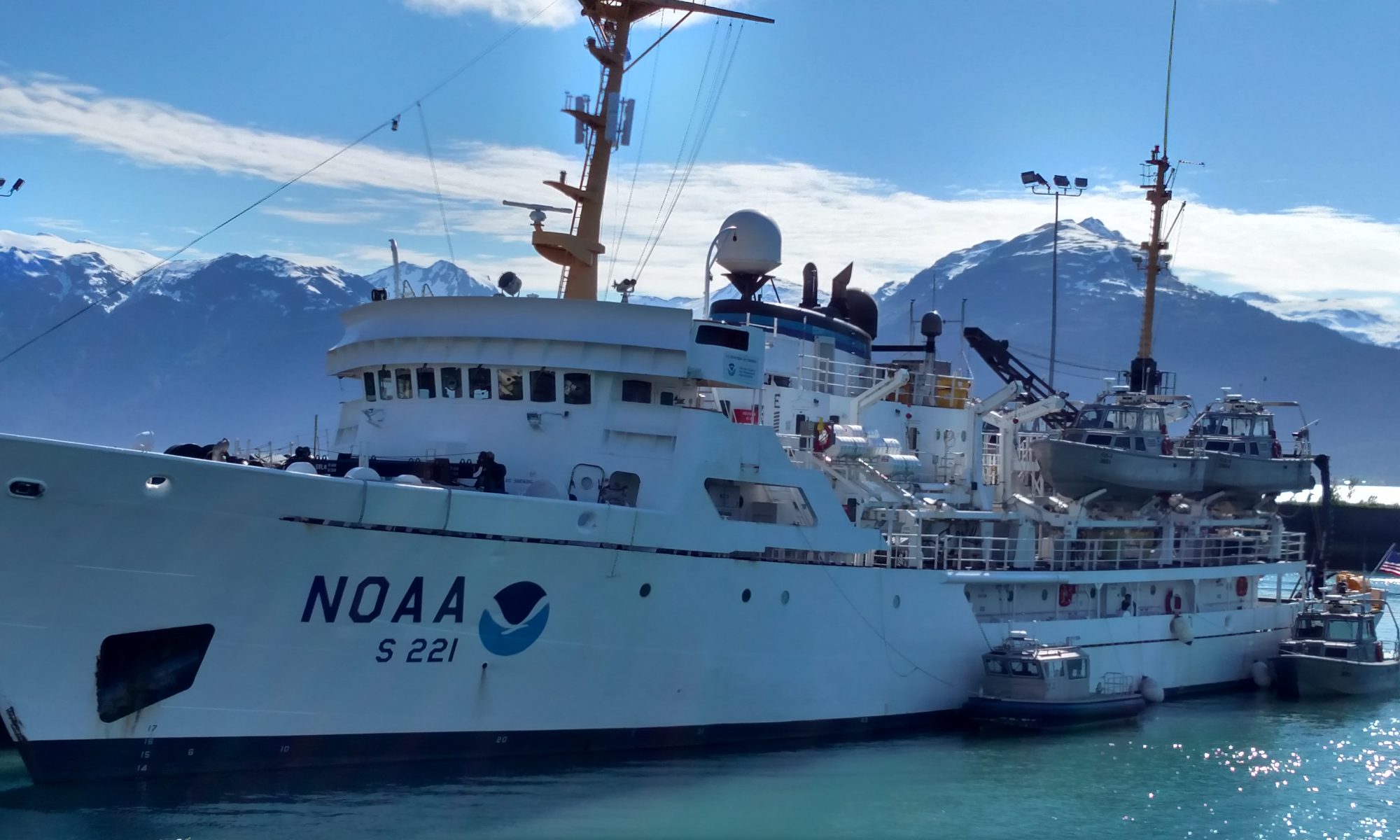
Jeff Lawrence, June 19, 2009

NOAA Teacher at Sea
Jeff Lawrence
Onboard Research Vessel Hugh R. Sharp
June 8-19, 2009 

Mission: Sea scallop survey
Geographical area of cruise: North Atlantic
Date: June 19, 2009

Weather Data from the Bridge In port at Woods Hole, Mass. 
W winds 5-10 KTs, cloudy overcast skies Light rain, 2-3 foot waves Air Temp. 66˚F

Jakub Kircun watches as a beautiful sunset unfolds.

Science and Technology Log 

The Research Vessel Hugh R. Sharp finally made it into port this morning at the National Marine Fisheries Service in Woods Hole on the Cape Cod coast of Massachusetts.  Although this cruise was not terribly long it is great to be back on land.  Scallop surveying is tedious work that is ongoing on a research vessel 24/7. The people onboard were great to work with and it is always a pleasure to get to know other people, especially those who share a passion for ocean research and science. Few people realize the great effort and sacrifices that people in the oceanography field have to give up to go out to sea to complete research that will help give a better understanding to three-fourths of the planet’s surface.  They must leave home and loved ones for many days to get the science needed for a more complete understanding of the Earth’s oceans.

lawrence_log6The noon to midnight shift includes myself, the Chief Scientist onboard, Stacy Rowe, watch chief Jakub Kircum, Shad Mahlum, Francine Stroman, and Joe Gatuzzi.  We are responsible for sorting each station on our watch, measuring and weighing the samples into the computer.  These people are very good at what they do and quite dedicated to performing the task with professionalism, courtesy, and a great deal of enthusiasm.  It is clear to see that each person has a passion for ocean sciences especially the fisheries division. The NOAA fisheries division carefully surveys and provides data to those that make regulations about which places will be left open for commercial fishing and those which will be closed until the population is adequate to handle the pressures of the commercial fishing industry. I have observed many different species of marine animals, some of which I did not even know ever existed.  Below is a photo of me and the other TAS Duane Sanders putting on our survival at sea suits in case of emergency.  These suits are designed to keep someone afloat and alive in cold water and are required on all boats where colder waters exist.

The Goosefish, also called Monkfish, is a ferocious predator below the surface and above!

Personal Log 

The fish with a bad attitude award has to go to the goosefish. This ferocious predator lies in wait at the bottom of the ocean floor for prey. On the topside of its mouth is an antenna that dangles an alluring catch for small fish and other ocean critters.  When the prey gets close enough the goosefish emerges from its muddy camouflage and devours its prey. I made the error of mistaking it for a skate that was in a bucket. I was not paying close enough attention as I grabbed what I thought was the skate from a bucket, the goosefish quickly bit down. Blood oozed out of my thumb as the teeth penetrated clean through a pair of rubber gloves. I pay closer attention when sticking my hand in buckets now.  There are many creatures in the sea that are harmless, but one should take heed to all the creatures that can inflict bodily damage to humans. 

Spiny Dogfish caught in the dredge

Questions of the Day 
Name four species you my find at the bottom on the Atlantic:
What is another common name for the goosefish?
What is the species name (Scientific name) for the goosefish?
What are the scientific names for starfish and scallops?

Duane Sanders, June 16, 2009

NOAA Teacher at Sea
Duane Sanders
Onboard Research Vessel Hugh R. Sharp
June 8-19, 2009 

Mission: Sea Scallop Survey
Geographical Area: New England Coast
Date: June 16, 2009

Weather Data from the Bridge 
Wind: Speed 10 KTS, Direction  50 degrees
Barometer: 1024 millibars
Air temperature: 13 0C
Seas: 3-5 ft.

Science and Technology Log 

A sorting table full of sand dollars!

Why is it that we find huge numbers of sand dollars at so many stations?  There have been some stations where our dredge was completely filled with sand dollars.  The sorting table was so full that there was no clear space in which to work. This has piqued my curiosity as a biologist. Some questions come to mind.  Are there any natural predators of sand dollars? What is it about sand dollars that allow them to out-compete other organisms that might otherwise be found at these locations?  What do sand dollars eat? How can there be enough food at a given location to support these huge populations? I talked with Stacy Rowe, the chief scientist for this cruise, and she was not aware of any research being done to answer these questions.  Stacy did know that a species of fish known as the Ocean Pout eats on sand dollars.  I am looking forward to seeing results of some research on these organisms.  Maybe one of my students will follow up.  Who knows?

Duane Sanders with Keiichi Uchida: A fellow scalloper!

Many different scientists use data taken during this survey.  NOAA staffers come to the ship with a list of types of organisms or samples that have been requested by researchers.  For example we have been setting aside a few scallops from certain stations for special handling.  The gender of each scallop is determined and then they are measured and weighed.  Next, the meat from each scallop is carefully removed and weighed.  The shells are carefully cleaned and set aside to give the scientist who made the request along with all of the measurement data.

I have made a new friend, Keiichi Uchida, of a visiting researcher from Japan. He is doing research that involves tracking the movements of the conger eel, Conger oceanicus, using GIS systems.  Keiichi is here to learn more about how NOAA does surveys like the one we are on now. He is also looking at data similar to his and trying to correlate the different data sets.

Personal Log 

In many ways I am going to miss living and working with people who are interested in the same branch of science as me.  I have had fun talking about all of the things I have observed and the kinds of work being done by this branch of NOAA. There is one thing about this trip that causes me some real sadness.  I have not seen a whale. Two whales have been spotted, but I have always been at the wrong place to see them.  I hope my luck changes before we dock at Woods Hole.

Duane Sanders, June 15, 2009

NOAA Teacher at Sea
Duane Sanders
Onboard Research Vessel Hugh R. Sharp
June 8-19, 2009 

Mission: Sea Scallop Survey
Geographical Area: New England Coast
Date: June 15, 2009

Weather Data from the Bridge 
Wind: Speed 6.8 KTS, Direction 65.7 degrees
Barometer: 018 millibars
Air temperature: 11.33 0C
Seas: 2-3 ft.

Dumping a dredge on the sorting table.

Science and Technology Log 

We had to change out the dredge during my last watch.  Actually, I watched while the crew did the dangerous work. We have been working in an area with a rocky bottom and the rocks caused substantial damage to the netting in the dredge. Fortunately, we are carrying four dredges plus spare netting. The crew put a new dredge into operation right away so that we didn’t lose too much time.  Geoff, our watch chief, directed the installation of the new mesh into the first dredge.

The scallop dredges we use are eight feet wide. Commercial dredges are sixteen feet wide. The basic design is the same for each.  The mouth of the dredge is a welded steel rectangular frame, with the height about one foot.  The bottom of this rectangle is a heavy steel bar, called the cutting bar. This breaks loose organisms from the bottom.  A steel plate, called the pressure plate, is welded at an angle across the top of the rectangle.  This plate creates a downward swirl of water that directs the organisms into the mouth of the netting. The bag attached to the dredge is made of a net of steel rings. A mesh liner is mounted inside the bag for scientific use. This helps to trap other organisms that make up bottom-dwelling communities.  This gives scientists a more complete picture for the survey.  Commercial dredges do not use a liner and the rings of the bag are larger.  This allows smaller size scallops and other organisms to pass through the bag and remain to help sustain a healthy scallop population.

The business end of a scallop dredge

We have been ‘shadowed’ by another ship, the Kathy Marie for part of the time we have been working.  She is carrying a device known as the “HabCam”, short for Habitat Camera.  This is an underwater camera system that is towed just over the bottom. It makes a photographic record of still images of the bottom taken at a rate of three per second. The HabCam accumulates data at about three terabytes per day. The Kathy Marie runs over the same area dredged by the Sharp after we move on to the next station. Images from these runs provide scientists with an index of dredge efficiency at capturing the bottom dwellers.  Once enough image data has been collected to make useful correlations to dredge data, it might be possible to reduce the number of physical dredge samples taken and use the HabCam to record the community ‘in situ’, that is, in position without disturbance.

Personal Log 

I said in an earlier log entry that fish are not my favorite type of organism.  Because of this bias, I had been avoiding helping with the fish sorting and identification.  After thinking about this for a bit, I decided that I needed to embrace my bias against fish and try to learn something as well as help my colleagues.  Besides, how could I face my students without at least making an effort?  So, I am trying to learn how to identify these critters.  So far, I am pretty good with goosefish, red hake, longhorn sculpin and some of the flounder species.

I wonder how long it will take me to adjust to walking on dry land after being at sea for eleven days. I guess I’ll find out soon enough.  I have been trying to read some before going to sleep, but I find that I can do a few pages at best.  Hard work, sea air and the rocking motion of our ship make powerful sleep inducers.

Jeff Lawrence, June 14, 2009

NOAA Teacher at Sea
Jeff Lawrence
Onboard Research Vessel Hugh R. Sharp
June 8-19, 2009 

Mission: Sea scallop survey
Geographical area of cruise: North Atlantic
Date: June 14, 2009

Weather Data from the Bridge 
East winds 3 KTs
1015mb pressure
Seas 2-4ft
Partly cloudy early, clearing sunny skies late afternoon

Science and Technology Log 

The bridge of a ship is a very busy place where all activities that are occurring on the ship being managed from this location.  When any equipment is going overboard it is the responsibility of the captain or first mate to ensure that it is done safely and correctly.  The ship must follow a predetermined route for each stations sampling and be kept on tract by precise navigating from the bridge. Whenever anything goes overboard the bridge has to be notified, it is important for the bridge to know everything that is in the water to avoid the boat from being fouled up by miscellaneous line in the water.  This could be dangerous and costly for the ship and crew.

Left: The bridge of the ship; Right: Crewmembers on the bridge discussing the cruise operational procedures

Captain Bill Byam has been very helpful to me and my fellow teacher at sea making sure we have the availability of the crew and ship to write our journal entries and then submit them online to NOAA. The ship’s crew is also responsible for deployments and retrieving of all instruments put overboard the ship. Along with the dredge and occasional CTD is deployed to get a profile of the water column and collect water samples at varying depths.  The water samples can be used for a variety of things, such as water filtering to see what microscopic critters may be present, chemical analysis, as well as conductivity or salinity of the water.  The CTD is standard instruments used on most science research vessels.  The crew on the Sharp are very proficient, professional, and hard working as they also help with assisting the scientist with some of the work on deck.

Personal Log 

Shad and Stacy repair the net on one of the dredges

The cruise has gone very smoothly with lots of scientific data have been collected for future analysis. I have worked closely on the deck with members of the noon to midnight shift for almost two weeks.  In that time we have collected many samples of scallops, crabs, starfish, sand dollars, sea urchins, many varieties of fish, and even occasional pieces of trash left from man’s misuse of the ocean.  I hope to be able to take the knowledge gleaned from this experience and the scientist onboard the ship and give my students back in Oklahoma a better understanding of our oceans and how their health impacts everyone around world even those in land-locked Oklahoma.  It has been my goal to better inform my 5th-8th grade students, my college students who are training to become teachers, and the general lay member how all of us impact the health of the oceans and how important the oceans are to us all in maintaining a homeostatic balance with the Earth’s biosphere and atmosphere.   We all have much to gain with a healthy ocean system and much more to lose if we are not adequate in our stewardship of our oceans.

I would like to give a special thanks to Chief Scientist Stacy Rowe for allowing me to participate in all aspects of the cruise and collecting samples.  The team I am with are very cordial and extremely helpful in answering all my questions.  They made me feel a part of the team and not an outsider. It was great to work with a group of people who are so dedicated.  When one team member finished a task they simply moved to help another team member until the whole catch was sorted, measured, and weighed.  It is good to work with people who are equally vested in their work. No one person stood and watched as others worked, each did an equal share of the work and made sure the task was completed in a timely and organized fashion.  This made the long hours of the shift seem shorter and the days went by much quicker.  It is always good to be a part of a good team.  Thanks to the crew aboard the Sharp, and the scientist that made this trip a profitable one, not only for me but also for my students back in Oklahoma.  Thank you Bill Byam, captain aboard the Sharp and all of his dedicated crew.  The ship’s crew, were hospitable host and I really enjoyed meeting you all.  Thanks to NOAA for allowing a previous teacher at sea another opportunity to learn more about the oceans and have another lifetime memory to share with others. 

Questions of the Day 
What instrument does a ship use today to navigate in precise lines? (hint cars use it also to find their way around town)

Who is Hugh R. Sharp? (ship is named after him)

Jeff Lawrence, June 13, 2009

NOAA Teacher at Sea
Jeff Lawrence
Onboard Research Vessel Hugh R. Sharp
June 8-19, 2009 

Mission: Sea scallop survey
Geographical area of cruise: North Atlantic
Date: June 13, 2009

Weather Data from the Bridge 
East winds 3 KTs
Temperature: 13˚C
Seas 3-4ft
1015 mb of pressure

Magnetic measuring board

Science and Technology Log 

There is a lot of sophisticated equipment aboard a science research vessel of today. Shad who is one of the scientists aboard the ship explained to me how they used to do scallop surveys on older ships just a few years ago. Then they would catch scallops using the dredge net that was then hauled onboard and dumped on the deck.  The scientist would then get on their hands and knees and sort through the pile for scallops or whatever they were looking for. The pile would have to be scoured twice to ensure everything was accounted for. There was a lot of shoveling and moving of the pile as things were being sorted. The work was long, dirty, and backbreaking.

Today the Sharp has a sorting table onboard which makes the job much easier and gives the ship and crew the availability of adding more stations to the survey and getting much more work done than in past seasons. Below is a photo of a magnetic measuring board.  The scallop or fish are placed on the board and a magnetic wand is put at the end of the sample where an accurate measurement is made and placed into the computer showing the size of the sample.  This process is much faster than measuring and recording by hand.  They are also weighed in large baskets to determine average weight of the catch.

Personal Log 

Scallops opening in the warm sun!

Some days have been very long at times yet fruitful.  A week has passed and we have collected thousands of scallops, hundreds of thousands of starfish, and many other species of bottom dwelling fishes and animals.  I have observed many varieties and species of animals that I have never seen before except on TV or in a textbook.  This hands-on experience will leave an indelible picture in my mind for many years of what research life is like onboard a research vessel. There are many dedicated scientist and crewmembers in NOAA fisheries that are insuring the viability of certain species so that commercial fishing does not over fish areas of our oceans.

These scientists do valuable research in the labs around the United States but also go out on research vessels and get their hands dirty, work extremely hard, and commit a large part of the personal lives to preservation of species in our oceans so that future generations can enjoy the wide diversity that our oceans provide for us today.  NOAA has scientist working all around the oceans of the United States as well as other parts of the world to give science a better understanding of the vital role each species has in its environment and how that species overpopulation or disappearance could impact the immediate area, larger habitat of the ocean, and the world as a whole. I feel more at ease knowing that there are dedicated people in the world ensuring not only the interest of humans but are also advocating for all species.  The diversity on earth is better understood every year giving scientist and the general public a better understanding of each species role on the world stage of life.

Question of the Day 
What does the term Keystone species mean?