Jason Moeller: June 23-24, 2011

NOAA TEACHER AT SEA
JASON MOELLER
ONBOARD NOAA SHIP OSCAR DYSON
JUNE 11-JUNE 30, 2011

NOAA Teacher at Sea: Jason Moeller
Ship: Oscar Dyson
Mission: Walleye Pollock Survey
Geographic Location: Gulf of Alaska
Date: June 23-24, 2011

Ship Data
Latitude: 54.86 N
Longitude: -161.68 W
Wind: 12.1 knots
Surface Water Temperature: 8.5 degrees C
Air Temperature: 9.1 degrees C
Relative Humidity: 95%
Depth: 52.43 m

Personal Log

As I mentioned in the last post, everything here has settled into a routine from a personal standpoint, and on that end there is not much to write about. However, there were three things that broke up the monotony. First, as always, the scenery was beautiful.

Cove
Snow covered hills shield the cove from the winds. Look how smooth the ocean is!
cove2
The view off the back of the ship.

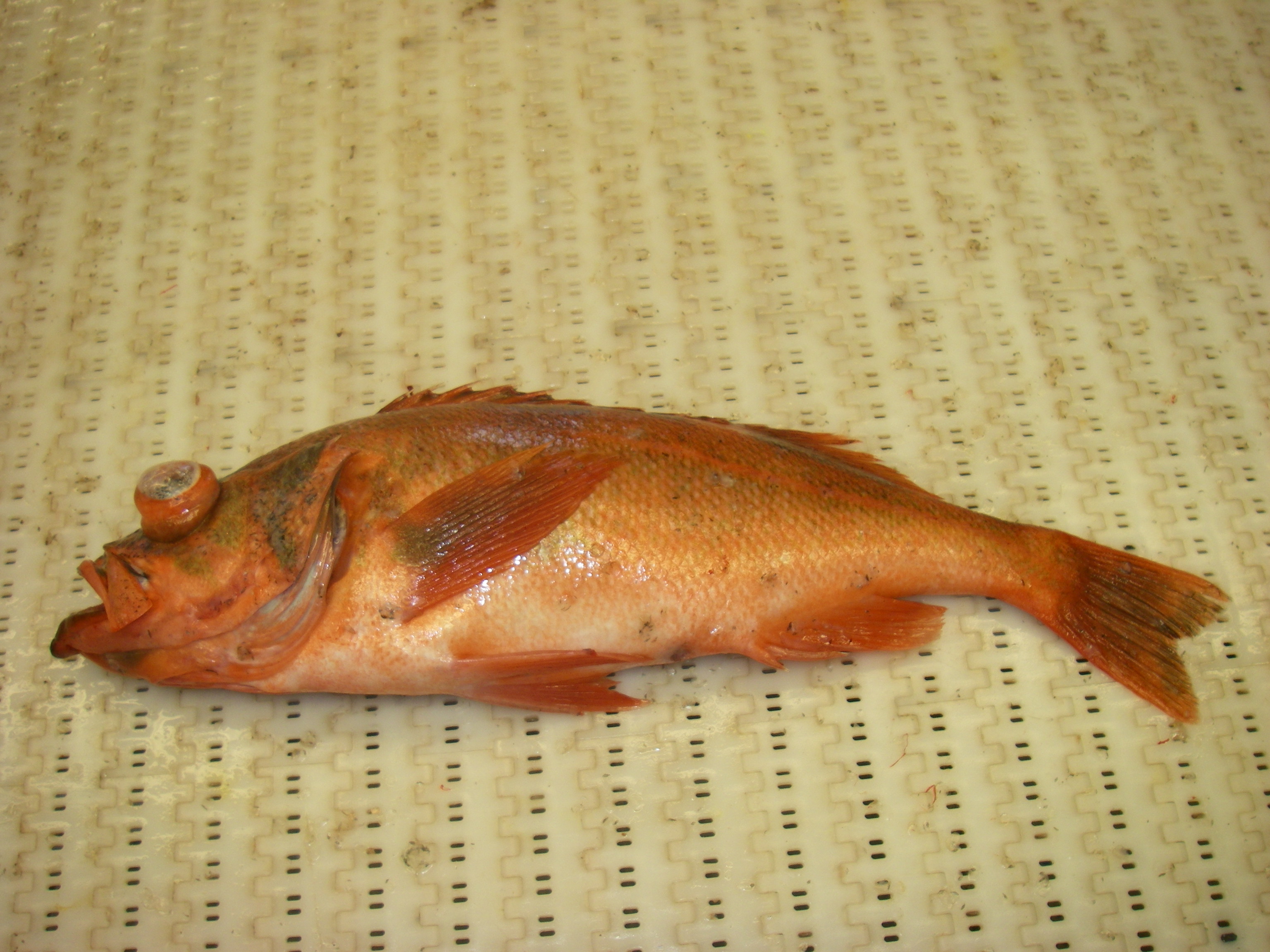
Second, I found out that even with all of the modern equipment on board, catching fish is still not guaranteed. We trawled three times last night on the 23rd and caught a total of 14 fish in all three trawls! Remember, a good sample size for one trawl is supposed to be 300 pollock, so this is the equivalent of fishing all day long and catching a minnow that just happened to swim into the fishing hook.

The first trawl caught absolutely nothing, as the fish dove underneath the net to escape the danger. The second trawl caught two pacific ocean perch and one pollock, and the third trawl caught eleven pollock. All in all, not the best fishing day.

pollock
The lone pollock from the second trawl.

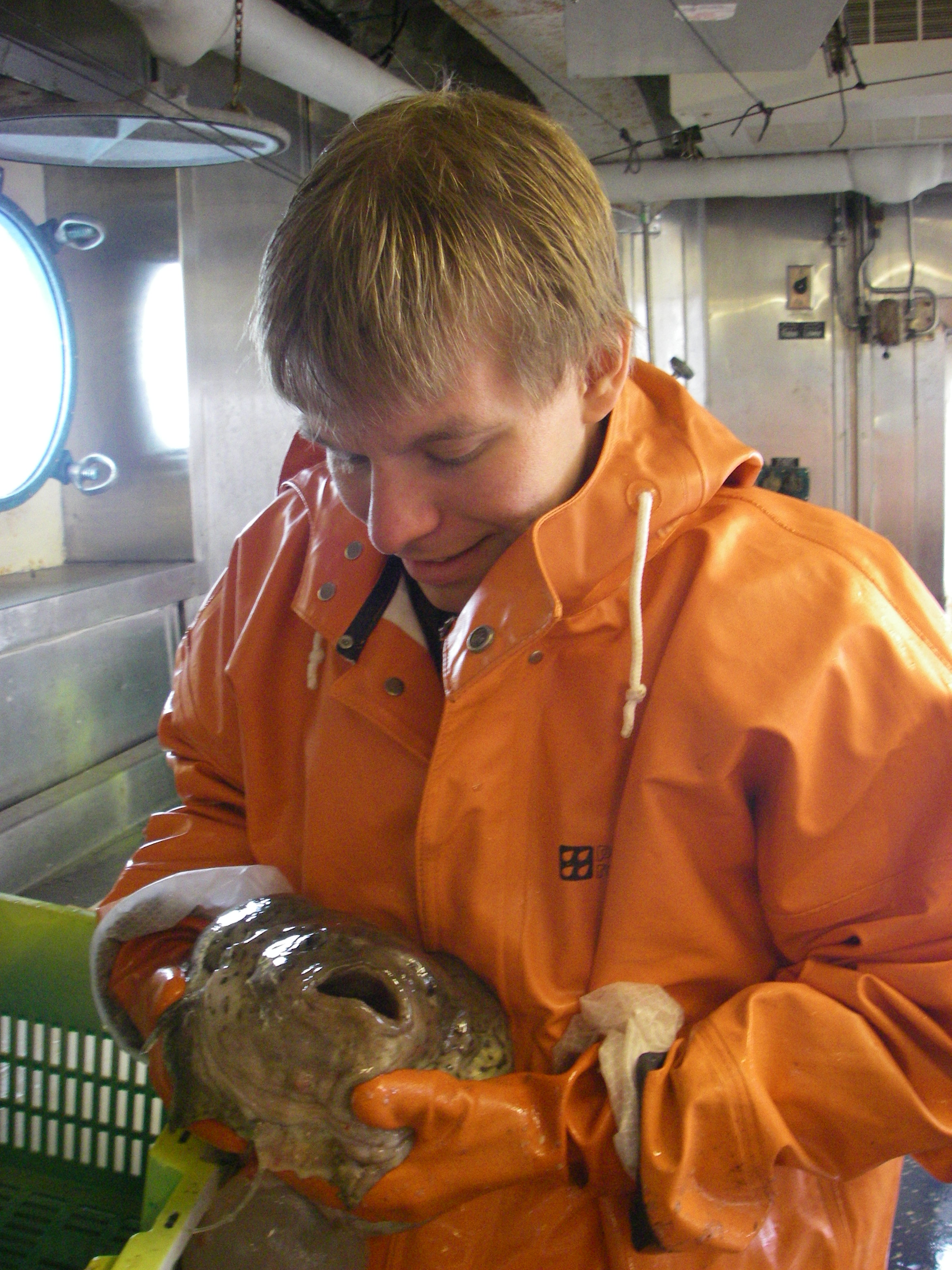
Despite the poor fishing, we did bring up this neat little critter.

isopod
This is an isopod! These animals are very similar to the pillbugs (roly-polys) that we find in the US. Many marine isopods are parasites, and can be a danger to fish!
isopod2
This is the bottom view of an isopod

The third thing to break up the monotony was the Aleutian Islands earthquake. On the evening of June 23rd, a magnitude 7.2 earthquake shook the Aleutian Islands. According to ABC news, the earthquake was centered about 1,200 miles southwest of Anchorage. The quake spawned a brief tsunami warning that caused a large number of Dutch Harbor residents (Dutch Harbor is the home base of the show Deadliest Catch) to head for higher ground. We had been in the Aleutian Islands and Dutch Harbor area on our survey route, but had left two days before, so the Oscar Dysonwas completely unaffected by the earthquake.

Dutch Harbor residents seek higher ground after a tsunami warning was issued. AP photo by Jim Paulin.

Science and Technology Log

In order to obtain photos of all of this neat sealife, we first have to catch it! We catch fish by trawling for them. Some of you may not know exactly what I’m talking about, so let me explain. Trawling is a fishing method that pulls a long mesh net behind a boat in order to collect fish. Trawling is used to collect fish for both scientific purposes (like we’re doing) and also in commercial fishing operations. We have two types of fish trawls onboard the NOAA Ship Oscar Dyson — a mid-water trawl net and a bottom trawl net. We’ve used both types throughout our cruise, so let me tell you a little about each.

The mid-water trawl net is just as it sounds — it collects fish from the middle of the water column — not those that live on the seafloor, not those that live at the surface. The technical name for the net we have is an Aleutian Wing Trawl (AWT) — it’s commonly used by the commercial fishing industry.

trawl net
Part of the mid-water trawl net as it's being deployed.

The end of the net where the fish first enter has very large mesh, which is used to corral the fish and push them towards the bag at the end. The mesh gets progressively smaller and smaller the further into it you go, and at the very end (where the collecting bag is), the mesh size is 0.5 inches. The end (where the bag is, or where the fish are actually collected) is called the codend.

codend
One of the codends on the deck of the Oscar Dyson

This is the kind of net we use when we want to collect a pollock sample, because pollock are found in the water column, as opposed to right on the seafloor (in other words, pollock aren’t benthic animals). Our particular net is also modified a little from a “normal” AWT. Our trawl has three codends (collecting bags) on it, each of which can be opened and closed with a switch that is controlled onboard the ship. The mechanism that opens and closes each of the 3 codends is called the Multiple Opening and Closing Codend (MOCC) device. Using the MOCC gives us the ability to obtain 3 discrete samples of fish, which can then be processed in the fish lab.

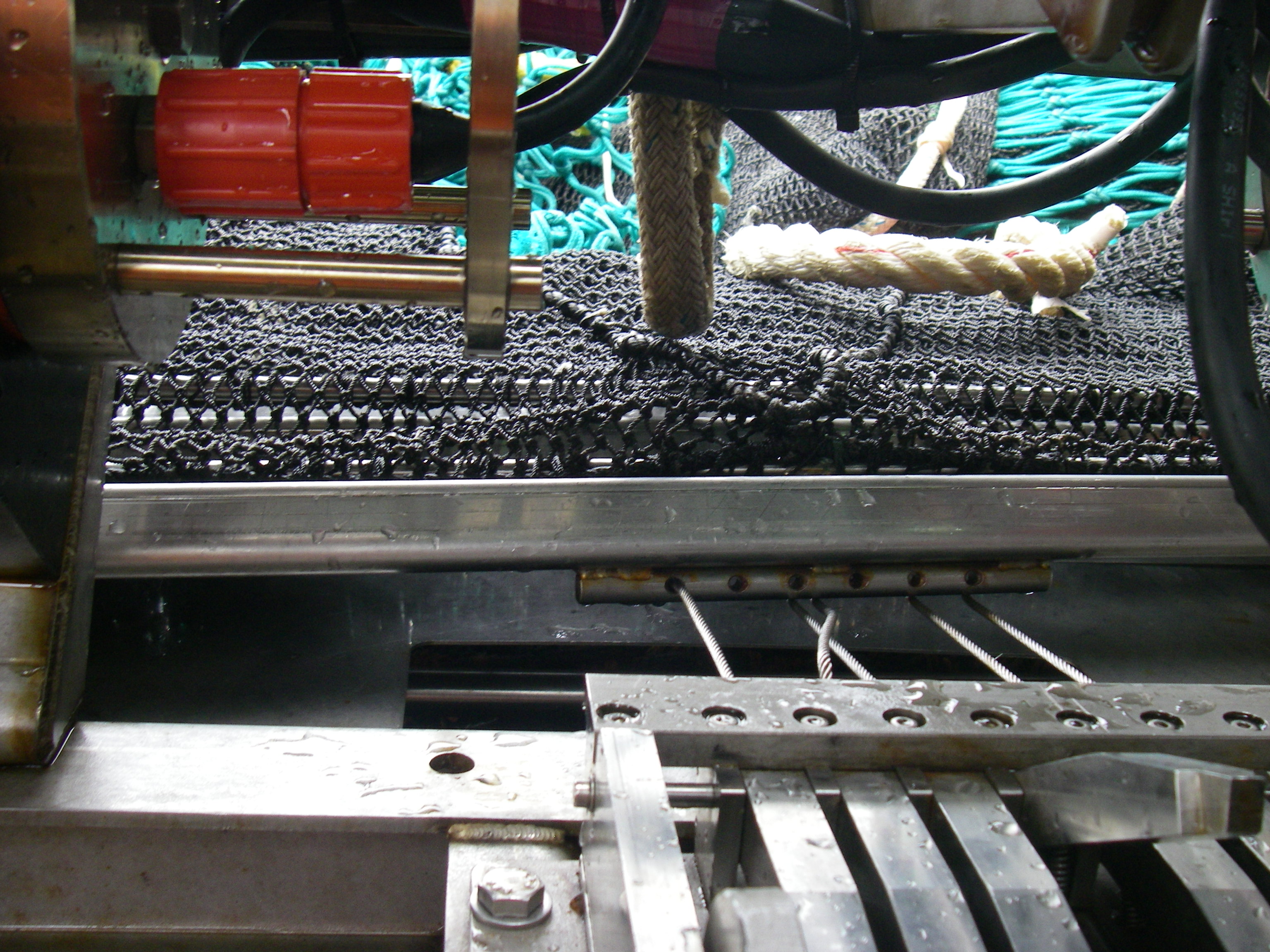
MOCC
The MOCC apparatus, with the 3 nets extending off.
bar
The nets are opened and closed using a series of metal bars. (The bar here is the piece of metal running across the middle of the photo). The net has 6 of these bars. When the first bar is released, the first codend is ready to take in fish. When the second bar is dropped, the first codend is closed. The third and fourth bars open and close the second codend, and the fifth and sixth bars open and close the third codend.
trigger
This is the trigger mechanism for the codends on the MOCC. When the codend is released, the trigger mechanism is up. When the codend is locked and ready to go, it is in the down position.

One other modification we have on our mid-water trawl net is the attachment of a video camera to the net, so we can actually see the fish that are going into the codends.

camera
This is the camera apparatus hooked up to the trawl.

When we spot a school of fish on the acoustic displays, we then radio the bridge (where the captain is) and the deck (where the fishermen are) to let them know that we’d like to fish in a certain spot. The fishermen that are in charge of deploying the net can mechanically control how deep the net goes using hydraulic gears, and the depth that we fish at varies at each sampling location. Once the gear is deployed, it stays in the water for an amount of time determined by the amount of fish in the area, and then the fishermen begin to reel in the net. See the videos below to get an idea of how long the trawl nets are — they’re being reeled in the videos. Once all of the net (it’s VERY long — over 500 ft) is reeled back in, the fish in the codends are unloaded onto a big table on the deck using a crane. From there, the fish move into the lab and we begin processing them.

Videos of the net being reeled in and additional photos are below!

http://www.youtube.com/watch?v=I50Q4SJzzaE
http://www.youtube.com/watch?v=VVAqbAGcxRs

net end
This is the end of the trawl net. They are lines that basically hold onto the net.
codend
One of the codends before being opened up onto the conveyor belt. We are inside waiting for the fish to arrive.
open codend
Opening the codend to release the fish catch!
reeled in
The mid-water trawl net all reeled in!

The other type of trawl gear that we use is a bottom trawl, and again, it’s just as it sounds. The bottom trawl is outfitted with roller-type wheels that sort of roll and/or bounce over the seafloor. We use this trawl to collect benthic organisms like rockfish, Pacific ocean perch, and invertebrates. There’s usually a random pollock or cod in there, too. The biggest problem with bottom trawls is that the net can sometimes get snagged on rocks on the bottom, resulting in a hole being ripped in the net. Obviously, we try to avoid bottom trawling in rocky areas, but we can never be 100% sure that there aren’t any rogue rocks sitting on the bottom 🙂

bottom trawl
The mesh and wheels of the bottom trawl.
btrawl2
More of the bottom trawl
btrawlreel
The bottom trawl, all reeled in!

Species Seen

Northern Fulmar
Gulls
Pollock
Pacific Ocean Perch (aka rockfish)
coral
Isopod

Reader Question(s) of the Day!

The first question for today comes from Rich, Wanda, and Ryan Ellis! Ryan is in the homeschool Tuesday class at the Zoo.

Q. We looked up what an anemone was and we found it was some kind of plant. Is that correct?

A. Great question! The answer is both yes and no. There is a type of flowering plant called the anemone. There are about 120 different species, and they are in the buttercup family. For one example of the plant, look below!

Anemone Nemorosa
Anemone Nemorosa. Taken from pacificbulbsociety.org

The sea anemone, however, is not actually a plant but an animal! Anemones are classified as cnidarians, which are animals that have specialized cells for capturing prey! In anemones, these are called nematocysts, which have toxin and a harpoon like structure to deliver the toxin. When the nematocysts are touched, the harpoon structure injects the toxin into the animal that touches it.

Cnidarians also have bodies consist of mesoglea, a non living jelly like substance. They generally have a mouth that is surrounded by the tentacles mentioned above.

Anemone
The Anemone we found.

The second question comes from my wife Olivia.

Q. What has surprised you most about this trip? Any unexpected or odd situations?

A. I think the thing that has surprised me the most is the amount of down time I have had. When I came on, I assumed that it would be physical and intense, like the show Deadliest Catch, where I would spend my whole time fishing and then working on the science. I figured that I would be absolutely toast by the end of my shift.

While I have worked hard and learned a lot, I have quite a bit of down time. Processing a catch takes about one hour, and we fish on average once or twice a night. That means I am processing fish for roughly two hours at most, and my shift is twelve hours. I have gotten a fair amount of extra work done, as well as a lot of pleasure reading and movie watching.

As for unexpected and odd situations, I didn’t really expect to get your camera killed by a wave. Fortunately, I have been allowed to use the scientist camera, and have been able to scavenge photos from other cameras, so I will still have plenty of pictures.

Another technological oddball that I didn’t think about beforehand was that certain headings (mainly if we are going north) will cut off the internet, which is normally fantastic. It is frustrating to have a photo 90% downloaded only to have the ship change vectors, head north, and cut off the download, forcing me to redownload the whole photo.
I also didn’t expect that the fish would be able to dodge the trawl net as effectively as they have. We have had four or five “misses” so far because the fish will not stay in one spot and let us catch them. While the use of sonar and acoustics has greatly improved our ability to catch fish, catching fish is by no means assured.

Perhaps the biggest “Are you kidding me?” moment though, comes from James and David Segrest asking me about sharks (June 17-18 post). An hour after I read the question, we trawled for the first time of the trip, and naturally the first thing we caught was the sleeper shark. Also naturally, I haven’t seen a shark since. Sometimes, you just get lucky.

Jason Moeller: June 21-22, 2011

NOAA TEACHER AT SEA
JASON MOELLER
ONBOARD NOAA SHIP OSCAR DYSON
JUNE 11 – JUNE 30, 2011

NOAA Teacher at Sea: Jason Moeller
Ship: Oscar Dyson
Mission: Walleye Pollock Survey
Geographic Location: Gulf of Alaska
Dates: June 21-22, 2011

Ship Data
Latitude: 55.03N
Longitude: -163.08W
Wind: 17.81 knots
Surface Water Temperature: 6.7 degrees celsius
Air Temperature: 10.10 degrees celsius
Humidity: 85%
Depth: 82.03 meters

Personal Log
Welcome back, explorers!

June 21
Today has been the calmest evening since I boarded the Oscar Dyson. The night shift did not fish at all, which meant that I basically had an evening off! Even the evenings we have fished have been relatively calm. It takes us about an hour to an hour and a half to process a haul of fish, and up to this point we average about one haul per night. That gives me quite a bit of down time! When I am on shift, that down time is usually spent in one of two places.

computer lab
The first spot is the computer lab in the acoustics room. This is the room where we wait for the haul to be brought in. I write the logs, lesson plan, check emails, and surf the web during quiet times.
lounge
This is the lounge. The cabinet under the TV has over 500 movies, and a movie is usually playing when I walk in. Behind the couch is a large bookshelf with several hundred books, so I have done a fair amount of pleasure reading as well.

When I am not sitting in one of these two places, I am usually running around the ship with my camera taking nature photos. Below are the best nature photos of the past three days.

Volcano
One of the coolest things about the Aleutian islands has to be the number of volcanoes that can be seen. This is the one on Unimak Island.
volcano2
A second picture of the same volcano.
coast
This is just a cool rock formation off of the coast. The Oscar Dyson has been hugging the coast the entire trip, which has been great for scenery.
gull
A gull skims the water by the Oscar Dyson.
gull2
A gull wings toward the Oscar Dyson

June 22
We resumed fishing today! These trawls brought in quite a few species that I had not seen before, along with the ever plentiful pollock.

Net
The net, filled with fish!
Jason by belt
Jason waits for the net to load the fish onto the conveyor belt.
Jason with flounder
Here, I am separating the arrowtooth flounder from the pollock.
skate
We managed to catch a skate in the net! Skates are very close relatives to sharks. We quickly measured it and then released it into the ocean.
skate 2
A second photograph of the skate.
lumpsucker
Do you remember the little lumpsucker from a few posts back? This is what an adult looks like!
lumpsucker2
The lumpsucker was slimy! I tried to pick it up with my bare hands, and the slime gummed up my hands so that I couldn't pick it up! Even with gloves designed for gripping fish I had trouble holding on.
lumpsucker3
A closeup of the lumpsucker
sculpin
This fish is called a sculpin.
crab
I finally saw a crab! None of us know what was attached to it, but the scientists believe that it was an anemone.
starfish
This is a starfish the net pulled up.

Science and Technology Log
There is no Science and Technology Log with this post.

Species Seen
Humpback Whales
Northern Fulmar
Gulls
Rockfish
Walleye Pollock
Lumpsucker
Arrowtooth Flounder
Atka Makerel
Salmon
Sculpin
Copepods
Isopods
Skate
Crab!!!

Reader Question(s) of the Day!

Today’s question comes from James and David Segrest, who are two of my homeschool students!

Q. What do you eat while you are on your adventures? Do you get to catch and eat fish?

The food is great! Our chef has a degree in culinary arts, and has made some amazing meals!

I wake up at 2:30 pm for my 4 pm to 4 am night shift, and usually start my day with a small bowl of oatmeal and a toasted bagel. At 5 pm, about two hours after breakfast, dinner is served, and I will eat a huge meal then too. Every meal has two main courses, a vegetable, a bread, and dessert. We have had a wide variety of main courses which have included bratwurst, steak, gumbo with king crab, fish, chicken parmesan, spaghetti with meatballs, and others!

We will often eat some of the fish we catch, usually salmon and rockfish since those provide the  best eating. The salmon disappears to the kitchen so quickly that I have not actually been able to get a photo of one! We have not caught a halibut in the trawl net yet, otherwise we would likely have eaten that as well. Yum! We have not yet eaten pollock, as it is viewed as being a much lower quality fish compared with the rockfish and salmon.

I’m out of questions, so please email me at jmoeller@knoxville-zoo.org with those questions please!

Jason Moeller: June 19-20, 2011

NOAA TEACHER AT SEA
JASON MOELLER
ONBOARD NOAA SHIP OSCAR DYSON
JUNE 11 – JUNE 30, 2011

NOAA Teacher at Sea: Jason Moeller
Ship: Oscar Dyson
Mission: Walleye Pollock Survey
Geographic Location: Gulf of Alaska
Dates: June 19-20, 2011

Ship Data
Latitude: 54.29 N
Longitude: -165.13 W
Wind: 12.31 knots
Surface Water Temperature: 5.5 degrees Celsius
Air Temperature: 6.1 degrees Celsius
Humidity: 97%
Depth: 140.99 meters

Personal Log

Welcome aboard, explorers!

To be honest, there is not a great deal to write about for the personal log. My daily schedule has settled in quite nicely! I get off work at 4 in the morning, shower, sleep until 2:30 in the afternoon, and then head down to the acoustics room where we track the fish. When we are processing a catch (see the science and technology section of this blog), I am in the fish lab wearing bright orange waterproof clothes that make me resemble a traffic cone.

fishing gear
Jason in fishing gear.

The rest of the time is down time, which is spent reading, working on the blog, learning about the ship, and dreaming up lesson plans that I can use to torment my students. I hope they are interested in a summer fishing trip, as that is the one I am currently planning.

Most of the blog work involves running around and taking photographs. My wife’s camera was soaked beyond repair during the prank that was pulled (see the previous post) as Sarah was holding the camera when the wave came over the railing. Fortunately, there was another camera on board.

Our survey is keeping us very close to the coast and islands of Alaska. As a result, I’ve gotten some gorgeous photos. This place is just beautiful.

An island shrouded by clouds.
waterfall
A waterfall falls off into the ocean.
Wind
Jason in front of an island. It was a bit windy, but at least it was sunny!
view
Mountaintops visible just above the island coast. Jake took this photo while I was in the fish lab.
sunset
Sunset over Alaskan waters.

Science and Technology Log

Pollock
Walleye Pollock waiting to be processed

We finally started fishing! As I mentioned in my very first blog, the Oscar Dyson is surveying walleye pollock, which is an important fish species here in Alaska. Walleye pollock make up 56.3% of the groundfish catch in Alaska, and is eaten in fast food restaurants around the world such as Wendy’s, McDonalds, and Burger King. It is also used to make imitation crabmeat.

Our first catch had a little over 300 walleye pollock, and we processed all of them. Three hundred is an ideal sample size for this species. If, for example, we had caught 2,000 pollock, we would only have processed 300 of the fish, and we would have released the rest of them back into the ocean.

The photo captions below will provide a tour of the fish lab as well as introduce blog readers to the data we wish to collect and how scientists aboard the Oscar Dyson collect it.

Conveyer belt
This is the conveyor belt. After the catch is pulled on board, it is loaded onto this conveyor belt and moved down the belt and into the lab. At this point, the scientists separate the pollock from the rest of the sea life that was accidentally in the net. Today, the majority of the "extra" sea life were brittle stars, sponges, and a few squid.
Gender Box
Once the pollock and other sea life are separated, they are moved to this box to be sexed. In order to do this, we would have to cut the fish open and look at the internal organs of the fish. Once this was done, females would go over the yellow sign on the right and into the box that was hidden behind it. The males went into the box on the left.
Length Station
Once we had determined the pollock's gender, we moved to the measuring station, which was on the other side of the last station. We laid each individual fish on the table on top of the ruler, and then measured the fish from the head to the fork of its tail. We recorded the length by tapping the table at the fork of the fish's tail with a sensor that we carried in our hand. A sensor in the table recorded the data and sent it to the computer monitor seen above the table.
measuring pollock
Jason measures a pollock on the board!

From this catch (we will do this for any following catch as well) we also took and preserved twenty stomachs from random fish. This was done in order to later analyze what the pollock had eaten before they died. We also took forty otoliths from random pollock as well. An otolith is the ear bone of the pollock, and it is incredibly important to researchers as they will tell the pollock’s age in a similar manner to the way a tree’s rings will.

This is a pollock otolith!
Stored Otoliths
After removing the otolith from the fish, they were put into these vials. Each pair of otoliths received their own vial.

While looking at pollock is the main focus of the survey, we did run into some other neat critters in this haul as well!

Atka Makerel
This is an Atka Mackerel. We also caught a salmon, but I didn't get a good look at it. Our kitchen grabbed it!
Basket Star
This is a basket starfish. We were trawling close to the bottom and pulled it up in the nets.
Lumpsucker
This is a lumpsucker! They spend their lives on the bottom where they eat slow-moving animals such as worms and mollusks.
Arrowtooth Flounder
This is an arrowtooth flounder. These are not very good eating fish, and are not the flounder found in the supermarket. Check out the nasty teeth in the photo below this one!
Flounder teeth
I wouldn't want to be bitten by this fish!
Rockfish
Finally, this is a rockfish! The red snapper that we see in the marketplace is often this fish instead.

Species Seen

Albatross
Northern Fulmar
Gulls
Rockfish
Walleye Pollock
Lumpsucker
Arrowtooth Flounder
Atka Mackerel
Salmon
Pacific Grenadier
Squid
Shrimp
Basket Starfish

Reader Question(s) of the Day!

Today’s question is actually a request. It comes from Tish Neilson, one of our homeschool parents.

Hey Jason –
I had a super favor to ask of you. There is a little girl from Jackson’s school that is a 5th grader and she was recently diagnosed with leukemia. There have been some bracelets created for her that say “Going Bananas for Anna” to show support and several moms and I have gotten together and are putting together a scrapbook for her and trying to get as many people as possible wearing her bracelets in really cool places. Then we are having them take pictures to send to us to put in her scrapbook so she can she how far her bracelets have traveled and how many people are pulling for her. If it’s possible to do so and you would be willing to do it I would LOVE to try and get you a bracelet to take some pictures and send to me from Alaska. Her nickname is Anna Banana and she is always asking for pictures and such so that is why we came up with this idea.
Tish Neilson

Unfortunately, I had left for Alaska before I received the email, and as a result I do not have a bracelet. Hopefully, a sign will work just as well.

For Anna
Hi Anna! This is Unimak Island! It is one of the Aleutian Islands off the coast of Alaska! Hang in there, we are rooting for you!

Tanya Scott, June 20, 2010

NOAA Teacher at Sea
Tanya Scott
Onboard NOAA Ship Miller Freeman
June 16 – 21, 2010

Mission:  Ecology of Juvenile Fishes  
Geographical Area: Central Oregon/Washington Coast
Current Location:  35 miles offshore, steaming to Seattle, WA
Date:  Sunday, June 20, 2010

Today is my last full day aboard the Miller Freeman.  It is currently 4:00 pm and I have just woken up!  I find that being on a ship rocks me to sleep.  Or, could it be that I was up until 6:00 am this morning?  Either way, I am fully rested and ready to rinse and store all of the scientific equipment in preparation for our departure tomorrow morning.  We are currently steaming towards Seattle, Washington where we will depart the ship.

Our work on Saturday turned out to be very interesting.  While pulling the midwater trawl, a small pod of Pacific Whitesided dolphin became interested in our tow.  They swam very close to the net for a time and had everyone worried that they may become entangled.  Luckily, they lost interest and swam away.  If they had become entangled in the net there are many protocols that would have been implemented.  The marine mammal stranding unit in Washington would have been called, a representative would have been sent to meet the ship, and many photographs taken as documentation.  It is always a concern that marine mammals may become entangled in nets but fortunately, this time was not one of those cases.

Krill brought in from the midwater trawl.

The catches from our midwater trawl brought up the familiar species of krill, purple lanternfish, rockfish, and hake.  Since the depth of this trawl does not target adult fish, we have been dealing almost exclusively with juvenile and larvae fish.  Our last haul produced more larvae rockfish than usual, which is good for the scientists conducting this survey.  They are, however, trying to determine where the largest concentrations of juvenile rockfish are during the season.  Rockfish are an important species in the Pacific Northwest.  It would be easy for you to think of how important flounder are in our area.  Rockfish are harvested for sale in fish markets and therefore are threatened by over harvesting.  It is important to monitor their movement and habitat in order to determine when and where Pacific Hake regulations should be put in place.  Another commercially important species is the Pacific Hake.  This fish is deboned and sold as fish sticks in the grocery store.  I’m sure that most of you have eaten a Pacific Hake and didn’t even know.  These fish are commonly caught by fisherman and, just as the rockfish, their populations are threatened by over harvesting.  When Pacific Hake are caught in the midwater trawl, their length is measured, recorded, and the fish are returned to the ocean.  All of the data collected by the scientist involved in this study will help to ensure the survival of these commercially viable species.  More importantly, keeping their populations stable will mean that the food web remains intact.  Just as we have discussed in class many times, everything on earth has its place.  Something else always depends on it for food, shelter, survival, and well being.

Pacific Hake

Since today is the last full day on board we will be preparing the equipment for transport back to Newport, Oregon.  It is important that everything is rinsed with freshwater to prevent corrosion.  After being rinsed and dried, we will package everything in boxes.  Our bunks will be stripped, our lockers emptied, and staterooms cleaned.  Although my time on board is coming to an end, I know that I will have many memories and experiences to share with you when I return.

Pacific Hake larvae

Tanya Scott

Elizabeth Eubanks, July 27, 2007

NOAA Teacher at Sea
Elizabeth Eubanks
Onboard NOAA Ship David Starr Jordan
July 22 – August 3, 2007

Mission: Relative Shark Abundance Survey and J vs. Circle Hook Comparison
Geographical Area: Pacific Ocean, West of San Diego
Date: July 27, 2007

Weather Data from the Bridge  
Visibility: 8-10 miles
Air temperature: 17.0 degrees C
Sea Temperature at 350m: 7 degrees C
Sea Temperature at surface: 19.0 degrees C
Wind Direction: 290 W Wind Speed:  18 kts
Cloud cover: clear –some cumulus, cirrus
Sea Level Pressure: 1013.2 mb
Sea Wave Height: 2-3 ft
Swell Wave Height: 2-3 ft

Science and Technology Log 

“First, do no harm.” –Michael J. Zoghby RPT 

Today was so exciting. We caught a Mola mola, Ocean Sunfish, and 22 sharks.  Many of them were baby Blue sharks and although this team tries very hard to keep all of the sharks alive, some of them are so badly thrashed by the hook and/or line that they don’t make it. Yesterday was the first day that we had our first mortality (dead shark).  It was a baby Blue and the gills were just ripped out by the hook.  Sad, no one likes to see a dead shark. Everyone is out here to preserve them and keep them safe.

We caught many average size sharks and a few really large ones.  Watching the scientist work on the large animals has got to be one of the most thrilling things to see, especially when they have the extra challenge of wave swells coming across the platform, soaking them and giving the shark a chance to do what it does best… swim. As one of the grad students put it, the pictures and videos we have taken during these events are not ones you would want your mom to see, the mix of slippery platform, scalpel in hand, swell water pouring in and of course a HUGE SHARK, could be a deadly mixture. But safety comes first. They probably had the shark on the platform for a good 3-5 minutes. The Blue was using every bit of what it had to get off of the platform. It was so exciting that I had to video and take still shots. This shark would’ve been a great choice for the satellite tag because of its size, but they didn’t get a chance to that. They removed what they could of the hook, identified him as a male and struggled to hold him down. The Blue shark was estimated at 220cm. We never did get an actual measurement, because for one thing it appeared to be longer than the platform measuring tape and for another Dr. Kohin made a decision to “just let it go” and that is a direct quote. Safety comes first for shark and for people.

Dr. Suzy Kohin surrounded by a big Blue Shark – notice the eye, the nictitating membrane covers the eye.

More safety notes: Late night we found out that there was a problem with one of the engine fans. So tomorrow morning our set is canceled. We will have to wait to see if they can fix it and if they can’t we go back to San Diego and the trip is over. Why? Because they follow the rule, the only rule you really ever need– First Do No Harm. Extra note: The Ocean Sunfish is an amazing fish. You will see them in the Pacific and at first think that they are sharks, because of their dorsal fin that sticks out of the water. They have been described as one of the most evolved fish and look like a super sized Frisbee.- A great fish to do a little personal research on, if you are into fish. (Sean Maloney – check it out!)

Personal Log 

“Bet ya goin’ fishn’ all the time, I’mma goin’ fishin’ too. I bet your life, your lovin’ wife is gonna catch more fish than you, so many fish bite if ya got good bait, here’s a little tip that I would like to relate, I’mma goin’ fish, yes I’m goin’ fishn’ and my babies goin’ fishin too!” 

– Not sure who sang or wrote this little diddy first, so I can’t give credit right now – but I didn’t write this “catchy” tune. 

I am working/ living on a fishing boat. Dah! It’s a goofy realization that just hit me today. Since I got accepted for this project, I have been in a narrow mindset that I am on a shark research vessel, which I am. I broaden my mindset and hit me that I am also on a fishing vessel. Fishing is what we do when we set and haul the long line. Fishing is what we can do in our spare time. We have bait, we have hooks and we have line. We catch fish. Oh and we cook and eat fish too. We are fishing.  Funny, but now it makes my experience even cooler. I have always wanted to work on a fishing vessel.

Right out of high school my girl friend and I had done a heap of research and were planning on moving to Ocean City, MD for the summer. We had spent hours investigating different job possibilities. We had heard that sometimes you spend all your summer working to pay your bills and don’t really get to enjoy the beach, but we didn’t care. She was interested in a job as a waitress and I had sent in a ••• dozen applications to fishing vessels. That is what I really wanted to do. That was my glamour job! I dreamed that I could be the one who baits the hooks and cleans the deck. I figured if I had to spend most of my time working, it should be on the water with fish and people who liked to fish. Anyway, that dream ended with a car crash – no one was killed, just minor injuries but it sure shook up my folks enough to keep me in PA for the summer.  So after all these years – I am working and living on a fishing ship. Super cool, huh!

Scientists Suzy Kohin and Russ Vetter tag the Mola mola, Ocean Sunfish

Question of the Day 

If you had to pick a research science career, what would you study? What would your problem be?

Question of the trip: Which hook, the J or Circle, will catch more sharks? 

Please make a hypothesis. Utilize resources to justify your hypothesis.  ———Yes, you get extra credit for this.