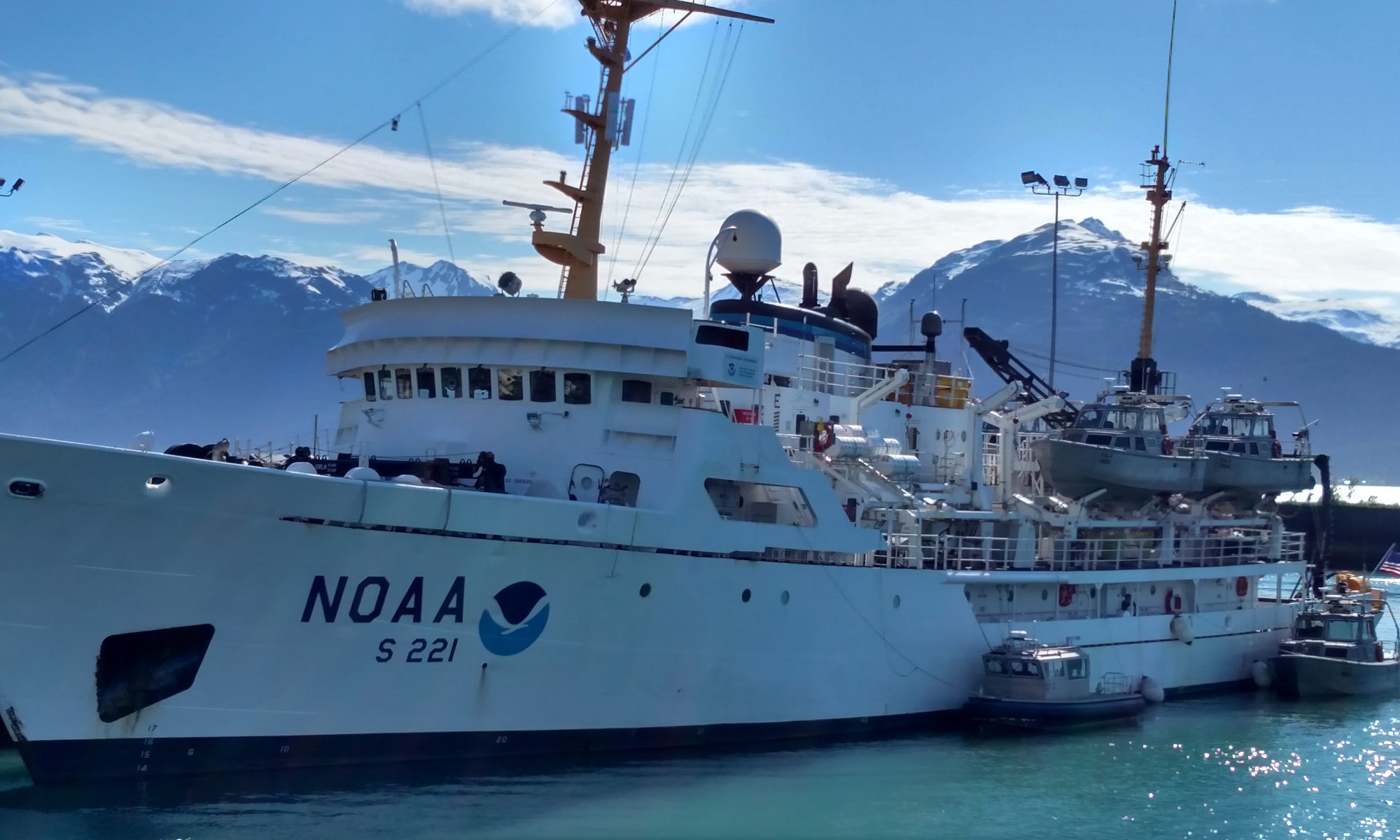
David Madden: Immersed in the Seascape July 18, 2019

NOAA Teacher at Sea
David Madden: July 18th, 2019


On board off the coast of North Carolina – about 35 miles east of Cape Fear, 40 miles south of Jacksonville, NC.  (33º50’ N, 77º15’W)

Mission: South East Fisheries Independent Survey

Geographic Area of Cruise: Atlantic Ocean, SE US continental shelf ranging from Cape Hatteras, NC (35°30’ N, 75°19’W) to St. Lucie Inlet, FL (27°00’N, 75°59’W)

Here’s our location from the other day, courtesy of windy.com.  And here is a good Gulf Stream explanation from our friends at NOAA:

Date: July 19, 2019

Science and Technology Log

Being at sea has got me thinking; about life at sea, the lives and careers of the men and women on board, and about the marine organisms around us.  Pause there for a minute.  Nature’s beauty and abundance on land is readily seen, so long as you travel to the right location and you’re patient.  The ocean, however, hides its multitudes beneath the waves.  I’ve found myself drawn to the ocean my whole life, and here on the cruise, I am drawn to staring at and contemplating the ocean and its life – the great hidden beneath.  You know the stats: the earth is covered by ~70% water, the deep ocean has been explored less than outer space, the ocean is warming and turning more acidic, etc.  I’m not saying that you and I don’t already know these things.  I’m only saying that you feel them differently when you are in the ocean, when you are immersed for days in the seascape.   

The goal is this cruise is to survey fish.  (SEFIS = Southeast Fisheries Independent Survey).  The science crew repeats a similar protocol each day of the cruise.  It looks something like this:

  1. Chief scientist, Zeb Schobernd, determines the site locations using NOAA sea floor maps. 
  2. The science team (broken into day and night shifts) baits six traps with menhaden fish bait, and starts the two GoPros that are attached to the traps.   
  3. The Pisces crew then deploys the traps, 1-6, at pre-determined locations (see step 1).  They do this by sliding them off the back of the ship.  Traps are attached to buoys for later pick up.
  4. Wait for around 75 minutes.
  5. Pisces Senior Survey Technician, Todd Walsh, along with crew members, Mike and Junior, drop the CTD [Conductivity, Temperature, Depth] probe.  See picture below. 

                *Stay tuned for a video chronicling this process. 

6. After ~75 min, NOAA Corps officers drive back to retrieve the traps, in the order they were dropped. (1-6)

7.  Crew members Mike and Junior, along with scientists, collect the fish in the trap and sort them by species.

8.  All fish are measured for weight and length. 

9. Depending on the species, some fish contribute further information, most notably, their otoliths (to determine age) and a sample of reproductive organs to determine maturity. 

10. Rinse and repeat, four times each day, for the length of the cruise. 

I mostly work with the excellent morning crew.

The most excellent and experienced morning crew.
Mike and Junior, running the CTD, and supporting their favorite NFL teams.

Here’s a view into yesterday’s fish count – more fish and more kinds of fish:

Here is a view off the back of the boat, called the stern, where the traps are dropped. 

On Wednesday the GoPros on one of the fish traps collected footage of a friendly wandering tiger shark.  Our camera technician, Mike Bollinger, using his stereo video technique, determined the size of the shark to be ~ 8.5 feet.  I added the location’s CTD data to the picture.  This is part of an upcoming video full of neat footage.  See below. 

Tiger Shark at 64.55 meters, footage from fish trap GoPro.

Personal Log:

Things continue to be exciting on board.  My mission to film flying fish flying continues (local species unknown/not really sure; probably family: Exocoetidae). But not without some mild success!  I managed to get some of ‘em flying off the port side near the bow.  Man are they quick.  And small.  And the seas were rough.  Yet I remain undeterred!  Here’s a picture of me waiting and watching patiently, followed by a picture of an unlucky little flying fish who abandoned sea and was left stranded at ship.  Poor little fella. 

Waiting patiently for the flying fish to fly. And fly right where I was aiming and focused.

General Updates:

  1. The seas have picked up quite a bit.  Rising up to 5-6 feet.  That may not seem terrifically high, but it sure does rock the ship.  Good thing seas were flat at the start, allowing me to get used to life at sea.   
  2. I just saw some dolphins!  Yippie!  Pictures and video to come.    
  3. Though not legal, I’m dying to take a swim in these beautiful blue waters.    
  4. I don’t think I’ll ever get tired of watching the ocean.  *short of being stranded at sea, I suppose.  See “In the Heart of the Sea: The Tragedy of the Whaleship Essex” – a true story and great book that’s may have served as inspiration for Moby Dick.  I loved the book, haven’t seen the movie.  Or check out the lost at sea portions of the, hard-to-believe-it-actually-happened, “Unbroken” – great book, okay movie. 

Neato Facts =

NOAA Ship Pisces won NOAA ship of the year in 2018.  This is no doubt due to the most excellent crew, seen below.  Congratulations!

We’ve caught a number of moray eels in the fish traps.  They’re super squirmy and unfriendly.  Turns out they also have pharyngeal mouth parts.  Essentially a second mouth that shoots after their first one is opened.  Check out this fascinating look into the morey eel’s jaw biomechanics.

Please let me know if you have any questions or comments. 

Andria Keene: Let the fun begin! October 17, 2018

NOAA Teacher at Sea

Andria Keene

Aboard NOAA Ship Oregon II

October 8 – 22, 2018


Mission: SEAMAP Fall Groundfish Survey

Geographic Area of Cruise: Gulf of Mexico

Date: October 17, 2018

Weather Data from the Bridge
Date: 2018/10/17
Time: 13:10
Latitude: 027 39.81 N
Longitude 096 57.670 W
Barometric Pressure 1022.08mbar
Air Temperature: 61 degrees F

Those of us who love the sea wish everyone would be aware of the need to protect it.
– Eugenie Clark

Science and Technology Log

After our delayed departure, we are finally off and running! The science team on Oregon II has currently completed 28 out of the 56 stations that are scheduled for the first leg of this mission. Seventy-five stations were originally planned but due to inclement weather some stations had to be postponed until the 2nd leg. The stations are pre-arranged and randomly selected by a computer system to include a distributions of stations within each shrimp statistical zone and by depth from 5-20 and 21-60 fathoms.

Planned stations and routes

At each station there is an established routine that requires precise teamwork from the NOAA Corps officers, the professional mariners and the scientists. The first step when we arrive at a station, is to launch the CTD. The officers position the ship at the appropriate location. The mariners use the crane and the winch to move the CTD into the water and control the decent and return. The scientists set up the CTD and run the computer that collects and analyzes the data. Once the CTD is safely returned to the well deck, the team proceeds to the next step.

science team with the CTD
Some members of the science team with the CTD

Step two is to launch the trawling net to take a sample of the biodiversity of the station. Again, this is a team effort with everyone working together to ensure success. The trawl net is launched on either the port or starboard side from the aft deck. The net is pulled behind the boat for exactly thirty minutes. When the net returns, the contents are emptied into the wooden pen or into baskets depending on the size of the haul.

red snapper haul
This unusual haul weighed over 900 pounds and contained mostly red snapper. Though the population is improving, scientists do not typically catch so many red snapper in a single tow.

The baskets are weighed and brought into the wet lab. The scientists use smaller baskets to sort the catch by species. A sample of 20 individuals of each species is examined more closely and data about length, weight, and sex is collected.

The information gathered becomes part of a database and is used to monitor the health of the populations of fish in the Gulf. It is used to help make annual decisions for fishing regulations like catch and bag limits. In addition, the data collected from the groundfish survey can drive policy changes if significant issues are identified.

Personal Log

I have been keeping in touch with my students via the Remind App, Twitter, and this Blog. Each class has submitted a question for me to answer. I would like to use the personal log of this blog to do that.

3rd Period - Marine Science II
3rd Period – Marine Science II: What have you learned so far on your expedition that you can bring back to the class and teach us?

The thing I am most excited to bring back to Marine 2 is the story of recovery for the Red Snapper in the Gulf of Mexico. I learned that due to improved fishing methods and growth in commercial fishing of this species, their decline was severe. The groundfish survey that I am working with is one way that data about the population of Red Snapper has been collected. This data has led to the creation of an action plan to help stop the decline and improve the future for this species.

4th Period - Marine Science I
4th Period – Marine Science I: What challenges have you had so far?

Our biggest challenge has been the weather! We left late due to Hurricane Michael and the weather over the past few days has meant that we had to miss a few stations. We are also expecting some bad weather in a couple of days that might mean we are not able to trawl.

5th Period - Marine Science I
5th Period – Marine Science I: How does the NOAA Teacher at Sea program support or help our environment?

The number one way that the NOAA Teacher at Sea program supports our environment is EDUCATION! What I learn here, I will share with my students and hopefully they will pass it on as well. If more people know about the dangers facing our ocean then I think more people will want to see changes to protect the ocean and all marine species.

7th Period - Marine Science I
7th Period – Marine Science I: What is the rarest or most interesting organism you have discovered throughout your exploration?

We have not seen anything that is rare for the Gulf of Mexico but I have seen two fish that I have never seen before, the singlespot frogfish and the Conger Eel. So for me these were really cool sightings.


8th Period - Marine Science I
8th Period – Marine Science I: What organism that you have observed is by far the most intriguing?

I have to admit that the most intriguing organism was not anything that came in via the trawl net. Instead it was the Atlantic Spotted Dolphin that greeted me one morning at the bow of the boat. There were a total of 7 and one was a baby about half the size of the others. As the boat moved through the water they jumped and played in the splashing water. I watched them for over a half hour and only stopped because it was time for my shift. I could watch them all day!

Do you know …

What the Oregon II looks like on the inside?
Here is a tour video that I created before we set sail.


Transcript: A Tour of NOAA Ship Oregon II.

(0:00) Hi, I’m Andria Keene from Plant High School in Tampa, Florida. And I’d like to take you for a tour aboard Oregon II, my NOAA Teacher at Sea home for the next two weeks.

Oregon II is a 170-foot research vessel that recently celebrated 50 years of service with NOAA. The gold lettering you see here commemorates this honor.

As we cross the gangway, our first stop is the well deck, where we can find equipment including the forecrane and winch used for the CTD and bongo nets. The starboard breezeway leads us along the exterior of the main deck, towards the aft deck.

Much of our scientific trawling operations will begin here. The nets will be unloaded and the organisms will be sorted on the fantail.

(1:00) From there, the baskets will be brought into the wet lab, for deeper investigation. They will be categorized and numerous sets of data will be collected, including size, sex, and stomach contents.

Next up is the dry lab. Additional data will be collected and analyzed here. Take notice of the CTD PC.

There is also a chemistry lab where further tests will be conducted, and it’s located right next to the wet lab.

Across from the ship’s office, you will find the mess hall and galley. The galley is where the stewards prepare meals for a hungry group of 19 crew and 12 scientists. But there are only 12 seats, so eating quickly is serious business.

(2:20) Moving further inside on the main deck, we pass lots of safety equipment and several staterooms. I’m currently thrilled to be staying here, in the Field Party Chief’s stateroom, a single room with a private shower and water closet.

Leaving my room, with can travel down the stairs to the lower level. This area has lots of storage and a large freezer for scientific samples.

There are community showers and additional staterooms, as well as laundry facilities, more bathrooms, and even a small exercise room.

(3:15) If we travel up both sets of stairs, we will arrive on the upper deck. On the starboard side, we can find the scientific data room.

And here, on the port side, is the radio and chart room. Heading to the stern of the upper deck will lead us to the conference room. I’m told that this is a great place for the staff to gather and watch movies.

Traveling back down the hall toward the bow of the ship, we will pass the senior officers’ staterooms, and arrive at the pilot house, also called the bridge.

(4:04) This is the command and control center for the entire ship. Look at all the amazing technology you will find here to help keep the ship safe and ensure the goals of each mission.

Just one last stop on our tour: the house top. From here, we have excellent views of the forecastle, the aft winch, and the crane control room. Also visible are lots of safety features, as well as an amazing array of technology.

Well, that’s it for now! Hope you enjoyed this tour of NOAA Ship Oregon II.  


Challenge Question of the Day
Bonus Points for the first student in each class period to come up with the correct answer!
We have found a handful of these smooth bodied organisms which like to burrow into the sediment. What type of animal are they?

Challenge Question
What type of animal are these?

Today’s Shout Out:  To my family, I miss you guys terribly and am excited to get back home and show you all my pictures! Love ya, lots!

Anne Krauss: The Reel Whirl’d, September 15, 2018

NOAA Teacher at Sea

Anne Krauss

Aboard NOAA Ship Oregon II

August 12 – 25, 2018


Mission: Shark/Red Snapper Longline Survey

Geographic Area of Cruise: Western North Atlantic Ocean/Gulf of Mexico

Date: August 26, 2018

Weather Data from the Air

Conditions at 0634

Altitude: 9585 meters

Outside Temperature: -38 ℃

Distance to Destination: 362 km

Tail Wind: 0 km/h

Ground Speed: 837 km/h

(While NOAA Ship Oregon II has many capabilities, flight isn’t one of them. These were the conditions on my flight home.)

Science and Technology Log

The idea of placing an elementary school teacher on a Shark/Red Snapper Longline Survey seems like a reality show premise, and I couldn’t believe that it was my surreal reality. Several times a day, I took a moment to appreciate my surroundings and the amazing opportunity to get so close to my favorite creatures: sharks!

Anyone who knows me is aware of my obsession with sharks. Seeing several sharks up close was a hallowed, reverential experience. Reading about sharks, studying them through coursework, and seeing them on TV or in an aquarium is one thing. Being only a few feet away from a large tiger shark (Galeocerdo cuvier) or a great hammerhead (Sphyrna mokarran) is quite another. Seeing the sharks briefly out of the water provided a quick glimpse of their sinewy, efficient design…truly a natural work of art. Regardless of size, shape, or species, the sharks were powerful, feisty, and awe-inspiring. The diversity in design is what makes sharks so fascinating!

A tiger shark at the surface.
Even just a quick peek of this tiger shark (Galeocerdo cuvier) reveals her strong muscles and powerful, flexible design.

A large tiger shark lies on a support framework made from reinforced netting. The shark and the structure are being lifted out of the water.
This female tiger shark was large enough to require the shark cradle. The reinforced netting on the cradle provided support for the 10.5 foot shark.

The snout and eye of a sandbar shark being secured on a netted shark cradle.
The shape of this sandbar shark’s (Carcharhinus plumbeus) head and eye is quite different from the tiger shark’s distinct design.

A great hammerhead's cephalofoil.
Even in the dark, the shape of the great hammerhead’s (Sphyrna mokarran) cephalofoil is unmistakable.

I envied the remora, or sharksucker, that was attached to one of the sharks we caught. Imagine being able to observe what the shark had been doing, prior to encountering the bait on our longline fishing gear. What did the shark and its passenger think of their strange encounter with us? Where would the shark swim off to once it was released back into the water? If only sharks could talk. I had many questions about how the tagging process impacts sharks. As we started catching and tagging sharks, I couldn’t help but think of a twist on the opening of MTV’s The Real World: “…To find out what happens…when sharks stop being polite…and start getting reeled.”

Sadly for my curiosity, sharks have yet to acquire the ability to communicate verbally, despite their many advantageous adaptations over millions of years. To catch a glimpse of their actions in their watery world, scientists sometimes attach cameras to their fins or enlist the help of autonomous underwater vehicles (AUVs) to learn more. The secret lives of sharks… reality TV at its finest.

Underwater camera footage is beginning to reveal the answers to many of the questions my Kindergarten-5th grade students have about sharks:

How deep can sharks swim?

How big can sharks get? How old can sharks get?

Do sharks sleep? Do sharks stop swimming when they sleep? Can sharks ever stop swimming? 

Do sharks have friends? Do sharks hunt cooperatively or alone?

Is the megalodon (Carcharocles megalodon) still swimming around down there? (This is a very common question among kids!)

The answers vary by species, but an individual shark can reveal quite a bit of information about shark biology and behavior. Tagging sharks can provide insight about migratory patterns and population distribution. This information can help us to better understand, manage, and protect shark populations.

Various tools are spread out and used to weigh (scale), collect samples (scissors and vials), remove hooks (pliers, plus other instruments not pictured), apply tags (leather punch, piercing implement, and tags), and record data (clipboard and data sheet).
These tools are used to weigh (scales on bottom right), collect samples (scissors and vials), remove hooks (pliers, plus other instruments not pictured), apply tags (leather punch, piercing implement, and tags), and record data (clipboard and data sheet).

Using several low-tech methods, a great deal of information could be gleaned from our very brief encounters with the sharks we caught and released. In a very short amount of time, the following information was collected and recorded:

• hook number (which of the 100 longline circle hooks the shark was caught on)
• genus and species name (we recorded scientific and common names)
• four measurements on various points of the shark’s body (sometimes lasers were used on the larger sharks)
• weight (if it was possible to weigh the shark: this was harder to do with the larger, heavier sharks)
• whether the shark was male or female, noting observations about its maturity (if male)
• fin clip samples (for genetic information)
• photographs of the shark (we also filmed the process with a GoPro camera that was mounted to a scientist’s hardhat)
• applying a tag on or near the shark’s first dorsal fin; the tag number was carefully recorded on the data sheet
• additional comments about the shark

Finally, the hook was removed from the shark’s mouth, and the shark was released back into the water (we watched carefully to make sure it swam off successfully)!

A metal tag is marked with the number eight. This is one of 100 used in longline fishing.
Longline fishing uses 100 numbered hooks. When a fish is caught, it’s important to record the hook number it was caught on.

Two kinds of shark tags: plastic swivel tags used for smaller sharks and dart tags used for larger sharks.
Depending on the shark’s size, we either attached a swivel tag (on left and middle, sometimes called a Rototag or fin tag; used for smaller sharks) or a dart tag (on right, sometimes called an “M” tag; used for larger sharks).

For more information on shark tagging: https://www.nefsc.noaa.gov/nefsc/Narragansett/sharks/tagging.html 

This slideshow requires JavaScript.

Other fish were retained for scientific samples. Yellowedge grouper (Epinephelus flavolimbatus), blueline tilefish (Caulolatilus microps), and red snapper (Lutjanus campechanus) were some of species we caught and sampled. Specific samples from specific species were requested from various organizations. Generally, we collected five different samples:

• fin clips: provide genetic information
• liver: provides information about the health of the fish, such as the presence of toxins
• muscle tissue: can also provide information about the health of the fish
• gonads: provide information about reproduction
• otoliths: These bony structures are found in the inner ear. Similar to tree rings, counting the annual growth rings on the otoliths can help scientists estimate the age of the fish.

A yellowedge grouper on a table surrounded by sampling equipment.
Samples were taken from this yellowedge grouper (Epinephelus flavolimbatus).

Samples were preserved and stored in vials, jars, and plastic sample bags, including a Whirl-Pak. These bags and containers were carefully numbered and labeled, corresponding with the information on the data sheets. Other information was noted about the fish, including maturity and stomach contents. Sometimes, photos were taken to further document the fish.


Personal Log

Thinking of the Oregon II as my floating classroom, I looked for analogous activities that mirrored my elementary students’ school day. Many key parts of the elementary school day could be found on board.

A 24-hour analog clock.
Sometimes, my students struggle to tell the time with analog clocks. The ship uses military time, so this 24-hour clock would probably cause some perplexed looks at first! We usually ate dinner between 1700-1800.

Weights, an exercise bike, resistance bands, and yoga mats.
Physical Education: Fitness equipment could be found in three locations on the ship.

A dinner plate filled with cooked vegetables.
Health: To stay energized for the twelve-hour shifts, it was important to get enough sleep, make healthy food choices, and stay hydrated. With lots of exercise, fresh air, and plenty of water, protein, and vegetables, I felt amazing. To sample some local flavors, I tried a different hot sauce or Southern-style seasoning at every meal.

A metal first aid cabinet.
There wasn’t a nurse’s office, but first aid and trained medical personnel were available if needed.

With my young readers and writers in mind, I applied my literacy lens to many of the ship’s activities. Literacy was the thread that ran through many of our daily tasks, and literacy was the cornerstone of every career on board. Several ship personnel described the written exams they’d taken to advance in their chosen careers. Reading and writing were used in everything from the recipes and daily menu prepared by Second Cook Arlene Beahm and Chief Steward Valerie McCaskill in the galley to the navigation logs maintained by Ensign Chelsea Parrish on the ship’s bridge.

A clipboard shows the daily menu for breakfast, lunch, and dinner.
The menu changed every day. You could also make your own salad, sandwiches, and snacks. If you had to work through mealtime, you could ‘save-a-meal,’ and write down your food choices to eat later. This was kind of like indicating your lunch choice at school. Instead of a cafeteria, food was prepared and cooked in the ship’s galley.

Shelves of books in the ship's library.
Library: The ship had a small library on board. To pass the time, many people enjoyed reading. (And for my students who live vicariously through YouTube: that sign at the bottom does say, ‘No YouTube’! Computers were available in the lab, but streaming wasn’t allowed.)

I often start the school year off with some lessons on reading and following directions. In the school setting, this is done to establish routines and expectations, as well as independence. On the ship, reading and following directions was essential for safety! Throughout the Oregon II, I encountered lots of printed information and many safety signs. Some of the signs included pictures, but many of them did not. This made me think of my readers who rely on pictures for comprehension. Some important safety information was shared verbally during our training and safety drills, but some of it could only be accessed through reading.

A collage of safety-related signs on the ship. Some have pictures, while others do not.
Without a visual aid, the reader must rely on the printed words. In this environment, skipping words, misreading words, or misunderstanding the meaning of the text could result in unsafe conditions.

A watertight door with a handle pointing to 'open'.
On a watertight door, for example, overlooking the opposite meanings of ‘open’ and ‘closed’ could have very serious consequences.

A watertight door with a handle pointing to 'closed'.
Not being able to read the sign or the words ‘open’ and ‘closed’ could result in a scary situation.


Did You Know?

Thomas Jefferson collected fossils and owned a megalodon tooth. The Carcharocles megalodon tooth was found in South Carolina. One of the reasons why Jefferson supported expeditions to lands west of the Mississippi? He believed that a herd of mammoths might still be roaming there. Jefferson didn’t believe that animal species could go extinct, so he probably liked the idea that the megalodon was still swimming around somewhere! (There’s no scientific evidence to support the idea that either Thomas Jefferson or the megalodon are still around.)

Recommended Reading

If Sharks Disappeared written and illustrated by Lily Williams

This picture book acknowledges the scariness of sharks, but explains that a world without sharks would be even scarier. Shown through the eyes of a curious young girl and her family, the book highlights the important role that sharks play in the ocean food web. As apex predators, sharks help to keep the ocean healthy and balanced.

The book includes some mind-blowing facts, such as the concept that sharks existed on Earth before trees. Through easy-to-follow examples of cause and effect, the author and illustrator explores complex, sophisticated concepts such as overfishing, extinction, and trophic cascade. The glossary includes well-selected words that are important to know and understand about the environment. Additional information is provided about shark finning and ways to help save sharks. An author’s note, bibliography, and additional sources are also included.

The cover of a children's book about the important role that sharks fill in the ocean food web.
If Sharks Disappeared written and illustrated by Lily Williams; Published by Roaring Brook Press, New York, 2017


Ashley Cosme: Otoliths, Ice Cream, and Annabelle – September 9, 2018

Ashley and shark

NOAA Teacher at Sea

Ashley Cosme

Aboard NOAA Ship Oregon II

August 31 – September 14, 2018

Mission: Shark/Red Snapper Longline Survey

Geographic Area of Cruise: Gulf of Mexico

Date: September 9, 2018

Weather data from the Bridge:

  • Latitude: 28 08.58N
  • Longitude: 92 24.27W
  • Wind speed:  8.66 Knots
  • Wind direction:  143 (from Southeast)
  • Sky cover: Scattered
  • Visibility:  10 miles
  • Barometric pressure:  1011.96 atm
  • Sea wave height: 0-0.5 feet
  • Sea Water Temp:  30.4°C
  • Dry Bulb: 28.7°C
  • Wet Bulb: 25.4°C

Science and Technology Log: 

In addition to collecting data on the many species of sharks in the Gulf of Mexico, this survey also collects data that will go towards assessing the population of red snapper (Lutjanus campechanus).  One piece of evidence that is collected from the red snapper is their two distinct otoliths.  Otoliths are structures that are used for balance and orientation in bony fish.  One fascinating characteristic of the otolith is that they contain natural growth rings that researchers can count in order to determine the age of the fish.  This information is important for stock assessment of the red snapper in the Gulf of Mexico.

Otoliths
Otoliths from a red snapper (Lutjanus campechanus)


Personal Log:

I would have to say that the hardest part about being out at sea is not being able to see Coral and Kai.  I miss them so much and think about them nonstop.  Coral is at a very curious stage in her life (I hope the curiosity stays with her forever) and I cannot wait to get home and tell her about all the animals that I have been lucky enough to witness on this adventure.  Kai is just the sweetest little boy and I can only imagine the way he will react when I get home.

Ashley and shark
Bearing Down on the Oregon II

I am very busy on the boat and when there is down time my team and I are getting shark lessons from the incredibly intelligent Chief NOAA Scientist, Kristin Hannan, or we are in the movie room catching up on all the Annabelle movies.  It is almost impossible to get scared while aboard a ship.  It may seem that many things could go wrong, but the lights are always on and someone is always awake.  It is the perfect environment to watch any horror film because this atmosphere makes it much less scary.

Probably the scariest thing that is happening on this boat is the amount of weight I have gained.  All of the meals are delicious and they come with dessert.  It is kind of nice to not have to worry about going to the gym or staying on a normal routine.  Life is always so hectic day to day when I am at home, but being out here on the water gives me time to relax and reflect on the amazing people I have in my life that made this opportunity possible.

I am sad to report that the Chicago Bears lost tonight to Greenbay, but I did show support for my team!  I think the best part of the day was when I was on the bow of the boat and Kristin announced over the radio that the Bears were winning 7 to 0.  It is exciting being out here seeing everyone cheer for their fantasy team, as well as their home town team.


Animals seen:

Red Snapper (Lutjanus campechanus)

King Snake Eel (Ophichthus rex)

Bonnethead Shark (Sphyrna tiburo)

Pantropical Spotted Dolphin (Stenella attenuate)

Atlantic Sharpnose Shark (Rhizoprionodon terraenovae)

Blacknose Shark (Carcharhinus acronotus)

Blacktip Shark (Carcharhinus limbatus)

Gulf Smooth-hound Shark (Mustelus sinusmexicanus)

Jeff Peterson: The Work in the Western Gulf, July 15, 2018

 NOAA Teacher at Sea

Jeff Peterson

Aboard NOAA Ship Oregon II

July 9 – July 20, 2018


Mission: SEAMAP Summer Groundfish Survey

Geographic Area of Cruise: Gulf of Mexico

Date: July 15, 2018


Weather Data from the Bridge

Date: 2018/07/18

Time: 16:05:45

Latitude: 30 05.44 N

Longitude: 085 52.76 W

Speed over ground: 05.3 knots

Barometric pressure: 1015.62 mbar

Relative humidity: 81%

Air temp: 27.6 C


Science and Technology Log

At the time of writing, we’ve completed the “stations” (i.e., the appointed stops where we trawl to collect specimens) in the western Gulf of Mexico, and are headed to the Florida coast, where we’ll conclude the 3rd leg of the Summer Groundfish Survey. Sometime tonight we’ll arrive and resume work, trawling and identifying fish. What follows is my attempt to furnish a detailed description of where we are and what we’re doing.

Stations: Where We Stop & Why

As I explained in my previous blog post, “Learner at Sea: Day 1,” the survey work being performed on this cruise contributes to a larger collective enterprise called SEAMAP, the Southeast Area Monitoring and Assessment Program. The “sample area” of SEAMAP is considerable, ranging from Texas-Mexico border to the Florida Keys.

image 1 SEAMAP - coverage
Spatial coverage of SEAMAP Summer and Fall Trawl Surveys in the northern Gulf of Mexico

Fisheries biologist Adam Pollack tells me that the total trawlable area–that is, excluding such features as known reefs, oil rigs, and sanctuaries–consists of 228,943.65 square kilometers or 88,943.65 square miles. That’s a piece of ocean of considerable size: nearly as big as Louisiana and Mississippi combined.

SEAMAP divides the sample area into a series of statistically comparable “zones” (there are two zones within each of the numbered areas in the diagram above), taking into account a key variable (or stratum): depth. It then assigns a proportionate number of randomized locations to every zone, arriving at 360-400 stations for the sample area as a whole. Statisticians call this method a “stratified random design.”

While Louisiana, Mississippi,  Alabama, and Florida participate in the SEAMAP, the lion’s share of stations are surveyed by NOAA.

These are the 49 stations we sampled during the first half of the cruise, off the shore of Louisiana:

leg 3 west
Stations covered in the western Gulf during the 3rd leg of the Summer Groundfish Survey

The data from the Summer Survey is analyzed in the fall and available the following spring. NOAA’s assessments are then passed along to the regional Fisheries Management Councils who take them into account in setting guidelines.

The Trawl: How we Get Fish Aboard

NOAA Ship Oregon II brings fish aboard using an otter trawl. As described in “Mississippi Trawl Gear Characterization,” “The basic otter trawl is the most common type of trawl used in Mississippi waters to harvest shrimp. The otter trawl is constructed of twine webbing that when fully deployed makes a cone shape. Floats on the head-rope (top line) and chains on the foot rope (bottom line) of are used to open the mouth of the trawl vertically. To spread the mouth of the trawl open as large as possible, each side (wing) is attached to trawl doors” (http://www.nmfs.noaa.gov/pr/pdfs/strategy/ms_trawl_gear.pdf). Positioned by chains so that their leading edges flare out, those doors are sizable and heavy, 40 inches high and 8 feet long, and help not only to spread the net open (and ‘herd’ fish in) but also to keep it seated on the ocean floor.

An otter trawl deployed

To mitigate environmental harm–and, in particular, to help save inadvertently caught sea turtles—trawling time is limited to 30 minutes. The trawl is 40 feet wide and is dragged over 1.5 miles of ocean bottom.

Here are the trawl’s technical specifications:

Trawl schematic
Trawl schematic, courtesy of NOAA fishing gear specialist Nicholas Hopkins

It should not go without saying that deploying and retrieving gear like this is mission critical, and requires physical might, agility, and vigilance. Those tasks (and others) are performed expertly by the Deck Department, manned on the day watch by Chief Boatswain Tim Martin and Fisherman James Rhue. Fisherman Chris Rawley joins them on the swing shift, coming on deck in the evening.

The process of bringing the trawl aboard looks like this:

doors up
Trawl doors on their way up toward the starboard outrigger

separating
Seizing the “lazy line” with the hook pole

orange section
The “elephant ear” (orange section) secured

cod end at the rail
Chief Boatswain Tim Martin brings a catch over the rail

The bottom of the trawl is secured with a special knot that permits controlled release of the catch.

knot
Among other names, this piece of handiwork is known as the “double daisy chain” or “zipper knot”


The catch emptied into baskets

CTD

Before every trawl, the CTD is deployed from the well deck (port side) to collect data on, as its acronym suggests: Conductivity, Temperature, and Depth. According to NOAA’s Ocean Explorer website, “A CTD device’s primary function is to detect how the conductivity and temperature of the water column changes relative to depth. Conductivity is a measure of how well a solution conducts electricity. Conductivity is directly related to salinity, which is the concentration of salt and other inorganic compounds in seawater. Salinity is one of the most basic measurements used by ocean scientists. When combined with temperature data, salinity measurements can be used to determine seawater density which is a primary driving force for major ocean currents” (https://oceanexplorer.noaa.gov/facts/ctd.html).

The CTD secured on deck


CTD in the water
The CTD suspended at the surface, awaiting descent

During daylight hours, a scientist assists with the deployment of the CTD, contributing observations on wave height and water color. For the latter, we use a Forel-Ule scale, which furnishes a gradation of chemically simulated water colors.


Forel-Ule scale
Forel-Ule scale


The Wet Lab: How We Turn Fish into Information

Once in baskets, the catch is weighed and then taken inside the wet lab.

the wet lab
The wet lab: looking forward. Fish are sorted on the conveyor belt (on the right) and identified, measured, weighed, and sexed using the computers (on the left).

Once inside the wet lab, the catch is emptied onto the conveyor belt

Fish ready for sorting

Snapper on the belt
A small catch with a big Snapper

Next the catch is sorting into smaller, species-specific baskets:

Emily McMullen sorting fish


batfish face
Say hello to the Bat Fish: Ogecephalus declivirostris

Calico Box Crab, Hepatus epheliticus


Blue Crab, Callinectes sapidus

At this stage, fish are ready to be represented as data in the Fisheries Scientific Computing System (FSCS). This is a two-step process. First, each basket of fish is entered by genus and species name, and its number recorded in the aggregate.

Andre entering data
Andre DeBose entering initial fish data in FSCS

Then, a selection individual specimens from each basket (up to 20, if there are that many) are measured and weighed and sexed.

Andre and Emily measuring
Andre and Emily measuring and sexing fish

Occasionally researchers from particular laboratories have made special requests for species, and so we label them, bag them, and stow them in the bait freezer room.

requests
Special requests for specimens


IMG_8214
Red Snapper, Lutjanus campechanus, for Beverly Barnett

Once every animal in the trawl has been accounted for and its data duly recorded, it’s time to wash everything down and get ready to do it all over again.

porthole
Late afternoon view from the wet lab porthole


Personal Log

The key to enjoying work in the wet lab is, as I see it, the enduring promise of novelty: the possibility of surprise at finding something you’ve never seen before! For me, that promise offsets the bracing physical rigors of the work and leavens its repetitiveness. (Breathtaking cloudscapes and gorgeous sunsets do, too, just for the record. Out here on the water, there seem to be incidental beauties in every direction.) Think of the movie Groundhog Day or Camus’s “The Myth of Sisyphus” and cross either of them with the joys of beach-combing on an unbelievably bounteous beach, and you’ll have a sense of the absurd excitement of identifying fish at the sorting stage. Life in the wet lab is a lot like Bubba Gump’s box of chocolates: “You never know what you’re gonna get.”

At the next stage, data entry, the challenge for the novice is auditory and linguistic. Between the continual growl the engine makes and the prop noise of the wet lab’s constantly whirring fans, you’ve got the soundscape of an industrial workplace. Amid that cascade of sound, you need to discern unfamiliar (scientific) names for unfamiliar creatures, catching genus and species distinctions as they’re called out by your watch-mates. The good news is that the scientists you’re working with are living and breathing field guides, capable of identifying just about any animal you hold up with a quizzical look. It’s a relative rarity that we have to consult printed guides for IDs, but when we do and that task falls to me, the shell-collector kid in me secretly rejoices.

IMG_7825
I found it! Ethusa microphthalma (female)

I’m enjoying the camaraderie of my watch, led by Andre DeBose, and, as my posts suggest, I’ve had some good opportunities to pick Adam Pollack’s brain on fisheries issues. My partner in fish data-entry, Emily McMullen–an aspiring marine scientist who’ll be applying to graduate programs this fall–did this cruise last summer and has been an easy-going co-worker, patient and understanding as I learn the ropes. I’ve also had some wonderful conversations with folks like Skilled Fisherman Mike Conway, First Assistant Engineer Will Osborn, and Fisheries Biologist Alonzo Hamilton.

It’s been a busy week, as you’ll have gathered, but I’ve still managed to do some sketching. Here’s a page from my sketchbook on the CTD:

CTD
Sketch of the CTD. The main upright tanks, I learned, are Niskin Bottles

And here’s a page from my journal that pictures three species we saw quite often in the western Gulf:

Longspined Porgy - Butterfish - Brown Shrimp
Longspine Porgy (Stenotomus caprinus), Butterfish (Peprilus burti), and Brown Shrimp (Farfanepenaeus aztectus)

Had I the time, I’d sketch the rest of my “Top 10” species we’ve seen most commonly in the western Gulf. That list would include (in no particular order): the Paper Scallop, Amusium papyraceum; Lookdown, Selene vomer; Blue Crab, Callinectes sapidus; Squid, Loligo; Lizardfish, Synodus foetens; Croaker, Micropogonias undulatus; and Red Snapper:

Red Snapper
Presented for your inspection: Red Snapper, Lutjanus campechanus

Did You Know?

Four of the species visible on the surface of this basket have been identified in the blog post you’ve just read. Can you ID them? And how many of each would you say there are here on the surface?

Basket of fish
Basket of fish


 Look for a key in my next blog post.