Kacey Shaffer: Fish Scales. Fish Tales. August 8, 2014

NOAA Teacher at Sea

Kacey Shaffer

Aboard NOAA Ship Oscar Dyson

July 26 – August 13, 2014


Mission: Walleye Pollock Survey

Geographical Location: Bering Sea

Date: August 8, 2014
Weather information from the Bridge:

Air Temperature: 11° C

Wind Speed: 27 knots

Wind Direction: 30°

Weather Conditions: High winds and high seas

Latitude: 60° 35.97 N

Longitude: 178° 56.08 W
Science and Technology Log:

If you recall from my last post we left off with fish on the table ready to be sorted and processed. Before we go into the Wet Lab/Fish Lab we need to get geared up. Go ahead and put on your boots, bibs, gloves and a jacket if you’re cold. You should look like this when you’re ready for work…


This is the gear you'll need in the Wet Lab. It can get pretty slimy in there! (Photo Credit: Emily)
This is the gear you’ll need in the Wet Lab. It can get pretty slimy in there! (Photo Credit: Emily)

The first order of business is sorting the catch. We don’t have a magic net that only catches Pollock. Sometimes we pick up other treats along the way. Some of the cool things we’ve brought in are crabs, squid, many types of jellyfish and the occasional salmon. One person stands on each side of the conveyor belt and picks these other species out so they aren’t weighed in with our Pollock catch. It is very important that we only weigh Pollock as we sort so our data are valid. After all the Pollock have been weighed, we then weigh the other items from the haul. Here are some shots from the conveyor belt.


Kacey lifts the door on the table so the fish will slide down onto the conveyor belt. This is when other species are pulled out. (Photo Credit: Sandi)
At the end of the conveyor belt, Pollock are put into baskets, weighed and put into the sorting bin. (Photo Credit: Sandi)

Not every single fish in our net is put into the sorting bin. Only random selection from the catch goes to the sorting bin. The remaining fish from the haul are returned back to the sea. Those fish who find themselves in the sorting bin are cut open to determine their sex. You can’t tell the sex of the fish just by looking at the outside. You have to cut them open, slide the liver to the side and look for the reproductive organs. Males have a rope-like strand as testes. Females have ovaries, which are sacs similar to the stomach but are a distinctly different color.


This is the sorting bin. Can you guess what Blokes and Sheilas means?
The white, rope-like structure is the male reproductive organ.
The pinkish colored sac is one of the female's ovaries. It contains thousands of eggs!
The pinkish colored sac is one of the female’s ovaries. It contains thousands of eggs!
Kacey uses a scalpel to cut the fish. She slides the liver out and looks for the reproductive organs. Is it a male or female? (Photo Credit: Darin)

Okay, no more slicing open fish. For now! The next step is to measure the length of all the fish we just separated by sex. One of the scientists goes to the blokes side and another goes to the sheilas side. We have a handy-dandy tool used to measure and record the lengths called an Ichthystick. I can’t imagine processing fish without it!

The Ichthystick is used to record the length of fish. A special tool held in the hand has a magnet inside that makes a connection with a magnet strip inside the board. It automatically registers a length and records it in a computer program called Clams
Kacey measures the length of a male with the Ichthystick. She holds the tool in her right hand and places it at the fork in the fish’s tail. A special sound alerts her when the data is recorded. (Photo Credit: Darin)

That is the end of the line for those Pollock but we still have a basket waiting for us. A random sample is pulled off the conveyor belt and set to the side for another type of data collection. The Pollock in this special basket will be individually weighed, lengths will be taken and a scientist will determine if it is a male or female. Then we remove the otoliths. What are otoliths? They are small bones inside a fish’s skull that can tell us the age of the fish. Think of a tree and how we can count the rings of a tree to know how old it is. This is the same concept. For this special sample we remove the otoliths, which are labeled and given to a lab on land where a scientist will carefully examine them under a microscope. The scientist will be able to connect the vial containing the otoliths to the other data collected on that fish (length, weight, sex) because each fish in this sample is given a unique specimen number. This is all part of our mission, which is analyzing the health and population of Pollock in the Bering Sea!

Kacey scans a barcode placed on an otolith vial. Robert is removing the otoliths from each fish and Kacey places them in the vial. It is important to make sure the otoliths are placed in the vial that corresponds to the fish Robert measured. (Photo Credit: Emily)


Kacey removes an otolith from a fish Robert cut open. The otoliths are placed in the vial Kacey is holding. (Photo Credit: Emily)

At this point we have just about collected all the data we need for this haul. Each time we haul in a catch this process is completed. As of today, our survey has completed 28 hauls. Thank goodness we have a day shift and a night shift to share the responsibility. That would be a lot of fish for one crew to process! For our next topic we’ll take a look at how the data is recorded and what happens after we’ve completed our mission. By the way, “blokes” are males and “sheilas” are females. Now please excuse us while we go wash fish scales off of every surface in the Wet Lab, including ourselves!

Personal Log:

Just so you know, we’re not starving out here. In fact, we’re stuffed to the gills – pun completely intended. Our Chief Steward Ava and her assistant Adam whip up some delicious meals. Since I am on night shift I do miss the traditional breakfast served each morning. Sometimes, like today, I am up for lunch. I’m really glad I was or I would have missed out on enchiladas. That would have been a terrible crisis! Most people who know me realize there is never enough Mexican food in my life! Tacos (hard and soft), rice and beans were served along with the enchiladas. Each meal is quite a spread! If I have missed lunch I’ll grab a bowl of cereal to hold me over until supper. I bet you’ll never guess we eat a lot of seafood on board. There is usually a fish dish at supper. We even had crab legs one night and fried shrimp another. Some other supper dishes include pork chops, BBQ ribs, baked steak, turkey, rice, mashed potatoes, and macaroni and cheese plus there are always a couple vegetable dishes to choose from. We can’t forget about dessert, either. Cookies, cakes, brownies or pies are served at nearly every meal. It didn’t take long for me to find the ice cream cooler, either. What else would one eat at midnight?!

Ava and Adam are always open to suggestions as well. Someone told Ava the night shift Science Crew was really missing breakfast foods so a few days ago we had breakfast for supper. Not only did they make a traditional supper meal, they made a complete breakfast meal, too! We had pancakes, waffles, bacon, eggs, and hashbrowns. It was so thoughtful of them to do that for us, especially on top of making a full meal for the rest of the crew. Thanks Ava and Adam!

There are situations where a crew member might not be able to make it to the Mess during our set serving schedule. Deck Crew could be putting a net in or taking it out or Science Crew could be processing a catch. We never have to worry, though. Another great thing about Ava and Adam is they will make you a plate, wrap it up and put it in the fridge so you have a meal for later.

Like I said, we’re not going hungry any time soon! Here are some shots from the Mess Deck (dining room).

Mess Deck on the Oscar Dyson.
Mess Deck on the Oscar Dyson. Can you guess why there are tennis balls on the legs of the chairs?
There are always multiple options for every meal. If you’re hungry on this ship you must be the pickiest eater on Earth!

Did you know?

Not only are otoliths useful to scientists during stock assessment, they help the fish with balance, movement and hearing.

Gregory Cook, The Dance, August 7, 2014

NOAA Teacher at Sea

Gregory Cook

Aboard NOAA Ship Oscar Dyson

July 26 – August 13, 2014

Mission: Annual Walleye Pollock Survey

Geographical Area: Bering Sea

Date: August 7, 2014

Science and Technology Log: Abiotic Factors in the Bering Sea

Ecosystems are made up of biotic and abiotic factors. Biotic is just another word for “stuff that is, or was, alive.” In a forest, that would include everything from Owl to Oak Tree, from bear to bacteria, and from fish to fungi. It includes anything alive, or, for that matter, dead. Keep in mind that “dead” is not the same as “non-living.”

Salmon and Black-Legged Kittiwake
The salmon and the black-legged kittiwake are both biotic members of the sub-arctic ecosystem.

“Non-living” describes things that are not, cannot, and never will be “alive.” These things are referred to as “abiotic.” (The prefix a- basically means the same as non-). Rocks, water, wind, sunlight and temperature are all considered abiotic factors. And while the most obvious threat to a salmon swimming up river might be the slash of a bear’s mighty claw, warm water could be even more deadly. Warm water carries less dissolved oxygen for the fish to absorb through their gills. This means that a power plant or factory that releases warm water into a river could actually cause fish to suffocate and, well, drown.

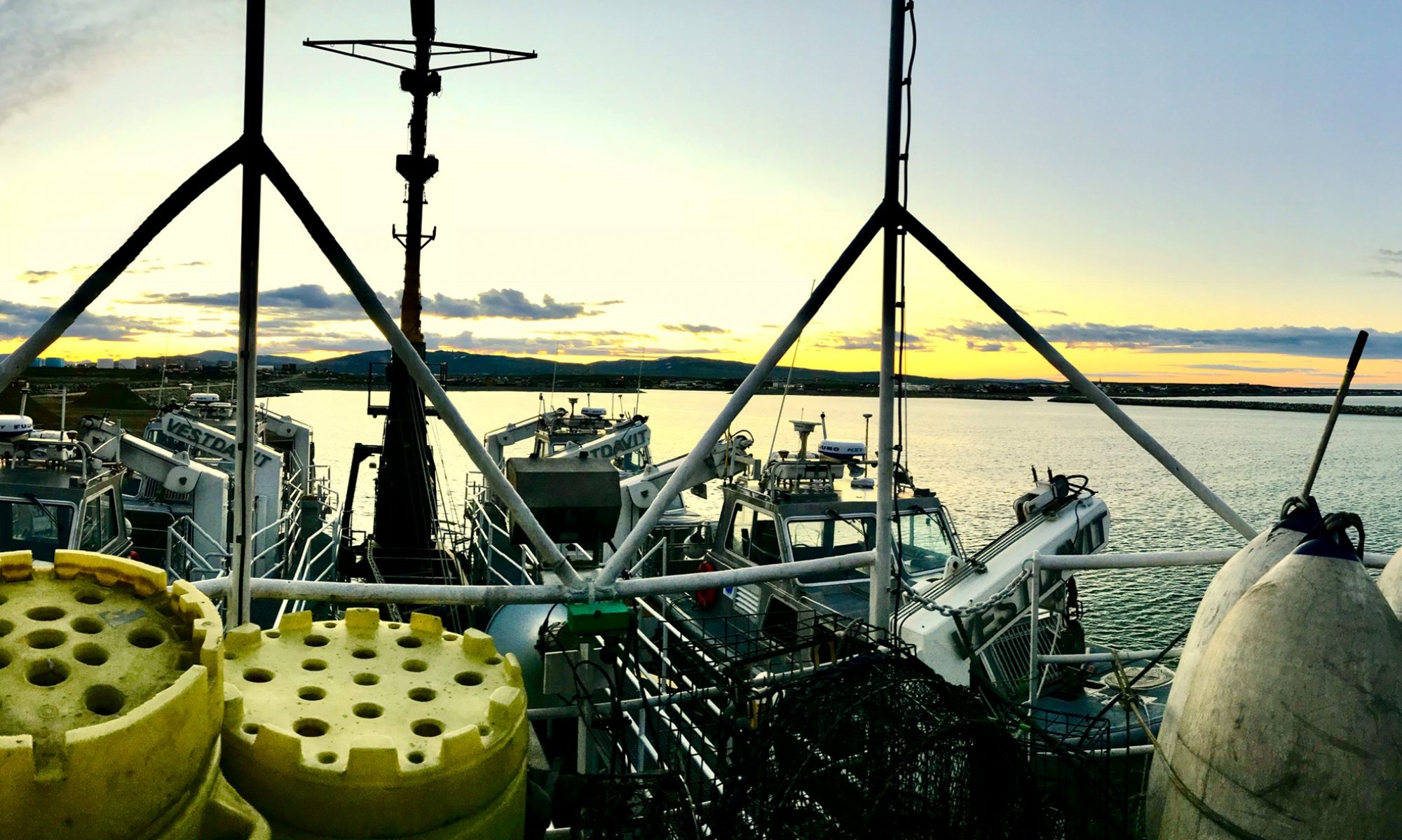
Bering Panorama
A 90 degree panorama of the Bering Sea from atop the Oscar Dyson. I’d show you the other 270°, but it’s pretty much the same. The sea and sky are abiotic parts of the sub-arctic ecosystem.

Fish in the Bering Sea have the same kind of challenges. Like Goldilocks, Pollock are always looking for sea water that is just right. The Oscar Dyson has the tools for testing all sorts of Abiotic factors. This is the Conductivity Temperature Depth sensor (Also known as the CTD).

CTD Deployment
Survey Technicians Allen and Bill teach me how to launch The Conductivity Temperature Depth Probe (or CTD).

The CTD sends signals up to computers in the cave to explain all sorts of abiotic conditions in the water column. It can measure how salty the water is by testing how well the water conducts electricity. It can tell you how cloudy, or turbid, the water is with a turbidity sensor. It can even tell you things like the amount of oxygen dissolved in the ocean.

To see how abiotic factors drive biotic factors, take a look at this.

Thermocline
The graph above is depth-oriented. The further down you go on the graph, the deeper in the water column you are. The blue line represents temperature. Does the temperature stay constant? Where does it change?

I know, you may want to turn the graph above on its side… but don’t. You’ll notice that depth is on the y-axis (left). That means that the further down you are on the graph, the deeper in the sea you are. The blue line represents the water temperature at that depth. Where do you see the temperature drop?


Right… The temperature drops rapidly between about 20 and 35 meters. This part of the water column is called the Thermocline, and you’ll find it in much of the world’s oceans. It’s essentially where the temperature between surface waters (which are heated by the sun) and the deeper waters (typically dark and cold) mix together.

OK, so you’re like “great. So what? Water gets colder. Big deal… let’s throw a parade for science.”

Well, look at the graph to the right. It was made from another kind of data recorded by the CTD.

Fluoresence
Fluoresence: Another depth-oriented graph from the CTD… the green line effectively shows us the amount of phytoplankton in the water column, based on depth.

The green line represents the amount of fluorescence. Fluorescence is a marker of phytoplankton. Phytoplankton are plant-like protists… the great producers of the sea! The more fluorescence, the more phytoplankton you have. Phytoplankton love to live right at the bottom of the thermocline. It gives them the best of both worlds: sunlight from above and nutrients from the bottom of the sea, which so many animals call home.

Now, if you’re a fish… especially a vegetarian fish, you just said: “Dinner? I’m listening…” But there’s an added bonus.

Look at this:

CTD Oxygen
Oxygen data from the CTD! This shows where the most dissolved oxygen is in the water column, based on depth. Notice any connections to the other graphs?

That orange line represents the amount of oxygen dissolved in the water. How does that compare to the other graphs?

Yup! The phytoplankton is hanging down there at the bottom of the thermocline cranking out oxygen! What a fine place to be a fish! Dinner and plenty of fresh air to breathe! So here, the abiotic (the temperature) drives the biotic (phytoplankton) which then drives the abiotic again (oxygen). This dance between biotic and abiotic plays out throughout earth’s ecosystems.

Another major abiotic factor is the depth of the ocean floor. Deep areas, also known as abyss, or abyssal plains, have food sources that are so far below the surface that phytoplankton can’t take advantage of the ground nutrients. Bad for phytoplankton is, of course, bad for fish. Look at this:

The Cliff and the Cod
The blue cloud represents a last grouping of fish as the continental shelf drops into the deep. Dr. Mikhail examines a cod.

That sloping red line is the profile (side view of the shape of the land) of the ocean floor. Those blue dots on the slope are fish. As Dr. Mikhail Stepanenko, a visiting Pollock specialist from Vladivostok, Russia, puts it, “after this… no more Pollock. It’s too deep.”

He goes on to show me how Pollock in the Bering Sea are only found on the continental shelf between the Aleutian Islands and Northeastern Russia. Young Pollock start their lives down near the Aleutians to the southeast, then migrate Northwest towards Russia, where lots of food is waiting for them.

Pollock Distribution
Alaskan Pollock avoid the deep! Purple line represents the ocean floor right before it drops off into the Aleutian Basin… a very deep place!

The purple line drawn in represents the drop-off you saw above… right before the deep zone. Pollock tend to stay in the shallow areas above it… where the eating is good!

Once again, the dance between the abiotic and the biotic create an ecosystem. Over the abyss, Phytoplankton can’t take advantage of nutrients from the deep, and fish can’t take advantage of the phytoplankton. Nonliving aspects have a MASSIVE impact on all the organisms in an ecosystem.

Next time we explore the Biotic side of things… the Sub-arctic food web!

Personal Log: The Order of the Monkey’s Fist.

Sweet William, a retired police officer turned ship’s engineer, tells the story of the order of the monkey’s fist.

William and the Monkey's Fist
Sweet William the Engineer shows off a monkey’s fist

The story goes that some island came up with a clever way to catch monkeys. They’d place a piece of fruit in a jar just barely big enough for the fruit to fit through and then leave the jar out for the monkeys. When a monkey saw it, they’d reach their hand in to grab the fruit, but couldn’t pull it out because their hands were too big now that they had the fruit in it. The monkey, so attached to the idea of an “easy” meal wouldn’t let go, making them easy pickings for the islanders. The Monkey’s Fist became a symbol for how clinging to our desires for some things can, in the end, do more harm than good. That sometimes letting go of something we want so badly is, in the end, what can grant us relief.

Another story of the origin of the monkey’s fist goes like this: A sea captain saw a sailor on the beach sharing his meal with a monkey. Without skipping a beat, the monkey went into the jungle and brought the sailor some of HIS meal… a piece of fruit.

No man is an Island. Mt. Ballyhoo, Unalaska, AK

Whatever the true origin of the Order is, the message is the same. Generosity beats selfishness at sea. It’s often better to let go of your own interests, sometimes, and think of someone else’s. Onboard the Oscar Dyson, when we see someone committing an act of kindness, we put their name in a box. Every now and then they pull a name from the box, and that person wins something at the ship store… a hat or a t-shirt or what have you. Of course, that’s not the point. The point is that NOAA sailors… scientists, corps, and crew… have each other’s backs. They look out for each other in a place where all they really have IS each other.

And that’s a beautiful thing.

Kacey Shaffer: That Is One BIG net! August 4, 2014

NOAA Teacher at Sea

Kacey Shaffer

Aboard NOAA Ship Oscar Dyson

July 26 – August 13, 2014

Mission: Walleye Pollock Survey

Geographical Location: Bering Sea

Date: August 4, 2014

Weather information from the Bridge:

Air Temperature: 11° C

Wind Speed: 8.95 knots

Wind Direction: 327°

Weather Conditions: Foggy

Latitude: 58° 59’92 N

Longitude: 176° 55’09 W

Science and Technology Log:

Now that we have chosen a location to fish, the real fun begins! With a flurry of action, the Bridge (control center of the ship) announces we are going to trawl (fish). This alerts the Deck Crew who has the responsibility of deploying a net. There are three different types of trawls, AWT (Aleutian Wing Trawl), 83-112 Bottom Trawl, and the Marinovich. The type of trawl chosen depends on the depth in the water column and proximity to the bottom of what we want to catch. The 83-112 Bottom Trawl pretty much does what it is called. It is drug along the bottom of the ocean floor and picks up all sorts of awesome sea creatures. The Marinovich is a smaller net that is trawled near the surface. For this Pollock survey, we have primarily used the AWT. It is a mid-water net and that is the area where Pollock primarily live.

Diagram of the Aleutian Wing Trawl (AWT).

As you can see in the diagram, the AWT is cone-shaped. When fully deployed it is 491 feet long! The opening of the net, similar to a mouth, is about 115 feet wide. The Chief Boatswain (pronounced bo-sun) controls the winches that let wire out which extends the opening of the net at least another 500 feet from the aft (rear) deck of the ship.

The ITI screen located on the Bridge that allows us to see how far behind the boat and at what depth the net is located.

The Deck Crew begins to roll out the net and prepares it for deployment. There are several pieces of equipment attached along the way. A Camtrawl is attached first. Can you guess what it does? It is essentially a camera attached to the net that records what is being caught in the net. Near the Camtrawl, a pocket net is attached to the bottom side of the AWT. This pocket net can show scientists what, if any, fish are escaping the AWT. On a piece of net called the kite that is attached to the headrope (top of the mouth/opening), the FS70 and SBE are attached. The FS70 is a transducer that reports data to the Bridge showing the scientist what is coming into the net, similar to a fish finder. The SBE is bathythermograph that records water temperature and depth. Tomweights are added next. These heavy pieces of chain help weigh the footrope (bottom of the mouth/opening) down, pulling it deeper into the water. The net continues to be reeled out and is finally connected to lines on each side of the deck. The horizontal distance between the lines helps the net to fully open its mouth.

The Camtrawl lets us see fish as they enter the net.
Attaching the tomweights as the net is deployed.

While the net is out the Bridge crew, the Chief Boatswain, the Survey Tech and at least one scientist are on the Bridge communicating. Each person has a role to ensure a successful catch. The Bridge crew controls the speed and direction of the boat. The Chief Boatswain controls the net; changing the distance it is deployed. The Survey Tech has information to report on one of the computers. Lastly, the scientist watches multiple screens, making the decision on how far out the net goes and when to haulback (brings the net in). Ultimately, the Bridge crew is the liaison between all of the other departments and has the final decision on each step of the process, keeping everyone’s safety in mind. This piece of the fishing puzzle quickly became my favorite part of the survey. It is so neat to listen to the chatter of all these groups coming together for one purpose.

On the Bridge during a trawl - left to right: Lt. Frydrych, Officer on Duty; Taina, Chief Scientist; Allen, Survey Tech; Chief Boatswain Kirk.
On the Bridge during a trawl – left to right: Lt. Frydrych, Officer of the Deck; Taina Honkalehto, Chief Scientist; Allen Smith, Survey Tech; Chief Boatswain Kirk Perry.

Once we have reached haulback the Chief Boatswain alerts his deck crew and they begin reeling the net back in. They watch to make sure the lines are going back on the reel evenly. When the tomweights come back on deck they are removed. The next items to arrive are the FS70 and SBE. They are removed and the reeling in continues. The Camtrawl comes in and is removed and the pocket net is checked for fish. By that point we are almost to the end of the net where we’ll find our catch. Because the net is very heavy, the deck crew uses a crane to lift it and move it over the table. A member of the Deck Crew pulls a rope and all the fish are released onto the table. The table is a piece of equipment that holds the fish on the deck but feeds them into the Wet Lab by conveyor belt. Once the fish have been removed from the net it is finally rolled up onto the reel and awaits its next deployment. In my next blog we’ll get fishy as we explore the Wet Lab!

Deck Crew members Bill (left) and Mike (right) prepare a full net to be hoisted to the table by the crane.


Personal Log:

I have delayed writing about this next location on the ship because it is my favorite place and I want to make sure I do it justice. Plus, the Officers who stand watch on the Bridge are really awesome and I don’t want to disappoint them with my lack of understanding. Here are a few pictures showing some of the things I actually do understand…

Display of tanks located on board the Dyson.

This screen provides Officers with valuable information about the ship’s engine, among other things. This diagram shows multiple tanks located on the ship. Some tanks take in seawater as we use diesel fuel, drinking water, etc. to counter balance that usage and keep the Dyson in a state of equilibrium. Also, if they are expecting high seas they may take in some of the seawater to make our ship heavier, reducing the effects of the waves on the ship. I’ve been told this may be important in a couple of days because we’re expecting some “weather.” That makes me a little nervous!

The General Alarm on the Bridge.

The General Alarm is really important to the safety of all those on the ship but it is not my favorite thing every day at noon. The General Alarm is used to signal us in an emergency – Abandon Ship, Man Overboard, Fire, etc. It is tested every day at noon…while I’m sleeping!! “Attention on the Dyson, this is a test of the ship’s General Alarm.” BEEEP. “That concludes the test of the ship’s General Alarm. Please heed all further alarms.”

Officer Gilman updates a chart during his watch.
ENS Gilman updates a chart during his watch.

What would happen if all of our fancy technology failed on us? How would we know where to tell the Coast Guard to find us? NOAA Corps Officers maintain paper charts as a back up method. At the time this photo was taken the Officer was predicting our location in 30 minutes and in 60 minutes. This prediction is updated at regular intervals so that we have a general area to report in the case of an emergency. Officer Gilman completes this task during his shift.

Kacey learns how to steer the Dyson from Officer Ostapeko.
Kacey learns how to steer the Dyson from Lt. Ostapenko. (Photo Credit: ENS Gilman)

Have I mentioned that the NOAA Corps Officers onboard the Dyson are awesome? They’re so great they let me steer the boat for a little while! In the photo Lt. Ostapenko teaches me how to maintain the ship in a constant direction. The wheel is very sensitive and it took some time to adjust to amount of effort it takes to turn left or right. We’re talking fingertip pushes! The rudder is so large that even just a little push left or right can make a huge difference in the ships course.

Kacey records data on the Bridge during an AWT.
Kacey records data on the Bridge during an AWT. (Photo Credit: Darin)

Since beginning our survey I’ve only missed being on the Bridge for one trawl. Because I have paid very close attention during those trawls Scientist Darin is now allowing me to record some data. I am entering information about the net in this photo. Survey Tech Allen is making sure I do it correctly!

There are so many other things on the Bridge that deserve to be showcased. The ship can be controlled from any one of four locations. Besides the main control center at the front of the Bridge, there are control stations on either side of the ship, port and starboard, as well as the aft (rear). There is the radar system, too. It is necessary so the Officers can determine the location of other vessels and the direction they are traveling. As I’ve been told, their #1 job responsibility is to look out the windows and make sure we don’t run into anything. They are self-proclaimed nerds about safety and that makes me feel very safe!

Did you know? The NOAA Commissioned Officers Corps is one of the seven uniformed services of the United States. There are currently 321 commissioned officers.

Gregory Cook, Super Fish, August 2, 2014

NOAA Teacher at Sea

Gregory Cook

Aboard NOAA Ship Oscar Dyson

July 26 – August 13, 2014

Mission: Annual Walleye Pollock Survey

Geographical Area: Bering Sea

Date: August 2, 2014

Science and Technology Log 

See this guy here? He’s an Alaskan Pollock.

If fish thought sunglasses were cool, this fish would wear sunglasses.
Alaskan Pollock, aka Walleye Pollock.
Credit: http://www.noaanews.noaa.gov

“Whatever,” you shrug.
“Just a fish,” you scorn.
“He’s slimy and has fish for brains,” you mock.
Well, what if I told you that guy there was worth almost one billion dollars in exports alone?
What if I told you that thousands of fishermen rely on this guy to provide for their families?
What if I told you that they were the heart of the Sub-Arctic food web, and that dozens of species would be threatened if they were to disappear?
What if I told you they were all secretly trained ninja fish? Ninja fish that carry ninja swords strapped to their dorsal fins?
Then I’d only be wrong about one thing.


Taina Honkalehto is the Chief Scientist onboard the Oscar Dyson. She has been studying Pollock for the last 22 years. I asked her what was so important about the fish.

“They’re the largest single species fishery in North America,” Taina says. That makes them top dog…err… fish… in the U.S. fishing industry.

Chief Scientist Taina Honkalehto decides where to fish based on data.

“In the U.S. they are fish sticks and fish-wiches (like Filet-o-Fish from McDonalds). They’ve become, foodwise, what Cod used to be… inexpensive, whitefish protein,” Taina continues. They’re also the center of the sub-arctic food web. Seals, walruses, orca, sea lions, and lots of larger fish species rely on Pollock as an energy source.”
But they aren’t just important for America. Pollock plays an important role in the lives of people from all over the Pacific Rim. (Remember that the Pacific Rim is made up of all the countries that surround the Pacific Ocean… from the U.S. and Canada to Japan to Australia to Chile!)

Pollock Need Love, too!

“Pollock provide a lot of important fish products to many countries, including the U.S., Japan, China, Korea, and Russia,” Honkalehto says.

Making sure we protect Pollock is REALLY important. To know what can go wrong, we only have to look at the Atlantic Cod, the fish that Cape Cod was named after. In the last twenty years, the number of Atlantic Cod has shrunk dramatically. It’s cost a lot of fishermen their jobs and created stress in a number of families throughout New England as well as tensions between the U.S. and Canada. The U.S. and Canada share fish populations.

The primary job of the Oscar Dyson is to sample the Pollock population. Government officials use the results to tell fishermen what their quota should be. A quota is a limit on the number of fish you can catch. The way we gather that data, though, can be a little gross.

The Aleutian Wing Trawl (or AWT)

Fishermen Deploy the AWT
Fishermen Deploy the AWT.

The fishermen guide the massive Aleutian Wing Trawl (or AWT) onto the deck of the ship. The AWT is a 150 meters long net (over one and a half football fields in length) that is shaped like an ice cream cone. The net gets more and more narrow until you get all the way down to the pointy tip. This is known as the “cod end,” and it’s where most of the fish end up. Here’s a diagram that XO (Executive Officer) Kris Mackie was kind enough to find for me.

AWT
The Aleutian Wing Trawl (or AWT). over one and a half football fields worth of Pollock-Snatching Power.

The AWT is then hooked onto a crane which empties it on a giant mechanical table. The table has a hydraulic lift that lets us dump fish into the wet lab.

Allen pulls a cod from the Table
Survey Technician Allen pulls a cod from the Table

Kids, whenever you hear the term “wet lab,” I don’t want you to think of a water park. Wet lab is going to mean guts. Guts and fish parts.

In the wet lab, the contents of the net spills onto a conveyer belt… sort of like what you see at Shaw’s or Market Basket. First we sift through the Pollock and pull any odd things… jellyfish, skates, etc… and set them aside for measurement. Then it’s time to find out what sex the Pollock are.

Survey Technician Alyssa and Oceanographer Nate pull a giant jellyfish out of a pile of pollock!

Genitals on the Inside!

Pollock go through external fertilization (EF). That means that the female lays eggs, and the males come along and fertilize them with their sperm. Because of that, there’s no need for the outside part of the sex organs to look any different. In science, we often say that form follows function. In EF, there’s very little function needed other than a hole for the sperm or egg cells to leave the body.

Because of that, the only way to tell if a Pollock is male or female is to cut them open and look for ovaries and testes. This is a four step process.

Ladies before Gentlemen: The female Pollock (in the front) has ovaries that look like two orange lobes. The Male (in the back) has structures that make him look like he ate Ramen noodles for dinner.
Ladies before Gentlemen:
The female Pollock (bottom) has ovaries that look like two orange lobes. The Male (itop) has testes that make him look like he ate Ramen noodles for dinner.

Step 1: Slice open the belly of the fish.

Step 2: Push the pink, flippy floppy liver aside.

Step 3: Look for a pair of lobes (a bag like organ) that is either purple, pink, or orange-ish. These are the ovaries! If you find this, you’ve got a female.

Step 4: If you strike out on step 3, look for a thin black line that runs behind the stomach. These are the testes… As Tom Hanks and Meg Ryan might say, you’ve got male.

Then the gender and length of the fish is then recorded using CLAMS… a software program that NOAA computer scientists developed for just this purpose. With NOAA, like any good science program, it’s all about attention to detail. These folks take their data very seriously, because they know that so many people depend on them to keep the fish population safe.

Personal Blog

Safety!

Lobster Gumby
Your teacher in an Immersion Suit. Sailors can survive for long periods of time in harsh environments in these outfits.

.

On the first day aboard the Oscar Dyson, we were trained on all matters of safety. Safety on a ship is often driven by sirens sounded by the bridge. Here’s a list of calls, what they mean, and what you should do when you hear them:

What you hear… What it means… What you should do…
 Three long blasts of the alarm: Man Over Board Report to safety station, be counted, and report in to the bridge (unless you’re the one that saw the person go overboard… then you throw them life rings (floaties) and keep pointing at them).
 One long blast of general alarm or ship’s whistle: Fire or Emergency onboard Report to safety station, be counted, and report in to the bridge. Bring Immersion Suit just in case.
 Six or more short blasts then one long blast of the alarm: Abandon Ship Grab your immersion suit, head to the aft (back) deck of the ship, be counted, and prepare to board a life raft.


The immersion suit (the thing that makes me look like lobster gumby, above) is made of thick red neoprene. It has two flashing lights also known as beacons…  one of them automatically turns on when it hits water! This helps rescuers find you in case you’re lost in the dark. It also has an inflatable pillow behind your head to help keep your head above water. Mostly just wanted to wear it to Starbucks some day.

Food!

Another thing I can tell you about life aboard the Oscar Dyson is that there is plenty to eat!

kind of awesome. For one thing, there is a never ending supply of food in the galley (the ship’s cafeteria). Eva is the Chief Steward on the Oscar Dyson (though I call her the Head Chef!).

Chief Steward Eva gets dinner done right!

You’ll never go hungry on her ship. Dinner last night? barbeque ribs and mac and cheese. Yesterday’s lunch? Steak and chicken fajitas. And this morning? Breakfast burritos with ham and fruit. I know. You were worried that if I lost any weight at sea that I might just disappear. I can confirm for you that this is absolutely not going to happen.

Tune in next time when I take you on a tech tour of the Oscar Dyson!


Kacey Shaffer: Let’s Go Fishing! August 1, 2014

NOAA Teacher at Sea

Kacey Shaffer

Aboard NOAA Ship Oscar Dyson

July 26 – August 13, 2014

Mission: Walleye Pollock Survey

Geographical Location: Bering Sea

Date: August 1, 2014

Weather information from the Bridge:

Air Temperature: 9.7° C

Wind Speed: 11.9 knots

Wind Direction: 153°

Weather Conditions: Foggy

Latitude: 58°19’42 N

Longitude: 175°14’66 W


Science and Technology Log:            

If you’ve ever been fishing, be it on a lake, river or stream, you know it is not productive to fish all day in a spot where they aren’t biting. If the fish aren’t biting in one spot, you would most likely pack up and move to a different spot. Now imagine trying to fish in an area that is 885,000 square miles. The equivalent to trying to find a needle in a haystack! Luckily, the Oscar Dyson has sophisticated equipment to help us determine where the fish are hanging out. Allow me to introduce you to a very important location on the ship – The Acoustics Lab.

When you enter The Acoustics Lab, you’ll immediately see a wall of nine computer screens. The data shown on the screens help Chief Scientist Taina and Fishery Biologist Darin make the key decision of where we will deploy the nets and fish. What information is shown on the screens? Some show our location on the transect lines we are following, which is similar to a road map we would use to get from point A to point B on land. The transect lines are predetermined “roads” we are following. Another screen tells us which direction the boat is heading, barometric pressure, air temperature, surface temperature, and wind direction and wind speed. The most technical screens show the data collected from transducers attached to the bottom of the ship on what is referred to as the Center Board. There are five transducers broadcasting varying frequencies. Frequency is the number of sound waves emitted from a transducer each second. The Dyson transducers emit sound waves at 18kHz, 38kHz, 70kHz, 120kHz and 200kHz (kHz= kilohertz). Why would it be necessary to have five transducers? Certain organisms can be detected better with some frequencies compared to others.  For example, tiny organisms like krill can be seen better with higher frequencies like the 120kHz compared to the lower frequencies. Also the lower frequencies penetrate farther into the water than the higher frequencies so they can be used in deeper water. Having this much data enables the scientists to make sound decisions when choosing where to fish.

A map of the Bering Sea showing transect lines in white. During this pollock survey the Oscar Dyson follows transect lines which benefits both the crew and scientists.
Transducers produce these images displayed on the screens in the Acoustics Lab. The thick red line at the bottom is the sea floor and the  many red, oblong shaped areas indicate large clusters of fish. Let’s go fishing!
Transducers produce these images displayed on the screens in the Acoustics Lab. The thick red line at the bottom is the sea floor and the many red, oblong shaped areas indicate large clusters of fish. Let’s go fishing!

Personal Log:

Each time I share a blog post with you I am going to focus on one area of the ship so you can get acquainted with my new friend, Oscar Dyson. I’ll begin sharing about my stateroom and the lounge. I was very surprised by the size of my room when I arrived last Thursday. My roommate is Alyssa, a Survey Tech. You will learn more about her journey to the Dyson later. She has been on the ship for a while so she was already settled in to the top bunk which put me on the bottom bunk! The beds are very comfortable and the rocking motion of the ship is really relaxing. I’ve had no trouble sleeping, but then again, when have I ever had trouble sleeping?! We have our own private bathroom facilities, which is a definite bonus. Take a look at our room.

The stateroom Kacey shares with Alyssa.
Our stateroom's private bath. Could that shower curtain be any more fitting?!
Our stateroom’s private bath. Could that shower curtain be any more fitting?!

Alyssa and I are on opposite shifts. She works midnight to noon and I work 4:00pm to 4:00am. There is a little bit of overlap time where she’s off and I haven’t gone to work yet. This is quite common for all of the people on the ship. This is a twenty-four hours a day, seven days a week operation. Someone is always sleeping and someone is always working. Fortunately there is a place where we can hang out without bothering our roommates. The Lounge is a great place to kick back and relax. There are comfy chairs and a very large couch and a television with the ability to play dvd’s or video games. Over the years people have brought books with them and then left them on the ship so we have an enormous library. Sometimes there are people just reading in the Lounge and other times a group of us will watch a movie together. There is one important rule of showing movies…if you start a movie you have to let it play all the way out. Even if you get bored with it or need to leave you must let it play because someone may be watching it in their room. It would be rude of us to continually shut movies off an hour into them!

Career Connections: ST Alyssa Pourmonir

ST Pourmonir checks data on the computer during a CTD deployment.

Alyssa hails from Pennsylvania. During her senior year of high school she chose to further her education at the Coast Guard Academy. She spent three years studying with the Coast Guard, but ultimately graduated from SUNY Maritime this past January. Alyssa landed a 10 week internship with a NASA facility in Mississippi. During the course of her internship she learned of an opportunity with NOAA. This position would be a Survey Tech, traveling on one of NOAA’s many ships. She arrived at the Dyson only a few weeks before I did.

Alyssa has many responsibilities as a Survey Tech. She assists with the deploying and recovery of the CTD instrument, helps process fish in the wet lab, completes water tests, and serves as a liaison between the ship’s crew and its scientists. When a trawling net is deployed or recovered, Alyssa is on the deck to attach or detach sensors onto the net. She also looks for safety hazards during that time.

When asked what the best part of her job is she quickly responds learning so much science is the best! As a Survey Tech, she gets the chance to see how all the different departments on the ship come together for one mission. She works closely with the scientists and is able to learn about fish and other ocean life. On the other hand, she also works side-by-side with the ship’s crew. This allows her to learn more about the ship’s equipment. Being the positive person she is, Alyssa turned the hardest part of her job into a benefit for her future self. Adjusting to 12 hour shifts has been a challenge but she noted this can also be helpful. When she is super busy she is learning the most and it also makes the time go faster.

Looking ahead to her future, Alyssa sees herself getting a Master’s Degree in a science related field. Some areas of interest are oceanography, remote sensing or even meteorology. Alyssa’s advice for all high school students: STUDY SCIENCE!

Did you know?

Lewis Richardson, an English meteorologist, patented an underwater echo ranging device two months after the Titanic sunk in 1912.