Geographic Area of Cruise: Gulf of Alaska (Kodiak to Yakutat Bay)
Date: 7/30/2019
Weather Data from the Gulf of Alaska: Lat: 58º 50.39’ N Long: 150º 14.72’ W
Air Temp: 14.2º C
Personal Log
Today we had the chance to sail up into Resurrection Bay on the Kenai Peninsula and it was beautiful! In general, transects, or lines the boat collects acoustic information along, run perpendicular to the Gulf of Alaska shelf because that is where pollock are most likely found. Luckily for us, a few of them travel up into bays along the coast and give us a welcomed change of scenery from the open ocean.
A map of the transects we followed up into Resurrection Bay.
Why do we survey in bays when pollock are usually open water fish? Well, during the winter, pollock sometimes aggregate to spawn (reproduce) in bays and those areas are documented by the scientists. In the summer, scientists want to see if there are still any pollock present in those areas. Unfortunately, we do not have time to survey all of the bays and so just a few are selected. For this leg, after the next couple of days back on the shelf, we will head up into Prince William Sound, which I am really looking forward to seeing.
The town of Seward – can you spot the cruise ship?
While following the transects up into Resurrection Bay, it was fun to see sailboats, fishing boats, helicopters and float planes rushing around us. To my surprise, I also saw masses of RV campers through the binoculars when looking at town. I learned that Seward is a popular place for people to visit from Anchorage and other areas for summer vacations and fishing opportunities. As for those of us on the boat, we also enjoyed the summer weather while sailing through. The sun was shining and it seemed that everyone took a moment to step outside, make a few phone calls home (we had service for a bit!) and soak up the warm weather. All in all, I think everyone feels re-energized going into our final 10 days at sea.
Enjoying the sunshine from the top deck of the boat
Science and Technology Log
We stopped to fish near the mouth of Resurrection Bay and found mostly age 1 and 2 pollock, along with a few adults. This shows us that pollock do utilize both the bay and the shelf areas during their lifecycle. Afterwards, we headed back out into the gulf and fished with a net called a Methot net.
The Methot net gets lifted up by the A-frame (yellow metal beams). I did not know the A-frame moved before this!
A Methot net is a different kind of net that is specialized to catch Euphausiids (krill). In addition to collecting data on pollock, scientists also collect data on Euphausiids (krill). The net used to collect krill is a bit different than the one used for pollock. There are no pocket nets along the side and instead of the end of the net being mesh, there is a small canister that the net filters krill into. Once we haul in the net, it is time to sort and collect data on the catch, just like the pollock trawls.
Processing fish in the wet lab. This one had a lot of jellies! Photo by Darin Jones
It has been back to regular fishing trawls since then, along with comparison trawls. A comparison trawl is when we fish twice over the same area using two different nets. This year, the scientists decided to replace the old survey net with a newly designed one that is a little bit smaller and easier for the deck crew to deploy. Now they need to compare the two nets to make sure the newer net is catching the same species and size of fish. Darin was explaining to me that they have to do approximately 25 comparison trawls on this survey and will continue comparisons during the winter survey as well. If all goes according to plan, they will permanently replace the old net next summer.
On one of our trawls the other day, we caught a lot of rockfish. Lucky for us, rockfish is a species we can keep and eat on the boat. We are not allowed to keep salmon, crab, halibut or herring since they are prohibited species. You are only allowed to keep those species if you have a special permit. While I wish we could eat the others, rockfish is also really tasty!
Lead scientist, Darin Jones, filleting dusky rockfish for dinner.
Did You Know?
There is an incinerator on NOAA Ship Oscar Dyson that burns all of our trash from the boat so that we don’t have to keep it aboard for the whole trip. Also, nothing is thrown overboard, not even food scraps. When I was taking a look yesterday, the temperature was over 800 degrees Celsius. Diesel fuel is used as fuel initially, followed by burning sludge from the boat once it gets hot enough. All leftover ash gets put into bins and discarded when back in port.
Thanks for following along!
Cheers, Jess
P.S. We go up and watch the sunrise everyday…it is beautiful out here!
Abigail McCarthy watches the sunrise every morning and ranks them. This one earned a “glorious!”
Geographic Area of Cruise: Gulf of Alaska (Kodiak to Prince William Sound)
Date: Saturday, July 20th, 2019
Weather Data from Kodiak, AK: 4:00am Lat: 57.79° N Lon: 152.4072° W Temp: 56 degrees F.
Personal Log
Good morning! It is currently 4:30am on Saturday, July 20th and I have just woken up for my first shift on the boat. So far, I have met scientists Abigail McCarthy and Troy Buckley, who will be working the day shift with me. I also met Ruth, an intern from the University of Washington and my bunkmate. It will be nice to have someone else on board who is also new to the experience!
From left to right: Myself, Ruth, Abigail and Darin exploring Spruce Cape. Photo Credit: Troy Buckley
Before talking about work, I’d like to share what we got up to in Kodiak before departing on the cruise. One thing to note – Chief Scientist Darin Jones explained that because this is the 3rd leg of the survey and the scientists are taking over from the previous group, we do not have any set up or calibration of equipment to do. If this had been leg 1 of the survey, the free days in port would have been spent doing those jobs. Lucky us!
After unpacking everything in our state rooms (bunks), we quickly set out to explore Kodiak. In two and a half days, were able to see a lot! Wednesday night, some friends of mine in town took us for a stroll on Near Island, followed by a yummy dinner at Noodle Bar.
Walking with friends on Near Island, just across the bridge from Kodiak. Photo by Ruth Drinkwater
Thursday morning, team building began with a run to Safeway and Walmart for all last minute necessities. The teacher in me couldn’t resist a fresh pack of sharpie markers and colored pencils. 🙂 In the afternoon, we walked along Spruce Cape where we picked a TON of blueberries and found the largest barnacle I have ever seen.
Check out this Giant Acorn Barnacle!
After a short recoup back on the boat, Darin and Abigail were ready for an evening surf session at Fossil Beach. This beach is the farthest south you can access by road in Kodiak and the drive was BEAUTIFUL. Prior to the trip, I hadn’t looked up any pictures of Kodiak and so the treeless green mountains, cliffy coastlines and herds of cows were exciting to see. Once at the beach, we jumped in the ocean, watched a successful surf session and finished our team building with a fire and dinner on the beach.
Fossil Beach: We hiked up the cliffs in the background to check out old WWII bunkers.
Happily grazing cows on the drive back from Fossil Beach.
Science and Technology Log:
In just a few days of being here, I have already learned a lot about the workings of the ship and what we will be busy doing for the next three weeks. Here is a preview.
To begin, science shifts run from 4am – 4pm and 4pm – 4am. Throughout this entire time, acoustic data is being collected and read. Acoustic data is gathered by sending out sound waves from a transducer box attached to the bottom of a centerboard underneath the boat. The sound waves reverberate out and bounce off of anything with a different density than water. In the picture below, you can see a bold line on the screen with smaller dots above. Take a look and see if you can identify what the line and dots might represent.
Chief Scientist Darin Jones looking at the morning acoustic data. This room is called “The Cave” because it is the only lab without windows.
If you thought the big bold lines on each screen were the seafloor, you were correct! Most of the little dots that appear above the sea floor are fish. Fish are identified from the sound waves bouncing off of their swim bladders. Swim bladders are the “bags” of air inside fish that inflate and deflate to allow the fish to raise and lower itself in the water column. Air has a different density compared to water and therefore shows up in the acoustics data.
Close up view of the acoustic data screen.
What is this acoustic data used for? There are 2 primary parts. The first is to identify where schools of fish are located and therefore areas well suited for collecting fish samples. The second is to calculate the total biomass of pollock in the water column by combining acoustics data with the actual measurements of fish caught in that same area. More specifics to come as I take part in the process throughout the survey.
Did You Know?
On this survey, scientists do not catch/survey fish at night (when it is dark). The reason? At night, bottom dwelling species come up off the seafloor at night to feed. During the day they settle back down on the seafloor. The scientists are primarily interested in catching pollock, a mid water species, so they fish during daylight hours.
View from the upper deck of the trawl net being hauled in.
Updates to come later in the week. It is time for me to join the scientists and get ready process our first catch!
Latitude: 57º 09.61 N Longitude: 152º 20.99W Wind Speed: 15 knots Wind Direction: 210 º Air Temperature: 12º Celsius Barometric Pressure: 1013 mb Depth of water column 84m Surface Sea Temperature: 12º Celsius
Science and Technology Log
Onboard the NOAA Ship Oscar Dyson with me are two volunteer biologists: Evan Reeve and Nathan Battey. Evan is on the opposite shift, so we often pass each other, but on occasion, we have been in the fish or chem lab at the same time.
Volunteer biologist Evan Reeve
I arrived here knowing very little about fish (other than how to care for a beta fish and how to cook salmon and trout). Evan, on the other hand, is a recent graduate of the University of Washington (or as he likes to say, “U-DUB”) with a degree in Biology (and an emphasis in fish biology). When I say recent, I mean recent. Evan graduated five days before we boarded the ship.
Evan has a remarkable “ready for anything”
attitude whether it is the start of his 12-hour shift, or the end. His background
may be one reason why. Originally from San Diego, he spent his freshman year at
the University of Missouri, Kansas City. A planned-year studying abroad at the
Universidad Veritas in San Jose, Costa Rica got cut short after one semester
due to an illness that forced him to return to San Diego. There, Evan made the decision to serve our
country and joined the Navy. For a few years, he served as a Navy corpsman
stationed with Marine infantry units until he was injured during training. That’s
when Ready-for-Anything Evan resumed his studies, eventually arriving at his
beloved “U-DUB”.
Evan currently lives in Washington, where he volunteers with the NOAA Hatchery Reform Program in Port Orchard, Washington, tracking hatchery released juvenile salmon in Puget Sound using both acoustics and traditional fishing techniques. When a biology professor mentioned the opportunity to spend time on the NOAA Ship Oscar Dyson in the Gulf of Alaska, Evan of course volunteered, eager to participate in a larger scale study involving different fish species. In Puget Sound, the haul is often 10 salmon. In contrast, the haul being studied onboard the Oscar Dyson is often 1000 pounds of Walleye pollock several times a day (along with prowfish, Pacific herring, rockfish, and a lot of jellyfish). Speaking of prowfish, herring, rockfish, and jellyfish…
FUN FISH FACTS AND PHOTOS:
PROWFISH: In my earlier blog, Oh, the Places You’ll Go, I wrote about the lumpsucker being the cutest fish I had ever seen. A close runner up is the baby prowfish.
juvenile prowfish
Every time we get a prowfish in a catch, everyone wants to look at it! We usually get juvenile prowfish which are about the length of my finger. (Adults can get up to 3 feet long.) The juveniles are very soft and smooth looking, and their lower jaw juts out slightly, making them look like they are pouting. Unlike adults prowfish, who spend most of their time near the bottom of the sea floor, juvenile prowfish spend their time in the middle levels of the water column, which is the area we are trawling on the NOAA Ship Oscar Dyson. I was surprised to learn that juvenile prowfish will try to avoid predators by hiding within the bells of large jellyfish.
PACIFIC HERRING, OR AS I LIKE TO CALL THEM, THE RAINBOW FISH:
Pacific herring
As a special education preschool teacher, I often read and discuss The Rainbow Fish (by Marcus Pfister) with my students.
The Rainbow Fish by Marcus Pfister
It is a popular children’s book
about a little fish with very sparkly scales who learns to share. Rainbow Fish
was considered the most beautiful fish in the ocean because of his many sparkly
scales. When a plain, little fish asks for
one of the sparkly scales, Rainbow Fish refuses to share. This makes all the
other fish mad, and they no longer want to play with the Rainbow Fish. In the end,
Rainbow Fish decides to share his sparkly scales with all the other fish,
keeping only one for himself. He is less
beautiful than he was before, but he has new friends and is now the happiest
fish in the sea.
The Pacific herring is similarly covered in sparkly scales, but boy, is he a super sharer (as we say in preschool)! Since herring are a small fish, they compensate for their size by forming schools (or groups of fish that swim together). Swimming in schools protects them as it reduces the likelihood that any one of them will be eaten by a predator. Sometimes we get only one herring with our huge haul of pollock. They are somewhat similar in shape and color. Evan (the volunteer biologist) has a theory: that it’s a herring who got separated from his school and sought protection by joining and blending in with a school of pollock. As a preschool teacher, I love the idea that a group of pollock would allow or even invite a lost little herring to “play” with them.
Other times, we get a lot of herring, and as I mentioned they love to share their sparkly scales. Everything (and everyone) ends up sparkly: the pollock, the fish belt, the measuring boards, the tables, and ME! You can always tell when there is herring in a catch by the sparkly fish scales in my hair.
ROCKFISH: Occasionally a few rockfish are in the trawl net. Rockfish have large eyes, and are not particularly sparkly or cute, but they are delicious! I even learned to fillet them!
My first time filleting a fish
It’s easier than I thought it would be!
It was exciting to later see the rockfish cooked and served for dinner.
The rockfish deliciously prepared by the Chief Steward, Judy Capper
AND FINALLY THE JELLYFISH: Not yet… keep reading…
FIRST,Nathan Battey: Nathan, the other volunteer biologist onboard, is on my shift, and works in the fish lab with me 12 hours a day processing the fish hauls. He is my “go-to fisheries biologist” whenever I need help identifying a fish or jellyfish.”
Volunteer biologist Nathan Battey with a lumpsucker
Since he is originally from Goffstown, New Hampshire, it should not come as a surprise that Nathan ended up on a ship since Goffstown is home to the famous Giant Pumpkin Regatta! Every October, Goffstown residents transform enormous pumpkins into boats. They scoop out the sometimes 1000-pound pumpkins, climb in, and race them down the Piscatoquag River.
Nathan studied biology and earth science at the University of New Hampshire and took a lot of oceanography courses along the way. Since graduating in 2015, he has done a myriad of fascinating things. He quantified nitrogen cycling in the wetlands of coastal New England, worked in a microbiology lab, counted larval fish under a microscope, regulated the upstream passage of salmon on the Seattle fish ladder, worked as a scallop fisheries observer, was a State Park Ranger on the eastern shore of Virginia, and worked with the Lower Elwha Klallam Tribe (alongside NOAA scientists, tribal scientists, fish and wildlife scientists, and National Park scientists) on the recolonization of the Elwha River for salmon and other fish after the dams there were removed. (The tribe had successfully sued the U.S. for the removal of the dams based upon their right to fish there.)
The last two positions were through AmeriCorps, which he highly recommends! AmeriCorps is a network of national service programs. It is sometimes thought of as the domestic Peace Corps since members serve on projects within the United States. According to their website: “AmeriCorps is your moment to take the path less traveled, to break the status quo, to stop talking about the problem and be the solution.” Whatever your passion, it is likely there is an AmeriCorps opportunity perfect for you. There are projects in the fields of education, public safety, health care, and environmental protection. If you are interested in learning more about AmeriCorps, visit https://www.nationalservice.gov/programs/americorps
Nathan is also a talented artist and drew detailed sketches of both marine and bird species which amazed everyone and now hang on the walls of the chem lab.
Nathan’s sketch of the albatross that would visit the ship during fishing times.
He will also be remembered for the nickname he gave to the Chrysaora melanaster jellyfish: Chrysaora melanasty.
Nathan’s sketch of the beautiful but dreaded melanasty
AT LAST, THE JELLYFISH:
Chrysaora melanaster are magnificent creatures. The photo below, captured one night using the drop camera, shows how elegantly they glide through the water with their ribbon-like tentacles flowing gracefully behind them.
Chrysaora melanaster captured on drop camera
It is often my job to grab the jellyfish as they come down the belt, separating them from the pollock. I have held some that are an inch wide, and some that are almost 3 feet wide (and quite heavy). Jellyfish are measured by their bell diameter, or how wide the top part is (not the tentacles).
Here I am with a large Chrysaora melanaster. Before my time on the Oscar Dyson, if I saw a jellyfish in the ocean, I swam away as quickly as I could. Now I probably touch 100 jellyfish per day, albeit with gloves on. Also, look at the sparkly scales in my hair. It must have been a herring day!
Volunteer biologist Evan Reeve and a tangled mess of Chrysaora melanster
The photo above might give you an idea of how the nickname “melanasty” came to be. In the net, all the glorious, long, sticky, ribbon-like tentacles of the Chrysaora melanaster get tangled and attached to all the glorious, long, sticky, ribbon-like tentacles of the other Chrysaora melanaster. As you try to pull one jellyfish off the belt, several more are attached in a slimy mess, and you often get splashed in the face, mouth, or eyes with jellyfish “goo.” One day, dealing with the tangle, Nathan dubbed them “melanasty” and the nickname stuck.
Geographic Area of Cruise: Gulf of Alaska (Kodiak to Aleutian Islands)
Date: Monday, July 15th, 2019
Weather Data from Juneau, AK: 8:50am Lat: 58.35° N Lon: 134.58° W
Personal Log
Hello everyone. In just a few days I will be swapping out halibut fishing in Juneau, AK for surveying walleye pollock in the Gulf of Alaska (GOA)…and I can’t wait! Our cruise on NOAA Ship Oscar Dyson will depart from Kodiak Island and sail out along the Aleutian Islands, a place I have yet to see or experience since moving to Alaska.
Fishing for Halibut near Holkham Bay. This photo was taken just after the fillet had slipped out of my hands and onto the boat deck…guess I’ll benefit from fish handling practice on the cruise!
Photo Credit: Laura Maruhashi
Three years ago, I left a curriculum consulting job in Portland, OR to begin teaching in Juneau. Prior to Oregon, I was living overseas in Australia, where I completed my Masters in Education and spent time with the Australian side of my family. I am incredibly excited to now call Juneau my home and be in the classroom as both an educator and a learner. Alaska is such a unique and special place – sometimes I still can’t believe I live here!
Currently, I work as a 7th grade Life Science teacher at Floyd Dryden Middle School. Not only is middle school my favorite age of kids to teach (yes, you heard that right), but I also love the curriculum we get to share with them. One main focus during the school year is to teach about ecosystems. Two years ago I developed a unit, along with NOAA Scientist Elizabeth Siddon, that focuses on how commercial fisheries quotas are set in Alaska. The lessons range from data collection and stakeholder input to presenting recommendations to the North Pacific Fisheries Management Council. Alaska takes several different aspects of the ecosystem into consideration when setting quotas and I think it is a great way for students to see how the science they learn in school can be applied to real life careers.
Students in my 7th grade life science class presenting ecosystem risk table recommendations to a panel of scientists for sablefish quotas in the Gulf of Alaska.
I myself have never had the chance to work as a scientist. That is why I am so excited for the opportunity to participate in data collection and analysis alongside a research team right here in Alaska. It will be fantastic to bring what I learn back to my students and be able to give them an even better understanding what being a scientist can entail.
Lastly, outside of teaching, I try to enjoy all of the outdoor activities Juneau has to offer. With the recent streak of unusually warm and sunny weather, my friends and I have been boating, swimming, and hiking as much as possible. While it will be hard to leave those things behind, I am looking forward to this next adventure!
Midway through a hike from Granite Creek Basin to Mount Juneau.
Photo Credit: Laura Maruhashi
Science and Technology Log:
The research team on NOAA Ship Oscar Dyson is conducting an acoustic-trawl (AT) survey to collect data, primarily on walleye pollock, to be used in stock assessment models for determining commercial fisheries quotas. When collecting data, scientists will work in 12 hour shifts and be looking to determine things such as species composition, age, length distribution etc.
NOAA Ship Oscar Dyson. Photo Credit: NOAA
Trawl fishing, for those of you unfamiliar, is a method of fishing when a net of particular size is pulled through the water behind a boat. Oscar Dyson is a 64 meter stern trawler that contains acoustic and oceanographic instruments to collect the necessary data. After researching online, I learned that the main instrument used is a Simrad EK60 split-beam echosounder system. Look for more information about what this instrument is (and others) in future blog posts!
Did You Know?
Alaska pollock is one of the largest commercial fisheries in the world!
Thank you for reading and I am looking forward to sharing more about life out at sea!
Fishing nets like the ones used on the NOAA Ship Oscar Dyson or on commercial fishing boats can be very expensive. If one plans on doing a bottom trawl (fishing with a net that goes down to the sea floor) one wants to make sure that there are not rocks or other things that can snag or tear the net. If there are too many rocks or boulders or uneven topography, the area is considered “untrawlable”. While computer imagery can provide some guidance with regard to what lies deep beneath the surface, scientists onboard the NOAA Ship Oscar Dyson are hoping that video images taken with an underwater camera can provide a more complete picture and be the basis for a more precise computer model of what areas are in fact untrawlable.
Why is this important? Scientists onboard the NOAA Ship Oscar Dyson are surveying the fish that live in the middle of the water column. However, groundfish surveys need to account for all the fish living on the ocean floor. If the groundfish program can’t trawl in certain areas, then they don’t know what is there. For example, rockfish often live in untrawlable areas. If a groundfish survey can’t put a net in areas where rockfish live, then they won’t really “count” the correct numbers of rockfish in their survey. Data obtained using an underwater camera can help determine what species of rockfish are being underrepresented by the groundfish program.
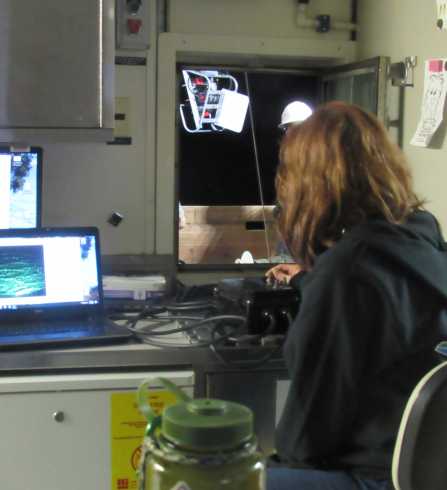
One of the many perks of being on the 4 p.m. to 4 a.m. shift is that I get to watch the drop camera in action! The camera (with its attached light) is slowly lowered to the sea floor.
The drop camera
I have seen the camera take 4 minutes to reach the bottom or as long as 8 minutes depending upon the depth of the water being surveyed. The camera is then “driven” along the bottom (or right above it) for 15 minutes via a control box on the boat (similar to a tiny joystick). I even got to drive it a few times!
My turn to drive!
The images are recorded and also seen in real time on several computer screens on the boat. We have seen rocks, of course, but also jellyfish, sea whips, crabs, anemones, octopuses, sea stars, and a wide variety of fish. One night, there were thousands of sand dollars. It looked like we had come across a buried treasure! It is fascinating to see what is happening deep beneath the boat. It’s kind of like virtual scuba diving!
Sand dollars and brittle stars
Tiger Rockfish
Flatfish
Giant Pacific Octopus
ANOTHER Giant Pacific Octopus!
Kelp Greenling
Quillback
Drop Camera Elementary School Math Fun
If the stereo drop camera takes 8 minutes to reach the bottom when the water is 200 meters deep, how long might it take to reach the bottom if it was:
100 meters
deep? ____________
50 meters
deep? ______________
300 meters
deep? _____________
Personal Log
It’s time to come clean and admit that I suffer from Pareidola. Don’t worry, it’s not contagious, or even dangerous. In fact, I think it’s a lot of fun. You see, Pareidola is a psychological phenomenon where you see patterns. Quite often, people with Pareidola will see faces in objects where there really isn’t one, like on an electrical outlet.
Electrical outlets… do you think they look like faces?
My Pareidola
has reached a new level on the NOAA Ship Oscar Dyson as I am seeing not
just faces but ROBOTS like these:
Robot!
Robot!
Let me
know if you see any robots at your house, and I am on the lookout for more
here!