Spencer Cody: A Sea of Uncertainty, May 28, 2014

NOAA Teacher at Sea

Spencer Cody

Aboard NOAA Ship Pisces

May 27 – June 11, 2014

Geographical Area of Cruise:  Gulf of Mexico

Mission:  SEAMAP Reef Fish Survey

Date:  May 28, 2014


Observational Data:

Latitude:  28˚ 1.564 N

Longitude:  92˚ 19.000 W

Air Temp: 26.2˚C (79.2˚F)

Water Temp: 23.3˚C (73.9˚F)

Relative Humidity:  90%

Wind Speed:  16.3 kts  (18.8 mph)

Barometer:  1,011.9 hPa (1,011 mbar)

Personal Log:

Aftermath of a fire early Sunday morning that destroyed most of the high school.  Credit Jill Cody for the photo
This is the aftermath of a fire early Sunday morning that destroyed most of the high school in Hoven.  My classroom is in the lower left of this picture.  Credit Jill Cody for the photo

I see the pictures, the video, and the news stories, and it is still hard to accept the reality of what happened Sunday morning.  For those of you who are not familiar with my town and the events surrounding it, our community suffered a great loss over the weekend by losing much of the high school to a fire.  Since I was on vacation when it happened and had to leave directly from that to the Pisces, I never saw the fire or the resulting damage, and I suppose reality will finally sink in three weeks from now when I see my school and classroom in person to see what science materials and equipment is salvageable.  My sympathies to those affected by this tragedy.  However, I am heartened by my community’s initial response of determination to rebuild our school and to continue our tradition of offering high quality education to rural South Dakota.  Though the future remains uncertain, I stand with those who support saving our school district and will be there to help see this transition through.  I will proceed with the NOAA Teacher at Sea program while keeping in mind that I am now helping move forward the recovery from this tragedy by advancing and enhancing the future of science education in Hoven and beyond.

Back in the Gulf, I flew into Gulfport, Mississippi, on Monday, May 26, and took a taxi to the Pisces in Pascagoula, Mississippi.  By chance I met a crewmember who noticed the NOAA Teacher at Sea t-shirt I was wearing at the airport.  He too had flown in on the same plane that I had from Atlanta.  He was very interesting to talk to learn about many of the diverse backgrounds needed to operate a ship like the Pisces.  In our conversation he had talked about why he joined NOAA and some of his past work that had given him the experience necessary for the job.  Since he is a crewmember on the deck crew, experience at sea and ship operations is a necessity.  The crew allows for day-to-day operations, ensures safety of the ship and the passengers, and assists with the research in its logistics and implementation where necessary.  The crewmember I talked to had extensive experience working at sea on cargo ships and looked forward to his future work with NOAA and was very interested in all the science that the Pisces carries out.  In general, the crew can be divided up into the following categories:  deck crew, officers, stewards, technicians, and engineering.  The deck crew carries out the implementation of operations and day-to-day maintenance of the decks.  The officers are members of the NOAA Corps, one of seven uniformed services of the United States.  The stewards maintain the galley (kitchen) and mess (dining room) providing meals to everyone on the Pisces.  The technicians process data and maintain data collection systems and other electronics.  Engineering operates and maintains the ship’s engines, equipment, and various electrical and operational systems.  Whether it is the deck crew, officers, stewards, technicians, or engineering, all are needed to make the science carried out by the science party possible.

100_0045
A picture of me on the top deck of the Pisces as we leave Pascagoula, Mississippi, for the Flower Gardens off the coast of Texas.  The USS America is in the background.  Credit Harriet Nash for the photo.

I arrived at the Pisces during the afternoon on the 26th.  This was very helpful in giving me some time to explore the area in Pascagoula and the ship before takeoff the next day.  I was assigned a very nice stateroom that I am sharing with another member of the science party.  I was surprised that our accommodations were so spacious.  We get our own desk, tv, sink, bathroom, and shower.  It reminded me of living in the college dorm my freshman year minus the group showers; so, I was more than pleased with the living arrangements.  Looking around Pascagoula directly adjacent to where the Pisces was docked, I was amazed at all of the heavy industry concentrated around the Pascagoula River.  The river hummed with activity day and night with trains, cargo ships, tugboats, oil and gas well repair work, ship repair work, fishing operations, and tourism.  It was quite remarkable to see where some of the goods that we buy in stores back in South Dakota first make their landing on the North American continent and to get a sense of the scale of the sea-based operations needed to make international trade possible.  The ocean is how you are able to sell your beans to Brazil or wheat to China.  It is the economical lifeblood that connects all of us, but we seldom think of what happens to our goods beyond the retail store or the elevator.  We just know the system works and take the infrastructure behind it for granted.  Though South Dakota is more than a thousand miles from the Gulf of Mexico, it is linked by trade with the rest of the world through the Gulf.

106_2291
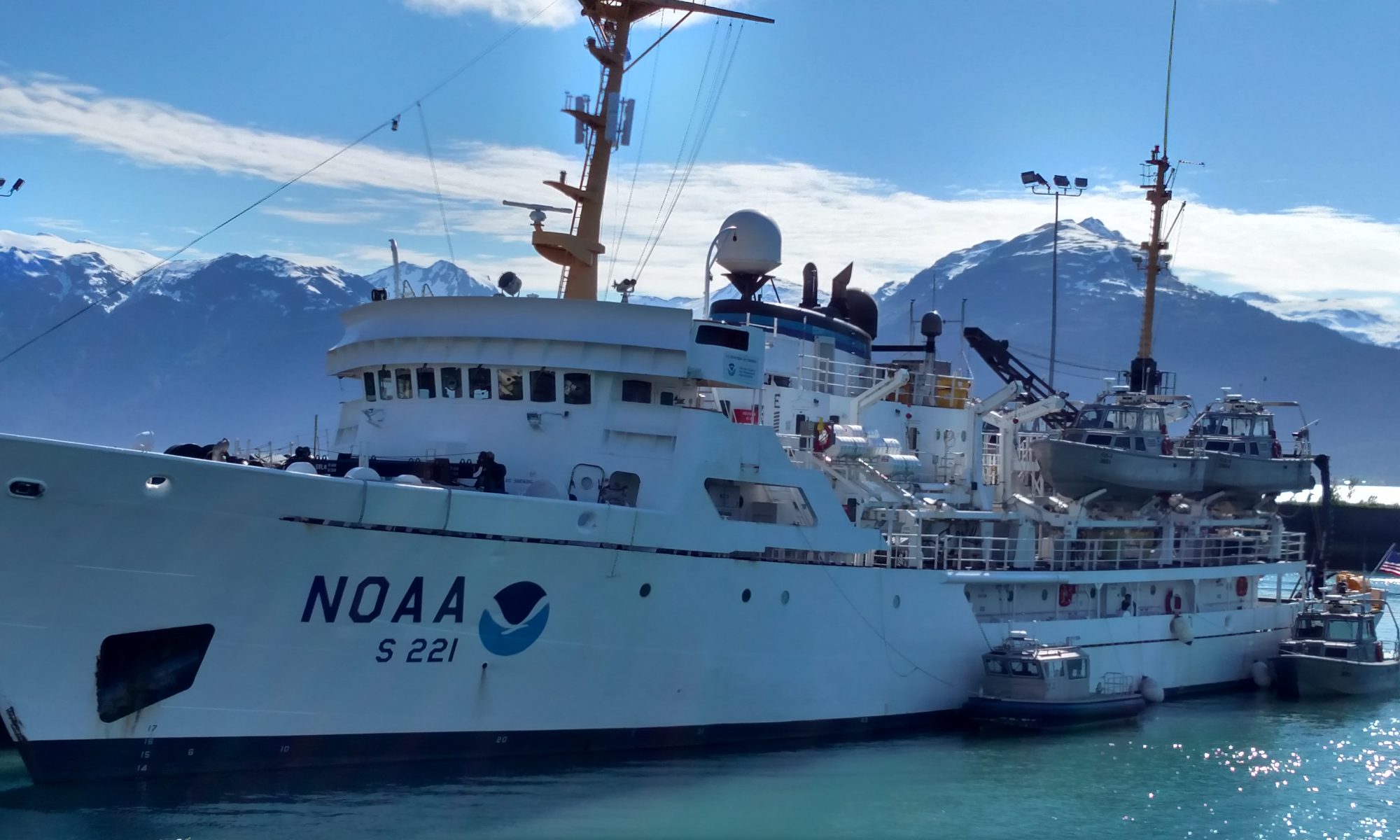
The NOAA ship Pisces is a state-of-the art research vessel.  Even when in transit to a specific operational location, it is always recording data and making observations of the ocean and the atmosphere.

Onboard the ship I was able to explore the different decks.  The Pisces is a large ship, but it is not until you move around on the decks that you realize how much space is needed to carry out all of the diverse series of scientific operations.  The Pisces is equipped with a hydraulic crane with the ability to lift 10,000 pounds, which is needed to raise and lower science equipment and remove and replace the gangway, the walkway needed to board and get off the ship while it is docked.  The ship also has a giant spool called a net reel where they store the fishing nets used for trawling missions and a series of winches with thousands of feet of wire to lower scientific instruments into the depths of the ocean.  Even when the Pisces is not carrying out any specific operations while in transit to an operation point, the ship is utilizing every opportunity to gather data on the ocean and the atmosphere.  The Pisces is specifically designed to run quietly to allow for state-of-the-art acoustic sensors to gather information on topographic features of the bottom and even information on various types of biomass in the water column such as fish, plankton, and the different types of coral on the ocean bottom.  The ship is also always taking meteorological readings for scientific use, calibration, and navigation.  Wind speed, wind direction, relative humidity, water temperature, barometric pressure are just some of the observations that are constantly being compiled; therefore, even in the dead of night in our transit, the Pisces is carrying out valuable scientific research and monitoring.

Science and Technology Log:

We are enroute to the Flower Gardens, one of the northern most reef forming corals in the world.  In fact, the Flower Gardens were not officially documented to have extensive coral reefs until the early 1960s when researchers started to investigate rumors of coral reefs in the northern Gulf of Mexico.  What research divers found was amazing:  a pristine coral reef not touched by poaching or pollution.  We are scheduled to arrive at the reefs this evening, May 28.  We will begin the fish surveys using the camera array and bandit reels tomorrow, as well, to document fish populations among the coral reef structures.

104_0086
One means of surveying fish abundance and size is using this submersible camera array. It is equipped with four cameras that are used for random sampling for survey data.  The array is fitted with a bait bag filled with squid in order to attract fish such as grouper and snapper.

Did you know?

The world’s coral reefs contain a remarkably rich and diverse multitude of life, yet they are threatened by poaching, pollution, disease, invasive species, and increasing ocean temperatures and acidity.

Spencer Cody: From the Center of the Continent to the Edge of the Continental Shelf, May 9, 2014

NOAA Teacher at Sea

Spencer Cody

Soon To Be Onboard the NOAA Ship Pisces

May 27 – June 11, 2014


Mission:  Reef Fish Survey

Geographical Area of the Cruise:  along the continental shelf edge off the coast of Louisiana

Date: May 9, 2014


Personal Log:

Pole of inaccessibility…I admit I was shocked to see that South Dakota claimed such a dubious geographical title in a recent issue of National Geographic.  South Dakota is technically not the geographical center of North America; that title goes to North Dakota.  South Dakota, however, does carry the rather obscure title of being a pole of inaccessibility for the North American continent, the point farthest from all North American shorelines.  Basically, if you live in South Dakota, you live at least 1,000 miles from a coast…any coast!  Perhaps our isolation from the ocean is more than a physical measurement on a map.  How often do South Dakotans think of living on an ocean planet?  Indeed, our perception of the world is seemingly skewed considering we live smack in the middle of that 30% we call land.  Living in South Dakota, it is easy to forget about the ocean and its impact on our daily lives.  We live as far from it as one can in North America; yet, we are inseparably bound to it.  The seafood you eat, the nearly subconscious purchases of foreign goods you make, the moisture we receive, the crops you sell, and even a large portion of the air that we breathe link us all to the ocean’s central value in our lives; therefore, understanding the ocean and the ocean sciences is vital to our daily lives even to landlocked South Dakotans.

Stoney Butte, South Dakota
South Dakota, a sea of former and current grassland! (Credit Spencer Cody for photo)

Here is where the National Oceanic and Atmospheric Administration and the Teacher at Sea program come into play.  It has become obvious to me since my selection as a Teacher at Sea that very few people in this region associate NOAA with ocean research.  They seem to know that NOAA plays a role in researching the atmosphere such as working with the National Weather Service to forecast storms, but they never make a connection to the ocean even if it is the second word in NOAA’s namesake.

It is understandable that South Dakotans in general would assume this because the only exposure we have to NOAA in this part of the country deals with storm and weather forecasting.  In reality NOAA operates a fleet of ocean research vessels that cover the expanse of U.S. waters and beyond in order to increase our understanding of what we really have in our oceans and how it all interacts with each of its differing component parts.  Also, NOAA has its own uniformed service called the NOAA Corps, which keeps the fleet operational and aids and assists in ocean research.  My goals as a Teacher at Sea are twofold:  connecting NOAA’s oceanic and atmospheric work to the classroom and connecting students to the education and training-related pathways that could potentially lead to NOAA careers.  Essentially, I am to learn and document as much as I can on my cruise and use this experience to enhance the education of my students and to provide access to possible careers in oceanic and atmospheric work through NOAA.  I am greatly thankful and humbled to receive such an opportunity through the NOAA Teacher at Sea program.  This is truly a great opportunity for learning for both me and my school.

Spencer Cody Hoven, SD
I enjoy geology, paleontology, and many other sciences. It is probably a safe guess that a large dinosaur left this track behind.

More about me…I will be starting my ninth year of teaching in Hoven this August. I teach 7-12 science:  Earth, Life, Physical, Biology, Biology II, Chemistry, and Physics.  I enjoy teaching all of the varied sciences.  It is hard to get bored when you teach everything.  Hoven is a very nice town to live and teach in.  It reminds me a lot of growing up in Veblen, another small, rural South Dakota town.  I have always been an advocate for rural education and strongly believe that small schools like Hoven offer an exceptional learning environment for students.

Unfortunately, I will have to leave my wife, Jill, and my daughters, Teagan and Temperance, behind for a few weeks.  I will miss them, but also realize that my four-year old daughter being present on a research vessel would make any productive research almost impossible.  She is very rambunctious.

I am counting down the days until I fly out on the 26th to Pascagoula, Mississippi, where the Pisces will be leaving and returning after the mission is completed.  I am very excited about the research involved in my upcoming mission.  Researching fish species abundances associated with the topography of the Gulf of Mexico has so many implications because our mission is just a small piece of a giant survey puzzle that includes nearly the entire edge of the North American shelf in the Gulf of Mexico.  Ships in the survey area have been using many innovative ways of monitoring reef fish abundance.  I look forward to learning more about this technology and will report more on the subject once I am underway.  For more information about the Pisces, visit the Pisces homepage or track our movements using the NOAA ship tracker.

Isle Royale National Park Spencer Cody
My wife and two kids on vacation at Isle Royale National Park in the middle of Lake Superior.


Paul Ritter: Sixteen Days… July 31, 2013

NOAA Teacher at Sea
Paul Ritter
Aboard NOAA Ship Pisces
July 16– August 1, 2013 

pisces team picture
Pisces team picture

Mission: Southeast Fishery-Independent Survey (SEFIS)
Geographical area of cruise: southeastern US Atlantic Ocean waters (continental shelf and shelf-break waters ranging from Cape Hatteras, NC to Port St. Lucie, FL)
Date: July 31, 2013

Weather Data from the Bridge

8-01-13 ship data

Science, personal, Technology Log

Date: Wednesday July 31, 2013
One day before we leave but you would not know it on the ship.  We are business as usual.  Our team is somewhere off of the coast of Cape Canaveral, and we have three sets of traps to set before we can call it a day.  With NASA’s Cape Canaveral Space Center in the background, we began laying traps in a zigzag pattern over the top of an underwater rock formation that the acoustics lab found the night before.

Our day’s catch was much better than in days past due to the fact that we he had moved much closer to shore.  For some reason our leg of the expedition experienced an unusual upwelling of cold water upon the continental shelf where we were exploring.  Our temperatures for most of the trip ranged from 14 to 16 degrees Celsius. Once we traveled closer to shore our temperatures went up to around 19 degrees Celsius.  This change in location meant that the water on the ocean floor was warmer and warmer water means more reef fish that are hungry.  FISH ON.

Notably, something that stands out in my mind that has made the entire trip successful is the camaraderie of the acoustics, and the wet /dry lab teams.  You would not know by looking, that many of them had never met prior to this trip.  Arguably, these people are the best of the best in the marine biology industry, and none of them have egos. They are so fun to be around.  They are very much a family.  Every time someone enters either lab, a round of “HEY’S” is shouted out by the entire group, as if we had not seen each other in years.   It reminds me of the old television show Cheers, when Norm would walk in to the bar and everyone would yell his name “NORM”.  I loved that show.  Anyway, I would give almost anything to work, side by side, with these people the rest of my life.  I imagine that this group of scientist is exactly what all other researchers aspire to have.

At the end of the day, trap six, the last trap, was pulled and we finished with a haul of good ol’ Black Sea Bass.  You got to love it.  The time was 3:45 and it was time to pack it up and clean the labs.  As a team, we boxed all of the equipment up, we scrubbed everything from top to bottom, and did it with the same enthusiasm we had had the entire trip.  We got the word from James Walker, Chief Bosun on the Pisces, to get all of our gear ready to be put into cargo nets ASAP.  He informed us that we were scheduled to arrive at Mayport Naval Station for a 7:00 A.M. dock time.  It did not take long for all of us to amass the gear and ready it all for transport.

At some point after supper, which was crab legs, and rib eye steaks, Ryan Harris, the skilled fisherman, and I were walking the deck and realized that we were about to get wet from a storm.  Thinking quickly, we moved all of the non-waterproof materials inside the wet lab.  I told Ryan I would see him in the morning and headed to my stateroom.  For some reason I could not get to sleep.  I was exhausted but just could not shutdown.  Zach, my roommate, and I talked about going home and all of the things we were going to do when we got there, for around an hour and then called it a day.

The Pisces steamed through the night and we were right on time.  Grabbing a cup of coffee, I raced out to the ships observation deck so I could watch us come into the dock.  It was amazing.  The crew and the bridge worked flawlessly together to bring our ship, that we have called home for the last sixteen days, back dockside.  My hat goes off to them.  James directed everyone to get into their positions. A small rubber ball with a long lines attached was hurled by one of the men, who was on port bow of the ship, overboard and onto land.  Waiting on shore, several young Navy men caught the ball and pulled the rope onto land forming a tight rope between the ship and land that any member of the Wallenda family could walk.  As the onshore men placed the rope on the davit, the ship motored forward to use the rope to pull the ships aft to the dock.  Upon docking, the crew of the Pisces completed our landing by connecting the massive cables that were lifted by a crane on shore.  These cables allowed the ship to shut off her engines, that had been going nonstop for the last sixteen days, and run on shore power.  Ah quiet at last.  Just because we were tied to land, it did not mean that our jobs were over.

OLYMPUS DIGITAL CAMERA
Off loading the scientific equipment aboard the Pisces.

We still had to move the cargo nets with all of our scientific equipment to land, and then the arduous task of loading it all into the team moving van.  The task of loading the van should have taken hours but the phrase “many hands make light work” was reaffirmed as the entire scientific party jumped in and made light work of the job.  Once complete, we all gathered, took our last pictures, hugged, and said our goodbyes.  And just like that, I jumped in a minivan with five of the ship’s crew and Matt Wilson, the team hydrographer.

Within 20 minutes we were at the airport and all headed to our gates.  My flight from Jacksonville was relatively easy, with no issues but when I arrived at O’Hare the same could not be said.  I think at last count my gate was moved at least 3 times before I made my way to gate G1.  Twenty minutes before flight time, I noticed that we had not boarded the plane yet.  The gate attendants were scurrying around like a mouse running from my cats, and then the ominous “ding” came over the speaker.  “Ahh ladies and gentlemen, we are sorry about the delay but we are experiencing some mechanical issues with plane”.  “We will try to keep you informed as to the progress and hopefully get you on to your final destination quickly”.  “Thank you for your understanding”.  After an hour or so, we finally got the direction that we were again moving to another gate.

As we were walking to our final exiting point, I started talking to a couple of the flight attendants and asked them what had happened.  Apparently, my original plane had taken a goose missile to one of the engines and it totally destroyed any chances that plane would fly again in the next several weeks.  As you could imagine, the attendants said it was quite a stressful situation.  I, for one, am very thankful that they changed my plane.  Finally, I boarded my new plane and made my way to my seat.  I could not wait to see my wife who was waiting for me at the airport.  As we taxied down the runway, the pilot came on the planes intercom and informed us that she was going to try to speed up our flight time a bit.  Speed up a bit?  I guess.  Our scheduled flight was to take 45 minutes to travel from Chicago O’Hare to Bloomington Regional Airport.  Our captain did it in 25 minutes flat.  Woo hoo.  I am going to American Airlines to request that she trains the entire fleet.  Just before landing, as if I could have scripted it, our plane flew over my hometown of Pontiac, Illinois.  It was then at that moment, that I knew I was home.  I could not wait to see my wife.  The plane landed and we rolled to the gate.  I don’t think it was 3 minutes and we were all off of the plane.  I hurried out the door, ran through the terminal, and there she was.  My wife was smiling and more beautiful than ever before.  I had missed her and my girls so much.

I will miss my new brothers and sisters of our scientific team and ship’s crew.  My students, family and friends are going to be amazed by all of the stories, pictures and videos. I am excited that all of them and others are going to be able to participate in reading the data from the real research we did on board.  I could not be more thankful to NOAA for my opportunity to live my childhood dream.  As I write these last sentences of my blog I am welling up with tears.  For sixteen days, in July of 2013, I aboard the NOAA Ship Pisces got to be a Marine Biologist, and ocean explorer.  I will never forget it.

OLYMPUS DIGITAL CAMERA
Paul Ritter in front of the ‘Pisces’ sign

Did You Know?  

I took a lot of pictures on my trip and these are what I consider my top 20 photos.

IMG_4772
Paul Ritter in a “gumby” suit
OLYMPUS DIGITAL CAMERA
Playing Bean Bags on the Pisces
xbt launch
Warren Mitchell and Paul Ritter lock and load the XBT
OLYMPUS DIGITAL CAMERA
Me…. and my Moray
OLYMPUS DIGITAL CAMERA
Sea turtle off the port bow
OLYMPUS DIGITAL CAMERA
Paul Ritter and Shark Sucker in the wet lab of the Pisces
OLYMPUS DIGITAL CAMERA
Paul Ritter and a 24 lb. Red Snapper in the wet lab of the Pisces
OLYMPUS DIGITAL CAMERA
Paul Ritter setting Traps on the Pisces
OLYMPUS DIGITAL CAMERA
Paul Ritter getting to know a Blue Crab
OLYMPUS DIGITAL CAMERA
Paul Ritter driving the Pisces
OLYMPUS DIGITAL CAMERA
Sunset on the Pisces
OLYMPUS DIGITAL CAMERA
Catch of the day.
OLYMPUS DIGITAL CAMERA
Paul Ritter and Ryan Harris catching Bonito.
OLYMPUS DIGITAL CAMERA
Paul Ritter with a Palm Warbler
OLYMPUS DIGITAL CAMERA
Atlantic Spotted Dolphins
vlcsnap-2013-07-19-20h12m25s184
Nurse Shark caught on our Go Pro camera
IMG_4901
Paul Ritter – Safety drill aboard the Pisces
IMG_4787
Paul Ritter and some of the many Sea Stars.
IMG_4907
Common Octopus
OLYMPUS DIGITAL CAMERA
Paul Ritter catching a Barracuda aboard the Pisces.

Paul Ritter: Start Your Day the Right Way with the Pisces McMuffin, July 24, 2013

NOAA Teacher at Sea
Paul Ritter
Aboard NOAA Ship Pisces
July 16– August 1, 2013 

Mission: Southeast Fishery-Independent Survey (SEFIS)
Geographical area of cruise: southeastern US Atlantic Ocean waters (continental shelf and shelf-break waters ranging from Cape Hatteras, NC to Port St. Lucie, FL)
Date: July 24, 2013

Weather Data from the Bridge

7-24-13 ship data

Science and Technology Log
Date: Wednesday 7-24-2013

Zeb and Doug in the lab making the call.

Woke up this morning around 6:15.  Worried that I overslept, I rushed as fast as I could to get to the aft deck for our daily trap baiting routine.  As I walked on deck, I quickly realized that no one else was on time either.  I knew something was amiss.  Immediately, I headed to the dry lab to find where the rest of the crew was located.  The day before we had to cut our expedition short due to high seas and heavy currents and today while the waves have calmed down the currents have not.  Zeb made the decision to wait until 8:15 to make our first drop of the day.  Quickly, traps one through six went into the water, and then came the waiting game. Ninety minutes went by and with fingers crossed we reeled in our chevron traps.  First trap in….. nothing.  Second trap….Nothing.  The third trap came to the surface and at first it appeared that we were skunked once again, but upon further inspection we had caught an Almaco Jack.  Almaco Jack (Seriola rivoliana) is a game fish that is in the same family as Yellowtail and Amberjack.  While I have not eaten this particular species of Jack, the crew tells me it is quite tasty.  An interesting fact about the Almaco Jack is that they remove their surface parasites by rubbing against the skin of passing sharks.  Nothing like asking for a shark to eat you.  Fourth trap was a big zero just like the first two, but the fifth trap had netted a Coney Grouper (Cephalopholis fulva) and Spider Crab (Libinia dubia).  Not many in our party had previously seen a Coney Grouper and it was exciting in the dry lab as the scientists all inspected our little five pound red beauty.  As for the Spider Crab, aka. Decorator Crab, I was shocked that it decided to ride the trap all the way to the surface, when it was small enough to escape at any point in time.  The Decorator Crab is so named for being a master of disguise.  This cunning little crustacean affixes to bits and pieces of seaweed, rock and other debris to disguise itself perfectly for the habitat that it lives in.  To me the Decorator Crab is one very cool little dude.  Even though our team found a couple of cool specimens it was not enough for us to spend the rest of the day there.  So Zeb made the call to head south.  Our next stop the waters of Florida.  It is estimated that it will take us around six hours to make the journey.

Me and My Coney
Me and My Coney
Say Hello to My Little Friend - Spider Crab
Say Hello to My Little Friend – Spider Crab

Personal Log

Cornhole
Cornhole anyone?

Having the lab clean and all of our chores completed we had to find a way to keep busy.  So what else could be better than playing Cornhole on the aft deck while traveling the waters south at 9.6 knots or about 11 miles per hour.  Zach, Julie, Patrick and I played about 10 rounds before we got tired and headed below deck.  I am sure you probably have wondered about life on the NOAA Ship Pisces.  There are several work schedules which people follow.  The crewmember’s position on the ship determines what shift they work.  It is possible to work two 4 hour shifts, an 8 hour shift or, 12 hours on, 12 hours off.  It just depends on your particular job on the shift.

Most all staterooms house two members of the crew.  Crewmembers are generally placed in staterooms where the other person in the room has an opposite schedule.  In other words, one person works when the other person sleeps.  This schedule seems to work well as long as the person who is awake does not disturb the person sleeping.  Each stateroom has its own private bathroom with a shower.  One thing that I have learned quickly is that it can be tricky to use the restroom while underway.  I do not want to go too in depth about using the privy but let’s just say this, it can be very tricky to use the restroom or shower for that matter, when you are bouncing off the walls from the waves outside.

Breakfast, lunch and dinner on the Pisces are served promptly at the hours of 7:00 a.m., 11:00 a.m. and 5:00 p.m.  The crew all make their way to the mess deck, where Moises, the Chief Steward, has an entire smorgasbord prepared and ready to eat.  Breakfast usually consists of a combination of eggs, pancakes, sausage, biscuits, English muffins, fried potatoes (hash browns), and BACON.  No breakfast would be complete without BACON.  The other day one of the NOAA scientists, Patrick Raley, suggested that I needed to try the Pisces McMuffin, which consists of bacon, egg, cheese and salmon on an English muffin. Well, when in Rome….  So I decided to have one for breakfast that day.  It was amazing.  I am here to tell you folks, if McDonalds finds out about this, you will find one on their menu.  Lunch and dinner consist of some meat (steak, crab, chicken, meatloaf, pork, scallops, and fish), vegetable (steamed, sautéed, or raw), some sort of potato, and a salad.

One thing I can tell you about being a field research scientist is that it is usually a messy job.  My clothes generally get destroyed every day.  Once on board, some species of the caught fish are simply measured for length and weight.  The real mess comes when we catch some of the more sought after species, which are more the focus of our study.  Each of these fish get a complete work up, including the collection of their otolith.  What is an otolith?  An otolith is basically a bone in the head of a fish that can tell us its age.  This bone would be similar to a person’s ear bone.   Why do we want to know how old fish are?  Knowing the age of any population allows biologists to better understand how populations react to various environmental and human pressures.  It allows us to be able to manage our natural resources in a sustainable way.

The Pisces McMuffin
The Pisces McMuffin

Anyway, it is not a good idea when you come to do your own expedition to bring new clothes or shoes.  It all will get very dirty.  Under the mess hall is the laundry facility.  I have already done one load of laundry since I have been on board and I am sure I will do many more before I head home.  To do laundry is no different from doing it at home with one exception.  Due to having only a few clothing items on this trip, I have to wash them all at the same time.  When my wife, Jodee, reads this, she will cringe, but I am not separating the whites, colors, lights or darks.

Did you know?

Did you know that otoliths are used to age fish?  How do we use otoliths to age a fish?  I would say it is like using tree rings to age a tree.  Do you want to give it a try?  http://www.afsc.noaa.gov/refm/age/ageinginteractive/pop_easy.htm


Paul Ritter: Lock and Load the XBT – The Joke is on Me, July 22, 2013

NOAA Teacher at Sea
Paul Ritter
Aboard the NOAA Ship Pisces
July 16– August 1, 2013 

Mission: Southeast Fishery-Independent Survey (SEFIS)
Geographical area of cruise: southeastern US Atlantic Ocean waters (continental shelf and shelf-break waters ranging from Cape Hatteras, NC to Port St. Lucie, FL)
Date: July 22, 2013

Weather Data from the Bridge

7-22-13 ship data

Science and Technology Log

Yesterday was a very exciting day.  After we dropped off our first traps, the ship’s officers brought the ship to a full stop and it was time to release the CTD.  What is a CTD?  CTD stands for Conductivity, Temperature, and Depth.  The CTD unit  is an array of sensors that is lowered to just above the bottom of the ocean to take a continuous profile of the water column.  Moments after the CTD reaches the bottom it is brought back to the surface and the deck hands bring it back on board the ship.  From here, the scientific crew can analyze the data from the CTD to determine the water conditions for the drop area.  On some expeditions, the CTD is fitted with a device that actually takes water samples at the different depths for chemical and biological analysis.   This information allows the scientists to get a complete picture of the water column where the traps are set and where the fish live.

What is a CTD? CTD stands for Conductivity, Temperature, and Depth.

Another instrument that is used by the ship is the Expendable Bathythermograph or XBT.  This device was used by the military for many years to measure the temperature of the water at various depths.  The most interesting thing about this probe is how it is deployed.

Warren Mitchell, a fisheries biologist for NOAA’s Beaufort Laboratory, decided it would be a good idea for me to be trained firsthand to deploy this vital instrument.  The first thing I had to do was put on my hardhat and safety vest and step on to the recovery deck.  At that point Warren called up to the bridge to ask for permission to drop the XBT.  The officers on the bridge gladly gave us permission and Warren then got me into a launching position with my feet spread apart and my elbow braced on hip.  The CO then happened to walk by and asked me if I had my safety glasses on, to which I immediately said yes.

It was at this point that Warren gave me permission to launch the XBT.  I was excited.  I was ready.  I could not wait for Warren to give me the signal.  The only problem was I did not know the signal and I could not find the trigger.  I did not know what to do.  I was getting worried.  Warren then repeated the orders “launch”.  “How?” I replied.  Tip the barrel forward, lean forward, he replied, and the XBT slid out of the tube into the water.

The joke was on me.  Here I had been led to believe that this was going to be some grand launch something just shy of the space shuttle taking off into space.  The reality was that the XBT just falls into the water.  Very non-exciting for me but everyone on the boat laughed for hours.  So did I.  It is good to be treated like one of the family.  After our final set of traps for the day, I ventured out to see what it is like to work in the acoustics lab.

Warren Mitchell NOAA Scientist instructs Paul Ritter on the proper use of the XBT.
Warren Mitchell NOAA Scientist gives instruction to Paul Ritter on the proper deployment of the XBT.

Personal Log

Monday 7-22-13

Nurse shark outside chevron trap.
Nurse shark outside our chevron trap.

To this point this expedition has been so amazing.  Would you believe there are 3 people aboard the NOAA Ship Pisces that live or once lived within 60 miles from my home town? Crazy I know.  We have had only one medium sized squall to this point with 3 to 5 foot seas.  We have brought up traps with tons of jellyfish, in which I got a nematocyst (jellyfish stinging cell) to the hand.  It was not too bad but I did feel a slight burning sensation.

We have had a number of different types of starfish, all of which I have never seen.  One particular trap that we sent to the ocean floor, while upon retrieval did not have any fish, but did have a secret to share.  After Julie Vecchio, one of our volunteer scientists replayed the video cameras that are on the top of the trap, we discovered that a nurse shark had been trolling the area around our trap. I have seen so many amazing things.  Several days ago we were hauling traps and just as we brought our trap up there was a sea turtle that came up to the boat.  I snapped a couple of photos, as quick as I could and then went right back to work.  It was not two minutes later and I saw a baby sea turtle the size of a fifty cent piece.  Immediately, the first thing that came to my mind was thought of Crush and Squirt from Disney’s Finding Nemo talking to me.

Crush: Okay. Squirt here will now give you a rundown of proper exiting technique.

Squirt: Good afternoon “Paul”. We’re gonna have a great jump today. Okay, first crank a hard cutback as you hit the wall. There’s a screaming bottom curve, so watch out. Remember: rip it, roll it, and punch it.

 Paul: Whoa! Dude! That was totally cool!

Turtle off the port bow.

Tuesday July 23, 2013

Somewhere in the middle of the night the wind picked up and so did the waves.  I share a stateroom with Zach Gillum a graduate student from East Carolina University.  This kid is amazing.  We really have become great friends.

One of the great things about this trip is to be totally immersed in an expedition with like-minded people. We will all hang around waiting for traps, or eating dinner and start conversations about some environmental issue or ecological principle.  I sure wished I lived closer to my new friends.  Anyway, our stateroom window is about 4 foot above the waterline.  Many times during the night, our window was under the water as a wave passed by.  When we woke up, the wind and waves increased.  A four to seven foot wave is enough to make many run for the toilet.  So far so good for me when it comes to sea sickness.

I just hope we don’t find any bigger waves.  We gathered on the aft deck as we usually do but we delayed deployment, waiting for improvement in weather conditions.  The major problem we had was with larger waves comes the possibility of the traps bobbing up and down on the ocean floor.  With adverse conditions on pick-up, we are also more likely to drag traps across the bottom.  We set the first six traps, pulled them up and just as we had suspected not many fish.  Around 1:00 P.M. Zeb Schobernd, our Lead Scientist, made the decision to head to another location.   It just goes to show you that when you are at sea, you need to follow the 3 F’s.  Flexibility, fortitude, and following orders.

Waiting to work.
Waiting to work.

Did You Know?

Did you know that a jelly fish’s nematocyst are like mini speargun?

These little stinging cells fire when they come in contact with the surface of and organism.  Some jellyfish tentacles can contain up to 5000 or more nematocyst.