Dave Grant: The “River in the Ocean”, March 2, 2012

NOAA Teacher at Sea
Dave Grant
Aboard NOAA Ship Ronald H. Brown
February 15 – March 5, 2012

Mission: Western Boundary Time Series
Geographical Area: Sub-Tropical Atlantic, off the Coast of the Bahamas
Date: March 2, 2012

Weather Data from the Bridge

Position: 26 degrees 19 minutes North Latitude & 79 degrees 55 minutes West Longitude
Windspeed: 14 knots
Wind Direction: South
Air Temperature: 25.4 deg C / 77.7 deg F
Water Temperature: 26.1 deg C / 79 deg F
Atm Pressure: 1014.7 mb
Water Depth: 242 m / 794 feet
Cloud Cover: none
Cloud Type: NA

“The moment one gives close attention to anything, even a blade of grass,
it becomes a mysterious, awesome, indescribably magnificent world in itself.”

Henry Miller

My evenings looking through the microscope are a short course in invertebrate zoology. Every drop of water filtered through the plankton net reveals new and mystifying creatures. Perhaps 90% of marine invertebrates, like newly hatched mollusks and crustaceans, spend part of their life in a drifting stage – meroplankton; as opposed to holoplankton – organisms that are planktonic throughout their life cycle.

MOLLUSK LARVAE

Bivalve
Bivalve
 Univalve
Univalve

The lucky individuals that escape being eaten, and are near a suitable substrate at the right moment, settle out into a sedentary life far from their place of origin. For the long distance travelers swept up in the Gulf Stream, the most fortunate waifs of the sea that survive long enough might make it all the way to Bermuda. The only hope for the remainder is to attach to a piece of flotsam or jetsam, or an unnatural and unlikely refuge like the electronic picket fence of moorings the Ron Brown is servicing east of the Bahamas.

“The gaudy, babbling, and remorseful day,
Is crept into the bosom of the sea.”
Shakespeare

A league and a half* of cable, sensors and a ton of anchor chain are wrestled on deck during a day-long operation in the tropical heat. (*A mariner’s league equals three nautical miles or 3041 fathoms [18,246 feet])

It is easy to be humbled by the immensity of the sea and the scope of the mooring project while observing miles of cable and buoys stretched towards the horizon, about to be set in place with a ton of anchor chain gingerly swung off the stern for its half-hour trip to the bosom of the sea.

Thanks to the hard labor and alert eyes of our British and French (“And Irish”) colleagues retrieving and deploying the attached temperature and salinity sensors, I am regularly directed to investigate “something crawling out of the gear” or to photograph bite marks from deep sea denizens on very expensive, but sturdy equipment.

A retrieved sensor with bite marks.

To my surprise, other than teeth marks, very little evidence of marine life is present on the miles of lines and devices strung deeper than about 200 meters. This may be due in part to the materials of which they are constructed and protective coatings to prevent bio-fouling, but sunlight or more precisely, the attenuation of it as one goes deeper, is probably the most important factor.

Fireworm (Drawings and images by Dave Grant - NOAA Ron Brown)
Fireworm
(Drawings and images by Dave Grant – NOAA Ron Brown)
Handle with care! Close-up of worm spines

The first discovery I was directed to was a striking red bristle worm wiggling out of the crevice in a buoy.  It appears to be one of the reef-dwelling Amphinomids – the aptly-named fireworms that SCUBA divers in the Caribbean avoid because of their venomous spines; so I was cautious when handling it.  This proved to be the deepest-dwelling organism we found, along with some minute growths of stony and soft corals.

Five o’clock shadow” on a buoy – A year’s growth of fouling organisms – only an inch tall.

On shallower buoys and equipment, there are sparse growths of brown and blue-green algae, small numbers of goose barnacles, tiny coiled limey tubes of Serpulid worms like the Spirobis found on the floating gulfweed, some non-descript bivalves (Anomia?) covered with other fouling growth, skeleton shrimp creeping like inch-worms, and of course the ubiquitous Bryozoans. Searching through this depauperate community not as challenging as the plankton samples, but not surprising since our distance from land, reefs or upwelling areas – and especially clear water and lack of seabirds and fishes; are all indicators that this is a nutrient-deficient, less productive part of the ocean.


Bio-fouling – “on the half-shell.”                       Skeleton shrimp (Caprellidae)

The Ron Brown is the largest workhorse in the NOAA fleet and its labs and decks are intentionally cleared of equipment between cruises so that visiting scientists can bring aboard their own gear that is best suited to their specific project needs. NOAA’s physical oceanographers from Miami arrived with a truckload of crates holding Niskin water sampling bottles for the CTD and their chemistry equipment for DO (Dissolved Oxygen) and salinity measurements; and in a large shipping container (“Ship-tainer”) from England, the British and French (“and Irish”) scientists transported their own remote sensing gear, buoys, and (quite literally) tons of massive chain and cables to anchor their moorings. (I am surprised to learn from the “Brits” that the heavy chain is shipped all the way from England because it is increasingly hard to acquire. )

In the lab: Scores of sensors serviced and ready for deployment

This is how most science is facilitated on the Brown and it requires many months of planning and pre-positioning of materials. I am lucky and can travel light – and with little advanced preparation. I am using simple methods to obtain plankton samples and images via a small portable microscope, digital camera and plankton net which I can cram into my backpack for any trips that involve large bodies of water. The little Swift* scope has three lens (4x, 10x, 40x) with a 10x ocular, and I get great resolution at 40x, and can get decent resolution to 100x. Using tips from Dave Bulloch (Handbook for the Marine Naturalist) I am able to push that somewhat with a simple Nikon Coolpix* point-and-shoot camera – but lose some of the sharpness with digital zoom.  As you might suspect, the ship’s movement and engine vibration can be a challenge when peering through the scope, but is satisfactory for some preliminary identification. (*These are not commercial endorsements, but I can be bought if either company is willing to fund my next cruise!)

PHYTOPLANKTON

Centric diatom - Coscinodiscus
Centric diatom – Coscinodiscus


Dinoflagellates –  Different Ceratium species

ZOOPLANKTON

A Plankton précis

Collecting specimens would be much more difficult without the cooperation of the Brown’s crew and visiting scientists, and their assistance is always reliable and appreciated. The least effective method of collection has been by filtering the deep, cold bottom water brought up in the Niskin bottles. As mentioned earlier, no live specimens were recovered; only fragments of diatom and Silicoflagellate skeletons surviving the slow drift to the bottom, which I have been able to identify through deep sea core images posted at the Consortium for Ocean Leadership website.

Needless to say, the most indiscriminate method of collection and the most material collected is through the large neuston net. The greatest biomass observed on the trip is the millions of tons of Sargassum weed, which covers the surface in great slacks around us that are even visible in satellite images.

Although the continuous flow of ocean water pumped into the wet lab and through my plankton net is effective and the most convenient collection method, the most surprising finds are from the saltwater intake screens that the engineer directed me to. This includes bizarre crystal-clear, inch-long, and paper-thin Phylosoma – larvae of tropical lobsters – that I initially mistook for pieces of plastic.

Inch-long Phylosoma larvae on a glass slide. (One of the tropical lobsters.)

“All the ingenious men, and all the scientific men, and all the fanciful men in the world …
…could never invent anything so curious and so ridiculous, as a lobster.”

Charles Kingsley -The Water-Babies

Plankton communities are noticeably different between the Gulf Stream, inshore, and offshore in the pelagic waters east of the Bahamas.  Near the coast, either the shallower Bahama Banks or the neritic waters over the continental shelf closer to Charleston, the plankton is larger, more familiar to me and less challenging to sort, including: copepods, mollusk larvae and diatoms. Steaming over the shelf waters at night, the ship’s wake is often phosphorescent, and dinoflagellates, including the “night-light” Noctiluca are common in those samples.

Dinoflagellate - Noctiluca
Dinoflagellate – Noctiluca

 The waters east of the Bahamas along the transect line are notable for their zooplankton, including great numbers and varieties of Foraminifera, and some striking amphipod shrimp. Compared to cooler waters I am familiar with, subtropical waters here have over a dozen species of Forams, and some astonishingly colorful shrimp that come up nightly from deeper water.

It’s not all work and no play on the Ron Brown, and there are entertaining moments like decorating foam cups with school logos to send down with the CTD to document the extreme pressure at the bottom. Brought back to class, these graphically illustrate to younger students the challenges of deep sea research.

Foam cup:  Before-and-after a trip to 5,000 meters
Foam cup: Before-and-after a trip to 5,000 meters

Navigating by Dead-reckoning

On calm days while we are being held on-station by the Brown’s powerful thrusters, I can measure current speeds using Sargassum clumps as Dutchman’s logs as they drift by. Long before modern navigation devices, sailors would have to use dead-reckoning techniques to estimate their progress.  One method used a float attached to a measured spool of knotted line (A log-line), trailing behind the moving vessel. The navigator counted the number of knots that passed through his hands as the line played out behind the ship to estimate the vessel’s speed (in knots). Since nothing is to be tossed off the Brown, I rely on a simpler method by following the progress of the Sargassum as it drifts by stem-to-stern while we are stationary at our sampling site. Since I know the length of the Brown at the waterline (~100-meters), I can estimate current speed by observing drifting Sargassum.

Watching sargassum, I wonder if a swimmer could keep pace with the currents in these waters. When in college
my brothers and would strive to cover a 100-meter race by swimming it in under a minute. Here is the data from east of the Bahamas. See if you can determine the current speed there and if a good swimmer could keep pace.

ESTIMATING CURRENT SPEED

Data on currents:
Average of three measurements of Sargassum drifting  the length of the Ron Brown = 245 seconds.
Length of the Ron Brown – 100-meters.

1. How many meters per second is the current east of the Bahamas?
2. As a swimmer in college – with my best time in the 100-meters freestyle of one minute – could I have kept up with the Ron Brown… or been swept away towards the Bahamas?

For more on currents, visit my site at the college:
http://ux.brookdalecc.edu/staff/sandyhook/Student%20Page%201/TUTS-2-09-1/Index.html

****************************

Other navigational exercises I try to include determining Latitude and Longitude. Latitude is easy as long as you can shoot the sun at midday or find the altitude of Polaris in the night sky; and sailors have done that for centuries. The ship’s navigator will get out the sextant for this, or, since the width of one’s fist is about 10-degrees of sky, I can estimate the height of both of these navigational beacons by counting the number of fists between the star and the horizon.

ESTIMATING LATITUDE

Data:
Night observation (Shooting the North Star) – Number of Fists from the Northern horizon to Polaris = 3
Day observation (Shooting the Sun) – Number of Fists from the Southern horizon to the Sun = 5.5

If the width of a fist is equal to about 10-degrees of horizon, our estimate of Latitude using Polaris is 30-degrees (3 x 10).
Not too bad an estimate on a rocking ship at night, compared to our actual location (See Data from the Bridge at the top.).

Shooting the Sun at its Zenith at 12:30 that day gives us its altitude as 55-degrees – which seems too high unless we consider the earth’s tilt (23.5-degrees). So if we deduct that (55 – 23.5) we get 31.5, which is closer to our actual position. And if we consult an Almanac, we know that the sun is still about six degrees below the Equator on its seasonal trip North; so by deducting that (31.5 – 6) we end up with an estimate of 25.5-degrees. This is an even better estimate of our Latitude.

Here is the dreaded word problem:

By shooting the Sun, our best estimate of Latitude is 25.5 degrees (25 degrees/30 minutes)
The actual Latitude of the ship using GPS is 26-degrees/19 minutes.
If there are 60 minutes to a degree of Latitude – each of those minutes representing a Nautical Mile – how many Nautical Miles off course does our estimate place us on the featureless sea?

**************************

Longitude is much harder to determine if you don’t have an accurate timepiece to compare local time with universal time (The time at Greenwich, England), and an accurate ship’s chronometer wasn’t in use until the mid-1700’s.
To understand the challenge of designing a precise timepiece that reliably will function at sea, I used two crucial clock mechanisms:  a pendulum and a spring. Finding a spring was easy, since “Doc” had a scale at Sick Bay. For the pendulum I fashioned a small weight swinging on a string)

Using the scale to observe the ship’s motion.

Standing on the scale and swinging the pendulum even in calm weather quickly demonstrated three things:

First: I have developed my sea legs, and no longer notice the regular motion of the ship.
Second: Even when the sea feels calm, the scale’s spring mechanism swings back and forth under my weight; adding and deducting 20 pounds to my real weight and reflecting the ship’s rocking that I no longer notice.
Three: On rough days, even if I can hold still, the ship’s heaving, pitching and rolling alters my pendulum’s reliable swing – its movements reflecting the ship’s indicator in the lab. Experimenting helps me appreciate clock-maker John Harrison, and his massive, 65-pound No. 1 Ship’s Chronometer  he presented to the Royal Navy in 1728.

Ship movement as recorded by the computer
Doc: Always on duty -  Sick Bay on the Ron Brown
Doc: Always on duty – Sick Bay on the Ron Brown

Besides having very well-provisioned Sick Bays, NOAA ships have experienced and very competent medical officers.  Our “Doc” received his training at Yale, and served as a medic during the Gulf War.

Especially alert to anyone who exhibits even the mildest symptoms of sea-sickness, Christian is available 24-hours for emergencies – and in spite of the crew constantly wrestling with heavy equipment on a rocking deck, we’ve only experienced a few minor bumps and bruises. He has regular office hours every day, and is constantly on the move around the ship when not on duty there.

Besides keeping us healthy, he helps keep the ship humming by testing the drinking water supply (The Brown desalinates seawater when underway, but takes on local water while in port); surveys all departments for safety issues; and with the Captain, has the final word if-or-when a cruise is to be terminated if there is a medical emergency.

Since a storm pounding the Midwest will head out to sea and cross our path when we head north to Charleston, he is reminding everyone that remedies for sea sickness are always available at his office door, and thanks to NASA and the space program, if the motion sickness pills don’t work, he has available stronger medicine. So far we have been blessed with relatively calm weather and a resilient crew.

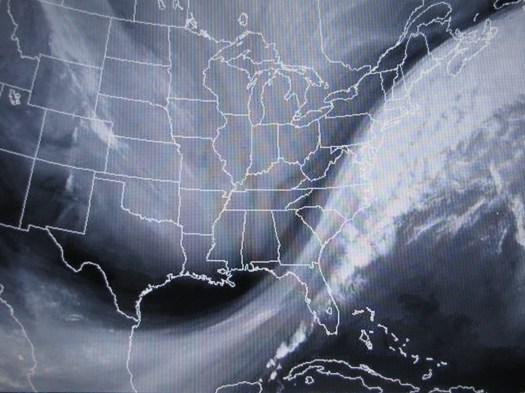
                          The warm  (Red) Gulf Stream waters viewed from a satellite iamge.
The warm (Red) Gulf Stream waters viewed from a satellite image.
 Contact: The edge of the Gulf Stream - Matthew Maury’s  River in the Ocean
Contact: The edge of the Gulf Stream – Matthew Maury’s River in the Ocean

Birdwatching on the Ron Brown

For the time being I take advantage of the calm seas to scrutinize what’s under the microscope, and when on break, look for seabirds. East of the Bahamas, as anticipated after consulting ornithologist Poul Jespersen’s map of Atlantic bird sightings, I only spotted two birds over a two-week stretch at sea (storm petrels). This is very much in contrast to the dozens of species and hundreds of seabirds spotted in the rich waters of the Humboldt Current off of Chile , where I joined the Brown in 2008.
(http://ux.brookdalecc.edu/staff/Web%2012-2-04/seabirds/Brown%20terns%202/Terns%20%20fixed/SEPacific.html)

Passing through Bahamian waters was no more rewarding, but now that we are west and in the Florida Straits there are several species of gulls during the day, and at night more storm petrels startled by the ship’s lights. One windy night a large disoriented bird (Shearwater?) suddenly fluttered out of the dark and brushed my head before bumping a deck light and careening back out into the darkness. Throughout the day a cohort of terns has taken up watch on the forward mast of the Brown and noisily, they juggle for the best positions at the bow – resting until the ship flushes a school of flying fishes, and then swooping down across the water trying and snatch one in mid-air.  Like most fishermen, they are successful only about 10% of the time.

Royal tern "on station" at the jack mast.
Caspian tern “on station” at the jack mast.
Royal tern "on station" at the jack mast.
Royal tern “on station” at the jack mast.


*************************************

Despite the dreary forecast from the Captain, Wes and I are enthusiastic about all we have done on the cruise and formulated a list of why NOAA’s Teacher At Sea program is so rewarding.

Top Ten Reasons:
Why be a Teacher At Sea?

10. Fun and excitement exploring the oceans!

9. Meeting dedicated and diligent scientists and crew from around the world!

8. Bragging rights in the Teachers’ Room – and endless anecdotes!

7. Cool NOAA t-shirts, pins and hats from the Ship’s Store!

6. Great meals, three times a day…and FREE laundry!

5. Amazing sunsets, sunrises and star-watches!

4. Reporting on BIG science to students…and in real-time!

3. Outstanding and relevant knowledge brought back to students and colleagues!

2. First-hand experience that relates to your students’ career objectives!

1. Rewarding hours in the lab and fieldremembering why you love science and sharing it with students!

Powerpoint:
Shots from the deck and under the microscope

(Drawings and images by Dave Grant – NOAA Ron Brown)

Dave Grant: Horse Latitudes, February 22, 2012


NOAA Teacher at Sea

Dave Grant
Aboard NOAA Ship Ronald H. Brown
February 15 – March 5, 2012

Mission: Western Boundary Time Series
Geographical Area: Sub-Tropical Atlantic, off the Coast of the Bahamas
Date: February 22, 2012

Weather Data from the Bridge

Position:26.30 N – 75.42 W
Windspeed: 0
Wind Direction: Calm
Air Temperature: 29 C
Water Temperature: 24 C
Atm Pressure: 1025
Water Depth: 4,410 meters
Cloud Cover: 0
Cloud Type: Slight haze

Science/Technology Log:

We are becalmed and even the veteran sailors onboard are remarking on how flat the sea has become. At about 30 degrees North and South Latitude, moist, low pressure air that was heated and lifted from the surface at the Equator has cooled and is now plunging back down to Earth, forming a line of light winds in a band across the sea. This dry, high pressure air becomes the Trade winds as it is drawn back towards the Equator along the sea surface in what is called a Hadley Cell (After its discoverer). We seem to be on the edge of this meteorological milepost, which was more than a nuisance in the days of sail. If stranded in its pattern too long, food and especially drinking water became an issue, and the first to suffer would be animals being transported from the Old World to the New. Legend has it that subsequent voyagers would come across their carcasses…hence the name Horse Latitudes.

While observing ships returning to port near his home, sixteen year-old future rock star Jim Morrison (The DOORS)  composed what is perhaps his most eerie ballot – Horse Latitudes.

“When the still sea conspires an armor
And her sullen and aborted
Currents breed tiny monsters
True sailing is dead
Awkward instant
And the first animal is jettisoned
Legs furiously pumping”

However, the stable ship makes deck work easier and I am catching up on samples under the microscope, including some of my own tiny “monsters” that the currents have bred.

It is the astonishing variety of life that makes the sea such a fascinating
hunting ground. Get a tow-net, dredge and simple microscope,
and a new world is yours – a world of endless surprises.”

(Sir Alister Hardy)

The chief survey technician set me up  with his  flow-through seawater system and I can leave a net under it to continuously gather plankton. I have noticed some patterns already.
One: Phytoplankton is scarce compared to temperate waters off of New Jersey, and this helps account for the clarity and
brilliant blue color of the water. The absence of large rivers here adding nutrients to the system, and little coastal
upwelling,  means that there is little to fertilize plantlife.
Two: More accumulates in the nets at night, confirming that Zooplankton rises to the surface at in the dark. This diurnal
pattern of the plankton community has been well documented ever since biologists and fishermen went to sea.
Three: Also, there is much more plankton at the surface than in deeper water. This is no surprise since sunlight is the
key ingredient at the surface of this ocean ecosystem.
Four: Creatures from offshore tend to have a more feathery look about them than inshore species. This added surface
area may use the turbulence to help support them near the surface  and increase their buoyancy.

It is said:  “Turn off the sun, and the oceans will starve to death in a week.”  It is assumed that among other stresses on the Biosphere that accompany disastrous impacts of large asteroids, dust and ash from these rare collisions block out enough sunlight to stifle photosynthesis, causing Phytoplankton (The “Pasture of the Sea”) to waste away, and setting the stage for the collapse of the Food Chain and mass extinction events. Fortunately we have plenty of brilliant sunshine here and no celestial catastrophes on the horizon.

Some of the most interesting Zooplankton are the Pteropods, the Sea Butterflies.

   
Empty shell and live pteropod specimen
(Images on the Ron Brown by Dave Grant)

The renowned oceanographer Alister Hardy used them as indicators of different water masses flowing around the British Isles; and New England’s great oceanographer, Alfred Redfield correlated their drifting with the anti-clockwise circulation of water in the Gulf of Maine. Although most are small and less than an inch long, they feed on a variety of creatures and in turn become food for many others. In surface waters they gather phytoplankton, some utilizing cilia and mucus to sweep food to the mouth; but in deeper waters, others are carnivorous.

I am informed by our English colleagues that on Europe’s fishing grounds, they are sometimes fed upon by herring, cod and haddock; which is bad news for British fishermen, whose catch rapidly decays and is not marketable. Such fish are referred to as “black gut” or “stinkers.”

How concentrated are pteropods? Whales and seabirds that we hope to encounter later in the cruise are sustained by them, and in the warmer waters of the Atlantic, at relatively shallow depths and on the tops of submerged peaks at around 2,000 meters, R.S. Wimpenny reports considerable deposits of “pteropod ooze” from their descending shells, covering an estimated 1,500,000 square kilometers of the bottom of the Atlantic (An area the size of the Gulf of Mexico.). Like the Foraminifera, in deeper waters the aragonite in their shells (a more soluble form of calcium carbonate) dissolves, and other sediments like silicates from diatoms accumulate instead. Check out any oceanography text and you are likely to find a picture of this biogenic pteropod mud, as well as other types of deposits.

At least 90% of the animals in the ocean are meroplankton – spending time in this itinerant stage before becoming adults. This phase may vary from a few days to over a year, depending on the creature. (European eels larva are the long distance champions; for over a year, drifting from below us in their Sargasso Sea breeding grounds, all the way to rivers in Britain and France.)

Drifting larvae are cheap insurance for a species, filling the surrounding habitat with individuals of your own kind, settling in new areas and expanding ranges, and particularly, not lingering around their birthplace and competing with the parent stock. However, most individuals simply end up as food for other creatures that are higher on the food chain.

Not surprising, there are copepods, the “cattle of the sea” grazing on smaller organisms.

  
(Images on the Ron Brown by Dave Grant)

Calanus finmarchicus is sometimes called the most abundant animal in the world and is found throughout the oceans, sustaining many types of marinelife; even right whales and basking sharks off the coast of New England.

Other sea soup and children of the sea that author David Bulloch likes to call them, drift by me and swim circuits trapped by surface tension in the water drop under the microscope.

  
Radiolaria are single cell Protozoa that not only ensnare food with mucous, but harbor mutualistic algae
among their spines. (100 x’s)


More live pelagic snails. (Pteropod means winged foot.)

  
An empty shell with  copepod sheltered inside. Other skeletons filled with Paramecia, and a mixed sample of shells
and dust particles.  (Images on the Ron Brown by Dave Grant)

Now that is calm, everyone seems to have their sea legs and are comfortable talking about their bouts of mal de mer.
Here is the worst story about sea sickness I have come across:

 From Dave Grant’s collection of sea stories:
The world’s worst tale of seasickness.
As told by Ulysses S. Grant in his Memoirs

One amusing circumstance occurred while we were lying at anchor in Panama Bay. In the regiment there was a Lieutenant Slaughter who was very liable to seasickness. It almost made him sick to see the wave of a table-cloth when the servants were spreading it. Soon after his graduation [from West Point] Slaughter was ordered to California and took passage by a sailing vessel going around Cape Horn. The vessel was seven months making the voyage, and Slaughter was sick every moment of the time, never more so than while lying at anchor after reaching his place of destination. On landing in California he found orders that had come by way of the Isthmus [Panama], notifying him of a mistake in his assignment; he should have been ordered to the northern lakes. He started back by the Isthmus route and was sick all the way. But when he arrived back East he was again ordered to California, this time definitely, and at this date was making his third trip. He was sick as ever, and had been so for more than a month while lying at anchor in the bay. I remember him well, seated with his elbows on the table in front of him, his chin between his hands, and looking the picture of despair. At last he broke out, “I wish I had taken my father’s advice; he wanted me to go into the navy; if I had done so, I should not have had to go to sea so much.”

Poor Slaughter! It was his last sea voyage. He was killed by Indians in Oregon.

Dave Grant: Going “Blue Water”
, February 17, 2012

NOAA Teacher at Sea
Dave Grant
Aboard NOAA Ship Ronald H. Brown
February 15 – March 5, 2012

Mission: Western Boundary Time Series
Geographical Area: Sub-Tropical Atlantic, off the Coast of the Bahamas
Date: February 17, 2012

Weather Data from the Bridge

Position: Windspeed: 15 knots
Wind Direction: South/Southeast
Air Temperature: 23.9 deg C/75 deg F
Water Temperature: 24.5 deg C/76 deg F
Atm Pressure: 1016.23 mb
Water Depth: 4625 meters/15,174 feet
Cloud Cover: less than 20%
Cloud Type: Cumulus

Science/Technology Log

Sailors used to describe their trips as short-haul or coastal,
or “long seas” which also was described as going “Blue Water”


We are off to a great start after passing the harbor lighthouse and breakwater, and the seas are calm and winds gentle. The Low Country and barrier islands of South Carolina disappear quickly over the horizon, and the most striking change for me is the color of the water. As we have transited from the sediment rich waters upriver, to the estuary, and out to the ocean, its color has gone from grayish, to green to blue.

Bay/Estuary water in Charleston
Gulf Stream water

As a rapid indicator of what’s going on within it biologically, oceanographers use the color of the water. To quantify their observations for other scientist to compare results, a white secchi disc is lowered just below the surface and the observer compares the ocean’s color with tinted water in a series of small vials – the Forel-Ule Scale. (Francois Forel was an oceanographer and his end of the scale is the bluest; and Willi Ule was a limnologist and his end of the scale is darker, reflecting the fresh waters he studied.) The 21 colors run the gambit of colors found in natural waters and modified by the plankton community and range from brownish-to-green-to-blue. This gives you a quick measure of productivity of the waters and the types of phytoplankton predominating. For example: Diatom blooms are brownish and Dinoflagellate blooms form the notorious red tides. Clear, less productive waters look blue, and we are sailing into waters that are a deeper blue with every league we sail.

I lack a secchi disk and we can’t stop the ship to lower one anyway, so I am using instead a scupper on the side as a photographic frame to document this well-studied and interesting phenomenon.

“Being on a boat that’s moving through the water, it’s so clear.
Everything falls into place in terms of what’s important, and what’s not.”
(James Taylor)

Before departing on the trip I came across Richard Pough’s bird map of the Atlantic. On it he divides the ocean into 10-degree quadrants and indicates the average water temperature and number of birds he sighted daily. The good news is we are heading southeast into warmer waters. The bad news is, he does not indicate a very productive hunting ground for bird watching. For example, Cape Hatteras, NC, where the Gulf Stream skirts North Carolina, shows 40 birds. Off the highly productive sub-polar regions like Iceland where there are great breeding colonies of seabirds like gannets, he indicates scores of birds. Regardless, I am hopeful we will find some true seabirds to photograph on our voyage; and perhaps have some migrating songbirds drop in for a rest.

Gulf Stream sunset

Today, as our colleague Wes Struble discusses on his blog, we retrieved our first samples with the CTD rosette. Water is retrieved from predetermined levels between the surface and 4,500 meters sealed in bottles for salinity and dissolved oxygen analysis. These two physical features, along with temperature, are the benchmarks physical oceanographers rely upon to track the ocean circulation.

For an understanding of this process and an overview of the project, I met with Molly Baringer in her office – a large bench that the ship’s carpenter built on deck. It seats three and is similar to a lifeguard stand, so it can give a view of the water and fit over the [dis]array of equipment constantly being shifted around the fantail by various scientists and deck hands. With the calm seas and sunny weather, it is the perfect spot on the ship to sit with a laptop to outline daily assignments for all of us, review the mass of data streaming in, and relax to watch the sunset.

“When I am playful,
I use the meridians of longitude and parallels of latitude for a seine,
and drag the Atlantic Ocean for whales!”

Mark Twain

Scientists and crew prepare to retrieve a mooring before the next big wave!

Chief scientist Dr. Baringer is a physical oceanographer and so is interested less in the creatures moving around in the ocean and more about the water currents that are moving them around, and particularly the vast amount of heat that is transferred from the Equator to the Polar Regions by “rivers in the sea” like the Gulf Stream.

 Currents and storms in our atmosphere produce our daily weather patterns, which of course change seasonally too. Ocean currents work on a much longer time scale and the text book example of the turnover time of warm water moving Pole-ward, cooling and returning to the Tropics as “centuries.” This timeframe infers that dramatic fluctuations in climate do not occur.

However, by analyzing ice cores from Greenland, scientists recently have detected evidence of abrupt changes in climate – particularly a significant cooling event 8,200 years ago – that could be associated with vacillations in the Gulf Stream. Although lacking a blackboard at her impromptu lecture hall on deck, a patient Dr. Baringer was artful in walking me through a semester of climatology and modeling to highlight the implications of an oscillating Gulf Stream and its deepwater return waters – the Deep Western Boundary Current.

Surface water is driven from the southern latitudes towards the Poles along the western side of the Atlantic, constantly deflected in a clockwise pattern by the Earth’s rotation. Bathing Iceland with warm and saltier water and keeping it unusually mild for its sub-polar latitude, the Gulf Stream divides here with some water flowing into the Arctic Sea and the rest swirling down the Eastern Atlantic moderating the climate in Great Britain, France and Portugal. (This explains the presence of a rugged little palm tree that I once saw growing in a Scottish garden.)

Perturbations in the northward flow of heat by meanderings of the Gulf Stream or the smothering of it of it by lighter fresh waters from melting ice in Greenland and Canada appears play a significant role in occasionally upsetting Europe’s relatively mild and stable climate – which is bad enough. What is more alarming is new evidence that these changes don’t necessarily occur gradually over centuries as once assumed, but can take place rapidly, perhaps over decades.

There is more bad news. The surface of the sea is dynamic and even without wind and waves, there are gentle hills and valleys between areas. I remember my surprise when our physical oceanography teacher, Richard Hires, pointed out that because of warmer water and displacement by the Earth’s rotation, Gulf Stream waters are about a meter higher than the surrounding ocean…that to sail East into it from New Jersey, we are actually going uphill. If these giant boundary currents are suppressed in their movements, it will exasperate an ongoing coastal problem as those hills and valleys of water flatten, resulting in rising sea levels and erosion along northern coastlines.

This explains why we are “line sailing” at 26.5 North, sampling water and monitoring sensors arrayed on the parallel of latitude between Africa and the Bahamas. To measure change, it is necessary to have baseline data, and the stretch of the Atlantic is the best place to collect it.

Snap shots of the water column are taken using the CTD apparatus as we sail an East-West transect, but at $30-50,000. Per day for vessel time, this is not practical or affordable. Here is where moorings, data recorders and long-life Lithium batteries come into play. By anchoring a line of sensors in strategic locations and at critical depths to take hourly readings, year-long data sets can be recorded and retrieved periodically. Not only does this save time and money, it is the only way to generate the ocean of data for researchers to analyze and create a model of what is happening over such a vast region – and what may occur in the future.

For more specific details, check out the project overview.

Deep Western Boundary Current Transport Time Series to study:
-the dynamics and variability of ocean currents;
-the redistribution of heat, salt and momentum through the oceans;
-the interactions between oceans, climate, and coastal environments; and
-the influence of climate changes and of the ocean on extreme weather events.
Information at:  http://www.aoml.noaa.gov/phod/wbts/ies/index.php

We hear that “The package is on deck” and it is time to collect water samples from the 24 different depths the Niskin bottles were fired (Remotely closed). As any aquarist will assure you, as soon as seawater is contained it begins to change, so we always start with the bottom water and work around to the top water since dissolved oxygen levels can drop with rising temperatures and biological activity from planktonic creatures trapped along with the water samples.

Although as oceanography students we read that most ocean water is quite cold (~3.5C)  because only the top 100 meters soaks up the warmth from sunlight, it is still an awakening for me to fill the sample bottles with even colder bottom water. After a half hour of rinsing and filling bottles, my hands are reminded of the times I worked in an ice cream parlor restocking containers from the freezer and filling soft-serve cones. It is a delight to get to the last several bottles of warm (25C) surface water.

Once the DO and salinity bottles are filled, they are removed to the chemistry lab and the Niskins are all mine. By holding a small plankton net under them as they drain excess water, I try my luck at catching whatever has almost settled to the bottom. There is an extra bonus too. A patch of floating Sargassum weed that tangled in the rosette was retrieved by the technician and set aside for me to inspect.

Windrows of Sargassum weed drift past the Ron Brown

Here is what I found under the microscope so far:

From depth:

The bottom water is absolutely clear with no obvious life forms swimming around. However a magnification of 50x’s and the extra zoom of my handy digital camera set-up reveals a number of things of interest I am sorting into AB&C’s:
Abiotic: Specks of clear mineral crystals. Are these minute sediments washed from the mainland or nearby Caribbean islands? Or is it possible they are quartz grains carried from much greater distances, like the Saharan dust that satellite images have proven are swept up by desert winds and carried all the way across the Atlantic?

Biotic: Although I can not find anything living, the silica dioxide skeletons (frustules) of at least two species of diatoms are present. These fragile fragments of glass accumulate in deep sediments below highly productive zones in the sea and different species are useful to paleontologists for determining the age of those deposits. On land, fossil diatom deposits are mined for diatomaceous earth – used as an abrasive and cleaner, pool filter material, and even in nanotechnologyresearch applications. There is other detrital material in the samples, but nothing identifiable.

Celestial(?): One tiny round particle caught my attention under the microscope. It looks like the images I’ve seen of microtektites – glassy and metallic meteor particles that have been molded by the heat of entry into the atmosphere. The Draxler brothers, two science students in Massachusetts, collect them and I hope they will confirm my identification when I see them again.

Dust particle (Right) and foraminifera (Center)

From the surface:

The warm, sunlit surface water here is covered with Sargassum weed, a curious algae that sustains an entire ecosystem in the waters mariners named the Sargasso Sea. On board the Brown it is simply called “weed” in part because it can be a minor nuisance when entangled with equipment. The Sargassum’s air bladders that support it at the surface reminded Portuguese sailors of their sargazagrapes and they named the gulfweed after them.

Can you spot the two Sargassum shrimp next to the air bladder?

Floating Sargassum weed harbors a great variety of other creatures including baby sea turtles, crustaceans and especially bryozoan colonies. The film of life encrusting the weed is sometimes called aufwuchs by scientists and is a combined garden and zoo.

A quick rinse in a plastic bag revealed two species of bryozoan and numerous tiny crustaceans. The Phylum Bryozoa is the “moss animals” a puzzling colonial creature to early biologists. Bryozoans are an ancient group with a long fossil record and are used by paleontologists as an “index” species to date sediments.

Byozoan colony

To my delight there were also some foraminifera in the samples. “Forams” as they are called by researchers, are single celled protozoa with calcium carbonate skeletons. They are abundant and widespread in the sea; having had 330 million years to adjust to different habitats – drifting on the surface in the plankton community and on benthic habitats on the bottom.

It is not necessary for you to go to sea with a microscope to find them. I have seen their skeletons imbedded in the exterior walls of government buildings in Washington, DC; and our own lab building at Sandy Hook, NJ has window sills cut from Indiana limestone – formed at the bottom of the warm Mesozoic seas that once covered the Midwest. In the stone, a magnifying glass reveals pin-head sized forams cemented among a sea of Bryozoan fragments. Some living forams from tropical lagoons are large enough to be seen without a magnifier, and  are among the largest single-celled creatures on the planet. With a drop of acid (The acid test!) our Geology students confirm that our window sills are indeed made of limestone as the drops fizzing reaction releases carbon dioxide sequestered when the animal shell formed.

Living foraminifera eat algae, bacteria and detritus and are fed upon by fishes, crustaceans and mollusks. Dead forams make contributions to us by carrying the carbon in their skeletons to the bottom where it is sequestered for long geological periods.

Geologists also use different species of forams as “index” species to fix the date of strata in sediment cores and rocks. The appearance and demise of their different fossil assemblages leave a systematic record of stability and change in the environment; and paleoclimatologists use the ratios of Carbon and Oxygen isotopes in their skeletons document past temperature ranges.

Our first plankton samples extracted from the deepest samples retrieved from the Niskin bottles at 4,000 meters (2.5C) did not produce any forams. This may be because in deep, cold water, calcium carbonate is more soluble and the skeletons dissolve. Presumably why we identified only the glassy tests of diatoms.

Foraminifera shell at 100x’s

Tiny Paramecia swarm over the detritus in my slide and taking a closer look at that and the growth associated with the weed I am reminded of Jonathon Swifts jingle:

Big fleas have little fleas
Upon their backs to bite ’em
And little fleas have lesser fleas

And so, ad infinitum 


Sunset over the Sargassum Sea

The Chief Scientist:

A day in the life of our chief scientist involves: checking with her staff to evaluate the previous day’s collections, consulting with visiting scientists on their needs and any problems that might arise, checking with the deck hands and technicians about equipment needs and repairs, advising the ship’s officers of any issues, and making certain we are on course and schedule for the next station.

And then rest? Hardly!

Even when off duty there are inquiries to field from staff, scientists and crew; equipment repairs to be made; and software that needs to be tweaked to keep the data flowing.

How does one prepare for a career like this?
Physically: the capacity to function on little sleep so you can work 12-hour shifts and be on-call the other twelve. (And there is little escape at mealtimes either, where the conversation never stays far from the progress of the cruise.)Mentally: the capability to multi-task with a variety of very different chores.
Emotionally: the flexibility to accommodate people with many different personalities and  needs, while staying focused on your own work.
Also, excellent organizational skills, since months of planning and preparation are crucial.
And perhaps most importantly, a sense of humor!


 “Lock-and-Load!
Midnight shift.
Chief Scientist Dr. Molly Baringer prepares to fire the XBT
off the stern for an 800 meter profile of temperature and pressure.

Elizabeth Bullock: Day 5, December 15, 2011

NOAA Teacher at Sea
Elizabeth Bullock
Aboard R/V Walton Smith
December 11-15, 2011

Mission: South Florida Bimonthly Regional Survey
Geographical Area: South Florida Coast and Gulf of Mexico
Date: December 15, 2011

Weather Data from the Bridge
Time: 3:15pm
Air Temperature: 23.6 degrees C
Wind Speed: 15.8 knots
Relative Humidity: 56%

Science and Technology Log

Liz takes a water sample
Here I am taking a water sample from the CTD.

Let’s talk about the flurometer!  The flurometer is  a piece of equipment attached to the CTD which is being used on this cruise to measure the amount of chlorophyll (specifically chlorophyll_a) in the water being sampled.  It works by emitting different wavelengths of light into a water sample.  The phytoplankton in the sample absorb some of this light and reemit some of it.  The flurometer measures the fluorescence (or light that is emitted by the phytoplankton) and the computer attached to the CTD records the voltage of the fluorescence.

The flurometer can be used to measure other characteristics of water, but for this research cruise, we are measuring chlorophyll.  As you know, chlorophyll is an indicator of how much phytoplankton is in the water.  Phytoplankton makes up the base of the marine food web and it is an important indicator of the health of the surrounding ecosystem.

At the same time that our cruise is collecting this information, satellites are also examining these components of water quality.  The measurements taken by the scientific party can be compared to the measurements being taken by the satellite.  By making this comparison, the scientists can check their work.  They can also calibrate the satellite, constantly improving the data they receive.

Combined with all the other research I’ve written about in previous blogs, the scientists can make a comprehensive picture of the ecosystem with the flurometer.  They can ask: Is the water quality improving?  Degrading?  Are the organisms that live in this area thriving?  Suffering?

Nelson records data from the CTD
Nelson records data from the CTD.

Collecting data can help us make decisions about how better to protect our environment.  For example, this particular scientific party, led by Nelson Melo, was able to inform the government of Florida to allow more freshwater to flow into Florida Bay.  Nelson and his team observed extremely high salinity in Florida Bay, and they used the data they collected to inform policy makers.

Personal Log

Today is my last full day on the Walton Smith.  The week went by so fast!  I had an amazing time and I want to say thank you to the crew and scientific party on board.  They welcomed me and taught me so much in such a short time!

Thank you also to everyone who read my blog.  I hope you enjoyed catching a glimpse of science in action!

Answers to Poll Questions:

1)      In order to apply to the Teacher at Sea program, you must be currently employed, full-time, and employed in the same or similar capacity next year as

a. a K-12 teacher or administrator

b. a community college, college, or university teacher

c. a museum or aquarium educator

d. an adult education teacher

2)      The R/V Walton Smith holds 10,000 gallons of fuel.  By the way, the ship also holds 3,000 gallons of water (although the ship desalinates an additional 20-40 gallons of water an hour).

Elizabeth Bullock: Day 3, December 13, 2011

NOAA Teacher at Sea
Elizabeth Bullock
Aboard R/V Walton Smith
December 11-15, 2011

Mission: South Florida Bimonthly Regional Survey
Geographical Area: South Florida Coast and Gulf of Mexico
Date: December 13, 2011

Weather Data from the Bridge
Time: 4:45pm
Air Temperature: 23.5 degrees C
Wind Speed: 15 kt
Relative Humidity: 68%

Science and Technology Log

Liz deploys a drifter
I'm deploying a drifter!

Last night, we deployed our first drifter.  There will be three deployed over the course of this cruise.  The frame of this drifter is built by the scientists at AOML (Atlantic Oceanographic and Meteorological Laboratory).  Afterwards, they attach a satellite transmitter so they can track where the drifter goes.  This helps them measure the surface currents.

What are some other types of research being conducted onboard?  I’m glad you asked!  Two NOAA researchers, Lindsey and Rachel, are studying water chemistry and chlorophyll.  They take samples of surface water from the CTD to study CO2 and the full carbonate profile.  They also use water collected at many different depths to study the chlorophyll content.  Chlorophyll is an indicator of the amount of phytoplankton in the water.

Collecting water from the CTD
Collecting water from the CTD.

Sharein, a PhD student at the University of Miami Rosenstiel School of Marine and Atmospheric Science, is studying a specific type of plankton called copepods.

The particular copepod that she is studying is food for the larval stages of some commercially important species of fish such as bill fish (which include blue marlin, sail fish, white tuna, and yellowfin tuna) and different species of reef fish.  If a species is commercially important, it means that many people depend on this particular fish for their livelihoods.

Female Copepod
Here is one of the species of copepods that Sharein is studying.

Do you think you would be interested in working at sea?  You would be a good candidate if you:

1)      Like meeting new people and working as part of a team

2)      Are interested in the ocean, weather, and/or atmosphere

3)      Don’t mind getting your feet wet

Personal Log

When we were on our way to the Tortugas, we didn’t have cell service and the TV in the galley had no signal.  It was nice to be disconnected for a while.  Although there are still 29 computers onboard which all have the internet, so we’re hardly off the grid!

It was hard at first to adjust to the night shift, but everyone onboard was really supportive.  Working the night shift means that you work from 7pm to 7am.

Species seen last night in the Neuston net:

Flying fish

Needle fish

Different kinds of sea grasses and sargassum

Moon jellies