Richard Chewning, June 6-7, 2010

NOAA Teacher at Sea
Richard Chewning
Onboard NOAA Ship Oscar Dyson
June 4 – 24, 2010

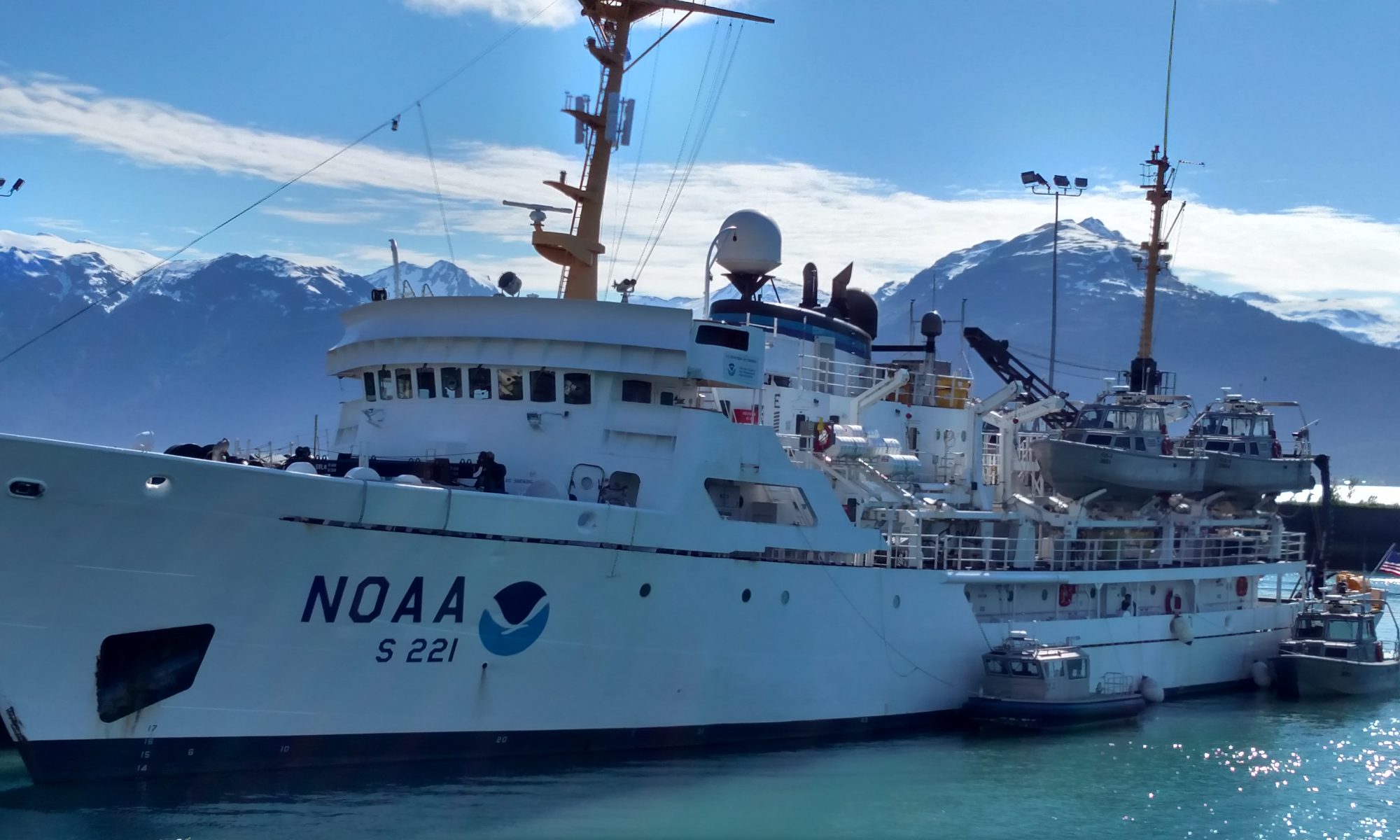
NOAA Ship Oscar Dyson
Mission: Pollock Survey Geographical area of cruise: Gulf of Alaska (Kodiak) to eastern Bering Sea (Dutch Harbor)
Dates: June 6-7, 2010

Weather Data from the Bridge

Position: Snakehead Bank, Gulf of Alaska
Time: 1700 hrs
Latitude: N 56 00.390
Longitude: W 153 46.380
Cloud Cover: Overcast
Wind: 12 knots from the SE
Temperature: 7.1C
Barometric Pressure: 1016.9 mbar

Science and Technology Log

I have been impressed by the wide array of oceanographic research the Oscar Dyson is able to conduct. A few examples include biological studies of organisms ranging from microscopic plankton to massive marine mammals, collecting a variety of weather data, describing both physical and chemical characteristics of seawater (such as temperature, salinity, chlorophyll, and dissolved oxygen), conducting acoustic surveys of marine life and the sea floor, and much more.

Three Saints Bay nautical chart

One of the Dyson’s ‘bread and butter’ surveys is our survey studying the distribution, biomass, and biological composition (male/female ratios and age) of walleye pollock in the Bering Sea. Walleye pollock is a very important fishery for Alaska. You have almost certainly been a part of this fishery as most fish sandwiches in fast food restaurants and fish sticks in the frozen food section of your local grocery store are Alaskan-caught pollock.

One of the Oscar Dyson’s many tools for this research is her impressive array of acoustic sensors located on the ship’s hull and centerboard. The centerboard is an extension of the hull that can be raised and lowered in the water in order to position most of the Dyson’s sensitive acoustic sensors below the bubbles often found near the water’s surface. These air bubbles interfere with sound traveling through the water and degrade the quality of the data being collected. The Dyson has six downward looking centerboard-mounted transducers, each transmitting a different frequency. Why so many frequencies? Since different types of marine organisms interact with sound waves differently producing varying acoustic signatures, the Dyson must be equipped with a variety of sensors to best characterize the variety of marine life encountered during a survey.

For example, lower frequencies are better suited for fish such as pollock and the higher frequencies are better suited for smaller organisms such as plankton. Think of transducers as a downward shining flashlight illuminating the depths of the ocean with sound rather than light.

The Dyson also has other acoustic sensors such as the ME-70 multibeam echosounder that has the unique ability to look over a much wider angle through the water. Acoustic research works on the same echo location principle that bats and marine mammals employ to find food and navigate. By sending out sound waves and measuring the time the sound takes to travel back after encountering an object, one can learn a great deal about that object’s properties such as distance, size, and movement.

Before traveling to the Bering Sea to start our pollock survey, the Dyson’s scientists must take great care to ensure that their echo-sounding equipment is calibrated correctly. Calibrating the transducers is similar in concept to tuning a piano string or zeroing a sight on a rifle. To this end, the Dyson anchored in Three Saints Bay, a sheltered bay protected from the wind, waves, and currents of the open ocean, at least theoretically. While a troublesome storm passed almost directly overhead, scientists from the Midwater Assessment and Conservation Engineering (MACE) Program (part of the Alaska Fisheries Science Center (AFSC) located in Seattle, WA), the US Fish and Wildlife Service (FWS located in Anchorage, AK), and the Pacific Institute of Fisheries and Oceanography (located in Vladivostok, Russia) worked diligently to fine tune their acoustic sensors.

Copper sphere used to calibrate the acoustic sensors
Bill and Patrick positioning spheres under the Dyson

Paul Walline, Patrick Ressler, Darin Jones, Bill Floering, and Mikhail ‘Misha’ Stepanenko worked day and night calibrating their equipment using metal spheres positioned directly under the ship.

Spheres of different sizes and materials with known acoustic signatures (such as tungsten carbide and copper) are used to calibrate the transducers.

The crew of the Dyson works around the clock as ship time is precious. The scientists work 12 hour shifts, either from 4am to 4pm (the shift to which I am assigned) or from 4pm to 4am. The acoustics lab where the data is collected and analyzed is affectionately called ‘The Cave’ as there are no portholes (windows) to tell the time of day outside.

The acoustic lab, a.k.a. “the cave”

Personal Log

I wasn’t sure when the Dyson arrived at Three Saints Bay as I had retreated to my stateroom early in the evening of the 4th as I was feeling the effects of the rolling seas. I am being berthed with the ship’s 2nd Cook, Floyd Pounds, who is also from Georgia but now calls the Dyson home.
Floyd works with the Chief Steward, Rick Hargis, who has been with NOAA for 20 years and is originally from Washington State. So far the meals have been very filling and satisfying (there is even an ice cream bar!).

My stateroom is located on the crew deck, one level below the main deck near the bow (the pointy end of the ship) on the starboard side (the right side when facing the bow). Utilizing every nook and cranny and with no wasted space, my berth is quite cozy and is surprisingly comfortable. Fortunately with the help of some seasickness medication, I soon found my sea legs and awoke feeling refreshed and hungry (always a good sign!). Seasickness comes from conflicting messages received from the inner ear and the eyes by the brain (the inner ear feels the motion of the boat rolling and pitching in the water but the eyes report a stable environment confusing the brain).

Snug as a bud in a rug
Richard, ready for a swim

A person soon observes that safety is paramount onboard the Dyson as with any NOAA vessel. For example, within 24 hours of leaving Kodiak, the entire crew conducted fire and abandon ship drills. These drills are conducted once a week and are essential for maintaining readiness in the event of an emergency. During the abandon ship drill, I was able to practice donning my survival suit just like our visiting Coast Guard kids did in Kodiak! Although the suit is designed to be quite snug to keep cold water out and to keep the body warm, I was thankful I didn’t have to put the suit to the test by going over the side. To my surprise, Chief Marine Engineer Jerome ‘Jerry’ Sheehan and ENS Russell Pate did just that, going for a dip in the frigid 7.3 degrees Celcius or ~45 degrees Fahrenheit waters! Jerry and Russell used dry suits to scuba dive under the Dyson to check the hull, the prop, and the transducers for anything out of place such as barnacles on the transducers or tangled fishing gear. The only discovery was of a piece of bull kelp snagged on one of the blades of the prop which may explain a noise that was heard on the hydrophones (microphones located under the Dyson’s hull) during our departure from Kodiak.

CO Hoshlyk overseeing recovery divers Jerry Sheehan and ENS Russell Pate

After completing our calibrations and safety operations, the Dyson sailed for a site called Snakehead Bank located 60 nautical miles southeast of Kodiak. The name comes from the bathometric profile of the seafloor of this area which resembles the head of a snake. We soon began conducting camera operations for ground-truthing sea floor composition that I will discuss in my next log!

Remnants of Nunamiut, earliest Russian settlement 1792 in three saints bay, Kodiak
Departing Three Saints Bay


Where did the NOAA ship Oscar Dyson’s name originate?


The Oscar Dyson is named for an Alaskan fisherman who was very influential in fisheries development and management in Alaska. From his days as a commercial fisherman, Oscar Dyson was a pioneer and advocate for Alaska fisherman and was very influential in the growth of this important industry. Alaska’s commercial fishing industry spans the state and includes salmon, herring, pollock, various shellfish, and various ground fish like halibut. While traveling through the Ted Stevens International Airport in Anchorage, I learned that Alaska is a land defined by water with more than three million lakes and more coastline than the rest of the United Sates combined! Alaska is also the only state in the US to have coastlines with three different oceans/seas: the Pacific Ocean, the Arctic Ocean, and the Bering Sea.

Richard Chewning, June 5th, 2010

NOAA Teacher at Sea
Richard Chewning
Onboard NOAA Ship Oscar Dyson
June 4 – 24, 2010

NOAA Ship Oscar Dyson
Mission: Pollock Survey
Geographical area of cruise: Gulf of Alaska (Kodiak) to eastern Bering Sea (Dutch Harbor)
Date: June 5th, 2010

Weather Data from the Bridge

Position: Three Saints Bay, Kodiak Island, Alaska
Time: 1000 hrs
Latitude: N 57 10.480
Longitude: W 153 30.610
Cloud Cover: overcast with light rain
Wind: 12 knots from NE
Temperature: 10.3 C
Barometric Pressure: 1001.1

Science and Technology Log

While taking on supplies and preparing for our cruise, the NOAA ship Oscar Dyson had the pleasure of welcoming six kids from the United States Coast Guard (USCG) 2010 Summer Program for a visit. These kindergarten through second graders were visiting from the USCG Integrated Support Command Kodiak, the largest Coast Guard base in the US. The Oscar Dyson’s medical officer ENS Amber Payne and I gave the students a firsthand tour of the Dyson.

NOAA Ship Oscar Dyson tied up in Kodiak, AK.
The Bridge
The Bridge

Highlights of the visit included a tour of the bridge with Executive Officer Lieutenant Jeffrey Shoup. The students were impressed to learn that the propeller of the Oscar Dyson is 14 feet across and specially tooled to be as quiet as possible so as not to scare away any fish that the scientists onboard want to study. The students also enjoyed looking through the BIG EYES, two high powered binoculars located on the flying bridge (the highest point on the vessel above the bridge) of the Oscar Dyson that will be used to survey marine mammals. Scientist Suzanne Yin of the National Marine Mammals Laboratory told the students about how she and her colleagues wbe surveying for whales during the upcoming cruise

The Big Eyes
The Big Eyes
Safety onboard the Oscar Dyson

The highlight of the tour involved a demonstration by Safety Officer Ensign Russell Pate of one of the Dyson’s Damage and Control lockers. The students also enjoyed trying on the immersion suits with help of Ensign Payne. Immersion suits are designed to protect the wearer from exposure other frigid waters that the Dyson will soon be sailing The kids had great fun donning the firefighting equipment and helping Fisherman Glen Whitney test one of the Dyson’s fire hoses off the fantail. The USCG kids also learned how to tie a square knot with Glen’s help. With a little practice, they were able to join their individual lines into one large line by tying each line end to end using the square knot they just learned. Each student was able to take their line home to practice their newly acquired knot tying skills

Another fun activity was led by Senior Survey Technician Kathy Hough. After Kathy led the students through a tour of the Dyson’s dry and wet labs, the students acted as junior scientists by sorting an array of Alaskan fish and measuring and describing each species, just like the Oscar Dyson’s scientists will do later during the upcoming Pollock survey.

After lunch, the students received a fun science lesson using the property of water’s high surface tension. The students constructed two-dimensional boats out of plastic milk jugs and used soap to propel their boats over a tray of water. This is a very fun activity for younger students that you can easily do at home. The materials required include cleaned plastic milk jugs, scissors, markers, trays of water, and soap (a bar of Ivory soap cut into small cubes). After tracing the outline of a boat (as if looking from the top down) on the flat surface of a milk jug, the kids cut out their boats and made a small notch on the back of the boat to place a small block of soap to serve as the engine. The kids then enjoyed racing their boats against each other across the trays of water! If trying at home, you will need to replace the water in the tray after each race as the water becomes contaminated by the soap. This activity works because water molecules want to strongly stick to each other creating a strong but flexible surface. By disrupting the arrangement of the water molecules and causing the water molecules to push away from each other, the soap enables the boat to ‘power’ across the surface of the water.

Holding a Baby King Crab

After all equipment and supplies were loaded and crew members were boarded, the Dyson moved a short distance to take on diesel at the fuel dock. At 1820 hours, we departed St Paul Harbor and said goodbye to the Oscar Dyson’s home port of Kodiak. The Dyson then sailed about eight hours south to Three Saints Bay, a protected harbor south on Kodiak Island. Three Saints Bay will serve as a location to anchor so the science team can calibrate their acoustic equipment and will shelter the Oscar Dyson from an approaching low pressure system producing gale-force winds.

Personal Log

Hello Everyone! My name is Richard Chewning, and I have the honor to be a part of NOAA Teacher at Sea program sailing with NOAA ship Oscar Dyson. For those who do not know, the National Oceanic and Atmospheric Administration (NOAA) is a federal government agency charged with studying all aspects of the ocean and atmosphere. As you can imagine, these are broad areas of study. While large in scope, the work of NOAA affects everyone, whether you live on a coast or not. Have you ever heard of The National Weather Service or The National Hurricane Center? Both are NOAA divisions.
Here I am holding a baby king crab.

NOAA’s Teacher at Sea Program (TAS) aims to increase the public’s awareness and knowledge of NOAA science and career opportunities by having educators work alongside NOAA offices, ship’s crew, and shipboard scientists. NOAA’s TAS program invites both formal classroom teachers and non-formal educators alike to be a part of this amazing program. I myself am an environmental educator with the Jekyll Island 4-H Center. A Georgia 4-H program, the Jekyll Island 4-H Center is part of the University of Georgia. The Jekyll Island 4-H Center’s Environmental Education program welcomes 1st-12th grade students for environmental education field studies teaching coastal ecology using Jekyll Island as an outdoor classroom. I am the Environmental Education Program Coordinator and have enjoyed working for Jekyll 4-H for five years. For more information, visit http://www.jekyll4h.org .

I am very excited to be selected as a NOAA Teacher at Sea Participant and look forward to sharing my experiences with you through these logs.

Animals Seen Today

Bald Eagles (Haliaeetus leucocephalus)
Kittiwakes (Genus Rissa)
Pigeon Guillemot (Cepphus columba)
Magpie (Family Corvidae)

Laura Rodriguez, June 2nd, 2010

NOAA Teacher at Sea
Laura Rodriguez
Aboard NOAA Ship Oscar Dyson
May 24 – June 2, 2012

Mission: Fisheries Surveys
Geographical Area: Eastern Bering Sea
Date: June 2, 2010

Why is Ocean Science Important?

Four Peak Glacier
Four Peak Glacier

My cruise is coming to an end. We are now sampling the last of the stations as we make our way back to Kodiak. On Saturday, we had a safety stand down drill. This entailed finding a spot close to shore where we could drop anchor and then have a little bit of free time. Some people fished for halibut off the boat and others went ashore to explore a little bit. I went ashore with a group that included the XO, Jeff Shoup, Ensign Amber Payne, Glen Whitney, Dennis Boggs, and two of the scientists, Tiffany Vance and Kevin Bailey.  We hiked around a part of Katmai National Park and Preserve. This is an area filled with active volcanoes and glaciers. We saw a brown bear and a fox.

Four-peaked-glacier
Four peaked glacier

We also saw a raft of sea lions close to shore that eventually came closer and told us to go away. Katmai Preserve is home to an estimated 2,000 bears. The area we visited is very remote with no roads leading to it.  Once back on board, it was back to work sampling more stations.

My time on board the Oscar Dyson has shown me both the beauty of the ocean and the need for people to understand and care for it. We are inextricably connected to the ocean. Whether we live near or far from the ocean, we depend on the ocean for fresh water (think water cycle) oxygen (the majority of oxygen in our atmosphere is produced by the phytoplankton in the ocean), food, medicines, and mineral and energy resources. Many people depend on the ocean for jobs and recreation. Our oceans, however, are fragile ecosystems that are affected by the activities of humans. Dumping wastes into the ocean, overfishing, drilling for oil and development along coastal areas all have consequences for the living things that call the ocean home. I have learned about areas where overfishing has depleted species of fish that may never come back. There is an area in the Gulf of Mexico that is called the dead zone because of fertilizers from farms dumped into the Gulf from the Mississippi River. Right now, there is the Deep Horizons oil leak that has already spilled 20 million gallons of oil into the Gulf of Mexico and is leaking over 500,000 gallons of oil a day. We have a history of taking the ocean for granted and believing that it is so big that it can absorb unlimited amounts of pollution. We are finding out how wrong we are. Taking care of the ocean is everyone’s responsibility. In order to take care of the ocean, it is crucial that we understand the interrelationships between what we do here on land and what happens in the sea. This is why research such as what the scientists are doing on the Oscar Dyson is so important.

Me and the four peaks

Answers to your questions:

Dan 1. – Radar is different from sonar. Radar uses radio waves, a form of electromagnetic radiation (light) to detect objects. Radar stands for radio detection and ranging. Sonar uses sound waves to detect objects.  Sonar stands for sound navigation and ranging.

Dan 2. –  The weather is not nearly cold enough to need the de-icers. I was, however, standing by one the other day and felt the warmth, so they are on.

Olivia – My classification on this cruise is officially “Teacher at Sea.” I am, however, included with the scientists.

Kylei – I have been very lucky with the weather. We have not had any bad weather. One day, the ocean had some pretty good swells and we were rocking and rolling a bit, but no real storm. It has actually been unusually sunny and mild here.

Sea Lions
Sea Lions

Your question to answer: Research one of the activities below that affects life in the ocean:

  1. Overfishing ( factory fishing ships)
  2. Whaling
  3. Offshore oil Drilling
  4. Ocean pollution
  5. Coastal development

Find out:

  1. Why are people concerned about this activity?
  2. What are people doing to protect the ocean from the negative aspects of this activity?
  3. What can you do to help protect the ocean and the life within it?

Laura Rodriguez, May 24th, 2010

NOAA Teacher at Sea
Laura Rodriguez
Aboard NOAA Ship Oscar Dyson
May 24 – June 2, 2012

Mission: Fisheries Surveys
Geographical Area: Eastern Bering Sea
Date: May 24, 2010

Pollock Survey Begins

Robert and Kerri deploy the CTD
Deploying the Bongo nets
The bongo nets are almost in
Retrieving the bongo nets, full of algae and hopefully full of Pollock Larvae

On Saturday, my watch began at 10:00 AM. Two of the scientists, Annette Dougherty and Kevin Bailey have watch from 4 AM until 4 PM. The other two scientists, Tiffany Vance and Steve Porter, have watch from 4 PM until 4 AM. I guess being the teacher they took pity on me and gave me half and half. Before getting to one of the stations, the scientists make sure that everything is ready. They lay out the bongo nets on the deck where they will be used. The bongo nets are two nets that from the top look like bongo drums. (See picture) There is an instrument attached to the bongo nets called a SEACAT that takes conductivity, temperature and salinity measurements during the tow. Inside the lab, buckets, bowls and tweezers are all laid out ready to be used.

As we approach each station, the bridge informs the scientists and survey technicians. The bongo nets have already been readied and are set to be deployed (put into the ocean) from the hero platform. When the OK is given, the nets are lifted by the hydrowinch to a point where they can be maneuvered over the rail and then they are lowered into the water. The nets are lowered until they are at 100 meters or 10 meters off the bottom. As they are lowered, the pilot of the boat keeps the wire at a 45° angle by moving the boat slowly forward. Once the nets reach their maximum depth, they are slowly brought back up again.  ( I tried to upload a video showing the deployment and retrieval of the bongo, but it won’t work so I’ll show you the video when I get back.

Pollock larvae under the microscope

When the nets clear the water, they are hosed down to get any organisms into the bottle on the end of the net (called the cod end.) The cod end is then removed and the contents of one net are poured into a bucket for sorting. The contents of the other net are preserved and sent to a lab in Poland where they use instruments to get a very accurate count of the Pollock.

Annette Dougherty and Kevin Bailey in the chem Lab

Inside the chem lab, the contents of the bucket are scooped out and poured little by little into a mixing bowl. We then perform a rough count by removing the very small Pollock larvae and any other fish larvae and put them into a petri dish with cold water (the petri dish is placed on top of ice.) They are only a few mm long (averaging between 6-10mm.) Once we have gone through the entire contents, the Pollock larvae are counted, photographed and the length measured. They are then placed into a labeled vial with 95% ethanol. The other fish larvae are placed in a separate vial in 100% ethanol. They are kept in case another scientific team needs the data. The Pollock larvae will be sent to the scientists’ lab back in Seattle where they will perform further analysis on them. I’ll tell you more about that in the next blog.


Answers to your questions:

Annalise – The ship travels at 12 knots when we are going between stations.

Abandon Ship drill – You need to know how to put on your survival suit

Matt T– The ship is very safe. Drills are conducted every week. My first day on the ship, we had a fire drill and abandon ship drill. (See photo of me in my survival suit.)

Dan – The Oscar Dyson observes and records a number of environmental conditions. The bridge takes weather readings every hour and keeps them in a weather log. These include wind direction, wind speed, seawater temperature, air temperature, air pressure, cloud cover, sea swell height and direction. Conditions in the water are also constantly monitored such as temperature, conductivity, salinity, and amount of oxygen.

Olivia – The bongo tow is one way to get fish eggs. The mesh used on the bongo nets is very fine). It is able to filter out these very small larval fish and fish eggs, too.

Brittany – There is no specific number of fish that need to be caught for this experiment. Part of the experiment is to see how many larval fish there are. For our rough count, the scientists measure 20 larvae to get an estimate of their size. They will then look at the otoliths (small inner ear bones) to estimate their age.

Euphausid – Krill
Copepod

Amy – Aside from the Pollock larvae in the nets, we have caught cod larvae, larval squid, fish eggs, amphipods, terapods, jellies, Euphausids or krill, copepods and the larvae of other fish. The nets are small enough that we don’t catch any large fish or other animals.

Josh W. and Jon – Joel Kellogg has the night shift, so I haven’t met him yet. Stephen Macri is not on this cruise so I can’t ask him your questions.


Questions for today

In your answers to the last blog, many of you researched the large animals that live here in the Gulf of Alaska. The most abundant organisms, however, are much smaller. Two organisms that are very important to the survival of the large animals here are copepods and Euphausids. The larval Pollock feed on the larval copepods that are called copepodites.

Find out what other animals feed on copepods and euphausids. Then, describe at least one food chain that includes copepods and one that includes krill. In your food chain start with a producer or autotroph Ex. Algae) and end with the highest level of consumer or predator (Ex. blue Whale)


Again, Please be sure to include the link to the website where you got your information.  Answer the questions in your own words writing complete sentences with as much detail as you can.

Laura Rodriguez, May 20, 2010

NOAA Teacher at Sea
Laura Rodriguez
Aboard NOAA Ship Oscar Dyson
May 24 – June 2, 2012

Mission: Fisheries Surveys
Geographical Area: Eastern Bering Sea
Date: May 20, 2010

Dutch Harbor/Unalaska

Bridge to Dutch Harbor
Fuel Pier View of Captain’s bay
Church of The Holy Ascension, Unalaska
Bald Eagles are like Pigeons here
The Oscar Dyson at dock in Dutch Harbor

Thursday morning I left Anchorage for Dutch Harbor. The flight was only 3 hours long, but we stopped to refuel in King Salmon. (Find the route on Google maps.) In Dutch Harbor, I was met by a junior officer of the NOAA corps, Ensign Amber Payne. Amber’s job is on the bridge piloting the ship. She is originally from Michigan, but went to college in Florida studying marine biology. Once on board, Amber gave me a tour of my home for the next 10 days.

After settling in, I took the “Liberty Van” to downtown Unalaska to sightsee a little.  A Liberty Van is simply a van that goes into town every hour to ferry people back and forth to the ship. In Unalaska, I saw the Church of the Holy Ascension, a Russian Orthodox Church built in 1826 by the Russian American Fur Company. I went down to the beach to touch the water; very cold!! The van driver, Kerri, estimated that the temperature is probably around 2°C or just a little above freezing; colder than I want to swim in. I also walked past the 3 schools in Unalaska, the community center and aquatic center. They are all beautiful new buildings. After the Liberty Van brought me back to the ship, I took a walk down the road the other way and saw many bald eagles, oystercatchers, harlequin ducks and black guillemots. I also spotted a bald eagle building a nest. The bald eagles around here are kind of like pigeons. They are everywhere.

When I got back to the ship, the scientists had arrived. We went into Dutch Harbor together to get dinner at a very nice Mexican restaurant called Amelia’s. One thing on the menu I found very interesting was a Louisiana sandwich which was made with reindeer sausage. ( I don’t remember any reindeer in New Orleans during my Earthwatch trip.) The scientists all live in the Seattle area and are oceanographers or fisheries biologists. They work at the NOAA headquarters in Seattle.

Friday I woke early and went to the mess for a delicious cheese omelette breakfast. After breakfast, we spent the morning organizing the labs by moving crates and boxes from previous research cruises. We then went into town to do a little last minute shopping. I also got to visit the Museum of the Aleutians. The museum details the prehistory and history of the Aleutian Islands. Very Cool Fact – The Unangun or Aleuts made parkas from the guts and esophagi of any large sea mammal. Second Very Cool fact – The Japanese invaded Dutch Harbor during World War II. To learn more about the Unangans and the history of the Aleutians visit the museums website:http://www.aleutians.org/.

We shoved off from Fuel Pier in Captain’s Bay around 4PM and headed out to sea.

Now, I’ll answer some of your questions. If I don’t answer your question at this time, be patient I’ll try to answer all of them by the end of the cruise.

Kevin M and Kate – There are 27 people on board the ship for this cruise. There are the 4 scientists, me and 22 crew members.

Trisha – The crew all work together on the ship for each cruise. The group of scientists are different each cruise. The three oceanography/fisheries scientists work as a team and do this particular cruise each year. Tiffany, the IT specialist was hired by the team to help with this cruise. They work together in Seattle and seem to know each other well.

Devin and Becca – The sleeping quarters are very nice. I share a room with Amber Payne. We have bunkbeds. I have the lower bed which is usually Sara Duncan’s, but she’s not on board for this trip. We have a small head (bathroom) with a very small shower. (Lots of hot water, though and that’s important!!) Overall the ship is very comfortable. There is a large mess (dining hall) and a lounge area with a large screen TV. They have a collection of movies that you can watch in the lounge or on computer monitors in your room. Last night, Amber was watching Shrek in our room while I was reading through your blog entries. (I have to admit I watched some of it, too)

Bryant  and Lucas McC– The food so far has been delicious. I had an omelette for breakfast yesterday, today I had yogurt and fresh fruit (cantaloupe, papaya and strawberries.) For dinner last night, we had our choice of Cornish hens or spare ribs. I’ll keep you updated on the future cuisine. Yesterday, the last thing brought on board was the food, so we have some very fresh food. The food is kept in the galley, in large refrigerators and pantry areas.

Hannah D. – I asked Amber why she came up here after having lived in Florida where it is much warmer. She said that Florida was actually too warm and they have different, cooler (pun), marine animals up here. She wanted to see whales and sea lions, etc. You don’t get that in warmer waters. She also said that on her last cruise they saw killer whales or Orcas – very cool!

Ben – The water where we are sampling is on the continental shelf and doesn’t go much below 100 meters deep. We will always sample from at least 10 m off the bottom. Further off the islands (south) the bottom drops sharply to a trench. The deepest part of the trench is 7,679 meters (25,194 ft).

Chris – The Oscar Dyson is not an icebreaker, but it can go through ice to a point. On the last cruise they had to go through the ice pack to get a scientist to the Pribilof Islands in the Bering Sea. The XO, Jeff Shoup told me they could only go so far and then they had to back up. The bow is reinforced for ice, but not the keel which could be damaged if they went too far.

Now it’s your turn – Find out about the types of marine animals that live in the waters of the Aleutian Islands. Then, describe one kind of animal in detail – Include information such as where they are found, what they eat and/or what eats them, their importance to humans and anything else you find interesting.


Please remember to include the website URL of where you got your information. And write in complete sentences including as much detail as you can.