Jacob Tanenbaum, October 8, 2008

NOAA Teacher at Sea
Jacob Tanenbaum
Onboard NOAA Ship Henry Bigelow
October 5 – 16, 2009

Mission: Survey
Geographic Region: Northeast U.S.
Date: October 8, 2008

Science Log

Today we started working. My shift is 12 midnight to 12 noon, so I slept for a few hours in the afternoon and then worked overnight and into the morning. It is hard to get used to staying up all night. It feels a little like I took an unexpected trip to Europe. Our first haul took the longest to sort out because many of us were learning how things were supposed to work, but after a full day, it started to feel routine. Here is a sampling of some of the amazing creatures that came up in our nets:

Big fish!
It’s a shark!
This is a dogfish. It is a relative of the shark, but without all those ferocious teeth. So many people have asked me if I have seen a shark, I had to put these photos up for you!
This lumpfish is a related to the anglefish, which has a light and lives in deeper water.
Here is a squid, a sea-robin a baby dogfish that had just hatched and a flounder or two.
This is a skate.
This is a skate.
These are the skate egg cases. Have ever found one on a beach? Now you know what it grows into.
This is a long horned sculpin. These creatures buzz when you hold them and stick their fins up to scare you off. Amazing!
The largest lobster I have ever seen. Can you guess why I'm smiling in the picture? Here is a special shout out to my favorite lobster (and clam) fans, Simon and Nicky Tanenbaum!
The largest lobster I have ever seen. Can you guess why I’m smiling in the picture? Here is a special shout out to my favorite lobster (and clam) fans, Simon and Nicky Tanenbaum!

And finally, we saw whales!

~~~

NOAA Ship Albatross, also working on this survey

On a personal note, this is a very comfortable ship. Zee and Snuggy will continue to show us around each day. Several of us watched the presidential debate on live satellite TV in the lounge tonight. Here are Snuggy and Zee having a quick meal.

Cottage Lane students, we are traveling about 8 knots per hour right now. Can you calculate how for we can travel in a day? Remember, the ship works all day and all night. How far can it go at that speed? Post your answers on the blog, then watch the video. Would you like to do this kind of work? Let me know.

I have enjoyed reading your comments very much. We are going to have a little delay in my responding to comments today as I get used to working the midnight shift. You are all correct when you say that the Bigelow has a LOT more technology than the Eagle. Consider this: I went on deck at about 4 in the morning to do some work and found that I could not see the stars because the electric lights on the ship were so bright! I guess we have to have a GPS when you reach that point! Celestial navigation just will not work on a ship with lights so bright!

Mascots in the galley

A lot of you were focusing on what sailors then and now need to survive: Food and water, for example. Did you know old sailing ships had to bring their entire supply of fresh water with them in barrels. Today, our ship can take the salt out of seawater to make it safe to drink. Technology has changed the way we live on ships!

To my fellow TAS from the Delaware: Thanks for writing. We are doing bottom trawls and are looking to survey the entire benthic community here. Thanks for the sea-sickness tips. I may need all the help I can get if the weather decides to change.

Lynn: thanks for reading the blog. Zee is fine, and so far so am I. With luck, the weather will hold! If not, Zee may do better than I do. We could see Cape Cod earlier today. Beautiful!

Jacob Tanenbaum, June 17, 2006

NOAA Teacher at Sea
Jacob Tanenbaum
Onboard NOAA Ship Miller Freeman
June 1 – 30, 2006

Mission: Bering Sea Fisheries Research
Geographic Region: Bering Sea
Date: June 17, 2006

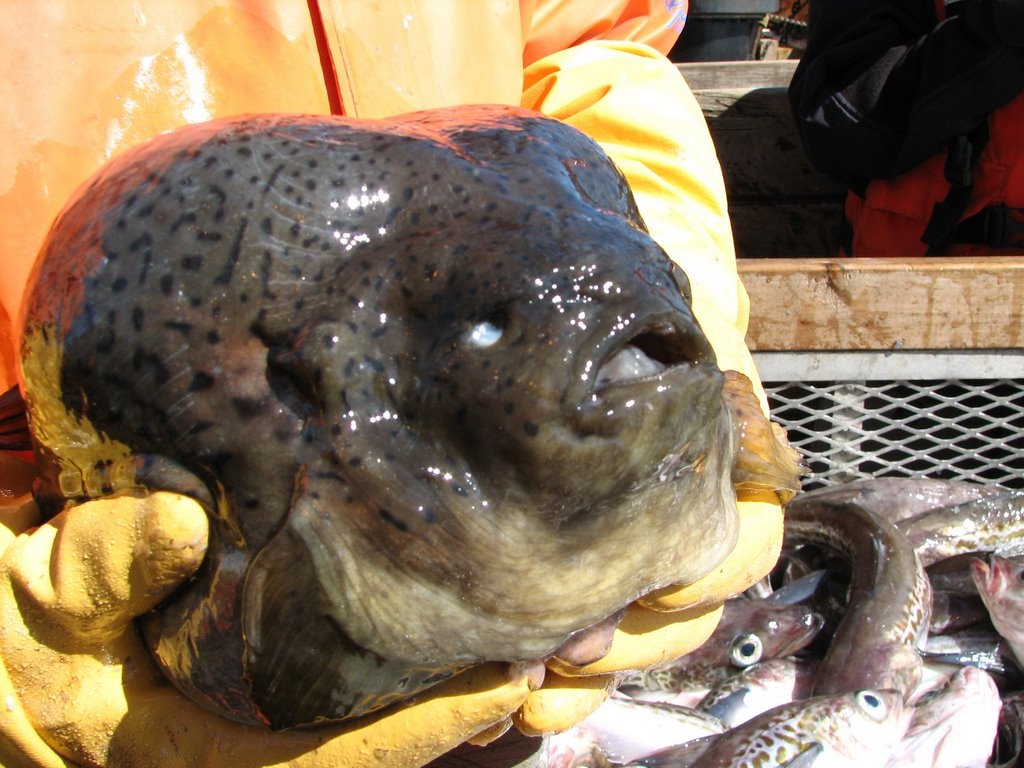
Smooth Lumpsucker fish.

Weather Data from the Bridge

Visibility: 14 miles
Wind Speed: 25 miles per hour
Sea Wave Height 7: feet
Water Temperature: 44.06 degrees
Air Temperature: 44.96 degrees
Pressure: 1009 Millibars

Personal Log

NOTE: We will arrive in the port of Dutch Harbor, Alaska on June 20. As the project draws to a close, I would like to evaluate how effective it was. There is a link to an electronic survey. I would like to ask students, teachers, parents, and other visitors to the site to take a few moments to let me know what you think of this idea. The survey is all electronic and only takes a minute or two to complete. Thank you in advance for your time. Click here to access the survey.

Well, we had pea soup for lunch today, also called storm soup by sailors. Legend is that when you serve pea soup, the weather will turn stormy, and sure enough, a gale is blowing nearby and the waves are picking up. The soup was great, though. As the ship rocks and rolls to the rhythm of the waves, lets take a closer look at how it moves. Sailors have lots of different terms for ships movement:

Pitch – refers to the up and down movement of the front, and back, or bow and stern of the ship

Yaw — when the ship spins from side to side.

Heave — When the entire ship moves up and down.

Roll — When the ship rocks from side to side.

Surge – When the ship jumps forward or backward.

Sway – When the ship jumps sideways.

Happy Father’s Day to all. A special hello to my own father, Elias, and my two son’s Nicky and Simon. I miss you, guys.

Science Log

Our trawl nets picked up the smooth lumpsucker fish near the bottom last night. This fish tends to say near the bottom and can inflate itself with water as a defense against predators. A good defense, I would say. Would you want to eat it?

Our survey continues. We brought in two hauls of fish this morning. Tamara is having less time on the bridge looking for birds in the last day or so. Her time is limited because we are fishing more and a large group of birds following a fishing net is not considered a natural occurrence, so she does not count them in her study. If the waves are too high, she cannot see the small birds in the troughs of the waves, so she can’t count during heavy seas, and right now, the seas are fairly heavy.

Question of the Day:

Look at the movements of the ship described above. When the ship drives into the wind and waves, sailors call it a corkscrew motion. Can you think why?

Answer to Yesterday’s Question

It is about 8:00 AM on Saturday morning. If the ship uses 2100 gallons of fuel a day, how many gallons of fuel will we need to get to Dutch Harbor on Tuesday Morning at about 8:00 AM?

It will take 3 days to reach Dutch Harbor. Since the ship uses 2100 gallons of fuel a day, we have to multiply 2100 x 3 which equals 6300 gallons of fuel. Enough for my car to drive 157500 miles. Wow.

Answers to Your Questions

Hello to James H from yesterday.

Thanks for writing