NOAA Teacher at Sea Kathleen Harrison Aboard NOAA Ship Oscar Dyson July 4 — 22, 2011
Location: Gulf of Alaska Mission: Walleye Pollock Survey
Date: July 4, 2011
Weather Data from the Bridge
Barometric Pressure: 1018.32 mb
Air Temperature: 8.77 ° C
Sea Temperature: 9.31 ° C
True Wind Direction: 218.63 °
True Wind Speed: 16.94 knots
Latitude: 55.12° N, Longitude: 157.31° W
Ship’s speed: 12.5 knots
Personal Log
Kodiak has the second largest fishing fleet in the U.S. This photo shows some of the various kinds of fishing boats that are docked in Kodiak.This is the survival suit, equipped with strobe light, inflatable, and leash. It is affectionately called "Gumby Suit". Isn't it adorable?
July 5, 2011: I might not have seen fireworks yesterday, but it was still a pretty exciting day, with the departure of the Oscar Dyson from the pier. I stood outside on the forward deck, and enjoyed the view as we pulled away from Kodiak. We have been cruising at a steady 12.5 knots (13.5 mph), heading toward the start point of Leg II of the Walleye Pollock Survey. Our charted course will take us from an area that is southwest of Kodiak Island, up past the east side of the island, and around to the west side of the island, ending back in the port of Kodiak. I will start working tomorrow morning – 4 am! Scientific information will probably be included in the next log entry. Kodiak is a scenic fishing town, on the edge of the island. In the picture above is one of the marinas.
Right before we left Kodiak, the ship ran 2 drills. We had to carry our survival suit to our muster station, and learn about abandoning ship, and fire drill procedures. I hope I never have to wear this suit for real, as I was quite claustrophobic putting it on. I know I would be thankful for it, if the need for wearing it ever came about.
I spent some time on the bridge, learning about radar, navigation, and sea birds. I even saw a whale spout!
NOAA TEACHER AT SEA CATHRINE PRENOT FOX ONBOARD NOAA SHIP OSCAR DYSON JULY 24 – AUGUST 14, 2011
Personal Log
As my date of departure nears, I have been having a lot of conversations about what the National Oceanic and Atmospheric Administration (NOAA) is, what I will be doing in Alaska, and what a Teacher at Sea does. The best way to answer your questions is through another cartoon.
Adventures in a Blue World, Issue 2
The official title of my mission is “NOAA’s Alaska Fisheries Science Center for their Walleye Pollock Survey aboard NOAA Ship Oscar Dyson.” (Say that ten times fast.) The Teacher at Sea goals also align with some of NOAA’s Enterprise Objectives: 1) An engaged and educated public with an improved capacity to make scientifically informed environmental decisions; and 2) Diverse and constantly evolving capabilities in NOAA’s workforce.
To read more about NOAA, check out their website: http://www.noaa.gov/ A peruse through just the headlines will teach you about ‘elusive basking sharks,’ why evenings are getting warmer, what to expect for solar flares in 2013 (a lot!) and how NOAA satellites are tracking wildfires across the west. Pretty interesting.
In the meantime, I am packing up for the trip of a lifetime: warm layers, my trusty binocs, and, of course, some anti-seasickness precautions, which I’ll be discussing in my next cartoon.
NOAA Teacher at Sea: Tammy Orilio NOAA Ship Oscar Dyson Mission: Pollock Survey Geographical Area of Cruise: Gulf of Alaska Date: 2 July 2011
Personal Log:
We arrived back at the City Dock in Kodiak early Wednesday morning, so I had all day Wednesday and most of Thursday to explore the area. One of the science team and I set off around noon on Wednesday to check out the town, and boy, did it feel good to finally be off the ship!! 18 days is a long time to be confined to one space! The area where the Oscar Dyson is docked is an “industrial” area, with lots of fish processing plants and canneries, and you could definitely tell even if you weren’t looking- the smell was that strong! Once we got past the industrial area, we were in the main part of the town of Kodiak- lots of little shops catering to fishermen, some restaurants, lots of bars, and a few little gift shops. We first went to a grocery store because we wanted to buy some candy (one thing we didn’t have on the ship!) and as soon as I got inside the store, I started feeling some “dock rock.” It didn’t last very long though, thank goodness!! We walked around a little more, then stopped in to the Kodiak Visitors Center, where they’ve got displays about all of Kodiak’s wildlife. A few of us went out to lunch for sushi later that day- you could definitely tell the salmon was fresh!! Later on, we went to a Mexican place for dinner, and I gotta say, Mexican is not very good up in Kodiak!
Big bear chase me! (Who knows the movie?)Mrs. Pearce used to work here!The marina.
On Thursday, Jason (the other TAS), Rick (one of the scientists) and I went to a place called Fort Abercrombie to do some hiking before we left later that evening. It’s got campsites, hiking trails, and remnants of World War II stuff there. I’d love to go back and camp there sometime!
Jason & Rick on some of the artillery.What an amazing view.It kind of looks like a monster with a big mouth.Clouds over the mountain.Lake Gertrude in the foreground.Little waterfall.
Jason and I were on the same flight out of Kodiak on Thursday evening, and we both also had a long (about 3 hour) layover in Anchorage, so we ate one last good Alaskan seafood dinner at the airport, and looked at some of the Native Alaskan art they had there. I left Anchorage around 9 p.m., and was unfortunately stuck in the middle seat for the LONG nearly 7-hour flight to Houston. Since I was stuck in the middle seat (and the guy next to me kept spreading his legs into MY space, grrrr) I didn’t sleep much on the flight. As soon as I landed in Houston (about 30 minutes later than scheduled), I had to get right on my last plane to Fort Lauderdale. I was back in the warm South Florida climate around 11 am Friday, and totally wiped out from traveling! Here are some of the last pics from my trip.
The Kodiak Airport. That’s all of it!You can see the Oscar Dyson- it’s the second ship from the left.The town of Kodiak.
NOAA TEACHER AT SEA JASON MOELLER ONBOARD OSCAR DYSON JUNE 11-JUNE 30
NOAA Teacher at Sea: Jason Moeller
Ship: Oscar Dyson
Mission: Walleye Pollock Survey
Geographic Location: Kodiak Harbor
Date: June 29-30
Ship Data
Latitude: 57.78 N
Longitude: -152.42 W
Wind: 4.9 knots
Surface Water Temperature: 8.5 degrees C
Air Temperature: 9.1 degrees C
Relative Humidity: 69%
Depth: 18.99
Personal Log
For the last time, welcome aboard!
We are now back in Kodiak, and I fly out on Thursday, June 30th. We got in late on the 28th, and so that gave us some time to explore! Once again, it was back to the trail to try and look for some bears!
We had a nice start when this bald eagle flew right above our heads and landed on a light!Another photo of the eagle.
On June 29th, after stopping for some Mexican food, Paul, Jake, Jodi and I hopped in a car and drove out to Anton Larsen Bay in hopes of some great photo opportunities and wildlife. Below are some of the best photographs that I took of the trip.
The first place we stopped the car had this beautiful view of rolling hills and mountains in the background.The road we took to get here. In the middle of the image is a lake, and if you look hard enough we could see all the way to the ocean.Jodi has fun demonstrating a yoga pose!Our next stop was to explore the actual bay. This mountain overlooked the spot where the water ended and land began.An empty boat was randomly just drifting in the bay. It made for a nice photo though.After looking at the bay, we began to explore a trail that led into the woods. There was supposed to be a waterfall at the end of the trail, but the trail just ended with no falls in sight. Oh well! This stream ran alongside of the trail the entire way.Another photo of the stream.It was nice and sunny yesterday, making it the first time I had seen sun in Kodiak! It made for some picturesque moments while walking through the woods.In the end, once again, I didn't see a bear. However, as we were driving back, we did see this fox catch a mouse!
Science and Technology Log
As the survey is now over, there is no science and technology log.
Species Seen
Gulls
Arctic Tern
Bald Eagle
Red Fox
Mouse
Reader Question(s) of the Day!
There are no questions of the day for this last log. However, I would like to extend some thank yous!
First, I would like to thank the NOAA organization for allowing me the wonderful opportunity to travel aboard the Oscar Dyson for the past three weeks. I learned an incredible amount, and will be able to bring that back to my students. I had a great time!
Second, I would like to thank the crew of the ship for letting me come onboard and participate in the survey. Thanks for answering all of my questions, no matter how naive and silly, teaching me about how research aboard this vessel really works, editing these blogs, and for giving me the experience of a lifetime.
Third, I would like to thank Tammy, the other NOAA Teacher at Sea, for all of the help and effort that she put into working with me on the science and technology section of the blog. Tammy, I could not have done it without you!
Next, a huge thank you to the staff of Knoxville Zoo for their support of the trip and granting me the time off! A special thanks especially needs to go to Tina Rolen, who helped edit the blogs and worked with the media while I was at sea. She helped keep me from making a complete fool of myself to the press. Another special thanks goes out to Dr. John, who loaned me the computer that I used to post the first several logs.
Thanks also go out to Olivia, my wonderful and beautiful wife, for supplying the camera that I used for the first half of the trip.
Finally, I would like to thank everyone who read the log and sent comments! I received many positive comments on the photography in this blog, although I must confess that I laughed a bit at those. Paul, our chief scientist, is the expert photographer on board, and his photos expose me for the amateur that I actually am. I would like to end this blog by posting some of the incredible images he gave me at the end of the trip.
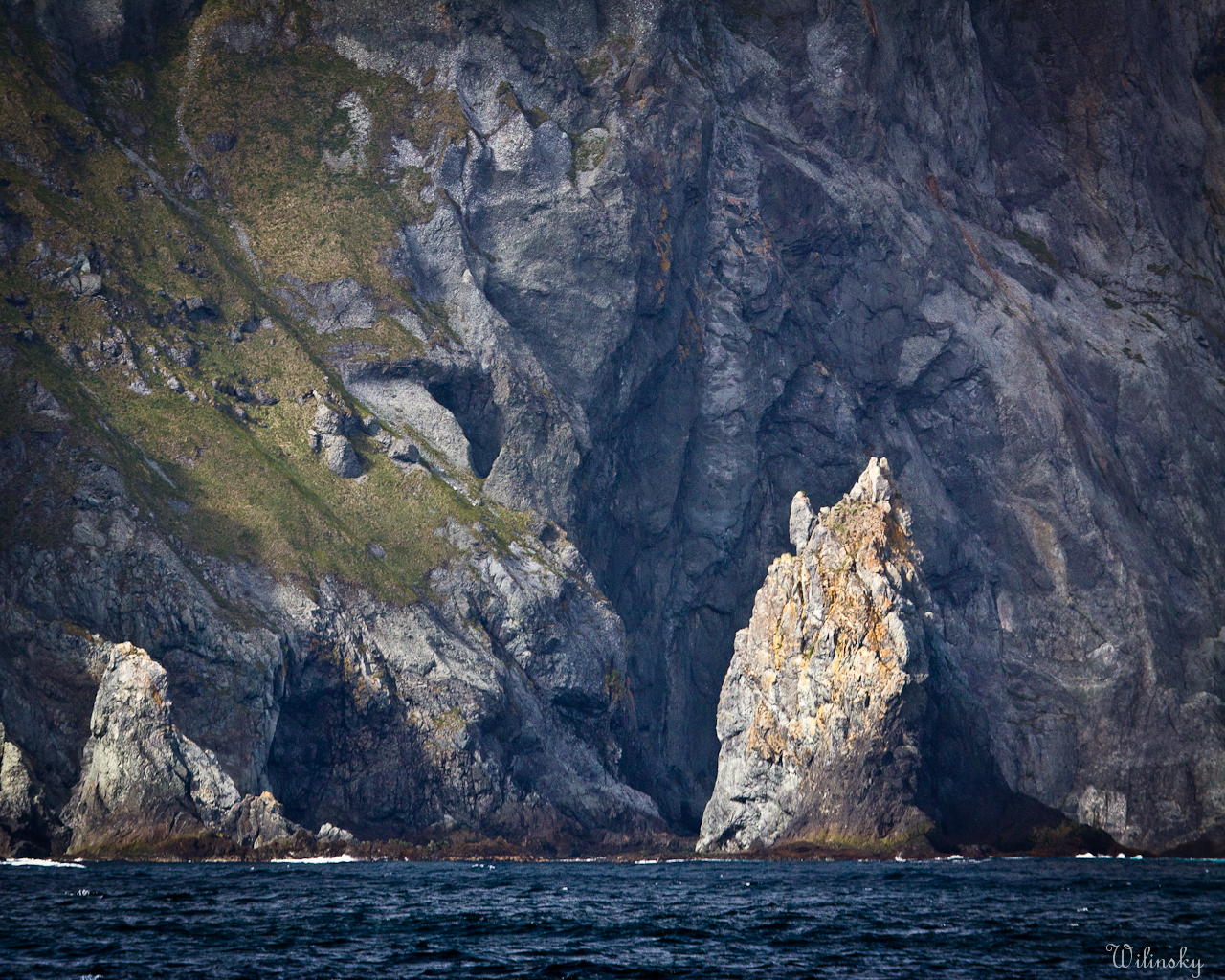
Cliffs rise sharply out of the ocean in the Gulf of AlaskaA waterfall plummets into the Gulf of AlaskaClouds cover the top of an island.
Fog rolls down the cliffs toward the ocean.
The Twin Pillars
A closeup of the cliffs that make up the Alaskan shoreline.
Since we saw so much of it, it seems appropriate to end this blog with a photo of fog over the Gulf of Alaska. Bye everyone, and thanks again!
NOAA TEACHER AT SEA JASON MOELLER ONBOARD NOAA SHIP OSCAR DYSON JUNE 11 – JUNE 30, 2011
NOAA Teacher at Sea: Jason Moeller Ship: Oscar Dyson Mission: Walleye Pollock Survey Geographic Location: Gulf of Alaska Date: June 11, 2011
Personal Log
Welcome back, explorers!
Kodiak, Alaska
Today was my official first day in Kodiak Alaska! Kodiak is a small city on Kodiak Island, which lies off the southern coast of Alaska. The city had a population of 6,653 people in 2009, and is likely growing due to its unique population of animals, including salmon, Kodiak bears, and bald eagles. The city’s main livelihood comes from the ocean, where halibut, pollock, several species of salmon, scallops, and crabs are pulled from the waters surrounding the island. A second source of income comes from tourism.
I woke up today to find the city covered in mist with rain steadily falling. This was bad news for several of our scientists and Tammy, the other teacher at sea on our trip, as they were unable to fly in from Anchorage due to the weather.
Jason's Stateroom on the Oscar Dyson
The weather, however, did not stop me from having an active day in the city. The first thing that I did was move onto the ship into my stateroom, where I will be sleeping during the research expedition. I was surprised at the size, as the room was larger than several college dorm rooms that I had seen.
Once I was moved in, I began to explore the ship. While I have not been given an official guided tour as of yet (that will happen when Tammy arrives), I was able to move around and find some of the rooms that I will be in frequently during the trip.
This is the sound/acoustic room, where we will look for the fish using sonar!This is the command deck of the Oscar Dyson. If I ask nicely, will they let me drive?The all important mess hall!Fred Zharoff Memorial Bridge
In talking with several individuals onboard, I found out that some of the best hiking in the area was within walking distance of the Oscar Dyson. Even better, hikers in this area occasionally saw bears. As I still wanted to see a bear in the wild, I immediately left for the bridge that would take me to another island right off the coast of Kodiak Island. I passed through town on the way.
After walking through town, I reached this bridge and crossed it.
This is the island that I was headed to.
After crossing the bridge, I came across the following park which had some stunning nature trails. I am going to let my photographs do the talking for this next part of the blog, as words do not do justice for the beauty of this place.
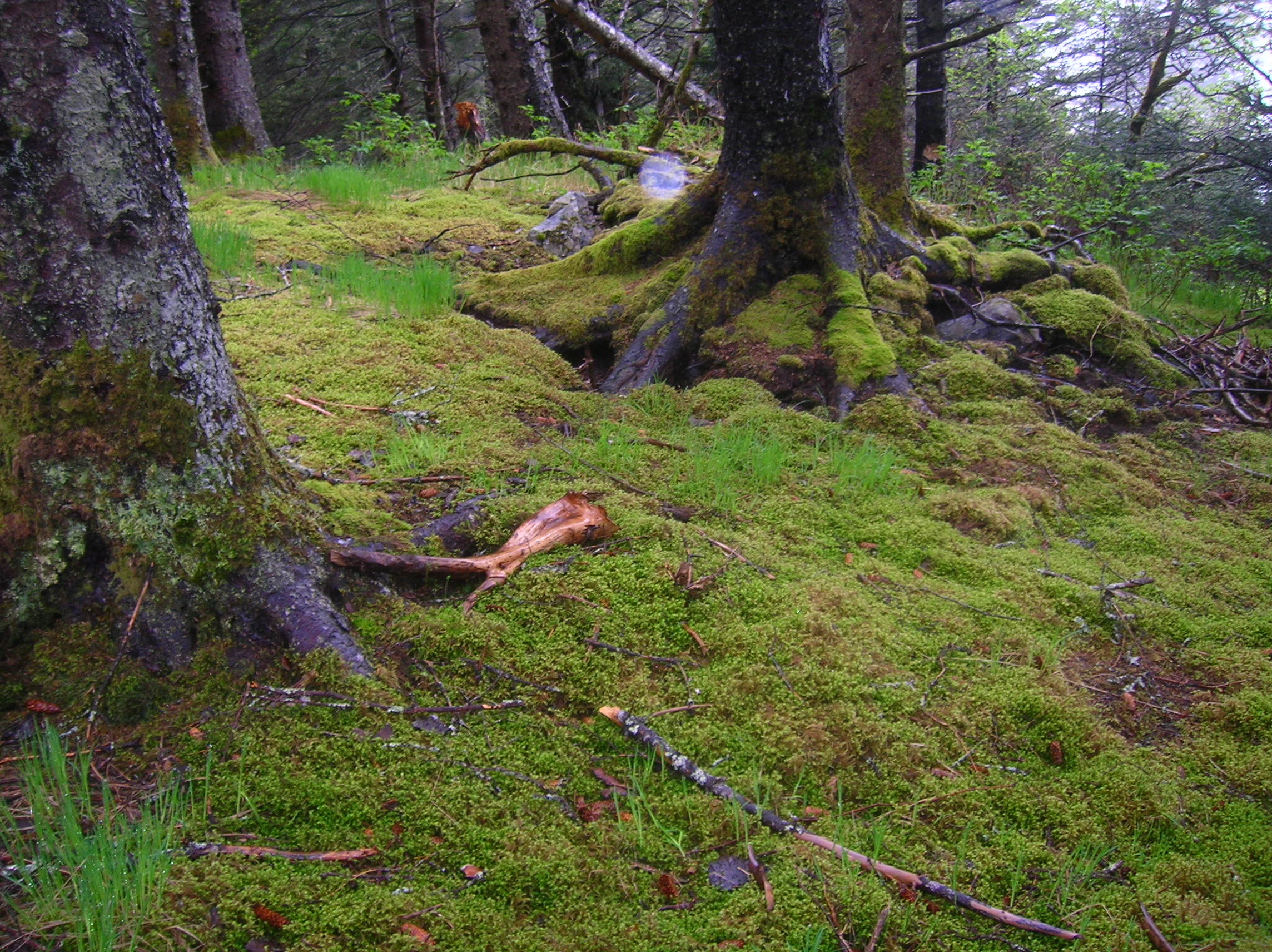
There were many of these thick bodied pines in the park.This image, as well as the next, shows the abundant moss in the woods. It carpeted the forest floor completely!
A nice view of the ocean from the trail.Another beautiful view of the ocean from the trail.Many of the low-lying bushes also had moss and lichens on them.One of the most common trees was the Pacific Red Elderberry. Elderberries are often used for making wines, and occasionally as the punchline in a joke.A few Elderberry trees!
Surprisingly, I did not see a great deal of wildlife, only seeing songbirds. I still have time to see a bear, but I did not spot one today and did not see any bear tracks. Deer tracks were in abundance but I did not see any deer on the pathways.
All in all, I was out hiking on the trails for over three hours, and was soaking wet when I got back.
After the hike and a change of clothes (it rained the entire time), I went out to dinner with a few of the ship’s engineers to a sushi/seafood restaurant. The salmon just melted in my mouth, I have never had salmon that fresh. I also had the opportunity to taste Alaskan king crab, and wish that I hadn’t. I am now addicted, and it is expensive at $47.00 a pound being the market price!
Science and Technology Log
The science and technology section of this blog will begin after the survey of the Walleye Pollock has been started.
Species Seen
Arctic Tern
Pacific Red Elderberry
Reader Question(s) of the Day!
The reader question(s) of the day will start after the survey of the walleye pollock begins. I will answer at least one question during each log, and hopefully will be answering more than one. Please submit your questions to me at jmoeller@knoxville-zoo.org.