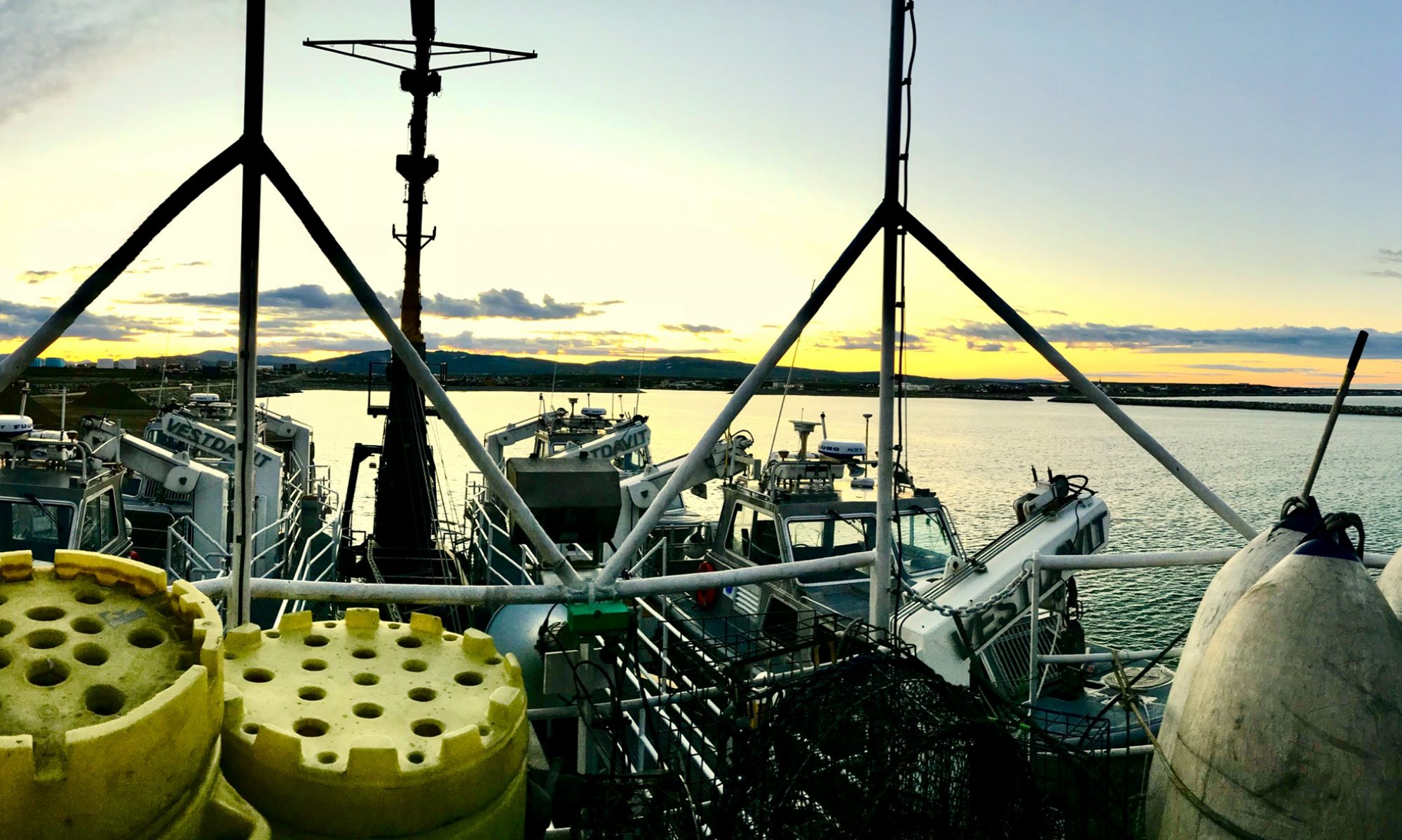
Staci DeSchryver: Things We Deliberately Throw Overboard Part Deux: The Ocean Noise Sensor July 20, 2017

NOAA Teacher At Sea

Staci DeSchryver

Aboard Oscar Elton Sette

July 6 – Aug 2

Mission:  HICEAS Cetacean Study

Geographic Area:  Northwest Hawaiian Island Chain, Just past Mokumanamana (Necker Island)

Date:  July 20, 2017

Weather Data from the Bridge:

Science and Technology Log:

As promised in Blog Post #3, I mentioned that “Thing number four we deliberately throw overboard” would have a dedicated blog post because it was so involved.  Well, grab some popcorn, because the time has arrived!

Thing number 4 we deliberately throw over the side of a ship does not get thrown overboard very often, but when it does, it causes much hubbub and hullaballoo on the ship.  I had the unique opportunity to witness one of only ten ocean noise sensors that are deployed in US waters come aboard the ship and get redeployed.  These sensors are found all over US waters – from Alaska to the Atlantic.  One is located in the Catalina Marine Sanctuary, and still others are hanging out in the Gulf of Mexico, and we are going to be sailing right past one!  To see more about the Ocean Noise Sensors, visit the HICEAS website “other projects” tab, or just click here.  To see where the Ocean Noise Recorders are, click here.

The Ocean Noise Sensor system is a group of 10 microphones placed in the “SOFAR” channel all over US waters.  Once deployed, they collect data for two years in order to track the level of ocean noise over time.  It’s no secret that our oceans are getting louder.  Shipping routes, oil and gas exploration, and even natural sources of noise like earthquakes all contribute to the underwater noise that our cetacean friends must chatter through.  Imagine sitting at far ends of the table at a dinner party with a friend you have not caught up with in a while.  While other guests chat away, you and the friend must raise your voices slightly to remain in contact.  As the night progresses on, plates start clanging, glasses are clinking, servers are asking questions, and music is playing in the background.  The frustration of trying to communicate over the din is tolerable, but not insurmountable.  Now imagine the host turning on the Super Bowl at full volume for entertainment.  Now the noise in the room is incorrigible, and you and your friend have lost all hope of even hearing a simple greeting, let alone have a conversation.  In fact, you can hardly get anyone’s attention to get them to pass you the potatoes.  This is similar to the noise levels in our world’s ocean.  As time goes on, more noise is being added to the system.  This could potentially interfere with multiple species and their communications abilities.  Calling out to find a mate, forage for food, or simply find a group to associate with must now be done in the equivalent din of a ticker-tape parade, complete with bands, floats, and fire engines blaring their horns.  This is what the Ocean Noise Sensor is hoping to get a handle on.   By placing sensors in the ocean to passively collect ambient noise, we can answer two important questions:  How have the noise levels changed over time?  To what extent are these changes in noise levels impacting marine life?   

Many smaller isolated studies have been done on ocean noise levels in the past, but a few years ago, scientists from Cornell partnered with NOAA and the Pacific Islands Fisheries Science Center (PIFSC) and the Pacific Marine Environmental Lab to streamline this study in order to get a unified, global data source of ocean noise levels.  The Pacific Marine Environmental Lab built a unified sound recording system for all groups involved in the study, and undertook the deployments of the hydrophones.  They also took on the task of processing the data once it is recovered.  The HICEAS team is in a timely and geographical position to assist in recovery of the data box and redeploying the hydrophone.   This was how we spent the day.

The recovery and re-deployment of the buoy started just before dawn, and ended just before dinner.

 Our standard effort of marine mammal observation was put on hold so that we could recover and re-deploy the hydrophone.  It was an exciting day for a few reasons – one, it was definitely a novel way to spend the day.  There was much to do on the part of the crew, and much to watch on the part of those who didn’t have the know-how to assist.  (This was the category I fell in to.)

At dawn, an underwater acoustic command was sent to the depths to release a buoy held underwater attached to the hydrophone.  While the hydrophone is only 1000m below the surface seated nice and squarely in the SOFAR channel, the entire system is anchored to the ocean floor at a depth of 4000m.  Once the buoy was released, crew members stationed themselves around the ship on the Big Eyes and with binoculars to watch for the buoy to surface.  It took approximately 45 minutes before the buoy was spotted just off our port side.  The sighting award goes to CDR Stephanie Koes, our fearless CO.  A crewmember pointed out the advancement in our technologies in the following way:  “We can use GPS to find a buried hydrophone in the middle of the ocean…and then send a signal…down 4000m…to a buoy anchored to the ocean floor…cut the buoy loose remotely, and then actually have the buoy come up to the surface near enough to the ship where we can find it.”  Pretty impressive if you think about it.

The buoy was tied to the line that is attached to the hydrophone, so once the buoy surfaced, “all” we had to do was send a fast rescue boat out to retrieve it, bring the buoy and line back to the ship, bring the crew safely back aboard the ship, hook the line up through a pulley overhead and back to a deck wench, pull the line through, take off the hydrophone, pull the rest of the line up, unspool the line on the wench to re-set the line, re-spool the winch, and then reverse the whole process.

Watching the crew work on this process was impressive at least, and a fully orchestrated symphony at best.  There were many tyings of knots and transfers of lines, and all crew members worked like the well-seasoned deck crew that they are.  Chief Bos’n Chris Kaanaana is no stranger to hauling in and maintaining buoys, so his deck crew were well prepared to take on this monumental task.

Much of the day went exactly according to plan.  The buoy was safely retrieved, the hydrophone brought on board, the lines pulled in, re-spooled, and all sent back out again.  But I am here to tell you that 4000m of line to haul in and pay back out takes. A Long. Time.  We worked through a rainstorm spooling the line off the winch to reset it, through the glare of the tropical sun and the gentle and steadfast breeze of the trade winds.  By dinner time, all was back in place, the buoy safely submerged deep in the ocean waters, waiting to be released again in another two years to repeat the process all over again.  With any luck, the noise levels in the ocean will have improved.  Many commercial vessels have committed to adopting “quiet ship” technology to assist in the reduction of noise levels.  If this continues to improve, our cetacean friends just might be able to hear one another again at dinner.


Personal Log

So, I guess it’s pretty fair to say that once you’re a teacher, you’re always a teacher.  I could not fully escape my August to May duties onboard, despite my best efforts.  This week, I found myself on the bridge, doing a science experiment with the Wardroom (These are what all of the officers onboard as a group are called).   How is this even happening, you ask?  (Trust me, I asked myself the same thing when I was in the middle of it, running around to different “lab groups” just like in class.)  Our CO, CDR Koes, is committed to ensuring that her crew is always learning on the ship.

 If her staff do not know the answer to a question, she will guide them through the process of seeking out the correct answer so that all  officers learn as much as they can when it comes to being underway –  steering the ship, preparing for emergencies, and working with engineers, scientists, and crew.  For example, I found out that while I was off “small-boating” near Pilot Whales, the Wardroom was busy working on maneuvering the ship in practice of man overboard scenarios.  She is committed to ensuring that all of her staff knows all parts of this moving city, or at a minimum know how to find the answers to any questions they may have.  It’s become clear just how much the crew and the entire ship have a deep respect and admiration for CDR Koes.  I knew she was going to be great when we were at training and word got out that she would be the CO of this Leg on Sette and everyone had a range of positive emotions from elated to relieved to ecstatic.

As part of this training, she gives regular “quizzes” to her staff each day – many of them in good fun with questions for scientists, crew, engineers, and I.  Some questions are nautical “things” that the Wardroom should know or are nice to know (for example, knowing the locations of Material Safety Data Sheets or calculating dew point temperatures), some questions are about the scientific work done onboard, while others are questions about personal lives of onboard members.

docandbromineDES_4437.JPG
The Chief Medical Officer, “Doc” gives a lesson on water quality testing.

 It has been a lot of fun watching the Wardroom and Crew seek out others and ask them where they live while showing them their “whale dance” to encourage sightings.  It has exponentially increased the interactions between everyone onboard in a positive and productive way.

The other teaching element that CDR Koes has implemented is a daily lesson each day from Monday to Friday just after lunch.  All NOAA Officers meet on the bridge, while one officer takes the lead to teach a quick, fifteen minute lesson on any topic of their choosing.  It could be to refresh scientific knowledge, general ship operations, nautical concepts, or anything else that would be considered “good to know.”

chiefengineerDES_4589.JPG
The Chief Engineer gives a rundown on the various ship emergency alarms.

 This sharing of knowledge builds trust among the Wardroom because it honors each officer’s strong suits and reminds us that we all have something to contribute while onboard.

I started attending these lunchtime sessions and volunteered to take on a lesson.  So, this past Tuesday, I rounded up some supplies and did what I know best – we all participated in the Cloud in a Bottle Lesson!

sextantDES_4607.JPG
Here I am learning to use a sextant for navigation.

The Wardroom had fun (I think?) making bottle clouds, talking about the three conditions for cloud formation, and refreshing their memories on adiabatic heating and cooling.  It was a little nerve wracking for me as a teacher because two of the officers are meteorologists by trade, but I think I passed the bar.  (I hope I did!)

groupworkbottlesDES_4329.JPG
Teaching about adiabatic cooling with the the Cloud in a Bottle Demo with the Wardroom!

It was fun to slide back into the role of teacher, if only for a brief while, and served as a reminder that I’m on my way back to work in a few weeks!  Thanks to the Wardroom  for calling on me to dust up my teacher skills for the upcoming first weeks of school!

JoshandTimDES_4325.JPG
ENS Holland and ENS Frederick working hard making clouds.


crew with bottlesDES_4340.JPG

Facebook Asks, DeSchryver Answers

I polled all of my Facebook friends, fishing (ha ha, see what I did there?) for questions about the ship, and here are some of the questions and my answers!


Q:   LC asks, “What has been your most exciting moment on the ship?”

It’s hard to pick just one, so I’ll tell you the times I was held at a little tear:  a) Any sighting of a new species is a solid winner, especially the rare ones  b) The first time I heard Sperm Whales on the acoustic detector c) The first time we took the small boat out for UAS operations….annnndddd d) The first time I was on Independent Observation and we had a sighting!

DES_3739.JPG
A group of Melon-Headed Whales, or PEPs, cruise along with the ship.

Q:  JK asks, “What are your thoughts on the breakoff of Larsen C?  And have there been any effects from the Alaskan quake and tsunami?”

We’re actually pretty isolated on board!  Limited internet makes it hard to hear of all the current events.  I had only briefly heard about Larsen C, and just that it broke, not anything else.  I had no clue there was a quake and tsunami!  But!  I will tell a cool sort of related story.  On Ford Island, right where Sette is docked, the parking lot is holding three pretty banged up boats.  If you look closely, they all have Japanese markings on them.  Turns out they washed up on Oahu after the Japan Tsunami.  They tracked down the owners, and they came out to confirm those boats were theirs, but left them with NOAA as a donation.  So?  There’s tsunami debris on Oahu and I saw it.


Q:  NG asks, “Any aha moments when it comes to being on the ocean?  And anything to bring back to Earth Science class?”

So many aha moments, but one in particular that comes to mind is just how difficult it is to spot cetaceans and how talented the marine mammal observers are! They can quite literally spot animals from miles away!  There are a lot of measures put in place to help the marine mammal observers, but at the end of the day, there are some species that are just tougher than nails to spot, or to spot and keep an eye on since their behaviors are all so different.  And as far as anything to bring back to our class?  Tons.  I got a cool trick to make a range finder using a pencil.  I think we should use it!


Q:  MJB asks, “Have you had some peaceful moments to process and just take it all in?”

Yes.  At night between the sonobuoy launches, I get two miles of transit time out on the back deck to just absorb the day and be thankful for the opportunities.  The area of Hawai’i we are in right now is considered sacred ground, so it’s very powerful to just be here and be here.

DES_3109_resize.JPG
These sunsets will give Colorado sunsets a run for their money.  No green flash in Colorado = point awarded to Hawai’i.


Q:  SC asks, “What souvenir are you bringing me?”

Well, we saw a glass fishing float, and we tried to catch it for you, but it got away.

Q:  LC asks, “What’s the most disgusting ocean creature?”

Boy that’s a loaded question because I guarantee if I name a creature, someone out there studies it for a living.  But! I will tell you the most delicious ocean creature.  That would be Ono.  In sashimi form.  Also, there is a bird called a Great Frigate bird – it feeds via something called Klepto-parasitism, which is exactly how it sounds.  It basically finds other birds, harasses them until they give up whatever they just caught or in some cases until it pukes, and then it steals their food.  So, yeah.  I’d say that’s pretty gross.  But everyone’s gotta eat, right?

Q:  KI asks, “Have you eaten all that ginger?”

I’m about two weeks in and I’m pretty sure I’ve eaten about a pound. I’m still working on it!

Q:  HC asks, ”Have you seen or heard any species outside of their normal ocean territory?”

Sort of.  Yesterday we saw Orca!  They are tropical Orca, so they are found in this area, but they aren’t very common.  The scientific team was thinking we’d maybe see one or two out of the entire seven legs of the trip, and we saw some yesterday!  (I can’t say how many, and you’ll find out why in an upcoming post.)  We have also seen a little bird that wasn’t really technically out of his territory, but the poor fella sure was a little far from home.

Q:  JPK asks, “What kinds of data have you accumulated to use in a cross-curricular experience for math?”

We can do abundance estimates with a reasonably simplified equation.  It’s pretty neat how we can take everything that we see from this study, and use those numbers to extrapolate how many of each species is estimated to be “out there.”

Q: AP asks, “What has surprised you about this trip?”

Many, many things, but I’ll mention a couple fun ones.  The ship has an enormous movie collection – even of movies that aren’t out on DVD yet because they get them ahead of time!  Also? The food on the ship is amazing.  We’re halfway through the trip and the lettuce is still green.  I have to find out the chef’s secret!  And the desserts are to die for.  It’s a wonder I haven’t put on twenty pounds.  The crew does a lot of little things to celebrate and keep morale up, like birthday parties, and music at dinner, and shave ice once a week.  Lots of people take turns barbecuing and cooking traditional foods and desserts special to them from home and they share with everyone.  They are always in really high spirits and don’t let morale drop to begin with, so it’s always fun.

DES_4454.JPG
Celebrating Engineer Jerry’s Birthday.

Q:  TS asks, “What’s the most exciting thing you’ve done?”

I’ve done lots of exciting things, but the one thing that comes to mind is launching on the small boat to go take photos of the pilot whales.  Such a cool experience, and I hope we get good enough weather to do it again while we’re out here!  Everything about ship life is brand new to me, so I like to help out as much as I can.  Any time someone says, “Will you help with this?” I get excited, because I  know I’m about to learn something new and also lend a hand. 


Staci DeSchryver: Exploring HICEAS on the High Seas! June 20, 2017

NOAA Teacher at Sea

Staci DeSchryver

Aboard NOAA Ship Oscar Elton Sette

July 6 – August 2, 2017

Mission:  Cetacean Study

Geographic Area of Cruise:  Hawaiian EEZ

Current Location:  Impatiently waiting to sail in Centennial, Colorado

Date:  June 20

Weather Data from the “Bridge” (AKA My Sun Porch):

wxdata_0620
Here’s the weather data from the “Bridge” in Centennial. (In Station Model format, of course. How else would we practice?)


Personal Log – An Introduction

Hello!  My name is Staci DeSchryver and I will be traveling this upcoming July on the Oscar Elton Sette as part of the HICEAS program!

I am an Oceanography, Meteorology, and Earth Science teacher at Cherokee Trail High School in Aurora, CO.  This August will kick off my 14th (yikes!) year teaching.  I know you might be thinking, “Why Oceanography in a landlocked state?”  Well, the reason why I can and do teach Oceanography is because of Teacher At Sea.  I am an alumna, so this is my second official voyage through the Teacher At Sea program.  It was all of the wonderful people I met, lessons I learned, and science that I participated in on the


DeSchryverIntroPic
This is my husband, Stephen, and I, at the game that sent the Broncos to the Superbowl!


Oscar Dyson in 2011 that led me to encourage my school to put an Oceanography course in place for seniors as a capstone course.  This past year was the first year for the Oceanography and Meteorology courses, and they were very well received!  I have three sections of each class next year, as well!  (Shout out to all my recent senior grads reading this post! You were awesome!)  We study our World’s Ocean from the top of the water column all the way to the deepest parts of the Marianas Trench, and from the tiniest atom all the way up to the largest whale.  I  believe it is one of the most comprehensive courses offered to our students – incorporating geology, chemistry, physics, and biology, but then again, I’m a bit biased.

Apart from being a teacher, I am a wife to my husband of 8 years, Stephen.  We don’t have children, but we do have two hedgehogs, Tank and Willa, who keep us reasonably busy.  Willa only has one eye, and Tank is named Tank because he’s abnormally large for a hedgie.  They are the best lil’ hedgies we know.  We enjoy camping, rock climbing, and hiking – the typical Coloradans, though we are both originally from Michigan.  When we aren’t spending time together, I like to dance ballet, read, write, and I recently picked up a new weightlifting habit, which has led me to an entire new lifestyle of health and wellness with an occasional interjection of things like Ice Cream topped with caramel and Nachos when in the “off” season (hey, nobody’s perfect).

I will be leaving for Honolulu, Hawaii on July 4th to meet up with the fine scientists that make up the HICEAS team.  What is HICEAS?  Read below to find out more about HICEAS and the research we will be doing onboard!

Science Log

The HICEAS (Hawaiian Islands Cetacean and Ecosystem Assessment Survey) is a study of Cetaceans (Whales, Dolphins, and Porpoises) and their habitats.  Cetaceans live in the ocean, and are characterized by being carnivorous (we will get along just fine at the dinner table) and having fins (since I am a poor swimmer, I will humbly yield to what I can only assume is their instinctive expertise).  This means that the study will cover all manners of these majestic creatures – from whales that are definitely easily identifiable as whales to whales that look like dolphins but are actually whales to porpoises that really look like whales but are actually dolphins and dolphins that look like dolphins that are dolphins and…  are you exhausted yet?  Here’s some good news – porpoises aren’t very common in Hawaiian waters, so that takes some of the stress out of identifying one of those groups, though we will still be on the lookout.  Here’s where it gets tricky – it won’t be enough to just sight a whale, for example and say, “Hey! We have a whale!”  The observers will be identifying the actual species of the whale (or dolphin or possible-porpoise).  The observers who tackle this task are sharp and quick at what is truly a difficult and impressive skill.  I’m sure this will be immediately confirmed when they spot, identify, and carry on before I say, “Wait! Where do you see it?”

hawaiian_archipelago_map_sm
This is the research area for the HICEAS project. Map/photo is credited directly to the HICEAS website, https://www.pifsc.noaa.gov/hiceas/whats_hiceas.php

There are 25 cetacean species native to Hawaiian waters, so that’s a big order to fill for the observers.  And we will be out on the water until we locate every last one.  Just kidding.  But we will be looking to spot all of these species, and once found, we will do our best to estimate how many there are overall as a stock estimate.  Ideally, these cetacean species will be classified into three categories – delphinids (dolphins and a few dolphin-like whales), deep diving whales (whales with teeth), and baleen whales (of the “swim away!” variety).  Once identified in this broad sense, they will then be identified by species.  However, I do have a feeling these two categorizations happen all at once.

Once the data is collected, there is an equation that is used to project stock estimates for the whole of the Pacific.  More on this later, but I will just start by saying for all you math folk out there, it’s some seriously sophisticated data extrapolation.  It involves maths that I have yet to master, but I have a month to figure it out, so it’s not looking too bleak for me just yet.  In the meantime, I’m spending my time trying to figure out which cetaceans that look like dolphins are actually possible-porpoises, and which dolphins that look like dolphins are actually whales.

Goals and Objectives of the HICEAS

The HICEAS study operates as a part of the Pacific Islands Fisheries Science Center (PIFSC) and the Southwest Fisheries Science Center (SFSC), both under the NOAA umbrella.  Our chief scientist is Dr. Erin Oleson, who will be the lead on this leg of the cruise. HICEAS last collected data in 2010, and is now ready for the next round of stock assessments.  HICEAS is a 187-day study, of which we will be participating in approximately 30 of those days for this particular leg.  Our research area is 2.5 million square kilometers, and covers the whole of the Hawaiian Archipelago and it’s Exclusive Economic Zone, or EEZ!  The HICEAS study has three primary goals:

  1.  Estimate the number of cetaceans in Hawaii.
  2.  Examine their population structure.
  3.   Understand their habitat.

Studies like the HICEAS are pretty rare (2002, 2010, and now 2017), so the scientists are doing their best to work together to collect as much information as they possibly can during the study.  From what I can gather in lead-up chats with on board scientist Kym Yano, we will be traveling along lines called “transects” in the Pacific Ocean, looking for all the popular Cetacean hangouts.  When a cetacean is sighted, we move toward the lil’ guy (or gal) and all his friends to take an estimate, and if it permits, a biopsy.  There is a second team of scientists working below deck listening for Cetacean gossip (whale calls) as well.  Acoustic scientists will record the whale or dolphin calls for later review and confirmation of identification of species, and, of course, general awesomeness.

But that’s not all!

We will also be dropping CTD’s twice per day, which is pretty standard ocean scientific practice.  Recall that the CTD will give us an idea of temperature, salinity, and pressure variations with depth, alerting us to the presence and locations of any of the “clines” – thermocline, halocline, and pycnocline.  Recall that in areas near the equator, rapid changes of temperature, salinity, and density with depth are pretty common year-round, but at the middle latitudes, these form and dissipate through the course of the solar year. These density changes with depth can block nutrients from moving to the surface, which can act as a cutoff to primary production.  Further, the CTD readings will help the acoustic scientists to do their work, as salinity and temperature variations will change the speed of sound in water.

There will also be a team working to sight sea birds and other marine life that doesn’t fall under the cetacean study (think sea turtles and other fun marine life).  This study is enormous in scope.  And I’m so excited to be a part of it!

Pop Quiz:

What is the difference between a porpoise and a dolphin?  

It has to do with 3 identifiers:  Faces, Fins, and Figures.

According to NOAA’s Ocean Service Website…

Faces:  Dolphins have prominent “beaks” and cone-shaped teeth, while Porpoises have smaller mouths and teeth shaped like spades.

Fins: Dolphin’s dorsal (back) fins are curved, while porpoises fins are more triangle-shaped

Figures: Dolphins are leaner, and porpoises are more “portly.”

Dolphins are far more prevalent, and far more talkative.  But both species are wicked-smart, using sonar to communicate underwater.

Resources:

HICEAS website

Bradford, A. L., Forney, K. A., Oleson, E. M., & Barlow, J. (2017). Abundance estimates of cetaceans from a line-transect survey within the U.S. Hawaiian Islands Exclusive Economic Zone. Fishery Bulletin, 115(2), 129-142. doi:10.7755/fb.115.2.1


Donna Knutson, September 29, 2010

NOAA Teacher at Sea Donna Knutson
NOAA Ship Oscar Elton Sette
September 1 – September 29, 2010

Mission: Hawaiian Islands Cetacean and Ecosystem Assessment Survey
Geograpical Area: Hawaii
Date: September 29, 2010

The last night on the Sette.

Mission and Geographical Area:  

The Oscar Elton Sette is on a mission called HICEAS, which stands for Hawaiian Islands Cetacean and Ecosystem Assessment Survey.  This cruise will try to locate all marine mammals in the Exclusive Economic Zone called the “EEZ” of Hawaiian waters.  The expedition will cover the waters out to 200 nautical miles of the Hawaiian Islands.

Data such as conductivity, temperature, depth, and chlorophyll abundance will be collected and sea bird sightings will also be documented.
Jay the second steward during a drill.
Science and Technology:
Latitude: 19○ 53.8’ N
Longitude: 156○ 20.8’ W  
Clouds:  2/8 Cu, VOG (volcanic ash fog)
Visibility:  10 N.M.
Wind:  8 Knots
Wave height:  2 ft.
Water Temperature:  26.3○ C
Air Temperature:  26.0○ C
Sea Level Pressure:  1015.5 mb
The first leg of the Sette’s HICEAS cruise is almost over.  By tomorrow noon we will come into port at Pearl Harbor.  The mission has been highly successful!  The scientists and birders have had an action filled thirty days.
The HICEAS cruise birders, Dawn Breese and Scott Mills have documented thirty-nine species of seabirds.
 In the “tubenosed” or Procellariformes order, there are the Petrels and Shearwaters.  The Petrels include the Kermadec, Herald, Hawaiian, Juan Fernandez, White-necked, Back-winged, Bonin, Wilson’s Storm, Band-rumped Storm, Cook’s, and Bulwer’s.  The Shearwaters include the Christmas, Wedge-tailed, Buller’s, Sooty, Short-tailed, and Newell’s.
Clementine, the chief steward, in the galley. Her and Jay made a banquet for every meal! I surprised her!

From the order Pelicaniformes the Red-tailed and White-tailed Tropicbird have been recognized and also the Brown, Red-Footed Booby, Masked Booby, and Great Frigatebirds.

Harry, the chief engineer, during a drill.
The shore birds seen so far are the Bristle-thighed Curlew, Pacific Golden-Plover, Red Phalarope, Ruddy Turnstone, Bar-tailed Godwit, Sanderling and Wandering Tattler. Terns include the Brown and Black Noddies, the White, Sooty, and Grey-backed Terns; Jaegers include Pomarine, Parasitic, and Long-tailed plus the South Polar Skua.
The HICEAS mammal observers, Andrea Bendlin, Abby Sloan, Adam U, Allan Ligon, Ernesto Vazquez and Juan Carlos Salinas, have had ninety-seven sightings!  The whales observed have been the sperm whale, Bryde’s whale, and Cuvier’s and Blainville’s beaked whales.
The CO,commanding officer, Anita Lopez.
The dolphins that were documented were the bottlenose dolphin, striped dolphin, Pantropical spotted dolphin, spinner dolphin, Risso’s dolphin, rough-toothed dolphin, killer whale, false killer whale, pygmy killer whale, and pilot whale.
The scientists were able to obtain nearly 50 biopsy samples from live cetaceans, 1 necropsied Kogia, 3 tracking tags, and hundreds of pictures!
Personal Log:
If someone asked me what qualities and or skills are needed to work on a ship, I would use the Sette crew as my model.
You must have dedicated, respected and competent officers.  The engineers need to be resourceful and good problem solvers.  The deck hands must be hard working and possess a good sense of humor.  The doctor should be a model for good physical health and have a inspiring positive attitude.   The stewards need to make creative delicious dishes, and be friendly and caring. The computer technician must be a great troubleshooter in order to work on anything that requires electricity.
Dr. Tran and the XO, executive officer, Stephanie Koes went to Midway with me.
The science crew must be focused, persistent and knowledgeable.  I have observed that scientists, regardless of their role, whether they are mammal observers, accousticians, oceanographers or chief scientists, need to collect data, organize the information into the correct format, and then report it.  All variables need to be accounted for.
 I am very impressed with the kind and helpful crew!  They truly made me feel at home.  That is exactly how it feels like on the Sette – like a home.  They have welcomed me with open arms.
Kinji, the boatswain, cut up the yellow fin tuna into shashimi.
I have learned much, much more than anticipated on this cruise.  I was included in activities in all divisions. I was encouraged to help out the scientists by being an independent mammal observer, run security on the CTD, and help package and label biopsy samples.
In the kitchen I learned how to sanitize the dishes and where to put them away, plus I got some helpful cooking hints to take back home and a lot of good conversation.
I helped the deck crew when working with the CTD and learned how to tie a bowline knot.
I went up to the bridge and helped look –out during an emergency situation, was invited to the officer’s book review, and drove the ship.  Wow! Do I have respect for people who can do that accurately!
 I received a thorough and informative engineering tour, and I am still impressed by all the systems that need to work together to keep the ship (which is like a mini city) afloat.
The “girls” of the science crew displaying their cups before sending them down 3000 ft. with the CTD. They came back up less than half the original size.
I wanted to be involved where ever I went. Learning by observing is great, but I wanted to be an active member of the crew and learn through experience.  It is impossible to write down everything I learned from this experience, but I want to ensure everyone who was over-run with my many questions, that I appreciate all your time and patience with me.
It feels as though I have a whole different world to show my students!  Our Earth really is an amazing place of adventure!  You never know who you will have a chance to meet or what you can learn from them!
Thank you to everyone who shared their life with me.  It allowed me to have a wonderful “soul filling” experience!

Donna Knutson, September 25, 2010

NOAA Teacher at Sea Donna Knutson
NOAA Ship Oscar Elton Sette
September 1 – September 29, 2010

Mission: e Hawaiian Islands Cetacean and Ecosystem Assessment Survey
Geograpical Area: Hawaii
Date: September 25, 2010

Oceanography
Me with the CTD.
Mission and Geographical Area: 
The Oscar Elton Sette is on a mission called HICEAS, which stands for Hawaiian Islands Cetacean and Ecosystem Assessment Survey.  This cruise will try to locate all marine mammals in the Exclusive Economic Zone called the “EEZ” of Hawaiian waters.  The expedition will cover the waters out to 200 nautical miles of the Hawaiian Islands.
Data such as conductivity, temperature, depth, and chlorophyll abundance will be collected and sea bird sightings will also be documented.
Getting the CTD ready for the water.
Science and Technology:
Latitude: 24○ 28.8’ N
Longitude: 165○ 50.5’ W  
Clouds:  3/8 Cu,Ac
Visibility:  10 N.M.
Wind:  12 Knots
 Wave height:  1-2ft.
Water Temperature:  26.6○ C
Air Temperature:  25.2○ C
Sea Level Pressure:  1021.1 mb
Ray uses the crane to lift the CTD into the water.

Oceans cover 71% of the Earth.  They contain 97% of the water on the planet, and amazingly 95% of the world under the ocean is unexplored!

Oceanography or marine science is a branch of earth science that covers many topics.  The studies can include marine organisms, ecosystems, ocean currents, waves, plate tectonics, and changes in the chemistry or physical properties within the ocean.  Physical properties are properties which can be measured from the water such as temperature, salinity, mixing of waves, tides and acoustics.
There are many reasons to study the ocean, but one reason is to understand global changes.   The atmosphere and oceans are linked through processes of evaporation and precipitation.  Weather worldwide is determined by the oceans physical and chemical properties, and its influence on air currents.
The National Oceanic and Atmospheric Administration (NOAA) collects data from oceans throughout the world, evaluates it, then distributes weather forecasts to various weather reporting agencies.  NOAA has the largest archives of oceanographic data in the world, and is using the information in long term monitoring of ocean climates and ocean research.
Corey is processing her chlorophyll.
The Oscar Elton Sette is obtaining such data.  The bridge of the Sette is transmitting data (as seen at the top of this blog) such as latitude, longitude, temperatures, pressure etc. to NOAA recording sites in order to plan weather forecasts.   The scientists are also acquiring data, but this data is more specific to the ocean water’s chemistry. They are measuring temperature, conductivity, salinity, and chlorophyll abundance.
Temperature and salinity differences within the ocean lead to increased circulation.  Water has a similar circulation pattern to air.  They are both fluids and behave accordingly.  When heated, fluids will absorb the heat causing the molecules to move faster.  Now that the molecules are colliding more often, they become farther apart.  The spread out molecules, in air or water, do not have the same density as before.  Because they are less dense, they are pushed up and away from the more dense portion of the fluid.
Corey is dropping in the XBT to measure temperature.

Due to the differences in density, either caused by changes in temperature or salinity, a small current will form.  This circulation causes a turn-over effect, and increases the amount of nutrients in the water. These nutrients will feed the phytoplankton (measured as chlorophyll) and microbes.  These “animals” are on the bottom of the food chain, will become food for larger animals and so on.  Changes in density and salinity are only a small but important means to move nutrients within the water column.

Most of the mixing of water is due to large currents.  The Hawaiian Archipelago, because of its location, does not have a lot of mixing water.  It is in the middle of the North Pacific Gyre.  A gyre is a large system of rotating currents.  The North Pacific Gyre is a system of four ocean currents converging in the same area causing a circular motion.  At the “edges” of the gyre, a lot of mixing is taking place due to the motion of the incoming currents, while at the center of the gyre, there is the least amount of movement and therefore the least mixing up of nutrients.
The North Pacific Gyre is located between the equator and 50 latitude.  It makes up the largest ecosystem on Earth measuring twenty million square kilometers.  If the nutrients are more plentiful at the edges of the gyre, then the ecosystem has an uneven distribution of animal life.
These are used for the bucket sample.

Testing for nutrients is part of the research being done on the Sette.  They are trying to match up animal populations in a location to the ocean water’s chemistry.  By understanding the variables that a particular species need in order to have a healthy community, will aid in population studies, and also in the tracking of more animals of that species in order to study them in a different context.

Personal Log:
I have been assisting Corey, the oceanographer on the Sette.  My “job” is not in analyzing her data, but rather to help make sure the main instrument that is used to take data is not at risk of hitting the boat when it is in the water.  It sounds as though I’m in charge of security.  Yeah that’s right I am part of the CDT security team!
The CTD (conductivity, depth, temperature) device consists of twelve bottles attached to a large rack.  The entire mechanism weighs several hundred pounds, and is lowered into the water by a crane.  When in the water, it is important that the device goes all the way down to one thousand meters without being pulled side to side or under the ship where the cable may become wrapped around a propeller.  That would be tragic!  So in the scheme of things, my meager “security” position is very important. The CTD is lowered into the ocean one hour before sunrise and one hour after sunset.  (I only do the morning “security”).
Because this is a very sophisticated piece of electronic equipment, there is also a person in charge of maintaining the CTD to make sure the instrument is working correctly.  This position is called a survey tech. Scott is the survey tech who supports Corey.  As the CTD is lowered into the water, Scott checks to make sure everything is working properly, and once it reaches one thousand meters, he starts taking readings.
Scott is the “survey tech” that works of the CTD.
Scott takes a reading every one hundred meters until it reaches the surface once again.  From his work station, the data of conductivity (which is a measurement caused by salinity), depth, temperature, and oxygen is plotted on a graph.  From the data collected, Corey organizes it and reports it along with latitude and longitude.
The bottles on the CTD “fire” or rather trap water at various depths.  When brought back to the surface Corey tests the water for chlorophyll which is her nutrient indicator.  The more nutrients suggest that the water is more productive and can maintain larger animal populations.
Corey has other tests to check chlorophyll and temperature just to make sure the instrumentation on the CTD is working properly.  Three times a day along the route, (the boat stays in one place for the CTD), she does another temperature test down to 760 m, it is called the XBT (expendable bathometric temperature). The XBT is a small black sensor which is weighted and connected by a copper wire to the ships computer back in the lab.  As the XBT is dropped behind the ship it records temperature data all the way down.  The ship’s computer graphs the temperature changes from 0 – 760m for two minutes.
Only two more days left of my “security” position. I enjoyed talking to Ray, and watching the squid that kept us company. Not a bad view to start off your day!
Another back-up test is the bucket test, it will recheck the chlorophyll.  The bucket test is as it says, a narrow bucket lowered over the side.  It too is dropped into the moving water, but is brought to the surface with a water sample.  Corey pours it into a sample bottle which she will test in the lab 24 hours later.  Temperature is also recorded at the same time.
All of this testing and retesting is what is needed to provide reliable data that can be stored and evaluated at a later date.  The data may seem inconsequential at the time, but it is truly the glue that holds the clues to why animals are in some areas and not in others.
Oceanography is a very exciting science because there is so much left to learn. The more information we have, the more clearly we can understand our global environment.

Donna Knutson, September 24, 2010

NOAA Teacher at Sea Donna Knutson
NOAA Ship Oscar Elton Sette
September 1 – September 29, 2010

Mission: Hawaiian Islands Cetacean and Ecosystem Assessment Survey
Geograpical Area: Hawaii
Date: September 24, 2010

I Hear Them!

I am in the stateroom writing.
I Hear Them!
September 24, 2010
Teacher at Sea:  Donna Knutson
Ship Name:  Oscar Elton Sette

Mission and Geographical Area:  

The Oscar Elton Sette is on a mission called HICEAS, which stands for Hawaiian Islands Cetacean and Ecosystem Assessment Survey.  This cruise will try to locate all marine mammals in the Exclusive Economic Zone called the “EEZ” of Hawaiian waters.  The expedition will cover the waters out to 200 nautical miles of the Hawaiian Islands.

Data such as conductivity, temperature, depth, and chlorophyll abundance will be collected and  sea bird sightings will also be documented.
Erin, Sussanah, and Kim working on the array.
Science and Technology:
Latitude: 25○ 13.6’ N
Longitude: 168○ 23.7’ W  
Clouds:  4/8 Cu, Ci
Visibility:  10 N.M.
Wind:  8 Knots
Wave height:  2-3 ft.
Water Temperature: 28.2○ C
Air Temperature:  25.6○ C
Sea Level Pressure:  1021.6 mb
Of the five senses, hearing is the most important sense to cetaceans.  Sea animals depend on hearing to feed and communicate.  In water it is impossible for whales see long distance, their sense of smell is not as developed as in sharks, their sense of taste and touch will not help in traveling through the water seeking food, so therefore the sense of sound has become the most developed.
“Guts” of the array.
Cetaceans whether odontocetes, the “toothed whales” such as the sperm whales and dolphins, or Mysticetes, the baleen whales such as the Bryde’s or humpback whales, have different ways of producing sound.  Because their methods and mouths are different, different kinds of whales produce different kinds sounds with varying frequencies.
Frequency is the number of waves or vibrations that pass a certain point in one second.  People have a hearing range of approximately 150 – 20,000 Hz.  Hertz or Hz is the unit for frequency meaning how many waves are reaching a destination in one second.   People talk within this frequency range and can hear slightly above and below this range.
Cetaceans have a much broader frequency range.  The “toothed whales” produce rapid bursts of high frequency clicks and whistles.  Their hearing range is 250 – 150,000 Hz.  Single clicks are used for echolocation and a collection of clicks for are used for communication.
Erin, Sussanah, Yvonne, Nicky and Kim checking the connections.
The baleen whales have a lower frequency range of about 10 – 31,000 Hz.  They too use sound for echolocation and communication, but the “whale song” often associated with humpback whales is primarily for sexual selection.
When comparing whales to other land animals, they even have a higher frequency range than dogs or bats.  The bat has a hearing range of 10,000 – 100,000 Hz and the dog’s range in 15,000 – 50,000 Hz.  In whales and bats the higher frequencies are used for echolocation.
 Another difference between the land and aquatic animals, is where their sound is transmitted.  Land animals send and receive sound through the air and cetaceans do both through water.  Sound travels almost four times faster through the water. That is the reason whale noises can travel thousands of kilometers.
Listening in.
Whale noise is not the only noise in the ocean. People are making a lot of noise themselves.  With increased noise from ships, sonar, and seismic surveys the ocean is becoming a noisy place. Environmentalists and cetalogists are concerned with the added noise.
Noise may be one of the factors in animal strandings.  The strandings may due to stress from noise, but in some cases cetaceans have had damaged ears.  It is unknown if increased noise levels have caused the ear damage or it is only old age.  This is definitely an area which could use more study.
Personal Log:
A group of sperm whales sound like the patter of rain.
It has been through my observations aboard the Sette, the acousticians have a challenging job! They of course have a love of cetaceans like all marine biologists, and want to locate and study these animals, but they need to work with very sophisticated electronic equipment rather than be out on the flying bridge looking through the “big eyes”. If the equipment is not designed properly, whale and dolphin sounds cannot be detected.
Yvonne, Sussanah and Nicky are the acousticians on the ship.  These young women have had additional adventures over and above others on the cruise, and adventures that they would probably wish they didn’t have to experience.  I am very impressed with their trouble-shooting abilities, their patience and their tenacity!
Each dot is a click, every color is a different animal.

At the beginning of the cruise the acousticians were gifted with a brand new array!  An array is a long clear soft plastic tube containing all the electronic equipment needed to absorb and transmit sound to the sound equipment back in the ships lab.  The array had (notice I said had – past tense) hydrophones and transmitting boards throughout its 50 foot length.  In order for the sound to travel through the water and be received by the array, the entire electronic circuitry inside the array needed to be immersed in a liquid similar to salt water’s density.  If the electronics were exposed to sea water there would be too much corrosion for the system to work properly. So, they chose a colorless oil to fill the array. The array is laid out on the fantail (back deck) bridge and is connected to a spool of power and relay cords (ok, you realize by now I know virtually nothing about electronics) and then the cords are slipped into the lab and connected to the sound equipment.  I know that last part for certain, because I helped Nicky wire tie them together at the beginning of the cruise.

Dawn listening to the sperm whales.

When the array was (yes, still past tense) lowered into the water behind the ship, it was 300 m back and 6 m deep.  It needed to get a long way past the boat, so the boatnoise wasn’t the only thing heard.  Unfortunately the acousticians could not pick up the normal ocean sounds and animal clicks that they have become accostumed to on past cruises.They looked at the inside equipment, took out boards, tested solders, and electrical power strips.  They checked out the transmitters, connections and screws.  (They reminded me of the Grinch not overlooking one last detail!)  Still the blasted thing did not work.  I hate to admit that I shyed away from them for a time, because all the help I could provide would be in giving inspirational clichés, and I know they had enough of those already. Eventually, enough was enough and even though, and yes remarkably so, they were in good spirits, time had come to take the array apart.  Erin was there to assist, and Kim the Sette’s electronic technician was working side by side with Sussanah, Nicky and Yvonne.  They gutted the whole thing, oil and all.  Then they checked the mini-microphones and relay boards.  I was very impressed!

You could hear the sperm whales loud blows.

All was done that could be so it was decided to put it back together, and try it again.  It worked!  I wasn’t surprised but rather amazed!  Unfortunately two of the four hydrophones stopped working.  Each hydrophone picks up different frequencies so if they don’t all work.  The array doesn’t work. Drat! Not to be overcome with minor setbacks.  (Minor to them, I’m thinking definitely Major if I had to work on it!) The acousticians set to work making an entirely new array!  One day I decided to stop down in the lab to check things out and see what new adventures they were presented with.  As Sussanah sat and stripped wires, I asked Yvonne and Sussanah how much electronic background they had to have for this job because I was clearly impressed.  Neither of them has had any classes, only the experience of working on similar equipment in the past.

Sperm whales use echolocation to find food. This is what you see before they make their vertical dive.

None of them had an electronic background, but they decided to make a new array themselves with the left-over parts. They were determined to become an active part of the survey team!   And they did it!  They built their own array!  It was (yes drat, past tense again!) working great until one day it was getting progressively worse. When the girls pulled it in, they noticed it had been bitten!  Some fish came up behind it and bit the newly fabricated array!  What kind of luck was that!   Salt water was leaking in.  “How can you fix that?” I asked Sussanah at dinner.  She said, with her British accent, (which is so much fun to listen to, and one of the reasons I like to ask her questions) the kevalar material inside the device, which is giving the new array strength and structure, is acting like a wick and soaking up the salt water.  So they split the kevalar and it is being held together with a metal s-connector to try and stop the wicking.

Ernesto, Adam and Juan Carlos gave a valiant effort. Unfortunately no biopsy samples were collected.

It will hold for the next six days until we can get back to port.  Wow, for all the adventures/troubles they are picking up some good information!  The array will receive the sounds from the “toothed whales” but to pick-up the lower frequencies from the baleen whales, the acousticians send out a sonobuoy.  A sonobuoy  is an independent device that is dropped over board, and floats on the surface while sending the signals back to the ship. As I am writing this I am told the acousticians are hearing pilot whales!  They can not only hear them, but can also tell where the whales are at!  I need to go check it out!  They are truly an amazing group of young women.  Even though I have known them for only for a short time, I am truly proud.  Their hard work has definitely paid off.  Their determination is to be admired