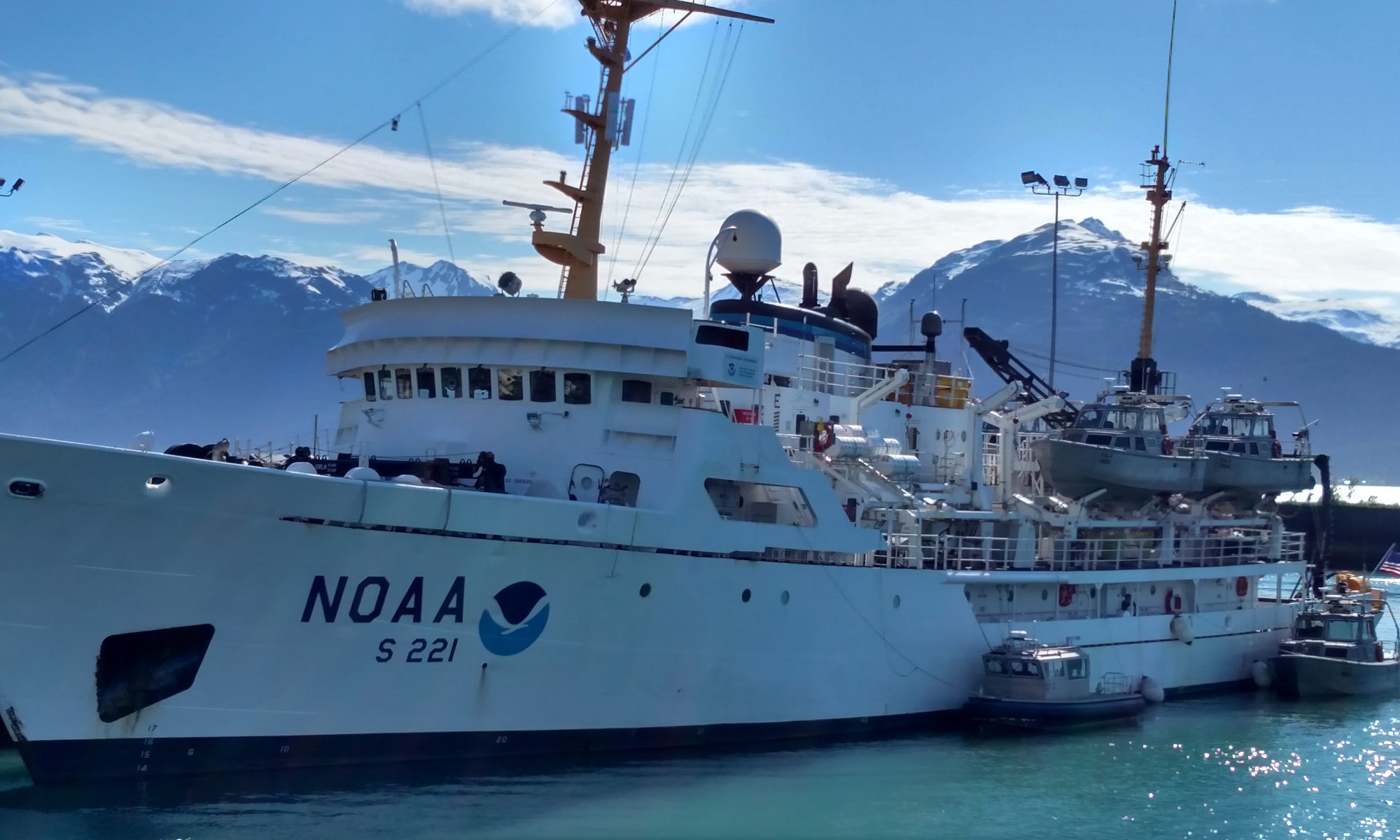
Geographic Area of Cruise: Northeast Atlantic Ocean
Date: August 26, 2018
Weather Data from the Bridge
Latitude: 39.487 N
Longitude: 73.885 W
Water Temperature: 25.2◦C
Wind Speed: 13.1 knots
Wind Direction: WSW
Air Temperature: 26.1◦C
Atmospheric Pressure: 1017.28 millibars
Water depth: 30 meters
Science and Technology Log
As if catching plankton and sneaking a peak with the microscope wasn’t exciting enough (see the picture of the larval eel!), there’s a lot more data being collected on this ship. All of it helps scientists understand what’s going on in this part of the Ocean. And some of it I am able to help with, which is my favorite thing about this cruise (well, maybe that and the incredible views).
I was able to examine some of the plankton samples with a microscope. Do you see the larval eel in the tray next to the scope?The CTD rosette and niskin bottles
At some of our stations, we lower a big and important science tool (called a rosette) into the ocean that contains niskin bottles (bottles used for water sampling) and a Conductivity, Temperature, and Depth meter (CTD). As the rosette is lowered into the depths and raised back up, the scientists can remotely operate the open niskin bottles to snap shut at specific depths. This allows each bottle to come up to the surface with a sample of water from many different depths! Meanwhile, the CTD can take measurements of conductivity (which indicates the salinity of the water), temperature, and pressure, among other things. Scientists have thought of many ways to collect A LOT of data at one time.
Bringing the CTD up from the depths.
When the CTD comes back onto the ship, it’s time for us to use the samples for different purposes. We collect water from 3 different bottles (so 3 different depths) to test the amount of chlorophyll in the water. Do you know what the chlorophyll comes from? If you said plants, you’re right! What are some plant-like things that are drifting all over the ocean? You guessed it! Phytoplankton! So the amount of chlorophyll gives scientists evidence as to how much phytoplankton is in the water. But first, we need to extract (take out) the chlorophyll from the water. We run the water through special filters and soak the filters in a chemical that extracts the chlorophyll. Then we can put the sample through a special machine that uses light to sense the amount of chlorophyll. Wow. One thing I am learning on this trip is how important light is in understanding a water ecosystem.
Me extracting chlorophyll samples
Do you remember what a hypothesis is? It’s an educated guess that answers a scientific question. When scientists come up with a hypothesis, it gives them something to test in an investigation. If you were presented with the question, “At what depth is phytoplankton most abundant?”, what would be your hypothesis?
Another thing we do with the water samples is collect a bit from most of the bottles to preserve and send to the lab to test for the amount of nutrients. When you think of nutrients, you probably think of healthy vitamins for people. But nutrients for plants are actually made from broken down waste of animals. It’s important for ocean water to have a balanced amount of nutrients so that phytoplankton can be healthy. But too much nutrients can also cause algae and phytoplankton to overpopulate!
But that’s not all! The scientists also take samples from the niskin bottles to test for Dissolved Inorganic Carbon (DIC). That sounds fancy, I know. Doing this basically helps scientists understand the pH of the water and look for evidence of ocean acidification (a result of climate change).
Jessica and I taking nutrient samples from the niskin bottles
Can you believe how much scientists can learn from dropping a big science tool into the water?
Scientist Spotlight – Harvey Walsh
Harvey is our Chief Scientist on the mission, meaning he oversees all of the scientific work happening on the ship. He has been so kind as to answer all of my many questions, including these:
Me – If you could invent any tool to make your work more efficient, what would it be and why?
Harvey – I would like a tool that allows you to easily and quickly identify fish eggs and larvae. Currently, it is a time consuming process that involves sorting through samples and identifying them in the lab. There have been and continue to be efforts to use image analysis and genetics to speed up the process. An image analysis has progressed quicker for phyto- and zooplankton, but fish and fish eggs still lag behind.
Me – When did you know you wanted to pursue a career in ocean science?
Harvey – I always thought I would end up studying freshwater fisheries in Minnesota, where I grew up, but after the first two ocean cruises I participated in, I knew the ocean was more for me and the lakes had less of an appeal.
Me – How long has EcoMon (the ecosystem monitoring program we are using) been conducted and how was the protocol (the methods we use) created?
Harvey – EcoMon started in 1992 but it was modeled after a program that started in 1977. The bongo plankton sampling has not changed much since it started, but with new technology we have added the water chemistry
Harvey relaxing in the bridge deck
testing, optics, and other instruments.
To create the protocol, scientists from around the North Atlantic region got together to form the International Commission for the Northwest Atlantic Fisheries. This council had the job of looking at plankton sampling techniques and deciding the best way to monitor plankton communities.
Me – Can you share an example of a way that people have used EcoMon data to form and test a hypothesis?
Harvey – Our data helps scientists make connections between different species in a food web, for example. After people noticed that Atlantic herring (fish) populations were getting low, they used EcoMon data to come up with a hypothesis like this:
“Increasing haddock populations lead to a lower stable state of herring because haddock feed on herring eggs.”
If people want to know more about a certain species of fish and how it survives and thrives, they need to understand the whole ecosystem, including the food web!
Personal Log
This cruise continues to amaze me. Sometimes we’ll have several hours between stations when I love to learn from others, bring a pair of binoculars up to the fly bridge and join the seabird observers, or catch up on a good book. Being around the water all day is calming and serene. I feel that this is the opportunity of a lifetime.
Me and the NOAA Drifter Buoy decorated for Ocean Studies Charter School!
Another rare opportunity came yesterday when I was able to launch my drifter buoy as part of the NOAA drifter buoy program! First, I decorated the buoy with our school’s name and a symbol for each of the classes at our school – the Sharks class, the Rays class, the Dolphin class, and the Sea Star class. Then, after gaining permission from the ship command, we dropped the buoy overboard!
The buoy has a long canvas tube that extends out like a spring after you release it. This allows the buoy to have a long tail that reaches into the water so that it can catch the ocean currents and drift. If it was just the floating buoy, it would get moved by the wind instead of the currents.
Everyone runs to the bow when dolphins are riding the wake!
The buoy has a satellite tag that sends a signal to a satellite wherever it goes. This way, back home my students and I can track the buoy online and see where it ends up! Where do you think the buoy will go?
Everyone on board gets excited when we spot a pod of dolphins or a whale spout! I can’t wait to see what’s out there tomorrow!
Did You Know?
Great Shearwaters are sea birds that spend most of their lives out at sea and only come to land to nest. They can dive deep to catch fish but do not have to dry out their wings like some other birds. They are almost always found soaring by air currents and they prefer stormy and rough weather for stronger air patterns to lift them up.
A great shearwater in flight. Photo courtesy of NOAA.
Challenge Yourself
If a plankton sample with 5,000 individual plankton contains 60% salps, 10% hake larvae, 20% arrow worms, and 10% crab megalops, how many arrow worms are in the sample?
Here’s a picture of an arrow worm from under a microscope. They are about the size of the letter “I” on your keyboard. Photo courtesy of NOAA.
Latitude: 29 51.066 N
Longitude: 088 38.983W
Sea wave height: .3 m
Wind Speed: 11.6
Wind Direction: 5.3 degrees starboard
Visibility: (ask bridge)
Air Temperature: 27.5 degrees Celsius
Barometric Pressure: 1014.88 mb
Sky: cloudy
Science and Technology Log
Lisa Jones is a fisheries biologist and the field party chief responsible for planning and logistics, manning the survey and the day to day operations. She is in charge of the science team. The Captain, Captain Dave Nelson, is charge of the ship. These two work together on the Oregon II making decisions on where we go.
Lisa has been doing this for 20 years and has been to locations including the Gulf of Mexico, Cuba, California, the western north Atlantic, and Mexico. The research has varied from a focus on shark/snapper like the one we are on to marine mammals, plankton, aeriel surveys, and harbor seals. Here are some of the questions I asked.
Q: What is the most interesting thing you have brought up from the ocean?
L: As far as sharks are concerned, one year off the Florida panhandle, we caught a sixgill shark so big we couldn’t even tag it.
Q: How big do you estimate the size of that shark?
L: Approximately fifteen feet
Q: What got you interested in sharks?
L: When I was working for the Cal Fish and Game, radio tagging and doing aerial surveys for harbor seals, we would see shark bitten seals as well as sharks during the aerial surveys. One of the coolest things we ever saw off the Channel Islands was a blue whale.
Q: Those are big, right? How big do you think it was?
L: I don’t know but it looked liked a small building in the water.
Q: What is your training?
L: My undergraduate degree is in geology. I took a lot of oceanography classes during that time. Later, in my 30s, I went back to graduate school for a degree in biology in Tennessee. It’s a long story but I knew I wanted to study sharks. Land locked in Tennessee, I attended a national conference that included many shark specialists. I introduced myself to get connected – basically anyone who would talk to me.
Lisa Jones explains a career in shark research, part 1:
Lisa Jones explains a career in shark research, part 2:
What questions do you have for Lisa? Post them in the comment section. She is happy to answer them!
Personal Log
I am adjusting to life on the ship and the 12-hour shifts. It’s been fun learning all the different jobs we have as we rotate through different stations. I have now baited hooks, recorded data on the computer as we deploy baited hooks and retrieve the longline to record what we catch, a slinger where I get the baited line ready to be attached to the longline, the high flyer pushing the buoy out that marks the start and end of the longline, and even tagged a large sandbar shark.
Check out this video of me slinging the bait:
There have been several questions regarding our route. The survey area has changed due to both Hurricane Harvey and Hurricane Irma. The next post will be all about weather so you can see how this has impacted our trip. I am wondering how much these hurricanes have impacted what and how much we catch.
Did You Know?
Salinity and dissolved oxygen in the water impacts what we catch.
Question of the day:
What advice did Lisa give for anyone interested in doing the kind of work she does? (hint: watch the video embedded in this post)
Geographic Area of Cruise: Pacific Ocean; U.S. West Coast
Date: 07/22/2017
Weather Data from the Bridge: (Pratt, Kansas)
Date: 08/02/2017 Wind Speed: SE at 5 mph
Time: 18:40 Latitude: 37.7o N
Temperature: 29o C Longitude: 98.75o W
Science and Technology Log:
During my last few days aboard the Reuben Lasker before steaming to Bodega Bay for a small boat transfer on July 30th, we were fishing off of the southern Oregon coast. The ship continued to run the longitudinal transect lines using acoustics and collecting data using the continuous underway fish egg sampler (CUFES) during the day and performing targeted trawls for coastal pelagic species (CPS) at night. The weather and the pyrosomes picked up as we moved down the Oregon coast to northern California, but on what would turn out to be the last trawl of my trip in the early morning hours of July 28th, we had our biggest catch of the trip with over 730 kg in the net. Once again we saw 3 of the 4 CPS fish species that are targeted for the survey including the Pacific sardine, Pacific mackerel, and jack mackerel, but no northern anchovies were to be found. The science crew worked efficiently to process the large haul and collect the data that will be used to provide the Southwest Fisheries Science Center (SWFSC) with information that can be used to help understand the dynamics of CPS in the California Current. The data collected from the CPS fish species includes length and weight, otoliths (used to age the fish), gender and reproductive stage, and DNA samples. The information from these different parameters will provide the biologists at SWFSC with information that can be used to understand the nature of the different populations of the CPS fish species that are being studied.
Jack mackerel to process (Photo Credit: Nina Rosen)
Sorted Pacific sardines to be processed
Tubs of pyrosomes
Kip checking reproductive maturity on jack mackerel (Photo Credit: Nina Rosen)
Kip and Sue record length/weight data (Photo Credit: Nina Rosen)
I am home now in southcentral Kansas, but as I am writing this, I can picture the science team beginning preparations for a night of trawling probably just north of Bodega Bay. By now (22:00) it is likely that a bongo tow and the conductivity, temperature and depth (CTD) probe samples have been collected providing data that will be used to calibrate and maximize the effectiveness of the acoustics for the area. Lanora and the rest of the team will have prepped the lab for a night of sampling, weather data will be recorded, and someone (maybe Nina or Austin) will be on mammal watch on the bridge. It all seems so familiar now; I hope the rest of the survey goes as well as the first half of the second leg. I will be thinking about and wondering how the science team of the Reuben Lasker is doing somewhere off the coast of California as I settle in for the night. One thing I am sure of, after spending two weeks aboard the ship, is that the entire crew on the Reuben Lasker is working together, diligently, as a team, using sound scientific practices to produce the best data possible to guide decisions about the fisheries resources in the California Current.
Video Transcription: (Narration by Kip Chambers)
(0:01) Ok, we’re preparing to remove otoliths from a jack mackerel. It’s for the Coastal Pelagic Species survey on the Reuben Lasker, July 27, 2017.
(0:22) We have Phil, from Washington Fish & Game, who’s going to walk us through the procedure.
(0:30) The otoliths are essentially the fish’s ear bones. They help with orientation and balance, and also have annual rings that be used to age the fish.
(0:48) And so the initial cut is – looks like it’s just in front of the operculum and about a blade-width deep.
(1:01) And the secondary cut is from the anterior, just above the eyes and kind of right level with the orbital of the eyes, back to the vertical cut.
(1:22) It’s a fairly large jack mackerel. And, once the skull cap has been removed, you can see the brain case, and you have the front brain and kind of the hind brain where it starts to narrow…
(1:42) … and just posterior to the hind brain, there are two small cavities, and that was the right side of the fish’s otolith,
(1:55) … and that is the left side. And that is very well done. Thank you Phil.
Phill collecting jack mackerel otoliths (Photo Credit: Nina Rosen)
Jack mackerel otoliths (Photo Credit: Nina Rosen)
I wanted to use a portion of this section of the blog to share some comments that were expressed to me from the members of the science team as I interviewed them before I left last week. The first “interview” was with Dave Griffith, the chief scientist for the survey. Dave was kind enough to provide me with a written response to my questions; his responses can be found below.
Chief Scientist Dave Griffith
Q1: Can you tell me a little bit about your background, including education and work history?
Q1: I was born and raised in a small suburb of Los Angeles county called Temple City. Located in the San Gabriel valley at the base of the San Gabriel mountains, it was the perfect place to exercise the love and curiosity of the animals I could find not only in my backyard but also in the local mountains. It wasn’t until I reached high school that I realized I had a knack for sciences especially biology. This interest and appeal was spurred on by my high school teacher, Al Shuey. With little concept of a career, I continued on to a junior college after high school still not sure of my direction. Here I dabbled in welding, art, music and literature but always rising to the surface was my love of sciences. My fate was sealed.
I entered San Diego State’s science program and was able to earn a bachelor’s degree and a master’s degree of science. For my dissertation I studied the re-colonization capabilities of meiofaunal harpacticoid copepods in response to disturbed or de-faunated sediments within Mission Bay. While studying for my masters, I was hired by Hubbs-Sea World Marine Laboratory as the initial group of researchers to begin the OREHAP project which is still operational today. The OREHAP project’s hypothesis was that releasing hatchery reared fish into the wild, in this case white seabass (Atractocion nobilis), would stimulate the natural population to increase recruitment and enhance the population. At the time the white seabass population numbers were at their all time low. During that time of employment at HSWML, I was also teaching zoology at SDSU as a teaching assistant in the graduate program. I was also the laboratory manager and in charge of field studies at Hubbs. My plate was pretty full at the time.
I heard about the opening at the SWFSC through a colleague of mine that I was working with while helping her conduct field work for her Ph.D. at Scripps. I applied and was hired on as the cruise leader in the Ship Operations/CalCOFI group for all field work conducted within CFRD (now FRD) working under Richard Charter. That was 1989. I have now been the supervisor of the Ship Operations/CalCOFI group since 2005.
My main objective on the Coastal Pelagic Fish survey as the cruise leader is to oversee all of the operations conducted by personnel from FRD during the survey. All scientific changes or decisions are made by the cruise leader using science knowledge, logic, common sense and a healthy input from all scientists aboard. I am the liaison between the scientific contingent and the ship’s workforce as well as the contact for the SWFSC laboratory. The expertise I bring out in the field is specific to fish egg identification, fish biology, field sampling techniques, knowledge of the California Current Large Ecosystem and sampling equipment.
Q2: What have you learned from your time on the Reuben Lasker during the 2nd leg of the Pelagic Species Survey?
Q2: First, that you never have preconceived ideas of what you expect to find. You always come out with knowledge of previous studies and a potential of what you might see, but the ocean always will show you and demonstrate just how little you know. When I was beginning in this career I was able to witness the complete dominance of a northern anchovy centric distribution change to a Pacific sardine centric distribution and now possibly back again. It’s mind boggling. I remember one of my colleagues, one of the pre-eminent fish biologists in the field, Paul Smith say to me during these transitions say, “Well, you take everything you’ve learned over the past 40 years, throw it out the window and start over again.” Yeah, the ocean environment will do that to you.
Q3: What advice would you give to a 1st year college student that was interested in pursuing a career in marine science?
Q3: Keep an open mind. Once you enter a four year university you will see areas of study that you never thought or believed existed. Have a concept of where you want to be but don’t ignore the various nuances that you see along the way. Go for the highest degree you feel capable of achieving and do it now because it becomes so much more difficult as you get older or the further away you get from academics if you begin working in a science position.
And last, and I feel most important. Read. Read everything. Journals, magazines, classics, modern novels, anything and everything and never stop. Communication is such an incredibly important part of science and you need to have a command of the language. Not only is reading enjoyable but it will make you a better writer, a better speaker and a better scientist.
Personal Log:
I am back home in Kansas now after wrapping up my assignment on the Reuben Lasker and I have started to contemplate my experiences over the last couple of weeks. There are so many facets related to what I have learned during my time on the ship; the technology and mechanics of such a large research vessel are both fascinating and daunting at the same time. There are so many moving parts that all have to come together and work in a very harsh environment in order for the ship to function; it is a testament to the men and women that operate the boat that things operate so smoothly. As impressive as the technology and research is on the Reuben Lasker, it is the people that have made the biggest impact on me.
You can see from Dave’s response above that there are some incredibly talented, dedicated individuals on the ship. I would like to share with you some of my observations about some of those people that I worked with including Dave Griffith. Dave is not only an outstanding scientist that has spent a lifetime making important contributions to fisheries science, he is also an incredibly well rounded person and an encyclopedia of knowledge. I would like to take this opportunity to personally thank Dave for his patience, and willingness to listen and provide insight and advice to me during my time on the ship. In my upcoming blog, I will provide more information about the other members of the science team that I had the pleasure to work with while on board. Until then please enjoy the pictures and video from my last week on the Reuben Lasker.
Weather Data is not available for this post because I am writing from the Biloxi/Gulfport Airport.
WHO WORKS ON THE OREGON II? Part 2: THE SCIENTISTS
Meet Lisa Jones, a career marine scientist who came to her present position as a Research Fisheries Biologist for NOAA from a life of working with animals. Born in Memphis and raised in the mountains of east Tennessee, she did her undergraduate work at Emory University, and then earned her Master of Science at East Tennessee State.
Lisa has lived and worked in Colorado where she trained horses for a while. She moved to California and worked for the Department of Fish and Game to earn money for grad school and eventually ended up in at the National Marine Fisheries lab in Pascagoula, Mississippi. She started there as a student intern and 19 years later is working as a research scientist for NOAA. Her schedule of being out on the water during the summer and home during the winter months suits her well.
Ten years ago Lisa got interested in doing agility training with a rescue dog she kept, an Australian Shepherd. Since then she has acquired 3 more Aussies through rescue and adoption (one dog left homeless by Hurricane Katrina.) Lisa’s interest in dog training and agility trial competition helps her recharge her energy and enthusiasm each winter so she is ready to go back to sea in the spring. Her big goal is to make it to the national agility dog competition trial with her Aussies.
Lisa’s advice for students interested in a marine science career is to do well in math and science, but do not neglect developing good research and communication skills: reading, writing and speaking. In a science career you will need to be able to work as a team member, report on your work and develop applications for grant funding. While you are young, get out and volunteer to get experience. Take internships, volunteer at an aquarium, a science camp or as a field work helper. Getting good field work experience is important even if you don’t plan a research career. It is hard to run support for researchers and set policy for others if you don’t have a fairly deep understanding of their jobs. “Always ask questions. Demonstrate your interest. The only stupid question is the one you don’t ask.”
Lisa has been my go-to person for everything I needed to know about living and working on the OREGON II. From making sure I met everyone, to teaching me to use and care for our equipment, to teaching me to cut mackerel and bait hooks, she has been right there. The success of this experience for me has been mostly due to having good teachers and being with a group of people willing to share their experience and expertise.
Kevin Rademacher, Fisheries Research Biologist, started out riding dolphins at Marine Life in Gulfport, Mississippi! He spent several years doing dive shows and working with performing marine mammals before he got into research work. Kevin was graduated from University of Southern Mississippi with major emphasis in biology and fisheries science and a minor in chemistry. After graduation he worked restoring antiques with his father while he applied for jobs in the marine science industry.
Kevin started out on NOAA Ship CHAPMAN, a 127’ stern trawler. In 1988 he spent 240 days at sea as a survey technician while earning certifications with survey equipment, deck equipment, as a diver, an EMT, worked the helm watch and corrected charts. Then he moved into the lab working with the marine mammal group, ground fish and reef surveys. He has chosen to continue working on reef fish surveys because it gives him the opportunity to work with cutting edge equipment like underwater cameras as they have evolved from simple video to using sophisticated arrays of four sets of camera groups, each cluster including a stereo black and white set and one color camera to give the fullest possible depth and detail 360⁰ images. Underwater work is Kevin’s main interest, but there are only so many research biologists so his job assignments have been varied. It was fortunate for me that he was assigned to work on the long-line survey this trip so I could learn from him.
During my time on the OREGON II Kevin has been a willing source of any information I request about the marine life we are seeing. He has a copious memory for facts and an encyclopedic knowledge of the appearance, habits, and names of the animals in the ocean. No matter what we brought up on our hooks, bony fish, sharks, algae, coral or shellfish, he knew them by common and scientific name and provided interesting facts to help me remember them. Kevin’s passion for his job is obvious in the way he attends to details and shares his knowledge. His irrepressible sense of humor made the afternoons baiting hooks with smelly fish in the hot sun an adventure instead of a chore.
The Day Shift Science Crew – Kevin Rademacher, TAS Barney Peterson, Lisa Jones, Mike Cyrana, and Kasea Price
Trey Driggers, Research Fisheries Biologist, first got interested in aquatic animals because of alligators. Growing up on a lake in Florida he was constantly warned to stay away from the water because there were alligators…the kind of warning guaranteed to intrigue any curious youngster. About then, the movie “Jaws” was released and the media blitz that accompanied it drew his imagination toward an even scarier predator. His interest grew and he remembers two books in particular that kept it alive: “The Dictionary of Sharks” and “Shark Attack.” From that point on his career path seemed to point straight toward marine biology.
Trey put in four years studying a basic liberal arts program at Clemson University. He remembers a Smithsonian presentation called “Shark in Question,” which had a chapter addressing the question “How can people become shark experts.” He entered the University of South Carolina and spent 2 years taking nothing but science courses to get enough credits and background knowledge to enter a Master’s program in Marine Science. He began working as a volunteer in labs and on commercial fishing boats to gain experience. Trey completed his thesis on yellowfin tuna and was ready to move on. Advisors warned him away from focusing on charismatic marine fauna, but his father had taught him to push back against barriers and pursue his goals. He began working as a volunteer in labs and on commercial fishing boats to gain experience. He spent 3 years earning his Ph.D. and worked in a post-doctoral position while looking for a research job. His previous volunteer work on surveys gathering information on blacknose sharks helped him get a foot in the door to get a contract position at the NOAA Fisheries Research Lab in Pascagoula. He continues research to add to our understanding of sharks and enjoys his job because he loves the challenge of not knowing all the answers.
Trey’s advice to young people is to get involved in volunteering in a variety of ways so you can discover where your interests lie. That volunteer experience can demonstrate interest that will set you apart from other applicants when it comes to applying for the limited number of positions that may be available in your chosen field.
Trey Driggers, head of the Night Shift Science Team, working in the dry lab
VOLUNTEERS
There were six unpaid volunteers aboard the ship this cruise. They provide important manpower to get the research done while gaining knowledge and experience to transfer to other areas of their lives. Most often they are students who are gathering data to use for research projects, working toward advanced degrees. Sometimes there will be a volunteer like me, a very lucky Teacher at Sea who has been chosen by NOAA…….. to participate in the cruise to learn about the work and careers in NOAA to take that knowledge back and share it with our students and the general public.
Mike Cyrana is a Post-Doctoral Student at Tulane University, working toward his PhD in Marine Biology. This is the second year he has worked with fisheries crews in the Gulf as he compiles data for his research. Mike was on my watch so we worked together 12 hours each day and got to swap stories and share information. He shows a passion for his work that lets you know he has chosen a career he loves. Mike is to blame for introducing me to chocolate tacos….my newest vice!
Mike showing off the catch
Lydia Crawford is also a Post-Doctoral Student at Tulane University. She is doing research about sharks for her PhD in Ecology and Evolutionary Biology. Lydia was on the midnight to noon shift so our paths crossed very seldom. She is knowledgeable and willingly shared what she knows to help make our jobs easier. She also has been out on research cruises as a volunteer before and helped us newbies learn the ropes.
The Night Shift at work – Trey, Chrissy, Lydia, and Toni
Kasea Price, working for her MS at University of Southern Mississippi was on day shift with me and helped me wrangle sharks, dissect for otoliths and collect any number of specimens to bring home to my class. On one of our last days working together she found out that she has been hired to work for one of her professors at school, a job that will make it possible for her to complete her degree without piling up huge loans. We all celebrated for Kasea.
Kasea Price showing off a large Red Grouper
Toni Mancinelli is the youngest of the volunteers. She is an undergraduate, just starting her junior year at The University of Tampa. She felt very fortunate to be accepted for this cruise and worked hard to learn and contribute while she participated. Her happy attitude and willingness to help made her a pleasure to know and work with.
NOAA Teacher at Sea
Mary Cook
Onboard R/V Norseman II
March 18-30, 2016
Mission: Deepwater Ecosystems of Glacier Bay National Park Geographical Area of Cruise: Glacier Bay, Alaska Date: Saturday, March 19, 2016 Time: 8:28pm
Weather Data from the Bridge
Temperature: 38°F
Pressure: 1013 millibars
Speed: 0.2 knots
Location: N59° 01.607’, W136° 10.159’
Weather Conditions: Intermittent light rain
Science Blog
Before the Norseman II left port, the Boatswain conducted all the required ship safety drills with us: fire drill, man overboard, and abandon ship. This is where we learned to don the emergency flotation suit, gathered at the Muster Station for roll call, and went over procedures in case of an emergency. These drills are taken very seriously.
What is a muster station?
Safety first! Hard hat and life vest must be worn when on deck.
Ms. Cook in “Gumby” suit
Where’s Qanuk? Hanging out on the Jacob’s Ladder (emergency rope ladder)
Ranger Greg is a good sport
We left the port of Auke Bay just north of Juneau at around 10 pm Friday night and steamed into Glacier Bay to arrive at Bartlett Cove this morning at 9 am. We disembarked to attend a required safety orientation for Glacier Bay National Park. Ranger Greg informed us that he had recently seen 4 humpback whales headed into the Bay! Also, that orca live in the Bay year round. Many of the channels are ice-free now because it is warmer than usual for this time of year.
After the brief stop at Bartlett Cove, we steamed into the East Arm of Glacier Bay toward White Thunder Ridge. Many of us were on deck with binoculars looking for wildlife and enjoying the scenic snow-capped mountains. We saw birds, otters, moose and mountain goats!
Chief Scientist Dr. Waller conducts science meeting
While en route, Chief Scientist Dr. Rhian Waller conducted a science meeting reviewing the purpose and plans for the cruise, which is to explore, collect samples and data on the presence and emergence of Primnoa pacifica in Glacier Bay. Primnoa pacifica is commonly called Red Tree Coral. NOAA’s Dr. Bob Stone, who first pursued collecting data on the Red Tree Coral in Glacier Bay back in 2004, is working on this expedition. Other than Bob’s documentation, the Primnoa pacifica of Glacier Bay, Alaska is a mystery.
Two dives were conducted below the steep incline of White Thunder Ridge. The divers got into their dry suits, reviewed their plans on how to communicate and collect samples underwater, and then boarded the little boat called a RHIB (rigid-hull inflatable boat). They returned to Bob’s old spot and dove about 72 feet down for sample collection. The dive took about 30 minutes and when they returned with samples, we began processing each one.
Dr. Stone prepares to dive
The black line is the ship’s track. It looks like we went in circles because that’s what we did!The ship was waiting at a distance on the divers to return.
Primnoa pacifica sample red tree coral
Samples for genetic studies
The Primnoa samples will be assessed for three different things: genetics, isotopes, and reproduction. The genetic fingerprints will be useful in determining the generational spreading pattern of the Red Tree Coral in Glacier Bay. The isotopes will aid in understanding what they eat and their place in the food web. The reproduction assessments will identify sex and level of maturity. An interesting observation is that Primnoa pacifica is one of the first corals to seed newly exposed rock faces when glaciers recede. Bob estimates that the tallest of these coral are about 40 years old because that is when the glacier receded past this point. Using that fact, he also calculates their growth rate to be about 2 centimeters per year.
Tonight, the ROV Kraken 2 will be deployed in order to explore deep depths for the presence of the Red Tree Coral. ROV means remotely operated vehicle. More on that tomorrow!
Kraken 2 Remotely Operated Vehicle (ROV)
Personal Blog
I must say it is a pleasure to be aboard the Norseman II with such enthusiastic scientists and crew. The atmosphere on the ship is one of anticipation and this is how I imagine the early explorers of Glacier Bay must have felt. Rhian, our Chief Scientist, described this expedition as exploratory in nature. I’ve always dreamed of being an explorer and now I get to watch some real explorers in action! These guys and gals have done so many cool things like study life in Antarctica, map uncharted territory, design and build new equipment, and travel to the deep ocean in the Alvin submersible. I am so thankful that they are excited to be a part of the NOAA Teacher at Sea program and share with our students in Scammon Bay and beyond. I’ve enjoyed listening as they brainstorm ways to use our eagle mascot, Qanuk, to engage young people in real science and exploration.
So, as I call it a day, I’d like to congratulate our Scammon Bay Lady Eagles who become the Class 1A Alaska State Champions today! Go Eagles! I’m so proud of both our boys and girls teams and their coaches. They’ve worked hard, played smart and represented our community with dignity and respect.
Good night…..