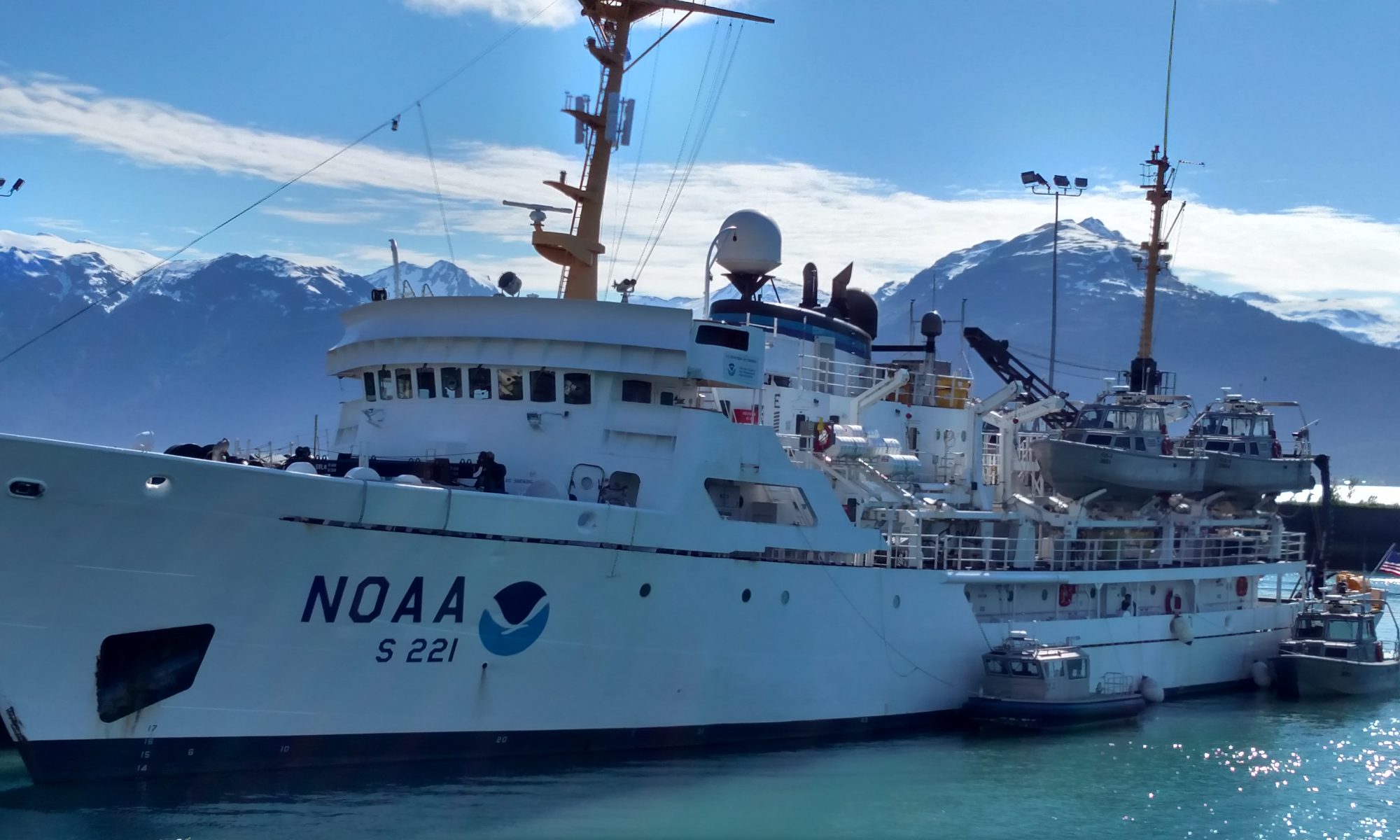
David Walker: Lots to Do, Lots to Learn (Days 1-2), June 26, 2015

Sorting by species

NOAA Teacher at Sea
David Walker
Aboard NOAA Ship Oregon II
June 24 – July 9, 2015

Mission: SEAMAP Bottomfish Survey
Geographical Area of Cruise: Gulf of Mexico
Date: Friday, June 26, 2015

Weather Data from the Bridge

Weather Log 6/26/15
NOAA Ship Oregon II Weather Log 6/26/15

Weather was quite calm on Days 1 and 2.  As noted in the above weather log, the only real disturbance was a small squall (SQ) observed at 7 AM on Day 2.  Sky conditions are estimated in terms of how many eighths of the sky are covered in cloud, ranging from 0 oktas (completely clear sky) through to 8 oktas (completely overcast).  FEW in the above log represents 1-2 oktas of cloud coverage.  SCT represents 3-4 octas, and BKN represents 5-7 oktas.

Science and Technology Log

I have been assigned the night watch, which runs from 12 midnight to 12 noon.  Accordingly, on Day 1, I went to sleep around 2 PM and woke up around 10 PM to prepare for watch. My first day consisted mostly of general groundfish biodiversity survey work, one of the focuses during the summer being on shrimp species.  Data collection points have been randomly plotted throughout the Gulf, and data is collected via trawling the seafloor, which consists of the boat pulling a fishing net behind the boat, along the seafloor, for a predetermined length of time.  To allow for collection along the seafloor, the net has rollers on the bottom.  The net also contains a “tickler chain” to stir up organisms (mainly shrimp) from the seafloor, so that they can be captured with the net. The trawl catch is transferred to the boat, where the following steps are completed:

Tranferring catch to boat
CJ Duffie transferring a trawl catch to the boat.

1. The total catch is weighed.
2. The catch is run along a belt, and the three significant shrimp species (white, brown, and pink) are taken out and saved. In addition, multiple unbiased samples are taken from the catch and saved.  The sample should contain at least one of each species encountered in the catch.
3. The entire taken sample is sorted by species.
4. Individuals within each species are counted.
5. Length, weight, and gender are recorded for shrimp individuals within a significant species (white, brown, and pink).
6. Length measurements are taken for all other species individuals within the sample. Weight and gender are recorded for one individual out of every five within a species, for species other than shrimp.
7. Everything is returned to the ocean.

Sorting by species
Sorting the catch by species along the belt. Left to Right — Volunteer CJ Duffie, Equipment Specialist Warren Brown, me, and Research Fisheries Biologist Kevin Rademacher.

On Day 1, we completed the above process for 4 separate catches.  Aside from my lack of knowledge, the only other mishap was that my middle finger accidentally got pinched by a fairly large Atlantic Blue Crab.  I was amazed at the amount of force of the pinch, as well as the amount of pain caused.  I ended up having to break the crab’s claw off in order to free myself.

Also on Day 1, I got to observe the CTD (Conductivity, Temperature, Depth) sensor in action.  A CTD’s “primary function is to detect how the conductivity and temperature of the water column changes relative to depth” (NOAA).  The salinity of the seawater can be determined from this conductivity and temperature data.  On the Oregon II, the CTD also contains a dissolved oxygen sensor for measuring levels of dissolved oxygen in the seawater.  In addition, the CTD is housed in a larger metal frame (called a “rosette”) with water bottles, allowing for sampling at various depths.  Various data collection points have been randomly plotted throughout the gulf, and data collection consists of sending the CTD (+ dissolved oxygen sensor and water bottles) to and from the ocean floor.  The photo at right shows the data output – the y-axis represents water depth, temperature is recorded in blue (two data points taken at each scan), salinity is recorded in red, and dissolved oxygen is recorded in green (2 data points taken at each scan).  The ocean floor was at a very shallow depth (between 10 and 20 meters) for all sampling done on Day 1.

CTD data output
CTD data output

On Day 2, we completed more shrimp survey work and CTD sampling.  I also got to participate in a plankton survey at the beginning of my shift.  This entailed dropping two fine-mesh nets into the water – a dual-bongo and a neuston – and dragging them through the water to collect plankton.  The dual-bongo is lowered to a predetermined depth, while the neuston remains at the surface.  Obtained plankton is transferred to a jars with salt water and formaldehyde (for preservation) and sent to a lab in Poland (with which NOAA has a partnership) where it is categorized, measured, etc.

Personal Log

I have already met all of the scientific personnel and most of the other core and crew on the ship.  Andre Debose is the Field Party Chief, and he heads up all scientific operations on the ship.  The Executive Officer of the ship is Lieutenant Commander (LCDR) Eric Johnson, a NOAA Corps Officer.  These are the two people who approve of all of my blog posts before I submit them to NOAA. The night watch (12 AM – 12 PM) consists of me, Kevin Rademacher, Warren Brown, and Alfonso Hamilton (watch leader).  The day watch (12 PM – 12 AM) consists of Adam Catasus, Jeffrey Zingre, Joey Salisbury, and Michael Hendon (watch leader).  CJ Duffie completes his watch from 6 AM to 6 PM. Adam, Jeffrey, and CJ are volunteer graduate students from Florida.  This is their first NOAA research cruise, but they have already completed a two-week leg, so they know much more than I do.  Alfonso, Kevin, Warren, Adam, and Joey are all seasoned NOAA veterans, have completed many years of research cruises, and have a wealth of knowledge.

Stateroom
My stateroom

My stateroom is quite nice.  There is sufficient storage space for all of my clothing and equipment, such that I am able to keep most everything off of the floor.  I am rooming with Joey Salisbury (I have top bunk), but as Joey is on the day shift, we do not see too much of each other.  I am quite paranoid about not waking up on-time, so I tethered my cell phone to a pipe on the boat, directly above my head.  This way, the phone alarm blares directly toward my face, and there is no danger of my phone falling off of the bunk.

I have not yet experienced any seasickness, although I am still taking preventative medication every day.  Andre noted before we left that ginger helps with seasickness, so I brought some ginger ale and ginger cookies.

The food served on the ship is amazing, definitely much more than what I was expecting.  There are multiple course options for each meal, and everything I have had so far has been exceptional.  The highlight was the made-to-order omelet that I had for breakfast after 7 hours of sorting and measuring fish.

Notably, I also got to experience two boat safety drills on Day 1 – a fire drill, and an abandon ship drill.  For the abandon ship drill, I got to try on my survival suit.  It is made out of neoprene, so in that regard it reminds me of fly fishing waders.  However it feels quite claustrophobic once you put your arms in it and zip it
halfway up your face.  I needed much assistance in putting it on.

Survival suit
In my survival suit, during an abandon ship drill

Did You Know?

NOAA has a Commissioned Service, one of the seven Uniformed Services of the United States.  The NOAA Corps consists only of Commissioned Officers (i.e. no enlisted personnel or Warrant Officers).  The Corps first became a Commissioned Service in 1917, during World War I, as the United States Coast and Geodetic Survey Corps.  In 1965, this Corps was renamed the Environmental Science Services Administration Commissioned Corps, and in 1970, was again renamed the NOAA Corps (Source — NOAA).

Notable Species Seen

June Teisan, Ichthyo-WHAT? Ichthyoplankton! May 6, 2015

NOAA Teacher at Sea
June Teisan
Aboard NOAA Ship Oregon II
May 1 – 15, 2015

Mission: SEAMAP Plankton Study
Geographical area of cruise: Gulf of Mexico
Date: Wednesday, May 6, 2015

Weather Data from the Bridge:
12:00 hours; Partly cloudy skies; Wind 080 (WNW) 9 knots; Air temp 25.8C; Water temp 25.7C; Wave height 3-4 ft.

Science and Technology Log:

From my very first shift the day we left port at Pascagoula, I’ve been out on the ship’s deck deploying nets and processing samples. Samples of what, you ask? Ichthyoplankton! Ichthyo-What? Ichthyoplankton are the eggs and larvae of fish, and are typically found less than 200 meters below the surface, in the “sunlit” zone of the water column. We have 40 testing sites or “stations” ahead during this cruise, as shown below.

SEAMAP_OregonII
The blue area holds the SEAMAP Plankton stations we plan to sample on the first leg of the spring cruise. The other stations will be sampled on the second leg May 17-31.


With my noon to midnight teammates Pam Bond and Jonathan Jackson, and the invaluable Oregon II deck crew to operate the winches, I’ve learned to draw samples from the Gulf with specially developed equipment: the Bongo net, Neuston net, MiniBongo net, and S-10 Neutson net, and the CTD sampler.

The Bongo and its smaller cousin the MiniBongo are designed with funnel-shaped nets that collect samples into a cylinder at the end of the net. Once the nets are sprayed down to chase the last of the biomass into the PVC cylinder or “codend”, we take the cylinders to the processing table to sieve the biomass, transfer that to the glass lab jars, and fill with preservative solution.

The Neuston net is affixed to a large metal rectangle and is pulled along the surface of the water for a ten minute time segment. The mesh of the Neuston is not as fine as the Bongo, so smaller plankton slip through and larger organisms are gathered.

 Once the samples are gathered they must be sieved, transferred into lab jars, and preserved. Immediately after collecting the samples, we walk the buckets holding the codend cylinders to the back deck where the processing table holds the equipment and solutions we need for this part of the process.

Personal Log:

I’ve been on board the Oregon II for five days, and I am deeply impressed by many facets of this scientific journey.

  • The level of dedication, professionalism, and passion of the NOAA science team: This work is high caliber data gathering in sometimes grueling conditions, with monotonous waiting periods in close quarters; but the good humor, dedication to best practice field science, and mutual respect and support among the team is always evident.
  • The complexity of running a working research vessel: From the Commanding Officer down the chain, each crew member has their jobs and each person is vital to the success of the excursion.
  • The importance of the work: Our fisheries are a vital food source; to manage the stocks and avoid overfishing we need data to make management decisions that ensure a healthy ecosystem.
  • The beauty and jaw-dropping magnificence of the Gulf: This vast expanse of water – teeming with life, driving weather patterns, supplying us with food and fuel – is a sight beyond words.

Finally, here’s a shout out for Teacher Appreciation Week! Kudos to all my colleagues across the country and especially to the teaching staff at Harper Woods Schools in Harper Woods, Michigan for all you do everyday!

huzzah
And a special hello for the students in Mrs. Wesley’s class all the way from the Gulf of Mexico!

Julia West: Bongos! March 22, 2015

NOAA Teacher at Sea
Julia West
Aboard NOAA ship Gordon Gunter
March 17 – April 2, 2015

Mission: Winter Plankton Survey
Geographic area of cruise: Gulf of Mexico
Date: March 22, 2015

Weather Data from the Bridge

Time 1700; clouds 100%, stratus; wind 325° (NNW), 9 knots; air temperature 22°C, sea temperature 25°C

Science and Technology Log

Here’s what we have covered as of Sunday evening, 3/22. I’m getting quite the tour of the Gulf! Notice we are going back and forth across the shelf break (the edge of the continental shelf), as that is our area of interest.

Stations covered 3/22
This is what we’ve covered so far. We’re doing well!

Again, thanks to all of you who are reading and asking questions. One recent question had to do with whether we are bringing specimens back. So let me explain what we do with them. Most plankton are so small that you see them best through a microscope. So the “specimens” that we are bringing back are all in jars – thousands of organisms per jar! Every time we collect samples, we get at least three jars – two from the bongo nets and one (or more) from the neuston net. That’s not including the CUFES samples described earlier, which are only big enough for a tiny bottle. Here are some pictures:

Kim labeling a sample
Kim Johnson (scientist) in the wet lab, labeling a sample. Notice the cardboard boxes – they are all full of sample jars, both empty and full.
Bongo sample
This is a nice sample from one of the bongo nets. Lots of little guys in there!


These samples get brought back to shore for analysis in the NOAA lab. Oddly, many of the samples get sent to Poland to be analyzed! Why Poland, you ask? Well, for a few decades we have had a cooperative agreement with the Polish sorting and identification center. They remove the fish and eggs from all samples, as well as select invertebrates. These specimens and the data get sent back to US for analysis. We double check some of the IDs, and plug the data into models. (If you are a biology student, this is an example of how models get used!) The information then goes to fisheries managers to use to help form fishing regulations. This division of NOAA is called the National Marine Fisheries Service (NMFS), which manages stocks of fish populations.

NOAA has been doing spring and fall plankton sampling for 30 years now. Winter sampling is newer; it started in 2007. SEAMAP (SouthEast Area Monitoring and Assessment Program) is cooperative agreement between the Gulf states, federal (NOAA), and university programs. The samples from the states and universities get sent to Poland with our samples. The the timing of the surveys is to target specific species when they are spawning. This winter survey is targeting grouper, tilefish, and other winter spawning species. The other surveys target bluefin tuna, red drum, red snapper, and mackerels, which spawn at other times of the year. The invertebrate data is used to build an understanding of invertebrate community structure throughout the Gulf.

In science, research is cumulative. We know, from past research, what the mortality rate of some fish species is. So if we get a fish larva or fry that is a certain size, we can estimate the percentage of that size larvae that will reach adulthood, and back calculate to see how much mortality has already happened to get fish of that size. All this allows us to get a peek into the size of adult population.

The first piece of equipment that we use when we get to each station is the bongo nets. You can see how they got their name!

Bongos
The bongo nets just entering the water. They will be lowered to 200m, or near the bottom if it is shallower.

Here are the bongos ready to be deployed:

Bongos ready to deploy
These bongos are ready to go as soon as we get the OK.
Flow meter for bongos
This little whirlybird is the flow meter.
SeaCAT
The SeaCAT


The flow meter is inside each bongo net, near the top. We read the numbers on it before the net goes out, and after it comes back. Using this information – the rate of flow, together with the area of the opening, we can calculate the volume of water filtered. The SeaCAT is a nifty unit that measures conductivity (salinity), temperature, and depth. Since we have a much fancier unit to measure these factors, we use this primarily for depth, so we know when we are getting to 200 meters (or the bottom, whichever comes first). We go to 200 meters because that is the lowest effective light penetration. Phytoplankton need light, and zooplankton need phytoplankton! What’s more, larval fish have not yet developed their lateral line (the organ that many fish use to sense vibrations in the water around them), so they feed visually. Even if they want to eat something below the photic zone, they wouldn’t be able to “see” it yet.

I, of course, am full of questions, and knowing that I’m supposed to identify every acronym I write, I asked what SeaCAT stands for. The unit is made by a company called SBE (Sea Bird Enterprises), so is the CAT just a fun name that they came up with? Nobody knew the answer! But everyone was curious, and Tony and Steve (both electronics technicians) did some emailing and got the answer straight from SBE. CAT stands for “Conductivity And Temperature” (seems we could have figured that out). And the Sea? Could be for Seabird, Seattle, or just the plain ol’ sea!

Deploying the bongos
Here I am holding the “codends,” ready to drop them over the side. The crane does all the heavy lifting. Photo by Andy Millett


Once we get the nets in the water, the crane operator monitors the speed that it is lowered. Our job is to communicate the “wire angle” constantly to the bridge and the lab. Here’s how this is done:

Measuring wire angle
Measuring the wire angle (angle of the cable) with the inclinometer. Photo by Madalyn Meaker.

The angle of the cable is important because it allows the nets to sweep the desired amount of water as they are pulled up. If the wire angle is too high (above 55°), the crew on the bridge slows the ship down just a bit. The perfect angle is 45°. Many other factors can mess this up, most notably current. The ship has to be facing the right direction, for example, so the current isn’t coming toward the ship (have you ever been fishing and had your line swept under the boat?). It’s tricky business, requiring constant communication between bridge, lab, and deck! Oh, and by the way, the cable is a “smart wire,” meaning it has electrical flow through it, which is how the depth gets communicated to the computers. Fascinating technology, both on the micro and macro scale!

Once we pull in the bongos, we hose them off very thoroughly, to get any of the little plankton that are stuck to the net. They are all funneled into the codend, which is a PVC cylinder. From there, we dump the sample into a sieve, and transfer it into a jar, and get read to do it again in 3 hours or so.

Bongo cod end
This is a close-up of the “cod end” of the bongo, where the plankton get funneled into.
Plankton from the bongo
This is the sample from one of the bongo nets. Can you see why it’s hard to come up with pictures of individual organisms? There are thousands in here!

Did I tell you that sampling goes on 24/7? Perhaps you figured that out when you heard the shift times. It costs a lot to run a ship; operations continue whether it’s night or day.

Personal Log

Now, to keep people happy when they are living in close quarters, far from home, and working strange shifts, what’s the most important thing of all? FOOD! The Gunter is well known among NOAA circles for having fantastic food for people of all diet types and adding ethnic flavor to her meals. The person responsible for our good and abundant food is Margaret, our Chief Steward. She has worked for NOAA for ten years, and says it’s the best job she has ever had. Her husband is now retired from the Coast Guard, so they moved around a lot. Margaret worked for the Coast Guard for four years, then went back to cooking school, and had various other jobs before signing on with NOAA. She has a few years left before she retires, and when she does, what will she do? She wants to do subsistence farming! This is right up my alley – Margaret and I have a lot to talk about! Not to mention the fact that Margaret makes her own juices, some amazing homemade hummus, AND dries her own fruit (dried cherries -yum!).

Margaret, chief steward
Margaret, assembling some spinach lasagna rolls while talking about her life.

Margaret also has a helper, Mike, who was reluctant to have his picture taken. He’s not the usual assistant steward, but sure seems highly capable! It always sounds like a lot of fun is being had in the galley.

Gunter dining room
The dining room, or “mess deck.”
condiment selection
World’s largest selection of condiments, including anchovy sauce and REAL maple syrup!


Lunch spread
Decisions….
more food
and more decisions…


That’s it for this post – I’m getting hungry. Time to eat!

Challenge Yourself

What executive branch of the U.S. government does NOAA belong to? Is it the same branch that oversees our national parks? How about our national forests?

Did You Know?

There are nearly 4000 active oil and gas platforms in the U.S. Gulf of Mexico (NOAA), and more than 27,000 abandoned oil and gas wells (Assoc. Press, 2010)

Oil and gas platforms in the Gulf
Locations of the active oil and gas platforms in the Gulf of Mexico. From http://oceanexplorer.noaa.gov/


Carol Schnaiter: Our First Day of Work, June 10, 2014

NOAA Teacher at Sea

Carol Schnaiter

Aboard NOAA Ship Oregon II

June 6 – 21, 2014

Mission: SEAMAP Summer Groundfish Survey

Gulf of Mexico

June 10-11, 2014

South wind  10 to 15 knots

Seas (waves) 3 to 4 feet

Partly cloudy

My home away from home for a few weeks!

Science and Technology Log

On June 9th we arrived at our first station. There are over 120 stations on this survey in the Gulf of Mexico. Unfortunately I was not able to participate in the first station. (More on that later)

When we arrive at the station the ship’s crew is very busy. The deck crew put trawling nets into the water and down to the bottom to catch fish, shrimp, and other organisms. Once these nets are back at the surface the crew uses cranes to lift them to the deck where the scientists can work on the catch. When the nets are in the water the ship must slow down, so the nets do not rip.

After the nets are raised the organisms collected in the nets are emptied into buckets. The scientists then weigh the buckets on a scale. To make sure they are only weighing the organisms, they first weigh the bucket when it is empty.

Weighing the catch
The basket must be weighed before we sort it.

Next everything goes into the “wet” lab. It is called a wet lab because this area has water available and it is where the organisms are poured out on to a long conveyor belt, sorted, and washed off.

Catch on the conveyor belt
Everything is poured onto the conveyor belt to be sorted.

First, everything is sorted by species. Then everything is counted, measured, weighed, and sometimes the gender and maturity are calculated. All of this is recorded into computers.

Some of the species are very tiny and others are large, but everything is counted.  Many of them look alike so the scientists need to be careful when sorting everything.

The scientists on the Oregon II know many of the names of what they catch, but they also use books, charts, and the computer to look up information to make sure.

Sometimes someone in the lab back on shore may be doing research on a certain species and if that species is found it will be tagged, bagged and sent back to the lab.

The CTD’s and bongo net tows are conducted from the forward well deck (check the first blog if you forgot what those do).

The bongo nets are used to collect ichthyoplankton and so the mesh on these nets is very tight, sometimes as small as 0.333 millimeters. These samples are placed into jars and will be examined back in the lab on land later.

Material from bongo net
This is what we collect using the bongo nets. Photo by Chrissy Stepongzi

By time everything is finished, it is time for the next station and everything starts over again.

The work that the Oregon II does is very important. This survey has been conducted twice a year since the early 1970’s and the information collected can show the scientists what is happening under the surface of the water.

The survey helps to monitor the population and health of everything, plus shows any interactions with the environment that may be happening.

Personal Log:

You may have noticed that I mentioned I could not participate in most of the first day’s work, I was seasick and I spent a lot of time in my stateroom.

State Room
State Room

Thank goodness for the medics and Chief Steward on the ship. Walter, the Chief Steward, sliced up fresh ginger for me to suck on, while Officer Rachel Pryor gave me sugar coated ginger to chew on.

The two trained medics, Lead Fisherman Chris and Fisherman James, both were great help and were all very concerned. Kim, the lead scientist, and my bunk mate, Chrissy, checked in on me throughout the night. I am so grateful for everyone that helped. I am now drinking a lot of water and Gatorade to stay hydrated.

As soon as I felt better I was able to help in the wet lab by sorting, counting, weighing, and measuring organisms that were pulled up. We found some really cool things, like this Atlantic Sharpnose shark that Robin Gropp is holding.

Atlantic Sharpnose Shark

The Atlantic Sharpnose Shark can grow to be 3.9 feet long and can live 10-12 years. It is a relatively small shark, compared to others.

The Common Terns (seabirds) follow the ship when we are trawling hoping to find a free meal. They sit on the ship’s rig that holds the nets waiting for food. The Common Tern is the most widespread tern and can be found by many large bodies of water. They are mostly white with a little black.

Common Terns waiting for dinner!

Taniya Wallace and Andre Debose are the two scientists on the night shift (midnight to noon) and they are extremely knowledgeable and explain everything to me. I am learning a lot of new words and I am even getting better at telling one fish from another.

Andre and Taniya holding the stingray.

The Southern Stingray that Andre is holding is just one of the amazing creatures we caught. We also brought up a Blackedge moray, a Texas Clearnose Skate, a sea hare, red snapper, jellyfish, pufferfish, sea horse, and many more. I can’t wait to share all of my photos next school year!

He may not look dangerous, but he could really hurt you!

I am working the midnight to noon shift and it is strange to “wake-up” at midnight and eat supper (the cooks save a plate if you ask) and then go to work. Again, the food is wonderful. Last night I had the best prime rib and mashed potatoes!

Everyone on the ship is so helpful and friendly. I enjoy listening to where everyone is from and why they decided to make the Oregon II their home.

On the Oregon II
Here I am enjoying the beautiful view from the bow. Photo by Rebecca Rosado

Emilisa Saunders: Finding the rhythm aboard the Oregon II, May18, 2013

NOAA Teacher at Sea

Emilisa Saunders

Aboard NOAA ship Oregon II

May 14, 2013 – May 30 2013

Mission: SEAMAP Spring Plankton Survey

Geographical Area of Cruise:  Gulf of Mexico

Date: May 18, 2013

Weather Data: Wind Speed: 13.94 knots; Surface water temperature: 25.4;  Air temperature: 26.4; Relative humidity: 87%; Barometric pressure: 1,015.33 mb

IMG_1991

Science and Technology Log:

For the scientists on board the Oregon II, each shift follows roughly the same routine.   When we start our shift, we check in at the dry lab to see how much time we have until the next sampling station.  These stations are points on the map of the Gulf of Mexico; they were chosen to provide the best coverage of the Gulf waters.  Our ETA, or estimated time of arrival, is determined by how fast the ship is moving, which is influenced by wind and currents, which you can see in the map below.  A monitor mounted in the dry lab shows us a feed of the route mapping system that is used by the crew on the Bridge to drive the ship.  This system allows us to see where we are, where we are headed, and what our ETA is for the next station.  We also get warnings from the Bridge at one hour, at thirty minutes, and at ten minutes before arrival.

Gulf Currents
The currents in the Gulf of Mexico, plus our planned route.  Image courtesy of NOAA.

At the 10-minute mark, we put on our protective gear – more on that later in this post – and bring the cod ends up to the bow of the boat, where we attach them to the ends of the appropriate nets.  Then, we drop the Bongo nets, the regular Neuston net, the Sub-surface Neuston net, and the CTD into the water, in that order.  These all go down one at a time, and each one is pulled out and the samples collected before the next net goes in.

Neuston
Towing the Neuston net on the night shift

The idea of dropping a net into the water probably sounds pretty simple, but it is actually a multiple-step process that requires excellent teamwork and communication amongst several of the ship’s teams.  The scientists ready the nets by attaching cod ends and making note of the data that tracks the flow of water through the net.  Because the nets are large and heavy, and because of the strong pressure of the water flowing through the nets, they are lifted into the water using winches that are operated by the ship’s crew.  The crew members operate the machinery, and guide the nets over the side of the ship.  While this is happening, the crew members communicate by radio with the Bridge, providing them with information about the angle of the cable that is attached to the net, so that the Bridge can maintain the a speed that will keep the net at the correct angle. At the same time, a scientist in the dry lab monitors how deep the net is and communicates with the deck crew about when to raise and lower the nets.  This communication takes place mostly over walkie-talkies, which means that clear and precise instructions and feedback are very important.

Operating the winches
Crewmember Reggie operating the winch, while crewmember Chris measures the angle of the cable

When each net is pulled back out of the water after roughly 5-10 minutes, we use a hose to spray any little creatures who might be clinging to the net, down into the cod end.  At stations where we run the MOCNESS, we head to the stern of the ship, where the huge MOCNESS unit rests on a frame.  Lowering the MOCNESS takes a strong team effort, since it is so large.  After we retrieve each net, we detach the cod ends and bring them to the stern, where a station is set up for us to preserve the specimens.  I’ll go into more detail about the process of preserving plankton samples in a later post.

Hosing down the nets
Alonzo, hosing down the Bongo nets before bringing them aboard.

We’ve had a couple of nights of collecting now, and so far it has been completely fascinating.  I’m in awe of the variety of organisms that we’ve come across.  The scientists on my shift, Glenn and Alonzo, are super knowledgeable and have been very helpful in explaining to me what we are finding in the nets.  Although this is a Bluefin Tuna study, we collect and preserve any plankton that ends up in the nets, which can include copepods, myctophids, jellies, filefish larvae and eel larvae, to name a few.  When we get the samples back to shore, they will be sent to a lab in Poland, where the species will be sorted and counted; then, the tuna larvae will be sent back to labs in Mississippi or Florida for further study and sometimes genetic testing.

My favorite creature find so far has been the pyrosome.  While a pyrosome looks like a single, strange creature, it is actually a colony of tiny creatures called zooids that live together in a tube-shaped structure called a tunic.  The tunic feels similar to cartilage, like the upper part of your ear.  Pyrosomes are filter feeders, which means they draw in water from one opening, eat the phytoplankton that passes through, and push out the clean water from the other end.  So far on the night shift, we’ve found two pyrosomes about four inches in length and one that was about a foot long; the day crew found one that filled two five-gallon buckets!

Me holding a pyrosome.  So neat!
Me holding a pyrosome. So neat!
Alonzo and the pyrosome
Alonzo holding the pyrosome

Challenge Yourself:

Hello, Nature Exchange Traders!  Pick one of the of the zooplankton listed in bold above, and research some facts about it: Where does it live?  What does it eat?  What eats it?  Write down what you find out and bring it in to the Nature Exchange for bonus points.  Be sure to tell them Emmi sent you!

Gumby Suit
In the Gumby suit, practicing the Abandon Ship drill. Photo by Glenn Zapfe

Personal Log:

Safety is the top priority on board the Oregon II.  We wouldn’t be able to accomplish any of our scientific goals if people got hurt and equipment got damaged.  We started our first day at sea with three safety drills: the Man Overboard drill, the Abandon Ship drill and the Escape Hatch drill.  For Man Overboard, everyone on board gathered, or mustered, at specific locations; for the Science team, our location was at the stern, or back of the ship.  Aft is another word for the back.  From there, we all scanned the water for the imaginary person while members of the crew lowered a rescue boat into the water and circled the Oregon II to practice the rescue.

For the Abandon Ship drill, we all grabbed our floatation devices and survival suits from our staterooms and mustered toward the bow, or front of the ship.  I got to practice putting on the survival suit, which is affectionately called a Gumby suit.  In the unlikely event that we would ever have to abandon ship, the suit would help us float and stay relatively warm and dry; it also includes a whistle and a strobe light so that aircraft overhead can see us in the water.

For the Escape Hatch drill, we all gathered below deck where our staterooms are, and climbed a ladder, where crew members helped pull us up onto the weather deck (the area of the ship exposed to weather) on the bow of the ship.  This is meant to show us how to escape dangers such as fire or flood below deck.

Safety gear
Safety gear on; ready for station!  Photo by Glenn Zapfe

But safety isn’t just practiced during drills; it’s pretty much a way of life on the ship.  Whenever winches or other machinery are in operation, we all have to wear hard hats and life jackets; that means that we wear them every time we reach a station and drop the nets.  We are also all required to wear closed-toed and closed-heeled shoes at all times, unless we’re sleeping or showering.  Another small safety trick that is helpful is the idea of, “keep one hand for yourself and one hand for the ship.”  That means we carry gear in one hand and leave one free to hold onto the swaying ship.  This has been really useful for me as I get used to the ship’s movements.

Until next time, everyone – don’t forget to track the Oregon II here: NOAA Ship Tracker