Angela Greene: “Surface Active Groups and Good Medicine” May 5, 2013

NOAA Teacher at Sea
Angela Greene
Aboard NOAA Ship Gordon Gunter
April 29-May 11, 2013

Mission: Northern Right Whale Survey
Geographical Area of Cruise: Atlantic Ocean out of Woods Hole, MA
Date: May 5, 2013

Weather Data from the Bridge: Air temperature-8.4°C or 47°F, Sea temperature-8.4°C or 47°F, Wind Speed 14 knots, Winds are out of the northeast, Barometric Pressure- 1024.4 mb, wave height- 1-2 feet.

Science and Technology Log:  To say the environment aboard the NOAA Ship Gordon Gunter changes when a right whale is spotted during a watch duty, would be a major understatement.  The goal is to find a Northern Right Whale, and when we do, the frenzy begins.

Me with Whale
Believe it or not, that white splash is a Northern Right Whale. Photo credit Mark Baumgartner

A quick decision must be made as to whether the small boats will be launched.  The small boats enable the scientists to get extremely close to the whales.  This proximity allows them the chance to photograph whales from many angles for later identification.  This distance may also provide an opportunity for scientists to use a crossbow to acquire a biopsy sample.  The sample will provide genetic information needed to determine the gender, parents, and siblings of the whale.  The biopsy also can give a toxicity level of the animal.

Crossbow
Holding the crossbow used to collect whale biopsy sample. Photo credit Eric Matzen

Being in the small boats also gives the team of four the opportunity to scoop a fecal sample from the ocean that a right whale may present.  Poop samples can give diet information and hormone levels.  Checking hormone levels enable scientists to determine the stress levels of the whale and whether or not the whale is pregnant.

Whale Poop
Whale Poop in a baggie.

Our team spotted a right whale, and the boats were launched.  The small boat was able to get extremely close to what is called a SAG, or “surface active group”.  This particular group of four Northern Right Whales was so close to the small boat that it looked as if the whales were performing a show for the scientists!  It was one of the most incredible events I have ever witnessed!

small boat blow
Small boat and a right whale blow. Photo taken under NOAA fisheries permit number 775-1875
good fluke
Small boat and a right whale fluke. Photo taken under NOAA fisheries permit number 775-1875

During the SAG event, many photos were taken under a NOAA fisheries permit, which is necessary due to the endangered status of the species.  It’s interesting to note here, that the public is not allowed to be within five hundred yards of a Northern Right Whale without a permit, making the opportunity to be in the small boat a momentous occasion.

A fecal sample was acquired, which is considered a rare opportunity, however a biopsy was not in the cards for this small boat launch.

Biopsied Last year
Northern Right Whale photo taken from small boat- a biopsy was acquired from this whale on last year’s trip. Photo Credit Jennifer Gatzke. Photo taken under NOAA fisheries permit number 775-1875
Stateroom
My stateroom. You may notice the trash can right next to my bunk.

Personal Log:  This is difficult fieldwork, indeed!  Two days of rough seas made our flying bridge observations come to a grinding halt.  I woke up Friday morning knowing I had a 7:00 am watch duty, and was throwing up the nothingness in my stomach.

My roommate came back to our stateroom with the news that many others, including the crew, were also experiencing seasickness.  I took an odd sense of comfort hearing that other people were also ill.  We were in the middle of ten foot ocean swells that made the boat feel like the inside of Maytag washing machine.  My roommate’s water bottle fell out of her top bunk and landed squarely on my forehead, and our desk chair toppled over on its side. Motion sickness medications work wonders, but make me incredibly sleepy.  Seems like everyone was either sleeping or watching movies… basically just surviving until calmer waters.

This morning’s sunrise brought much happier seas, and the whale watch continues.  It’s cold enough for me to finally don the “Mustang Suit” as everyone tells me I will feel more comfortable than my lined jeans and Tecumseh Arrows jacket.  I am hoping for my chance to get to be in the small boat!

Animal Sightings Log: 

Aquatic-

Right Whale

Sei Whale

Fin Whale

Minke Whale

Humpback Whale

Atlantic Whitesided Dolphin

Harbor Porpoises

Birds-

Herring Gull

Wilson’s Storm Petrel

Northern Gannet

Sooty Shearwater

Northern Fulmar

Atlantic Puffin

Angela Greene: “And So the Love Story Begins… “ April 25, 2013

NOAA Teacher at Sea
Angela Greene
(Almost) Aboard NOAA Ship Gordon GunterApril 29-May 11, 2013
Mission:  Northern Right Whale Survey

Geographical Area of Cruise:  Atlantic Ocean out of Woods Hole, MA
Date:  April 24, 2013


Personal Log:

I am quite certain I am about to fall in love with a whale, as I embark upon a journey that will surely change me forever.  My name is Angela Greene, and I have had the honor of teaching middle school in the Tecumseh Local School District for the last twenty-five years!

TMS
Tecumseh Middle School: “Home of My 8th Grade Scientists!”

I care deeply about my students, and I am committed to providing them with amazing science experiences in my classroom!  I love my job, my students, and learning.  I am a NOAA Teacher at Sea!

I applied for the NOAA Teacher at Sea program because I believe the best way to develop myself, as a professional educator is to seek out field experiences that will enable me to work side by side with leaders in the scientific community.  I can’t think of a better way to efficiently expose my students to careers in the field of science as well as the scientific issues that will directly affect their lives than to “walk in the shoes” of highly trained scientists.

Kristin and Me
“Walking in the Shoes of a Scientist”: Me with Dr. Kristin Stanford, Lake Erie Water Snake Recovery Plan Coordinator

The purpose of this blog is to tell my family, students, friends, and colleagues a story, a love story, if you will.  I hope to share my love of teaching, my love of wildlife, and my insatiable love for learning.

In only a few hours, I will fly to Boston, Massachusetts, take a bus to Woods Hole, and board the NOAA Ship Gordon Gunter.  The ship will take me, as well as a group of ocean scientists, into the Northern Atlantic to search for the critically endangered Northern Right Whale.

Gordon Gunter
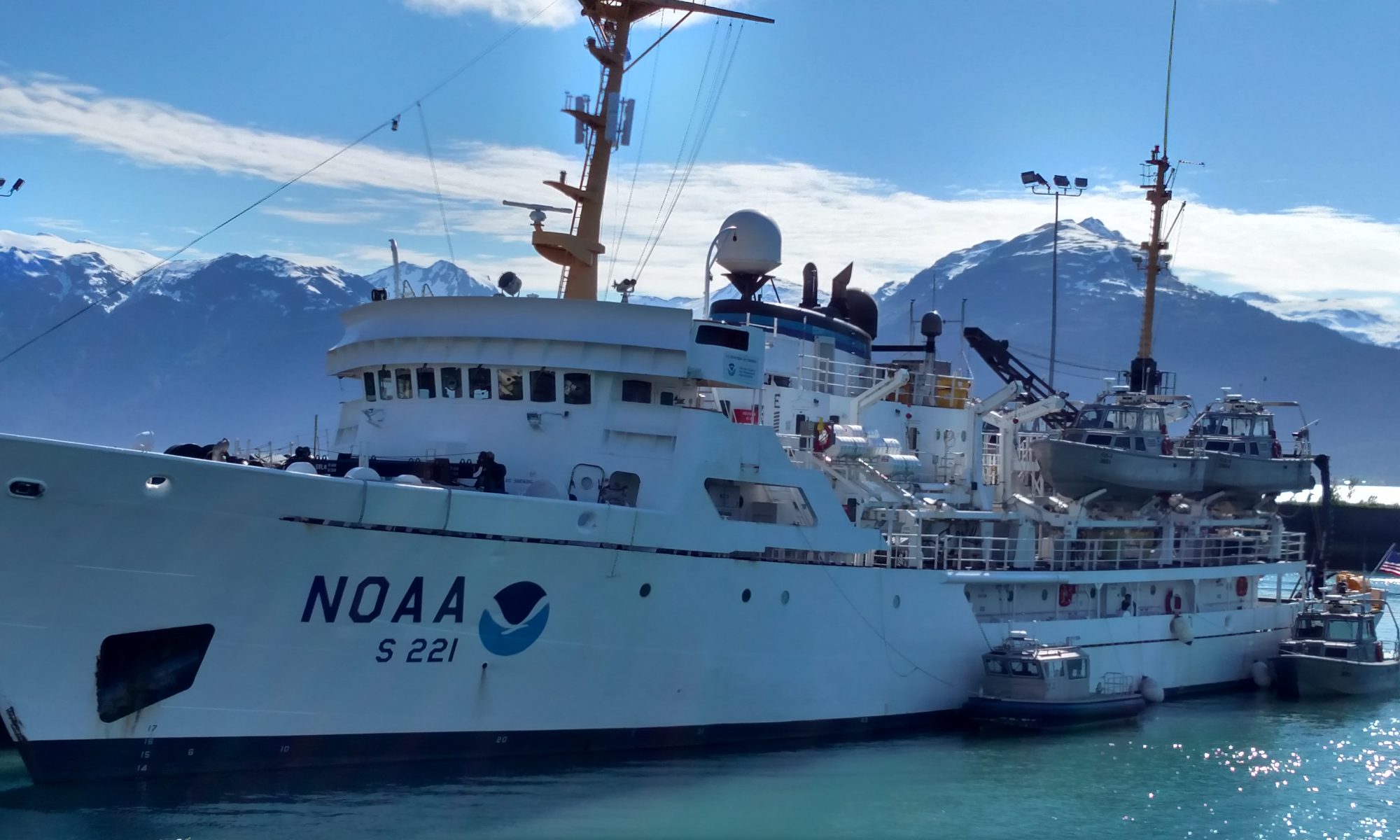
NOAA Ship Gordon Gunter (photo credit NOAA)

At this point, I know very little about this mammal, so I enlisted the help of my 8th grade scientists using a technique I called “Teach Your Teacher”.  Together, we brainstormed a list of questions about Right Whales, the Gordon Gunter, and marine research.  Each student selected a topic, complied a summary of their findings and wrote me a quick “good bye” note.  I collected the pages and promised not to read them until I was on the bus to Woods Hole.

Whale Biopsy
Tecumseh 8th Grader Researching Whale Biopsy

I also wanted my students to have an understanding of the actual size of Northern Right Whales and other North Atlantic Whale species.  We celebrated our new learning and my incredible opportunity to sail with NOAA by having “Tecumseh Middle School Whale Day”.  For one day the concrete campus of our school became ocean habitats to student-created “chalk whales”.  We calculated the actual size of four whale species using the scaled measurements of sketches found in our research.  This data enabled us to create over forty whales using sidewalk chalk!  We were amazed at the size of our whales, and the chalk models enabled us to compare the external anatomy among the species.  Our local news channel, WDTN, stopped by to film us for the evening news!  We determined that 14 middle school students could fit head to toe along the length of a fin whale.  We had a terrific day!

My preparation time is coming to an end.  I need to finish packing, say my goodbyes to my family and dogs, and focus on the journey that’s about to begin.  One of the most important lessons a teacher can learn from rare field experience opportunities is that this time will quickly end.  I promise to enjoy every second while I am falling in love with a brand new world.

14 in Fin
Fourteen Tecumseh Students Fit Head to Toe in a Chalk Fin Whale
rightwhale_baleen_georgia
Northern Right Whale (Photo Credit NOAA)

Kate DeLussey: Studying Deep Water Corals – The Work Continues, July 17, 2012

NOAA Teacher at Sea
Kate DeLussey
Onboard NOAA Ship Henry B. Bigelow
July 3 – 18, 2012

Mission:  Deep-Sea Corals and Benthic Habitat:  Ground truthing and exploration in deepwater canyons off the Northeast
Geographical area of cruise: Atlantic Ocean, Leaving from  Newport, RI
Date: Tuesday , July 17, 2012

Kate DeLussey
Teacher at Sea on the Henry B. Bigelow


Location:
Latitude:  40.3456 °
Longitude: -68.2283°

Weather Data from the Bridge:
Air Temperature: 21.90° C
Wind Speed: 12 Kts
Relative Humidity:  102.00%
Barometric Pressure: 1,008.83 mb
Surface Water Temperature: 21.63° C

Science and Technology Log

TowCam returned to the ship for the last time this cruise.  The components have been stored, batteries have been charged, and data logged in ten minute increments has been saved in excel files for others to read.  The last pictures have been upload from the camera for a grand total of over 35,000 photos. Yes, the images of corals, sponges, and fish have been celebrated, reviewed, and annotated, but the real learning work is just beginning.

The scientific team will spend years studying, thinking, comparing, wondering, and hypothesizing about corals and coral habitat.  They will compare what they have learned with what they already know. They will read what other scientists have written about corals and talk to one another about what they see.  They will write papers explaining their findings, and make presentations to share their learning with others.

These scientists will do this hard learning work because they are curious, because coral habitats are unique and special, and because they care about our  planet’s oceans and the creatures living there.

As earth citizens we are should be grateful and supportive of the research these scientists do.  They work to care for and protect ocean life that very few people even know about.  Hopefully, we all will learn from their work.

The Science Team led by Dr. Martha Nizinski aboard the Bigelow. July 2012

Thank you to NOAA and to:  Chief Scientist Dr. Martha Nizinski

Thanks also to: Dr. T. Shank, Dr. D. Packer, Dr. V. Guida, Dr. E. Shea, Dr. B. Kilan, Dr. M. Malik, Dr. G. Kurras, and Dr. L Christiansen.

Through your dedication and work we all get to learn about the wonders of our planet.

Personal Statement

I have been able to share in this amazing coral research.  Don’t get me wrong.  This is not all fun and games.  There were many challenges, and the hours on shift were long and sometimes difficult.  This is getting down and dirty with real science.  BUT… this is different, usually teachers say the good stuff first:)

Pay close attention to this next statement:  Many of the corals seen in the photos collected by TowCam have never been seen in these locations before. Never!   Some of the corals might even be new discoveries.

Only eleven people have seen corals in the canyons of the Mid- and North Atlantic.  I am one of those people.

I will never be the same, and if you are in my class next year, well, you will never be the same either. You are going to love the Oceans.  You will be surprised to find yourself choosing to watch NOAA videos over video games.   You will read non-fiction to find answers to your questions, and you will write to be a persuasive voice for corals because some of them only know 11 people and they need more friends.

Perhaps you will be amazed and wonder about bioluminescent sea creatures lighting up the sea like lightning bugs.  (I am still waiting to see them Dr. Packer! )  It is possible you will develop a passion for cephalopods like Dr. Shea, or maybe you are simply thinking that you could do this ocean science research.   You can prepare by reading the writings of Dr. Nizinski and others.  It is all possible- you just need to wonder, think, hypothesize, and try.

I may look like Kate DeLussey, but the experience of researching Deep Sea Corals has changed me.    Learning will do that to you !

Next Time:  You could be a scientist at sea.   The corals and other sea creatures will thank you!

Carmen Andrews: News from Somewhere in the Atlantic Ocean off the Coast of Georgia, July 9, 2012

NOAA Teacher at Sea
Carmen Andrews
Aboard R/V Savannah
July 7 – July 18, 2012

Mission: SEFIS Reef Fish Survey
Geographical Location: Atlantic Ocean, off the coasts of Georgia and Florida
Date: July 9, 2012

Location Data:
Latitude: 30 ° 54.55’   N
Longitude: 80 ° 37.36’  W       

Weather Data:
Air Temperature: 28.5°C (approx. 84°F)
Wind Speed: 6 knots
Wind Direction: from SW
Surface Water Temperature: 28.16 °C (approx. 83°F)
Weather conditions: Sunny and fair

Science and Technology Log

Purpose of the research cruise and background information

The Research Vessel, or R/V Savannah is currently sampling several species of fish that live in the bottom or benthic habitats off the coasts of Georgia and Florida.

Reef fish study area
The coastal zone of Georgia and Florida and the Atlantic Ocean area where the R/V Savannah is currently surveying reef fish

These important reef habitats are a series of rocky areas that are referred to as hard bottom or “live” bottom areas by marine scientists. The reef area includes ledges or cliff-like formations that occur near the continental shelf of the southeast coast. They are called ‘reefs’ because of their topography – not because they are formed by large coral colonies, as in warmer waters. These zones can be envisioned as strings of rocky undersea islands that lie between softer areas of silt and sand. They are highly productive areas that are rich in marine organism diversity. Several species of snapper, grouper, sea bass, porgy, as well as moray eels, and other fish inhabit this hard benthic habitat.

Reef fish
Hard bottom of reef habitat, showing benthic fish — black sea bass is on left and gray trigger fish is on right side of image.

It is also home to many invertebrate species of coral, bryozoans, echinoderms, arthropods and mollusks.

Bottom organisms pulled up with fish traps
Bottom-dwelling organisms, pulled up with fish traps deployed in the reef zone.

The rock material, or substrate of the sea bottom, is thought to be limestone — similar to that found in most of Florida. There are places where ancient rivers once flowed to a more distant ocean shoreline than now. Scientists think that these are remnants of old coastlines that are now submerged beneath the Atlantic Ocean. Researchers still have much to discover about this little known ocean region that lies so close to where so many people live and work.

The biological research of this voyage focuses primarily on two kinds of popular fish – snappers and groupers. These are generic terms for a number of species that are sought by commercial and sports fishing interests. The two varieties of fish are so popular with consumers who purchase them in supermarkets, fish markets and restaurants, that their populations may be in decline.

Red snapper close up
Red snapper in its reef habitat

At this time, all red snapper fishing is banned in the southeast Atlantic fishery because the fish populations, also known as stocks, are so low.

How the fish are collected for study

The fish are caught in wire chevron traps. Six baited traps are dropped, one by one from the stern of the R/V Savannah. The traps are laid in water depths ranging from 40 to 250 feet in designated reef areas. Each trap is equipped with a high definition underwater video camera to monitor and record the comings and goings of fish around and within the traps, as well as a second camera that records the adjacent habitat.

Chevron fish trap
Fish swimming in and out of a chevron fish trap

I will provide the details of the fish trapping and data capture methods in a future blog.

Who is doing the research?

When not at sea, the R/V Savannah is docked at the Skidaway Institute of Oceanography (SKIO)on Skidaway Island, south of Savannah, Georgia. The institute is part of the University of Georgia. The SKIO complex is also the headquarters of the Gray’s Reef National Marine Sanctuary. The facility there has a small aquarium and the regional NOAA office.

The fisheries research being done on this cruise is a cooperative effort between federal and state agencies. The reef fish survey is one of several that are done annually as part of SEFIS, the Southeast Fisheries Independent Survey. The people who work to conduct this survey are located in Beaufort, North Carolina. SEFIS is part of NOAA.

The other members of the research team are from MARMAP, the Marine Research Monitoring Assessment and Prediction agency, which is part of the South Carolina Department of Natural Resources . This team is from Charleston, South Carolina.

Carmen, suited up to retrieve fish from traps
Mrs. Andrews, on deck near the stern of the R/V Savannah, getting ready to unload fish traps

NOAA also allows “civilians” like me — one of the Teachers at Sea– as well as university undergraduate and graduate students to actively participate in this research.

Alexandra Keenan: Singing Whales, June 23, 2012

NOAA Teacher at Sea
Alexandra Keenan
Onboard NOAA Ship Henry B. Bigelow
June 18 – June 29, 2012

Mission: Cetacean Biology
Geographical area of the cruise: Gulf of Maine
Date: June 23, 2012

Weather Data from the Bridge:
Air temperature: 14.4° C
Sea temperature: 13.3° C
Wind speed: 10.5 knots
Wind direction: from the SW

Science and Technology Log:

Whales are social creatures with a remarkable ability to communicate with one another over long distances using sounds. Male humpback whales, for example, can sing for days on end over mating grounds to attract the ladies, or over feeding grounds such as the ones on Georges Bank (where we are!) The acoustic behavior of sperm whales may even provide for distinct cultures within the species.

Listen: Song of a humpback whale (courtesy Denise Risch)

Given these vocalizations, it is possible to monitor the distribution and behavior of acoustically active marine animals using special recording units called “marine autonomous recording units” (MARUs). For the past few days, we have been zig-zagging and loopty-looping around Georges Bank to retrieve several of these MARUs (track our ship’s course here).

MARUs are little buoys designed to sit on the ocean floor and record all sounds within a certain range of frequencies. The MARUs we retrieved during this cruise have been on Georges Bank since the March cruise on the Delaware II (see Chief Scientist Allison Henry’s blog post).

To retrieve a buoy:

1. An acoustic signal (a sound) is sent out from a speaker lowered into the water that basically says to the buoy, “Hello! Are you there?” Listen: Signal used to contact buoy

pop-up buoy retrieval
Bioacoustician Denise Risch sends a signal to the MARU.

2. The buoy can then respond with another acoustic signal, “Yup!”

listening for the pop-up buoy
Research analyst Genevieve Davis and intern Julia Luthringer listen for a response from the MARU.

3. Upon hearing confirmation that the buoy is indeed in the area, the bioacoustician can send another signal to the buoy telling it to burn the wire anchoring it to the sandbags on the ocean floor.

4. The buoy is free! It floats to the sea surface and is retrieved from the side of the ship.

Denise Risch, Genevieve Davis, and Julia Luthringer wait for the ship to approach the MARU (small yellow dot in ocean).

5. Data is retrieved from flash memory on the buoy for further analysis.

MARU
MARU ready for data retrieval.

What will these MARUs be able to tell bioacousticians (scientists that study sounds produced by living organisms)?

Lots!  Using passive acoustic monitoring (recording the sounds that marine mammals make), scientists can study the distribution of acoustically active mammals and can couple distribution data with environmental measurements of the area to identify relationships between conditions on the ocean and acoustic activity. Scientists can also distinguish whale species based on their sounds, so certain species of whale can be monitored.

Physics break: Why do you think whales have evolved to use sound rather than sight or smell to communicate underwater?

Personal Log:

I have been amazed by the amount of maintenance being done while we are underway. Even with a relatively new ship like the Bigelow, there is always something to be done, whether it be grinding away at the deck for subsequent repainting or fixing a malfunctioning pump.

Maintenance on the Bigelow
Deck crew member Tony repaints the deck after grinding off the old paint while we are underway.

We spend most of our days out on the fly bridge watching for whales, and mostly we see whales.

whale watching
Equipment used for watching for whales from the flybridge.

However, once in a while a shark, turtle, or mola mola floats by. I really get a kick out of the mola molas. They look like they could be the subject of a Pokemon trading card– a big flat fish head with fins sticking out. They eat jelly fish and have few natural predators. Adults weigh an average of 2200 lbs!

mola mola
The other-worldly mola mola.

A short video of one in action below:

Finally, I wanted to introduce everyone on the science team for this cruise:

aglow following a blue whale sighting
From left to right: Me, Scientist Pete Duley, Bioacoustician Denise Risch, Chief Scientist Allison Henry, Scientist Jen Gatzke, Research Analyst Genevieve Davis, and Intern Julia Luthringer (photo courtesy CO Zegowitz)