Weather Data from my patio in Mission Viejo, California
Latitude: 33.64
Longitude: -117.62
Sea wave height: 0 m
Wind speed: 13 mph
Wind direction: East
Visibility: 8.6 nm
Air temperature: 24 C
Barometric pressure: 1014 mb
Sky: Clear
Personal Log and Introduction
What a summer I am having! I just got back from an eight-day adventure to Belize with sixteen of this year’s AP Biology students. During our trip we hiked in the rainforest both during the day and at night, snorkeled the meso-American reef at South Water Caye, went tubing in a limestone cave, visited the Mayan site of Xunantunich, hiked into the Actun Tunichil Muknal cave system to see Mayan artifacts and remains, and zip-lined above the rainforest in the Mayflower Bocawina National Park. Now I begin preparations for my Teacher at Sea adventure aboard NOAA Ship Pisces. What a life I lead… I sometimes feel as though I am living in a mashup episode of “Dora the Explorer”, “Where in the World is Carmen Sandiego”, and “The Secret Life of Walter Mitty”.
El Castillo temple at Xunantunich. Behind me is Belize and Guatemala. (photo by David Knight)
I have been teaching at University High School in Irvine, California since 1990. UNI was my first and will be my only teaching position—I’ve found a great place and intend to teach there my entire career. The teachers in my department are not only my colleagues, they are my friends. I have so much respect for the staff at UNI because we all work hard to teach and serve the students and share a passion for investing in the lives of kids. The students at the school are motivated to learn, are respectful and encouraging of one another, and are supported by parents that value education. I frequently tell people, “when I got hired at UNI 28 years ago, I won the lottery!”
Throughout my career I have taught all levels of life science, from remedial biology to AP Biology and everything in between. My current teaching schedule includes Marine Science and AP Biology. I began teaching Marine Science four years ago and love the class. In Marine Science we get to study Oceanography and Marine Biology throughout the year so I get a chance to practice some of my physical science skills along with my love of biology. Teaching this class has reinvigorated me and has given me a chance to teach a diverse range of students. I know that my experience as a Teacher at Sea will benefit both Marine Science and AP Biology, but I also hope it will benefit my colleagues at UHS and in the Irvine Unified School District.
As previously mentioned, I just got back from a trip to Belize with my AP Biology students. For the past fifteen years I have been taking groups of AP Biology students outside the United States to see and experience the natural world first-hand. On our trips we have learned about tropical rainforest and coral reef systems, plants and animal diversity, and geology as well as many different cultures and customs in countries like Belize, Costa Rica, Peru, Ecuador, Honduras, Guatemala, and Iceland. My former students tell me that these trips have played an integral part of their high school experience and have given them opportunities to challenge themselves physically and mentally as well as a great appreciation for the world in which we live.
Me and my students on South Water Caye, Belize. (photo by David Knight)
As a Teacher at Sea I will be working with Dr. Nate Bacheler of the NOAA Southeast Fisheries Science Center aboard NOAA Ship Pisces. The NOAA Ship Pisces is a 208 ft. ship that was designed specifically for fisheries studies. The ship is designed to sail quietly through the water in order to better collect samples using a variety of collection methods including hook and line, traps, and video systems. During my cruise on NOAA Ship Pisces I will be helping scientists survey snapper and grouper to better understand their distribution and abundance for better management of these economically important species. Additionally, we will be collecting bathymetric and water quality data at various sample sites.
TAS Lacee Sherman getting in rain gear to process a haul
Weather Data from the Bridge at 19:00 on 6/24
Latitude: 56° 0.7 N
Longitude: 169° 34.5 W
Sea Wave Height: 3-4 ft
Wind Speed: 16 knots
Wind Direction:107° (E)
Visibility: 10 nmi
Air Temperature: 8.1°C
Water Temperature: 7.7° C
Sky: Overcast
Science and Technology Log
With this blog, I will be focusing on the biodiversity in the Eastern Bering Sea. Biodiversity includes all of the different types of plant and animal species in a given environment. All of the species that I will be discussing I’ve seen come up in the trawl net, or have seen from the ship.
Adult Walleye Pollock
Common Name: Walleye Pollock
Scientific Name: Gadus chalcogrammus
Identifying Features: 3 Dorsal Fins, large eyes
Ecological Importance: Polllock influence the euphausiid populations and are food to many larger marine species, and humans.
Interesting Facts: Walleye pollock produces the largest catch by volume of any single species inhabiting the 200-mile U.S. Exclusive Economic Zone.
Krill (Euphausiid)
Krill (Euphausiids)
Common Name: Krill
Scientific Name: Euphausiidae (Family)
Identifying Features: 1-2 centimeters in length on average. They look similar to very small shrimp, and often swim in schools.
Ecological Importance: Krill are a very important food source for many fish and also larger marine mammals such as whales.
Interesting Facts: They are filter feeders and eat zooplankton and phytoplankton, which makes them omnivores.
Chrysaora melanaster
Common Name: Northern Sea Nettle, Brown Jellyfish
Scientific Name: Chrysaora melanaster
Identifying Features: 16 lines from the center of the bell to the outer edges of the bell. Large range in sizes, from very small to very large.
Interesting Facts: Jellyfish may become a problem for the Bering Sea in the future because they reproduce in large numbers and they can dominate an entire environment easily.
Pacific Ocean Perch
Common Name: Pacific Ocean Perch
Scientific Name: Sebastes alutus
Identifying Features: Bright to light red with brown blotches dorsally near fins, large spines on dorsal and anal fins, knob on lower jaw
Ecological Importance: delicious
Interesting Facts: Pacific Ocean Perch are a type of Rockfish. Pacific Ocean Perch have a swim bladder similar to that of pollock, so they reflect similar acoustic signals and can sometimes be acoustically confused for pollock if no sample is taken in a specific area.
Yellowfin Sole
Common Name: Yellowfin Sole
Scientific Name: Limanda aspera
Identifying Features: Black line between body and dorsal and ventral fins, fins may appear yellow in color
Ecological Importance: Yellowfin sole are benthic (live and feed on the ocean floor).
Interesting Facts: Yellowfin sole grow slowly and may be 10.5 years old by the time they reach 30 cm in length.
Magister Armhook Squid
Common Name: Magister Armhook Squid
Scientific Name: Berryteuthis magister
Identifying Features: 8 tentacles and two larger feeding arms, dark red in color, but white when damaged
Ecological Importance: Prey on fishes and other squid
Interesting Facts: These are the most abundant squid found in the waters of Alaska.
Chum Salmon on the conveyer belt with pollock
Common Name: Chum Salmon
Scientific Name: Oncorhynchus keta
Identifying Features: Metallic dark blue on the top and silvery on the sides
Ecological Importance: Chum Salmon have adapted to live in saltwater and freshwater. They mainly eat copepods, fishes, squid, mollusks and tunicates.
Interesting Facts: Chum salmon eggs are hatched in freshwater rivers and streams. They then travel downstream to live most of their life in the ocean. When it is time, Chum Salmon spawn (reproduce) in the same freshwater stream they hatched in. Once a salmon spawns, they die.
Pacific Herring
Common Name: Pacific Herring
Scientific Name: Clupea pallasii
Identifying Features: Large scales that are shiny silver along the sides and shiny blue along the top of the fish. Tail has a fork and there is only one dorsal fin.
Ecological Importance: Eat phytoplankton and zooplankton. Herring and their eggs are eaten by fish, birds, marine mammals, and humans.
Interesting Facts: Herring eggs (roe) are considered a traditional delicacy in Japan called kazunoko.
Yellow Irish Lord
Common Name: Yellow Irish Lord
Scientific Name: Hemilepidotus jordani
Identifying Features: Yellowish tan to dark brown, white to yellow bottom, and yellow gill membranes
Ecological Importance: Since they are usually found close the ocean floor, they regularly eat things like fish eggs, isopods and amphipods, worms, and small fishes.
Interesting Facts: There is another species of Sculpin that is similar called a Red Irish Lord.
A photo of our fish lab gloves
Personal Log
During our hauls, a member of the science team is needed on the bridge to watch for the presence of marine mammals and endangered bird species. I am one of the people that gets to do this, and I must admit, there is a slight conflict of interest. I, of course, want to see all of the marine mammals possible, but if they are nearby during a haul, we are required to give them space until they pass so that they are not injured in any way by the ship. This can definitely slow down the process of hauling if we see them, but of course I don’t mind it if I get to see more whales. Most of the time I don’t see any marine mammals and just end up enjoying a beautiful view of the open ocean.
I am definitely feeling more comfortable and at home on the ship now. Constant motion from the swells is the new normal, and the creaks and sounds of the ship are a new soundtrack to listen to (on repeat). Sometimes I like to push the limits and see how far forward or backward I can lean during larger swells to maintain balance and have a few superhero moments as I pretend to defy the laws of physics.
I’m getting to know more about the other people on the ship every day and it’s nice to get into a rhythm and start to really work well together and have a good flow, especially in the fish lab. If we are motivated to finish before meal times, we can process a good haul of Pollock in around 45 minutes. That is much quicker than we started at, and it’s because we have really learned how to capitalize on each other’s strengths and just being willing to do whatever job is needed in the lab, even if it is not our favorite task.
Some of the science team in the fish lab. (left to right) TAS Lacee Sherman, Darin Jones, Sarah Stienessen, Denise McKelvey, Matthew Phillips, and Mike Levine
I have claimed a workspace in “the cave” (acoustics lab) that is perfectly in the way of the phone when it rings, but it’s usually quiet in there and I can focus on these blogs, reading, or planning for next school year. I’ve also been reading the transcripts to a ton of TED talks when we don’t have access to the internet.
Did You Know?
In Alaska, during the summer, they experience what is called “the midnight sun”. It is rarely ever dark enough to see the stars during the summer. This happens because of how far north it is!
This photo was taken just after midnight on 6/21/18 (summer solstice).
Bonus! Cool Photo time!
Cam Trawl image of pollock and pacific ocean perch. Can you tell the difference?This bird flew into the table where the fish are held before being processed. It was just hoping for a free meal, but ended up getting stuck. After realizing it couldn’t get out on its own, a survey technician helped to get it out and back on its way.The black bars on the sides of the doors hold it shut and are controlled by the black lever on the left of the photo. Talk about a tough door!
Jorgensen, Elaina M. Field Guide to Squids and Octopods of the Eastern North Pacific and Bering Sea. Alaska Sea Grant College Program, University of Alaska Fairbanks, 2009.
Mecklenburg, Catherine W., et al. Fishes of Alaska. American Fisheries Society, 2002.
TenBrink, Todd & W Buckley, Troy. (2013). Life-History Aspects of the Yellow Irish Lord ( Hemilepidotus jordani ) in the Eastern Bering Sea and Aleutian Islands. Northwestern Naturalist. 94. 126-136. 10.1898/12-33.1.
From New Hampshire and coming soon this August from the Arctic
Yesterday, June 21, 2018, was the last day of school for us at the Maple Street School in Hopkinton, New Hampshire. It was an appropriate day for the last day of school as summer vacation starts on the summer solstice this year. We ended the school year with a promotion of the NOAA research mission I will be taking part in this summer. Part of this unique learning opportunity is to bring the learning experience to students and the general public, not only in Hopkinton, NH but across the country. If you have found my blog, congratulations! Please follow the blog so you to can join me on this adventure.
Above are the students of Maple Street during the end of year assembly. The Maple Street School is located in the village of Contoocook in the town of Hopkinton, New Hampshire. The school is composed of students in grades 4-6 grade and approximately 210 students.
Overview of Mission
There will be over 40 scientists and I the Science teacher headed into the Arctic Ocean sailing out of Nome Alaska to the Barrow Canyon. The Barrow Canyon is an underwater gorge that runs East to North West of Barrow Alaska and is known for its rich marine life. Scientists will be conducting numerous studies and observations at many locations during the trip. The scientific studies taking place will have a common theme, how are the rapid changing Arctic Sea Ice conditions affecting the region?
This NOAA image from November shows the historically low ice in the study area this fall. Historically the Chukchi Sea has had sea ice at this time. This map is a good guide to orient you to the study area from Nome to the north-northwest of Barrow, Alaska.
For the last two years, regional sea ice in the Bering Sea has been at a historic low. What changes does this have on the region’s ecosystem? This includes the microscopic plankton to fish, marine birds to larger marine mammals. These creatures live anywhere from the sea floor to the air, and all these areas will be observed. As we observed in my 6th-grade science class this year, in an ecosystem the living (biotic) is affected by the non-living (or abiotic). Non-living factors that will be measured will include the salinity of the water, the water temperature, and changes in ocean currents themselves. Changes in ocean currents have larger effects on local and regional climates, which include those on land.
This annual survey will allow for changes over time to monitored. What will scientists learn this year? Follow this blog to find out. To sign up to be notified of updates click the follow button on the bottom right of your screen and you will be notified when there is a new post to read. The blog will be updated at the start of and during the mission from the from one of the most remote areas of the world, north of the Arctic Circle in the Arctic Ocean. I look forward to talking to you again soon from the Arctic Ocean during the first week of August!
Hello, my name is Vickie Obenchain and I am the K-5 science specialist and 6-8 middle school science teacher at the Saklan School in Moraga, California. I was an outdoor environmental educator before becoming a classroom teacher and found water ways fascinating, as they can show you the health of an area, see human impact and also connect so many areas of the world and environments. Now in the classroom, as my school is very close to the San Francisco Bay, water and ocean topics are always a discussion in my science classes.
Tomorrow, I leave for northwest Alaska to take apart in oceanic research on board NOAA Ship Fairweather. I will be working with NOAA scientists to help map the ocean floor around Alaska to help boats maneuver along those water ways, as most commerce comes either by boat or plane. Accurate up to date data is necessary to help also with storm surges and wave modeling.
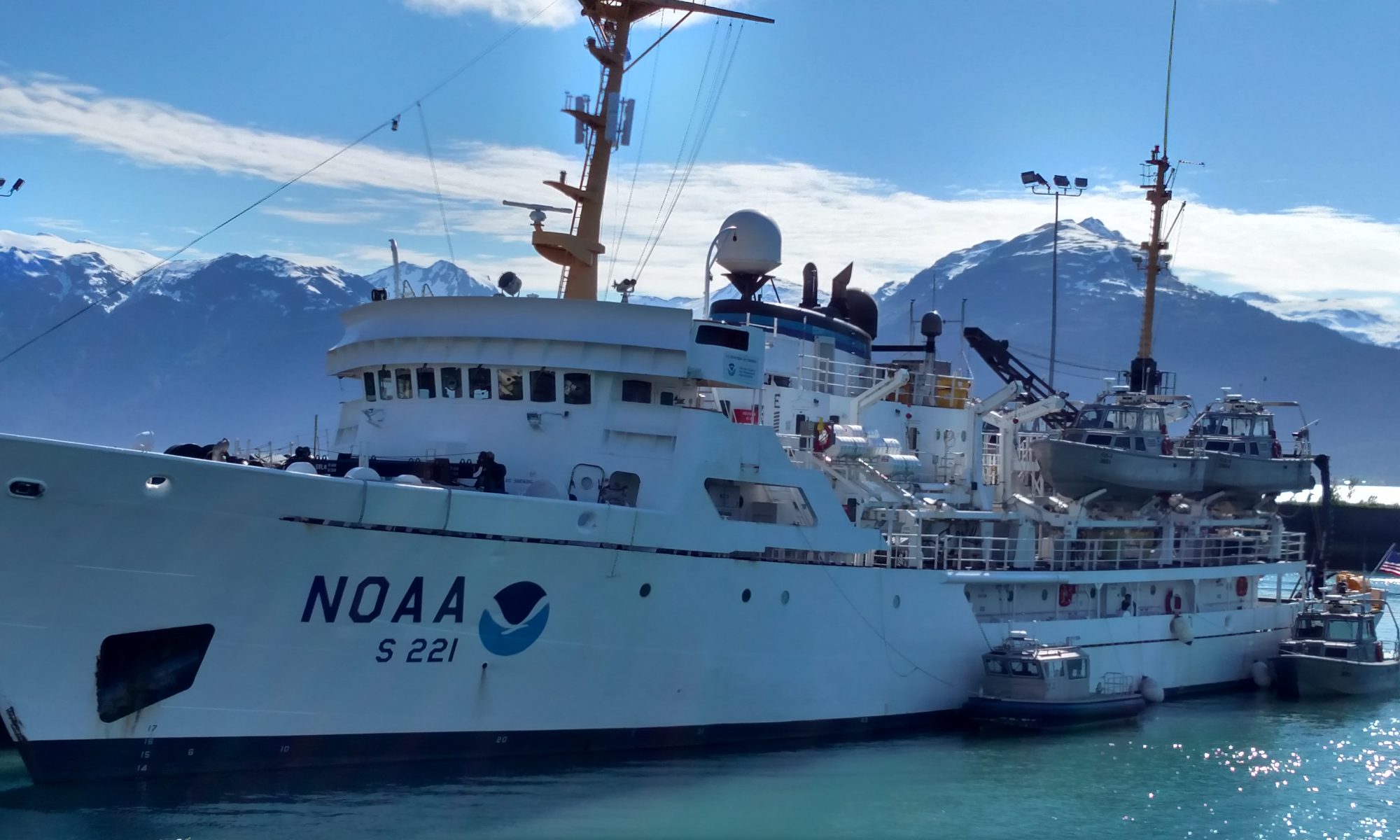
NOAA Ship Fairweather (Courtesy of NOAA)
I am very excited to take part in this research. Being chosen to be a Teacher At Sea and learn along other scientists, take part in important research and travel to an area I have never seen before excites me to think of what all learning opportunities I will be able to bring back to my classroom. Most of all, I am excited to share with my students what a scientist’s life may look like; as they may get inspired themselves.
The weather in Alaska looks like it is in the 50’s and 60’s during the day and down into the 40’s at night, so I am packing a bit warmer clothes then I have been wearing the last week. Along with my awesome new NOAA Teacher At Sea swag I received to make me feel like one of the gang.
Mission: Hydrographic Survey of navigable waters to develop and update navigational charts. At sea June 25 – July 9, 2018. Geographic Area of Cruise: Lisianski Strait, along the SE coast of Alaska followed by transit of the Inside Passage to home port in Newport, OR. Date: June 21, 2018, the Summer Solstice!
Weather Data from the Bridge [okay, the front porch at home!]:
44.1589° N, 94.0177° W Current Weather: Light Rain, 70°F (21°C)
Humidity: 79%
Wind Speed: E 15 mph
Barometer: 29.81 in
Dewpoint: 63°F (17°C)
Visibility: 10.00 mi
Welcome! It’s nearly time to embark on this adventure! I’ve always appreciated chances in life to explore and learn about different parts of the world. Recently I’ve enjoyed the book “One Earth, Two Worlds” by the Minnesota SCUBA diver Bill Mathies. I’m fascinated by the realm of underwater exploration. A large percentage of our planet has never even been seen by humans! NOAA’s hydrographic research vessels are in place around the world to map the ocean floor and promote safe navigation.
Science and Technology Log I am Eric Koser and I live in southern Minnesota where I have worked with students learning about physics for 24 years. I teach at Mankato West High School, one of two mid-sized high schools in our river community of about 100,000 people. Mankato and North Mankato are the regional hub of south-central Minnesota. Our school district is home to about 9000 students K-12. Our community has particular strengths in manufacturing, education, and healthcare. Read more here at greatermankato.com! I teach a variety of physics courses at West including AP Physics and Physics First at grade 9. I love to engage kids in learning physics by helping them to discover patterns and systems in nature. I really enjoy developing experiments and demonstrations to illustrate ideas. I also coach our YES! Team as a part of our Science Club here at West. Youth Eco Solutions is a program to support students to make positive energy and environmental based changes in their communities. These kids have tackled some big tasks – replacing styrofoam lunch trays with permanent trays, updating our building lighting’s efficiency, and systematically monitoring campus electrical usage.
Personal Log My wife Erica and I have four kids that we love to support. They are currently ages 20, 18, 15, and 10 and always on the move. Our oldest, Josh, is an engineering and technical theater student at the U of MN. Our next, Zach, just graduated from high school and is rebuilding a small hobby farm and an 1800’s house to become his rural home. Ben is an avid photographer now working at a local photo studio shooting professionally for events. Meron is headed to fifth grade– she is our most social kid who loves being with her friends and our many pets here at home.
“Team Koser” – our immediate family.
Our summers often involve many days at ‘the lake’, a place we enjoy in northern Minnesota with extended family. We love to fish, swim, kayak and explore the water there. As a SCUBA diver, I’ve begun to explore below the surface of the water as well.
Lake diving in Minnesota can be chilly! – Photo by Ben KoserBen captures the last of this Minnesota lake sunset – photo by Eric Koser
This summer has also involved lots of construction on Zach’s farm as we bring a once gutted two-story house into a finished home.
Zach’s Minnesota Hobby Farm – photo by Eric Koser
In a few short days, I look forward to joining the NOAA Ship Rainier on a hydrographic survey of Lisianski Inlet on the SE coast of Alaska. I’ll meet up with the Ship in port at Sitka, Alaska.
NOAA Ship Rainier – Photo courtesy NOAA
The Rainier is a 231 foot long ship equipped with a variety of tools to digitally map the bottom of the ocean with the goal of updating and improving navigational charts. I look forward to meeting and working alongside the experts on Rainier while I learn everything I can about the important work that they do. I look forward to bringing questions and ideas to my students and community during and after this experience!
Questions!
The Rainier design specifications list a “draft” of 14.3 feet. What does this mean?
This ship displaces 1800 tons of water. What does this mean?
How could you determine the ‘footprint’ of the ship in the sea based on these two pieces of data? What is the average area of the footprint of this ship?