Robert Oddo, July 14, 2009

NOAA Teacher at Sea
Robert Oddo
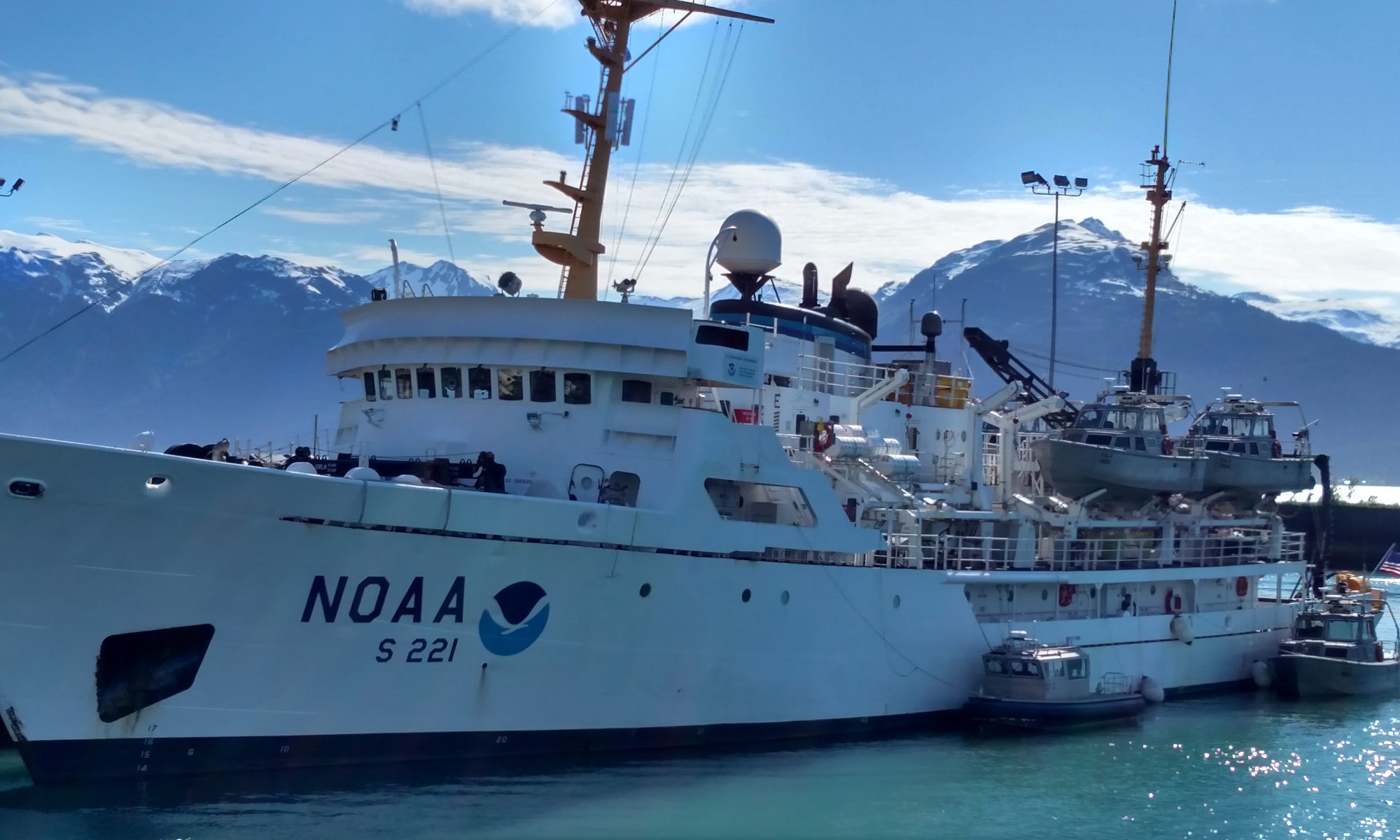
Onboard NOAA Ship Ronald H. Brown 
July 11 – August 10, 2009 

Mission: PIRATA (Prediction and Research Moored Array in the Atlantic)
Geographical area of cruise: Tropical Atlantic
Date: July 14, 2009

Deploying a radiosonde

Weather Data from the Bridge 
Outside Temperature 26.01oC
Relative Humidity 89.26
Sea Surface Temperature 28.3oC
Barometric Pressure 1015.9 inches
Latitude 8o 53.96 N Longitude 48o 05.43 W

Science and Technology Log 

We released our first radiosonde this morning.  These balloons have instruments attached to them that will measure atmospheric pressure, temperature and relative humidity as they go up into the atmosphere.  As the balloon rises, it expands as the atmospheric pressure outside the balloon decreases. After about 2 hours the balloon bursts and falls back into the ocean. Four of this particular type of radiosonde will be released every day.  This data is used as input for weather prediction models, weather and climate change research, input for air pollution models and ground truth for satellite data.

Radiosonde is off!
Radiosonde is off!

We also deployed our first global drifter this afternoon. A surface drifter consists of a buoy and a sea anchor. The drifters have sensors that can measure sea surface temperature and the ocean current.  Information is collected by the sensors and uploaded to a passing satellite and then transmitted back to Earth where all the information from all the drifters give us a better picture of what is happening out in the ocean. Drifters are deployed from hurricane hunter aircraft so we can better predict and understand hurricanes. Data from drifters was used to determine where floating debris would be found shortly after the disappearance of Air France flight 447 on May 31, 2009.  For more information on the NOAA Global Drifter Program, visit their website.  

Personal Log 

The drifter buoy is deployed.

I have received a couple of emails asking about the food on the ship.  We have three meals a day and there is quite a selection. For breakfast, you can have pancakes, eggs, sausage, oatmeal, fresh fruit or a selection of dry cereal.  For lunch, it really varies; today there was a salad, hot dogs, hamburgers and french fries.  Dinner also varies, but so far we have had fish, ribs, chicken and a salad. There is also a veggie option for each meal.  Coffee, tea and other beverages as well as some snack items are pretty much available 24 hours.

Our dining hall
Our dining hall
Tracking the cruise plan

Robert Oddo, July 13, 2009

NOAA Teacher at Sea
Robert Oddo
Onboard NOAA Ship Ronald H. Brown 
July 11 – August 10, 2009 

Mission: PIRATA (Prediction and Research Moored Array in the Atlantic)
Geographical area of cruise: Tropical Atlantic
Date: July 13, 2009

Weather Data from the Bridge 
Outside Temperature 27.7oC
Relative Humidity 80.16
Sea Temperature 28.2oC
Barometric Pressure 1013.76 inches
Latitude 10o 21.11 N Longitude 52o 13.67 W

The replacement PIRATA Buoy

Science and Technology Log 

We have been steaming at full speed towards our first buoy. To the right you can see a picture of the replacement buoy that is on the back of the ship.  This buoy will be lowered into the water using cranes on the ship and then anchored in place. These buoys are anchored on the bottom of the ocean, which is very deep here in the Tropical Atlantic.  The ocean here right under this ship is 4,990 meters or 16,371 feet deep. That’s a lot of chain to attach to the anchor!!  A picture of the buoy instruments that will be redeployed are on the right.  There are other instruments that extend down into the ocean.

Personal Log 

Anchors for the buoys ATLAS buoy instruments that will be redeployed
Anchors for the buoys

I was wondering how we were going to deal with time as we traveled to the East.  A notice was put up yesterday telling us that we should change our clocks from 4 hours ahead of Greenwich Mean Time to 3 hours ahead of Greenwich Mean Time.  This ship has things going on 24 hours, so it is really easy to lose track of time and the day.

All in all, it is pretty comfortable on board and the people are very friendly. If you need to take a break from your work you can watch a video, read in the library, or sit out on the back deck of the ship.

Anchors for the ATLAS buoy instruments that to redeploy
Anchors for the ATLAS buoy instruments to redeploy
Cruise ship plan
Cruise ship plan
We change our clocks as we move east

Robert Oddo, July 12, 2009

NOAA Teacher at Sea
Robert Oddo
Onboard NOAA Ship Ronald H. Brown 
July 11 – August 10, 2009 

Mission: PIRATA (Prediction and Research Moored Array in the Atlantic)
Geographical area of cruise: Tropical Atlantic
Date: July 12, 2009

Weather Data from the Bridge 
Air Temp 27.5o C(81.5F)
Relative Humidity 76.63
Sea Temp 28.22
Barometric Pressure 1015.15 inches
Latitude 11o42.80 North Longitude 56o 07.33 West
Traveling at 10.7 knots

Setting up the lab
Setting up the lab

Science and Technology Log 

There is a lot of unpacking and setup that has to be done on a scientific cruise like this one. Researchers were busy today getting schedules setup, equipment working and orienting themselves to their workspaces. We are now steaming directly to 0o, 23oW to service a buoy in the PIRATA backbone that has not been transmitting data since 21 June 2009.

Yesterday, I wrote about PIRATA (Prediction and Research Moored Array in the Atlantic). Another project that is also going on simultaneously is the Aerosol and Ocean Science Expedition (AEROSE).  Saharan dust storms are estimated to inject three billion metric tons of mineral aerosols a year into the troposphere. The aerosols impact precipitation, fertilize the ocean, and change the air quality and impact ecosystems in the Caribbean and the US eastern seaboard. Red tides, increased rates of asthma and changes in precipitation in the eastern Atlantic and Caribbean have been associated with this dust from the Sahara. The data collected from this cruise will help us understand better the impact of his Saharan dust on the Caribbean and the US eastern seaboard.

Here I am out on the back deck.

One must be prepared for emergencies at sea and today we had an abandon ship drill and a fire drill. There are 49 people aboard the Ronald H. Brown and it is important to know what do in case of an emergency and make sure everyone is accounted for.

Personal Log 

We got underway from Barbados yesterday afternoon and the seas were described as being a bit “lumpy”.  I noticed little by little people seemed to disappear and was wondering what was going on and then it hit me.  Nausea, cold sweats and not being to get comfortable at all.  I got real sleepy and found a spot in the library and crashed for a couple hours. There is really no place to go. I woke up around dinner, took some seasickness medicine and hung out for the rest of the evening. Believe me, I was not the only one trying to get their sea legs.  There were very few people around. It takes time for the body to adjust to the rocking of the boat and some adjust faster than others.  This morning, I feel much better.

The course we have taken since we departed from Bridgetown
Sunset from the back of the ship

Robert Oddo, July 11, 2009

NOAA Teacher at Sea
Robert Oddo
Onboard NOAA Ship Ronald H. Brown 
July 11 – August 10, 2009 

Mission: PIRATA (Prediction and Research Moored Array in the Atlantic)
Geographical area of cruise: Tropical Atlantic
Date: July 11, 2009

NOAA Ship Ronald H. Brown docked in Barbados

Weather Data from the Bridge 
Air Temperature 27.6o C (81.7o)
Relative Humidity 82.6%
Sea Surface Temperature 28.4oC (83.1oF)
Atmospheric Pressure 1014.8

Science and Technology Log 

The Prediction and Research Moored Array in the Atlantic (PIRATA) is project that is monitoring the upper ocean and near surface atmosphere of the Tropical Atlantic.  This is done by the deployment and maintenance of moored buoys and meteorological stations across the Atlantic. One of the purposes of this cruise is to do maintenance work on some of the buoys. The last couple of days have been spent loading equipment onto the ship and preparing the ship for this mission.

One of the science labs with equipment ready to be unpacked

There is an incredible amount of preparation for a cruise such as this one. Scientific equipment must be packed carefully, shipped to the location where the ship is docked, and then unloaded and set up. If you forget something you might not be able to collect some of the data that you hoped to obtain. The data collected from this array of buoys will lead to a better understanding of an area of the Atlantic which is the main development region of tropical cyclones that threaten the United States.

Personal Log 

Arrived in Barbados late on the night of July 9th. Got to the R. H. Brown early on the morning on the 10th. Spent most of the day getting situated and meeting members of the scientific team as well as the crew.  Berths are small but comfortable.  I was surprised at all the amenities on the ship.  There is wireless Internet, a ship store, movies at 5:30pm and 7:30pm, laundry and even an exercise room with free weights, and elliptical and a treadmill. We attended an orientation session this morning regarding ship procedures, safety and general life onboard the R. H. Brown. 

Picture of my berth.  I have the top bunk.
Picture of my berth. I have the top bunk.
 Practicing getting in and out of immersion suits
Practicing getting in and out of immersion suits 

Robert Oddo, July 15-20, 2009

NOAA Teacher at Sea
Robert Oddo
Onboard NOAA Ship Ronald H. Brown 
July 11 – August 10, 2009 

Mission: PIRATA (Prediction and Research Moored Array in the Atlantic)
Geographical area of cruise: Tropical Atlantic
Date: July 15-20, 2009

Weather Data from the Bridge 
Outside Temperature 24.19 oC
Relative Humidity 78.87
Sea Temperature 24.28 oC
Barometric Pressure 1016.0 inches
Latitude 00o 12.5 N Longitude 23o 37.28W

The CTD
The CTD

Science and Technology Log 

We have been steaming at around 10 knots(approx 11.5 mph) 24 hours a day to our first buoy. The scientists on board are preparing equipment for the work that awaits them once we arrive at our first stop, 0 degrees 01.0 South latitude, 22 degrees 59.9 West.  Replacement tubes for the buoys are being readied and the “CTD” is being prepared for deployment.  The “CTD” is the name for a package of instruments that is lowered in the water that includes sensors that measure conductivity, temperature and the depth of the seawater. Conductivity and temperature are important since salinity can be derived from these values.  The CTD is connected to the ship by means of a cable through which real-time data can be sent back to scientists on the ship as the winch lowers and raises the CTD through the water. The metal frame around the CTD has a number of bottles attached to it that collect seawater samples at various depths.  This water then can be analyzed back in the laboratory when the CTD is brought back on board. 

We have deployed a number of drifters as we are making our way to the first stop.  For the last couple of days, we have not been allowed to collect any data as we traveled through the territorial waters of Brazil. On the night of July 19th we launched an ozonesonde. An ozonesonde transmits information to a ground receiving station information on ozone and standard meteorological quantities such as pressure, temperature and humidity. The balloon ascends to altitudes of about 115,000 feet (35 km) before it bursts.

Deployment of the ozonesonde

Personal Log 

A few days ago, I toured the bridge of the ship. There is always one officer on the bridge and also a person on watch. Unfortunately there is not a big wheel like I imagined up there to steer the ship (I always wanted my picture at one of those big wheels). But there are a number of thrusters that you maneuver the ship with.  There are also a number of radar screens that enable one to see surrounding objects and well as computers that allow the ship to run on different auto pilot modes. Before a radiosonde or a buoy is launched, one needs to inform the bridge and the operation is logged in. You really get a unique perspective of the ship from up on the bridge.

I have spent hours on deck watching for signs of life out in the ocean. We did have a pod of dolphins of our bow one day, flying fish seem to be out there all the time and one day we believe we saw a pod of false killer whales (maybe).  I expected to see some birds, but so far not one.

Here I am at the helm of the Brown.
Research cruise plan