Karen Grady: It’s Not ALL About The Sharks! April 18, 2017

NOAA Teacher at Sea

Karen Grady

Aboard NOAA Ship Oregon II

April 5 – April 20, 2017

Mission: Experimental Longline Survey

Geographic Area of Cruise: Gulf of Mexico

Date: April 18, 2017


Weather Data

Latitude 2827.10
Longitude 09148.6
75 degrees
Sunny
No precipitation
Winds at 10 KTS
Waves at 2-4 FT

Science and Technology Log

There are always many things happening on a research vessel. As we moved from station to station, scientists Paul Felts and Kevin Rademacher have been deploying a trolling camera with a lure attached. I asked Kevin about the camera and he explained what they are trying to accomplish.  The ultimate goal of this experimental camera system is to help develop an index of abundance for pelagic species (billfish, dolphinfish, King mackerel, tunas, etc) to be used in stock assessments for those species.  Currently, there are no fishery independent indices for adults of these species. We are trying to achieve this by attaching a camera in front of a hook-less trolling lure. If it is successful, the plan is to deploy it when running between stations on all of our surveys. This would give us enough samples to hopefully create an annual index for these species.

This trip they have taken the system from the idea and initial system build back at the lab, and are trying it in the real world; modifying portions that are not working to get it to work. What is desired is towing the system to where the lure is acting as potential prey, is not being negatively affected by the vessel’s propeller wash or bubbles from the vessel or waves, at a vessel’s transit speed, and is depth adjustable.

a

The scientists were working opposite watches and during watch changes they would share what they had observed and discuss small changes that they wanted to make to obtain better results.   The camera allowed them to watch video footage to assess how clearly the lure could be viewed under the water as it traveled behind the ship.  The ship’s crew up in the bridge worked with the scientists requests for the changes in speed they needed for short periods of time while the trolling camera was in the water during a transit to another station.

The longline hooks often yield other species besides sharks. On one set we caught 3 king snake eels, Ophichthus rex, that have long bodies, that are very stoutly built.  Instead of a tail fin they have a fleshy nub.  One of them was almost as long as scientist Paul Felts is tall.  This species is distributed in the Gulf of Mexico.  It is often caught around oil rigs.  The species is consumed on a very small scale and is prepared and sold in Florida as “keoghfish”. This a burrowing species that inhabits mud, sand and clay between 15-366 meters deep.  King snake eels may reach sizes up to 11 feet.


2
Paul Felts weighs a large King Snake eel


3
King Snake eels don’t like to stretch out for measurements. It took a few extra hands to get this large one to cooperate.


Personal Log

What is a day in the life of this NOAA Teacher at Sea like?

We are on the downhill side of this cruise. It has been full of so many amazing things. I miss my family and will be ready to see them, but am so thankful for this experience.  Life on the ship is quite a unique experience. There are 29 of us on this cruise. But because of working 12-12 approximately half are working while the others are sleeping and having some down time.  This means we don’t see each other except around shift changes.  You are very aware of not banging things, or accidentally letting the motion of the boat slam a door because someone is always sleeping.   The berths are small but functional.  I am sharing a berth with the XO, LCDR Lecia Salerno, who is also on day watch.  You can see from the photo below that the space in any of the berths is limited.  I have the top bunk which is kind of scary for those who know how graceful I am, but as of yet I haven’t had any mishaps.

4
This is a typical berth on the Oregon II. Usually one crew member has it for 12 hours then they switch. This allows for uninterrupted sleep and  a little privacy on a small ship with 29 crew members onboard.


What is a day like onboard the Oregon II for me? I wake up around 8 am and try to convince myself to do a few minutes on the Jacob’s Ladder and a few weights for upper body.  Breakfast for me is a power bar, each watch usually eats two meals in the galley and mine are lunch and dinner.  There is time to do laundry if the washer is available. Twenty-nine people using one washer and dryer calls for everyone to be courteous and remember to get your laundry done and out of the way.  I usually spend about an hour reading or working on blogs and even some new plans for my students next year. I am lucky that the boat has wifi that bounces in and out so I can use I-message and stay in touch with some of my family and friends as well as facebook, and email.

5
Crew’s lounge where we watched the occasional movie, and I wrote all my blogs.


Lunch is at 11 and our watch eats and gets out of the way because we are on at noon and need to let the other watch get into the galley for their lunch. Did I mention the galley only has 12 seats and that courtesy is the big thing that makes life on the ship work?  When we aren’t baiting hooks, setting out the line, or pulling in the line we hang out in the dry lab.  There are computers in the dry lab and the scientists are able to work on emails, and data that is being gathered.  There is also a television and we have watched some random things over the long shifts.  Lots of laughter happens in this room, especially the more tired we get.  I will also admit that we joined the rest of the internet world in stalking April the Giraffe until she had that baby!!! There is time between sets to go do a little bit of a workout and sometimes I take advantage of this.  An important activity is hydration. You do not realize how the warm weather on the deck depletes your system.  There are notes posted reminding us to stay hydrated.  It is also important for me to keep a little food in my stomach to ward off any seasick feelings.  I try not to snack at home, but dry cereal or a piece of toast have become my friends on this cruise.  Other than the first night at sea I have not had any real queasy moments so I am going to continue this pattern as long as we are moving.  One thing is that I tend to snack and drink a lot of water.  Dinner is at 5 and occasionally it falls about the time we have to set out a line or pull in a line. This means we eat really fast and get back to work.

6
The stewards cook three meals a day out of this small galley kitchen. They did a great job of giving us menus with lots of options.

When it is time to set a line we all go out on deck and we bait 100 hooks. The hooks will be baited with either chunks of mackerel or squid.  There is nothing glamorous about this at all. If you aren’t paying attention you can even take a shot of squid or mackerel juice to the face.   When it is time to get the line in the water there are jobs for each of us.  One person puts the high flyer in the water, this marks the start and end of the line of hooks and has a flashing light for night time.  One person attaches a number to each hook’s line and hands it to the slinger who puts the hook over the side and hands the line to one of the fisherman to attach to the line and send it on its way.  One person mans the computer and inputs when the high flyer, three different weights and each hook go over the side.  The computer records the bait used, the wave height, cloud cover, precipitation, longitude and latitude of each hook.  I told you the scientists’ collect a lot of data on these cruises.  The last person scrubs the barrels clean and places them up front on the bow for the haul back.  The deck gets washed down.  The crew works hard to keep the ship clean.

8
I had no idea how much squid ink or juice one person could get on them until I learned to bait a hook with squid for long-line. Mackerel is SOOOO much better!

7
Putting the high flyer over the rail. One marked the beginning and end of each line we put out.

When the crew on the bridge gives us the 10 minute call we all dawn our life jackets, grab our gloves and head to the bow to see what we might have caught. The deck crew is getting ready to pull in the high flyer, the computer gets set up and all the necessary equipment for collecting data is laid out.  We have two measuring boards, a small sling for weighing bigger sharks on deck, two types of taggers, scales, scissors, tubes for fin clips, pliers, measuring tape, bolt cutters, data sheet, and hard hats for all.   One person works the computer, recording if we caught a fish, or whether or not there was any bait left on the hook, another person takes the line and hook and places it in a barrel ready to be baited next time, the number is removed and placed on a cable, two people are ready to “play” with the sharks and fish, meaning they will do the measurements, weights and any tagging, and one person fills out the data sheet.  It all works very quickly and efficiently.  Sometimes it gets a little crazy when we have fish and sharks on several hooks in a row. I spent most of my time doing the data recording and I must say my experience working the chutes with tagging and vaccinating cattle sure came in handy when it came to keeping the information straight.

11
Science team works check if a female bull shark is pregnant using an ultrasound machine
10
Measuring a sharp nose shark
9
Sometimes the more active sharks took more than one person to remove the hook so we could release them.

The day watch comes on shift at midnight, but they usually show up around 11:30 to visit and see what has happened on our shift. By midnight we are free to go.   I stop in the galley for a quick sandwich made of toast and ham.  Next up is the much needed shower.  We use mackerel and squid for bait and let’s just say the juice and squid ink tends to fly around the deck when we are baiting hooks.  Then you get the salty sea air, handling sharks, red snapper, king snake eels, and it makes a hot shower is much anticipated.  Lastly, I crawl into my top rack (bed) and adjust to the pitch and roll of the ship.

Did You Know

Typically, biologists can age sharks by examining cross sections of shark’s vertebra and counting the calcified bands, much like you can count the rings on a cross section of a tree trunk. The deep-water sharks we are looking for are trickier to age because their vertebra do not become as calcified as sharks found in shallower depths.

Mark Wolfgang: What Does It Take? April 18, 2017

NOAA Teacher at Sea

Mark Wolfgang

Aboard NOAA Ship Reuben Lasker

April 11 – April 22, 2017

Mission: Spring Coastal Pelagic Species (Anchovy/Sardine) Survey

Geographic Area of Cruise: Pacific Ocean

Date: April 18, 2017

Weather Data from the Bridge:

Lat: 36o 52.3’N         Long: 121o 53.9’ W

Temperature: 12.62oC (54.7oF)

Wind speed: 4 knots (4.6 mph)

Barometer:  1016.96 mbar

Conditions: Blue skies with a few clouds, smooth seas

Scientific and Technology Log:

I have been blessed to work with a great science team and I hope I have been helpful.  There is a mixture of talents and strengths, but a common love for the oceans.  Since there is always a need for reliable data, the entire team does their job with precision.

4.16 Otolith12
Fishery biologist Bev Macewicz teaches me to remove the otilith from an anchovy

I have enjoyed my conversations with them as we wait to get to a trawl location or for the nets to come in.  There are all possible careers available on the oceans.  From the NOAA Corps of officers, to the deckhands and fishermen, to the guys who work in the acoustic labs, to the engineers that make sure the ship is running properly, to the chief steward and second cook, to the science team, there are so many different potential careers if you love a life at sea.  I interviewed a few members of my science team.

Sue Manion, Chief Scientist:

DSC00046
Chief Scientist, Sue Manion, watches the deployment of a bongo net.

Sue has a B.S in Fisheries Biology from Michigan State University and worked with an aquaculture program with the Peace Corps in the Dominican Republic.  When she was in elementary school, she loved the outdoors and animals, both domestic and wild.  She
always knew she would become a wildlife biologist.  Her first position with NOAA was a temporary job as a Marine Mammal observer on a tuna fishing boat.  Sue told me that she loves the outdoor, physical work and never imagined she would get a permanent position as a sea-going fisheries biologist on the ocean.

Favorite part of the job:

“The most enjoyable part of my job is the outdoor, physical work.”

Dream job:

“I would be raising horses and running a wildlife sanctuary.”

I asked Sue, what advice would you give to a student who wanted to pursue a career in marine sciences?

“Take all the science, math, computer, and writing classes available. Learn all you can about working with hand tools and small electrical tools.”

Ed Weber, Research fisheries biologist

Ed has a B.S in Biology from the University of Michigan, M.S. in Fisheries and Wildlife Science from New Mexico State University, and a Ph.D. in Fisheries and Wildlife Biology from Colorado State University.  Ed told me he knew he wanted to do some type of

DSC00164
Ed Weber preserves specimens collected from a pairovet

biology work, but never considered a career in academia and became interested in fisheries after doing a work-study position at the USGS Great Lakes Science Center.  Most
of his experience was with freshwater fisheries and he never expected to be working in oceanography.  He was hired because of his skills in statistical analysis and programming and is “still learning a lot of oceanography.”

Favorite part of the job:

“I like the days when I finish an analysis and go home feeling like I know something that I didn’t know the day before, and neither did anyone else. Most of these are very small incremental research advances that won’t change the world, but it’s still a lot of fun.”

I loved his advice for interested students:

“I think the most important and valuable skills are those that make you a good scientist in any discipline. I suggest early-career scientists focus on critical thinking, the ability to read and synthesize information from a variety of sources, and the ability to write well. Specific tools and techniques can always be learned later. A final piece of advice is something I learned by example from one of the best fisheries biologists I know. That is to approach research with a sense of humility. Never hesitate to admit what you do not know, even if you become a world expert in your area. Then go out and find the person who does know and ask that person about the problem. An honest and humble approach to science will make you a much better than you might have thought you could be.”

Personal Log:

I think I am finally “getting my sea legs.”  I am not referring to sea sickness or getting around the ship.  The last few days, I committed myself to experiencing as much as I can since my time aboard the Reuben Lasker is ending.  I have had a lot of moments where I looked around and smiled because I never thought I would experience something like this.  I hoped for a little more biodiversity in the trawls, but that is science field work.  You get the data that you get.  As I was sorting through seemingly endless pyrosomes, I had to take a moment and realize all that I have seen.  I saw fish and marine invertebrates I only have read about.  I saw a drone take off from a ship (I will share more about that later).  I saw humpback whales swimming in pods from the bridge.  I saw Pebble Beach golf course from the ocean.  How many teachers get that opportunity?  I am a lucky guy and am committed to “soaking it all in.” I am looking forward to seeing my family soon, but I will live for each day.

Did you know?

Phronima is a genus of amphipods that live throughout the world’s oceans.  These semitransparent animals attack salps.  They use their mouths and claws to eat the animal and hollow out its gelatinous shell.  The females enter this cavity and lay their eggs inside.  Phronima propels the salp through the water as the larvae develop which provides them fresh food and water.  Hollywood used this animal as the model for the queen alien in the 1979 science fiction horror film, Alien.


4.13 Phronima
Phronima sp.


Karen Grady: Sometimes You Find A Little Something Extra, April 16, 2017

NOAA Teacher at Sea

Karen Grady

Aboard NOAA Ship Oregon II

April 5 – April 20, 2017

Mission: Experimental Longline Survey

Geographic Area of Cruise: Gulf of Mexico

Date: April 16, 2017

 Weather Data

Latitude 2848.37 N
Longitude 09247.66 W
76 degrees
Sunny
No precipitation
Winds at 11 KTS
Waves at 2-4 FT

Science and Technology Log

Sometimes when a shark or fish is brought on board it has a “hitchhiker’ attached. We caught a blacknose shark that had a common remora, often referred to as a sucker fish, or shark sucker, attached to it. Scientist Kevin Rademacher placed this sharksucker (Echeneis naucrates) on my arm. I couldn’t really feel it but he was stuck there until I peeled him off. It was like peeling a piece of tape off. You can see from the photo how he is designed to attach to host species. Their head is actually a modified dorsal fin that has an oval shaped sucking disk with slat-like structures that open and close to create suction and take a firm hold against the skin of its host animal such as a shark, turtle, whale, or ray. By sliding backward, the remora can increase its suction, or it can release itself by swimming forward. They can be small like the one attached to my arm or they can grow to over two feet in length. The remora can move around on the host, removing parasites while at the same time gaining protection provided by the host. This relationship is often looked at as one of commensalism where both the host and the remora benefit.

Photos of the remora that was attached to a black-nosed shark.

When one hears that this is an experimental long-line survey of sharks and reef fish, all you think of is catching these creatures and collecting data. However, scientists are collecting data about the environment as well. It is very useful to obtain information about the water where they catch large numbers of a species and areas where they may not catch anything. One way they can do this is by using a Conductivity Temperature Depth Profiler (CTD).

The CTD gives scientists a profile of the water column where we just put out our line. The CTD has sensors that collects information on oxygen levels, temperature, water clarity, chlorophyll concentration, and salinity. The CTD is placed in the water and allowed to sit for three minutes to let the oxygen sensors soak and adjust from being on the deck and lowered into the water. The crew lowers it to a depth that is decided based upon the depth to the ocean floor. They like to take it as close to the bottom as possible in order for the information they gather to be as complete as possible. It is allowed to settle, run its scans and then is brought back up to the surface and the sensors are flushed with fresh water. The data is automatically loaded into the database. This information is collected at each station. It takes a joint effort of the deck, science and bridge crews to place the CTD in the water. Walkie talkies are utilized for communicating between all the crew involved in the operation.

Personal Log

Being at sea with Easter approaching had its moments when I thought of family and friends. We have our Easter traditions and I would be missing them this year. The Easter Bunny (Field Party Chief, Kristin Hannan) decided we needed an early visit this year. I think she was right. The surprise and the treats perked all the science staff up.

TAS Karen Grady 4-16-17 Easter basket

FPC Kristin Hannan asks me often if I have any questions about what they are doing or anything in general. I will be honest… I have gotten so caught up in what we are doing, trying to do my best at whatever job I am working on, and being in awe that I am actually out here that I forget to ask questions about the details. I love the anticipation of what might be on the next hook, I am mesmerized by the sleek lines of the sharks when we have them on board.

TAS Karen Grady 4-16-17 shark liver
Shark liver

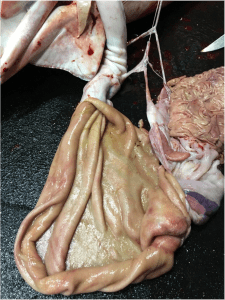
When we had one come onboard that was dead due to low oxygen levels in the water where we caught it, we did a dissection on the deck while we waited to put out another line. The animal science nerd in me came to life!   I had no idea the liver was the largest organ inside a shark. Think about it …these creatures have no body fat and they store their energy in the liver. Then we looked at the intestines. There is not a lot of room in there so the shark we looked at the intestines are rolled up like you would roll a piece of paper. This gives them maximum absorption area but takes up a limited space.


One thing I think of as we are catching these species is that very few people stop and think about the actual research scientists do to help understand what is needed to maintain healthy populations. It is necessary to do these surveys, catch the species, tag some, draw blood, take fin clips, keep whole specimens, and dissect some. On our cruise we were lucky enough to ultrasound a few pregnant sharks and see the pups inside.

TAS Karen Grady 4-16-17 shark ultrasound
Baby sharks visible on ultrasound

Now stop and think about all those things I just listed that we do at times. When a hook comes up and there is a fish or shark on it is handed off to one of the science crew.  It is noted in the computer that there was a something caught. The science crew member will take measurements and weight of the fish or shark. If it is a shark, the sex will be noted and some species may be tagged, have a fin clip taken and blood drawn. While all of these activities are taking place, the next hooks keep being brought up. The deck can get pretty crazy if there are several hooks in a row with something on them. The data collector has to keep tag numbers, species, measurements, samples and weights all written in the correct spot while having two or three people calling them out for different fish and or sharks. I had experience working cattle which would mean filling syringes, writing down tag numbers, filling taggers, etc. But this is even crazier than that could get at times. And everything stops if someone calls “hardhats” because that means we have one big enough for the cradle. Working back writing down data or taking measurements you can’t see what is on the next line so you sneak up for a peak when they say it’s a big one then you get out of the way.   One of the best experiences so far was almost getting a big tiger shark in the cradle. I was lucky enough to get a video of her, so stay tuned! Unfortunately, when the big shark brushed against the cradle she snapped the line and was gone with a huge spray of water.

This second leg of the experimental long-line survey is winding down. There have been long days but they are filled with laughter, giggles, anticipation, excitement, teachable moments (I can finally get the circle hooks out by myself…sometimes) , and the dreaded words “snapper.” I mean nothing against the Red Snapper, they are a bright colorful and tasty fish, but when you are hoping for a shark to be on the hook…. let’s just say the sets where we get 12 snapper and two sharks are not our favorites.

Photos: “Shark!” or “Fish on!” means a busy deck.

TAS Karen Grady 4-16-17 hammerhead cradle
Scalloped hammerhead shark

When the guys at the rail grab the hard hats it means it is time for the cradle and we get to see things like this gorgeous scalloped hammerhead. Things move very quickly when one is in the cradle. Safety for those on deck comes first and everyone is focused on getting measurements, fin clip and a tag on the shark and getting it safely back in the water as quickly as possible.

TAS Karen Grady 4-16-17 baby tiger shark
Baby tiger shark

Baby tiger shark in the cradle. They warned me that they were cute and they were so right. Yes, a shark can be “cute” when your referring to baby tiger sharks and baby hammerheads!

Did You Know

Sharks store energy in their liver. It is the largest organ in their body. The heart on the other hand is extremely small in comparison to the size of the shark.

TAS Karen Grady 4-16-17 hammerhead dissection
Dissected scalloped hammerhead with liver visible

Look at the liver of this scalloped hammerhead. It is amazing how big it is in relation to the body of the shark. This is just one way these amazing creatures are designed to be efficient and survive in their underwater world.

Sharks have a nictitating membrane that they can close over their eye for protection. When a shark is brought on deck you can touch near the eye and the membrane will automatically move to close.

TAS Karen Grady 4-16-17 nictitating membrane
Nictitating membrane partially closed on the eye of a scalloped hammerhead

Mark Wolfgang: Fish Eggs, I Will Take Mine Over Easy; April 15th, 2017

NOAA Teacher at Sea

Mark Wolfgang

Aboard NOAA Ship Reuben Lasker

April 11 – April 22, 2017


Mission: Spring Coastal Pelagic Species (Anchovy/Sardine) Survey

Geographic Area of Cruise: Pacific Ocean

Date: April 14, 2017

Weather Data from the Bridge:

Lat: 35o 47.1’N         Long: 122o 58.8’ W

Temperature: 14.9oC (59oF)

Wind speed: 29 knots

Barometer:  1020.92 mbar

Conditions: Windy, blue skies with a few clouds, choppy seas

Scientific and Technology Log:

The research into the fish that live in this area of the Pacific Ocean investigates the entire life cycle.  The night trawls will usually catch adults or juveniles.  There are other techniques to collect eggs and larvae.  One of these techniques is a Continuous Underway Fish Egg Sampler (CUFES).

DSC00050
The Continuous Underway Fish Egg Sampler (CUFES)

There is an intake valve 3m under the surface of the water and it is collecting water (and anything living in it) all the time.  As the Reuben Lasker moves along a transect water is collected through this machine and filtered.  Every 30 minutes, the specimens that have been collected are removed, counted, and identified under the microscope.  The samples are then rinsed into small vials, preserved in formalin and are labeled and stored.  On this survey, they are looking for sardine, anchovy, jack mackerel, hake, and squid eggs.  The sample also has numerous copepods, but those are not counted and recorded.  So far, we have found mostly jack mackerel and squid eggs which are reflected in our catches during the night trawl.

A second technique involves nets dropped off the side of the ship.  The first is net called a

DSC00040
Deck hands and the chief scientist deploying the pairovet from the side station

pairovet.  A pairovet is a vertical plankton tow.  The net is dropped off the side of the ship
to a depth of 70 meters.  The net stays in place for 10 seconds and then are pulled back up.  The specimens collected are rinsed into containers.  One net’s collection is placed in formalin, a preservative, for later identification, while a second net’s collection is placed in ethanol for possible DNA analysis.  The other net is called a Bongo Net.  This net is an oblique tow and is dropped to a depth of 210 meters and is pulled in at an angle of 45o.  The contents are preserved for later identification and possible DNA testing.  The pairovet has a finer mesh to the net, so it collects smaller zooplankton and icthyoplankton.

DSC00046
The Bongo net being lowered into the waters off of Big Sur


The trawls on the night of the 12th had some Jack mackerels, some larger squid, a couple octopi, and a single sardine.  For the Jack mackerel and sardine, we recorded their length

DSC00035
Jack Mackerel

and mass.  We also took tissues for DNA analysis as well as the gonads for female sardines, anchovies, Jack mackerel, and Pacific mackerel.  These will be used for histology and fecundity studies.  Fecundity is the ability to produce an abundance of offspring or their fertility.  We remove a small, hard structure called the otolith.  The otolith is found in the inner ear and maybe used for balance.  The otolith can be used for aging the fish.  We had high winds on the 13th, so we were only able to one trawl.  Ironically, we watched “Finding Dory” while we waited for the bridge to say it was safe to let out the trawl nets.  We didn’t find her.

Personal Log:

It has been quite challenging changing my sleeping schedule.  Not only am I all screwed up with the 3 hour time difference from home, I am currently working the night trawls from 6 pm to 6 am, although the heavy work doesn’t begin until after sunset.  I was awake for 28 hours straight, but was able to get some sleep and relax some this afternoon.  I got a chance to call home and talk to my family.  It has been difficult being away from them and not getting a chance to talk, but I had that opportunity today.  For that I am thankful.  There were some plans to fly the drone when we arrived at the coast of Big Sur, California, but the winds were too high to do so.  I continue to be impressed with the scientists and crew.  I love watching the team work – it is quite impressive.  As we moved up the coast today, I took a few minutes to look around and soak it all in.  Big Sur was beautiful, the sky was clear with only a few clouds, and the water was a deep rich blue.  It was gorgeous.  I am so glad I took a moment to realize how lucky I am.

DSC00038
Big Sur, California


Did you know?

The Pacific Ocean is the biggest ocean in the world.  It contains 30% of the space in the earth and contributes half of the water to the world.  It is also the deepest ocean in world, counted at 3800 m.  I am currently traveling through the Northern Pacific Ocean.

Karen Grady: One Fish Two Fish Red Fish …… Weird Fish, April 10, 2017

NOAA Teacher at Sea

Karen Grady

Aboard NOAA Ship Oregon II

April 5 – April 20, 2017

Mission: Experimental Longline Survey

Geographic Area of Cruise: Gulf of Mexico

Date: April 10, 2017

Weather Data

Latitude 2827.10
Longitude 09148.6
75 degrees
Sunny
No precipitation
Winds at 10 KTS
Waves at 2-4 FT

Science and Technology Log

We have continued to move between deep stations setting the baited line and hoping to catch deep water fish and sharks. These deep sets require longer soaking time to allow the hooks to reach the bottom.   The downside is that we have been retrieving one set of gear and putting out one set of gear in a 12 hour period of time. Some sets have a few fish and some we get a big goose egg.   There is always anticipation though as the 100 hooks are brought up. Everyone stands in their spots waiting to hear either “fish on,” “shark” or everyone’s favorite, “hard hats!” which means there is a big shark and it’s time for the sling. Below you will see the awesome Great Hammerhead (Sphyrna lewini) we caught.

TAS Karen Grady 4-13-17 great hammerhead
Great Hammerhead Shark

The first few days we have been fishing deep in the Mississippi Canyon. The Mississippi Canyon is a geological formation in the Gulf of Mexico. It is located in an area which is part of the territorial waters of the United States. We put out some deep lines with the deepest at 1900 feet. These lines soaked four hours once fully deployed.  They soak longer because they have so far to sink to get to the depth the scientists want to fish at. When we deploy a line the first thing in the water is the High Flyer, which stands like a beacon and bobs in the water marking the start of our fishing line. The next thing over the side of the ship is a weight that helps carry the line to the desired depth. Halfway through, another weight is deployed, and after the 100th hook, the third weight goes in.   The last thing over is another High Flyer to mark the end of the line. If it is dark outside, the High Flyers have lights attached on top that flash so that they can be seen.

TAS Karen Grady launching high flyer
“High Flyers” mark the beginning and the end of the long line set.

At our last deep station we caught a Mexican Grenadier, Coryphaenoides mexicanus. This fish is very unusual in color and appearance. If you feel the scales on the fish you find that they are very unique. Each scale has tiny sharp, thin spinules. As you run your hand over the fish you can feel these scale modifications. The eyes are bulged due to the pressure change of coming up from such deep depths. The scientists determined the sex of the Grenadier and then it was frozen for future study.

TAS Karen Grady 4-13-17 grenadier
Mexican Grenadier

We also caught two Cutthroat Eels, from the family Synaphobranchidae, that were both females. Synaphobranch means unified gill… the two gill slits join together making it look like a cut throat. They are bottom-dwelling fish, found in deep waters. The eels were weighed, measured, and the scientists determined the sex and maturity of each eel. It is important that they make accurate identification of specimens and collect data. The scientists work together using personal knowledge and books when necessary. There are times on deck when the scientists will stop to examine a species and will take multiple pictures of certain identifying parts so that they can look at them closely later.


Personal Log

One of the great things during a watch is being able to talk with the scientists. I am an avid listener and observer. This is what they do year in and year out and they love what they do. I am a quiet observer a lot of the time. I listen and then ask questions later. It’s not exactly easy to carry around paper and pencil to take notes. But during the transit portions or soak times I ask more questions and gather information to share in my blog posts or for the lesson plan I will be writing when I get home.

The food has been great here on the ship. Our stewards have fresh salads, and menus that include two main course options, a daily soup, dessert and multiple side choices.   There are snacks available 24/7 so you are never hungry. Because the meals are so great you see most people trying to fit in a workout during the day. I have been introduced to the Jacob’s ladder for workouts. I never liked hills and now I can say I don’t like climbing ladder rungs either. That machine is evil!! However, I will continue to do cardio on it as the food is excellent and keeping food in your stomach helps prevent sea sickness. I will happily eat more than I usually do if it means I don’t get seasick. An example of a typical lunch would be today when we had choices of salad, reuben, tuna melt, french fries, sweet potato fries, cookies and several other sides.

Today started with us catching two Cutthroat Eels and a Mexican Grenadier. You can see from the pictures I have posted that they look very different from most fish that you see. They really are that color. It was a shock after the sleek sharks and the bright orange Red Snapper I had seen on previous sets. I was busy watching the scientists using their books and personal knowledge to identify each species accurately.   After we finished the work up on the fish we caught we headed for the next station. Now we are back to shallower fishing and expect to catch sharks, red snapper, and a variety of other fish.

TAS Karen Grady 4-13-17 grenadier and eels
Two cutthroat eels (top) and Mexican grenadier (bottom)

I can honestly say that the 12 hour shifts start wearing you down, and sleeping is not an issue once you climb under the covers. The waves will wake you up now and then. And some mornings I wake up and can smell them cooking breakfast but sleep overrides the smell of food because I know how long it will be till I get to bed again. Walking out on deck each morning to views like this does lead to a smile on your face, that and the music that is playing loudly on the deck. Yesterday it was Hair Nation…. taking me back to the 80’s.

TAS Karen Grady 4-13-17 blue water
View from the deck of NOAA Ship Oregon II

Did You Know?

The Gulf of Mexico is roughly 995 miles along its longer, east-west axis. It has a surface area of about 600,000 square miles.

A wide variety of physical adaptations allow sharks to thrive in the Gulf of Mexico. They have powerful smell receptors. The sensory organs lining their prominent snouts, called ampullae of Lorenzini, can detect movement of potential prey even if the sharks cannot see it. These sensory organs assist in trailing injured marine animals from great distances. They help sharks locate all sort of other things, too– shrimp boats, other sharks, birds, turtles (tiger sharks a big turtle eaters!), even boats that are dumping trash.

The skin on a shark is smooth if you run your hand head to tail and rough like sandpaper if you run your hand from tail to head. At one time, sharks skin was used as a form of sandpaper. The dermal denticles, or skin teeth, can be different from species to species and can sometimes be used as a character to look at when trying to identify one species from another.