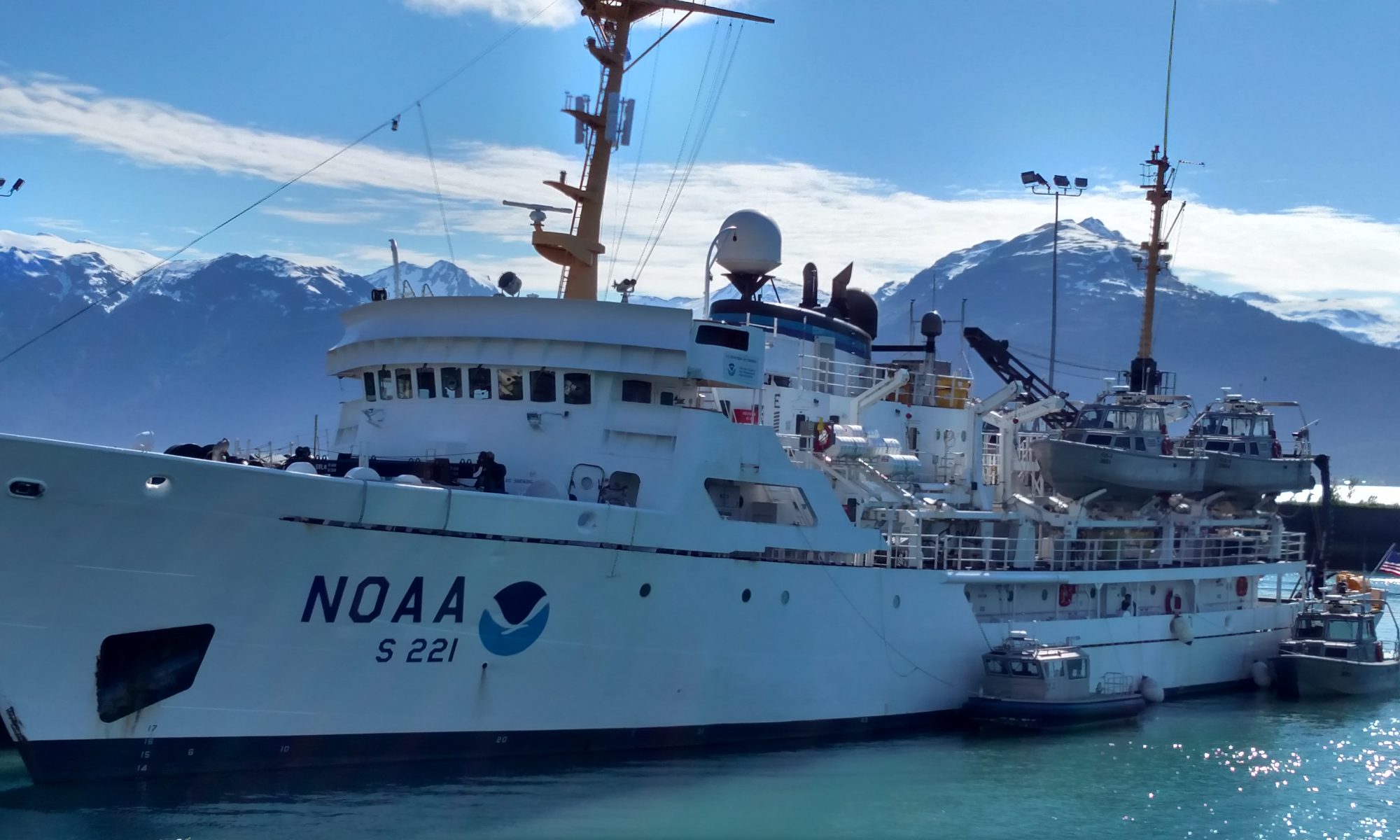
Krista Fleming: From Otoliths to Officers: Exploring the Science and Mission of NOAA, Sept. 20, 2026

NOAA Teacher at Sea

Krista Fleming

Aboard NOAA Ship Oregon II

September 5-20, 2026

Mission: Shark/Red Snapper Bottom Longline Survey, Leg 3

Geographic Area of Cruise: Western Gulf of America

Date: September 20, 2026

Science and Technology Log: Otoliths, Red Snapper, and SEDAR

One of the things I’ve really enjoyed about this trip is how willing the scientists are to explain their research. I’ve learned quite a bit about otoliths, small structures inside a fish’s head that help with balance and hearing. They also record a fish’s growth throughout its life. By studying the growth rings in an otolith, scientists can determine the age of a fish, much like counting the rings on a tree.

Dr. Tera Winters studies otoliths and the information they provide about fish age and growth. Knowing the age of red snapper helps scientists understand how quickly they grow, when they mature, how long they live, and the age structure of the population. It gives scientists a better idea of what is happening within the population rather than simply knowing how many fish were caught.

I even had the opportunity to remove otoliths myself. We caught a red snapper that had been partially eaten—we assume by a shark—so I removed its otoliths to bring back and use when teaching my students. I also assisted Dr. Trey Driggers and Dr. Winters with removing otoliths from other red snapper that will be used for further research. It was a great opportunity to take something I’ve learned aboard the ship and bring it back to my classroom.

close-up photo of two fish ear bones extracted, cleaned, on a surface
Otoliths that I removed from a red snapper!

The information collected from these otoliths becomes part of SEDAR (Southeast Data, Assessment, and Review), which brings together years of data from scientific surveys, commercial and recreational fisheries, and biological samples to assess fish populations. These assessments help scientists and fishery managers understand population size, age structure, growth, and mortality, and provide information used in making decisions about managing fisheries. It’s pretty amazing to think that something as small as an otolith can help tell the much bigger story of red snapper in the Gulf of America.

Krista, wearing a life vest, boots, yellow gloves, and her Teacher at Sea hat, stands on the aft deck of NOAA Ship Oregon II. she holds up a red snapper in each hand, grasping the line still connected to the hook in each fish's mouth. the sky and water are bright blue.
Two red snapper that were saved for research purposes.

Personal Log

Before I left, I got the chance to tour the engine room with Mike Fountain, a Junior Engineer aboard the NOAA Ship Oregon II. He showed me how the engineering crew keeps all of the ship’s systems running. One thing that surprised me was that we take salt water and turn it into drinking water right here on the ship. Mike showed me the system and explained how the process works.

I was amazed by the size of the engines and the number of gauges and systems they have to monitor. There are so many things happening below deck to meet the needs of everyone onboard and keep the ship running.

I also met with Chief Engineer Joe Howe, who gave me more insight into the day-to-day operations in the engine room. He explained just how much the engineering crew has to keep track of while we are at sea.

I’ve spent most of my time learning what happens on the deck and in the labs, so it was interesting to get a look at another part of the ship. It definitely gave me a greater appreciation for the crew members working behind the scenes to keep the NOAA Ship Oregon II moving and all of us supported while we do our work at sea.

view of the two engines aboard NOAA Ship Oregon II. they are CAT brand engines, painted yellow, surrounded by white piping.
Ship Engines

NOAA Corps Aboard the NOAA Ship Oregon II

One of the things I really enjoyed learning about during my time aboard the NOAA Ship Oregon II was the NOAA Corps and the important role these officers play in making NOAA’s scientific missions possible. I spent some time on the bridge, where I was able to see the officers at work and learn about everything they monitor and manage while the ship is underway. I learned about navigation, ship handling, communications, safety, weather conditions, and planning the ship’s movements. I was especially surprised by how much weather and environmental data is collected from the bridge. The officers make regular observations and monitor conditions that contribute to NOAA’s larger understanding of the ocean and atmosphere. Seeing this firsthand helped me realize that the bridge is not just where the ship is “driven”—it is an important part of the data collection and scientific mission as well.

I also learned that NOAA Corps officers typically spend about two years assigned to a ship before moving to a shore assignment, generally for two to three years. Throughout their careers, they can move through different positions and take on increasing levels of responsibility, from junior bridge officers to Operations Officer, Executive Officer, and eventually Commanding Officer.

Commander Jesse Milton, the Commanding Officer of the Oregon II, was a wealth of knowledge and experience. I especially enjoyed hearing about his 13-month expedition to Antarctica and learning from his experiences there. Listening to him talk about his career gave me a better understanding of just how many different opportunities and experiences can come with serving in the NOAA Corps.

One of my biggest takeaways was seeing how closely the NOAA Corps, ship’s crew, and scientists work together. Everyone has a different role, but all of those roles have to come together for the mission to be successful. The scientists depend on the ship and its crew to safely get them where they need to go, while the officers and crew work to make sure the vessel can support the research being conducted.

Spending time on the bridge gave me a completely different perspective on what happens behind the scenes of a scientific expedition. I came aboard the NOAA Ship Oregon II expecting to learn about fisheries science and the research being conducted, but I left with a much greater appreciation for the people who operate the ship and make that research possible.

Reflection

view of sunset or sunrise out a round portal window on the ship
View out portal window

My time aboard the NOAA Ship Oregon II was an incredible learning experience that expanded my understanding of marine science far beyond what I could have imagined. From studying red snapper and collecting otoliths to learning about shark research, tagging, and fisheries management, I had the opportunity to work alongside scientists and experience firsthand how research is conducted at sea. I also gained a greater appreciation for the engineering, navigation, and daily operations that keep the ship running, as well as the important role of the NOAA Corps in supporting scientific missions. Most importantly, I built lasting connections with an incredible group of scientists, officers, and crew members who were willing to share their knowledge and experiences. I am returning to my classroom with new knowledge, real-world experiences, and ideas that I can share with my students to help bring marine science to life. This experience has strengthened my passion for environmental education and reminded me that learning never stops, especially when you step outside the classroom and become part of the science yourself.

Krista Fleming: CTDs, Snapper & Fish Prints: Life on Deck,  September 17, 2026

NOAA Teacher at Sea

Krista Fleming

Aboard NOAA Ship Oregon II

September 5-20, 2026

Mission: Shark/Red Snapper Bottom Longline Survey, Leg 3

Geographic Area of Cruise: Western Gulf of America

Date: September 17, 2026

Weather Data from the Bridge

Latitude: 29°26.7622 N

Longitude: 94°12.5035 W

E/NE Winds 21 kts. 

Seas 4ft E/NE at 4 seconds

Operations are currently suspended due to weather conditions.

Science and Technology Log

CTD Deployment

Krista, wearing a hard hat, life vest, waterproof boots, and clutching a pair of gloves, stands on deck next to a large metal apparatus containing a circle of narrow water sampling bottles and the conductivity, temperature, and depth probe.
Krista and the CTD

Since learning about the CTD (Conductivity, Temperature, and Depth) from Dr. Miller-Way at the Dauphin Island Sea Lab years ago, I have been excited to finally help deploy one as part of our survey. The CTD is much more than a device that measures conductivity, temperature, and depth—it is essentially a package of sensors that gives scientists a detailed picture of the water column and the seafloor.

At each station we encounter, we deploy the CTD to collect a sample. I help attach the camera and light and remove the protective caps covering the tubes where the water samples are brought to the sensors before deployment. Once the CTD is lowered to the bottom,  the camera captures images of the seafloor. The scientists use these images, along with two weights secured to the bottom of the CTD that disturb the sediment when they reach the seafloor, to help determine the bottom composition—such as whether the substrate is primarily mud or sand. Knowing the composition of the seafloor is another important piece of information for understanding the habitat where we are sampling and the types of species that may be found there.

As the CTD moves through the water column, its many sensors collect a wide variety of information:

  • Conductivity: Measures how well the water conducts electricity, which is used to calculate salinity.
  • Temperature: Records the temperature of the water at different depths.
  • Depth: Tracks the CTD’s position in the water column.
  • Dissolved oxygen: Measures the amount of oxygen dissolved in the water, which helps scientists understand the conditions available to marine organisms.
  • Fluorescence: Detects fluorescence from chlorophyll-a, giving scientists an indication of the presence and relative amount of phytoplankton in the water.
  • Beam transmission: Measures the percentage of light from a laser that travels through the water and reaches the sensor’s lens. Less light reaching the lens can indicate more suspended particles in the water, providing information about turbidity.
  • Sound velocity: Measures how quickly sound travels through the water. Sound velocity is affected by factors such as temperature, salinity, and pressure and is important for understanding how sound travels underwater.
  • Voltage: Monitors the electrical output from the instruments and sensors and helps the scientists make sure the equipment is functioning properly.
  • Altimeter: Measures the distance between the CTD and the seafloor as it approaches the bottom. This helps the crew know when the CTD is getting close to the seafloor and helps prevent the instrument from hitting it too hard.

Once the CTD comes back aboard, I help rinse the sensors thoroughly with fresh water to remove salt and help protect the equipment. Properly preparing, handling, and caring for the instruments is an important part of the process and helps ensure the CTD is ready to collect accurate data on the next deployment.

It has been really interesting to see how much information can come from one piece of equipment. The CTD gives scientists a detailed snapshot of what is happening throughout the water column—from temperature, salinity, and dissolved oxygen to phytoplankton and turbidity—while the camera gives us a look at the seafloor itself. Together, all of this information helps scientists better understand the habitat where we are conducting our survey.

Personal Log

After completing a haulback, we caught several snapper that were going to be used for research. Sean has been practicing Gyotaku, a traditional Japanese art form that uses a real fish to create a detailed print, and he let me observe him in action.

Sean leans over a red fish (a red or vermillion snapper) that he has placed on a plastic tray, on top of cardboard, lining a work table. he lightly grasps a bowl of black paint in his right hand, and with his left, carefully paints above the fish's eye with a thick brush. he is looking down at his work.
Sean applying black paint to the snapper

He carefully coated the fish with black paint and then gently pressed a piece of fabric canvas over it. When he lifted the canvas, the image of the fish was transferred onto the fabric, capturing its shape, scales, fins, and other intricate features.

with two hands, Sean holds up the paper containing the finished fish print; we can only see the top of his head behind the paper. on the table in front of him is the snapper, still mostly covered in black paint. other supplies are scattered around the work surface.
Sean reveals the fish print

It was fascinating to watch Sean turn one of the fish from our survey into a piece of art. I especially enjoyed seeing the details that emerged in the print—features that are easy to overlook when simply looking at a fish. It was a fun opportunity to learn about a hobby he enjoys while at sea.


Meet the Deck Crew!

Sean Gronquist

Sean, wearing a hard hat, life vest, and fish gloves, reaches toward the upturned head of a hammerhead shark resting on the mesh shark cradle. he grasps one side of the hammerhead's "hammer" with his right hand, and with his left, works to remove the hook from the shark's mouth. two more hands from a person otherwise obscured by Sean reach over to insert a tag into the shark at the same time.
Sean removes a hook from a hammerhead shark

Sean serves as the Acting Chief Bosun aboard the ship, but his primary title is Lead Fisherman. Safety is his top priority, both for the crew and for the animals we are handling. He has been sailing for two years, but his experience on the water extends well beyond his time aboard the Oregon II. He has captained boats, works as a charter captain and Yamaha technician, and spends much of his free time around the water. He enjoys climbing, free diving, and surfing, and when he isn’t working, you can often find him fishing off the stern of the ship.

The shark bottom longline survey is Sean’s favorite survey, and it is easy to see why when you watch him work. When a shark is brought aboard, Sean is responsible for overall deck safety and for managing and controlling the cradle operations. Once the shark is secured in the cradle, he takes control of the animal’s head and works to keep both the shark and the crew safe.

Sean explained that controlling a shark requires commitment. If you hesitate or fail to commit to what you are doing, an accident can happen. He has learned to read the shark’s behavior closely. He says you can sometimes feel the surge of adrenaline in a shark before it panics. As the shark begins to tense, he can often anticipate when it is about to thrash and prepare for the movement.

What stood out to me was that Sean’s focus isn’t simply on controlling the shark—it’s on maintaining safety while also prioritizing the well-being of the animal. Watching him work made it clear that handling these animals requires experience, confidence, communication, and a deep respect for the wildlife we are studying.

Joseph Pastusek

Joseph, wearing a hard hat and life vest, pulls with two hands on a line (rope) attached to the hook of the J-frame. he looks up at the hook. other lines extend from pulleys out of each side of the photo. the sky is cloudy white.
Joseph working on deck

Joseph is an Ordinary Seaman aboard the Oregon II, an entry-level position in the deck department. He has been sailing for two years and is currently augmenting the crew, which means he is filling a position for this particular leg of the mission. When this mission is complete, he will return to his regular ship, the NOAA Ship Ronald H. Brown.

Joseph assists with many of the ship’s operations and operates some of the machinery used during our surveys, including cranes and winches. One of his responsibilities during our survey is helping deploy the CTD using the J-Frame, the movable arm that extends over the side of the ship to lower and retrieve equipment. He also assists the crew with a variety of other deck operations throughout the mission.

When I asked Joseph about his favorite place he has sailed for work, he immediately chose Iceland. He loved the scenery, but what really stood out to him were the people and the culture. He described everyone as happy and welcoming. While there, he had the opportunity to see the Northern Lights and encountered plenty of dolphins and seals.

His time at sea has taken him to some pretty incredible places. He has sailed across the Equator and traveled as far north as the Arctic Circle. For someone who has only been sailing professionally for two years, he has already experienced quite a bit of the world from the deck of a ship.

Alasdair O’Brien

Alasdair, wearing a hard hat, life vest, and sunglasses, stands behind the control panel of the winch on the ship; we can only see lines and cloudy sky behind him
Alasdair operating the crane

Alasdair is augmenting the crew for this leg of the survey. On his permanently assigned ship, the NOAA Ship Ronald H. Brown, he serves as a Bosun Group Leader. In that role, he helps run the deck and steps into the Bosun role when the Bosun is away. The Ronald H. Brown is currently undergoing repairs following a fire in the engine room, so Alasdair is spending this mission aboard the Oregon II.

Alasdair has been with NOAA for approximately five years and has gained experience sailing throughout much of the United States. He has worked along both the East & West Coasts, all five Great Lakes, and has spent time in the Bering Sea. His career at sea actually began on traditionally rigged sailing ships, giving him a unique background that combines traditional sailing with modern oceanographic research.

His work has taken him into a variety of research environments. In Alaska, he worked aboard the NOAA Ship Oscar Dyson conducting midwater trawl surveys used to collect information that helps establish sustainable catch limits for the pollock industry. He has also assisted with deploying weather buoys and works on a variety of fishing research projects.

When he isn’t working for NOAA, Alasdair continues to spend time on the water. He works aboard tall ships and participates in oceanographic educational programming through the Sea Education Association, helping teach others about marine research and life at sea.

One thing Alasdair emphasized is that so much of the experience at sea is determined by the crew and how you choose to make the most of the experience. After hearing about the places he has sailed and the people he has worked with, I can understand why that perspective is so important. Life at sea brings together people from many different backgrounds, and the crew becomes an important part of the experience.

Krista Fleming: Taking the Classroom to Sea: Learning Science Through Place and Experience, August 24, 2026

NOAA Teacher at Sea

Krista Fleming

Aboard NOAA Ship Oregon II

September 5 – 20, 2026

Mission: Shark/Snapper Bottom Longline Survey

Geographic Area of Cruise: Gulf of America

Date: August 24, 2026

a professional headshot photo of Krista, taken outside. she is wearing a suit jacket with lapel pins that are hard to make out.
Teacher at Sea Krista Fleming

My name is Krista Fleming, and I teach Marine Biology and Environmental Science in Gulf Shores, Alabama. Science has always been a passion of mine, and I am especially excited to have the opportunity to combine my love of teaching, the Gulf, and hands-on science as I join the NOAA Ship Oregon II for the third leg of its snapper and shark research expedition in the Gulf of America (formerly Gulf of Mexico.)

I am looking forward to stepping outside of my classroom and into the role of a student again as I work alongside scientists conducting research on shark and snapper populations. I am excited to learn not only about the species being studied, but also about the methods scientists use to collect data, analyze populations, and better understand the health of our Gulf ecosystems.

This experience is particularly meaningful to me because of the work I am doing with my students this year. I am excited to be co-teaching a class with Dr. Caroline Hamilton that focuses on place-based science. We are taking Alabama Science standards out of the traditional classroom and into the field by doing real science in the places we are studying. Shout out to my Dolphin Family! #MakeWaves!

Our students aren’t just learning about ecosystems—they are experiencing them. They are observing their surroundings, asking questions, collecting data, investigating environmental challenges, and learning that science doesn’t always have a predictable outcome. They are beginning to see themselves as scientists rather than simply students learning about science. That is one of the things I am most excited about bringing back from the Oregon II.

Science isn’t something we should only teach students to read about. Some of the most powerful learning happens when we put students in the environment they are studying and let them observe, question, collect data, and experience the uncertainty that real scientists face.

As a teacher, I have the unique opportunity to take what I learn from this research expedition and bring it directly back to my students. I want them to hear about the long days, the data collection, the unexpected discoveries, the questions scientists still don’t have answers to, and the teamwork required to conduct research at sea.

I also hope this experience helps my students understand that the Gulf isn’t just something they see from the beach. It is a living, changing ecosystem that scientists are constantly working to understand and protect. The research being conducted offshore has a direct connection to the communities where my students live, work, and play.

I often tell my students that Gulf Shores is our classroom. For this trip, I get to take that classroom a little farther offshore—where the Gulf itself becomes our floating laboratory. Instead of learning about the ocean from the shore, we’ll be immersed in it, observing, exploring, and learning firsthand from the waters that are right outside our classroom door.

I am excited to learn from the scientists aboard the Oregon II, experience marine research firsthand, and return to my students with new stories, new questions, and new ways to connect the science we teach in the classroom to the world around us.

Beyond my work in the classroom, I am also fortunate to co-lead one of Alabama’s sea turtle conservation teams. This experience has allowed me to connect my passion for marine science and environmental education with hands-on conservation efforts in our local community. This work has strengthened my understanding of the importance of protecting our coastal ecosystems and the species that depend on them.

I am also incredibly grateful for the support of my husband throughout these experiences. Whether it has meant understanding long hours, supporting my many commitments, or encouraging me to pursue opportunities that push me outside of my comfort zone, his support has made it possible for me to say yes to so many of these experiences. I appreciate having someone who not only supports my passion for education, science, and conservation but also celebrates these opportunities with me.

Overall, I hope to remind my students—and myself—that being a scientist isn’t about having all the answers. It is about being curious enough to ask better questions, willing to follow the data, and excited enough to keep learning.

Cheryl Milliken: Setting Sail in the Gulf, July 21, 2025

Cheryl Milliken

Aboard NOAA Ship Oregon II

July 25 – Aug 10, 2025

Mission: Bottom Longline Survey, Leg 1

Geographic Area of Cruise: Atlantic Coast of Florida

Date: July 21, 2025

Personal Introduction

Hello from Cape Cod, Massachusetts!
I’m so excited to be preparing for an upcoming experience at sea—a unique opportunity that will deepen my connection to marine science and bring new inspiration to my classroom.

For the past 23 years, I’ve taught high school science at Falmouth High School here in Falmouth, MA. I currently teach Marine Ecology, Marine Engineering and Technology, and Forensic Science. I love sharing my passion for these subjects and helping students make real-world connections through exploration and hands-on learning.

view of a classroom from the back; we see high school students seated at tables, facing away from the camera. at the front of the classroom are four women in matching t-shirts and orange lanyards. They are standing in front of a screen with a slide that contains a photo of a whale
Falmouth High School students in Marine Engineering and Technology learn about protecting North Atlantic right whales by implementing ropeless lobster gear from experts from the Whale and Dolphin Society. (Photo by C. Milliken)

My love for the ocean started early. When I was in second grade, a middle school teacher visited our class to share her seashell collection from around the world. I was mesmerized by the intricate beauty and complexity of those shells, and I’ve been curious about the ocean ever since. Though I grew up on Johnson’s Pond in the middle of Rhode Island—swimming, boating, and fishing on the lake—I didn’t spend much time by the ocean. But summer marine science camps, including two Girl Scout Wider Opportunities (now called Destinations), in Virginia and Michigan, helped solidify a lifelong love for marine science.

Cheryl, at left, wearing a green sash with Girl Scout patches, poses with a man in a suit in front of a flag.
Girl Scouts from the Water-Is-Fundamental wider opportunity received the President’s Environmental Youth Award in Washington, DC, in 1985.

I earned my Bachelor of Science in Zoology from the University of Rhode Island and my Master of Science in Zoology from the University of New Hampshire.  At UNH, I learned to scuba dive and completed a thesis studying two crab species in the Gulf of Maine. I also worked as a teaching assistant and found a genuine joy in working with students. That experience shaped the path I would eventually take into teaching—and even earned me the Graduate Teaching Assistant Award.

After grad school, I spent a few years in research, including work related to the North Cape oil spill off Rhode Island. That’s actually how I met my husband, Henry, who now works full-time for NOAA Fisheries. We moved to Cape Cod for his job, and I began working as a contractor for NOAA’s Food Web Dynamics Program in Woods Hole. I participated in two habitat cruises to Georges Bank and the Great South Channel, examining fish communities in areas closed to commercial fishing. The biodiversity and fish abundance in closed areas was astounding!

During my NOAA years, we also welcomed two sons into our family, and my priorities shifted. With both of us working in marine science—and sometimes going to sea—I decided to transition into teaching full-time so I could be home with our kids. I took a one-year project mapping herring runs across Massachusetts (an adventure in itself!) and completed an accelerated teacher certification program designed for mid-career professionals.

That leap into education turned out to be the perfect fit. 

a group photo 14 people (and two black labs) in a driveway in front of a house. they are all dressed warmly.
Annual family gathering for Christmas 2024.

This upcoming expedition feels like a full-circle moment—reconnecting with the marine science field I love and bringing that experience back to my students. I can’t wait to share what I learn with them and continue to inspire the next generation of ocean explorers.

Preparing for My Mission

I’m thrilled to share that I’ll be heading out on a new research adventure! This week, I’ll board the NOAA Ship Oregon II in Pascagoula, Mississippi, to begin Leg 1 of the Bottom Longline (BLL) Survey. Our mission is to assess the abundance and distribution of coastal sharks and reef fish, including red snapper, throughout the Southeast.

This will be my first time sailing in the Gulf—and my first time traveling through the Straits of Florida—so I’m eager to experience these regions and learn more about the diverse marine life they support.

One of the highlights of this mission will be launching a NOAA ocean drifter as part of the Adopt a Drifter program. This initiative is a collaboration between NOAA’s Global Ocean Monitoring and Observing (GOMO) program and the Global Drifter Program, which began in 1979.

The drifter is a sophisticated tool: it consists of a surface buoy, a tether, and a drogue (a long, submerged component that ensures the buoy follows ocean currents rather than just surface winds). The buoy includes a satellite antenna that transmits data such as sea surface temperature, location, and time. These data are crucial for forecasting weather, predicting the movement of oil spills and marine debris, and tracking hurricanes and storms.

Illustration of NOAA drogue drifter, showing surface float with the capability to send location and data via satellite, and drogue or sea anchor suspended in the water column.

I’ll be working with scientists and data specialists from NOAA’s Atlantic Oceanographic and Meteorological Laboratory (AOML) in Miami, Florida, to launch the drifter and monitor its path over the next 18 months. As someone who has long been involved with student drifter programs, I’m excited to share this experience with my students. It’s a powerful way to connect them to real-world ocean science and to explore how currents influence ecosystems far beyond our local waters off Cape Cod.

Stay tuned for updates from the field—I can’t wait to share what we discover!