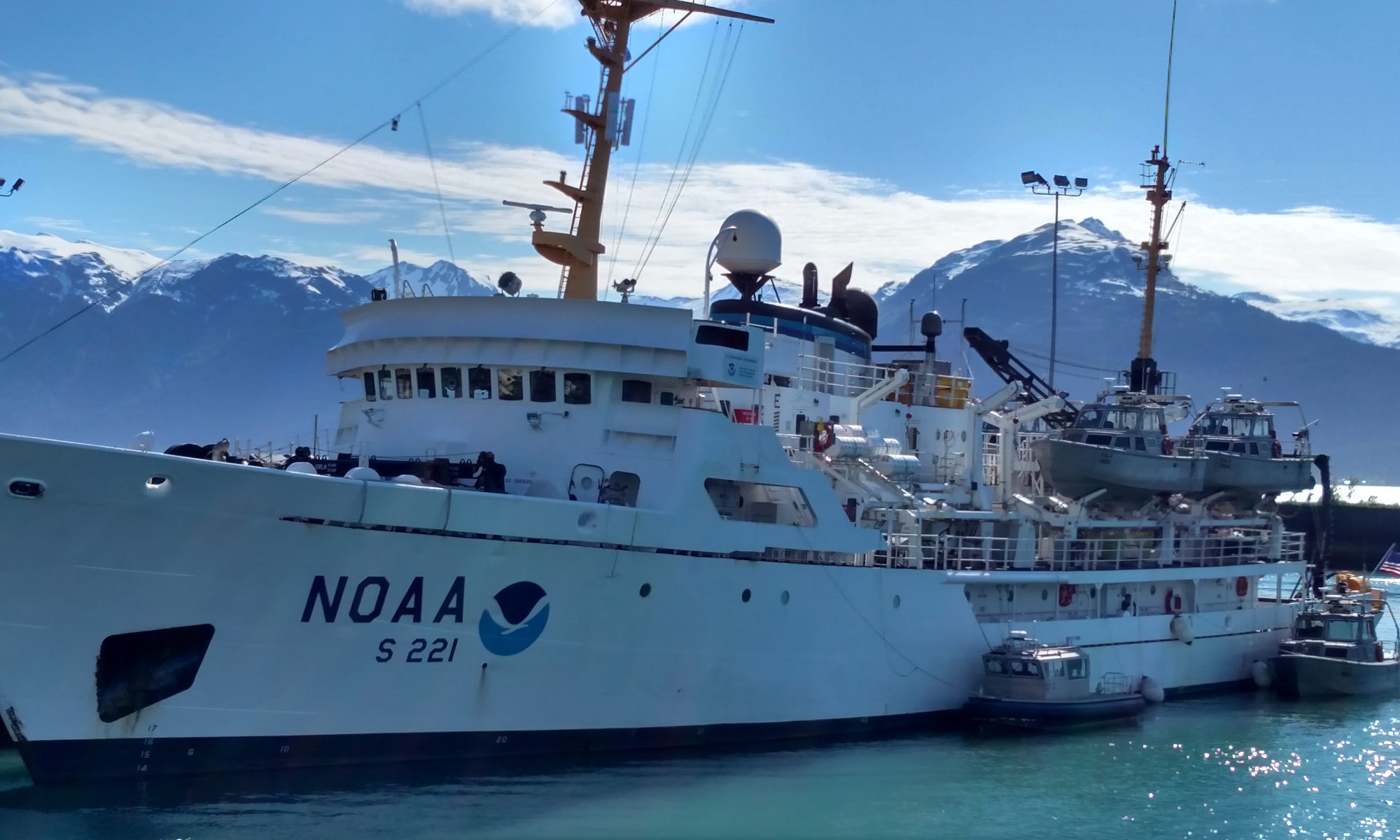
Marian Wagner: Out at Sea, August 16, 2011

NOAA Teacher at Sea
Marian Wagner
Aboard R/V Savannah
August 16 — 26, 2011

Mission: Reef Fish Survey
Geographical Area: Atlantic Ocean (Off the Georgia and Florida Coasts)
Date: Tuesday, August 16, 2011

Weather Data from the Bridge (the bridge is the wheelhouse, where the controls of the ship are)
E winds 15-20 knots
(1.15 statute miles = 1 nautical mile)
Sea depth at 4:30pm was 17.4 meters (getting deeper by about1 meter per mile out)
Seas 3-4 feet (measure of the height of the back of the waves)

Science and Technology Log

Marian's on deck, ready to work

The Research Vessel Savannah departed around 1:00pm from its port at Skidaway Institute of Oceanography, 25 minutes outside Savannah, Georgia.  There are 9 members of a science team including me, and 6 crew members, for a total of 15 people onboard.  In the morning, we loaded the research equipment and supplies (8 traps, ice bins, bait, buckets, research cameras that we mount on the traps, water, lots of sunscreen, etc.).  Richard Huguley, ship engineer, led many of us on a tour of the engine room before it was roaring and heated up. A few fascinating facts about the engine room are below!

Richard tours us through the engine room before it's too hot!

We set out of port on the Skidaway River, to the Wilmington River, and out to Wassaw Sound, an estuary where fresh water meets its fate, the Atlantic Ocean. Just as the boat was beginning to rock from the rougher seas of the open ocean, Michael Richter, the first mate and safety officer of the ship, called a safety meeting, which included what to do in case of emergencies such as a fire onboard, man overboard, abandon ship, as well as general safety rules to keep us safe on a daily basis (e.g. how to open doors so you don’t break a finger, gear to wear during work on the deck).  Someone had to model how to get into the “Gumby suit”, a survival wetsuit that will protect from hypothermia, jellies, and sharks should we have to abandon ship immediately.  Well of course I had to be the one to try out the Gumby suit!

In my survival suit, the "Gumby suit"

Finally, we were told a muster drill would occur soon.  Later on, just as I was exiting the head (toilet), the general alarm sounded and a “man overboard” drill was conducted.  See below to learn how to respond to a man overboard emergency.

After the safety demonstration, discussion, and modeling of Gumby suit, our chief scientist, Warren Mitchell, reinforced the meaning of the safety talk by saying, “Safety is most important. Our scientific data is not worth compromising our safety for.”

The focus of this NOAA Fisheries cruise is to survey the population of commercially-important species to inform stock assessments.  Christina Schobernd explained the mission another way: “We study how many fish there are, where they are, and get information so we can tell fisheries how many fish to catch so that the fish populations are sustained (or, so that they don’t run out of fish).”  We will be taking samples of fish that swim into our traps, observing and recording their abundance (how many) and location.  Some of the fish will be taken into the lab for further study. It is critically important to monitor the populations of these fish to avoid over-fishing of these waters.

Each day out at sea starting 8/17 to 8/25, we will drop 6 traps per round of sampling, and as we process the fish we catch, we’ll drop another round. We do this for a total of 4 rounds per day, or a total of 24 samples per day, if all goes as planned. I am working the noon-midnight shift with a team of three other scientists: David Berrane, Katie Rowe, and Stephen Long.

Personal Log

I love the life of living in a boat!  Everything is compact, space is limited, and efficiency is the key.  The ship is actually far more outfitted than I expected: with a light and power plug at my bedside, air conditioning in my stateroom, running (not pumping) water in the head, a state-of-the-art-for-boats kitchen with walk-in fridge and hooded stove!

Moving in to my stateroom

It took us many hours to travel to where we were to begin dropping the traps so, besides preparations, we did not have a lot of work to do the first day.  This was advantageous to give me a chance to transition into life at sea, especially with the ship rocking in a  “wash-machine” like motion, I spent the first afternoon and evening getting sick, or as we like to say out here at sea, more elegantly: “Getting my sea legs”.  Read more below about why seasickness is so common.  Although it is very unpleasant to get seasick, it was comforting to know many of us were in the same boat.  Many of those who travel at sea on a frequent basis were sick last night too.

This morning on our second day out, I am feeling fully recovered from seasickness, and I have spent the morning eating delicious banana pecan waffles and enjoying conversations with fellow scientists and crew.  The sea is very calm this morning too so that helps.  In less than an hour from now, I’ll be on my first 12-hour shift!  I am learning so much from this experience and am embracing every moment!

Some of the scientists and crew I am working with!

Fun facts about the engine room

Fact #1: We use laser light to detect temperatures of instruments in the engine room to make sure they are not overheating and all running smoothly.

Fact #2: How can we keep the water that runs our air-conditioning cool? To run the ship’s air conditioners, it takes 1.5 gallons of fresh water per minute.  With 25 air-conditioning units on board, that is a lot of water!  With a limited amount of weight and space available on ship, we couldn’t possibly keep enough new fresh water to ensure we have cool water entering the system.  So how do we do it?  We have a closed system, so the same water cycles through over and over again, and we use a heat exchanger mechanism to keep it cool as it starts a new cycle. What could we use that is cool that we have an unlimited supply of?   Salt water!  The heated fresh water runs in the bottom of the heat exchanger machine, and comes out the top. Cool salt water runs in a countercurrent direction: in the top and out the bottom.  As the cool salt water passes by the heated fresh water, the heat transfers from the fresh water to the salt water, cooling the fresh water, heating the salt water before it is disposed of back into the ocean. Because the salt water is so abundant, it can run in an open system, where it is continuously fed anew into the pipes as it is continuously running out of pipes at the other end.

How to respond to a man overboard emergency

If the person was witnessed going overboard, the witness should:

  1. Call out for assistance and throw a life ring buoy into the water (best if it has a strobe light). Pass the word to the Bridge by any means possible.
  2. Wait about one minute and throw a second life ring buoy into the water to create a visual range to aid in the search effort.
  3. Keep the victim under surveillance if at all possible, but do not delay passing the word to the Bridge.

Unwitnessed Man Overboard

Until proven otherwise, when a crewmember is unaccounted for, it will be presumed that the individual has been lost overboard.  The time of the casualty will be unknown.  The ship’s navigation record will be crucial for search planning, as will the hourly weather observations entered into the Weather Log.

Why seasickness is so common

Most people feel some level of illness or discomfort when they first go to sea. Seasickness is a result of a conflict in the inner ear (where the human balance mechanism resides) caused by the erratic motion of the ship through water.  Inside the cabin of a rocking boat, for example, the inner ear detects changes in linear and angular acceleration as the body moves with the boat. But since the cabin moves with the passenger, the eyes register a relatively stable scene. Agitated by this perceptual incongruity, the brain responds with a cascade of stress-related hormones that can ultimately lead to nausea and vomiting. Its effect can be magnified by strong smells (like diesel fumes or fish). It usually occurs in the first 12-24 hours after sailing, and dissipates when the body becomes acclimated to the ship’s motion. Rarely does anyone stay ill beyond the first couple days at sea, regardless of sea state.  Don’t be embarrassed or discouraged!  If you get sick, chances are that others are sick too!  No one—fishermen, ship’s officers, scientists—is immune to seasickness.

Tips of the day:

Tip 1: Dehydration comes quick. Drink lots of water.

Tip 2: Give one hand for the boat. (As I walk up and down the stairs, I always have a hand on the rail.)

Peggy Deichstetter, August 30, 2010

NOAA Teacher at Sea
Peggy Deichstetter
Aboard Oregon II
August 29 – September 10, 2012

Mission: Longline Shark and Red Snapper Survey
Geographical area of cruise: Gulf of Mexico
Day 1 August 30

Stateroom
Stateroom

I met my roommate, Claudia, this morning. She was on this cruise last year. Basically we catch, tag and release sharks and any other fish we may catch. I walked into town to pick up things I forgot. Ashley, Guy and I run into town for our last meal on land, a Subway. During the excitement of casting off, I’m informed that I have the night shift. Me, the goddess of the morning. they must be kidding. As we reach open water the sea is really rough.

At dinner I’m advised to go to bed right after dinner and get up at 2:00am to acclimate my body to the night shift. So right after (6:30pm) dinner I head off to bed. My roommate is already there, she is green. She tells me she doesn’t feel well and needs to lie down. There is no way I can fall asleep. I lie there, waiting to fall asleep. Finally, I’ve been lying there so long, it most be time to get up. I look at my watch… its only 9:00. I finally fall asleep.

Stateroom
Stateroom

Nancy Lewis, September 16, 2003

NOAA Teacher at Sea
Nancy Lewis
Onboard NOAA Ship Ka’imimoana
September 15 – 27, 2003

Mission: Tropical Atmosphere Ocean (TAO)/TRITON
Geographical Area: Western Pacific
Date: September 16, 2003

Nuku Hiva, Marquesas Islands, French Polynesia

0815       Anchor Aweigh:  Underway

Weather Observation Log:  0100

Latitude:  8 degrees, 56.7′ S
Longitude:  139 degrees, 59.1′ W
Visibility:  12 nautical miles (nm)
Wind direction:  100 degress
Wind speed:  18 knots (kts)
Sea wave height:  5-6 feet
Swell wave height:  5-7 feet
Sea water temperature:  27.2 degrees C
Sea level pressure:  1013.8 mb (millibars)
Dry bulb temperature:  28.0 degress C
Wet bulb temperature:  23.0 degrees C
Cloud cover:  2/8 Cumulus, Altocumulus

Personal Log

Today is my first full day on the KA’IMIMOANA, and we steamed out of the harbor of Nuku Hiva at 8:15 am past the huge rocks that guard both sides of the bay.  I was out on the forward deck for much of the morning, admiring the striking coastline of Nuku Hiva as we got underway in what were somewhat rough sea conditions.  I took some pictures of the dramatic cliffs that break off sharply down to the sea with not a sign of any human habitation. I was somewhat wistful at departing this very unspoiled island, but thought, perhaps some day I will get to return.  After all, I never in my life expected to ever visit such a remote spot as the Marquesas Islands.  Off in the distance, so shrouded in mist it seemed almost a mirage, could be faintly discerned another one of the Marquesas Islands, its craggy peaks rising up like castle ramparts in a fairy tale. I remained on deck taking in the salty breeze, but the ship was heaving up and down in seas that were at least 6-9 feet.

I thought I should go back to my stateroom and finish my unpacking and arranging my things, as everything on board a ship has to be “ship-shape,” meaning neat, clean  and orderly.  I was aware that I really wasn’t feeling all that well, having developed somewhat of a queasy feeling from the rocking of the ship while in the bay at Nuku Hiva. I went outside a few more times to catch some final glimpses of  island we were leaving behind, and it  seemed that the seas were definitely rough.  Uh, oh, I had heard horror stories about some crew members being seasick for days on end.  By this time, I was feeling quite ill.  I talked to several “old hands” on board, and several urged me to take it easy, and maybe try and sleep.  We were steaming to our destination at 4 degrees South Latitude from Nuku Hiva, which is at 8 degrees South latitude, and so were basically headed north, along the 139th meridian of Longitude.   We had no buoy operations scheduled today, so I decided it would be best to just take it easy.

There is nothing worse than being seasick, although I never really got that bad.  I took some more Dramamine and hoped for the best.  The few times I did get up in the afternoon to go down to the mess for some tea,  I saw other crew members, and they were telling me it was unusually rough, and I was not the only one feeling sick.  So there isn’t much to tell about today, except that they say that a little seasickness comes with first going to sea until you get your “sea legs”.  As I turned in for the night, I imagine my face looked a little green, and I was fervently hoping I would get those legs as quickly as possible.

From the Plan of the Day:  Notice:  ” Secure all items for sea”

Does that include lunch?

Aloha from the KA!

Jennifer Richards, September 5, 2001

NOAA Teacher at Sea
Jennifer Richards
Onboard NOAA Ship Ronald H. Brown
September 5 – October 6, 2001

Mission: Eastern Pacific Investigation of Climate Processes
Geographical Area: Eastern Pacific
Date: September 5, 2001

Latitude: 32.7°N
Longitude: 117.2° W
Temperature: 75° F

Seas: Since we are still at port in a protected harbor, there is no swell. The water is extremely calm.

Science Log: Research has not yet started. The scientific crew was notified in a ship briefing that they are not allowed to gather and record data until the ship leaves Mexican waters.

Travel Log: This morning, my husband Rob and John Kermond from NOAA came to watch the ship depart. Rob brought me an extra pair of shoes since mine were still stuck in the drawer. Then I realized the drawer had a special latch that had to be pushed in, and my shoes weren’t locked in after all! Dork mistake #1.

There was a lot of activity around the ship as the crew and scientists rushed to tie everything down- from computers to bottles and flasks, to heavy equipment and cranes on deck. Everything on the ship must be securely locked or tied down or bolted to something prior to departure, since the movement of the ship could cause things to start flying.

Finally, the big departure at 10am. We sailed for an hour up to the fueling dock at Point Loma, where we docked for another 5 hours. It was evening before we were out at sea.

As soon as the ship left the protected harbor, I was very aware of the swaying, and knew I would need something to prevent me from getting seasick. Some people wore special wristbands that use acupuncture to suppress seasickness. Other people wore a patch behind their ear that releases medication into their bodies. I chose an over-the-counter medication called Meclizine. It works well, but puts me to sleep.

I started reading the “Voyage of the Beagle” which is Charles Darwin’s journal of his 5-year voyage in the 1830s to the Galapagos Islands and all over the world. You may recall that Darwin developed the theories of evolution, natural selection, and survival of the fittest that we still believe today. Did you know that Darwin was seasick during the entire voyage??!! How miserable that must have been. During the 5-year journey, he was only on the ship for 18 months, and never more than 45 days at a time (I’ll be on this ship for 31 days). He was 20 years old when he left Britain on the HMS Beagle, and 25 years old when he returned home, only a few years younger than me, and not too much older than my high school students. It’s pretty inspiring to think of someone so young contributing so much to the scientific community. I’ll fill you in on more Darwin stuff as I keep reading his journals.

Question of the day: One of today’s photos shows a “marine layer” (see photo descriptions below). What causes the marine layer to sit over coastal land in San Diego?

Photo Descriptions: Today’s photos focus on the beautiful scenery of San Diego harbor. You’ll see pictures of a variety of ocean vessels, the picturesque Coronado bridge, and the “marine layer” off the coast. The marine layer is an area of the San Diego coast that is fogged in, even when the sky above the water and the sky further inland is perfectly clear and sunny.

Keep in touch,
Jennifer

Susan Carty, March 19, 2001

NOAA Teacher at Sea
Susan Carty
Onboard NOAA Ship Ronald H. Brown
March 14 – April 20, 2001

Mission: Asian-Pacific Regional Aerosol Characterization Experiment (ACE-ASIA)
Geographical Area: Western Pacific
Date: March 19, 2001

My goodness, I am beginning to need the calendar to see what day it really is! The days are beginning to blend together.

There are some “green faces” today. After fairly gentle seas yesterday, the swells have increased in size and the gray clouds are threatening us with rain.  I am ever so grateful for my calm stomach, so far. The ships physician offers a guide with the following helpful hints to ease the discomfort of sea sickness.

1. Drink lots of water
2. Avoid fried foods
3. Take naps ( this is a particularly good suggestion !)
4. Keep some food in your stomach
5. Don’t work at a computer terminal too long
6. Don’t read too long
7. Get topside and breath in fresh air
8. Focus on the horizon or some object that is stationary

Apparently no one is immune to sea sickness. If the seas become rough enough for long enough we may all become green (like Kermit).

Testing continues daily. I am now becoming more familiar with the testing terminology. At times it is necessary for the ship to stop and hold position for a few hours for tests and other times, like today, the ship continues on course but tries to maintain a steadier position. Today is more difficult to do that.

What makes the RON BROWN such an excellent vessel for scientific experimentation
is the vast array of equipment on board. Here is a sample of that equipment.

a. Multibeam Echo Sounding System
b. Hydrographic/Sub-Bottom Profiler
c. Depth Recorder/Indicator System
d. Acoustic Doppler Current Profiler
e. Doppler Speed Log
f. Acoustic Positioning System
g. Conductivity, Temperature, Depth System (CTD)
h. Global Positioning System (GPS)
i. Scientific Computer System (SCS)

Sounds really impressive, doesn’t it? One of my goals is to understand how each piece of equipment actually works.

The albatross are gone now. Where could they go way out here anyway?

QUESTION OF THE DAY: What actually causes motion sickness? Why are some people more susceptible than others?

Bye for now,
Susan