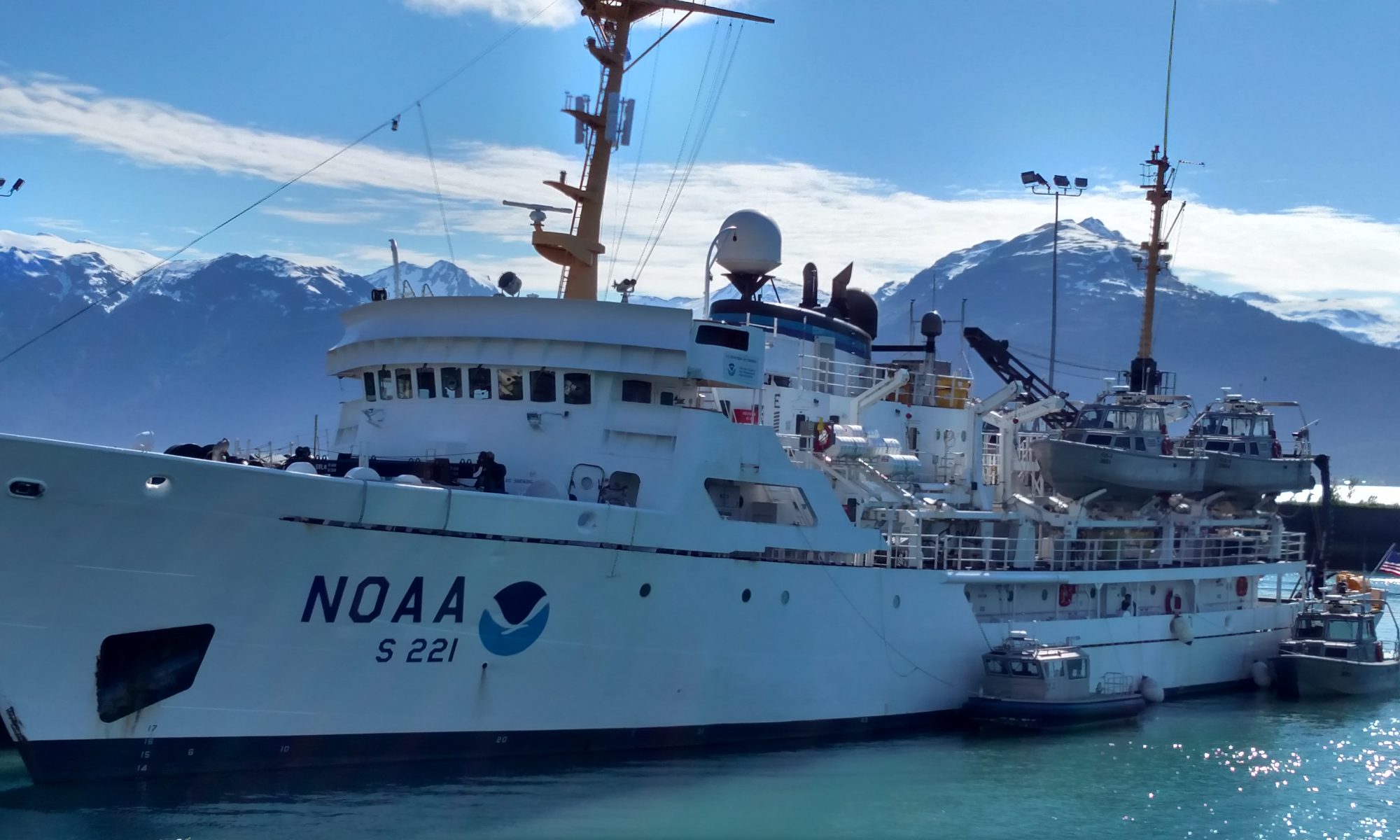
Sabrina Whitaker: Perfectly Imperfect, August 18, 2026

NOAA Teacher at Sea

Sabrina Whitaker

Aboard NOAA Ship Thomas Jefferson

August 18-31, 2026

Mission: Hydrographic Survey, Leg 3

Geographic Area of Cruise: Lake Ontario

Date: August 18, 2026

Weather Data from the Bridge

Latitude: 43°51.0527′ N

Longitude: 76°29.1419′ W

Winds: SW at 14 knots

Air Temperature: 74°F

Science and Technology Log

Today was jam-packed with preparation, community, and reflection. I was struck not only by how meticulously everyone prepares for emergencies, but also by the crew’s thoughtful debriefs. They continuously strive for operational perfection, yet never at the expense of appreciating a job well done.

We began the morning with shipboard safety briefings. At sea, addressing a fire quickly is paramount. Everyone has a designated duty and muster station. On land, the standard advice for a building fire is to evacuate immediately—even if it’s small. However, as the Executive Officer (XO) and crew emphasized, if you spot a small fire aboard ship, the best immediate action is to grab an extinguisher and put it out. The reason for this stark difference is simple: on open water, help is miles away. An uncontrolled fire endangers the entire vessel, forcing an abandon-ship scenario that carries far greater risk than tackling a localized flame right away.

There were two new members of the crew besides me. They were assigned to firefighter roles and we went through the process of getting them gear and setting it up so that they could just hop into it if they needed to use it. 

two men stand in an interior room of the ship wearing khaki firefighting jackets and pants and protection for their hands. they smile for a photo. hard hats and life jackets are stored on the wall behind them.
New crewmembers trying on firefighting gear

Should the call to abandon ship ever be given, comprehensive protocols are already in place. Everyone gathers their immersion suits and proceeds to the lifeboats. Each lifeboat holds up to 20 people. With roughly 30 personnel currently aboard the Thomas Jefferson and several lifeboats available, there is more than enough capacity for everyone.

From safety drills, we transitioned to the Leg Operations Brief, led by Operations Officer Mark Meadows. This meeting serves a dual purpose: preparing for the upcoming leg while reflecting on the previous one. Because personnel rotate frequently—some staying for multiple legs, others returning home or arriving from across the country—a structured presentation ensures a seamless transition. The team openly analyzes both the strengths and challenges of the prior leg to set up the incoming crew for success.

Next was a technical discussion on Pulse Per Second (PPS), a concept directly applicable to the data-collection software used on board. Operations Officer Meadows provided a thorough explanation, highlighting why understanding the mechanics behind our equipment (and its software) is crucial for real-time operational adjustments.

NOAA Corps officers, wearing their standard blue uniforms, in conversation in a room filled with computer monitors. OPS Meadows may be the one standing in the middle pointing to screen.
Operations Officer Meadows presenting on the previous leg of the mission

The software generates a pulse display similar to the diagram below:

photo of a visual output display from an older instrument. it features a graph of volts versus time, with a yellow line pulsing vertically up, over, and then back down.
Example of a 1 pulse per second signal generated by a GPS receiver. Photo from Codrey Electronics.

The time from the leading edge of one pulse to the leading edge of the next is exactly 1 second. Meanwhile, the duration between the leading edge and the trailing edge of a single pulse is approximately 1 millisecond (ms). This subtle nuance means it is remarkably easy for data collection to end up off by a millisecond. In many contexts, that tiny margin is negligible; in high-precision hydrography, it matters. Recognizing how the software handles these signals allows the team to correct data post-collection if needed. It reminded me of a favorite lesson from my own high school physics teacher: Always understand how your equipment works so you know how to troubleshoot it when it doesn’t.

After the briefings wrapped up, it was time to get underway! This was the moment my physics-teacher heart sang. It’s rare to see a fundamental physics concept demonstrated so dynamically in real life.

view from an upper deck of NOAA Ship Thomas Jefferson as the ship carefully pulls away from the dock at the Port of Oswego; we see a concrete road along the shore here, and port buildings, and a smaller boat docked farther down.
The separation from the dock and part of the maneuvering into open water
photo of screens on the bridge of NOAA Ship Thomas Jefferson displaying electronic nautical charts. we can see the blue water of Lake Ontario out the windows behind the display.
The course Thomas Jefferson plotted after maneuvering away from the pier

The deck crew expertly maneuvered the ship away from the dock, accounting for wind force, current, and the thrust vectors of the ship’s engines. It was a beautiful, real-world ballet of vector addition—one that my students would be relieved they didn’t have to calculate on paper! The crew handled the separation from the dock and navigation around the pier with effortless precision.

four NOAA corps officers in blue uniforms stand around the controls and displays on the bridge of NOAA Ship Thomas Jefferson. another crewmember, not a NOAA Corps Officer, is visible in the background.
Deck crew of NOAA Ship Thomas Jefferson as they maneuver the ship out from port

Once we reached open water, the crew gathered for what the XO fondly called “Story Time”—a post-maneuver debrief. Once again, they analyzed what went smoothly and what could be refined. They praised the steady speed and smooth handling, while constructively noting that higher communication volume over the radio would make it easier for everyone to follow along. Both praise and critique were taken to heart. Because the Thomas Jefferson will be navigating this same harbor all season, the pursuit of perfection is an ongoing goal—but everyone acknowledged that the crew’s skill today was exceptional.

Personal Log

Trying on the immersion suit was pretty hilarious. I unrolled it in my stateroom and then I had to read the directions. Are you supposed to keep your shoes on? Yes, and luckily, it says so on the instructions on the outside of the packaging. I was able to get into it ok, and then I kind of flopped upstairs so I could get help with getting a picture. I also realized that in a real emergency, I will need some help zipping it up because the zipper is very hard to slide. I’ll have to practice that some more. The worst part though, was taking it off and then rolling it up and putting it back into its bag. I’m not going to lie, that part was a little rough.

Sabrina tries on a bright red and yellow survival suit and gives two thumbs up with the comically large 3-fingered gloves. she stands inside the ship in a desk area.
TAS Sabrina Whitaker tries on a survival suit

Did You Know?

The Great Lakes are technically considered non-tidal.

Ocean tides (true tides) are generated by the gravitational pull of the moon and sun. While the Great Lakes do experience a spring tide during a new or full moon, the water level changes by only about 2 inches (5 cm)—compared to 5 to 7.5 feet in places like the Long Island Sound. Because these lake tides are so minor, they are masked by greater local weather forces and categorized as non-tidal.

However, the Great Lakes experience short-term water level fluctuations that closely mimic ocean tides. These are called seiches (pronounced sayshes)—standing waves that oscillate back and forth within an enclosed or semi-enclosed body of water.

Unlike tides driven by gravity, seiches are driven by strong winds and rapid changes in atmospheric pressure that literally push water from one end of the lake to the other. Lake Erie is famous for dramatic seiches, but all the Great Lakes experience them. In fact, in 1954, the extreme winds of Hurricane Hazel piled up so much water near Toronto that it triggered a massive seiche on the opposite shore of Lake Ontario!

Jennifer Widdig: Fair Winds and Following Seas, July 1, 2026

NOAA Teacher at Sea

Jennifer Widdig

Aboard NOAA Ship Thomas Jefferson

June 17 – June 30, 2026

Mission: Hydrographic Survey
Geographic Area of Cruise: Lake Erie and Lake Ontario
Date: Wednesday, July 1, 2026

Weather Data from Oswego, New York

Latitude: 043o27’N
Longitude: 076o30’W
Sky Conditions: Partly Cloudy
Visibility: 9 miles
Wind speed: 2 knots
Wind direction: NE
Temperature: 78oF
Humidity: 82%

Jen, wearing a Teacher at Sea hat, takes a selfie at the railing of NOAA Ship Thomas Jefferson. In the background, rather than water, we see the Port of Oswego: a dock lined with buildings, leading back to warehouses and storage tanks.
Port of Oswego before heading home

Science and Technology Log

Real-World Career Pathways at Sea

Before stepping aboard NOAA Ship Thomas Jefferson, I assumed most of the crew would be scientists. While hydrography is certainly at the heart of the mission, I learned that it takes professionals from many different career fields to keep the ship operating safely and efficiently. In fact, many of the jobs on board connect directly to the career pathways offered where I teach, Pickaway-Ross Career & Technology Center.

screenshot of a website listing 12 course names with accompanying photos. examples of courses include automotive, culinary arts, electrical.
PRCTC’s list of programs (Credit: PRCTC)
screenshot of a website listing 11 course names with accompanying photos. examples of courses include health science, law and public safety, precision welding.

The survey technicians are responsible for collecting and processing hydrographic data using multibeam sonar, side-scan sonar, GPS, and specialized computer software. Their work combines engineering technology, robotics, and cyber security & networking.

The deck department operates cranes and davits, launches and recovers the survey boats, performs maintenance, handles lines during docking, and ensures the safe operation of the vessel. These careers require technical skills, teamwork, problem-solving, and attention to safety which are qualities developed through career and technical education programs. Especially since we train our students in Lean Six Sigma.

a launch vessel, still attached by cables to davit arms, is lowered down the side of NOAA Ship Thomas Jefferson. Crewmembers in hard hats and life vests stand nearby or board the small vessel.
Bosun Alex Bischoff helping 2904 crew aboard

Behind the scenes, the engineering department keeps the ship running 24 hours a day. Engineers maintain the propulsion systems, generators, pumps, electrical systems, and countless pieces of equipment that allow the Thomas Jefferson to complete its mission. Students pursuing careers in diesel technology, industrial maintenance, electrical trades, or advanced manufacturing would recognize many of the same hands-on skills used every day aboard ship.

The bridge is staffed by NOAA Corps officers, who are responsible for safely navigating the ship, supervising survey operations, managing personnel, and making operational decisions. Their careers combine leadership with navigation, meteorology, technology, project management and safety. These officers work very similarly to the students in the Public Safety course at PRCTC.

at least 8 NOAA Corps officers, wearing navy blue uniforms and hats, stand in a line on the bridge of NOAA Ship Thomas Jefferson. They all face out the windows, away from the camera; some look down at screens and instruments on the bridge.
Officers working the bridge on NOAA Ship Thomas Jefferson

Even the steward department plays a vital role. Preparing three meals a day for a crew working long hours requires planning, organization, food safety knowledge, inventory management, and culinary skills. The galley keeps morale high and ensures everyone has the energy needed to perform demanding work much like our commercial foods program.

The Thomas Jefferson also relies on electronics, communications, information technology, logistics, administration, and medical support. Every member of the crew contributes specialized skills that allow the ship to operate as a single, coordinated team.

One of the biggest takeaways from this experience is that there isn’t just one pathway to working aboard a ship like the Thomas Jefferson. Whether your interests are welding, diesel technology, engineering, information technology, culinary arts, electronics, leadership, or science, there is a place where those skills can make a difference.

As a teacher at Pickaway-Ross CTC, this experience has given me real-world examples to bring back to my classroom. Now I can point to an entire ship where technical skills, problem-solving, teamwork, and communication are used every single day. Career and technical education doesn’t just prepare students for jobs, it also prepares them for opportunities they may have never imagined, including serving aboard a NOAA hydrographic survey vessel.

Clearing the Way

While the NOAA Ship Thomas Jefferson is best known for charting U.S. waters, the ship can also play a critical role in responding to natural disasters.

In 2017, after Hurricane Maria devastated Puerto Rico and the U.S. Virgin Islands, the Thomas Jefferson was deployed to help restore safe navigation to the region. Using its multibeam sonar and side-scan sonar systems, the crew surveyed ports and waterways to identify underwater hazards and ensure safe passage for the U.S. Coast Guard, relief vessels, and other emergency responders. Because so many essential supplies reach the islands through these ports, reopening them quickly was vital to the recovery effort.

Over the course of just three weeks, the Thomas Jefferson surveyed 13 areas, including more than 18 ports, helping authorities safely resume maritime traffic.

a nautical chart of the water surrounding Puerto Rico and the Virgin Islands. 13 boxed map insets show enlarged views of survey areas and the color-coded shading of depth measurements. these surveyed areas represent all the major ports. there are three photos also superimposed on the map: one of NOAA Ship Thomas Jefferson and two of survey launch vessels.
Areas surveyed by NOAA Ship Thomas Jefferson after Huricane Maria in 2017 (Credit: NOAA)

One of the ship’s greatest strengths is its ability to operate independently. With a crew of 38, the Thomas Jefferson can remain at sea for several weeks without relying on outside support, making it an ideal platform for extended emergency response missions. Its two survey launches, 2903 and 2904, further enhance its capabilities by allowing crews to survey shallow waters and areas where storm debris may have accumulated.

Learning about the Thomas Jefferson‘s role after Hurricane Maria gave me a broader perspective on hydrography. Before this experience, I mainly associated nautical charting with supporting everyday navigation. Seeing how these same surveying skills and technologies can be used to assess storm damage, clear ports, and help restore critical shipping routes showed me just how important this work is. It is another example of how the crew’s expertise extends far beyond routine charting operations.

Personal Log

Unfortunately, I am on my way home. However, I want to share a few last memories from this experience.

The Crew’s Greatest Challenge

I had started to think the crew aboard the Thomas Jefferson was almost flawless, then game night happened.

Communication on the bridge during unfavorable conditions is exceptional. Navigating video games? Not so much.

four men and two women sit around a table covered in a blue table cloth and lines of condiment bottles. the wall behind them is wallpapered in nautical charts. there is a large tv screen mounted on this wall above their heads.

Crew working on their communication skills during game night

The Commanding Officer remained calm, cool, and collected through two weeks of transiting the Welland Canal, changing weather, and demanding survey operations. Yet during game night, I caught a glimpse of what looked like a silent question in the CO’s eyes: “Is this really my crew?” as everyone demonstrated their less-than-stellar teamwork in a video game. I also learned that it is, in fact, possible to earn negative points.

The evening was filled with unforgettable comments like, “I have steak on the starboard quarter!” followed by, “Fish pasta, aye!” and “Who keeps putting the fire extinguisher on the stove?” Somehow, those made perfect sense in the middle of the chaos. And no game night would be complete without a few “passionate” debates over the official rules of Scrabble.

Crew demonstrating teamwork skills during game night

As entertaining as the games were, my favorite part was seeing this side of the crew. After watching them work with such precision and professionalism every day, it was refreshing to see the Commanding Officer and Executive Officer relax alongside everyone else. For a few hours, ranks took a back seat to friendly competition, laughter, and good-natured teasing. It was a wonderful reminder that the strong teamwork I had witnessed throughout the mission is built not only through hard work, but also through shared moments like these.

at least 8 people in a room at two different tables; the back table is focused on the video game displayed on a large monitor mounted on the wall, and the table in the foreground has a scrabble game.
Crew of NOAA Ship Thomas Jefferson at game night

Sharing the Mission

An exciting part of my journey home was getting the chance to share my experience aboard the Thomas Jefferson with people I met along the way. My Uber driver and the hotel front desk attendant were both curious about why I had been on a NOAA ship, which gave me the opportunity to explain the mission of the Thomas Jefferson and the important work the crew does to create accurate nautical charts and ensure safe navigation. They both had said they had lived here all their lives and never saw a boat like that in the port or knew that the lake was not surveyed. After spending time with the crew, I found myself proudly talking about their work and the dedication it takes to accomplish such an important mission.

Mission Complete

I want to extend my sincere thanks to Commanding Officer Kidd and Executive Officer Duffy for welcoming me aboard and giving me the opportunity to be part of this incredible experience.

I also want to thank the entire crew for making me feel at home from day one. Everyone was so welcoming, patient, and willing to answer my endless questions. A special thank you goes to the survey technicians, who took the time to explain everything to me slowly and more than once when needed. Their patience and enthusiasm for their work made it easy to appreciate the science and technology behind every survey.

two women wearing life vests stand near the railing of NOAA Ship Thomas Jefferson facing out toward the water, opposite the camera. a metal frame containing the conductivity, temperature, and depth probe is partially visible on the deck in front of the woman on the right. a pully on a beam extends into the photo from the right, over the women's heads, and rope hangs on either side of the pully. the sky and water are bright blue.
Chief Scientist Sarah Thompson explaining the Sea-Bird CTD proceedures

I also want to thank my roommate, Junior Officer Bridget Ruiz, for making life aboard so enjoyable. Thank you for your friendship, the great conversations, and for making me feel at home while we were at sea. Sharing this adventure with you made the experience even more memorable.

I feel incredibly fortunate to have been assigned to NOAA Ship Thomas Jefferson. I have a much deeper appreciation for the important work this crew does. More importantly, I am returning home excited to share what I have learned with my students. I hope that through these stories, they will discover careers they may have never considered and see that science can lead to adventures far beyond the classroom.

Fair winds and following seas, Thomas Jefferson. Thank you for an unforgettable journey.

view of NOAA Ship Thomas Jefferson underway on the lake, sailing away from the camera toward the horizon. it appears to be dusk - there is a little color toward the horizon, and a lot of cloud cover. the water is dark blue and still enough to reflect the image of the ship.
NOAA Ship Thomas Jefferson on Lake Ontario