Amanda Dice: From Sea to Shining Sea, August 17, 2017

NOAA Teacher at Sea

Amanda Dice

Soon to be aboard NOAA Ship Oscar Dyson

August 21 – September 2, 2017


Mission: Juvenile Walleye Pollock and Forage Fish Survey

Geographic Area of Cruise: Gulf of Alaska (near Kodiak)

Date: August 17, 2017

Weather Data: 30.5°C, cloudy, 78% humidity

Location: Baltimore, MD

Intro
Out on the east coast waters utilizing my favorite form of Baltimore’s transportation options – its fleet of kayaks!

Introduction

It is hot and sticky here in Baltimore and I am looking forward to breathing in the crisp air in Alaska. I am also looking forward to being out on the water. As a Baltimore resident, I am able to spend time in the beautiful Chesapeake Bay. It is a great place to get out on a kayak and take in nature. I can’t wait to take this experience to the next level on the waters of the Gulf of Alaska. I try to go on at least one big adventure each year, and the Teacher at Sea experience definitely will fulfill this goal for 2017! I am also excited about all of the new things I will learn on this trip and I am looking forward to sharing these with my students. I teach STEM courses to students who attend online school. I have seen how connecting scientific experiences and data with students can spark their interest in STEM fields.  I am very excited to have the opportunity to use this experience to engage students in scientific activities and discussions.


Science and Technology Log

This mission will take place on the NOAA Ship Oscar Dyson, which has its home port in Kodiak, Alaska. From Kodiak we will move through the waters surrounding Kodiak Island and eastward into the Gulf of Alaska. The scientific team will be studying populations of walleye pollock and zooplankton in these waters. The mission will be conducted in two parts. I will be aboard for Leg 1 of the mission. Leg 2 will begin shortly after we return to port on September 2nd. The map below show all of the sampling locations that will be visited during this mission. Leg 1 sampling locations are indicated by red dots. At each location, a variety of sampling will take place. From what I have learned about the mission, it looks like we will be using several different trawls to collect samples. We will then use a variety of methods to identify species and collect data once the samples are onboard.

leg 1 map
This map shows the sampling locations of Leg 1 (red) and Leg 2 (blue) for the Gulf of Alaska Juvenile Walleye Pollock Survey. Courtesy of NOAA.

The Oscar Dyson is described as “one of the most technologically advanced fisheries survey vessels in the world.” From what I see on the NOAA website, it seems to have an impressive amount of scientific equipment onboard. It has a wet lab, dry lab, computer lab, biology lab and hydrology lab. It also has a wide array of data collection gear and mechanical equipment. I am looking forward to checking out all of this equipment for myself and learning more about how it will be used.

Science and Tech Log
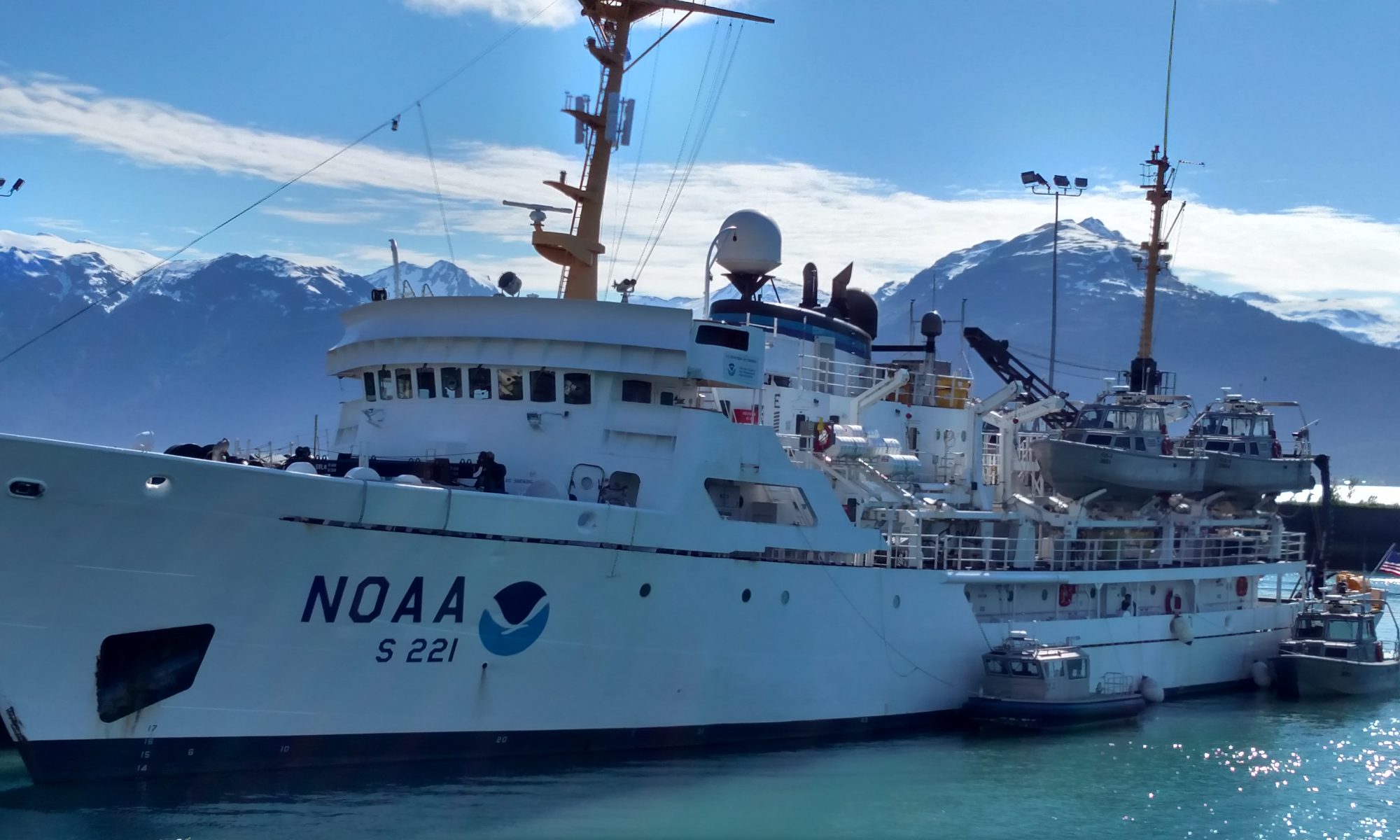
NOAA Ship Oscar Dyson on the chilly waters in Alaska. Courtesy of NOAA.

This study will focus on collecting data on walleye pollock populations. This fish is a member of the cod family and lives primarily in the waters of the northern Pacific Ocean. As juveniles, this species feeds on krill and zooplankton. As they mature, they eat other fish, including juvenile pollock!  Many marine species rely on populations of these fish as a food source in the Gulf of Alaska. Humans also like to eat pollock. It is sold as fillets, but is also used in fish fingers and to make imitation crab meat. Pollock fillets are becoming more popular as cod and haddock populations become overfished. Pollock populations have fluctuated over the years, but are not currently overfished. The dotted line in the graph below shows population numbers in the Gulf of Alaska (GOA).

pop graph
The dotted line on this graph shows the population numbers of walleye pollock in the Gulf of Alaska (GOA). Courtesy of NOAA.

A scientist from the U.S. Fish and Wildlife Service will also be aboard the Oscar Dyson conducting a seabird observation study. She will work mainly from the bridge, keeping track of the different seabird species she sees as we move from one sampling location to the next.

Personal Log

I am excited about my upcoming adventure for many reasons. As an undergrad, I majored in Natural Resource Management. I went on to be a science teacher, but have always been interested in learning about findings from ecological studies. This experience will allow me to get an up close look at the technology and techniques used to conduct this kind of study. I am looking forward to being able to contribute to the team effort and learn new things to bring back to my students. I am also very excited to be aboard a ship off the coast of Alaska. A trip to Alaska has always been on my bucket list and I am looking forward to taking in the scenery and spotting marine mammals and seabirds. I am also hopeful that we will be able to see a partial solar eclipse from the water. I am bringing my sun viewers, just in case!

Did You Know?

It would take 88 hours to drive from Baltimore, MD to Kodiak, AK.

Did You Know
Glad I am flying! Courtesy of Google Maps.

Sian Proctor: It’s Getting Fishy, July 20, 2017

NOAA Teacher at Sea

Sian Proctor

Aboard NOAA Ship Oscar Dyson

July 2 – 22, 2017

Mission: Gulf of Alaska Pollock Survey

Geographic Area of Cruise: Gulf of Alaska

Date: July 20, 2017


Me with an adult pollock.

Weather Data from the Bridge

  • Latitude:  57° 47.02 N
  • Longitude: 152° 24.56 W
  • Time: 1700
  • Sky: Overcast
  • Visibility:  2 nautical miles
  • Wind Direction: variable
  • Wind Speed:  Knots
  • Sea Wave Height:  0  foot swell
  • Barometric Pressure:  994 millibars
  • Sea Water Temperature:   11.9° C
  • Air Temperature:   12.2° C

Science and Technology Log: It’s Getting Fishy!

Alaska pollock are found in the Bering Sea and Gulf of Alaska and are part of the cod family. The dorsal side of the pollock is speckled brown in color with a slight olive green hue and the ventral side is silver. They eat krill, copepods, and small fish – mainly their own offspring. They quickly grow into adults, reaching reproductive age after 3-4 years, and are very fertile, replacing harvested fish in just a few years. Pollock swim in large schools during the day and disperse overnight. They can be found throughout the water column, but young pollock tend to live in the mid-water region while the older fish tend to live near the sea floor.

Alaska_Pollock_-_source_NOAA_fishwatch.govScience-based monitoring and management play a key role in the sustainability of the Alaska pollock fishery. It is managed by the North Pacific Fishery Management Council based on data provided by the NOAA’s Alaska Fisheries Science Center. The Alaska pollock fishery is the largest, by volume, in the United States and one of the most valuable in the world.  Products made from pollock include fish fillet, roe eggs, and imitation crab. The entire industry is valued at over a billion dollars. It is also considered one of the best-managed fisheries in the world. Scientists from the Alaska Fisheries Science Center conduct acoustic trawl surveys to estimate the abundance of Alaska pollock using acoustics and by catching small samples.

While on NOAA Ship Oscar Dyson I had the opportunity to spend time in  the fish lab learning how pollock data are collected.. This video is an example of what I experienced.

The main way commercial pollock is caught in the United States is by net. Scientifically trained observers are sent out on U.S. pollock fishing boats and, similar to the NOAA scientists, they collect sample data from each catch and send it back to NOAA.  They also observe the fishing practices on the boat and  report any regulatory infractions. All the collected data and interactions between the fishing industry and NOAA have been established to make sure the Alaska pollock fishery remains sustainable.

NOAA Opportunities for students: https://www.afsc.noaa.gov/education/students/careers.htm 

Interview with Michael Martin

Fisheries Biologist

  • Official Title
    • Deputy Director
  • Normal Job Duties
    • Leadership and administration of the Resource Assessment and Conservation Engineering (RACE) Division within Alaska Fisheries Science Center (AFSC)
  • What is your current position on Oscar Dyson?
    • Fish lab biologist
  • How long have you been working on Oscar Dyson?
    • of and on for ~ 10 years
  • Why the ocean? What made you choose a career at sea?
    • I loved exploring sea creatures a the beach as a kid; Jacques Cousteau.
  • What is your favorite thing about going to sea on Oscar Dyson?
    • Getting out of the office; Seeing amazing scientists do their work and getting to participate.
  • Why is your work (or research) important?
    • The information we collect plays a very important role in managing fisheries in Alaska, providing economic and food security for many people. We also do tremendous research that benefits the science community and subsequently people world-wide. We are among the leaders in understanding fish and invertebrate abundance and behavior in the world.
  • When did you know you wanted to pursue a career in science or an ocean career?
    • I’m still trying to figure out what I want to do if I grow up! Probably between 10 and 13 years old I developed an interest in the ocean.
  • What part of your job with NOAA (or contracted to NOAA) did you least expect to be doing?
    • Dealing with bureaucracy.
  • What are some of the challenges with your job?
    • Leading a group of scientists is, in some ways, like herding a group of very intelligent cats. They are very focused on their research and have very strong opinions about things that they feel could detract their ability to do the best job possible. This can be a challenge for me at times, but is a great problem to have!
  • What are some of the rewards with your job?
    • Being able to facilitate scientists and help them accomplish their goals is very rewarding.
  • Describe a memorable moment at sea.
    • Rescuing a family in a life raft that had been missing for 3+ days.

P1130809

Interview with Meredith Emery

Fisheries Biologist

  • Official Title
    • Survey Technician
  • Normal Job Duties
    • As Survey Technicians, our primary responsibility is to monitor and maintain fisheries and oceanographic equipment. In addition, we have to run and verify the Scientific Computer System (SCS) is collecting quality data and all the ship’s sensors connected to SCS are working properly. We also are the liaison between scientists and the crew members, and assist the scientists with any part of their research. Survey Technicians have the unique opportunity to participate in all aspects of the fisheries or oceanographic operation start to finish. During the fishing operations: 1. Scientist communicates to the people on the bridge, deck and survey technicians when they are going to fishing. 2. We put the fishing equipment on the net, as the net is casting out. 3. Assist the scientists log net dimension data when the net is in the water. 4. As the net is being recovered, we retrieve all the fishing equipment. 5. We help the deck with emptying the catch on the fish table, when needed. 6. Lastly, which is my favorite part, is when we get to assist the scientists collect biological fish samples in the wet lab. During oceanographic operations we are in charge of deploying and recovering the equipment (Conductivity, Temperature and Depth (CTD)). In addition we verify all the sensors on the CTD are presenting quality real time data. From the CTD we can collect water samples that can be used for several studies, like salinity, dissolved oxygen, chlorophyll, or micro plankton. We are able to see the operations in action, understand the importance of the research through the science perspective and ultimately know the reason the Oscar Dyson is in the middle of the Gulf of Alaska.
  • What is your current position on Oscar Dyson?
    • I am one of two Survey Technicians on the Oscar Dyson.
  • How long have you been working on Oscar Dyson?
    • I have been working on the Oscar Dyson about 10 months.
  • Why the ocean? What made you choose a career at sea?
    • My fascination for the ocean started when I was young playing with the anemones on the rocky intertidal beach. I’ve always enjoyed being at the beach and seeing the organisms there. I became curious of life at sea and really wanted to see the marine wild life in action, especially when the ice first melts and there is a high abundance of phytoplankton and zooplankton that attracts marine mammals, birds and fish to migrate there. Being on the Oscar Dyson, I was able to observe the fluctuation between high abundance of phytoplankton, zooplankton or fish, depending on the area and time of year.
  • What is your favorite thing about going to sea on Oscar Dyson?
    • I enjoy seeing the scenery. Like the untouched lands, glaciers, marine wild life; the fishes, mammals or birds. Also I like seeing the endless blue of the ocean, especially calm weather. Really puts the vastness of the ocean in perspective.
  • When did you know you wanted to pursue a career in science or an ocean career?
    • The reason I pursued a career in studying the ocean is because I come to realize that people take the ocean for granted and don’t recognize how much we depend on it. I obtained a Bachelor’s of Science degree in Biology emphasis marine. One of my favorite college courses was oceanography. It was the first time for me to see the connection between geology, physics, chemistry and biology in one scenario like in the ocean processes. Each component relies on the other. First the geological features of the ocean floor and land masses influences the physics of the current flow, wave motion, and up-welling. Then the ocean movement determines the mixing and distribution of the water chemistry. Finally the biodiversity, location, and populations of marine organisms rely on the water chemistry, like nutrients or dissolved oxygen.

Personal Log

I really enjoyed learning about the variety of sea creatures in the Gulf of Alaska. Here is a video showing a few of the sea creatures I encountered. Totally amazing!

Education Tidbit: FishWatch Website

Another cool resources is the Fishwatch website. Here you can learn more information about sustainable fisheries and the science behind the fish we eat. It is worth checking out!

Did You Know?

Did you know that fresh pollock have a very distinctive smell that isn’t like any other fish? It’s not fishy – more like dirty feet!

Sian Proctor: A Ship & Seashells! July 3, 2017

NOAA Teacher at Sea

Sian Proctor

Aboard NOAA Ship Oscar Dyson

July 2 – 22, 2017

Mission: Gulf of Alaska Pollock Survey

Geographic Area of Cruise: Gulf of Alaska

Date: July 3, 2017

Weather Data from the Bridge

Latitude:   57° 47′ 24″ N
Longitude: 152° 24′ 26″ W
Time: 1000
Sky: Broken Clouds
Visibility:  10 nautical miles
Wind Direction: 068
Wind Speed:  5 knots
Sea Wave Height:   <1 foot swell
Barometric Pressure:  1013.3 millibars
Sea Water Temperature:   9.0° C
Air Temperature:   9.8° C

IMG_2307
NOAA Ship Oscar Dyson in Kodiak, Alaska

Science and Technology Log

Oscar Dyson is one of NOAA’s fisheries survey vessels. It was commissioned in 2005 and its home port is Kodiak, Alaska. The ship was named after the Alaskan fisherman Oscar Dyson who was an activist for improving the fishing industry. He passed away in 1995. The purpose of Oscar Dyson is to collect data on marine life and ecosystems primarily in the Bering Sea and Gulf of Alaska. Most of the research has been focused on the management of Alaska pollock, which is the largest fishery by volume in the United States. The ship houses a crew of up to 24, which includes NOAA Corps officers, engineers, deck hands, survey technicians, stewards, and electronic technicians along with up to 15 scientists. They all work together to make daily operations on the Oscar Dyson a success.

The 208 ft. long Oscar Dyson runs on 4 super charged diesel engines. The engines are designed to produce up to 3 megawatts of electricity a day. The alternating current is converted into direct current in order to power the two propulsion motors. Oscar Dyson’s engine room is fully automated and will add or remove diesel generators based on load demand. Oscar Dyson has a cruising speed of 12 knots and a range of 12,000 nautical miles.

I was pleasantly surprised by how spacious my accommodations are on Oscar Dyson. I am in a 4-person room but have only 1 roommate. Her name is Alex Padilla. She is an ocean engineering graduate student from University of New Hampshire interested in  studying the acoustics of bubbles. Our room has bunk beds on both sides of the room, a desk, multiple storage lockers, a toilet & shower, and a large wall mounted TV with movies and Direct TV.

This slideshow requires JavaScript.

Just down the passageway from my stateroom is a crew lounge where we can gather and watch movies. There is a mess deck (cafeteria) that serves three meals a day and is open 24/7 for soup, salad, and snacks. Oscar Dyson has a variety of labs that I will cover in future blogs. I was fortunate to have 3 days on the ship before our departure and have become somewhat familiar with the layout of the ship.

Click here for more specification on the Oscar Dyson: NOAA Ship Oscar Dyson Specification

Personal Log

I got to go on a field trip to Fossil Beach before leaving Kodiak and here is a short video about my experience.

To dive deeper into the fossils and geologic history of that region you can click this link for Allison and Marincovich Jr’s geologic survey paper: A Late Oligocene or Earliest Miocene Molluscan Fauna From Sitkinak Island, Alaska

Click this link for more information on concretions.

Did You Know?

The Weather Bureau was founded in 1870 and Fish and Fisheries in 1971, making up the first conservation agency for the United States. The National Oceanographic and Atmospheric Administration was started in 1970 as an agency within the department of Commerce. Today NOAA has many branches that focus on weather, climate, ocean & coasts, fisheries, satellites, marine & aviation, etc. You can learn more about the history of NOAA and the various branches by clicking this link: NOAA.gov

Sian Proctor: Desert to Sea, June 30, 2017

NOAA Teacher at Sea

Sian Proctor

Aboard Oscar Dyson

July 2 – 22, 2017

Mission: Gulf of Alaska Pollock Survey

Geographic Area of Cruise: Gulf of Alaska

Date: June 30, 2017

Video Above: My 360 degree introduction video from the Atacama Desert, Chile.

I am very excited and grateful to be a 2017 National Oceanic and Atmospheric Administration (NOAA) Teacher at Sea (TAS). The TAS program has existed since 1990 and their mission is to provide real world research experience for kindergarten through college-level teachers. The application process opens in the fall and teachers are notified in the spring if they are selected. This year there are 29 teachers who have either already sailed or, like me, are about to embark. Check out the TAS FAQ’s page to learn more about the program: NOAA TAS Frequently Asked Questions.

Where is Kodiak, Alaska?

Video Above: Google Earth view of where I will be starting my Teacher at Sea cruise.

Kodiak, Alaska is a small fishing village on Kodiak Island. There are two ways to get to the island – by air or by sea. I will be flying to Kodiak from Anchorage and will board the NOAA vessel Oscar Dyson. This is my 3rd time visiting Alaska but my first time at sea. I got engaged in 2014 on top of the Harding Icefield in Kanai Fjords National Park.

Weather Data

Video Above: NOAA National Weather Service for June 30 2017: Interactive Digital Map

Having just arrived home from one of the driest deserts in the world (Atacama, Chile) I am reminded that the desert is my home. I have lived in Phoenix, Arizona, far away from the sea, for the past 25 years. I love the warm sunny heat of the desert but not when it gets over 110 degrees. So I am looking forward to a change in weather and scenery. Alaska is beautiful in the summer with really long days of sunlight. I am hoping to see a whole new view of this rugged wild state during my three seeks at sea. I just hope I don’t get sea sick!

Science and Technology Log

I have three objectives for my TAS adventure. They are:

  1. To be able to describe how and why we research pollock.
  2. To be able to describe life at sea on a NOAA ship and the careers associated with the NOAA Corps.
  3. To be able to describe navigation techniques and how they have changed over time.

My ultimate goal is be able to bring this information back to the classroom. I have always been fascinated with navigation. Reading maps is an important part of being a geologist and I wonder how similar or different it will be at sea. As a geology student I leaned how to map the contact between two rocks. So I am really curious to learn how you chase fish in the sea. Please feel free to leave a comment below if you have any questions or want me to investigate something while at sea.

Personal Log

When you apply to the TAS program they ask you which type of research cruise (hydrographic, oceanographic, or fisheries) you would prefer. I checked both hydrographic or oceanographic because of my geology background. I teach about weather, climate change, and have always been curious about how we map the ocean. So I am a little nervous about being on a fisheries cruise for 3 weeks. But I am also excited about the opportunity to learn and explore something completely outside my norm. My family finds this amusing because as a kid all I did was fish.

Proctor Fishing
Me fishing around 9 years old.

Here is a photo of me fishing at age 9. During the summer time, while living in New Hampshire, I use to fish everyday. But around the age of 12 that changed. I became less interested in the biological world and more into the physical world (geology, physics, chemistry, etc.). I stopped fishing and haven’t picked up a pole in over 35 years.  Even when I was into fishing as a kid, I still didn’t like touching them. Now I will be spending 3 weeks studying Alaska pollock (walleye pollock) off the coast of Alaska. As a result of this experience, I wonder if the girl in this photo will rise like a phoenix and fall back in love with fishing. Hmm – at the moment I’m thinking it’s a 50-50 chance! What do you think? Leave me a message in the comments below.

Did You Know?

The word fish (noun) has an old English connection meaning any animal living exclusively in water. (Source: Online Etymology Dictionary)

Virginia Warren: All My Bags are Packed, I’m Ready to Go!!! March 9, 2016

Hi! My name is Virginia Warren. I teach 5th Grade math and science at Breitling Elementary School in Grand Bay, Alabama. I have been a teacher for 6 years. I am currently in the process of going back to graduate school at the University of South Alabama to get my Master’s Degree in Instructional Design and Development.

I am set to fly out of Pensacola, Florida this coming Thursday morning. I will have a short layover at the Dallas Fort Worth Airport in Texas.Then, I will be off again to Seattle, Washington where I will stay the night before finishing my journey the next day. I am excited about getting to spend even a short amount of time in Seattle because I have never been on the West Coast of the United States. I plan to get as much sight seeing in as possible before my flight to Anchorage, Alaska the next morning. Once I get to Anchorage, I will catch another plane to Kodiak, Alaska where I will rendezvous with the rest of the science crew and the NOAA Ship Oscar Dyson on Saturday.

Flight Diary
This image is created from http://flightdiary.net/ and it depicts the flights that I will take to get to Kodiak, Alaska.


This will be my second NOAA Teacher at Sea opportunity. In the summer of 2013 I participated in a sea scallop survey on the Research Vessel Hugh R. Sharp. As a teacher this experience has become invaluable to me because it made scientific research come alive to me in way that I had never been able to express to my students prior to this experience. I am extremely excited about having a second opportunity to travel the world and learn about real data research. I am also excited to be able to share this trip with my 5th grade students back home in Grand Bay, Alabama.

edited2 without man behind me.jpg
This picture is from my first NOAA Teacher at Sea research cruise in 2013 aboard the R/V Hugh R. Sharp

I will spend about 2 weeks aboard the NOAA Ship Oscar Dyson participating in an acoustic-trawl survey to estimate pollock abundance in Shelikof Strait.