Jennifer Fry, July 15, 2009

NOAA Teacher at Sea
Jennifer Fry
Onboard NOAA Ship Miller Freeman (tracker)
July 14 – 29, 2009 

Mission: 2009 United States/Canada Pacific Hake Acoustic Survey
Geographical area of cruise: North Pacific Ocean from Monterey, CA to British Columbia, CA.
Date: July 15, 2009

Weather Data from the Bridge 
Wind Speed: 19 kts.
Wind direction: 355° north
Temperature: 15.4°C (dry bulb); 13.2°C (wet bulb)

Science and Technology Log 

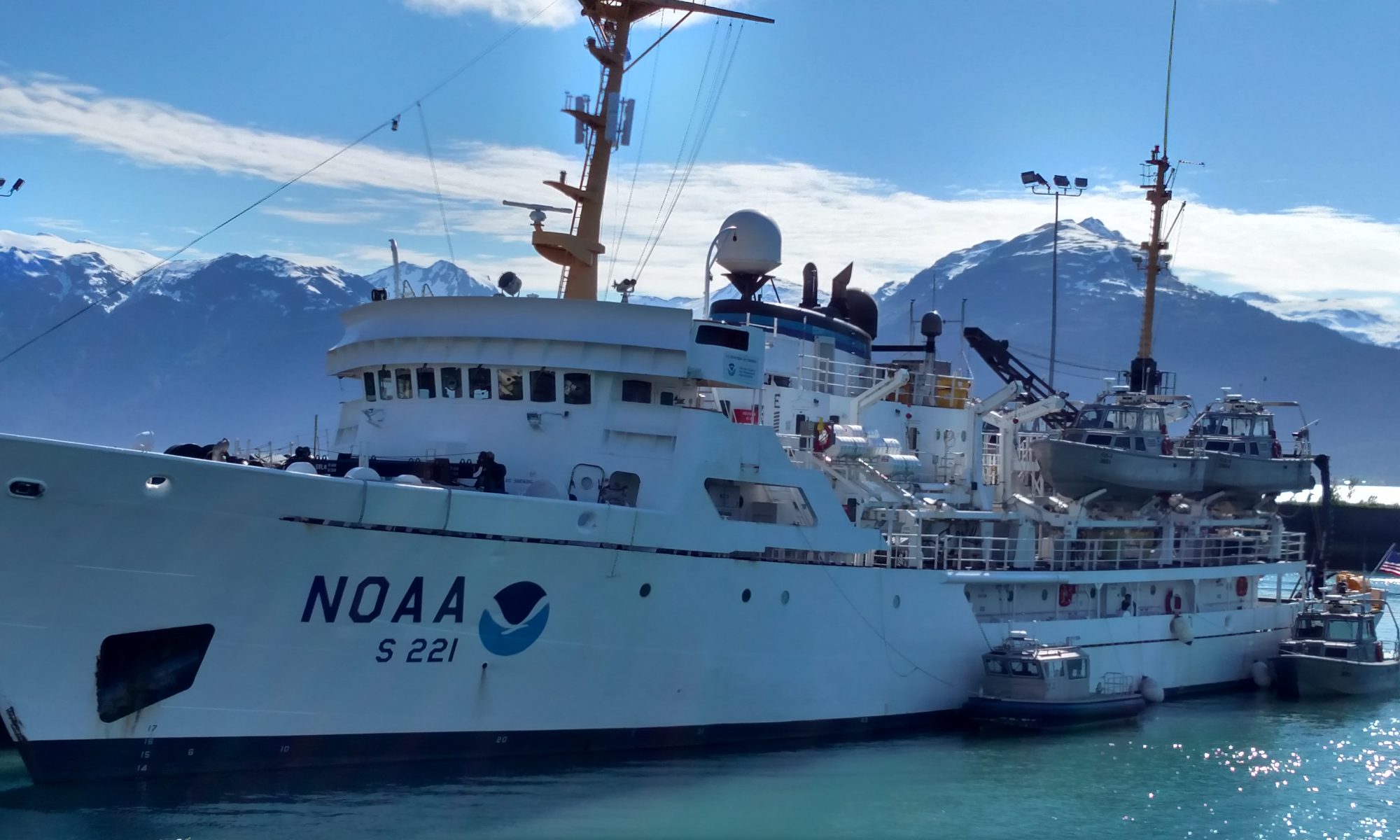
This picture shows the Miller Freeman in Alaskan waters.  On our cruise, it’s working off the coast of California.
This picture shows the Miller Freeman in Alaskan waters. On our cruise, it’s working off the coast of California.

Our cruise was delayed for a day due to poor weather conditions and heavy seas. We began with a meeting of the scientific team which consists of 8 members all with their specific scientific knowledge and expertise. We will be conducting several types of oceanographic sampling during our cruise:  2-3 hake tows per day, weather permitting, an open net tow where fish are viewed through a camera, XBTs: Expendable Bathythermograph, HABS: Harmful Algal Bloom Sampling, and CTD: Conductivity, Temperature, and Density. The ship conducted Man Overboard and Fire drills.

The research vessel Miller Freeman set sail from Eureka, California on Wednesday, July 15th at approximately 12:30. Each person aboard is assigned a specific job and place to report on the Miller Freeman during such an event. Our assignments are posted on our stateroom door. During a Fire/Emergency Drill the signal is a 10 second blast of the general alarm and/or ship’s whistle. I am to report or muster to the Chemical Lab.

In the event of an Abandon Ship Drill, I am assigned to life raft #2 and muster on the O-1 deck, port (left) side. The Abandon Ship signal is more than 6 short blasts followed by one long blast of the general alarm and/or ship’s whistle. If a Man Overboard Drill is called, we will hear 3 prolonged blasts of the general alarm and/or ship’s whistle.  The muster station is the Chemical Lab. If we personally see a person go overboard the ship there are three things to do immediately: Throw a life ring overboard, call the bridge, and keep your eyes on the person. 

These things all need to be done as simultaneously as possible to assure the safety and recovery of the person who is in the sea. It is important to conduct these emergency drills so that everyone is ready and prepared in the case of an emergency event.

Personal Log 

I am sharing a stateroom with Julia Clemons, an oceanographer on board the Miller Freeman. She works for NOAA Fisheries in Newport, Oregon.  Her educational background includes a Bachelors’ degree in Oceanography and a masters’ degree in Geology. The scientists and crew on board are so professional and willing to teach and tell about their job.  They are an amazing group of people.

New Term/Phrase/Word 
Domoic acid

Questions of the Day? 
What does a hake look like in person?

Animals Seen Today 
5 Egrets
1 great blue heron
Numerous gulls

Jennifer Fry, July 14, 2009

NOAA Teacher at Sea
Jennifer Fry
Onboard NOAA Ship Miller Freeman (tracker)
July 14 – 29, 2009 

Mission: 2009 United States/Canada Pacific Hake Acoustic Survey
Geographical area of cruise: North Pacific Ocean from Monterey, CA to British Columbia, CA.
Date: July 14, 2009

NOAA Ship Miller Freeman

Weather Data from the Bridge 
No data (In port)

 Science Log 

After arriving at the Eureka airport I found my way to the Miller Freeman thanks to many friendly Eurekan locals. What a lovely town with many interesting sights including the dock area, downtown with its renewed turn of the century architecture.   Upon arriving at the Miller Freeman I was greeted by Ensign Heather Moe who graciously gave me a tour of the ship.

There were four decks or levels to the ship which include:

  • Flying Bridge Deck: observations take place as well as storage
  • Bridge Deck: Navigation can take place from the bridge or the trawl house.  The trawl house faces toward the stern of the ship and is used to control the ship during “fishing.”
  • Boat Deck: Officers’ & Chief Scientist’s staterooms.  A stateroom is where you would sleep on a boat or ship. Your bed is called a “rack.”  Most staterooms on the Miller Freeman have bunk beds. The boat deck is where the small launches/rescue boats are stored.
  • There is: a FRB, Fast Rescue Boat, and a small launch.
  • Quarterdeck/ Main Deck:  Ship’s store, survey officers’ staterooms and the back deck, used for fishing. *The term quarterdeck was originally, in the early 17th century, used for a smaller deck, covering about a quarter of the vessel. It is usually reserved for officers, guests, passengers. It is also an entry point for personnel. Lower/ Galley Deck: Crew’s and scientists’ staterooms, library, two lounges, galley, where everyone eats their meals.
  • Hold: Gym for exercising and engineer’s storage area.

Question of the Day 
Where did the word quarterdeck* originate? (see answer above)

Animals Seen Today
Egrets Blue Heron Gulls

Stephen Anderson, June 30, 2009

NOAA Teacher at Sea
Stephen Anderson
Onboard NOAA Ship Miller Freeman
June 28 – July 12, 2007

Mission: Hake Survey
Geographic Region: California
Date: June 30, 2009

We’re on station south of Monterey Bay and starting our pattern of parallel east and west course up the coast of California.  Imagine a block capital “S” , and you get the idea.  Using different frequencies on the sonar, Dr. Chu and his colleagues from NOAA/NMFS/NWFSC can detect various types of marine organisms. Here is a picture of what the screen looks like.

Once they detect what we think are hake, we make ready the net and drop it
Once they detect what we think are hake, we make ready the net and drop it 

Because we didn’t find any hake, we looked at the small fish to see if they had a swim bladder. The swim bladder on a fish is like a balloon that inflates and deflates depending on the depth of the fish.  However, when the sound bounces off these swim bladders it may make the fish appear bigger than it actual size. The dissection of these small fish was no fun.

However, today we didn’t find hake.  Instead, we found a Humboldt squid, several small fish, and some shrimp.
However, today we didn’t find hake. Instead, we found a Humboldt squid, several small fish, and some shrimp.

It’s amazing the number of scientific instruments and studies that are being carried out on this ship.  In the following picture a marine biologist is taking a salt water sample.  He will then filter it to identify the presence of toxic plants (algae) and animals (plankton).  These microorganisms not only affect the food chain, but can also be a threat to humans.

Big squid!
Big squid!
Biologist Anthony Odell conducts a test for toxic plankton

Another instrument they use to monitor the ocean is an XBT.  This lead weight is attached by a very thin copper wire. In the following picture a scientist is attaching this to a cable that goes to a computer.  This is then “launched” or dropped overboard reading temperatures and sending them to the computer as it sinks to the bottom (greater than 760 meters or 2200 feet).

Biologist Chris Grandin prepares to launch an XBT

Personal Log 

  • The food has been great.  There is only an hour for each meal, and you have to eat fast.  But there is always a great menu.  I’ll have to try to get to the gym or else I’m going to gain weight.
  • Everyone has been very cooperative.  Being on a ship puts you in tight quarters with everyone.  This cooperation and team spirit helps to make everything work very smoothly.
  • There is an emphasis on safety.  You can tell that everyone is highly trained for their job and role. Yesterday we had our fire and abandon ship drills. On the deck we wear life jackets and hard hats.  Everyone watches out for everyone else.  The level of expertise and professionalism is impressive.

Stephen Anderson, June 29, 2009

NOAA Teacher at Sea
Stephen Anderson
Onboard NOAA Ship Miller Freeman
June 28 July 12, 2009

The CTD Instruments
The CTD Instruments

Mission: Hake Survey
Geographic Region: California
Date: June 29, 2009

We anchored in Monterey Bay.  After putting the anchor down there were several tests that had to be made.  The first was to send in SCUBA divers to check our propeller.  The second test was to check on the transducers for our sonar.  The third was to put over the side the CTD (conductivity, temperature, and density instruments).  This instrument is useful not only to tell the composition of the water, but also to determine currents. Included in this set of instruments is an automatic camera that will catch video of the small animals (micro-organisms) at various depths (what the fish eat).  The fourth test was to send three balls of different sizes and materials to hang under the boat using what we in Michigan would call salmon downriggers.  Dr. Chu, our chief scientist, and Stan Tomich, our engineer, can control these miniature cranes to raise and lower these balls.  They can then calibrate (set the readings on the sonar sensors) to make sure they have the correct depth for the fish they will be able to see with the sonar.  The sonar array in this boat is accurate to within one centimeter. Later tonight we will weigh anchor to go further south to begin our chase after hake.

Divers over the side to check the propeller and sonar.

For those of you who don’t know hake.  This is a cod type of fish that is very important to the fish industry on the west coast of the US and Canada.  If you’ve had a fish stick, you’ve probably had hake.

We were visited today by some very interesting animals: several species of jelly fish, several sea lions, a few dolphins, and a mola mola fish which is sometimes called a sun fish.

A Mola Mola, or Sun Fish. This guy was probably 6 feet in length.

Katie Turner, July 30, 2008

NOAA Teacher at Sea
Katie Turner
Onboard NOAA Ship Miller Freeman
July 10 – 31, 2008

Mission: Pollock Survey
Geographical Area: Eastern Bering Sea
Date: July 30, 2008

Screen shot 2013-11-03 at 10.15.47 AMWeather Data from the Bridge 
Visibility:  10 miles
Wind Direction:  050
Wind Speed:  7 knots
Sea Wave Height:  0-1 foot
Swell Wave Height:  2-3 feet
Seawater Temperature: 8.3 ˚C.
Present Weather Conditions: partly cloudy

Science and Technology Log 

This was the final day at sea for this cruise and we have just returned Dutch Harbor.  The cruise has been challenging for the scientists as they have had to scale back their study, and even eliminate some experiments.  Fifteen days of cruise time were lost while repairs were made to the ship. Conditions while working at sea are unpredictable and require acceptance, patience, and flexibility.

Ship's cruise path
Ship’s cruise path

The Buoy Experiment 

In addition to the side by side comparison study, a unique experiment was designed and performed during this cruise to investigate how walleye pollock (Theragra chalcogramma) behave in the absence versus presence of either vessel, to augment the comparison study.  Transducers were mounted on a buoy, which was deployed from OSCAR DYSON, and allowed to drift while collecting acoustic data on pollock schools with the ships at a distance.  As the buoy drifted along, MILLER FREEMAN and OSCAR DYSON alternately passed by the buoy on a “racetrack” 6 nautical miles (nm) long.  Each ship passed the buoy within 10 meters along the racetrack about every 30 minutes, and maintained a position opposite one another.

The racetrack pass experiment will provide information on how fish respond to the ship as it approaches and passes over them, and then as it moves away. The acoustic data collected by the transducers on the buoy was monitored aboard OSCAR DYSON during the operation, and was downloaded in entirety once the buoy was retrieved for analysis. We made a total of seven buoy passes, which took about 3 ••• hours.  This experiment was done at night when pollock schools migrate up from the bottom of the ocean into mid-water regions.  It was interesting to observe the navigation operations from the bridge as ships maneuvered around the racetrack in the dark. The computer screenshot below shows the track (in red) of the MILLER FREEMAN after our 6th pass of the buoy.  The short, blue vertical line at the end of the red track line at the top of the screen represents the ship. (Green lines are depth contours.) After completing the buoy experiment we picked up the transect from where we had left off and continued the side-byside study.

View of Unalaska
View of Unalaska
On the bridge bringing MILLER FREEMAN into Captain’s Bay, Executive Officer Natasha Davis (official owner of ship’s cat) and Ensign Otto Brown
On the bridge bringing MILLER FREEMAN into Captain’s Bay, Executive Officer Natasha Davis and Ensign Otto Brown

Another Setback 

Later that day the ship developed engine problems and it was necessary to shut down the main engine to investigate. Leaks in the cooling system involving two separate cylinders had developed. This same problem occurred recently with a different cylinder, and was one of the problems that originally delayed our cruise out of Dutch Harbor.  The engineers repaired the system and we were underway again within a few hours.  At this point we were nearly 450 nautical miles from Dutch Harbor, with limited resources for additional repairs.  In the best interest and safety of all aboard, the Commanding Officer decided to discontinue our north and westward direction along the cruise course and head the ship back to Dutch Harbor.

Ship's cat
Ship’s cat

Personal Log 

Our final day in the Bering Sea was mostly sunny.  Dall’s porpoise and whales were occasionally sighted off in the distance, and we watched ash clouds rise from Okmok volcano off our starboard side all afternoon as we closed in on Unalaska.  The wind seemed to be carrying the ash cloud to the southwest, and we hoped that it would not affect flights out of Dutch Harbor for those of us who are flying home.  We arrived in Unalaska before 10 pm, leaving just enough time to anchor and repeat the acoustic calibration. After the scientists and I leave the ship in the morning, she will head back to her home port of Seattle, where she will have a maintenance check before the next cruise. I have thoroughly enjoyed my stay on MILLER FREEMAN and owe many thanks to the officers and crew for their hospitality. It has been a pleasure to get to know everyone and I will have good memories of this cruise, despite the breakdowns and delays. I am especially grateful to the scientists on board, Patrick Ressler and Paul Walline, for sharing their work, helping me understand a little about acoustic surveys, and for their friendship during this experience.