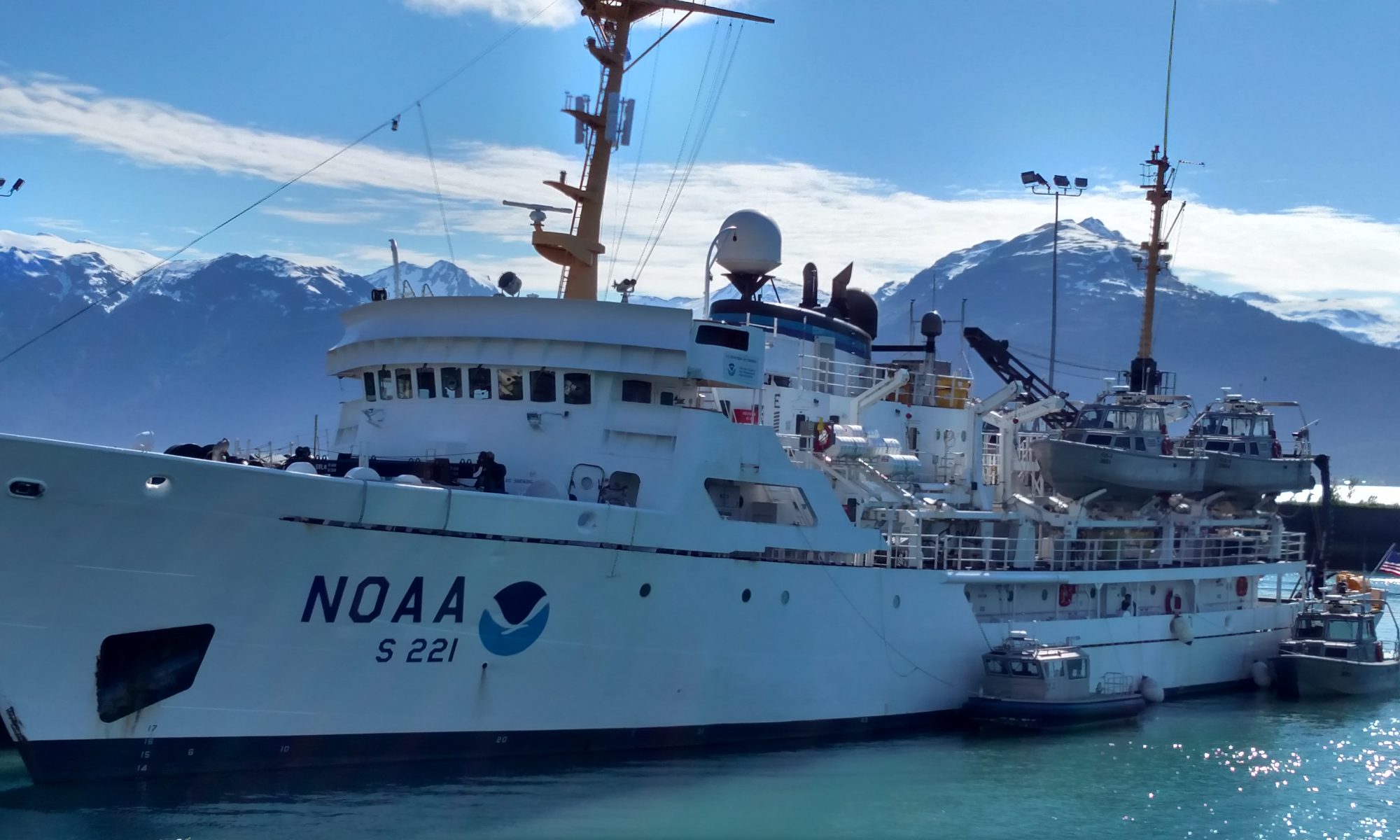
NOAA Teacher at Sea
Melanie Lyte
Aboard NOAA Ship Gordon Gunter
May 20 – 31, 2013
Mission: Right Whale Survey, Great South Channel Geographical Area of Cruise: North Atlantic Date: May 22, 2013
Weather Data from the Bridge:
Air Temperature: 12.01 degrees Celsius or 54 degrees fahrenheit
Wind Speed: 8.88kts
Relative Humidity: 97%
Barometric Pressure: 1,012.42mb
Scientific crew on the Gordon Gunter Photo credit: Mark Weekely
Science and Technology Log
FOG (by Carl Sandburg)
The fog comes
on little cat feet.
It sits looking
over harbor and city
on silent haunches
and then moves on.
And that’s just what we awoke to this morning – heavily clouded skies and fog. Unfortunately, it hasn’t moved on yet, and actually looks like it’s here to stay. This made visibility very poor. The fog horn had been blasting every few minutes all night so the fog didn’t come as a surprise, but was a disappointment. My first shift on watch was moved to the wheel house and we watched with the “naked eye” instead of the “big eye” (giant binoculars that are outside on the bridge). Our primary mission is to search for right whales, but any sea life observed is recorded. I was lucky enough to see 6 white sided dolphins on my first watch after Allison Henry (chief scientist) pointed them out to me. By mid-morning, the fog had lifted and the visibility improved. I am on 90 minute shifts from 7am-7pm with 90 minute breaks between shifts. While working we either watch for whales or record data as others watch for whales.
The scientists want to identify each whale they see. They do this by examining the unique patches of callosities the whales have on their heads and backs. The whales’ callosities are categorized as either broken or continuous.
Diagram from New England Aquarium
They have cataloged 669 right whales using this method since they began the identification process in the late 70’s. The callosities are the same color as the whale’s skin, but appear white or yellow due to the presence of thousands of tiny crustaceans called cyamids, or “whale lice”.
Photo credit: Allison Henry
If we spot a right whales and the conditions are good (no fog and the seas are not too choppy) some of us will go in the “small boats” to photograph the whales, and to do a biopsy sample on the whale if it has not already been sampled.
Biopsy tag in right whale Photo Credit: NOAA/NEFSC/Lisa Conger under Permit #775-1875
Another small boat will try to tag the whale. Tagging the whale is a sophisticated process and uses high tech equipment. Mark Baumgartner from Woods Hole Oceanic Institute (WHOI) showed us the dermal tag he will be using on whales. He also showed us how the tagging equipment has evolved over the last few years. The tag is shot into the whale where it goes into the skin about 3 inches. It has a GPS attached to it so it can be recovered from the whale when it falls off (usually in 24 hours). The scientists can set it to come off the whale in a certain amount of time. The implantable dart stays in the whale’s skin until it eventually works its way out which they estimate to be in 3-4 weeks. This process startles the whale, but is not thought to cause them pain.
Personal Log
We have been out on the water for 24 hours at this point, and I feel like I am adjusting well to life at sea. No seasickness yet (knock on wood), and I slept very comfortably last night (I know that comes as no surprise to any of you who know the ease with which I sleep in any situation). Everyone on the ship has been very friendly and willing to share information with me. The food is excellent, with lots of vegetarian choices, great mixed greens salad, and even a pineapple upside down cake for dessert last night.
Did You Know?
Did you know that right whales are identified by the callosities on their heads and bodies?
Did you know that the North Atlantic right whale is one of the most endangered whales? It is estimated that there are only about 470 right whales alive today.
Question of the day: What is the smallest whale in the world?
Getting just one small jar of plankton back to the lab on shore requires a lot of work. First comes all of the net-dropping work I described in the last post, which is a team effort from everyone on board, just to bring the samples onto the ship. From there, we have to take several more steps in order to preserve the sample.
Step 1: After the nets are brought back onto the bow of the ship, we hose them down very thoroughly using a seawater hose, in order to wash any clinging plankton down into the cod end.
Here I am, hosing down the Bongo nets. Photo by Alonzo Hamilton
Then we detach the cod end and bring it to the stern of the ship, where a prep station is set up. The prep table is stocked with funnels, sieves, seawater hoses and jars, and the chemicals that we need to preserve the plankton that we collect – formalin and ethyl alcohol.
Prep Station
Step 2: We carefully pour the specimen through the fine-mesh sieve to catch the plankton and drain out the water. It’s amazing to see what’s in the sample. This, of course, includes lots of tiny plankton; all together, they look kind of like sludge, until you look very closely to see the individual creatures. Lots of the fish larvae have tiny, bright blue eyes. (On a funny note, my breakfast granola has started to look like plankton after a week of collecting!)
Plankton in a sieve
Getting to see what makes it into each sample is kind of like a treasure hunt. Sometimes bigger organisms like fish, sea jellies, eel larvae, pyrosomes and snails end up in the sample. Quite frequently there is sargassum, which is a type of floating seaweed that does a great job of hiding small creatures. Take a look at the pictures at the end of the post to see some of these!
Step 3: Next, the sample goes into a jar. We use seawater from a hose to push the sample to one side of the sieve, and let the water drain out. Then, we put a funnel in a clean, dry jar and use a squeeze bottle of ethyl alcohol to wash the sample into the jar through the funnel. We top the jar off with ethyl alcohol, which draws the moisture out of the bodies of the plankton so that they don’t decompose or rot in the jar. The sample from the left bongo – just this sample and no other – is preserved in a mixture of formalin and seawater because it goes through different testing than the other samples do once back on shore. We top all of the bottles with a lid and label them: R for Right Bongo, L for Left Bongo, RN for Regular Neuston, and SN for Subsurface Neuston.
Plankton Ready to go in the Jar
Step 4: After the jars are filled, Alonzo and I bring them back to the wet lab, where Glenn attaches labels to the tops of the jars, and puts a matching label inside of each jar as well. The label inside the jar is there in case the label on the lid falls off one day. These labels provide detailed information about where and when the sample was collected, and from which net.
A label on the jar gives detailed information about the plankton inside
Step 5: After 24 hours, it’s time to do transfers. Transfers involve emptying the samples from the jars through a sieve again, and putting them back into the jars with fresh ethyl alcohol. We do this because the alcohol draws water out of the bodies of the plankton, so the alcohol becomes watered-down in the first 24 hours and is not as effective. Adding fresh alcohol keeps the sample from going bad before it can be studied. Once the transfers are done, we draw a line through the label to show that the sample is well-preserved and ready to be boxed up and brought back to the lab!
Boxes full of plankton samples ready to be brought back to shore
Personal Log:
I have the great fortune of working with some intelligent, knowledgeable and friendly scientists here on the Oregon II. Jana is my bunkmate and one of the scientists; she pointed out to me that just about every animal you can imagine that lives in the ocean started off as plankton. As a result, while the scientists who work with plankton do each have a specialty or specific type of plankton that they focus on, at the same time, they have to know a little bit about many types of organisms and the basics of all of their life cycle stages. In a way I can relate to this as a Naturalist; I need to have a bit of knowledge about many plants, animals, minerals and fossils from the Mojave Desert and beyond, because chances are, my smart and curious Nature Exchange traders will eventually bring them all in for me to see and identify!
The science team, from left to right: Andy, Alonzo, Glenn, me, Jana and Brittany. Photo by Brian Adornado
I want to take a few moments to introduce all of the members of the science team. I thought I’d have fun with it and use my own version of the Pivot questionnaire:
Meet Alonzo Hamilton
Alonzo Hamilton, scientist, testing water samples in the Wet Lab.
Alonzo is a Research Fisheries Biologist; he has been working with NOAA since 1984. Alonzo earned an Associate’s degree in Science, a Bachelor’s degree in biology, and a Master’s degree in Biology with an emphasis in Marine Science. Alonzo was born in Los Angeles and grew up in Mississippi.
What is your favorite word? Data
What is your least favorite word? No or can’t. There’s always a solution; you just have to keep trying until you find it.
What excites you about doing science? Discovery
What do you dislike about doing science? The financial side of it.
What is your favorite plankton? Tripod fish plankton
What sound or noise on the ship do you love? The main engines
What sound or noise do you hate? The alarm bells
What profession other than your own would you like to attempt? An electrician. There are some neat jobs in that field.
What profession would you not like to do? Lawyer. There’s a risk of becoming too jaded.
If you could talk to any marine creature, which one would it be, and what would you ask it? A coelacanth. What is your life history? What’s a typical day of feeding like? Is there a hierarchy of fish, and what is it? What determines who gets to eat first?
********************
Meet Glenn Zapfe
Glenn Zapfe, scientist, contemplating the plankton samples.
Glenn is a Research Fisheries Biologist; he worked with NOAA as a contractor for 8 years before being hired on as a Federal employee three years ago. Glenn earned a Bachelor’s degree in Marine Life, and a Master’s degree in Coastal Science. He grew up in the Chicago area.
What is your favorite word? Quirky
What is your least favorite word? Nostalgia
What excites you about doing science? Going to sea and seeing organisms in their natural environment.
What do you dislike about doing science? Statistics. They can sometimes be manipulated to fit individual needs.
What is your favorite plankton? Amphipods
What sound or noise on the ship do you love? The hum of the engine
What sound or noise do you hate? The emergency alarm bells
What profession other than your own would you like to attempt? Glenn grew up wanting to be a cartoonist – but he can’t draw.
What profession would you not like to do? Lawyer
If you could talk to any marine creature, which one would it be, and what would you ask it? A cuttlefish, to ask about how they are able to change the color of their skin.
*************************
Meet Jana Herrmann
Jana Hermann, scientist and volunteer, aboard the Oregon II
Jana is a Fisheries Technician with the Gulf Coast Research Lab, and is on this cruise as a volunteer. She has worked with the Gulf Coast Research Lab since February 2013, but worked within the local Marine Sciences field for 8 years before that. Jana earned a Bachelor’s degree in Marine Biology and Environmental biology, and will be starting graduate school in the fall of 2013. Jana grew up in Tennessee.
What is your favorite word? Pandemonium
What is your least favorite word? Anything derogatory
What excites you about doing science? Just when you think you have it all figured out, something new comes up.
What do you dislike about doing science? Dealing with bureaucracy and having to jump through hoops to get the work done.
What is your favorite plankton? Janthina
What sound or noise on the ship do you love? This is Jana’s first cruise on the Oregon II, so she doesn’t have a favorite noise yet.
What sound or noise do you hate? Any noises that keep her from sleeping.
What profession other than your own would you like to attempt? A baker or pastry chef.
What profession would you not like to do? Any mundane office job with no creative outlet.
If you could talk to any marine creature, which one would it be, and what would you ask it? She would ask a blue whale if it is sad about the state of the environment, and she would ask it if mermaids are real.
******************
Meet Brittany Palm
Brittany Palm, scientist, aboard the Oregon II
Brittany is a Research Fisheries Biologist; she has worked with NOAA for 4 years. Brittany earned a Bachelor’s degree in Marine Biology, and is currently working on her Master’s degree in Marine Science. Brittany grew up on Long Island.
What is your favorite word? Midnattsol – the Norwegian word for “midnight sun”
What is your least favorite word? Editing. That’s not a fun word to hear when you hand in drafts of your thesis!
What excites you about doing science? Constantly learning. All of the fields of science, from chemistry to physics to biology, are interwoven. You have to know a little bit about all of them.
What do you dislike about doing science? Also, constantly learning! Every time you think you know something, a new paper comes out.
What is your favorite plankton? Glaucus
What sound or noise on the ship do you love? The ship’s sound signal, which is a deep, booming horn that ships use to communicate with each other.
What sound or noise do you hate? When she’s trying to sleep in rough seas and something in one of the drawers is rolling back and forth. She has to get up and go through all of the drawers and cabinets to try to find it and make it stop!
What profession other than your own would you like to attempt? Opening a dance studio. Brittany competed on dance teams throughout high school and college.
What profession would you not like to do? Anything in the health field, because she empathizes more with animals than people.
If you could talk to any marine creature, which one would it be, and what would you ask it? The Croaker fish. Brittany is studying Croaker diets and has dissected over a thousand stomachs. She would like to be able to just ask them what they eat!
*********************
Meet Andy Millett
Andy Millett, scientist, in the Dry Lab of the Oregon II.
Andy is a Research Fisheries Biologist, and is the Field Party Chief for this cruise. He has worked with NOAA for 3 years. He has a bachelor’s degree in Marine Biology and a Master’s degree in Marine Science. Andy grew up in Massachusetts.
What is your favorite word? Parallel
What is your least favorite word? Silly
What excites you about doing science? When all of the data comes together and tells you a story.
What do you dislike about doing science? Having to be so organized and meticulous, since he is typically pretty disorganized.
What is your favorite plankton? Pelagia
What sound or noise on the ship do you love? Spinning the flowmeters on the nets. It sounds like a card in the spokes of a bicycle.
What sound or noise do you hate? Alarms of any kind, whether they are emergency alarms or alarm clocks.
What profession other than your own would you like to attempt? Video game designer
What profession would you not like to do? Anything in retail or customer service
If you could talk to any marine creature, which one would it be, and what would you ask it? A giant squid, because we don’t know much about them. Andy would ask what it eats, where it lives, and other basic questions about its life.
******************
Challenge Yourself: Hey, Nature Exchange traders! The scientists shared their favorite plankton types; all of them are truly fascinating in their own way. Research one of these animals and write down a few facts. Or, pick your favorite Mojave Desert animal and write about that. Bring your research into the Nature Exchange for bonus points. Tell them Emmi sent you!
Bristletooth Conger Eel Larva. See its tiny little face on the left?Sargassum is a floating seaweed that often ends up in our Neuston nets. We record its volume and throw it back.Sea jellySargassum fish – they hide in the sargassum!Porpita jellyMyctophids are shiny silver and black, and quite pretty!A juvenile flying fish. I’ve seen some adults gliding through the air as well!Alonzo holding a juvenile filefish
NOAA Teacher at Sea Elizabeth Nyman Assigned to NOAA Ship Pisces May 28 – June 7, 2013
Mission: Reef Fish Survey Geographical Area of Cruise: Florida Date: May 21, 2013
Me, with a map of Reykjavik, Iceland
Hi everyone! My name is Elizabeth Nyman, and I just finished my first year as an assistant professor of political science at the University of Louisiana at Lafayette. UL Lafayette is a public university with about 16,000 students, located in a region with twin claims to fame: a center for Acadiana/Cajun culture (and food!) and the heart of the Louisiana offshore oil industry. Ocean resources are very important to southwestern Louisiana, both living and mineral. My students and their families live near or in some cases on the water; their favorite places to vacation are the beaches on Florida’s panhandle.
I have been teaching undergraduates since 2007, mostly courses on international relations and comparative politics. All professors have to have their own areas of arcane specialization, and mine is international maritime law and conflict. I do research and teach about maritime piracy, island tourism and sustainable development, and international maritime treaties like the Safety of Life at Sea, written to protect future ship passengers after the sinking of the Titanic.
I tell people I have the best career in the world, and when they hear more about what I do, most people agree. I got my Ph.D. in political science from Florida State University, in Tallahassee, FL, about two hours drive from where I grew up in Jacksonville, FL. The first week of graduate school, I was supposed to find a topic for my First Year Paper, a sort of mini-thesis designed to throw us into the world of high level research. I sat through hours of my professors talking about what they did, and doodled in the margins of my notebook. One doodle said “international conflicts over oceans?” and that became the topic of my paper.
(See, I was paying attention! Honest!)
For my dissertation, I received a grant to study an international fishery dispute between the Caribbean island states of Barbados and Trinidad and Tobago. It wasn’t much money, but I was a grad student and thus very, very skilled at living on nothing. And I wanted to spend as much time in the Caribbean as possible. Other students were talking about their plans for dissertation research, visiting archives in major cities or traveling to presidential libraries. And strangely enough, people who had always wondered why anyone would care about international ocean politics suddenly wished they’d chosen that as a topic.
The fact that this was two blocks away from where I stayed had nothing to do with their change of opinion, I’m sure. 🙂
But make no mistake, ocean politics are serious business. I don’t need to convince my students of that – they know the economics behind offshore drilling, as well as what happens when things go wrong. They know how much the region known for its seafood depends on shrimp and other fisheries. The resources of the ocean are big business, and sustain livelihoods across the state and across America.
Thing is, fish don’t stay in one place, and today’s American fishing vessels compete with others around the world to catch fish as they dart in and out of national waters. Fish that are unfortunately running out, according to the FAO– about 30% of the world’s marine fish are being overfished, meaning that more are being caught than are being born to replace them. Another 57% are being caught at capacity, or about as many are caught as are born to replace them.
Fish, fish, everywhere…for now. (Picture courtesy of National Geographic)
Now, I’m no biologist, and one of the things that has always been a mystery to me is how we know what we know about fish populations. We know that close to 90% of the world’s fish are being caught at or above capacity – but how do we know what “capacity” is? How do we know if a population is in decline?
I applied for the Teacher at Sea program because I wanted to be able to answer questions like this. My students are intelligent and curious, and I usually get asked about the science behind the policies at least once a semester. I talk to them about NOAA and the work they do, but I wanted the opportunity to experience it for myself. It’s one thing to read about research, and another thing to understand it by taking part in it. I am excited that I get the chance to have this experience, and will be able to better bridge the gap between understanding the science and understanding the policies.
I am fortunate enough to be assigned to the Pisces, a ship involved in fisheries research off the coast of my home state of Florida. The Atlantic and the Gulf are my waters, in a sense, where I have lived and worked for almost my entire life, and these are our fish. They belong to all of us, those who live on the coast and those who only come for a visit. I can’t wait to learn more about them, to finally fill in the scientific gaps in my knowledge.
NOAA Teacher at Sea
Sue Cullumber
(Soon to be) Onboard NOAA Ship Gordon Gunter
June 5– 24, 2013
Mission:Ecosystem Monitoring Survey Date: 5/21/13 Geographical area of cruise: The continental shelf from north of Cape Hatteras, NC, including Georges Bank and the Gulf of Maine, to the Nova Scotia Shelf
My students on a field-trip to the desert.Howard Gray School in Scottsdale, Arizona.
Personal Log:
Hi my name is Sue Cullumber and I am a science teacher at the Howard Gray School in Scottsdale, Arizona. Our school provides 1:1 instruction to students with special needs in grades 5-12 and I have been teaching there for over 22 years! In less than two weeks I will be heading out to the Atlantic coast as a NOAA Teacher at Sea. I am so excited to have this opportunity to work with the scientists aboard the NOAA ship Gordon Gunter.
I applied to the NOAA Teacher at Sea program for the following reasons:
First, I feel that directly experiencing “Science” is the best way for students to learn and make them excited about learning. To be able to work directly with NOAA scientists and bring this experience back to my classroom gives my students such an amazing opportunity to actually see how science is used in the “real world”.
Visit to Española Island – photo by Pete OxfordStudents holding “Piggy” and our other baby Sulcata tortoises.
Secondly, I love to learn myself, experience new things and bring these experiences back to my students. Over the past several years I have had the opportunity to participate in several teacher fellowships. I went to the Galapagos Islands with the Toyota International Teacher Program and worked with teachers from the Galapagos and U.S. on global environmental education. From this experience we built an outdoor habitat at Howard Gray that now houses four tortoises. Students have learned about their own fragile desert environment, animal behavior and scientific observations through access to our habitat and had the opportunity to share this with a school in the Galapagos. I worked with Earthwatch scientists on climate change in Nova Scotia and my students Skyped directly with the scientists to learn about the field research as it was happening. Last summer I went to Japan for the Japan-US Teacher Exchange Program for Education for Sustainable Development. My students participated in a peace project by folding 1000 origami cranes that we sent to Hiroshima High School to be placed in the Hiroshima Peace Park by their students. We also held a Peace and Friendship Festival for the community at Howard Gray.
Completion of the 1000 cranes before sending them to Hiroshima.Japanese teachers learn about our King Snake, Elvis, from the students.
This year we had a group of Japanese teachers visit our school from this program and students taught them about many of the sustainable activities that we are working on at school. Each has brought new ideas and amazing activities for my students to experience in the classroom and about the world.
Dusk at the south rim of the Grand Canyon.
Lastly, Arizona is a very special place with a wide variety of geographical environments from the Sonoran Desert (home of the Saguaro) to a Ponderosa Pine Forest in Flagstaff and of course the Grand Canyon! However, we do not have an ocean and many of my students have never been to an ocean, so I can’t wait to share this amazing, vast and extremely important part of our planet with them.
So now I have the chance of a lifetime to sail aboard the NOAA ship Gordon Gunter on an Ecosystem Monitoring Survey. We will be heading out from Newport, RI on June 5th and head up the east coast to the Gulf of Maine and then head back down to Norfolk, Virginia. Scientists have been visiting this same region since 1977 from as far south as Cape Hatteras, NC to the an area up north in the Bay of Fundy (Gulf of Maine between the Canadian provinces of New Brunswick and Nova Scotia). They complete six surveys a year to see if the distributions and abundance of organisms have changed over time. I feel very honored to be part of this research in 2013!
NOAA Ship Gordon Gunter (photo credit NOAA)
One of the activities I will be part of is launching a drifter buoy. So students are busy decorating stickers that I will be able to put on the buoy when I head out to sea. We will be able to track ocean currents, temperature and GPS location at Howard Gray over the next year from this buoy. Students will be studying the water currents and weather patterns and I plan to hold a contest at school to see who can determine where the buoy will be the following month from this information. While out at sea my students will be tracking the location of the Gordon Gunter through theNOAA Ship Tracker and placing my current location on a map that one of my students completed for my trip.
Spending time with my husband, Mike, and son, Kyle.
Outside of school, I love to spend most of my free time outdoors – usually hiking or exploring our beautiful state and always with my camera! Photography is what I often call “my full-time hobby”. Most of my photos are of our desert environment, so I look forward to all amazing things I will see in the ocean and be able to share with my husband and son, students and friends! One of my passions is to use my photography to provide an understanding about the natural world, so I am really looking forward to sharing this fantastic adventure with everyone through my blog and photos!
Enjoying the view during one of my hikes in the Sonoran Desert.
NOAA Teacher st Sea Emilisa Saunders Aboard NOAA Ship Oregon II May 14th – 30th, 2013
Mission: SEAMAP Plankton Study Geographical area of cruise: Gulf of Mexico Date: Monday, May 13th, 2013
Science and Technology Log:
Me and the Oregon II (and the silly crewmember in the background). Photo by Kaela Gartman
I’m finally aboard the Oregon II!
Today I got a sneak preview from the lead scientist, Andy, of the labs and some of the equipment that we’ll be using to collect plankton once we’re underway. There are three labs where we’ll be doing science for the next 17 days: the dry lab, the wet lab, and the chem lab. The dry lab, where I’m sitting and typing right now, is a room with computers that are used to remotely monitor the depths of the nets once they have been dropped, and to record data about those drops. The wet lab is where samples of plankton are preserved in jars to be sent back to shore and studied. The chem lab is where chlorophyll is separated from plankton samples.
I got to see the CTD, which is a unit that collects water at specific depths in order to measure physical characteristics of the water, such as salinity, fluorescence, temperature, and dissolved oxygen. I’m looking forward to learning more about this physical data and why it is important once we are underway.
The CTD collects water samples for testing
Andy also showed me the nets we will use to collect plankton. All of the nets are large and heavy and are raised and lowered by winches that are operated by the ship’s crew. The first is a Bongo net. If you’ve ever seen bongo drums, you can get a sense of what this unit looks like: two side-by-side nets with round openings. The nets themselves are shaped like cones, and we’ll attach a bottle called a cod end on the end of each to capture all of the plankton from the nets. Then there are two Neuston nets, which have large, rectangular openings. The regular Neuston net will be towed along the surface, and the Subsurface Neuston will be towed in a pattern at various depths, as will the Bongo. The unit that I am most excited about is the MOCNESS. This big frame holds up to ten nets, which can be opened and closed at certain depths; that way, we can collect samples from various depths and monitor plankton at separate locations and at specific depths in the water column. In the other nets, you know what you get and where it came from, but not how deep it was.
Bongo netsSubsurface Neuston Net
The water column is an idea that scientists use to think about and study the ocean from top to bottom, or from the surface to the ocean floor. When you think about the water column, imagine the ocean as an aquarium, and you’re looking into it and seeing the organisms that live at different depths and what the water is like at those depths.
The reason that the MOCNESS is so exciting to me is that it reminds us that the water in the ocean is not just a uniform mixture all throughout; different creatures live at different depths, and in different numbers at those depths. It’s easy to imagine that creatures that are benthic – meaning, they live on the ocean floor – will vary depending on where they are in the world and how deep the ocean floor is in that spot. It’s harder to imagine that pelagic organisms – those that live in the water column, neither at the very surface, nor at the bottom or at the shore – will also vary greatly depending on depth and location. The water itself is different as well; the temperature of the water and the amount of salt, light and oxygen changes with depth.
Challenge Yourself: Here’s a challenge for my Nature Exchange Traders: go on into the Nature Exchange and explain the terms water column, benthic and pelagic to earn some bonus points. Tell them Emmi sent you!
The journey begins! Photo by Kaela Gartman
Personal Log
Flying over Alabama on the descent into Mobile on Sunday, I was struck by how much water there was everywhere below me. Everywhere I looked, there were slow, meandering rivers, sparkling ponds, lakes and streams. At times when I thought I was looking down on a forest, I saw the sun reflecting off of water blanketing the ground beneath the trees and shrubs. I was even struck by the number of puddles in parking lots and lining the streets. I kept thinking that, living in the desert, I’m just not used to seeing so much water – and I hadn’t even reached the harbor yet! It was as if I was being slowly introduced to the world that I’m about to live in for the next 17 days.
I’ve been aboard the Oregon II at dock for just a few hours now, and I’m already overwhelmed with fascination, excitement, curiosity, and anticipation. I started the morning at my hotel feeling very nervous, knowing that I was about to experience a rush of newness: new people, places, sights, sounds, rules, routines, you name it. I told myself just to take a deep breath and take it in one thing at a time, and that really helped me to enjoy the experience. Now the nerves are mostly gone and I’m just very much looking forward to the ship’s departure tomorrow afternoon!
To my great fortune, I’ve already found everyone I’ve met to be incredibly kind and friendly. I got to meet some of the NOAA lab scientists who study the plankton that is collected from the Gulf, as well as field scientists Alonzo and Glenn, with whom I’ll be working the night shift on the Oregon II. Last but not least is Andy, the lead scientist for this cruise, who helped plan logistics for my arrival, gave me a tour of the ship and helped me get situated on board.
The folks I’ve met on board are from all over the United States. Some of them came to Pascagoula to work for NOAA to study the effects of the Deepwater Horizon oil spill; some came as part of their graduate school studies. Everyone I’ve met either has or is pursuing an advanced degree, so the intelligence on board the ship is impressive. As challenging as it can be to for the scientists to be away from home for more than a hundred days out of the year, all of them have some level of appreciation for doing field work. Not all of the scientists who study plankton in Pascagoula are able to leave the lab to go on the cruises, so I am even more grateful that I have the honor of taking part. I’m also extremely grateful to learn that I will be of help to the team. Because of limited staffing and budgets, the science team depends on teachers, like me, to provide extra sets of hands during the field work.
My stateroom on the Oregon II
I’ll be staying in Stateroom 5 for this cruise, which I’ll share with a volunteer scientist named Jana. “Stateroom” is the word used for a bedroom on a ship. The stateroom is small, as expected, but it actually feels like it’s the perfect size. All of my belongings are unpacked in drawers and cabinets, and they all fit just fine. There’s a bunk with two beds, a sink, and three storage cabinets. Two of the cabinets are entirely for our use, and one mostly holds safety gear and flotation devices. There is enough floor space that I could lay on the floor and do snow angels, so there will be plenty of room to move around. I don’t expect to be spending all that much time in the stateroom once we are underway.
Time has taken on a whole new meaning in the past two days. Yesterday morning I left Las Vegas in the Pacific Time Zone and flew to Atlanta in the Eastern Time Zone, then to Mobile in the Central Time Zone. It was almost like time travel. After we embark tomorrow, I’ll start my work schedule, which will have me on duty from midnight to noon every day. Work goes on around the clock on NOAA vessels. This schedule will take some getting used to, but as a morning person, I am excited that I’ll be awake and active for my favorite part of the day, and I’ll get to watch the sun rise. Right now, I’m attempting to stay awake for my entire first night on the ship so that I can get on my work schedule right away. To add another level of confusion to my sense of time, ship crews observe 24-hour military time instead of using AM and PM. Numbers are difficult for me and don’t come naturally, so this will take some getting used to.
The clocks on the ship show the 24-hour military time system.
Just being on the ship feels quite surreal. As I write this at 23:33hrs, there are just a handful of people on board, and we are still at dock. Every once in a while some subtle movement reminds me that this is a ship in the water, but mostly it feels like solid ground. I know that will change once we get moving. Aside from the obvious signs, there are other little reminders that this is a ship, where everything must be secured for rougher waters. Computers and monitors are strapped and bolted to the tables, there are gripper pads spread out on tables and in drawers, and every door, from drawers and cabinets to staterooms, has to be latched shut and unlatched to open, and open doors have to be secured with a hook so that they don’t slam shut when the ship shifts. There’s also a constant hum of noise on the Oregon II. I’m interested to see how loud it is when we’re actually moving!
The adventures in science begin tomorrow!
Sunset at dock, from the dry lab of the ship
Did you know?
Bluefin tuna plankton are a type of ichthyoplankton, which comes from the Greek words for “fish drifters.” For those of you in Nevada, think of our state fossil, the ichthyosaurus, which means “fish lizard!”