Staci DeSchryver: A Major Ursus, August 3, 2011

NOAA Teacher at Sea
Staci DeSchryver

Onboard NOAA Ship Oscar Dyson
July 26 – August 12, 2011 

Mission: Pollock Survey
Geographical Area of Cruise: Gulf of Alaska
Location:  57.43287 N, 152.28867 W
Heading:  
241.2 (Stationary)
Date: August 3, 2011

Weather Data From the Bridge
Overall Weather:  Clouds and fog

Science and Technology Log

One of the most serious emergencies that can take place onboard a ship is a fire.  The NOAA Ship Oscar Dyson has many security measures in place in the event of a fire while underway.  During our time in port, the crew of the Dyson planned a ‘’Safety Stand Down” Day to review safety protocol for all types of emergencies, particularly what the crew should do in the event of such a serious issue.

Before we began discussing some of the features of fire-fighting and emergency equipment, we participated in a survival activity that will certainly be used for the first days of school in my AVID class.    The activity consisted of a list of 15 items that we had in a mock abandon-ship emergency situation.  We were supposed to rank order the items of greatest to least importance for survival.  Some items were quite obviously important (water, food, and shelter, for example) and some were quite important but at first glance appeared to be about as useful as chewing gum.  There was a third group of items that appeared to be important, but in reality, ended up being about as valuable as a lawn ornament.  We rank ordered the items first on our own, and then formed groups of four or five to discuss our lists and come up with a group consensus of what is valuable.  As I predicted, repurposing items was the name of the game and those seemingly useless chewing gum items realized their full potential for being used for some other function.  Overall, I won!  I will be accepting applications for spaces in my life raft in the event of an emergency.  Preference will be given to those who can demonstrate strong paddling capabilities and have a deep aptitude for celebrity impersonations for entertainment purposes while on the raft.  Although all candidates will be judged carefully, those who write detailed, yet succinct and poignant essays will be given highest consideration due to limited on-raft seating.

After we finished the safety exercise, we were given the opportunity to take a look at the fire-fighting gear.  Think about this:  what happens when there is a fire at home?  It is usually detected by a smoke alarm, then, if there is time, the type of fire is determined.  Did it start with grease in the kitchen?  Or is it coming from an unknown source, maybe like an electrical fire?  The type of fire will determine what can and cannot be used to put it out.   If the fire can’t be put out quickly, the next step is to…call…the…fire…department.  Now, think about this:  What would happen on a ship in the event of a fire?  Well, many people are typically on watch to ensure that fires don’t start to begin with.  But fires can start on board in all of the same ways they can start at home.  So, in preparation for this, the ship must be equipped not just for fire, but for all kinds of fire.  If the fire can’t be put out quickly, the next step is to…call…the…fire…department…but wait!  That really can’t be done.  Who, then, do we call?  (Not the Ghostbusters, but good try.)  The crew doubles as the fire department.   In fact, any person who is on the ship is a member of the fire-fighting team to a certain extent.  My job is to be accounted for and stay the heck out of the way so the pros can do their job.

All of the crewmen are trained in firefighting procedures.  There are two fire lockers, one fore and one aft of the ship.  Inside the fire locker is a treasure trove of nozzles, hoses, and fire axes.  They are ready for anything on the ship because they have equipped themselves with a variety of means with which to fight different kinds of fires.

fire gear
Here, two members of the Oscar Dyson practice changing out air supply tanks.

What I found both interesting and important is that all of the hose lengths must be able to reach any connection on the ship so that all parts of the ship are covered in the event of a fire.  This can easily be explained if you think about a poorly designed sprinkler system.  If your sprinklers don’t cover all areas of the yard, you end up with conspicuous brown patches in the grass where the water doesn’t reach.  However, if the sprinkler system is set up correctly, no brown patches exist.  The Oscar Dyson requires that all of the hoses are long enough so that there are no “brown areas” on the ship.  If appropriate and necessary, the hoses will pull seawater out directly from the ocean to fight a fire in favor of the purified water onboard.  Usually, they prefer to use carbon dioxide to fight the fire.  It’s relatively benign in terms of dangerous reactions that could potentially take place.  For example, if there was a grease fire onboard, it wouldn’t make much sense to put water on it, but Carbon Dioxide would be a great option.

Next, we were given a demonstration of all of the nifty features of the firefighting gear. Ensign David Rodziewicz, the head safety officer, gave pointers on how to effectively put fire-fighting gear on.  The goal is to be able to get in and out of fire gear in less than two minutes, with the ideal time being less than a minute.  ENS Rodziewicz indicated that the most important way to be successful with suiting up is to have the gear properly set up – if boots are tipped over and gloves are strewn all over the place, not much will be accomplished in the time frame allotted – and being able to fight a fire quickly, while critical in all areas, is imperative on a boat.  Where land-based fires are a tragic and sobering experience, there is often an escape.  One can leave and go to a wide parking lot or out to the street away from the flames.  On the ship, the only place to go if things really take a turn for the worse is the ocean.  This is why timing is so important.There are some neat features on the fire-fighting equipment.  The air supply tanks are equipped with a 45-minute supply of air.  Most fire fighters are not expected to stay in an active fire area for that long, but the supply is large enough just in case there is a problem.   There is no need to keep time while fighting fires.  A “heads-up” display is clearly visible in the fire mask, with green, yellow, and red indicator lights representing the percentage of air left in the tanks.  The batteries for the light displays are changed quarterly – an important thing to check off on a to-do list!  Of all of the things to remember to do on a ship, it seems to me like that would be an easy task to forget.  But, they never do.  Another interesting feature is the communications system.  Each fire-fighting mask has a built-in communications system, so there is no need to take a radio in to an area with flames.  It’s almost like having a fire-fighting Bluetooth.  Each coat is also equipped with a flashlight and an emergency nylon strap in case of an emergency.  The neatest feature to me was the emergency bypass for the oxygen tanks.  If a crew member runs out of air, he or she can “latch” on to another person’s tank by ENS Rodziewicz utilizing a connector hose from the back of the rescuing party’s tank.  This will give approximately a ten minute air supply, although  points out that if one finds    himself or herself in that kind of a situation, he or she should not be in a fire zone for an additional ten minutes.  The emergency air supply is to safely remove a crew member only – not for fighting fires.One of the most useful ways to fight fire on a ship is to simply cordon off the area and then let the fire run its course in the offending room.  On the ship, there are many fire-retardant walls built into the bulkhead.  At that point, the fire fighters will utilize a tactic known as “boundary cooling.”  When you shut off a single room in the ship, the above and below decks can still conduct heat.  Therefore, the crew will spray a layer of ocean water in the rooms directly above and below the target area to ensure that the fire does not spread above or below floors.  Water has a high specific heat, so it acts as an excellent energy absorber.   This tactic is called boundary cooling, and is used often used in fire-fighting on a ship.Afterward, we watched the crew practice putting on, activating, and utilizing their fire-fighting equipment.  Each person who is responsible for fire-fighting has a partner who assists him or her in getting suited up, changing out air supply tanks, and assisting in other duties as necessary.Here, Cat and I are pret-a-porte in our stylish life-saving devices. Will we go into the water? Check out my other blog to find out…

From there, the day got really exciting, but if you want to read about it, you’ll have to visit my other blog at www.mrsdisonaboat.blogspot.com– a quick hint:  it involves a gumby suit and a big splash!  It’s not for the faint of heart.  Here’s a preview in the picture to the left.  Also, be sure to check out Cat’s blog:  www.blueworldadventures.blogspot.com to see what she’s been up to!  Cat does some incredible cartoons that are really funny and informative, so she is capturing this adventure in a completely different light.  We make a great team!

Personal Log

Will Cat and I make a big "splash?" Check out my other blog to find out!

Yesterday, Cat and I went out to Fort Abercrombie.  Fort Abercrombie was an established World War II outpost that was designed to defend American soil in the event of an attack from the Axis Powers.  We found this really interesting interpretive trail called the Wildflower Trail.  Along the trail, there were informative signs about various wild flowers, their scientific name, their Inuit name, and uses for the roots, blossoms, stems, and leaves.  After encountering a sign, it was a sure bet that we would see the celebrity flower just a few clicks up the trail.  The trail carried us to a decrepit lookout post over the inlet that we could enter into and see what the defenders of our nation saw when they looked out on the glass blue waters of the bay.

The lookout
Here at Ft. Abercrombie, Marshmallow busied himself by taking post in the military lookout. He claims he was scanning the air for potential threats to our borders. Since there are not imminent threats to Alaska at this juncture, I maintain that he stole Cat's binoculars to look for Salmon.

Old buildings stood steadfast, fighting reclamation by the forest while many had a legacy left only by a sign pounded in to a rotting foundation.  Again, I found myself trying to tell the story of those who used to call this enchanted forest home.

We also (sound trumpets!) saw a Kodiak Brown Bear!  There is a difference between a Brown Bear, a Kodiak Bear, and Grizzly Bear – mainly demographic.  A Brown Bear (Ursus arctos) is called a brown bear because it is found in coastal areas.  Kodiak Bears are the largest of the Brown bears and are found only on Kodiak Island.  Inland bears (like the ones you find in Yellowstone) are called Grizzlies (Ursus arctos horriblis).  Bears on boats are called Marshmallows.  All bears (excepting Marshmallow himself) are in the genus Ursus.   Brown bears, Grizzly Bears, and Kodiak Bears are Ursus arctos, while Marshmallow’s distant cousins to the north are Ursus maritimus.  After discovering this as his namesake, Marshmallow was quite revolted.  He has decided to write a strongly worded letter to the Linnaeus Society as the term maritimus paints a less menacing and voracious picture of polar bears than does the Grizzly’s namesake.

Mbear in the flowers
Marshmallow has been quite incorrigible since his discovery of his species name. I suggested that he attach this photo to his strongly worded letter, which paints him in a most frightening manner.

He has suggested instead to be called Ursus kickyerbuttus.    I maintain that Marshmallow should be renamed Ursus domesticus stuffedus wimpus, because the closest he has ever been to a salmon run is from the comfort of his 60 inch HDTV.  He has a stateroom for crying out loud.

As we drive along the road, we slow down to a crawl at all of the river crossings hoping to see Kodiak Bears.  Our luck was good that day, because we saw three in a matter of about 4 hours.  Here he is now.

Brown Bear
This bear is not a Marshmallow. Nor is he a Pooh or a Yogi. Let me break this down into a simple equation: No stuffing + large + curious and furtive glances at surrounding humans + large teeth and claws = I should probably be further away than I am right now.

A fisherman nearby hypothesized he was a juvenile male, about 2 or 3 seasons away from his mamma and on his own as a hunter.  He was pretty indifferent to the existence of people, but not menacing in any way.  He ambled along, chasing after magpies and hopping in and out of the water.  It was neat to see him up so close, but still have the safety of the bridge to keep us at a safe distance.  This was of course, until he decided to climb up onto the road.  He was quicker than I would have liked him to be!

After dinner, we were driving back to the ship along Women’s Bay and one ran out in front of the car!  His shoulder blade was at the same level as the roof of the Impreza we were driving – no fish tale.  He glanced casually at us and loped off into the trees toward the salt marsh.  The next creek up the bay hosted a third bear, but we only got a glimpse of him as he was gone by the time we turned the car around.  It was really a blessing to get to see (more than once!) such neat little critters.  And by little critters I mean large toothed, long clawed beasts that have the capability to chew your head off in one fell swoop.  Thankfully, they are more interested in salmon at this time of year, and really don’t have much of a taste for people.  (In defense of Mr. Kodiak, there are more casualties from dogs in a given year than there are fatal maulings in ten years from Kodiak Browns.  We would have much more to worry about if we tasted like Salmon or Salmonberries, as this is what comprises the majority of their diet.  However, they should be treated with a healthy respect – especially a momma bear with her cubs.)

It has been an action packed week so far.  We are hoping to learn as much as we can about the island while we are here, and we are making the best of being in port while we wait to set sail.  It’s been wonderful to walk out on the peninsula every morning and have some time to myself to show gratitude for all that has been done for me to get me out here and experience this first hand.  The standing joke when we witness something truly spectacular is to say “I think in my evaluation of the Teacher At Sea program I am going to suggest that they actually find places for us to go that aren’t so ugly.  This place is such an eyesore…”  I hope you sense the sarcasm dripping in my voice.

Trivia Question:

True or False?  Sea Stars are Echinoderms that can regenerate lost body parts.

Answer:  True.  “Sea stars are remarkable, as they are able to regenerate lost or damaged parts of their bodies. An arm that is broken off can be regrown. Some species can actually regrow a complete new body from a single severed arm, if it is attached to part of the central disc.”

**http://www.marineparks.wa.gov.au/fun-facts/95-sea-stars.html

Anne Mortimer: Swell Sleeping, July 12, 2011

NOAA Teacher at Sea
Anne Mortimer
Onboard NOAA Ship Oscar Dyson
July 4 — 22, 2011 

Mission: Pollock Survey
Geographical area of cruise: Gulf of Alaska
Date: July 12, 2011

Weather Data from the Bridge
Conditions: Foggy and windy, changing to partly sunny and windy
Air Temperature: 10.1 ⁰C
Sea Temperature: 7.6 ⁰C
Wind direction: 237 ⁰C
Wind speed: 20 knots
Wave height: 2-3 ft.
Swell height: 5-6 ft.

Science and Technology Log

Last night we had a “splitter” catch. The scientists found an area that they couldn’t pass up fishing, so at about 9pm the trawl was put in the water. The 540 ft. long Aleutian wing trawl brought in lots of pollock and Pacific ocean perch, a type of red-colored rockfish.  A catch is called a splitter when it is so big it won’t all fit on the table. To get a weight of the whole catch, the deck crew use a crane to weigh the net, then empty it out.  Then the catch is dumped into a bin that is split in two parts. Only one part of the bin is then raised, putting a sub-sample on the table to be worked-up. It took a long time to process all of the catch. We separated the species on a conveyor belt system, then the messy stuff happens. I mentioned that otoliths and stomachs are collected, but I don’t think I emphasized just how gross this can be. To sex the fish, we use a scalpel to slice the fish down the side, then look for larger pink-colored ovaries or a stringy, twisted looking testes. To collect otoliths, the fish skull is cut just behind the eyes and cracked open. The otoliths are then picked put with tweezers. If you are really good at pulling otoliths, you can pull both at once, which can be very challenging. My double-take record is only 2 in a row, but I’ve pulled both at once at least 5 times now!  The last messy thing is stomach collection. You can imagine what this entails, I’m sure. I’m happy to say that I’ve only had to hold the baggie for the stomach, not cut any out! Processing this catch took several hours– we didn’t end until after 1am.

red rockfish
This red-colored fish is a pacific ocean perch, or P.O.P. to a fish biologist.
Pacific ocean perch

When I am not processing a trawl or on the bridge observing, I have been working to annotate some videos from the cam-trawl. The cam-trawl is a stereo-camera system that takes snapshots of whatever comes through the net. This cam-trawl was designed by several of the scientists on the pollock survey. They are hoping it will help lead to less actual fish samples needed if the images can accurately provide evidence of species, numbers, and sizes. Some trawls would still have to be taken aboard for sexing, weights, and otolith and stomach samples.  Annotating the images basically means that I click through the images, counting each species of fish or invertebrate (usually jellies) that I see. This can very tedious, but the whole idea of the project is very exciting. I’ll talk more about the cam-trawl and this technology in my next blog.

Personal Log

Yesterday was my first real encounter with rocking and rolling on the Oscar Dyson. The winds were blowing at about 30 knots (that’s about 35 mph), and there was a lot of swell. Swell waves are long-wavelength surface waves that could have originated from a storm hundreds or thousands of miles away. The combination of these two made for a very rocky ride until we hid behind an island until sunrise. Since I go to bed at 4:30am, it wasn’t long before the boat was headed back out to unprotected waters, and I was rudely awakened by the swell. To say I didn’t have a swell sleep is an understatement. I had to take a nap this evening to compensate for my lost hours!

Pre-trip Pondering

 NOAA TEACHER AT SEA
CATHRINE PRENOT FOX
ONBOARD NOAA SHIP OSCAR DYSON
JULY 24 – AUGUST 14, 2011
 
Personal Log
I will be traveling in a few short weeks to join the crew of the NOAA ship the Oscar Dyson in the Gulf of Alaska.  During the voyage, I will be keeping this log up to date and documenting my “adventures” with a cartoon series as well.  
I hope that you will follow along, ask lots of questions, and travel with me digitally.  
Until our next adventure, Cat 

Richard Chewning, June 6-7, 2010

NOAA Teacher at Sea
Richard Chewning
Onboard NOAA Ship Oscar Dyson
June 4 – 24, 2010

NOAA Ship Oscar Dyson
Mission: Pollock Survey Geographical area of cruise: Gulf of Alaska (Kodiak) to eastern Bering Sea (Dutch Harbor)
Dates: June 6-7, 2010

Weather Data from the Bridge

Position: Snakehead Bank, Gulf of Alaska
Time: 1700 hrs
Latitude: N 56 00.390
Longitude: W 153 46.380
Cloud Cover: Overcast
Wind: 12 knots from the SE
Temperature: 7.1C
Barometric Pressure: 1016.9 mbar

Science and Technology Log

I have been impressed by the wide array of oceanographic research the Oscar Dyson is able to conduct. A few examples include biological studies of organisms ranging from microscopic plankton to massive marine mammals, collecting a variety of weather data, describing both physical and chemical characteristics of seawater (such as temperature, salinity, chlorophyll, and dissolved oxygen), conducting acoustic surveys of marine life and the sea floor, and much more.

Three Saints Bay nautical chart

One of the Dyson’s ‘bread and butter’ surveys is our survey studying the distribution, biomass, and biological composition (male/female ratios and age) of walleye pollock in the Bering Sea. Walleye pollock is a very important fishery for Alaska. You have almost certainly been a part of this fishery as most fish sandwiches in fast food restaurants and fish sticks in the frozen food section of your local grocery store are Alaskan-caught pollock.

One of the Oscar Dyson’s many tools for this research is her impressive array of acoustic sensors located on the ship’s hull and centerboard. The centerboard is an extension of the hull that can be raised and lowered in the water in order to position most of the Dyson’s sensitive acoustic sensors below the bubbles often found near the water’s surface. These air bubbles interfere with sound traveling through the water and degrade the quality of the data being collected. The Dyson has six downward looking centerboard-mounted transducers, each transmitting a different frequency. Why so many frequencies? Since different types of marine organisms interact with sound waves differently producing varying acoustic signatures, the Dyson must be equipped with a variety of sensors to best characterize the variety of marine life encountered during a survey.

For example, lower frequencies are better suited for fish such as pollock and the higher frequencies are better suited for smaller organisms such as plankton. Think of transducers as a downward shining flashlight illuminating the depths of the ocean with sound rather than light.

The Dyson also has other acoustic sensors such as the ME-70 multibeam echosounder that has the unique ability to look over a much wider angle through the water. Acoustic research works on the same echo location principle that bats and marine mammals employ to find food and navigate. By sending out sound waves and measuring the time the sound takes to travel back after encountering an object, one can learn a great deal about that object’s properties such as distance, size, and movement.

Before traveling to the Bering Sea to start our pollock survey, the Dyson’s scientists must take great care to ensure that their echo-sounding equipment is calibrated correctly. Calibrating the transducers is similar in concept to tuning a piano string or zeroing a sight on a rifle. To this end, the Dyson anchored in Three Saints Bay, a sheltered bay protected from the wind, waves, and currents of the open ocean, at least theoretically. While a troublesome storm passed almost directly overhead, scientists from the Midwater Assessment and Conservation Engineering (MACE) Program (part of the Alaska Fisheries Science Center (AFSC) located in Seattle, WA), the US Fish and Wildlife Service (FWS located in Anchorage, AK), and the Pacific Institute of Fisheries and Oceanography (located in Vladivostok, Russia) worked diligently to fine tune their acoustic sensors.

Copper sphere used to calibrate the acoustic sensors
Bill and Patrick positioning spheres under the Dyson

Paul Walline, Patrick Ressler, Darin Jones, Bill Floering, and Mikhail ‘Misha’ Stepanenko worked day and night calibrating their equipment using metal spheres positioned directly under the ship.

Spheres of different sizes and materials with known acoustic signatures (such as tungsten carbide and copper) are used to calibrate the transducers.

The crew of the Dyson works around the clock as ship time is precious. The scientists work 12 hour shifts, either from 4am to 4pm (the shift to which I am assigned) or from 4pm to 4am. The acoustics lab where the data is collected and analyzed is affectionately called ‘The Cave’ as there are no portholes (windows) to tell the time of day outside.

The acoustic lab, a.k.a. “the cave”

Personal Log

I wasn’t sure when the Dyson arrived at Three Saints Bay as I had retreated to my stateroom early in the evening of the 4th as I was feeling the effects of the rolling seas. I am being berthed with the ship’s 2nd Cook, Floyd Pounds, who is also from Georgia but now calls the Dyson home.
Floyd works with the Chief Steward, Rick Hargis, who has been with NOAA for 20 years and is originally from Washington State. So far the meals have been very filling and satisfying (there is even an ice cream bar!).

My stateroom is located on the crew deck, one level below the main deck near the bow (the pointy end of the ship) on the starboard side (the right side when facing the bow). Utilizing every nook and cranny and with no wasted space, my berth is quite cozy and is surprisingly comfortable. Fortunately with the help of some seasickness medication, I soon found my sea legs and awoke feeling refreshed and hungry (always a good sign!). Seasickness comes from conflicting messages received from the inner ear and the eyes by the brain (the inner ear feels the motion of the boat rolling and pitching in the water but the eyes report a stable environment confusing the brain).

Snug as a bud in a rug
Richard, ready for a swim

A person soon observes that safety is paramount onboard the Dyson as with any NOAA vessel. For example, within 24 hours of leaving Kodiak, the entire crew conducted fire and abandon ship drills. These drills are conducted once a week and are essential for maintaining readiness in the event of an emergency. During the abandon ship drill, I was able to practice donning my survival suit just like our visiting Coast Guard kids did in Kodiak! Although the suit is designed to be quite snug to keep cold water out and to keep the body warm, I was thankful I didn’t have to put the suit to the test by going over the side. To my surprise, Chief Marine Engineer Jerome ‘Jerry’ Sheehan and ENS Russell Pate did just that, going for a dip in the frigid 7.3 degrees Celcius or ~45 degrees Fahrenheit waters! Jerry and Russell used dry suits to scuba dive under the Dyson to check the hull, the prop, and the transducers for anything out of place such as barnacles on the transducers or tangled fishing gear. The only discovery was of a piece of bull kelp snagged on one of the blades of the prop which may explain a noise that was heard on the hydrophones (microphones located under the Dyson’s hull) during our departure from Kodiak.

CO Hoshlyk overseeing recovery divers Jerry Sheehan and ENS Russell Pate

After completing our calibrations and safety operations, the Dyson sailed for a site called Snakehead Bank located 60 nautical miles southeast of Kodiak. The name comes from the bathometric profile of the seafloor of this area which resembles the head of a snake. We soon began conducting camera operations for ground-truthing sea floor composition that I will discuss in my next log!

Remnants of Nunamiut, earliest Russian settlement 1792 in three saints bay, Kodiak
Departing Three Saints Bay


Where did the NOAA ship Oscar Dyson’s name originate?


The Oscar Dyson is named for an Alaskan fisherman who was very influential in fisheries development and management in Alaska. From his days as a commercial fisherman, Oscar Dyson was a pioneer and advocate for Alaska fisherman and was very influential in the growth of this important industry. Alaska’s commercial fishing industry spans the state and includes salmon, herring, pollock, various shellfish, and various ground fish like halibut. While traveling through the Ted Stevens International Airport in Anchorage, I learned that Alaska is a land defined by water with more than three million lakes and more coastline than the rest of the United Sates combined! Alaska is also the only state in the US to have coastlines with three different oceans/seas: the Pacific Ocean, the Arctic Ocean, and the Bering Sea.

Dan Steelquist, July 21, 2009

NOAA Teacher at Sea
Dan Steelquist
Onboard NOAA Ship Rainier
July 6 – 24, 2009 

Mission: Hydrographic Survey
Geographical Area: Pavlov Islands, Gulf of Alaska
Date: July 21, 2009

Weather Data from the Bridge 
Latitude: 55°10.84’ N
Longitude: 161°41.87’ W
Visibility: 10+ Nautical Miles
Wind Direction: 220° true
Wind Speed: 16 knots
Sea Wave Height: 0-1ft.
Swell Waves: 1-2 ft.
Water Temperature: 9.4° C
Dry Bulb: 10.0° C
Wet Bulb: 9.4° C
Sea Level Pressure 980.0 mb  

Science and Technology Log 

NOAA Ship Rainier from the shore of Wosnesenski Island

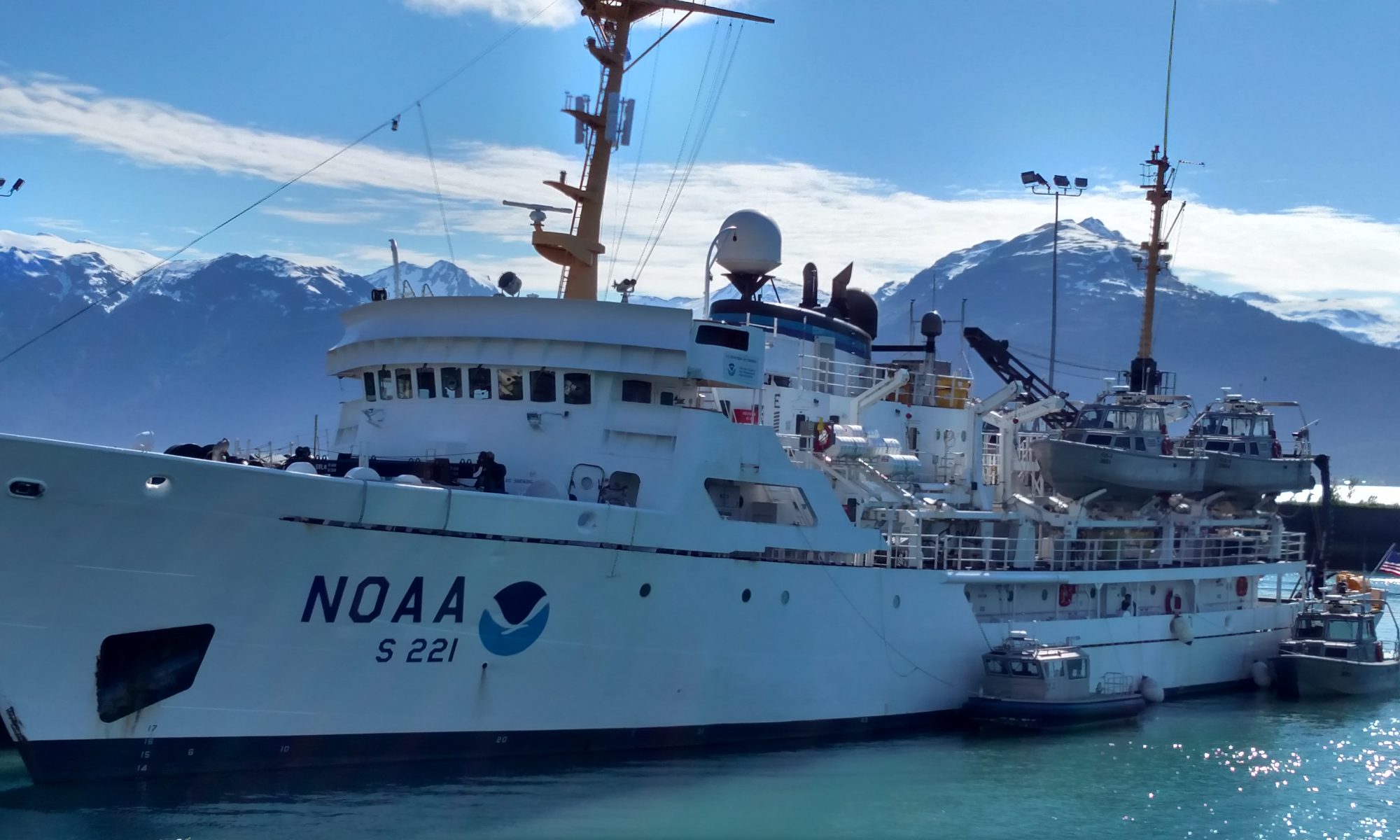
NOAA Ship Rainier is an important workstation used for gathering hydrographic survey data. Rainier is able to cover large distances in order to get to remote places where charting information is needed, but there are no communities from which hydrographers and crew can work. Therefore Rainier herself is a compact city.  The science of operating a small city might seem simple enough, but a closer look at the major parts and it becomes obvious that there is much involved. Two of the areas I have found to be very interesting would be the bridge, where the ship is operated when underway, and the engineering department (the “public works department” of this small community).

The bridge is the command center of the ship. While tied to a pier or at anchor, there are many responsibilities for those on duty on the bridge. Weather data is gathered every hour and radios are monitored for any emergencies that might come up on other ships in the area. While at anchor, the ship’s position is closely watched using radar and GPS to be sure the anchor is holding fast. While underway, the bridge has direct control of the engines and steering. Safe navigation and following a predetermined sail plan are also the responsibilities of those on the bridge. Getting this small city safely and directly to the places it needs to work is critical to the mission of the Rainier.

The engine room is also a very important and interesting area on board this ship. Rainier has two large diesel engines each capable of producing over 1,200 horsepower. A typical automobile produces between one hundred and two hundred horsepower. Those two engines can push this 231 ft ship at a cruising speed of about thirteen knots per hour.  The engineering department can be compared to a public works department of a city because they provide many of the same services. All of the electricity used by Rainier is generated on board. The engineering department is also responsible for making fresh water from salt water using evaporators capable of producing one hundred fifty to one hundred seventy gallons per hour. Any wastewater created on the ship is also treated on board Rainier before it is discharged. The engineering department is also responsible for all of the heating and cooling systems onboard the ship including a large walk-in refrigerator and freezer. Rainier is capable of carrying a crew of over fifty people on hydrographic survey missions for up to three weeks at a time. To make that operation possible, this ship is a floating city complete with all the services and utilities any small town would need to function effectively.

Personal Log 

I’ve been on board Rainier now for almost three weeks. I have seen and learned many things. The work of the hydrographers is very important. The ship provides an excellent work platform from which to gather data and each of the different departments contributes greatly to the mission of the ship. There is quite a bit of quality science and mathematics going on everywhere on board. I have had a chance to watch these people work and I have seen science and math being applied everywhere. What has stood out to me the most over these weeks has been that even with the variety of types of work being done on Rainier everyone works together to get the mission completed. I am excited to share all my experiences on board with my students back home. Perhaps one day some of them will have a chance to be a part of a ship like this.

Something to Think About 
The Rainier has many different types of work on board that require many different types of knowledge. If you want to apply navigation interest, work with computers, become an engineer, work as a deck hand, become a cook, or become a scientist, why not do it on a NOAA ship like Rainier?