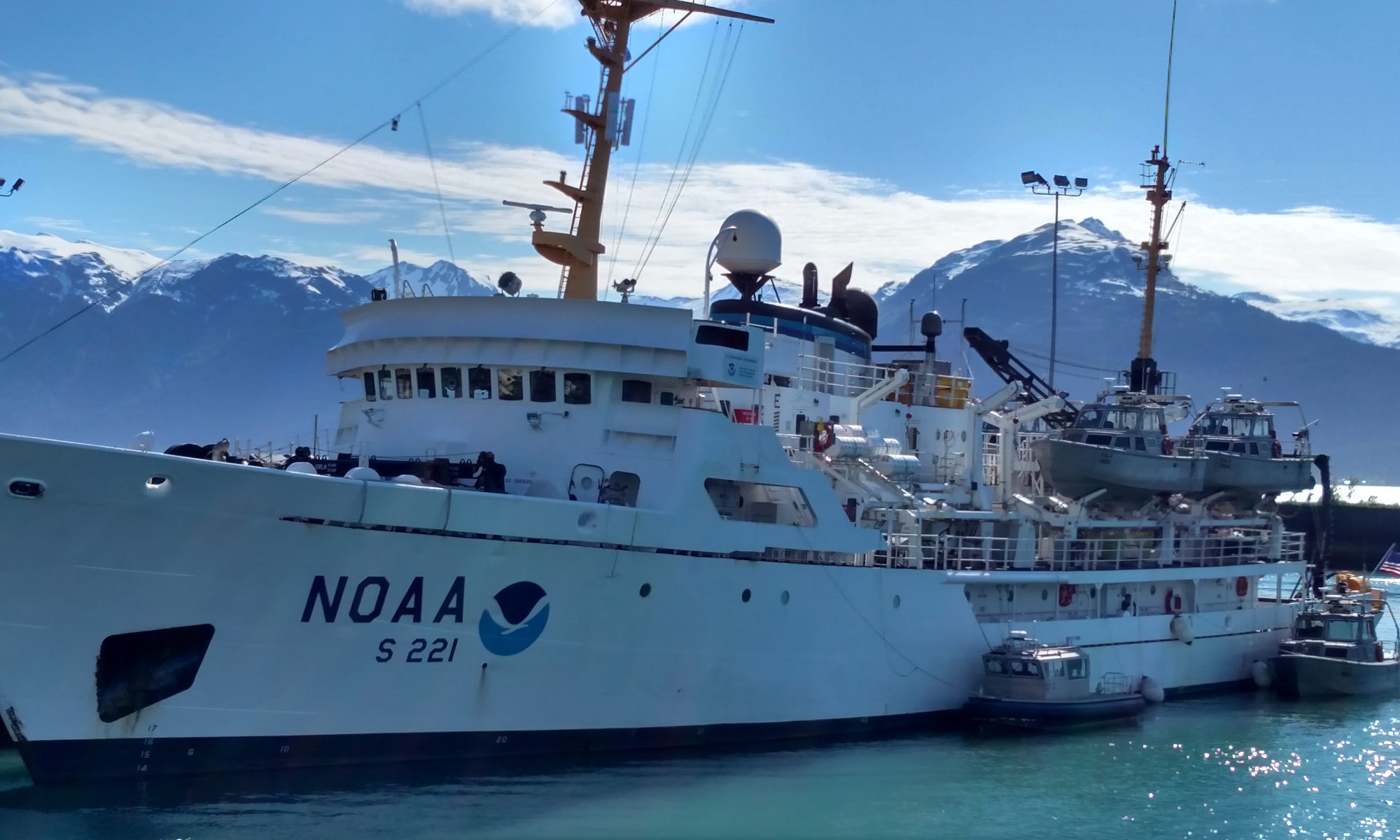


NOAA Teacher at Sea
Jacqueline Omania
Aboard NOAA Ship Reuben Lasker
July 14- July 24, 2025
Mission: Oceanographic and Biological Monitoring of Davidson Seamount
Geographic Area: Davidson Seamount/Monterey Bay National Marine Sanctuary
Date: July 26, 2025
Weather Data: 15°C/ 59°F in Berkeley, CA
Science and Technology Log:
Our mission ended and I disembarked in Alameda on Thursday morning. The Lasker is now headed back to its home port of San Diego. We accomplished the seven days of transects and had two additional days of data collection in which we did several more deep CTD drops (to 2400m) and two more full days of bird and mammal observations. Our total bird and mammal observations were 1333 with 986 birds and 347 mammals. Leach’s Storm Petrel and Red-necked Phalarope were the most common birds. Fur seals and whales (both unidentified) were the most common marine mammals with Fin whales coming in third. Besides these observations, we also observed 14 ocean sun fish (Mola mola), 12 sharks and 20 pieces of floating plastic and styrofoam. It was jarring and painful to see a plastic bottle floating by so far from land. This data will be added into the long term study of the Davidson Seamount which has been happening every few years since 2010. The past missions have been in 2010, 2015, 2018, 2022 and 2024. Thus, together with our work this year, we are building a story of the life above and below the seamount.
Overall, we surveyed over 500 miles and the ship traveled twice that- 1000 miles- since it doubled back in the night, collected more CTD samples, and then transited to the next line. Overall, we did 86 CTD casts and collected 81 eDNA samples which will give us a picture of the character and life of the ocean below the surface. This picture will complement our observations above the water and allows us to know how animals interact with their environment so we can work to conserve them. Given the fact that 95% of the ocean is unexplored, it feels amazing to be part of this effort and contributing to our understanding of the Monterey Bay National Sanctuary and specifically the Davidson Seamount.
In the down time between observation efforts on the flying bridge (highest deck on the Lasker), I had the chance to interview the two early career scientists- Kylie Marozsan and Melissa Ashley. Everyday Kylie and Melissa added so much enthusiasm and positivity to our work and I was inspired by how much they have accomplished in their lives so far. I believe they are great role models to my 5th grade students and the middle and high school students I mentor.

—————————–

Early career scientist- Kylie Marozsan
Kylie is from Pennsylvania and is a rising senior at the University of Miami majoring in marine biology/ecology and minoring in microbiology/immunology. Beyond her studies, she is president of the marine mammal rescue team; a team of volunteers who are basic stranding certified so they can assist local officials with rescuing marine mammals. She is here as a NOAA Hollings Scholar.
What is a NOAA Hollings Scholar?
It is an eight-week program where students intern in NOAA between their junior and senior year of college. You fill out an application, write an essay and send in your resume. Then you have access to possible placements. I saw a post by Chad King, research ecologist for Monterey Bay National Marine Sanctuary, interviewed and did a site visit. While I have been at the Monterey Bay National Marine Sanctuary, I have worked on improving the sanctuary’s video database, assisted with microplastic field work on both the beach and the ocean, and participated in this 10 day research cruise aboard the Reuben Lasker. On July 29th, I will present my summer work at the NOAA Headquarters in Silver Spring, Maryland.
What do you enjoy about your experience?
I am enjoying the research with the Monterey Bay National Marine Sanctuary. The experience is well rounded with both field work and office work and being on a research crew.
What has been a challenge?
Moving to a new place, adjusting to a new climate with my first “adult” job and living on my own have all been challenges. Yet, the people and everyone have been so welcoming and kind.
Why is this work important?
We have been given a beautiful planet; we must do what we can to protect it and we can’t protect the people we love without protecting the place we love.
When did you know you wanted an ocean focused career?
Ever since the 6th grade I loved Shark Week on the Discovery Channel. Shark Week happens for a week every summer. I loved it so much I messaged the filmmaker that I wanted to do his job and he told me “live the life you dream”.
What is a book/ activity you recommend to someone who wants an ocean focused career?
I recommend the book Silent Spring by Rachael Carson. It is an eye-opening book about the chemicals in our world written by a woman. It made me more aware about products and their sustainability. Silent Spring discusses how pollution from land can accumulate and hurt all different levels of ecosystems including the ocean.
For activities- go snorkelling! You can learn a lot from what’s out there.
——————————-
Early career scientist- Melissa Ashley

Melissa is from San Jose, California. She grew up going to northern California beaches and loved visiting the Monterey Bay Aquarium. In high school, she enjoyed marine biology so much that she led a marine biology club that did dissections, presentations and river clean-ups. She graduated from the University of San Diego in environmental and ocean sciences and then received her master’s degree from the Middlebury Institute of International Studies in Monterey. She focused on ocean and coastal management. Melissa now lives in Monterey and is a California Sea Grant Fellow.
What is a California Sea Grant Fellow?
It is a one year placement in a state agency focused on marine and coastal policy. I have been with Monterey Bay National Marine Sanctuary since February. Over the past ten years, we have seen a decline in bull and giant kelp throughout different parts of northern and central California believed to be attributed to a combination of marine heatwaves, sunflower sea star die-offs and a sea urchin population surge. Since we aren’t able to restore all of the kelp that has been lost, I am helping identify which kelp bed locations throughout the sanctuary are the most important to people who rely on them. One of the things I love most about being a fellow at a marine sanctuary is the chance to be involved in such a wide range of work. While I don’t typically work with seabirds or eDNA in the office, trips like this highlight the many different roles that go into managing a sanctuary.
Why is your work important?
My work is important because it helps bridge science and policy. Studying marine resources is incredibly important, but without strong policy, we can’t protect the resources that we study. Long term, I’d like my work to help protect the marine resources that we study, but also help the people that rely on these resources for their livelihoods.
What do you enjoy about your work?
On this mission, I love learning about so many new marine mammals and sea birds- like the Cook’s Petrel which you can only see offshore. It’s also been so fun getting to meet and spend time with such a dedicated and passionate team on board also enjoying getting to know everyone on board.
What is a challenge?
I’d say my biggest challenge right now is just adjusting to life at sea. It’s very comfortable here on the ship, but sometimes we’re stationary for long periods of time. As someone who likes being active, I have to make an effort to find different ways to stay active – whether that’s going to the ship’s gym in the evening or having impromptu dance parties during our breaks on the flying bridge!
When did you know you wanted an ocean focused career?
Ever since elementary school, I’ve loved both art and science, and I’ve always been curious about the natural world. As I watched documentaries online, I discovered that while the ocean is beautiful and inspiring, it also faces many threats. Studying environmental and ocean sciences in college felt like a natural path. It took some time, but I eventually found the policy space. Working in policy allows me to combine science, law, and policy-making it a perfect fit where I can draw on all my different interests.
What is a book/ activity you recommend to someone who wants an ocean focused career?
A couple of my favorite books I’ve read are California Against the Sea by Rosanna Xia and Seaweed Chronicles by Susan Hand Shetterly.
In terms of activities, try getting involved by volunteering to help with beach cleans up or starting a club of your own at school. If you’re in high school, community college courses and summer programs are a great way to explore topics of interest too. In high school, I participated in UC San Diego’s Academic Connections program where I lived on a college campus for three weeks and took a marine ecology class at Scripps Institute of Oceanography.
—————-
More Learning from the Science Team

During the moments in which we were ‘off effort’- not observing birds and mammals- I was able to have in-depth conversations with each member of the science team. I learned so much during these exchanges and would like to share some excerpts from our conversations. Since Chad, Mike and Holly were featured in a previous blog, I will focus on Rudy, Erica, Jim, Amity and Julie.
Erica Burton (marine ecologist) :
My favorite movie is Incredible Mr. Limpet because he loved the ocean so much, he wished for it and fell into the ocean and became a fish. I also recommend the book Dove by Robin Graham about a boy who sails around the world.
Advice: Don’t be afraid to take courses to find out what you like and don’t like; you never know what will be of interest. Volunteer in your community to do community science with all your friends.
Jim Tietz (Point Blue Marine Scientist):
New learning: A ‘spark bird’ which is the bird that gets you interested in birding. For me, it was the American Kestrel, which is a very beautiful bird I found in my neighborhood while in college. It led me to get a book out and learn to identify birds in my yard. It is important to get out into nature and have people show you animals and plants where you live.
I recommend The Song of the Dodo by David Quammen because it describes how scientists have approached evolutionary problems.
Rudy Wallen (Point Blue Marine Scientist):
Story: I saw my spark bird when I was five at grandfather’s farm in Wisconsin. I was walking near the barn and kicking up insects with my steps. The bird swooped by and banked -stretching its wings and flaring its tail- and I saw a deep iridescent blue black color, a midnight steely blue, and then an orange rust color on the underside. I still have a snapshot of that moment; it is frozen in time for me.
Julie Howar (Point Blue Marine Scientist):
Advice: Go to the beach and look around. Focus on looking at little things- especially things you might think of as ‘gross’- something dead even. Look and really see what is there… on a rock, or under a rock. Also when an opportunity presents itself, take it if you can. (Julie speaks from experience as she travelled to Antarctica on the Polar Duke as part of a volunteer research team to study krill in 1994.)
Amity Wood (Education and Outreach Coordinator for Monterey Bay National Marine Sanctuary):
Advice: Explore nature! Get out to the tidepools, an estuary, a beach, and only take binoculars or a magnifying glass. Bird watch, take photos, and draw or paint what you see! It’s amazing what you’ll become excited about from opening your mind and senses to your natural surroundings. Humans are a part of nature and we should make connections daily.
Personal Log:

In these 10 days at sea, crossing 1000 miles of ocean, I spent days on end with no ship or land in sight. I was outdoors, invigorated by the fresh breeze, from early morning to after sunset. From the flying bridge, I looked out in full circle for miles into the horizon and watched the waters change as the skies changed – from cobalt to teal to silver and from glassy to rippled to white capped. With each rock and sway, the ocean spoke to us with her breath and reminded us that she is the one who sustains us.
As the project progressed, I learned that science takes time and patience. I honed my observation skills as I began to master my binoculars. With practice, I changed from my first days of missing every sighting, to being able to spot whale spouts on the horizon, a shark fin drifting by in the distance and to identifying birds- such as storm petrels and Red-necked Phalaropes- as they crossed our bow. As my patience grew, I became accustomed to the long days of observation and eagerly awaited each experience with the hope of new discoveries. Yet, we had days where there rarely was a bird or mammal in sight. We also had long waits- up to 1 hour 45 minutes- for the CTD rosette to descend and return from a 2400m drop. However, in these times, each scientist had so much to share to keep up the positive spirit. In the wet lab, Erica had a box of amusing finger fidgets, long lasting candies and a waterproof card game. On the flying bridge, people shared stories, favorite songs (click the link to listen), jokes and a range of crunchy snacks. There was always joy and laughter.
The story of science is also a story of the people who make it happen. We were 36 people alone on the ocean, on the Reuben Lasker, doing science as a team. The science couldn’t happen without the ship crew; our 11 member science team was supported by 25 crew. Each person aboard was unique and yet everyone was bound together by a desire to further understand our ocean and to protect it. For me, since I too love the ocean and science, being part of such a community was both fulfilling and awe-inspiring. I leave with a deep sense of hope that our work will have a lasting impact for the good of the ocean.
Now my mission continues at home, as I work to pass on this curiosity and joy of exploration to the next generation of sanctuary stewards. As my students and I study the 50 states (a 5th grade standard), we will also learn about the 18 national marine sanctuaries with a focus on the Monterey Bay National Marine Sanctuary and the work of this cruise. We will identify, study and monitor birds (‘being on effort’) right where we are- on our school grounds. Thus, I hope to empower my students as explorers of the natural world with the same joy and wonder I have experienced.
Did you know?

Red-necked Phalaropes breed in the Arctic tundra and winter at sea. They are only seven inches long. The females are brightly colored and fight fiercely over males. Yet, once they lay their eggs, they lose interest and the males incubate and raise the young. Meanwhile, the females seek out new males and lay a new clutch. On our cruise, the Red-necked Phalaropes and other birds were attracted to the night lights of the ship. After this was discovered, the ship turned its outside lights off at night to protect the birds.

Final Thanks …
I’d like to thank the Teacher at Sea program and specifically Emily Susko for offering me this special experience in my local Monterey Bay National Marine Sanctuary. I am also grateful to Chad King and the entire science team for allowing me to learn, sample, observe, appreciate and wonder with them. And finally, thank you to the entire crew of Reuben Lasker that transported us safely to the Davidson Seamount and back.


