NOAA Teacher at Sea
Jeff Lawrence
Onboard Research Vessel Hugh R. Sharp
June 8-19, 2009
Mission: Sea scallop survey Geographical area of cruise: North Atlantic Date: June 9, 2009
Weather Data from the Bridge
S winds 5-10KT
Seas 1-2ft
Barometric pressure 1029mb
Air Temperature 78˚F
Visibility clear
Cold front moving offshore towards us later today, rain expected.
The contents of the dredge are emptied onto the sorting table.
Science and Technology Log
The sorting table is full of activity as soon as the dredge is pulled aboard the ship. After the crew secure all lines and dump the load the volunteers and scientist begin to sort through the biological that has been brought up from the bottom or the Atlantic Ocean. Each dredge can bring a varied amount of sea life on the ship. We are always looking for scallop, yet every third dredge we also sort for crabs. All fish are also sorted and counted.
After all the sorting is done the fish, scallops, and crabs are weighed and measured for length. They are then logged into the onboard computer for analysis of results for each catch. We are trawling along closed areas for scallops. These areas have been closed for commercial fishing to ensure that the population has time to recover in that area. Scallop surveys are carried out by the R/V Hugh R. Sharp, in three phases during the summer. Duane and I are on the second leg, which encompasses the area to the east of Delaware, areas around Long Island, and the area around Martha’s Vineyard south of Cape Cod, Massachusetts.
Personal Log
You may find some interesting creatures during sorting.
The work aboard the ship can be very long and laborious. The days are long, as each member of the cruise will do a 12-hour shift. My shift is from noon to midnight. The conditions can vary greatly during a shift. During the day the sun may be out with light winds and it gets very warm with all the wet weather gear that is worn during sorting. It is necessary to leave the gear on between dredges, since they occur so often. As soon as the sun goes down the temperatures can drop very rapidly. It is important to keep a hooded sweatshirt and other warm weather gear nearby for the changing conditions. All gear must be taken with you when you leave your cabin so that the other shift can sleep uninterrupted. The days are long, with the goal of all who are onboard to get the science completed in a timely fashion. Keeping a ship stored with goods and running is very expensive so the goal is to get as much science completed in the allotted time as possible.
Question of the Day
What other bottom dwelling species in the Atlantic are under protection from over-fishing?
Animals Seen Today
Scallops, eels, crabs, starfish, clams, silver dollars, urchins, goose fish, and many varieties of bottom dwelling fish.
NOAA Teacher at Sea
Elise Olivieri
Onboard Research Vessel Hugh R. Sharp May 9 – 20, 2009
Mission: Sea Scallop Survey Geographical area of cruise: Northwest Atlantic Date: May 10, 2009
Weather Data from the Bridge
Air Temperature: 16.3 Degrees Celsius
Barometric Pressure: 1019 mb
Humidity: 78%
Research Vessel Hugh R. Sharp
Science and Technology Log
Today around 08:00 we set sail to begin the Sea Scallop Survey that will be conducted on this cruise. This annual series of quantitative data is collected to determine the distribution and abundance of Sea Scallops. This survey will randomly collect sea scallops from Virginia all the way to Canadian waters. The Chief Scientist and his field operations officers randomly selected stations with in depth boundaries called strata. These selections are either in closed areas where commercial fishing is prohibited, or open areas where commercial fishing is allowed. Areas may be closed to protect the population growth for 2-3 years. The government will most likely allow closed areas limited access with recommendations from NOAA. Samples of sea scallops are taken randomly by using a dredge.
The dredge is 8 feet wide and 20 feet long. It has a metal frame with a ring bag off the back. Each ring is 2 inches in diameter and the bag is lined with a 1.5 inch twine mesh liner. The bag is closed on the top and open on the bottom. This survey consists of three Legs. Leg I will complete approximately 200 tows. Each tow is deployed to the bottom of the sea floor. An inclinometer is used to ensure the dredge is completely at the bottom of the sea floor. This instrument measures time on the bottom. If you know your average speed and multiply it with time this equals the distance towed on the bottom. Timestamps are matched up between the data collected at FSCS and the inclinometer. Each tow lasts for 15 minutes at a speed of 3.8 knots. Tows can be as shallow as 20 meters, and as deep as 150 meters. After a tow is pulled up from the sea floor, 4 to 6 people manually sort through the catch and pull out Sea Scallops, Starfish, Cancer Crabs, and all fish. All samples that are collected are placed into baskets. The baskets are weighed and sea scallops and fish are measured.
Personal Log
Sorting scallops brought up by the dredge
Today I spent most of the day feeling sea sick. I thought it would never end. Now I feel like a million bucks. It took me a little while to get my sea legs. Today I learned so much. I spent most of the day asking a lot of questions and watching everyone closely. I work the night shift from 12:00 AM to 12:00 PM. There is much excitement when a tow comes in and is emptied on the sorting table. The crew gets excited to see what we brought up. Today we deployed 9 tows on my shift. We had quite a few clean tows and many muddy tows. A clean tow has many scallops and very few mud clumps. Life at sea is not easy, it is hard work. The living conditions are great on the Sharp. The galley is stocked with anything you can imagine. Meals are excellent and snacks are a part of sea life. My stateroom is very comfortable and the showers are very nice too.
I really enjoy sea life. The scenery is incredible. At night you can see the moon so clearly and the light gently reflects off the rolling waves. During the day there is blue sea for miles. It is very relaxing. Everyone is so nice and willing to explain how things are done. I feel great and I am looking forward to resting for a while.
Animals Seen Today
Sea Scallops, Starfish, Black Sea Bass, Hermit crab, Spider Crab, Sea Squirts or Tunicates, 4 Spot Flounder, Goosefish, Northern Sea Robin, and Scup.
NOAA Teacher at Sea
Maggie Flanagan
Onboard NOAA Ship Oscar Elton Sette June 12 – July 12, 2007
Mission: Lobster Survey Geographical Area: Pacific Ocean; Necker Island Date: July 7, 2007
A turkeyfish and white spotted toby found in lobster traps.
Science and Technology Log – Bycatch
Though spiny and slipper lobsters are our target species for sampling, many other interesting creatures are interested in our bait, and wind up in our traps. Some of the smaller creatures spend a little time in our on board aquarium for observation and acclimation. These fish are upside down because their swim bladders, which regulate buoyancy in the ocean, have not yet adjusted to the surface (barotrauma). They wouldn’t survive if they were immediately released. The turkeyfish, aka Hawaiian lionfish, Dendrochirus barberi, is red/orange with large fins. It has venomous spines in its dorsal (back) fin, and will lunge pointing them at a threat. We used a net instead of gloves to observe this one. This fish in known to enjoy a meaty diet, eating other smaller fish. The Hawaiian white spotted toby, Canthigaster jactator, is a sharp nose puffer, brown with white spots. This toby is endemic to Hawaii, found naturally only in Hawaii. These fish can make themselves swell in size to ward off predators by filling their stomachs with water. They carry a toxin in their skin, which can harm other aquarium creatures if released.
Swimming crab (Charybdis paucideutis) and hermit crab (Dardanus brachyops)
The red figure in the background of the above photo is a sea hare, Aplysioidea, aka sea slug. These invertebrates are hermaphroditic, carrying both male and female sex organs. We also encounter a variety of crabs with a variety of adaptations. Hermit Crabs, Dardanus, have been the most numerous in our traps, and there are reported to be up to 2000 species of hermit crabs world-wide. They take over the shells of marine snails and keep their soft abdomens tucked inside. Many of the hermit crabs we’ve found in the North West Hawaiian Islands take protection even one step further – they keep anemones on their shells. The anemones eject bubble-gum-pink stinging threads called acontia when threatened. We wear gloves when handling the crabs to protect ourselves. Scientists have discovered that the anemones don’t live on the shells when the snail is alive, and that hermit crabs will actually move their anemones from shell to shell as they move to new shell homes. They figure that the anemones benefit from mobility with the crab and from food particles spread by the hermit crabs as they rip and shred.
Swimming Crabs, Charybdis, are the most aggressive crab in the trap. In both body and behavior they’re similar to the blue claw crabs of my home waters, so I was prepared for their quick attempts to pinch and slice my fingers. Their last pair of legs is oval like a paddle – perfect for swimming. On board, we call the box crab, Calappa calappa, the Vader crab. Its claws fold perfectly into its oval body, making it look like the face mask of that notorious space villain. These crabs can be mean too; those wide claws are powerful and help the crab eat mollusks. Imagine how well camouflaged it is folded up down in the sand.
A box crab (Calappa calappa), a.k.a., the Vader crab
Personal Log
During our lobster survey work, we catalogue the other animals that also get in the traps, and release them as healthy as possible. The creatures that you catch unintentionally are generally called bycatch. A current issue in commercial fishing is animals killed and wasted because they’re caught as bycatch, and not sold or eaten. Many times they’re dumped back in the sea dead. It’s a complicated issue on a global scale considering the definitions of what makes bycatch, all the different kinds of fishing gear, the variety of marine ecosystems, applications of technology, and the multiple political and economic groups involved. There are many figures being reported, from 30% to over 50% of the take winding up as wasted bycatch, or perhaps 28 million metric tons world-wide. But, statistics on this topic are difficult to determine, which makes solving the problem even more difficult. Technology has innovated some fishing gear which particularly reduces the bycatch of sea turtles and marine mammals, and recent focus on bycatch by type of fish and type of gear may inspire more solutions to this serious problem.
NOAA Teacher at Sea
David Riddle
Onboard NOAA Ship Albatross IV July 13 – 28, 2006
Mission: Sea scallop survey Geographical Area: New England Date: July 17, 2006
A seahorse that came up with the dredge
Science and Technology Log
It’s almost halfway through my watch now, and I have a little down time. The day started with several stations that were close together, which kept us busy. Now the sampling stations are farther apart, and I’ve had time to work on some photographs of shells.
Our catches turn up lots of interesting creatures. Some I recognize from my college invertebrate zoology course (oh, so many years ago!) Others I’ve only seen pictures of. There are occasional sea squirts, bulbous little creatures that squirt a stream of water when squeezed. We find an occasional “sea mouse”, a polychaete worm, bristly-looking on the backside and shaped sort of like, well, a mouse. Underneath you can see the segments. Hermit crabs are abundant; many of them simply abandon their shells when they’re dumped onto the deck. This is probably not a good survival strategy, since they get dumped back overboard only to drift slowly to the bottom without any protection at all. Oh well, most everything in the ocean is somebody else’s lunch anyway. We find other species of crabs as well. The larger ones are set aside and are sitting in a bucket which has seawater continually being pumped through it to keep them alive. I wonder whose lunch they’ll turn out to be? We’ve caught a few small dogfish sharks, under two feet in length. I’m told on some of the ground fish surveys they catch tons of them (literally). Considerably smaller were two needlefish, about 6 inches long and ••• inch wide.
I find myself wondering things like, “What must it be like to be that small, living in this huge ocean?” Them I’m reminded of our little planet’s location in our galaxy, and the Milky Way’s tiny place in a universe with millions of other galaxies. OK. Humility is a good thing.
Then too, I’m reminded that small is not always equivalent to unimportant. Do you like breathing? Well, consider that roughly 3 out of every 4 breaths you take come to you courtesy of the phytoplankton in the oceans of the world. There they are, soaking up the sunshine and the carbon dioxide and pumping out huge quantities of oxygen every single daylight hour. They’re microscopic, but their importance in the overall scheme of life on this planet is enormous. I suppose it would be helpful to remember, while we’re busy saving the whales, we should take care of the little guys too. But then, how would “Save the Plankton” look on a T-shirt or bumper sticker?
On a more practical note, we’re due to reach our turn-around point in 5 more stations. We will have reached our southernmost latitude, which will put us due east of the North Carolina-Virginia border. Then we’ll begin making our way back up the coast, stopping at the stations in shallower waters. I flew to Boston from my home in western NC to take part in this Teacher at Sea experience. So this is the closest to home I’ll be for the next 12 days.
I keep thinking I’m done with my log for the day and then something else happens. At station 99 we caught a seahorse! The depth was 24 fathoms, and I seriously doubt it was on the bottom, but when the dredge came up, there it was on deck.
Sightings: The osprey was still here this morning, but as of late afternoon it was gone.
NOAA Teacher at Sea
Jacob Tanenbaum Onboard NOAA Ship Miller Freeman June 1 – 30, 2006
Mission: Bering Sea Fisheries Research Geographic Region: Bering Sea Date: June 15, 2006
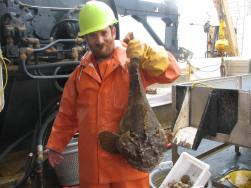
Holding up the catch
Weather Data from the Bridge
Visibility: 14 miles
Wind Speed:19.5 miles per hour
Sea Wave Height: 4 foot
Water Temperature: 44.4 degrees
Air Temperature: 44.2 degrees
Pressure: 1018.8 Millibars
Personal Log
I got to thinking the other day that the engines on this ship have been running since we left port almost two weeks ago now. I started to wonder how they could stay running for so long and so I decided to ask Chief Engineer Steve Bus to tell me more about them. So put on your ear protection, and lets go to the engine room. The engine room on NOAA Ship MILLER FREEMAN is like a small city below the deck. In addition to the 2100 horsepower diesel engine that moves the ship forward, there are generators sufficient to power a small town. A research vessel, after all, needs a lot of electricity to run all the electronics we need. In addition, the engine room has equipment to make it’s own drinking water out of sea water. We cannot drink sea water because it has too much salt for our bodies to handle. The machines in the engine room take the salt out of the water and, clean it, and make it possible for us to drink it.
There are boilers to heat water and make steam to keep the ship warm. There are also machines that process waste water. Finally, there is shaft alley. This is the part of the engine room where a long metal shaft connects the diesel engine to the propeller. Take a look at this video to see shaft alley. The ship burns 2100 to 2200 gallons of fuel on an average day. Who keeps it all running? Chief Engineer Steve Bus and his crew. They are responsible for the ship from bow to stern.
How do you prepare for an emergency at sea? The same way you do in school. By drilling over and over. Today, we had a fire drill where the some of the crew got into firefighting gear and practiced what they would do in an actual emergency. Want to come along? Click here for a video.
Science Log
We had some interesting returns on the echosounder this morning. Take a look at the screen. You can clearly see the top and bottom of the water column. You can clearly see the different groups of fish. The echosounders can tell us so much information. When we put the nets down near the surface, we knew exactly what to expect. We did a trawl along the bottom of the sea floor last night and brought up some of the most interesting creatures I’ve ever seen. Here are a few.
This is a basket star, a kind of sea star. Its branches are hard and are divided into many different branches. The basket star uses all of these to catch plankton. In the center is the mouth.
Next, we have a lyre crab. Have you ever seen a hermit crab without a shell? This one lost his on the way up from the bottom.
This next photo includes a huge sea star, a sea urchin, a hermit crab without its shell, a tanner crab and several fish called poachers. These fish have scales that are hard, almost like bone or a shell. This last one is my personal favorite. The fish at the top of the screen is called a big mouthed sculpin. It has the biggest mouth of any fish I’ve ever seen. This fish stays on the bottom waiting for smaller fish to come by, and then… watch out! When it came up in the net, it had a smaller fish in its mouth.
Finally, we brought up a creature called a brittle star. It is a kind of sea star with soft tentacles. It moves very fast for a sea star. The arms can break easily, but don’t worry, they grow back. That’s why they call it a brittle star. Here is a video of a brittle star moving across the lab table.
Later on the same day, our ship was visited by some dall’s porpoises. Click here for a video
Question of the Day
Look at the answer to yesterday’s question. Let’s try another one. If our ship wants to do a trawl 50 meters below the surface, how much wire would it need.
Answer to Yesterday’s Question
How much wire would the ship need to let out if it wanted to put the nets 200 feet below the surface? Make sure to watch the video on nets before you try to answer the question.
The ship must put out two feet of wire for every one foot of depth. So you have to multiply 200 x 2 which gives 400 feet of wire. Wait, we are not finished yet. Each net has, not one, but three wires holding it to the ship. So you would need 3 wires. All three are 400 feet in length. That gives us 1200 feet of wire to do our trawl.
Answers to Your Questions
Hello to all who wrote today.
The MILLER FREEMAN does seem like home to me now. I have gotten used to the constant rocking of the ship and the routines of the day. I really enjoy being at sea. By the way, they had pizza for lunch, but I asked the cook to make me some fresh pollock that we caught and filleted last night.
Do people eat jellyfish? I asked our chief cook, Mr. Van Dyke. He told me many species of jellyfish are poisonous. Even those that are safe to touch with your hands. So, no, we don’t’ eat them here, but in some countries they do. We have caught many tons of fish, but more importantly, we have seen many fish without catching them using our echosounder. This device allows us to survey fish without capturing so many.
There are 34 people on board with us for this cruise. That will change next week when we get to port.
The squid felt slimy, but not much more slimy than most fish seem. I don’t recall it spraying anything.