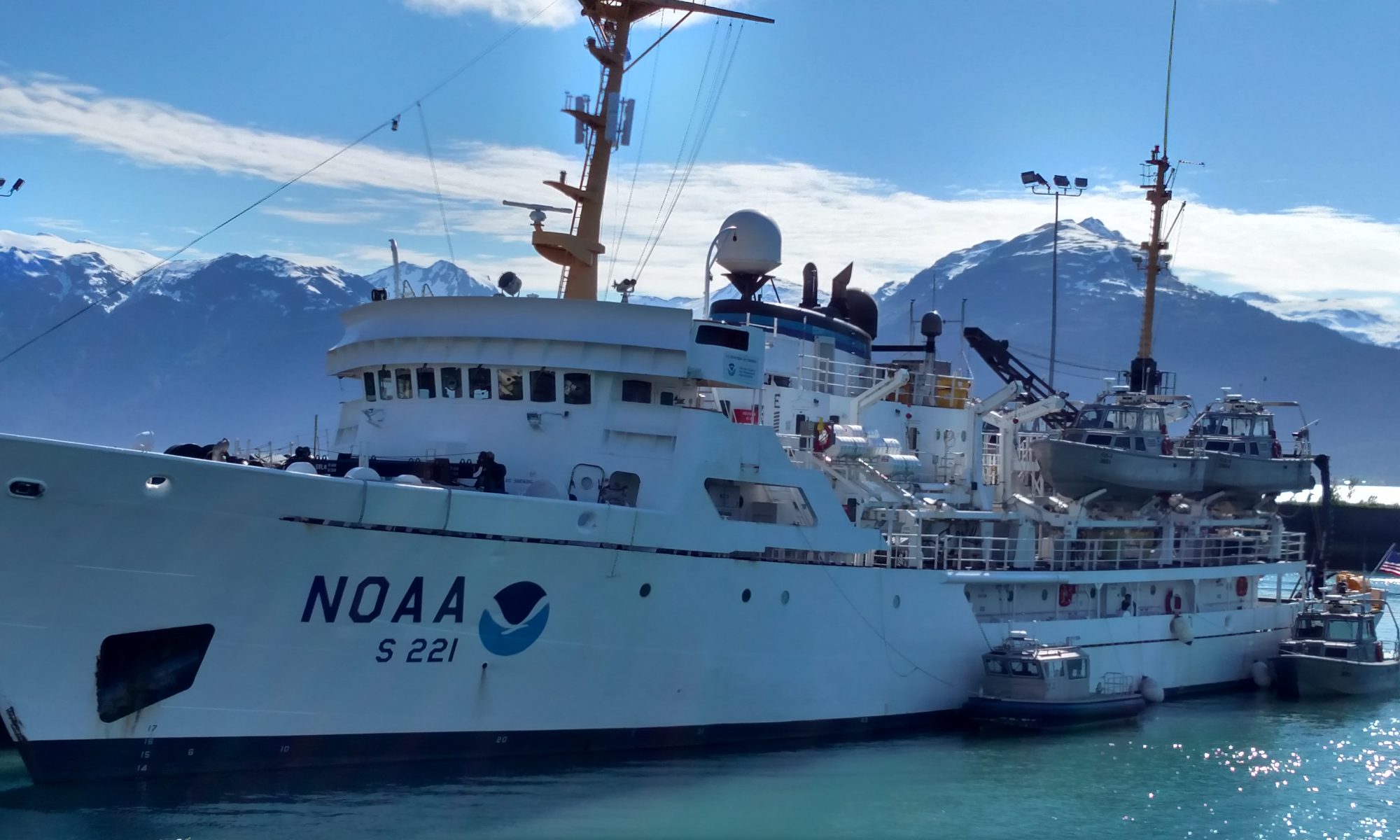
NOAA Teacher at Sea
Cindy Byers
Aboard NOAA Ship Fairweather April 29 – May 13, 2018
Mission: Southeast Alaska Hydrographic Survey
Geographic Area of Cruise: Southeast Alaska
Date: May 19, 2018
Weather: It is SPRING in Wisconsin!
Personal Log
I got home this week from an absolutely amazing experience on NOAA Ship Fairweather! I arrived so excited to share what I have learned with students and other teachers alike! I went to school 30 minutes before the end of the day bell when I arrived. I felt like I was welcomed back like a hero! My students and the staff were happy to see me, and I was very happy to see them! I got lots of hugs and high fives. It was especially exciting to hear that the students had enjoyed and learned from my blog. They especially liked to learn what I had eaten!
I was able to share some pictures and stories this week as our year winds down. I have begun organizing my photos and have plans with the staff to give a presentations to all the 4-8 grade students in the fall. Ideas are flowing through me about how I will incorporate my new knowledge and experiences into my different curriculums. There is so much potential!
I have not stopped talking about my experience with people in and out of school. I love having so many experiences to share. The people of NOAA Ship Fairweather where so willing to teach me about hydrography and ship life. I have strong memories of people asking if I wanted to try doing something, or calling me over to explain something they were doing. I, of course, hopped in and tried everything I could! I got to drive the ship on my first morning! I also was able to drive the launches! (Thanks Colin!) I learned so much about being a hydrographer thanks to all the surveyors! What a wonderful group of people. I could thank everyone really, the deck crew, the engineers, the stewards, the NOAA Corps officers, and the great leadership of the XO and CO. I was able to learn from all of them. Everyone always made me feel like they had time to teach me how to do things, and to answer questions. It is exciting to be in a place with so many talented educators!
This is a trip that will influence how I approach my teaching and my everyday life. I will never forget the kindness and caring of NOAA Ship Fairweather personnel, or the beauty and splendor of SE Alaska!
NOAA Corps Officers! Mustaches are required.Taking a CTD CastSetting up a HorCon (Horizontal Control) StationOur NOAA Physical Scientist at Dawes GlacierA Bald Eagle skull being examinedSkiff ride to a shore partyA game of Settlers of CatanSam, one of the stewards, in the galleyAli Johnson, Hydrographer, at workHydrographer Bekah Gossett looking up marine mammalsNOAA Corps Officer LTJG Douglas on the bowLife on the BridgeKayakingMe and the mountains from the glacial moraine
Mission: Conduct ROV and multibeam sonar surveys inside and outside six marine protected areas (MPAs) and the Oculina Experimental Closed Area (OECA) to assess the efficacy of this management tool to protect species of the snapper grouper complex and Oculina coral
Geographic Area of Cruise: Continental shelf edge of the South Atlantic Bight between Port Canaveral, FL and Cape Hatteras, NC
Date: May 17th, 2018
Weather Data from the Bridge Latitude: 23° 29.6290’ N Longitude: 80° 09.6070’ W Sea Wave Height: 2-3 feet Wind Speed: 18.2 knots Wind Direction: 199.3° Visibility: 8–9 nautical miles Air Temperature: 25.3°C Sky: Scattered clouds
Science and Technology Log
Software: ArcGIS and Microsoft Access Data processing may be seen by some to be a less glamorous role compared to ROV operators and their joysticks. But data management is essential for communicating and validating findings of the ROV dives. Huge data sets are created on each dive. 24,000 records were created on just 2 dives that needed to be inventoried and processed.
Stephanie Farrington processing the photo grabs taken every 2 minutes from the dive
Stephanie Farrington, Biological Research Specialist with Harbor Branch Oceanographic Institute at Florida Atlantic University, gave me a crash course on data management that may be better explained through some of the pictures and activities I was involved in below. Two types of software seemed of particular significance, ArcGIS and Microsoft Access.
ArcGIS (Geographic Information System) provides layers of information
ArcGIS (Geographic Information System) provides layers of information, anything from land use patterns, topography to local data for an area on water quality or hurricane patterns. The software allows you to stack this information on top of each other geographically to look for patterns or to make graphic and visual displays of complex data sets. On May 16th the dive gathered footage at two sites where barges were dropped to the ocean floor in 2014, one at approximately 80 meters and the other at 100 meters. After seeing that the structure had undergone considerable changes in its integrity, a question arose about the potential impact a hurricane could have made with these barge structures. The photo above is an example of a layer of information on hurricane travel patterns and how GIS might be used to make predictions on whether this sort of event could have impacted the barge wreck sites integrity.
Access is a Relational Database and is used as an information and storage management tool for larger data sets. It is less prone to errors compared to Excel and better for managing “big data”. One skill Stephanie demonstrated to me was her code writing abilities that, once written, allow the keyboard and the database to communicate with each other. As I typed in the key for “new note,” the image below with the heading on the right saying “Site Number” would pop up ready for me to enter information about the type of bottom substrate, the slope and other features of the sample site. Each of these button choices immediately populated the database and created a running record of the dive’s key features. Microsoft Access is built using SQL and uses VBA script to create macros (repeated, automatic behaviors).
Keyboard programmed to automatically communicate information into a database for quick counts and standard methods of habitat classifications
The X-Keyboard was purchased from a company called P.I. Engineering and comes with its own GUI (Graphical User Interface) for programming the individual keys.
In the image below is an example of a portion of one of John Reed’s notes taken during the dive to record times, observations and coral reef communities observed. Notice that Weather, Salinity, Wind Direction and Depth are all added into the notes as well as discrepancies or issues that arise. Notes on this page demonstrate a point early in the dive when it became clear the map features between the ROV operator and Stephanie’s screen were off by many meters, this was because an incorrect Geographic Datum (the screen displaying in WGS 1984 but the ROV feed was being sent to the screen in NAD 1983 causing a false skew in the visualized data stream).
Picture taken during my lesson on where each key was coded to represent a certain feature that would automatically enter the database.
This is a section of the screen I worked within to add notes, such as written description of a metal ladder structure seen in a different location on barge then previous dive.
This is an example of a portion of one of John Reed’s notes taken during the dive to record times, observations and coral reef communities observed. Notice that Weather, Salinity, Wind Direction and Depth are all added into the notes as well as discrepancies or issues that arrive.
How many people can say that one of their first yoga experiences happened on the flying bridge on a NOAA ship in an offshore location in the Atlantic? LT Felicia Drummond, a newly certified yoga instructor, introduced us to Ashtanga yoga philosophy and techniques, and I finally know what the pose downward dog should look like. Ashtanga yoga philosophy focuses on breathing and balanced movements to build the strength of your core and muscles.
Forward fold = Uttanansana
Classes held on the ship’s deck like this would certainly tone one’s body and improve your focus. There are standing, sitting and finishing poses. I considered myself lucky if I didn’t fall on my face or crash into the pillars with anything but a sitting pose. But it reminded me of the balance needed in life- both in the physical and mental demands we put on ourselves. Even at sea there is a need to search for these moments of time to quiet our mind.
Today I am reminded of the different ways of knowing. I have always been a bit of a bookworm, introverted and learning through textbook study. But learning through experience on this ship is a whole different level in the depth of comprehension. I am immersed in both the history and story-telling of the original discovery of these reefs by watching 1970’s footage of Professor John Reed’s first “Lock-Out” dives within Florida’s Deep-Water Oculina Reefs. At the same time I am witnessing and participating first-hand in the collection of new data in similar locations. Although it is sad to see some of the trawling devastation of the past, the regrowth of these areas and the dedication to their protection brings a positive message for me to share with my students. I am excited to share the video I watched today with them when I return and the story about a Warsaw grouper, Hyporthodus nigritus, that tried to steal calipers during Professor Reed’s coral measurements many years ago. To read more about some of Reed’s work click on the hyperlink.
Did You Know?
Hermodice carunculate, Bearded Fireworm
Hermodice carunculate, the Bearded Fireworm, bristle out their setae upon touch and those setae act like hypodermic needles to inject a powerful neurotoxin into the offending predator or careless tourist. The injury can give a sensation that feels like a fire burning for hours. It reminded me of a fuzzy underwater centipede. This creature was spotted on an ROV dive near a sunken barge at around 100 meters. Others were clustered along the walls of the barge that were encrusted with oysters and a few purple sea urchins. Seen in this image next to the Fireworm are hermit crabs. https://www.scienceandthesea.org/program/201701/fireworm
The following section of the blog is dedicated to explaining the story of one crew member on NOAA ship Pisces.
What is your specific title and job description on this mission? ROV Pilot/Technician. He assists in keeping the ROV running efficiently and safely. His job includes taking turns on this mission with Eric Glidden to pilot the ROV and deploy and recovery of the ROV from the ship.
How long have you worked for University of North Carolina? He has worked for University of North Carolina for almost 5 years.
What is your favorite and least favorite part of your job? Troubleshooting computer problems is his least favorite part of the job. His favorite part of the job is getting to work with different scientists from all around the United States and world on different types of scientific projects.
When did you first become interested in this career (oceanography) and why? He grew up watching the weather channel and surfing in North Carolina. Dr. Steve Lyons on weather channel and predicting surf inspired his original interest in the study of meteorology/oceanography.
What science classes or other opportunities would you recommend to high school students who are interested in preparing for this sort of career? He said if you are a student interested in the technical aspect of the study of oceanography you should look for a marine technology program at a university or community college. He uses a lot of math and physics and recommends at the high school level to take a full course load in both. He also recommends taking any available electronic classes and stay proficient in computers.
What is one of the most interesting places you have visited? His most interesting trip was in the Philippines where he ate white rice for 2 weeks straight and people were on the back deck of the ship fishing for the very same fish he was collecting video footage on. He mentioned that the Philippines had the most beautiful coral he had ever seen.
Questions from my Environmental Science Students in Camas, WA
How heavy is the ROV? With the skid on it, approximately 800 lbs
How tough is it? Moderately –you can run the ROV into things but don’t want to run into a steel ship or you break things.
How expensive is it? If it somehow broke, what would you have to do? Try and repair it on the ship with spare parts? A half-million dollars. Yes. They have spares for most everything except the high definition video camera and digital stills camera, which cost $27,000 and $32,000 respectively.
How many cameras are on the ROV and how easy is it to maneuver? 5. One main video camera to navigate the ROV, digital still camera, 3 lipstick cameras on the skid to collect samples and see with the manipulator. If there is no current then the ROV is fairly easy to maneuver but when conditions decrease by, murkiness, current (more than ½ knot) or terrain is in high relief it becomes more difficult. Ship wrecks with steel debris are also especially difficult to maneuver around.
What is the ROV like to control, does it respond quickly or is there a lag time from when you control it to when it responds? It instantaneously responds.
Do you have to have training to be able to operate it? It is on the job training however there are a few ROV specific training schools around the country.
Mission: Conduct ROV and multibeam sonar surveys inside and outside six marine protected areas (MPAs) and the Oculina Experimental Closed Area (OECA) to assess the efficacy of this management tool to protect species of the snapper grouper complex and Oculina coral
Geographic Area of Cruise: Continental shelf edge of the South Atlantic Bight between Port Canaveral, FL and Cape Hatteras, NC
Date: May 16th, 2018
Weather Data from the Bridge Latitude: 32° 05.2647’ N Longitude: 79°13.2777’ W Sea Wave Height: 1-3 feet Wind Speed: 9.2 knots Wind Direction: 166.61° Visibility: 7-8 nautical miles Air Temperature: 21.7 °C Sky: Overcast, rainy and lightning
Science and Technology Log Scientists- A Team of Diverse Skills:
Swiftia exerta identified and photographed prior to collection by the ROV
After the ocean floor has been mapped with multibeam sonar, ROV (Remotely Operated Vehicle) dives are made to ground truth the maps and to describe the benthic habitat and fauna and flora. In order to identify the taxonomy of what we see in the video and photos, we often need to sample the macrobiota. Many species of sponges, gorgonians and black corals are very difficult to identify from photos alone, and some are even new species. Taxonomist, specializing in deep-coral ecology, Professor John Reed, works in this field of science that involves an understanding of organisms by using a variety of features both on the macroscopic and microscopic level for identification. The red arrow in the picture is pointing to one of the target species in these dives, the gorgonian coral, Swiftia exerta. Gorgonian octocorals are often called by their common names of sea fans and sea whips. They are characterized generally by being sessile (attached to the bottom), colonial (composed of hundreds of individual animals called polyps) and belonging to the phylum Cnidaria. For more information about corals see the link below. https://oceanservice.noaa.gov/education/kits/corals/coral01_intro.html
Manipulator used to sample the Swiftia before depositing into a sampling bottle or drawer.
Once the coral is identified through visual inspection with the ROV’s high-definition video, Andrew David uses the robotic arm (called the “manipulator”) to get the sample into a collection bin. The ROV brings the sample to the surface to be processed by the scientists. And yes — this picture with the red arrow pointing at a book below the monitor screen is for my students — they still use field guides!
Field guides help in confirming identification and to confirm key features on those species that may be spotted that are less common- or for science teachers who are trying to do a quick cram study.
Scientists still use field guides!
Close up image of a portion of Swiftia with the polyps visible
Elizabeth Gugliotti dissecting out pieces of the polyp tissue that need to be kept on ice.
LT Felicia Drummond holding the temperature and depth recorder, the top black portion detaches and plugs into a computer to download recorded data collected during dive
Elizabeth Gugliotti preparing the labels for the samples
Elizabeth Gugliotti holding up the Swiftia sample taken off the ROV
LT Felicia Drummond getting pieces of Swiftia ready for a photograph with a reference ruler and its reference code
The calyces contain many calcareous sclerites that can interfere with the PCR reaction. PCR selectively can amplify codes of DNA that then can be sequenced and its DNA compared in a nucleotide database program like BLAST (Basic Local Alignment Search Tool). These samples will serve as an outgroup for phylogenetic analysis of Swiftia in the Gulf of Mexico. The captions of the pictures explain the actions of each of the scientific team members seen in the images and a listing below gives their names, titles, associated organization and a very brief description of a portion of their skill sets brought for this expedition at sea.
Stephanie Farrington, biological research specialist from Harbor Branch Oceanographic Institute at Florida Atlantic University. She not only has ability to identify the marine biota but also manages, analyzes and tracks the enormous amounts of data collected during the trip.
Elizabeth Gugliotti, graduate student at the University of Charleston.
She collects and processes the coral samples for future phylogenetic analysis. Her thesis advisor is Dr. Peter Etnoyer, a marine biologist and lead scientist for NOAA’s Deep Sea Coral Ecology Lab. In addition, on this adventure, she is my state room bunk mate.
Jason White, ROV technician, to be featured in the next blog. University of North Carolina Wilmington Undersea Vehicles Program. Piloting the ROV underwater to capture photo/video images and samples, bringing the ROV on and off the ship using a winch and pulleys.
Eric Glidden, ROV technician, University of North Carolina Wilmington Undersea Vehicles Program. Piloting the ROV underwater to capture photo/video images and samples, bringing the ROV on and off the ship using a winch and pulleys.
Stacey Harter, research ecologist, NOAA National Marine Fishery Service, Panama City Laboratory. See her featured in earlier blog under What’s My Story.
Andrew David, research fisheries biologist at Panama City Lab in Panama City, Florida.
He makes a running commentary on habitat and species recording with the live video footage, as well as operating the robotic arm to collect samples.
John Reed, Research Professor at Harbor Branch Oceanographic Institute, featured below. He specializes in taxonomy of invertebrate and deep-sea coral ecology. Featured below in What’s My Story.
LT Felicia Drummond, research scientist and NOAA corps member. She assists in fish identification and brought the additional bonus skill set as a yoga instructor and volunteered to lead us in yoga on the Skybridge on breaks.
Personal Log
I am enjoying my crash course in fish and invertebrate identification. LT Drummond in this image offered to identify species out loud for my benefit, filling the background noise of habitat readings and descriptions with shout-outs about Spotted Goatfish and Graysby. My favorite, so far, has to be the Sharpnose Puffer.
Sharpnose Puffer
Everyone on board Pisces is extremely helpful and friendly. I can’t overstate this point enough, I continue to feel welcome and included in all aspects of the operations of this expedition.
LT Drummond teaching me the common names of a variety of fish species during live video stream during ROV dive
It is interesting to watch how many mini-lessons occur between the crew to help each other. From the database tutorial between a graduate student and the data manager to explanations by the ROV operator to the fisheries biologist on how to operate the joystick and other control buttons on the video equipment.
I could not have possibly anticipated moments like today, May 15th, when Prof. John Reed shared a video made about a deep dive in a manned submersible. Witnessing the creatures of the deep from people who captured this footage themselves and are making novel discoveries in both the past and present continues to amaze me.
Morning view from the porthole of my stateroom on Pisces
I’m also surprised at the ease to which I am able to sleep on a bunkbed on the Pisces rocking in the Atlantic Ocean. There is something calming at night about the motion or maybe it is my exhaustion after a full day of activity. Whichever it might be, my basic needs have been met and exceeded for shelter, food and sleep. I do miss my family and friends–and even my nonbiological kids (aka my students). I am thankful for my oldest daughter sending me emails that keep me in touch with the happenings at home. There is so much to tell and words/photos don’t do justice to the experiences I am having.
Did You Know?
Certain species of Scamp or Mycteroperca phenax, have a coloration differential that distinguishes the dominant male in the group from lesser males and females. And if the dominant male dies or is fished from the group, the most dominant female within 2 months can change sex and become the new leader for the school of females. For the extra curious read about the research on this phenomenon, authored by R. Grant Gilmore and Robert S. Jones, Color Variation and Associated Behavior in the Epinepheline Groupers, Mycteroperca microlepis (Goode and Bean) and M. Phenax Jordan and Swain in the Bulletin of Marine Science 51(1): 83-103,1992.
Fact or Fiction? A majority of corals reproduce by asexual reproduction and are considered r-strategist.
To learn more about their reproductive habits of sending out a larval form called a planula (after egg and sperm combine) visit NOAA’s link below. https://oceanservice.noaa.gov/education/kits/corals/coral06_reproduction.html
What’s My Story? Professor John Reed The following section of the blog is dedicated to explaining the story of one crew member on Pisces.
What is your specific title and job description on this mission? Research Professor, Deep Sea Coral Program at Harbor Branch Oceanographic Institute
How long have you worked for Harbor Branch Oceanographic Institute and in this field? 42 years
What is your favorite and least favorite part of your job? Favorite part is going to sea and all parts of fieldwork, whether it is on land or sea. His least favorite is the administrative paperwork and bureaucratic forms and processes that go along with the job.
When did you first become interested in this career and why? He always knew he wanted to do something outside, and in middle school was interested in careers of such as a forest ranger or archaeologist. In high school he started watching The Undersea World of Jacques Cousteau TV series and began following the travels of this family in the documentary type series as they visited underwater coral reefs and original marine habitat never explored and shared with the public before. After that he was hooked.
What science classes or other opportunities would you recommend to high school students who are interested in preparing for this sort of career? He commented that students should take their basic STEM curriculum, but emphasized it is equally important to have a broad background of the arts, civics and humanities and studies outside the STEM focus. In high school and undergraduate school students will need to develop their basic foundations of essential understandings of biology, chemistry, genetics, and mathematics including statistics, , and in his field to learn some basic anatomy/physiology of organisms.
What is one of the most interesting places you have visited? He is by far a world traveler with 60 expeditions around the world, visiting 50 different countries and he considers himself extremely fortunate to have the opportunities to go down to 3000 feet deep in a submersible to see things that have never been seen before. He mentioned Papua New Guinea as one of his favorites, and that during one submersible dive off Granada, they accidentally dropped down into a volcano and then subsequently got blown out by the hot water plume. In another exciting submersible dive in the Florida Keys, they were the first to dive into giant sink holes, 1000 ft deep and some ½ mile in diameter. On one of the sink hole dives, they got attacked by an eight foot swordfish which hit the plexiglass sphere in which they were sitting in the Johnson-Sea-Link submersible, which was rather unnerving. So in a pitch black environment, except for the lights provided by the sub he said it feels a bit like being in a fish bowl with a 380 degree field of view.
Do you have a typical day or skills and tasks you perform? A typical year involves 2-3 months at sea or in the field and then a return to the lab or office, where his work involves primarily computer work. Following a typical 2 week cruise an additional 2-3 months is required to analyze the ROV photos and videos, to proof all the notes and data that has been recorded, and then write up the cruise report. After that, then trying to publish manuscripts and write grants to do the fieldwork takes up the remainder of a typical year. 100% “soft” money is used to support this sort of research. “Soft” money means that they must get grants to support all aspects of the study, paying the principle investigator salary and his/her team, and 48% or more overhead is typically paid to the investigators home institution.
What are some other careers or divisions of study at the Harbor Branch Oceanographic Institute? The engineering division is developing AUVs (Automated Underwater Vehicles), and wave gliders, equipment used on submersibles, acoustics, and software the is used for tracking on the ROV. Another division is their biomedical unit where chemists are looking at bioactive products from the sponges and other creatures found in the marine environment. Their aquaculture program is developing a closed circulation system, trying to address the pollution created by some aquaculture programs.. And the division that Prof. Reed works for is the Deep Coral Biology Program that studies corals and fishes, and is also studying the genetics and bioinformatics of marine systems.
Why does your research matter? He views his primary mission in the realm of basic science, discovering and researching new reefs and then trying to protect them. His research and discoveries resulted in the first deep-water coral Marine Protected Area (MPA) in the world, the Oculina Coral Habitat Area of Particular Concern (HAPC) in 1984; and in 2010, a 16,000 sq. mile Deep-water Coral HAPC which extends from Florida to North Carolina. He is asking scientific questions such as, what kind of fish community do you see on a high relief vs. low relief bottom? How well are the MPAs working–are they providing spawning and breeding grounds, protecting from destructive fishing procedures? How does the dive footage compare outside and inside the MPA area for human impacts? In the long run he views his research helping the fishing community and providing protections for sustaining these habitats and food webs for future generations.
Mission: Conduct ROV and multibeam sonar surveys inside and outside six marine protected areas (MPAs) and the Oculina Experimental Closed Area (OECA) to assess the efficacy of this management tool to protect species of the snapper grouper complex and Oculina coral
Geographic Area of Cruise: Continental shelf edge of the South Atlantic Bight between Port Canaveral, FL and Cape Hatteras, NC
Date: May 15, 2018
Weather from the Bridge Latitude: 32° 23.3070’ N Longitude: 79°02.4555’ W Sea Wave Height: 2-3 feet Wind Speed: 10.7 knots Wind Direction: 131.42° Visibility: 10 nautical miles Air Temperature: 25.1°C Sky: Scattered Cloud Cover
Science and Technology Log
Multibeam Bathymetry Lieutenant Jamie Hart (seen on the bridge in the picture below) explained how sonar pings allow software to paint a picture of the ocean floor.
LT Jamie Park on the bridge, Screen in the middle of the photo (see red arrow) matches the screen being used below ship shared by the Hydrographic technicians
Images can get ‘noisy’ if the return velocity of the wave is atypical due to the hitting of the beam at higher angles or the power of the original beam is increased creating more scatter of the signal, living creatures and the overall dimensions of an object- a slender object may be more difficult to view
Communication between the bridge, the technicians and the scientists are continuous to keep the mission coordinated and progressing.
With GPS that determines the latitude and longitude, the sonar determines the last piece of information to gain a three-dimensional view. Adjustments have to be made below deck by Mr. Todd Walsh, Hydrographic senior technician (see previous post for additional information). The echo of return waves are detected downstream and calibrated to adjust for time, salinity, depth and a host of other factors to create the images used by the scientist to choose a path for sampling.
These images are being used to determine locations for the ROV (remotely operated vehicle) dives and to navigate during the collection of samples and observations when running transects for inventory of the fish, coral and habitat.
Eric Thompson, Information Technician explains EK60 software for a sonar system that depth and contour of the ocean as well as fish that might be in the water column.
Images like the ones above are being used to determine locations for the ROV (Remotely Operated Vehicle) dives and to aid in navigation during the collection of samples and observations when running transects for inventory of the fish, coral and habitat.
Robotic Arms and Taking Samples of Coral and Sponges
Screen displays in front of the ROV operator, Eric Glidden, includes information on the sea floor gathered from the multibeam sonar technology discussed in text above.
Mohawk, Remote Operating Vehicles’ Robotic Arm reading out to sample coral. To learn more about 5 function vs. 9 function arm systems visit the following link from the supplier of this feature, Schilling Robotics.
Screen displays in front of the ROV operator, Eric Glidden, includes information on the sea floor gathered from the multibeam sonar technology. Other screens include information coming in from a still camera, cameras that are set to view the sampling bottles and drawers, as well as high definition images of the live ocean floor feed ahead of the ROV and images from cameras directly on the robotic arm. The blue image in the picture is Pisces, another smaller red image not visible on this photo is the location of the ROV. The ROV operator ensures that there are no collisions, even if there is a loss of power or other malfunction, the ROV floats to the surface for recovery.
Two modes of sampling with ROV attachments visible in this image; on the left a suction hose and on the right is the robotic claw, used both to maneuver the hose and to grab samples for removal from the ocean floor by twisting and rotating the claw device. Using this arm reminds me a bit of those arcade area claws where one attempts to grab that coveted stuffed animal prize to have it ultimately not clasp or drop the treasure. Unlike these games, the ROV operator and the claw expertly grasp and deposit coral and sponges with a 5 function arm system.
After samples are recovered topside they are brought inside the wet lab for processing, barcoding, photographing and for those samples needing genetic analysis, placed in vials and test tubes filled with ethanol for longer term storage and preservation of the coral’s tissues.
Dr. John K. Reed (Biologist/Taxonomist) discusses the sampling of a recovered sponge with Felicia Drummond (LT NOAA Corps) in picture.
Dr. Reed showing me the tentacle structures of the polyps that help classify one subclass form another of coral.
Examination of both interior and exterior of Ircinia campana, oscules (current of the water exits) visible on the interior
Close up of the oscules of the sponge from exterior
John K. Reed (Biologist/Taxonomist) discusses the sampling of a recovered sponge with Felicia Drummond (LT NOAA Corps). Dr. Reed explains to me the octagonal polyps to look for when identifying this particular type of coral.
Caribbean Spiny lobster, Panulirus argus. One of the many biotic factors observed on this ROV dive.
Other highlights this day were observations of two sandbar sharks and a stout moray eel, spotted on May 14th dive, and May 13th respectively.
Personal Log
May 13th, day 2 on the ship, I had one of the most surreal experiences of my life. I found myself playing corn hole off the back of a ship in the Atlantic ocean with Navy officers, deckhands, stewards, engineers and scientists at sunset. For those of you that may not have heard of such a game, it involves throwing 4 bean bags at a hole. Landing on the board seen in the pictures without sliding off, is a point. Getting the bean bag into the hole is 3 points. First team to 12 wins. I enjoyed the additional challenge of being on a swaying ship, keeping one’s balance and making the toss, all at the same time.
EET Burton and ENS Creed waiting for a turn at Corn hole at sunset on Pisces
Jennifer Dean, TAS, playing Corn hole against steward, an amazing cook, Dana Reid.
Corn hole competition
This was a fun and an amazing day with a fire hose dose of information coming at me. There are so many interesting directions of study pulling for my attention. I am curious about the formation of the ocean floor that gives the appearance of ancient Mayan formations. The evolution of these block-like limestone formations created from water erosion and the laying down of sediment layers makes for beautiful habitat for a diversity of creatures seen during the dives. Yet the biotic factors are equally fascinating to study with their adaptations of form, corals with polyps that have 6 tentacles, belonging to a subclass of Hexacoralia to 8 tentacles, from another subclass Octacoralia. What advantages and disadvantages do these differences in form provide to these creatures in their marine environment? Some of these hard corals we are observing and collecting evolved back in the Miocene. To learn more about coral and for ideas and activities for teaching about coral evolution visit this site: https://oceanservice.noaa.gov/education/kits/corals/coral04_reefs.html
Last, but not least, I was on this adventure during Mother’s Day, so I not only want to thank my own mother for helping to get my daughters to school and looking after pets and plants during my absence, but for being a constant and committed pillar of support for me growing up and now into my adult life. I wouldn’t be living the dream without her guidance and not to mention those brutal critiques of my writing over the decades. Thanks to my mom and all the others mom’s out there reading this blog! Happy Belated Mother’s Day.
Did You Know? Scientists make observations about not only a sponges’ appearance but also its texture and smell. Some are very stinky giving off odors similar to that of a rotten egg and vomit while others can emit a spicy aroma!
Fact or Fiction? Excretions from certain sponges are demonstrating pancreatic cancer fighting properties. Additional information can be found at this link for the extra curious: http://www.fau.edu/newsdesk/articles/marine-sponge.php
What’s My Story? Stacey Harter
The following section of the blog is dedicated to explaining the story of one crew member on Pisces.
What is your specific title and job description on this mission? Chief Scientist and Fisheries Ecologist
Stacey Harter, Chief Scientist and Fisheries Ecologist, posing after emergency training
How long have you worked for NOAA? 16 years
What path did you take to get to your current position? Undergraduate at Florida State University with a degree in Biology; As an undergraduate, she did an internship at the Panama City lab and fell in love with the research side of marine science. She got her Master’s degree in marine science at the University of South Alabama and at the end of her Master’s she took a position as a contractor for 5 years before becoming a staff member with NOAA as a federal employee.
What is your favorite and least favorite part of your job? She enjoys going to the South Atlantic Fishery Management Council meetings and giving them information on what they have learned about the MPAs and then seeing that data being used to make management decisions.
Reading all the ROV data is quite time consuming and can become monotonous at times.
When did you first become interested in this career and why? Even though Stacey grew up in landlocked New York, her passion for marine science started early on with visits to Sea World and watching the Discovery channel as a kid. In high school she realized that she could take this interest in the marine world and make a career out of it.
What science classes or other opportunities would you recommend to high school students who are interested in preparing for this sort of career? She recommends as much math and science as one can take. She highly recommends students participate in internships. She has witnessed many times over the years that these internship opportunities later turn into long-term employment. In addition she recommends students volunteer in research labs and try to experience as many aspects of the different parts of the career as possible.
What is one of the most interesting places you have visited for work?Around 2009 she went down in a manned submersible and explored the unique deep ocean communities at 2500 feet. She was blown away by the incredible different and original biota found in this environment.
Do you have a typical day? Or tasks and skills that you perform routinely in this job? Her typical day involves identifying fish species on video footage collected during and after dives. Another task she regularly performs is using software programs like Access and Excel for data analysis. She shared that about every couple of years she communicates their research by attending both scientific meetings and delivering information to the South Atlantic Fisheries Management Council.
Has technology impacted the way you do your job from when you first started to the present? Definitely. When she first started, pad and paper were used for recording dive information and species observed which was later entered after a dive into Excel. Now everything is done digitally and directly into computer software as the dive occurs. In addition to the approach to data collection, media storage has changed with how video footage is stored into hard drives rather than on mini-DV tapes.
What is one misconception or scientific claim you hear about how the ocean and atmosphere works and/or NOAA’s mission that you wished the general public had a greater awareness of? She doesn’t spend all of her time on boats doing field work. While field work is a fun, it is actually a very small portion of the job. She actually spends about 90% of her time at a desk in front of her computer analyzing data and writing reports.
Mission: Conduct ROV and multibeam sonar surveys inside and outside six marine protected areas (MPAs) and the Oculina Experimental Closed Area (OECA) to assess the efficacy of this management tool to protect species of the snapper grouper complex and Oculina coral
Geographic Area of Cruise: Continental shelf edge of the South Atlantic Bight between Port Canaveral, FL and Cape Hatteras, NC
Date: May 13th, 2018
Weather Data from the Bridge
Latitude: 30°25.170’ N Longitude: 80°12.699’ W Sea Wave Height: 1-2 feet Wind Speed: 8.4 knots Wind Direction: 55° Visibility: 10 nautical miles Air Temperature: 25.9°C Sky: Scattered Cloud Cover
Science and Technology Log
A team on deck working to get the Mohawk, a Remotely Operated Vehicle ready to deploy
It isn’t real science if it works the first time. Isn’t this what we try to get our students to understand as they start an original long-term project or design their first experiment? I hope as a teacher to give my students opportunities to experience set-backs, struggles, even occasional failures and develop characteristics of resilience and persistence. Today I got the privilege to see collaboration in action, between scientists, NOAA corps officers, engineers and deck hands to overcome problems and do science. On Saturday I observed how a team worked to get the Mohawk, a Remotely Operated Vehicle, in the water and tracking correctly. After a quick recovery from the tracking issue, the flash on a camera system became temperamental on the next deployment. These challenges reminded me that, in real science, additional troubleshooting is an on-going part of the adventure. I watched firsthand how working on a team with multiple skill sets and ideas can make the difference in the success or failure of a mission’s goals.
Mohawk, the Remotely Operated Vehicle
Mohawk, the Remotely Operated Vehicle
This ROV carries on it both a high definition camera for video footage as well as a low definition camera that is used to overlay information about the site such as water depth, latitude/longitude and the time a photo is taken. There is the capability to take still shots from one meter up that capture an area of approximately 7 square meters every 2 seconds. For additional information on this ROV and to see what kind of video the instrument can capture visit the links provided. https://sanctuaries.noaa.gov/news/features/1213_mohawk.html https://oceanservice.noaa.gov/caribbean-mapping/rov-video.html
Stacey Harter, the chief scientist and fisheries ecologist, along with LT Felicia Drummond, seen from behind in this image, monitored the video footage and recorded and observed species such as barracuda, lionfish and gag fishes.
As the video footage streamed in the fisheries ecologists worked to identify fish species, corals and sponges. I liked these special keyboards that were modified for quicker entry of more commonly found species. As the ROV dropped onto the ocean floor a variety of fish from Gags to Scamps to angelfish came into view. While two scientists identified fishes others distinguished between corals and sponges. Names were being called out like “Red Finger Gorgorian” coral, “Clathrididae” and “Tanacetipathes.”
these special keyboards that were modified for quicker entry of more commonly found species
Stacey Harter, the chief scientist and fisheries ecologist, along with LT Felicia Drummond, seen from behind in this image, monitored the video footage and recorded and observed species such as barracuda, lionfish and gag fishes. I was amazed by the clarity and color in the images.
Personal Log
My first day on Pisces began with a beautiful sunrise and a chance to take a quick picture before we left the dock. I was also able to explore the Skybridge and spotted several pods of dolphins on our way out to the Marine Protected Areas. Images below are captioned to explain the Welcome Aboard meeting and other events of the morning and early afternoon on my first day at sea. Most of the morning involved learning some of the safety features of the ship including practicing for three types of emergencies- fire, abandon ship and man over-board. Although I have a smile on my face in the picture, I realize the serious nature of practicing for the unexpected and it reminded me of our school shooting drills; that although rare and unlikely to happen, are still a necessary drill to routinely engage in and practice for, in order to expect quick responses that can make the difference in saving lives later.
The canister I am holding provides enough air for two to three minutes to escape from a situation that involves fumes from fire. I now know where my survival suit, life jacket and my assigned life boat is located and have practiced getting into both my life jacket, survival suit and can quickly navigate to the location of my assigned life boat. This task may seem simple, but I still find myself confused on whether to turn right or left after coming down stairs and looking at doors and walkways that all resemble each other.
LT Jamie Park delivers the Welcome Aboard meeting in the Galley on PiscesSafety training involves finding and putting on your assigned survival suit and finding a life boat
Sunrise at Mayport Naval Station, May 12thPisces at Mayport Naval Station May 12th right before departure
The canister I am holding provides enough air for two to three minutes to escape from a situation that involves fumes from fire.
Another photo of the canister.
Fact or Fiction?
Lionfish consume over 50 other species of fish and have spines that can sting releasing a venom into a person’s bloodstream that can cause extreme pain and even paralysis.
Mr. Todd Walsh explains how the multibeam bathymetry works
What’s His Story? Mr. Todd Walsh
The following section of the blog is dedicated to explaining the story of one crew member on Pisces.
What is your specific title and job description on this mission? Hydrographic Senior Survey Technician
How long have you worked for NOAA? What path did you take to get to your current position? 10 years. Todd took classes that gave him a strong background in math and science in high school. This foundational work allowed him to continue into college in the medical field. He later became interested in land management and dendrology which led him to take more STEM related classes at night school exposing him to a variety of engineering content and hydrology. Later he was recruited by NOAA and accepted his first position with NOAA out of Alaska.
What is your favorite and least favorite part of your job? He likes being able to integrate a group’s (like scientists) needs with his ability to satisfy their aims and missions. His least favorite is being away from his family.
What science classes or other opportunities would you recommend to high school students who are interested in preparing for this sort of career? Todd recommends being strong in your physical sciences and that taking your math classes are key to doing well in this sort of career.
What is one of the most interesting places you have visited? Midway Island, Johnston Atolls and being up on the Arctic circle
Has technology impacted the way you do your job from when you first started to the present? He gets to play with fun tools. He noted that automation has really changed the requirements and skills needed for the job.
I want to say a big thank you to Todd for answering all my questions and even playing some classic rock and roll during my mapping lessons that went till midnight.