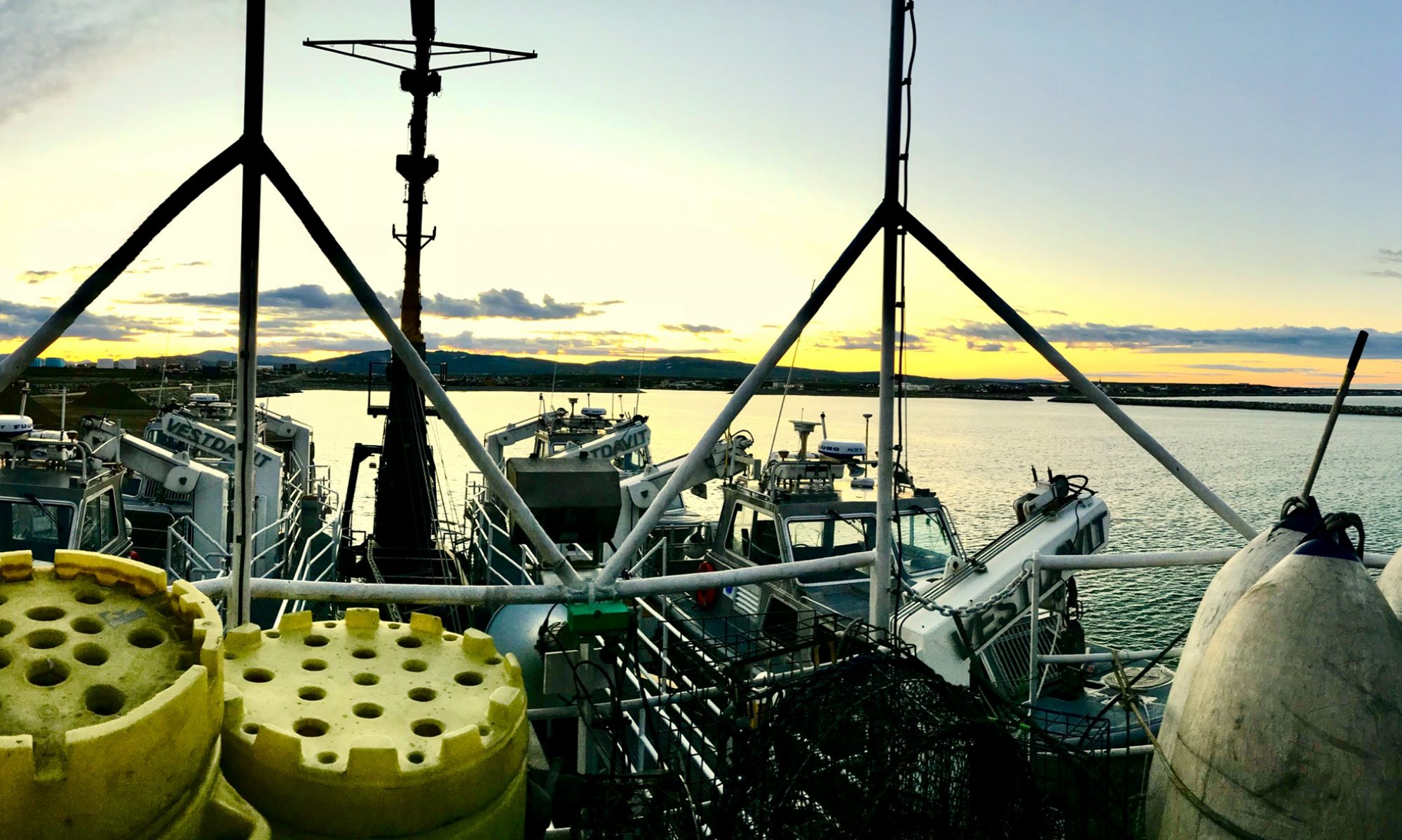
Michele Brustolon, July 1, 2010

NOAA Teacher at Sea
Michele Brustolon
Onboard NOAA Oscar Dyson
June 28 – July, 2010

NOAA Teacher at Sea: Michele
NOAA Ship Oscar Dyson
Mission: Pollock Survey
Geographical area of cruise: Eastern Bering Sea (Dutch Harbor)
Date: July 1, 2010

Weather Data from the Bridge

Time: 1400
Latitude: 58.19 N
Longitude: 170.01 W
Cloud Cover: 100%, dense fog
Wind: 11.49 knots
Air Temperature: 3.800 C/ 38.840 F
Water Temperature: 3.960 C/ 39.1280 F
Barometric Pressure: 1003.10 mb

Science and Technology Log

Here fishy fishy!
July 1st began by spending time in the Acoustics Lab learning about the equipment used to analyze the data. The Oscar Dyson has 5 transducers on its center board and 1 temporary transducer on the side of the center board that looks horizontally. The transducers allow us to see where the fish are. Because of where the transducers are placed, we can only see the pollock from 16m to the bottom. This means that if there are any fish between the surface and 16m they will not be detected. This is the near surface “dead zone”. Why this happens? The transducers are mounted on the bottom of the centerboard about 9 m below the water line, and near the transducer face (first 7 m), no good data are collected. Why it’s okay? Pollock tend to hang out in mid-water. Although a few baby pollock might be in the near surface “dead zone,” the majority of pollock will be in the area we are watching. There is also a bit of a “dead zone” at the other end near the ocean floor. Yesterday the bottom was around 69.35m.

Transducer data

Why acoustics?
Ideally, the acoustic data collection would allow us to track aggregations of pollock without actually having to fish them out of the water. All parties involved (scientists, fish, bank accounts) would benefit from this change but scientists are still in the process of perfecting this process. The Oscar Dyson is part of a fleet of five boats that was specifically designed for acoustics. Specifically, it is considered a “quiet boat” where the engine noise is decreased to prevent scaring the fish. Other Acoustic projects include: Pacific hake off the coast from California to Vancouver Island (run as a joint project with Canada), herring in the northwest Atlantic, and krill in the Antarctic. Acoustics are used throughout the globe and many countries depend on acoustics for their fish surveys.

A little help from UNH!
Along with the transducers, there is also a multibeam SONAR that produces the same information as the transducers but with a wider angle range. The multibeam ME70 sends its signal out after the transducers information is sent and returned. They alternate about 1.5 seconds apart. The University of New Hampshire (UNH) is helping to use the tool and also to analyze the data. To analyze the transducer data collected, a program is in place from Tasmania to help determine what the boat is seeing. The scientists use the program to help separate species in the water column. Scientists utilize the multibeam ME 70 along with the transducers and fish trawling to ensure they are capturing an accurate picture of the mid-waters.

Multibeam ME70 data

How the survey data we collect are used. The data we collect on the Oscar Dyson during the summer pollock surveys are used by scientists and policy makers to determine the fishing quota (the “take”) of pollock for the next season. Quotas are important for maintaining the population of pollock (and other species) for this generation and generations to come. The data we collect on the Oscar Dyson help ensure that maximum stock can be taken without negatively impacting the Eastern Bering Sea pollock population.

Here I am deploying the XBT (eXpendable bathymetric thermograph)

Personal Log

Although there was no fishing yesterday, I certainly was able to be involved. I launched the XBT off the Hero Deck just as we began our fire drill. Once that was completed I returned to the Acoustics Lab until we were cleared from the drill. We then had our abandon ship drill where we get our survival suits and head to our assigned position. My meeting location is at life raft 3 and 4. Once we learned how to deploy our life raft, we headed inside to the conference/lounge to practice donning our suits. While this is very serious, it is also worth a laugh or two watching people struggle and become orange gumbies! The goal is to be able to don your suit in under 60 seconds!

Zodiac ride into the cove of St. Paul’s Island

Yesterday I had the opportunity to head into St. Paul’s Island; the largest of the Pribilof Islands. St. Paul’s is also called the Galápagos of the north. The Zodiac was driven by Joel Kellogg and Amber Payne, and our CO (Commanding Officer Mike Hoshlyk) allowed Katie, Rebecca, and I the opportunity to take the trip inland. Our mission while on land was to bring science equipment (ice-flow detector) to the airport that needed to be sent to Anchorage. Stepping foot onto St. Paul’s Island seemed eerie and mysterious. There was the lurking fog along with a very industrial feel to the island. Because most of the island consists of coalescing small volcanoes, the sediment’s dark color is due to lava flow which didn’t brighten the land at all. We did not see many people other than those working on dredging the new causeway or the people in the airport. Our taxi driver said that they hadn’t gotten mail since Monday and it was Thursday which explained why the people waiting for flights at the airport seemed a bit anxious. On our way back to the boat, we were able to see sea lions and some puffins hanging out in the water and around the break wall. As we approached the boat, it was like an apparition appearing before us. Just another once in a lifetime chance that I have had this cruise!

Want more information about the Pribilofs? Check out http://www.amiq.org/aleuts.html

Oscar Dyson coming back from Pribilofs

Animals Seen

Auklets
Murre (2 different types differentiated by bill type)
Fox
Puffins
Sea lions

(but no fur seals…everyone told me I would see them but they were missing. It seems to be a question everyone is asking.)

Word of the day

Desmadre: troublemaker

New Vocabulary

Transducer: instrument used to send out signals that return and show where fish are located
Ground fishing: trawling on the ocean floor

Michele Brustolon, June 30th, 2010 part 2

NOAA Teacher at Sea
Michele Brustolon
Onboard NOAA Oscar Dyson
June 28 – July, 2010

NOAA Ship Oscar Dyson
Mission: Pollock Survey
Geographical area of cruise: Eastern Bering Sea (Dutch Harbor)
Date: June 30th, 2010

Weather Data from the Bridge

Time: 1600 hrs
Latitude: 57.16 N
Longitude: 169.09 W
Cloud Cover: Dense fog
Wind: 11.56 knots
Air Temperature: 5.30 C/ 420 F
Water Temperature: 5.090 C/ 410 F
Barometric Pressure: 1005.02 mb

Science and Technology Log

Fishy Fish
Why Pollock?
Walleye Pollock (Theragra chalcogramma) is an important fish for Alaska (and the entire United States). Although you may not know it, you’ve probably eaten Pollock when you have enjoyed fish sticks, a fish sandwich at a fast food restaurant, or imitation crab meat. Walleye Pollock produce one of the largest catch of any single species within US waters and accounts for over half the groundfish catch in Alaska (see:http://www.afsc.noaa.gov/species/pollock.php for more information)

Acoustic Lab with Abigail McCarthy and Neal Williamson

How the Oscar Dyson helps? By surveying the Pollock populations within the Bering Sea, scientists can gather data on these important fish – including size, gender distribution, maturity rates, location, and diet.

How do we find the fish? Scientists work around the clock gathering data through acoustics to identify the locations of populations. The Oscar Dyson has five transducers located across the bottom of the ship on its centerboard. These transducers send out signals and the data are graphed on large computer screens in our Acoustics lab. While on shift, we eagerly await word that a fish population has been identified and await the trawl.

First trawl net to come up on Leg 2
Here I am getting ready to sort the first catch in my foul weather gear!

And the Trawl…
Luckily for me, fish were seen on my first shift and we conducted the trawl in the afternoon. The take varies based on the populations identified and the net may be out for two minutes or an hour. This first trawl was out for 45 minutes before the crew hauled it in. It was amazing how many seabirds were swarming around the net as it was pulled up and how many jellyfish were caught in the lines. The first task once the catch is brought on deck and placed in the fish table, is to sort the specimens. We had Pollock, Pacific cod, and 2 types of jellies. Once the catch was sorted, the fish were weighed and then sexed. After they were sorted into Blokes and Sheilas (males and females), the fish also had to be measured. A small sample was dissected to remove stomachs and otiliths (ear bones of Pollock that are used for aging the fish) for further study.

Abigail McCarthy and Kathy Hough taking samples of Pollock stomachs and otiliths
The wet lab

Personal Log

While this is a continuation of the first log (it was way too long!), it focuses on the why we are studying Pollock and how the first trawl went. No fishing was done until after lunch. When the net did come up, there were five of us in the wet lab where we processed the catch; Abigail McCarthy, Kathy Hough, Rebecca Kimport, Katie Wurtzell, and me. It was very interesting to see all the information that came from a sampling of Pollock: weight, length, sex, stomach contents, and otiliths (ear bones). This brought us to the end of our 12 hour shift at 1600 hours.

Exercise was next…running on the treadmill was by far the weirdest feeling as the boat is rolling you feel as though the incline is moving up and down on its own and you have to hold on at different times. This is with pretty calm seas too! Dinner was fabulous as always. We have been spoiled here on the boat with meals like king crab legs, salmon, prime rib, Jamaican jerk chicken. Now do you see why I have to try to exercise EVERYDAY!!! I think the hardest part right now is trying to get to bed early enough so when 0315 arrives, I can get up and going.

Workout room

Animals Seen on First Shift
Euphausiids
Jellies
Pollock!!!
Pacific Cod

New Vocabulary
Blokes: male Pollock
Sheilas: female Pollock
Otiliths: ear bones of Pollock that help age the fish (they have rings that are counted much like trees)

Michele Brustolon, June 30th, 2010

NOAA Teacher at Sea
Michele Brustolon
Onboard NOAA Oscar Dyson
June 28 – July, 2010

NOAA Ship Oscar Dyson
Mission: Pollock Survey  
Geographical area of cruise: Eastern Bering Sea (Dutch Harbor)  
Date: June 30th, 2010  

Weather Data from the Bridge

Time: 1600 hrs
Latitude: 57.16 N
Longitude: 169.09 W
Cloud Cover: Dense fog
Wind: 11.56 knots
Air Temperature: 5.30  C/ 420 F
Water Temperature: 5.090 C/ 410 F
Barometric Pressure: 1005.02 mb

Science and Technology Log

Time with Birds and Mammals
Once we finally left Dutch Harbor behind, I spent some time on the bow with birder, Nate Jones.

As I know very little about birds, I quizzed him on every flying specimen we encountered and used his binoculars to observe the birds up close. After a few sightings, I was able to identify the Fulmar by its unique wing movement (quick quick quick soar). We also saw tufted puffins and a black footed albatross. There are two birders on this leg who are responsible for scanning the horizon and counting and identifying the sea birds they observe from the bridge.  We were distracted from our bird watching by a call of orcas. I hustled up to the “flying bridge” to join the marine mammal observers. There are three “mammals” on this leg and they are constantly scanning the horizon with their “big eyes” to observe and identify cetaceans. I was able to observe two separate groups of orcas and heard that porpoises were also spotted.

Although I am technically on the fish shift, I hope to check in with the “birds” and “mammals” later in the cruise.

What’s in your water?
I began my shift this morning at 0400 and reported to the Acoustics Lab to meet with head scientist, Neal Williamson. In addition to Neal, my shift includes Abby McCarthy, a NOAA research fisheries biologist, Katie Wurtzell, awesome biologist and my fellow TAS Rebecca. We began the shift by observing our first CTD (Conductivity Temperature Depth)  profiler which will be deployed approximately 10 times throughout our trip. The CTD measures conductivity, temperature, and depth (used to calculate salinity) and gathers samples to measure dissolved oxygen. In addition, fluorescence is measured to monitor chlorophyll up to a 100 m from the surface.

The CTD – measures Conductivity, Temperature, and Depth

After our first CTD, we completed our first Methot trawl. A Methot trawl is named after the scientist who designed the net used. A Methot grabs the creatures and collects them into a codend (to make it easier for us to process) at 30-40 m below the surface – our Methot collected jellies and euphausiids (also known as krill). My first duty was to sort through the “catch” to pick out jellies. Next, we measured the weight of the krill before counting a small sample. We also preserved a couple samples for use in larger studies.

Following our Methot, I observed the deployment of an XBT (eXpenable Bathymetric Thermograph). The XBT is used to measure quick temperature data from the surface to the sea floor. The data are graphed at depth vs. temperature to highlight the thermocline, which is where colder water meets water warmed by the sun. Here in the Bering Sea, the thermocline is not always noticeable as the water column is subject to mixing from heavy winds and shallow depths.

Methot – graphing temperature vs. depth – shift in graph shows thermocline.

Personal Log

As I approached Dutch Harbor, I began taking photos from the plane. It sounds crazy, but the landscape is like nothing I have ever seen. Once I was off the plane, my smile grew because of the crisp air and the smell of saltwater. After two days of travel I had finally made it to Dutch Harbor and my luggage made it with me! I was brought to the boat to drop off my bags and then into town to catch up with others on Leg 2. The Oscar Dyson was having work done on its large generator so we didn’t leave port until June 29 at 1430 hours. It actually gave me time to get to know a good portion of the people on this leg (the crew, scientists, “birders,” mammalian observers, and the stewards). I was also able to explore Dutch Harbor, Unalaska (we tried to find wild horses…no luck!), and take some walks from the Oscar Dyson. Some of the most common flowers and birds seen are the lupines, orchids, and bald eagles EVERYWHERE! They are incredibly loud too! They remind me of seagulls and squirrels back home because there are so many! Wednesday, June 30 was the first day of our 0400- 1600 work shift so we won’t see everyone until we are transiting back because of the different shifts. The Oscar Dyson has 40 bunks and we are occupying 39 of them-talk about a full ship! For information about what happens during our shift, take a look in the science and technology log. I am truly enjoying my time and there are plenty of people to make me laugh which is the best medicine when you are a tyro!

Dutch Harbor at low tide from the dock of
the Oscar Dyson
Dutch Harbor during a typical day

Animals Seen in Dutch Harbor

Bald eagles
Ground Squirrel
Sea Urchin
Sea Stars
Sea Cucumber
Pigeon Guillemont
Oyster Catchers
Mussels
Chiton
Limpets
Hermit Crabs
Snails
(but no horses…)

A Bald Eagle named “Charlie” sitting outside the Unisea Restaurant

Animals Seen in Transit

Orcas
Fulmars
Black Footed Albatross
Tufted Puffin

Animals Seen on First Shift

Euphausiids
Jellies
Pollock!!!
Pacific Cod

Word of the Day

Tyro: a novice or beginner

New Vocabulary:

CTD: (Conductivity Temperature Depth) A device used to measure conductivity, temperature and depth at specific locations within the Bering Sea

Methot: A net used for shallow trawls, named after the scientist

XBT: eXpendable Bathymetric Thermograph

Thermocline: the point when the temperature drops