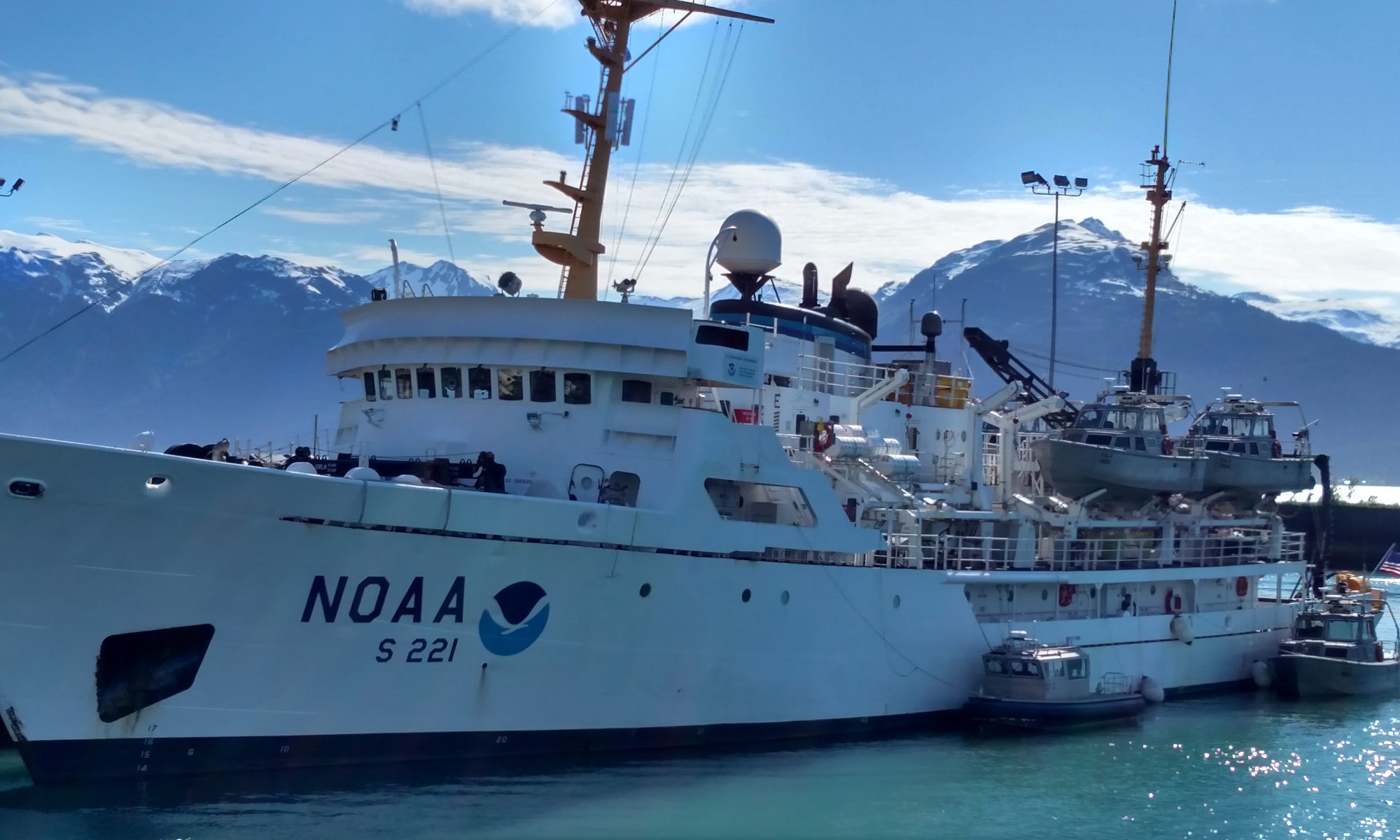
Mission: Shark/Red Snapper Bottom Longline Survey, Leg 1
Geographic Area of Cruise: Western North Atlantic Ocean
Date: August 19, 2026
Late afternoon on August 11, 2026, my last night aboard Oregon II.
On August 12, 2026, I disembarked from Oregon II and set foot on land for the first time in 17 days in Charleston, South Carolina. Gradually, the team we had formed for the first leg of the survey began to break up as people went their separate ways. Some would be embarking again in three days’ time for the second leg of the survey. Some were taking their vacations or heading back to work on land but would return for legs three or four. Others, like me, were only part of this one journey from Pascagoula to Charleston.
Arthur Ravenel Jr. BridgePhoto credit: Gretchen ArndtArriving at port in Charleston, SC
It is certainly a strange experience to work so intensely with a group of people – even living and eating meals together – and know that the same team will never come together again exactly as it is. Those of us who wouldn’t return were making way for new people to arrive and gain their own experience. (There is even another Teacher at Sea expected later in the survey!) This is also something we have to accustom ourselves to in education. For a year, we build a sort of family in a classroom, with our own rituals, inside jokes, and memories. Then we ultimately have to say good-bye so that everyone can move on and keep growing somewhere else. As a teacher, I want to make sure that what students experience in my class helps them to contribute the best of themselves to every new team they join.
This week I am returning to school to get ready for the new academic year. I am reflecting on what I learned from my work and life aboard Oregon II and how I can bring that to bear on my teaching and collaboration with colleagues this year. Of course there are many lessons about science and maritime careers. But there are also lessons about resilience, curiosity, and being willing to take risks. I enjoyed so much support from my family, friends, and colleagues at home. My entire district was cheering me on and colleagues told me how brave they thought I was for trying this. Yet it is this very support that allowed me to feel brave enough to go for this opportunity and follow through with it. Having a foundation of trust and support makes people more willing to take on new challenges. We can risk failure because we know somebody will be proud of us just for trying. This is the kind of culture that needs to be built in a classroom. As I decorate my classroom and write lessons, I am thinking of how I can both challenge and support my students this coming year.
That being said, I am also super excited to show my students pictures of sharks, sharks, and more sharks! It occurred to me how very few people have been able to touch, tag and hold sharks like I did. My students are going to be so excited and they will have so many questions for me. Besides sharks, I want to show them pictures of scientists working outside with tools that are like what they might find in a toolbox at home or what their parents might use at work. I want to show them strong scientists holding shark heads and tails to keep their colleagues safe while they measure and tag an animal. I want them to know that some of the scientists I met didn’t always have the easiest time at school, but they still went on to learn, achieve, and snag one of the coolest jobs in the world. I’m also eager to show them pictures of some of the cool machinery aboard ship and allow them to imagine what skills they might need to be an engineer or steward. A boat is like a floating city and it requires many talents to keep it safe and moving forward.
I’m looking forward to sharing what I’ve learned with other educators. (I’ve already had other teachers ask me about they can become NOAA Teacher at Sea!) In our first meetings back at my school, we discussed our main objectives for the year, one of which is to strengthen students’ writing in science class. Being a Teacher at Sea gave me a lot of first-hand experience with how difficult it can be to express scientific concepts clearly and how important it is to be precise. Yet the processes of recording, writing, and drawing can actually help us solidify new learning. Next week my students will be putting together their science notebooks in which they will record all their observations during classroom experiments. We will discuss the importance of taking precise measurements and recording them carefully with the correct units. (After being the data recorder while a team of scientists holds down a thrashing shark to measure it in millimeters, I feel like I have some insights to share.) I can’t wait to see those notebooks fill up with all of their learning and — most important — new questions to investigate.
If you have been following along on my journey, I want to take a moment to thank you. At times, it was a real challenge to sit down and write but then I would think about everyone who told me they enjoyed reading my blog or looking at my pictures. Knowing I had people excited to read about what we were up to on Oregon II or to learn something new about the ocean motivated me. It’s been such a pleasure to share this with you.
Mission: Shark/Red Snapper Bottom Longline Survey, Leg 1
Geographic Area of Cruise: Western North Atlantic Ocean
Date: August 8, 2026
Latitude: 31° 36.130’ N
Longitude: 79° 40.546’ W
Weather Data from the Bridge: South to southeast winds, 5 to 10 knots. Seas 4 to 5 feet. Showers likely and scattered thunderstorms.
Science and Technology Log
NOAA Operations Officer Heather Gaughan and science volunteers Maysin Douglas and Kleys Morillo measure the length and weight of an Atlantic sharpnose shark (Rhizoprionodon terraenovae)
In the past couple days, we have begun to catch a greater number of small sharks that do not require the cradle. When a smaller shark is hauled up, length measurements are taken on a board that’s like a big ruler. They can be weighed by hanging them from a handheld scale. During this process, I was able to hold a juvenile tiger shark!
How do you hold a shark safely? Sharks are similar to alligators in that they have very strong muscles for biting down but weak muscles for opening their mouths. If you hold them firmly in the right spot, it is possible to keep their jaws clamped shut. In the cradle, the person controlling the shark’s head applies downward pressure to keep the jaws closed. On the deck, grasping with thumbs and fingers on either side of the jaw does the trick.
I was assisting with measuring when suddenly everyone around me insisted that I hold the shark. I am not going to lie: I was terrified to hold that shark! But everyone here is very encouraging and they want to make sure I don’t leave anything on the table. After all, I came out here for a challenge. So I took the shark that was handed to me and now I can live without regret. I sent this picture to a student’s mother to show him and he said, “Aww, that’s my teacher, she’s a shark catcher!” New teaching level unlocked.
Because this leg of the survey spans the end of July and the beginning of August, we have had to participate in abandon ship drills twice. During these drills, we practice getting to our muster stations for fire, mariner overboard, and abandon ship emergencies. For the abandon ship drill, we have to practice putting on our survival suits. These all-in-one suits are designed to keep you afloat and prevent hypothermia while awaiting rescue. They are also equipped with whistles and lights so that you can alert other ships to your location. My suit was comically large, but I was assured that it would still keep me warm and afloat should I need it.
You might wonder why we would need protection from hypothermia in the summer when the water is around 80° F. Water conducts heat better than air. This is why you can briefly stick your hand into a 400° oven without injury but 212° water will burn you instantly. Being immersed in water below your body temperature will sap your body heat much faster than air at the same temperature would and your body can’t keep up with maintaining warmth. You can become hypothermic in 80° water within a couple of hours. When you are far from shore, it could take much longer than that for another vessel to know you’re in trouble, locate you, and arrive to rescue you.
Although being aboard ship — or out on a recreational boat — can be a lot of fun, safety should always be first in everyone’s mind. If you’re planning to get on the water, please make sure you’re ready for emergencies and have all required safety equipment. Boating laws vary by state but this site from the US Coast Guard is a great place to start learning: https://www.uscgboating.org/recreational-boaters/
Cheyanne Vanderdonckt wearing a survival suit during a safety drill (Photo credit: Maya Seehotlz)
While the deck crew and science team work in the well deck hauling in the line, the officer driving the ship is just as busy up on the bridge. NOAA vessels are under the command of officers from the NOAA Corps, which is a uniformed service branch. Oregon II’s commanding officer (CO) is Commander Jesse Milton and he was kind enough to give me a tour of the bridge during haulback operations one evening. It is the quietest place on the ship and it has a wonderful mix of 1960s era control panels and new technology. After dark it is illuminated only with red lights to preserve night vision. Even with modern radar and sonar systems, the most important safety feature is the vigilance of the person at the helm.
In the picture below you can see Operations Officer Heather Gaughan looking out the starboard window to maneuver the boat from the controls there. There is a similar setup on the port side, as well as the primary controls in the center. Being able to operate the vessel from these different vantage points assists with operations such as docking and hauling in the fishing lines. After the fishing line is set, the line is cut so it is no longer attached to the ship. This means the ship must go back and pick it up again. The ship must approach the high flyer close enough for crew members to be able to catch the line attached to it with a grappling hook, but not so close that it runs over the line. Then the ship must change its angle of approach so that the line is more or less parallel to the side of the ship. These are delicate maneuvers that require coordination and communication between the bridge and the crew hauling in the line.
In the bridge, Operations Officer Heather Gaughan drives the ship while looking out the window to starboard while Commanding Officer Jesse Milton looks out the front.
As part of my Teacher at Sea experience, I was invited to deploy two drifting buoys as part of NOAA’s Adopt-a Drifter Program. This program helps connect students to ocean science as they track the movements and data from their drifters.
The drifter itself consists of a spherical float — like a large, rigid beach ball — attached by a tether to a drogue. The drogue looks kind of like a large windsock or a fabric play tunnel. It helps to anchor the buoy in the upper surface of the water, rather than allowing it to be tossed around in the wind and the waves. Students can track the drifter buoy as it moves along in ocean currents and gathers data on sea surface temperature. Other data gathered can include barometric pressure, wind speed/direction, and salinity.
The data from drifters can be used to support weather forecasting, as well as climate research. All of these drifters are part of the Global Drifter Program, which aims to maintain an array of these mobile data transmitters around the globe. You can see all the drifters on a map and click on each one to learn more about it here: https://www.aoml.noaa.gov/global-drifter-program/
Before deploying the first drifter, we decorated it with stickers and messages for my students. We chose a spot within the Gulfstream current to give the drifter buoy a good chance of traveling far. The batteries typically last about 400 days but they have been known to last much longer. Before we tossed it off the stern, the bridge made an announcement for anyone who wanted to come watch. It felt like a little celebration.
Our decorated drifting buoy ready to be deployed, deployment with lead fisherman Sean Gronquist, and a view of the buoy drifting away. (Photo credits: Cheyanne Vanderdonckt and Maysin Douglas)
Aboard ship, we are beginning to ask one another what we miss from land. We miss our pets and going barefoot (not allowed for safety reasons on the ship). I miss my husband and taking naps on the couch with my dog. It’s also a little frustrating to see all this water and not be allowed to swim!
I am still enjoying being at sea, but I miss working within my realm of expertise. At my workplace, I am an experienced employee that people may come to for help with challenging student behaviors or ideas for teaching a tricky concept. Here I am helpful with routine tasks, but way over my head in scientific conversations. This is also really helpful for understanding the emotional dimensions of learning. When students are struggling, they need support but they do not need us to remove all of the discomfort. This is often our first instinct as we teachers tend to be compassionate people, but being able to tolerate some level of discomfort is critical to learning. Supporting students through this — rather than seeking to eliminate all friction — is how we can help them to become lifelong learners. Instead we can remind them that making mistakes and temporary confusion are normal parts of the learning process. You can invite students to think about skills they have now that used to be difficult or impossible for them and think about how they improved. Sometimes all we need is a reminder that we have done hard things before and we can do them again.
While learning more about sharks, I have also been learning how scientists and the ship’s crew manage to write reports and e-mails in an office swinging from side to side at an inconstant rate. For the last few days the ship has been rocking quite a bit due to swell from a storm off the coast of Florida. This has made it challenging to read or write. Large objects on the ship are secured to keep them and us safe, but not everything can be strapped down so there are still some things falling off shelves. We will go on deck for a set or haul and return to find computers or other equipment on the floor. Everyone takes it in stride as part of life at sea. When I applied for the Teacher at Sea program, the application stressed three qualities above all: flexibility, fortitude, and the ability to follow orders. I can see these traits in the people working aboard Oregon II and I’m thinking of ways I can help to cultivate them in myself and my students.
Did You Know?
A chronometer is a highly accurate clock that can keep time under extreme conditions, such as those encountered at sea. Accurate timekeeping was difficult at sea when clocks relied on mechanical components whose movement was affected by the constant motion on the water. Being able to keep time accurately was important for navigation, particularly for calculating longitude. The marine chronometer was invented in the 18th century and began a new era for navigation.
During my tour of the bridge, Commander Milton told me I should get an engineer to take me down to the engine room to see Oregon II’s chronometer. It was originally part of the ship’s predecessor Oregon and is 100 years old. NOAA has educational activities to learn more about geography and navigation at https://nauticalcharts.noaa.gov/learn/educational-activities.html
Oregon II’s chronometer, originally part of its predecessor Oregon’s equipment
Mission: Shark/Red Snapper Bottom Longline Survey, Leg 1
Geographic Area of Cruise: Western North Atlantic Ocean
Date: August 4, 2026
Latitude: 34° 20.659’ N
Longitude: 76° 35.444’ W
Weather Data from the Bridge: Southwest winds 5 to 10 knots becoming 10 to 15 knots in the afternoon. Seas 3 to 4 feet. Showers with a chance of thunderstorms in the morning, then a slight change of showers and thunderstorms in the afternoon.
Science and Technology Log
The survey is in full swing. Every day during our 12-hour shift we will arrive at 2-3 stations, and the night shift will do the same. The exact number depends on how far apart the day’s stations are, as well as weather conditions and how long haulbacks take. We work in the rain, but not if there is lightning. The distance between stations varies from about 10 to 50 nautical miles. (A nautical mile is approximately 1.15 miles on land.) Our exact speed varies with current and wind, but we generally travel at about 11 knots, which means 11 nautical miles per hour. We begin to bait the hooks for the next station about 15-20 minutes before we arrive. Then it takes about 20 minutes to deploy the line off the ship’s stern. As soon as we are done with that, a few members of the science team will go to the bow with the deck crew to deploy a device that collects data about the water column (more on that below). An hour after the line was set, we will begin to haul in the line.
What are we hauling in? In this part of the Atlantic Ocean, we are mostly catching sandbar sharks (Carcharhinus plumbeus). Other species include tiger sharks (Galeocerdo cuvier), nurse sharks (Ginglymostoma cirratum), and Atlantic sharpnose sharks (Rhizoprionodon terraenovae). As explained in my previous post, most sharks are hauled up using the cradle. In the cradle, length measurements are taken.
Why more than one measurement? Before this trip, I always heard about, say, a “six foot shark.” I knew that scientists use the metric system so we wouldn’t be measuring in feet and inches, but we are also taking 3-4 length measurements for each fish. These measurements have been standardized using parts of the shark’s anatomy as endpoints. This allows scientists to make comparisons across different specimens and field studies, but it also helps them check for accuracy. It can be challenging to get accurate measurements on a living, moving shark. In addition, some species do not have a fork in the tail or a pre-caudal pit. The measurements generally taken are the pre-caudal length (from the tip of the snout to the point where the caudal fin meets the body), the fork length (from the snout to the fork in the tail), and the total length. You can see these lengths on this helpful diagram from the Florida Museum of Natural History. As a scientist takes the measurements, a recorder stands by with a data sheet to write them down.
A diagram showing how to take different length measurements of a shark (Image credit: Florida Museum of Natural History)
When we catch a small shark, we can measure and weigh it on the deck. However, there isn’t a practical or safe method for weighing a large shark in Oregon II’s cradle. Instead, weights can be estimated based on length. If you are interested in how much a shark of a specific length might weigh, you can use this handy calculator from NOAA: https://apps-nefsc.fisheries.noaa.gov/shark/ This could be a great activity for having a little fun with measurement for students! After using good measurement practices to get your height, type your height in inches or centimeters into the calculator to see how much you would weigh if you were a shark. (If I were a sandbar shark, I would weigh about 95 pounds.)
The most exciting part of a shark catch is getting to tag the shark. Shark tagging helps scientists study shark behavior, populations and migration. If somebody catches a tagged shark, they can provide updated information on its location using a phone call or a website with a form. The tags we are using look like a piece of yellow coated electrical wire rather than a big plastic tag. They are inserted into the body right alongside the shark’s dorsal fin. After making a short (less than an inch) incision in the skin, the tagger inserts the tip of the tag with a device that resembles a large metal hypodermic needle. It’s important for everyone to work carefully but quickly to reduce stress on the animal and the chances of anyone being injured. After tagging, the hook is cut from the shark’s mouth and it is lowered back down to the water to be released. I have been allowed to tag three sandbar sharks so far and it is awe-inspiring to be so close to these amazing creatures.
Cheyanne Vanderdonckt (in yellow hardhat) tags a sandbar shark in the cradle while science party chief William Driggers and lead fisherman Sean Gronquist control the head and tail (Photo credit: Masyn Douglas)
This is the first leg (of four) of the Shark/Red Snapper Bottom Longline Survey. On this leg, we are fishing off the east coast of Florida, Georgia, South Carolina, and North Carolina. On the next legs, they will be in the Gulf and will likely catch much more red snapper. Red snapper has been fished commercially in the Gulf since the 1840’s and by the 1920’s there were already signs of overfishing that led to regulation. Today, it is considered a sustainable seafood choice because it is responsibly managed in the United States. The annual survey conducted by NOAA Fisheries helps inform the process of establishing catch limits.
Survey technician Gretchen Arndt measures the length of a red snapper (Lutjanus campechanus)
When a red snapper is caught, length and weight measurements are taken. Then the otoliths (ear stones) are retrieved. Otoliths are structures made of calcium carbonate that help the fish with balance and determining their position in the water. Otoliths of different species develop new layers at different rates. Marine scientists use the layers of the otolith to determine the age of a fish — much like counting the rings of a tree’s trunk. The fish is also examined to determine its sex and other tissue samples may be taken.
Maritime Career Focus: Survey Technician
Senior Survey Technician Gretchen Arndt is responsible for the scientific survey equipment on Oregon II. She has a bachelor’s degree in biological sciences with a marine focus from Florida Atlantic University. She worked as a field biologist and a field operations manager in the Florida Everglades. Marine biology is a competitive field that attracts many talented individuals. Gretchen says that driving and maintaining airboats and other equipment in the field helped give her the technical experience that led to her being hired by NOAA.
One of the pieces of survey equipment that Gretchen is responsible for is known as the CTD (for conductivity, temperature and depth). CTDs come in various designs and they are integral to the science of oceanography. The CTD can be used to retrieve samples of water for further analysis, as well. This device is deployed off the bow deck after each line is set. Getting the CTD into and out of the water is a coordinated effort between the bridge, the science team, and the deck crew. Gretchen also equips Oregon II’s CTD with a light and camera so that the science team can visually evaluate the seabed.
Gretchen Arndt with the “CTD”
Personal Log
Another beautiful sunset, viewed from the stern deck.
I feel like I could just look at the sea and the sky all day and night. Fortunately, we do have transit time between stations so I am able to spend some time gazing. At first I just see blue everywhere, but the longer and closer I look, the more colors I can pick out. In the reading curriculum we use in my school district we have lessons in which students spend time silently observing a work of art. They aren’t allowed to speak for at least a minute because it’s important to let everyone form their own impressions before they hear others’ ideas. I will definitely share some of my sea and sky photos with my class to have them look for as many colors as they can see.
A view of the Atlantic Ocean from Oregon II. How many colors can you see?
Occasionally I see other ships on the horizon and sometimes I can make out some features on shore. When we passed by the Kennedy Space Center at Cape Canaveral, I could see the massive Vehicle Assembly Building. My favorite view, however, is when dolphins swim alongside the ship. Dolphins follow boats and ships for many reasons. They can ride the bow wave to conserve energy. As the ship moves through the water, it can also disorient smaller fish, making them easier to catch. It is very hard to catch the exact moment a dolphin leaps to the surface, but I took a video one night while a spotlight was being used to illuminate the water for hauling back the longline.
One thing I enjoy about being a teacher is that people often tell me what they were like as children at school. At least a couple of people working aboard Oregon II have told me tales of having trouble at school because they didn’t like to sit still or got bored easily. Like many teachers, I always loved school. But I know this is not the case for everyone. In education circles, we talk about the “hidden curriculum.” Success in school requires a set of skills and traits that have nothing to do with the academic content being taught and which can be really challenging for neurodivergent students, students with disabilities, and many others. But this does not mean they lack the intelligence or drive to learn. In fact, many of them have the type of insight and creativity that is needed to drive innovation. If schools can’t support them, we are all losing out on the unique gifts and talents they have to share. To that end, I am always trying to find ways to make learning hands-on and connected to the real world. Although there is time for quiet and reflection, most of the day should be active and even a little loud. I try to highlight ways that my students’ character traits and interests might lend themselves to different career paths. I’m getting so many ideas from watching people work aboard Oregon II.
In my opinion, one of the coolest jobs on board is that of Fisherman. Fishermen handle lines and operate equipment, including cranes (I’m jealous!), winches, and the anchor windlass. They work with the scientists during fishing operations and maintain the fishing equipment. On this survey we are using a longline, but the ship is also equipped with trawling nets. (In fact, the ship’s design is basically that of a fishing trawler). When a shark is in the cradle, fishermen operate the crane to haul it up, handle the lines on the cradle to help guide it into place, and help control the shark.
Fishermen, deck crew and science team members setting longlines and operating the crane used to haul sharks up to deck level.
Lead Fisherman Sean Gronquist shared one of his hobbies with us after we caught a red snapper. He paints one side of the fish with a biodegradable ink and stamps it onto canvas to make a print. This preserves the size and details of the fish, and makes a beautiful piece of art. The Japanese name for this art is gyotaku. In my classroom, I use arts integration a lot in science and math. Arts integration is a method in which a lesson addresses both academic content standards and fine arts standards. It has been shown to increase student engagement and improve retention of learning. It’s also great fun. I’m really excited to share this cool art form with my students. It has a physicality to it that makes it more interesting than a photograph. It will also be a great starting point to talk about texture. If you’re interested in educational uses for fish printing, here is an article from Smithsonian Museum of Natural History: https://ocean.si.edu/conservation/get-involved/educational-uses-gyotaku-or-fish-printing
Lead Fisherman Sean Gronquist demonstrates steps in the process of making prints from fish. After the initial printing, he will return to add details.
We have about a week to go in our survey and I am still enjoying every minute of my time on board. We had a couple of windy days that tested my sea legs, as well as my ability to sleep. Ships are very noisy in the first place, but the sounds increase as things start to slide around and doors knock around in their frames. Fortunately, I’ve got old hands to teach me tricks like stuffing bits of paper towel into drawers and doors to stop them from rattling. Nothing is as simple on a ship as it is on land, but that’s all part of the adventure.
Did You Know?
Although they are fish, many sharks give live birth. This means that some sharks have “belly buttons” that remain for a few months after birth. (If we come across a shark belly button I promise to share a picture!) Sharks also have two uteri. This year, one of my students was very excited to tell me that sand tiger shark embryos eat their siblings in utero and that checks out too. Although it may seem a little gruesome as a “fun fact,” it also helped us put things into perspective one day when he shared that he was in a bad mood because he had a fight with his sister. You never know when some scientific knowledge will come in handy!
Mission: Shark/Red Snapper Bottom Longline Survey, Leg 1
Geographic Area of Cruise: Western North Atlantic Ocean
Date: July 30, 2026
Latitude: 27° 40.261’ N
Longitude: 80° 12.372’ W
Weather Data from the Bridge: Southwest winds 15 to 20 knots. Seas 2 to 3 feet.
Science and Technology Log
I promised more details of how the longline survey is carried out and I will do my best to describe it here. A long fishing line (about a mile long) is equipped with weights and buoys at each end, along with a weight in the middle. The buoys also have a “high flyer,” which is a marker that sticks up off of the buoy so that we can see where it is. Attached to this longline are 100 shorter lines called “gangions” (say “GAN-jin”) with a number and a baited circle hook. (Circle hooks are used because they cause less damage to fish than “j-hooks.”) The longline is deployed, then given about an hour to “soak,” before we go back and start reeling it in.
Longline setup (Credit: NOAA)
How do you manage a mile-long line with 100 shorter lines attached without getting everything tangled? It’s a careful and orderly — albeit fast-moving — operation. The hooks are set up in barrels with notches that keep them lined up and ready to be attached to the longline as it is let out off the stern (back of the ship). Later when the line is hauled in, somebody will place them back in order to be ready for the next station. When every element of this set-up — high flyers, weights, and every single hook — is either deployed (thrown off the stern) or hauled in at the bow (front of the ship), somebody is ready at the computer to record the exact time, latitude, longitude, the state of the bait, whether there is a fish, weather conditions, etc. for each hook. Fortunately, the computer records most of this automatically so there are only a few keys to push when each piece is either deployed or hauled in.
Hooks baited with mackerel attached to the gangions ready to be clamped to the longline
At our first station we caught four sandbar sharks (Carcharhinus plumbeus). When a shark is caught, it is a carefully coordinated operation to haul it up in a “cradle” (a big net with a stiff metal frame) using a crane. There is an operator working the crane, two people holding onto ropes attached to each side of the cradle, and at least two people to manage the shark’s head and tail while measurements and samples are taken. They are also communicating with the bridge where the officers driving the ship have to maneuver it to help get the cradle into position. The shark’s length is measured in millimeters and a small tissue sample is taken from its fin. Most sharks are also tagged, which allows scientists to track movements and examine growth rates. When smaller fish are caught, they are brought onto a measuring board in the middle of the deck. (More pictures and information about all of this will be coming in future posts!)
William “Trey” Driggers helps secure the tail of a sandbar shark while it is tagged
Wildlife Spotted
One afternoon when the skies cleared after some rain, a pair of brown boobies (Sula leucogaster) came to rest on the weather station. A fellow science volunteer alerted me to their presence and we spent some time watching them spin around. To my amazement, they were still there hours later. I spent some more time watching them with the nearly full moon behind them.
Two brown boobies (Sula leucogaster) perched on the ship for hours
Simple Machines on a Ship
I have a student who got really interested in simple machines this year after, so I thought I would investigate as many of the simple machines as I could find on the ship. Simple machines are devices with few or no moving parts that make work easier. There are six basic types: wheel-and-axle, inclined plane, lever, pulley, wedge, and screw. A good example that we have at my school is a ramp, which is an inclined plane. I couldn’t carry a shopping cart full of science supplies up the stairs, but the ramp — along with the wheels and axles on the cart — allows me to push a heavy load up to the second floor relatively easily. Likewise, you probably can’t pick up your best friend, but if you get on a see-saw (a type of lever), you can send him high up into the air. Simple machines can be used on their own or in combination to make work easier.
There are many pulleys on the ship. They help make it easier to lift heavy objects. Winches are used to make it easier to haul in lines and to adjust the length of cables on cranes. Winches are essentially made of a wheel and axle and a lever. The rope or line wraps around the wheel as it turns on the axle. The handle acts as a lever that makes it easier to turn the wheel. The reel on a fishing rod acts as a winch when you turn the crank to reel the line in. Motorized winches use motors to turn the wheel.
Pulleys on one of the outriggersThis winch lowers and raises scientific gear attached to the “J-frame,” which is a big arm that can go out over the waterThe reel on a fishing rod acts as a winch when you haul in the lineSimple machines on the ship
A screw is a simple machine that is basically an inclined plane that wraps around a cylinder. If you have a screw at home, you can put your finger at the tip and follow that one groove all the way to the head. Think about cars driving up a circular ramp in a parking garage: they move on a continuous inclined plane that spirals around from bottom to top. The ship has engines that turn a big propeller and that propeller is a giant screw that pushes against the water to make the ship move forward. Although the blades of a propeller are separate rather than one continuous plane, they operate on the same basic principle as a screw.
Obviously I can’t see the ship’s propeller because it is under the water, but I asked the crew to tell me more about it. Oregon II has a variable pitch propeller which means that they can change the angle of the propellers relative to the axis that they spin around. The angle of this pitch changes the amount of work the screw can do with one full rotation. So a 1-foot pitch means that turning the screw one full rotation would theoretically move the ship 1 foot (This can vary depending on the other forces acting on the ship, such as currents and wind). Oregon II’s propeller has a maximum pitch of 6 feet. Naturally, I had to ask why you wouldn’t just always use the maximum pitch to go as fast as possible. It is like the gears on a bike or a car. If you have a bike with gears, you have probably found yourself pedaling furiously at some point, wearing yourself out without going any faster. If you choose the right gear, your energy will not be wasted. The officer driving the ship determines which pitch is appropriate for the conditions and the desired speed.
These are some of the simple machines I’ve discovered so far. Look around you and see what simple machines you have at home, work, school, or in the community. How do they make work easier? Can you use some objects in your house to make a simple machine?
Resources from NOAA:
NOAA has a great handout for students on the six basic simple machines at https://oceanexplorer.noaa.gov/wp-content/uploads/2025/04/simple-machines-handout.pdf (Teachers and parents: After introducing the basics of simple machines, look up some “Rube Goldberg” machine videos and challenge students to identify the different simple machines involved!)
I am settling into life aboard ship. Because I get off duty at midnight and still need time to shower and wind down a bit, I am waking up later in the morning than I am used to in order to get a full night’s sleep. (I always tell my students how important sleep is and I like to practice what I preach.) This means that I wake up after breakfast and just about an hour before lunch is served. At home I tend to eat something on the sweet side for breakfast, but I am getting used to starting my day with a hearty meal of pulled pork, cod, or fried green tomato sandwiches. I was told to expect good food and I have not been disappointed. Everything is fresh and delicious! As you can imagine, the people aboard all have great stories and interesting backgrounds. I hope to introduce you to some of them in future posts.
As we had three days of transit time without much for me to do, I got to spend a lot of time just looking at the water and the sky and this is truly a gift. Everyone should have the opportunity to see and experience this. Earlier this summer I participated in a teacher training course with the Chesapeake Bay Foundation. I enrolled thinking it would be another way to enhance my scientific understanding of our local watershed and it certainly did that. However, the instructors and community partners also took the time to let us simply experience being in nature and encouraged us to let our students do the same. We visited an urban farm with a summer camp (and soon to have an all-outdoor year-round preschool program!) and the staff talked about how they incorporate nature to help students with emotional regulation and other skills that develop the whole child. They emphasized that these are things we can do anywhere outdoors. We don’t need to go off to the wilderness or even a park. In fact, the more we can get children to pay attention to the nature that they see everyday in their yard, neighborhood, or schoolyard, the deeper their connection will be. This will in turn drive their curiosity and their desire to learn more.
I am experiencing this myself aboard ship. Although I have work to do, taking some time to just experience what is around me with all of my senses helps to calm me, refresh me, and make me even more eager to keep learning. Being at sea is a new experience for me, but I can tell that even the veterans aboard still carry that sense of awe. People still come out to watch the sun set over the water and they still get excited to see dolphins surface. I wrote in a previous post about the teacher’s charge to help students feel emotionally secure so that they can learn. Finding ways to let them experience amazement at our world is another dimension to this. In first grade students learn about the phases of the moon and I always encourage my students to look for the moon throughout the night and day. It is notoriously hard to get a good picture of the moon with a cell phone, but I took this video before putting my phone away and just looking.
View of the moon from NOAA Ship Oregon II
Ship Rules
When I return to my classroom in August, I will spend a lot of time teaching my students about the rules of the school and the classroom. Of course, this is not always popular, but I do my best to explain the purpose of each rule and invite students to think about what could happen if we don’t follow it. (Admittedly, we sometimes get silly with these scenarios.) Children often feel bombarded by rules and that they are uniquely burdened by them. So I think it’s important to share examples of rules adults have to follow, as well. I’m going to have lots of great examples of rules Ms. Vanderdonckt had to follow while at sea. When you’re on land and close to the nearest hospital, your health and safety might be your own business. But on a ship far from shore, your health and safety affects everyone. If somebody were to be careless and get injured, it could jeopardize the entire mission that has been so carefully planned.
There are rules that are written and taught explicitly and then, of course, there are unspoken rules of etiquette and society that we just have to pick up on. This is something many neurodivergent students can struggle with. Special educators use tools like social stories to help them understand various social scenarios and explicitly teach expectations. Being in a completely different type of social environment is forcing me to simply ask people about etiquette and expectations. This is another dimension of my learning experience that I wasn’t even expecting. I knew I had a lot to learn about science and fishing, but I’m learning just as much by asking somebody, “Hey, if you’re working in your office with your door open does that mean it’s okay to ask a question?” Fortunately, people are very kind about teaching me the ropes.
Hardhats and PFDs (Personal Flotation Devices) are mandatory during operations. (Photo credit: Kleys Murillo)
Accessibility Corner
As a special educator, I’d like to share some insights and tips with teachers and caregivers that I am thinking about on my journey. As parents do shopping for the new school year, a big item on the list is new shoes. Many young students and/or students with fine motor challenges have difficulty tying shoes on their own. Velcro can be a great help but what if the pair your child is begging for have laces? My packing list suggested slip-on shoes because on a ship you need to get in and out of your shoes frequently and quickly. I don’t find most slip-ons comfortable so I’m using these elastic laces for my favorite sneakers. The bumps help me adjust them to my perfect comfort level. These could be great for students (or adults) who have trouble tying independently or who have sensory issues requiring fine tuning of laces. There are many brands, sizes and colors available.
My favorite pair of sneakers are easier to get on and off quickly with elastic shoelaces
Did You Know?
Sargassum is a type of floating brown algae. It can provide shelter and food to many types of marine life. It plays an important role in supporting life in the Atlantic Ocean but it can also cause issues when a lot of it washes up on shores at once. To learn more about sargassum, visit https://oceanservice.noaa.gov/news/sargassum/
Sargassum floats on the surface of the water in the Atlantic Ocean
Mission: Shark/Red Snapper Bottom Longline Survey, Leg I
Geographic Area of Cruise: Atlantic Ocean
Date: July 28, 2026
Latitude: 27° 04.803’ N
Longitude: 85° 14.792’ W
Weather Data from the Bridge: West winds 10 to 15 knots. Seas 2 to 3 feet. Waves west 3 feet at 4 seconds and south 1 foot at 8 seconds. A slight chance of showers and thunderstorms in the morning.
Science and Technology Log
For the first days of our journey, we will be traveling south from Pascagoula through the Gulf to the Straits of Florida. This means we will not be starting our survey work until later in the week. So for this post, I will be giving you some background information on the survey’s mission, our ship, and what I’ve learned about the maritime industry while staying in Pascagoula.
Mission
If you’ve ever been fishing you know that it is governed by very strict rules. There are short seasons when you are allowed to catch certain species, as well as limits on the number, sex, and size of fish you are allowed to take home. When it comes to fishing, it is important that we have an accurate picture of the health and abundance of fish stock to promote the health of our marine ecosystems. NOAA Fisheries plays an important part in this. The Shark/Red Snapper Bottom Longline Survey takes place in four stages/legs every year in late summer in the western North Atlantic Ocean. The team decides on specific areas to sample and they make records of everything they haul in. (More details on how this is done will come in later posts.) Because they visit the same region annually, the scientists can measure trends in the health and abundance of species across time.
NOAA Ship Oregon II
Our home and workplace for the next 17 days is NOAA Ship Oregon II. Its home port is Pascagoula, Mississippi where it was built at Ingalls Shipbuilding, which is still in operation today. This shipyard played an important role in World War II, as it built nearly 100 ships for the United States and British Royal Navy. Oregon II is 170 feet long. It has a beam (width at its widest point) of 34 feet and a draft (the distance from the waterline to the lowest part of the boat) of 14 feet.
You can follow Oregon II on Facebook at https://www.facebook.com/NOAAShipOregon2 to see the various types of missions its crew and scientists carry out throughout the year. If you would like to track Oregon II or any other NOAA vessel, you can use its unique identifiers (IMO Number 6728068 or MMSI Number 303976000) on a variety of marine vessel tracking websites.
For parents and teachers, this could be a great way to teach children about geography, transportation, and economics. You can “adopt” a ship and watch it travel the globe or track how long it takes a container of goods to travel to your nearest port from across the world. My hometown Baltimore, Maryland, has a “roll-on, roll-off” (Ro Ro Cargo) port that allows cars, trucks, farm equipment, and other vehicles to be driven right off the ships. Car-loving children might enjoy tracking how their favorite imported models arrive.
Screenshot from vesselfinder.com
Maritime Career Focus: Shipbuilding
Are you interested in shipbuilding or know a student who is? While people zip around the world on airplanes, the majority of our goods still travel the way they have for millennia: on the water. Although technology changes, waterways are still vital for commerce and the demand for ships and those who build them is still strong. According to Fortune magazine, there is a shortage of 250,000 workers in the industry. Shipbuilding requires “workers from across nearly every skilled trade. Shipyards rely on welders, electricians, pipefitters, and machinists.”
Operations at Ingalls Shipbuilding in Pascagoula, Mississippi
Personal Log
Finally I get to see Oregon II up close! (Photo credit: William Tilley)
After spending two nights in Pascagoula, I boarded the ship Monday morning at 7:30. Although I was able to see the ship at the dock from the street the day I arrived, this is my first close up view of Oregon II. I have seen many pictures of it from the NOAA website and Teacher at Sea alumni blog posts, so it was kind of like meeting my favorite celebrity in person. I received a warm greeting from William (Will) Tilley, a NOAA fisheries biologist who has been my contact for pre-travel orientation. I was nervous about boarding and departure, but Will was so welcoming I immediately felt more at ease.
The first order of business was to find my stateroom (a bedroom on a ship) and get unpacked and settled in. Space is tight and I am sharing with another member of the science team, so tidiness is key. I received a mesh laundry bag with linens for my stay and made up my bed. I haven’t slept in a bunk bed since my days of sharing a room with my sister! I will be working the day shift (noon to midnight) and my roommate works the opposite shift so that we will each get time alone in the room.
The stateroom has two berths (a bed on a ship) and storage space for our belongings. The “EEBD” (Emergency Escape Breathing Device) helps you breathe in case of fire evacuation. This card reminds me what signals I will hear in case of an emergency, where I should muster (meet up with my team), and what my task will be.
After moving into my stateroom, I met with members of the crew and the science team for orientations and safety briefings. There are other volunteers aboard ship — mostly undergraduate and graduate students — and they assured me I was in for a lot of fun. Everyone has been friendly and welcoming.
Without other duties for the day, I had plenty of time to explore the ship and enjoy the views. I found a shady spot on deck and read a book on my Nook. (I’m on my second book since I left Baltimore two days ago!) I did not bring any physical books in order to save on space, but the ship has a small library. If you’re a big reader like I am, you know how cool it is to see somebody else reading a book you love. I had a moment like that as I looked through the books and saw that there is a copy of Men Against the Sea, part of the Bounty Trilogy by Charles Nordhoff and James Norman Hall. This is a classic true story of endurance and survival at sea. Seeing a story I love in the library is another way that I feel welcomed to the ship.
A true find in the library of the ship’s lounge.
A great moment this afternoon was when I saw my first container ship on water. I turn into a little kid when I see big working ships. Soon after the big news story of the Evergreen Evergiven running aground and blocking the Suez Canal in 2021, we had our own container ship drama in Chesapeake Bay. The Ever Forward (also an Evergreen ship) ran aground off Pasadena, Maryland in 2022 and I insisted on an outing to go see it. (Did I mention I like boats?)
A container ship came into view off the starboard deck.
My husband and me in 2022 with Ever Forward aground in the background.
In the evening, I witnessed a beautiful sunset over the water, which I had been looking forward to all day. I tucked into the ship’s lounge with some other science volunteers to watch a movie and write. Since our shift ended at midnight, we all dipped into the generous stock of snacks in the mess (dining room). I was nervous about how I would sleep but the cool, dark, and the gentle rock of the ship helped me sleep like a rock. Then in the morning, I got to enjoy some delicious coffee to warm my teacher’s heart. Today will be another day underway and it’s rainy with some thunder and lightning so we are staying indoors.
Sunset on Monday, July 27, 2026 viewed from the starboard deck of Oregon II.
A view of the rainy weather from inside the ship’s lounge.
Did You Know?
Without roads, how do ships know how to get into port without running aground like our friend Ever Forward? Besides their charts and equipment, they also use a system of buoys called “lateral marks.” When leaving port, the ship will keep the green buoys to the starboard (right when facing the front of the boat) and the red buoys to port side (left side when facing the front of the boat). When returning, the colors will be reversed, giving way to a classic nautical mnemonic: “red right returning.”
Leaving the port in Pascagoula we pass through the navigational buoys.