NOAA TEACHER AT SEA CATHRINE PRENOT FOX ONBOARD NOAA SHIP OSCAR DYSON JULY 24 – AUGUST 14, 2011
Mission: Walleye Pollock Survey
Location: Kodiak, Alaska
Date: October 25, 2011
Personal Log:
“It’s not a party without a lumpsucker?”
What is the best birthday party you ever had? Let me set the stage for you to picture mine. It was a theme celebration: the guests came as a superhero or supermodel. Everyone was in costume. Balloons covered the floor. People brought so many flowers that I started putting them in washed out mayonnaise and pickle jars. The cake was homemade: I can’t now remember if it was chocolate oblivion or an upside-down fruit. I just remember that it was made from scratch. There were prizes for the best costumes. People danced for hours. I didn’t think that it could have ever gotten better. Until recently. Recently, I discovered lumpsuckers. For all of these years, I had no idea that my 29th could have gotten any better. Until now. Now I know that It’s not a party without a lumpsucker (Cartoon citations 1, 2 and 3).Adventures in a Blue World, Issue 16
Smooth and spiny lumpsuckers.
I should explain why I chose a squishy dumpling with fins for the final cartoon of Adventures in a Blue World. It isn’t because my 29th birthday balloons should have been adorned by adorable fish (although admittedly they would have been grand). It is because, once again, I have found yet another inhabitant of our planet that I was ignorant of. As a biology teacher, I like to think that I have a fairly good handle on life, especially of our Animalia Kingdom. Who could have guessed, in their wildest dreams, that there were creatures like the lumpsucker that inhabit our oceans–our planet? With only 3% of the oceans explored, I can’t even fathom what else is out there. If we don’t explore, catalog and protect our oceans, we may never know.
I want to thank the Teacher at Sea Program of NOAA for an excellent and amazing adventure. In particular, the crew of the Oscar Dyson, the scientists of MACE, my fellow Teacher at Sea (rockstar) Staci DeSchryver and Elizabeth McMahon deserve special recognition. Thank you all so much.
Until our next adventure!
I wish you fair winds and following seas, a sailor’s farewell…
Cathrine Prenot Fox
Last evening: green flash watch.Leaving Kodiak, AK.Before I left I may have tagged some of the hard hats with cartoons…
Personal Log:
Perhaps you are sitting at your desk right now, contemplating finishing work that you probably should be doing, or putting the last touches on a college application, or wondering if anyone brought any treats to share that are sitting in the lounge waiting your attention. Maybe it is late at night, and you are wishing that your work tomorrow was just a little more exciting.
Winslow Homer, Breezing Up. National Gallery of Art.
What if your work tomorrow looked like this? Why not choose a life at sea instead? Think of this: thousands before you have gone off to sea… …and while it isn’t as romantic as it once was with pirate attacks and years away from home, it is now a lot more comfortable. Perhaps you have always dreamed of becoming a commanding officer of a ship, or a boatswain, or an engineer… How does one do it? How do you get to live, work, and learn through the National Oceanic and Atmospheric Administration? Look no further friends, I have just the right reading material to get you started: So you want to be a scientist? (Cartoon citations 1, 2 and 3).
Of particular interest to me (not surprisingly) are the opportunities for science research and exploration. I was captivated by Dr. Edith Widder’s research about bioluminscence, interested in the 2004 Titanic Expedition, and humbled by the wealth of knowledge presented in interviews with people from a variety of ocean careers.
Adventures in a Blue World, Issue 15
Until our next adventure,
Cat
Kodiak HarborMeasuring Walleye Pollock.Dawn on the DysonBobble-heads on the Bridge.Insert your photo here: Life at Sea!
NOAA TEACHER AT SEA CATHRINE PRENOT FOX NOAA SHIP OSCAR DYSON JULY 24 – AUGUST 14, 2011
Personal Log:
Late night television=brain torture. I think late night t.v. might be designed to shrink brain neurons: shopping networks, exercise shows, self help and reality programs. Some studies have even linked watching late night t.v. to obesity and sleep deprivation. I’d rather stab myself with a butter knife than be trapped on a couch watching a self help guru in the middle of the night… …On the Oscar Dyson, though? You couldn’t drag me away from the 4:30 a.m. screen, as it shows a live feed of the floor of the ocean 100 meters below us.
The camera drops were just one part of the night-time research aboard the Oscar Dyson. Dr. Jodi Pirtle, a post doctoral research associate at the University of New Hampshire Center for Coastal and Ocean Mapping, utilized her lab hours to explore and document “untrawlable” portions of our survey area. Rocky bottoms, pinnacles, shelves… …all make it difficult to drop a net down to get an accurate reading of groundfish diversity and abundance without destroying the net.
Throughout the night the ship maneuvers tight turns to provide high resolution acoustic signals of the bottom. My fellow Teacher at Sea, Staci DeSchryver, describes the ship’s movements as akin to “lawn mowing.” My father, watching the NOAA ship tracker online after one of these sessions, asked if the captain had had one too many cocktails (absolutely not, by the way). These turns, in addition to making me sleep like a baby, provide an overlapping and highly accurate map of the ocean floor. Below is a multibeam image of a seamount (underwater mountain) mapped during the 2004 Gulf of Alaska Seamount Expedition.
“In this multibeam image of Ely Seamount, the caldera (aka the Crater of Doom) is visible at the apex of the seamount.” Image courtesy of Jason Chaytor, NOAA
After a night of intensive napping, I mean mapping, I go on shift at 4am. I know I have mentioned this before, but I have the best job in the world: my first task in the morning is helping with camera deployment. I am sure you will agree after checking out Issue 14 that several camera drops equal the best Late Night T.V. I have ever seen (Cartoon citations 1 and 2).
NOAA TEACHER AT SEA CATHRINE PRENOT FOX NOAA SHIP OSCAR DYSON JULY 24 – AUGUST 14, 2011
Personal Log:
I have not always had the best morals when it came to eating seafood. I discovered the joys of sushi in San Francisco after I graduated college. There was one place that I would frequent so often that the sushi chefs would would create something for me when I walked through the door. I later learned from Ruth Reichl in her book Garlic and Sapphires that the phrase I was looking for was “Omakase.” Literally: I am in your hands. In their capable hands I tried unagi (eel), hon maguro (bluefin tuna), and hamachi (yellowtail) for the first time. And I fell in love.
A few years later, a friend mentioned to me that I might want to moderate my adoration of some fish. Never one to take someone else’s word, I did my own research. I read, with growing horror, that my delicious eel farms were not sustainable, and that bluefin tuna was declining worldwide. Evidently, there were so many others that shared my love of the cool simple taste of hon maguro that we were loving these and other species to death. I know, you probably don’t want to take my word for it. Do your own research and then come back: FishWatch and SeaFoodWatch.
Back? Did you see that Yellowfin tuna are being sustainably harvested? Yes, me too. One order of hamachi sashimi, please.
What is my point with all of this? I want to show you what data are used to make these determinations about sustainability. I assure you, it is not random or haphazard. In fact, the purpose of my time in Alaska was to provide data to fisheries managers (composed of teams of fishermen, scientists, and officials) to let them make educated decisions on the health of walleye pollock populations in the Gulf of Alaska. What data do we collect? How do we know what the fish are doing, and how many there are? It isn’t an easy job… there is no Walleye Pollock Facebook Status Page that you can just check… (Cartoon citations 1, 2, and 3). You have to get dirty and do some real science.
Adventures in a Blue World, Issue 13
Until our next adventure,
Cat
Walleye Pollock age classes.
p.s. Although my “real job” has severely impacted the amount of time I have to cartoon, I am still working on at least two more (and up to seven, if I find a way to get a hold of a Time-Turnerlike Hermione Granger) cartoons. Thank you for being patient!
NOAA TEACHER AT SEA CATHRINE PRENOT FOX ONBOARD NOAA SHIP OSCAR DYSON JULY 24 – AUGUST 14, 2011
Mission: Walleye Pollock Survey
Location: Kodiak, Alaska
Date: August 11, 2011
Weather Data from the Bridge
Latitude: 57deg 22.630N, Longitude: 152.02° W
Air Temperature: 13.6° C
Water temperature: 9.0° C
Wind Speed/Direction: 12kn/240°
Barometric Pressure: 1020.1
Partly cloudy (5%) and sun
Science Log:
Stern of the Oscar Dyson
Somewhere back in my family history there must have been a fishmonger, because I’ve been channeling something or someone. The entire process of watching the acoustic footprint of the ocean under the ship, deciding where to physically sample (trawl) populations, and then seeing and processing the fish that live 100 meters or more below us? Fascinating. Add to this camera drops to get snapshots of the ocean floor (more amazing footage this morning), and interesting ‘Methot’ plankton tows to sample what is available for the fish to eat and give a more accurate and complete picture? How many adjectives can I use?
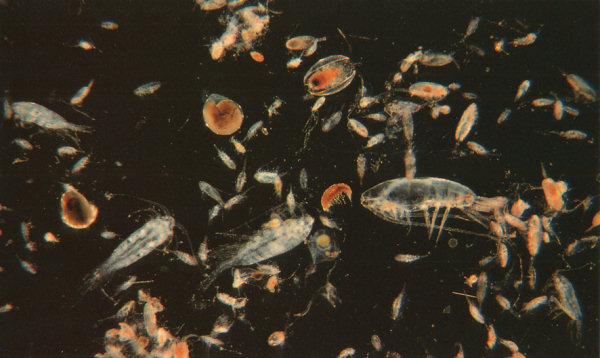
Before we dive too far into the depths, let me explain/refresh what plankton are. Plankton are any drifting organisms that inhabit the water columns of bodies of water. In fact, their name derives from the Greek for “wanderer,” and it would be helpful if you thought of them as drifters in the current…from deep in the ocean to up on the surface. They are generally broken down into plant-like-photosynthesizing plankton (phytoplankton) and animal-like plankton (zooplankton).
Phytoplankton are “photosynthesizing microscopic organisms that inhabit the upper sunlit layer of almost alloceans and bodies of water” (wikipedia). If you have taken biology or forensics with me, I have described some of them ad nauseam: diatoms? Those organisms that are in every body of water on the planet? Ah, yes. I can see it all coming back to you.
Zooplankton encompass a diverse range of macro and microscopic animals. They generally eat the phytoplankton or one another. Examples include krill, copepods, jellyfish, and amphipods.
In the great food web of life, other organisms eat the zooplankton. Among them was a pod of 50+ Humpback whales in the Barnabas Trough off of Kodiak Island. They were exciting enough that I went from being sound asleep to dressed and on the bridge in less than five minutes. Issue 12, Humpback Whales: Better than any alarm clock I have ever known delves into these organisms (Cartoon citations 1, 2, 3 and 4).
Our chief survey technician, Kathy Hough, took a lot of photos the following day as we traveled from Barnabas Trough to Alitak Bay. The three photos that follow and descriptions are courtesy of Kathy.
Adventures in a Blue World, Issue 12
Whale tail: Individual humpback whales can be identified by the black/white pattern on the ventral side of the fluke (tail). The pattern is like a human’s fingerprint, unique to one animal.There is evidence of three whales in the photo above: the closest whale’s rostrum (blow hole) is visible. The second whale is diving and you can see the peduncle (the stocky part of the tail before the fluke). The glassy area in the back of the photo is evidence of a recent dive and is called a “footprint.”This Humpback was last seen in this area in 2004, and has not been seen since. The white marks on its fluke are from a killer whale attack! Kathy emailled photos of the whales to observers, and they were able to identify individuals!All hands on deck… 100+ Humpback Whales. Darin and Staci.
Our team of scientists sample plankton using a Methot net, which is fine mesh and captures macroscopic organisms. We sample plankton for the same reason that we physically trawl for fish: we need to make certain what we are “hearing” is what is down there, with a focus on the types and sizes of the plankton. Additionally, knowledge about what and where plankton populations are will help with modeling the entire ecosystem. If you know where the food lives, its abundance and composition, by extension you have a much greater understanding of the predators, both pollock and whale.
(If you get a chance, check out this video about how whales hunt with bubble nets; fascinating!)
Personal Log
Bowditch
I try to spend time on the bridge every morning before breakfast. I bring up a cup of tea and watch the horizon lighten until the sun pushes its way up above the lingering clouds. This morning, I saw the green flash for the first time. The green flash is not a superhero. It is not a myth. It is not a sailor’s fish tail. It is real. Furthermore, if you still don’t believe me, the green flash is in the “bible” of maritime studies, The American Practical Navigator (Bowditch, if you are on a first name basis). I was told by Ensign David Rodziewiczthat “if it is in Bowditch, it must be true.” So there.
The green flash appears on the horizon just after the sun sets or just before it rises. For one moment on that spot the sky looks as if someone broke a green glow stick and smeared a distant florescent mark. As fast as it was there, it is gone. The name is appropriate: green flash. It occurs because light is bent slightly as it passes through the atmosphere (refraction); this bending is greatest on the horizon. Since light is made up of different colors with different wavelengths, the bending causes the colors to be seen separately. Bowditch says it is like offset color printing (nice metaphor, eh?). The red end of the spectrum is first to rise. The blue end of the spectrum is scattered the most by the atmosphere, leaving behind the momentary and memorable second of green.
Evidently, to see the green flash is considered very good luck. I already feel very lucky. I am in one of the most beautiful places in the world, on a ship with interesting and intelligent people, driving around the Gulf of Alaska learning about science and occasionally checking out whales. If I can get luckier than this… well… wow.
Tomorrow is the last day of our cruise, but I have a few more cartoons up my sleeves, so keep checking back. In the meantime, thank you to the incredible staff of the Oscar Dyson, the scientists of MACE, my rockin’ cohort Staci, and the NOAA Teacher at Sea program.
Until our next adventure,
Cat
p.s. Whales have the worst morning breath I have ever smelled. I know it isn’t really their fault–imagine having 270-400 baleen sheets on either side of your mouth that you could get krill stuck in…